
Our readers keep the lights on and my morning glass full of iced black tea. As an Amazon Associate, I earn from qualifying purchases.
You want the living room or game room to feel like a cinema, but the model numbers and specs read like a code. The single most important job an audio receiver with Bluetooth does is take every sound source you own — your TV, turntable, gaming console, phone — and send clear, powerful audio to your speakers without a nest of separate remotes and wires. The models worth your money share one thing: they make the invisible stuff simple, from connecting to your TV with a single wire to playing a playlist from your phone across every room.
I’m Min — the co-founder and writer behind Gadgets Feed. This guide is built by comparing the manufacturers’ published specifications and the patterns across verified customer reviews, so you get each pick’s real strengths and trade-offs instead of marketing spin.
Finding the right audio receiver with bluetooth means choosing between raw power, smart room calibration, and the right channel count (the number of speakers and subwoofers it can power) for your space — and this guide lays out exactly which model nails that balance for your budget.
How To Choose The Best Audio Receiver With Bluetooth
Picking a receiver comes down to understanding your speakers, your space, and how you will actually use it day-to-day. Focus on these three factors first, and the right model becomes clear.
Channel Count: Matching Your Speakers
The number on the box (like “5.2” or “7.2”) tells you how many speakers and subwoofers (a subwoofer is a dedicated speaker for low bass) the receiver can power. A 5.2-channel receiver handles five speakers and two subwoofers — perfect for a standard living room with front left, center, front right, two rear surrounds, and dual subs for deep bass. A 7.2-channel receiver adds two more speakers, often used as surround back speakers or “height” speakers for Dolby Atmos, which makes sound seem to come from above you. If you have a simple speaker package, a 5.2 channel unit saves money and space; if you plan to add ceiling speakers later, a 7.2 (or 9.2) gives you room to grow.
Room Calibration: The Real Secret to Great Sound
Every room reflects sound differently — hard floors, carpet, windows, and furniture all change what you hear. Room correction software is a microphone and a computer inside the receiver that listens to test tones and then adjusts the sound automatically. On budget-friendly receivers, this is basic (AccuEQ or YPAO). On premium models, it is advanced (Dirac Live or Audyssey MultEQ) and can fix muddy bass or harsh treble caused by your specific room. The better the room correction, the better any speaker sounds in your actual home, not just in a showroom.
HDMI and Bluetooth: How You Connect Today
Modern receivers use HDMI (High-Definition Multimedia Interface) — a single cable that carries both video and audio from your TV, game console, or streaming box. Look for HDMI eARC (Enhanced Audio Return Channel) because it lets your TV send sound like Dolby Atmos back to the receiver through the same HDMI cable, so you use one remote to control volume. Bluetooth is standard on every receiver here, but the version matters: codecs (standards for compressing audio wirelessly) like aptX HD or AAC deliver better wireless sound from your phone than basic SBC (the default Bluetooth codec). If you plan to listen with wireless headphones, a receiver with bi-directional Bluetooth (which can send audio out to headphones and receive audio from your phone) is a nice extra.
Quick Comparison
On smaller screens, swipe sideways to see the full table.
| Model | Category | Best For | Key Spec | Amazon |
|---|---|---|---|---|
| Onkyo TX-NR6100 | Premium Mid-Range | THX-certified (cinema-quality sound standard) power for gaming & movies | 210W/Ch, THX Select, 5.2.2 Atmos | Amazon |
| Denon AVR-S970H | Premium Mid-Range | Versatile 7.2 with great room calibration (Audyssey MultEQ, which fine-tunes sound for your room) | 90W X 7, 8K, Audyssey MultEQ | Amazon |
| Onkyo TX-NR7100 | High-End | Professional-grade room correction (Dirac Live system for precise audio tuning) | 100W/Ch, 9.2-Ch, Dirac Live | Amazon |
| Yamaha RX-A2A | High-End | Premium build quality & Surround:AI (a system that adjusts sound in real-time for action or dialogue) | 7.2-Ch, Surround:AI, YPAO R.S.C. | Amazon |
| YAMAHA RX-V6A | Mid-Range | Solid performance & multi-room MusicCast (Yamaha’s system for streaming music to other rooms) | 7.2-Ch, 8K, MusicCast | Amazon |
| Denon AVR-S670H | Entry-Level | Best value 5.2 with HEOS (Denon’s multi-room streaming) streaming | 75W X 5, 8K, HEOS Built-in | Amazon |
| Sony STR-AN1000 | Entry-Level | Sony’s 360 Spatial Sound (a system that creates a wide, three-dimensional sound field) & easy setup | 7.2-Ch, 8K, DCAC IX | Amazon |
In‑Depth Reviews
1. Onkyo TX-NR6100 7.2 Channel THX Certified Network AV Receiver
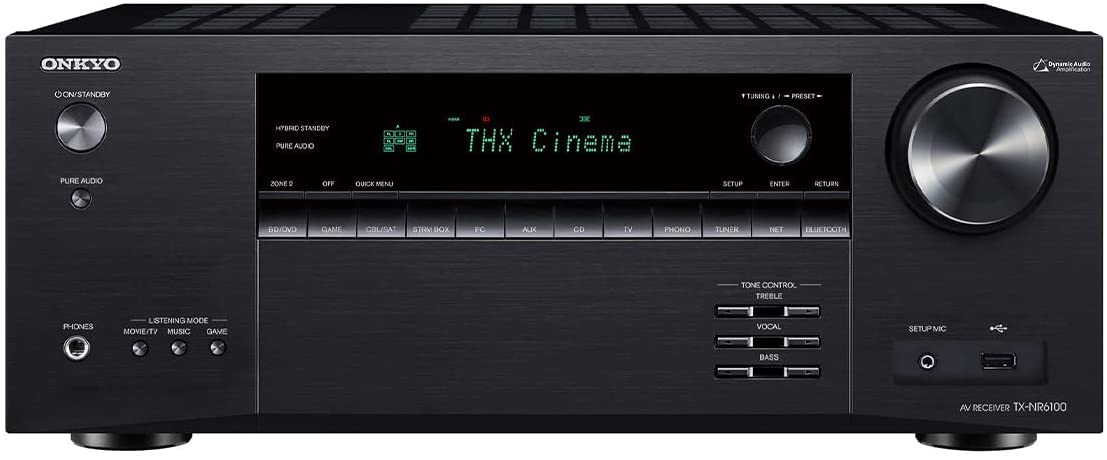
210 watts per channel and THX Select certification make the Onkyo TX-NR6100 the top pick for gamers and home theater enthusiasts who want certified cinema-level sound in a medium-sized room without distortion.
The TX-NR6100 handles 7.2 channels and supports 5.2.2 Dolby Atmos, so you can add two height speakers for overhead sound effects without losing rear surround channels. It also has three HDMI 2.1 inputs that pass 8K video at 40Gbps, making it a perfect match for a PS5 or Xbox Series X. Buyers report it is “much louder than Denon X1700,” and one reviewer noted the 8 HDMI ports and customizable sound modes per device made it easy to integrate everything from a game console to a turntable.
The catch is the physical size — at 21 inches deep and 18.64 inches wide, it is a 3.4 times larger footprint than competitors like the YAMAHA RX-V6A, so measure your media console before buying. For sheer muscle and feature density, this receiver owns its price point.
Why it’s great
- THX Select Certified for guaranteed cinema-quality sound
- 210W per channel provides headroom for large speakers
- Three HDMI 2.1 inputs for 8K/4K gaming at 120Hz
- 5.2.2 Dolby Atmos with height channel support
Good to know
- Very large dimensions (21″D x 18.64″W) require a deep cabinet
- Remote control is not backlit
- Some reports of defective units; check return policy
2. Denon AVR-S970H 8K Ultra HD 7.2 Channel AV Receiver

Against the top-pick Onkyo TX-NR6100, the Denon AVR-S970H delivers 90 watts per channel (versus the Onkyo’s 100 watts) but compensates with Audyssey MultEQ room correction that analyzes multiple listening positions, whereas the Onkyo uses basic calibration — a difference that matters more for sound quality than a 10-watt gap in peak power.
With 90 watts across 7 channels, it powers a full 5.2.2 Dolby Atmos setup or a traditional 7.2 surround array. It also includes a phono input for a turntable, six HDMI inputs (three of which are 8K-capable), and HEOS multi-room streaming so you can send music to other Denon wireless speakers around the house. Owners mention it runs significantly cooler than comparable Onkyo models — one measured 80°F vs 90-92°F — which is a real advantage if your receiver sits in an enclosed entertainment center.
Choose the AVR-S970H over the Onkyo TX-NR6100 if you prioritize a fine-tuned, seamless listening experience in a medium room and want the flexibility to add a second zone or a turntable, rather than the sheer brute force of a THX-certified powerhouse.
Where it shines
- Audyssey MultEQ room calibration for accurate, balanced sound
- Runs cooler than many competitors (around 80°F)
- Phono input for vinyl and built-in HEOS multi-room streaming
- 8K HDMI 2.1 with VRR, ALLM for next-gen gaming
Worth noting
- Powered Zone 2 uses back speaker channels, limiting to 5.2 in main room
- No programmable TV power button on the remote
- HEOS source cannot be sent to Bluetooth headphones
3. Onkyo TX-NR7100 9.2-Channel AV Receiver
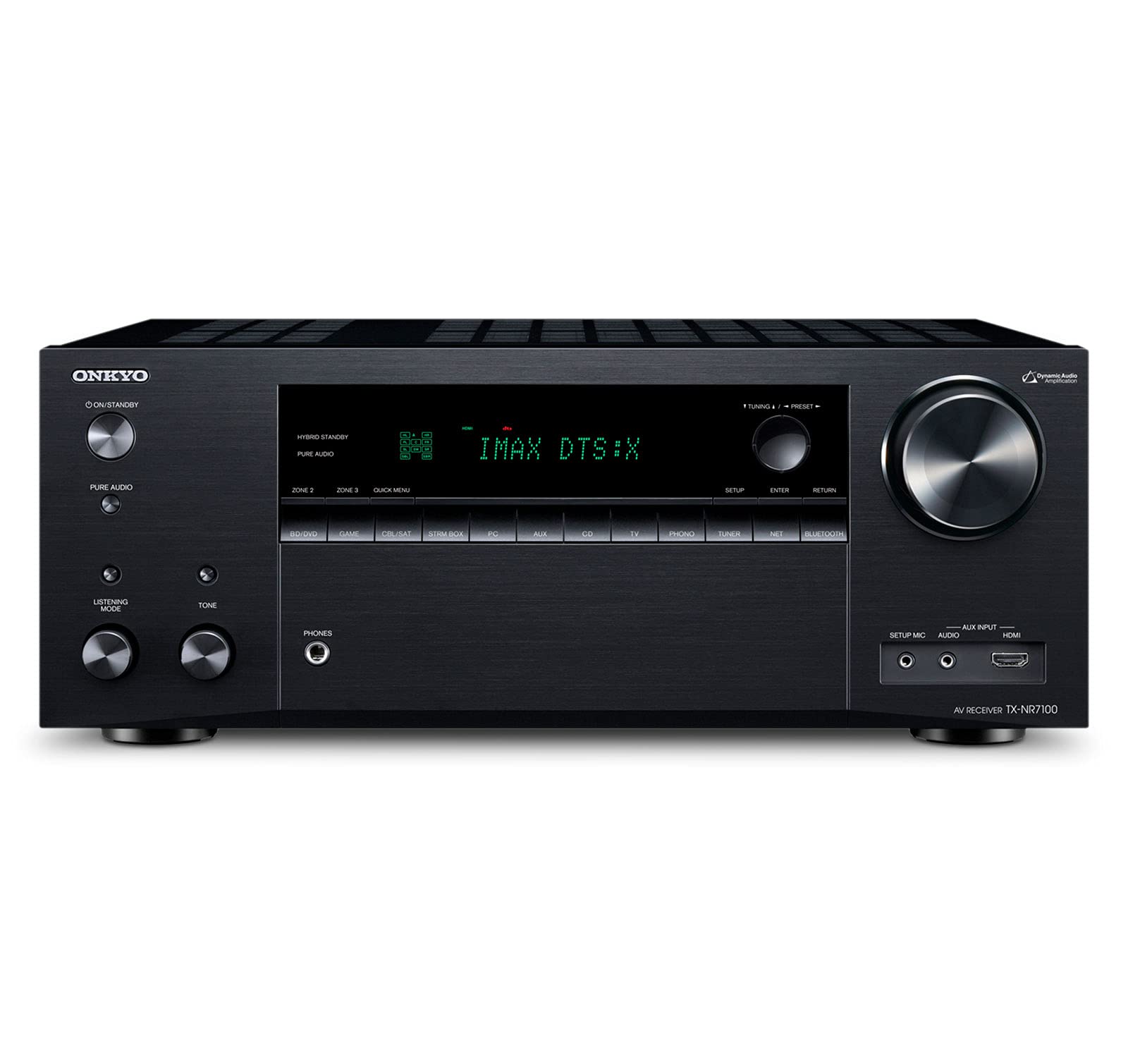
Imagine you have a room with odd corners, a thick rug, and windows that rattle — the Onkyo TX-NR7100 is built for exactly that scenario because it includes Dirac Live room correction right out of the box. Dirac Live is widely considered the best automated calibration system in consumer audio; it measures your room with a microphone and then applies precise filters to remove echoes, smooth out bass peaks, and tighten imaging, making even modest speakers sound significantly better.
With 9.2 channels and 100 watts per channel, this receiver gives you the headroom for a 7.2.2 Dolby Atmos setup (seven ear-level speakers, two subs, and two height speakers) or a 5.2.4 layout for four overhead channels. It also features bi-directional Bluetooth — it can stream audio from your phone via SBC or AAC and send audio to wireless headphones using aptX or aptX HD, including 24-bit audio over aptX HD. Reviewers consistently praise the “warm sound” and how Dirac Live “improves clarity and bass,” though they note the setup process can be time-consuming.
A standout spec callout: the TX-NR7100 beats the Denon AVR-S670H on sheer channel count, offering 77% more channels (9.2 vs 5.2), which makes it the clear upgrade path for anyone planning a dedicated home theater with height speakers.
What stands out
- Dirac Live room correction for professional-grade audio tuning
- 9.2 channels for advanced 7.2.2 or 5.2.4 Atmos setups
- Bi-directional Bluetooth with aptX HD for wireless headphones
- HDMI 2.1 with 8K/60Hz and 4K/120Hz for gaming
The trade-offs
- Dirac calibration setup can be time-consuming and technical
- Some units experience HDMI glitches or static noise (QC concerns)
- Remote is not backlit and menus can feel lackluster
4. Yamaha RX-A2A AVENTAGE 7.2-Channel AV Receiver

The single number that matters most here is Surround:AI, an artificial intelligence system that analyzes audio content in real-time and adjusts the sound field to emphasize dialogue during quiet scenes or expand the soundstage during explosions, automatically. The Yamaha RX-A2A sits in the AVENTAGE line, which is Yamaha’s top-tier series known for premium construction — including a rigid chassis with a fifth foot at the center to reduce vibration, which is a detail you do not find on mid-range models.
The downside you accept with the A2A is that while it sounds fantastic and is built like a tank, it is a 7.2-channel receiver with no ability to expand beyond that. If you ever want a 9-channel or 11-channel setup, you would need to step up to a higher-end model. It also has a known intermittent no-signal issue with some Sony TVs, fixable by power cycling, but it is worth noting.
This receiver offers superb sound refinement and Yamaha’s excellent YPAO R.S.C. room calibration, and it is often available at a significant discount — one buyer snagged it for , well below its MSRP. For the price, you are paying for build quality and intelligent sound processing rather than raw channel count.
The upsides
- AVENTAGE line premium build with anti-vibration design
- Surround:AI intelligently optimizes sound in real-time
- YPAO R.S.C. room calibration with multipoint measurement
- Supports MusicCast, AirPlay 2, and Works with Sonos
Keep in mind
- Limited to 7 channels with no expansion option
- Intermittent no-signal issue with some Sony TVs reported
- At full MSRP, value is less competitive; best on sale
5. Denon AVR-S670H 5.2 Ch Home Theater Receiver

At this lower price, you actually get 8K video passthrough, Dolby TrueHD, and a phono input — features you would normally have to spend significantly more to obtain. You get 75 watts across 5 channels, which is plenty for a standard 5.1 surround setup in a medium-sized living room, plus built-in HEOS for streaming music via Wi-Fi or Bluetooth to other rooms.
What you give up is channel count and power headroom. At 5.2 channels, you cannot add height speakers for Dolby Atmos or expand to a larger configuration later. It is also not as robust as the higher-tier Denon models — one buyer summed it up as “more entry level when it comes to Denon but for us this was the correct choice.” The good news is you can often find it renewed at around a discount, as customers note.
This receiver is the perfect choice for someone adding surround sound to a small to medium room for the first time, who wants modern 8K compatibility and easy setup without spending for features they will not use.
Why we’d pick it
- 8K/60Hz and 4K/120Hz passthrough for modern TVs
- Phono input for turntable and HEOS multi-room streaming
- Easy setup with on-screen guides and Audyssey calibration
- Voice control with Alexa, Google Assistant, Siri
A few caveats
- 5.2 channels only — no support for height speakers
- 75W per channel may not be enough for large, power-hungry speakers
- HEOS app and AirPlay reliability can be inconsistent
6. YAMAHA RX-V6A 7.2-Channel AV Receiver with MusicCast

The YAMAHA RX-V6A is the best option for someone who wants a reliable, well-known brand with a strong feature set and does not need the absolute latest in room calibration. It offers 7.2 channels with Dolby Atmos and DTS:X support, 8K HDMI 2.1 inputs, and Yamaha’s MusicCast system for streaming music to multiple rooms — all in a compact chassis that is 3.4 times shallower than the Onkyo TX-NR6100, making it far easier to fit in a standard AV cabinet.
Buyers consistently report it is easy to set up, with one noting a “simple setup (~20-25 min)” despite a “dated but simple menu.” It handles 4 ohm speakers without breaking a sweat, and its eARC function integrates well with modern TVs for one-remote control. The main weakness is that the room calibration (YPAO) is less sophisticated than Audyssey or Dirac Live, and some users say the menus feel a bit behind the times.
The gentle caution here is that while the RX-V6A is a fantastic mid-range workhorse, it does not have the advanced auto-tuning or THX certification of higher-priced rivals.
Strong points
- Compact size (6.25″D) fits easily in most cabinets
- 7.2 channels with Dolby Atmos and DTS:X
- 8K HDMI 2.1 with HDCP 2.3 for full future-proofing
- MusicCast multi-room system works with Alexa and Google Assistant
Before you buy
- YPAO room calibration is less sophisticated than Dirac or Audyssey
- Menu system feels dated, but is simple to navigate
- Some users report eARC does not auto-power on with certain Sony TVs
7. Sony STR-AN1000 7.2 CH Surround Sound Home Theater 8K A/V Receiver

The Sony STR-AN1000 undercuts similarly-equipped premium receivers on price while offering Sony’s unique 360 Spatial Sound technology, making it the most compelling option if you prioritize immersive, spatial audio and a dead-simple calibration process without spending for premium features you will not use. It uses Sony’s Digital Cinema Auto Calibration IX (DCAC IX) and 360 Spatial Sound Mapping to create a wide, three-dimensional sound field — even without dedicated height speakers — which reviewers point out makes movies like “The Wizard of Oz” feel genuinely enveloping.
With 7.2 channels and support for Dolby Atmos, DTS:X, and IMAX Enhanced, this receiver covers all standard surround formats. It also includes three HDMI 2.1 inputs for 8K/4K120 gaming, Chromecast built-in, Spotify Connect, and works with Sonos for easy integration into a whole-home system. One reviewer who bought it on CNET’s recommendation said it handled the “thunder and lightning” in Ghostbusters: Frozen Empire with striking realism and praised its ability to handle 2160p 4K HDR and Dolby Atmos simultaneously.
The field-vs-this value line: the STR-AN1000 undercuts similarly-equipped premium receivers on price while offering Sony’s unique 360 Spatial Sound technology, but it lacks a phono input for turntables and has a known HDMI handshake issue with Apple TV 4K for Dolby Vision passthrough that requires a direct connection to the TV. The one clear reason to choose it is its ability to create a convincing three-dimensional sound field without requiring dedicated height speakers.
What we like
- 360 Spatial Sound Mapping creates immersive audio without height speakers
- Easy graphical setup with DCAC IX calibration
- Works with Sonos for whole-home integration
- 8K HDMI 2.1 and all major HDR formats supported
The downsides
- No phono input for turntables
- Apple TV 4K Dolby Vision passthrough can fail; connect directly to TV
- Front display is hard to read from a distance (over 10 ft)
Understanding the Specs
Channel Configuration (5.2, 7.2, 9.2)
The first number is the number of standard speakers the receiver can power. The second number is the number of independent subwoofer outputs. A 5.1 setup means five speakers (left, center, right, two rear) and one subwoofer. A 7.2 adds two more speakers (usually rear surrounds or height speakers for Dolby Atmos). The more channels, the more immersive the sound can be, but you also need the matching speakers to fill them. For an average living room, 5.1 or 5.2 is plenty; for a dedicated theater room, 7.2.2 or 9.2 gives you that bubble of sound from all directions.
HDMI eARC and 8K Support
eARC (Enhanced Audio Return Channel) is a feature on modern HDMI ports that allows your TV to send high-quality audio like Dolby Atmos back to the receiver through a single cable. Without eARC, you might need separate cables for video and audio, or lose advanced sound formats. Support for 8K and 4K/120Hz means the receiver can pass the highest-resolution video signals from a gaming console or streaming box to your TV without degrading the picture, which is essential for modern TVs and next-gen consoles like the PS5 or Xbox Series X.
FAQ
Can I use a Bluetooth receiver for wireless headphones while watching TV?
How many watts per channel do I really need for my speakers?
Is room correction software really necessary or is it just a marketing feature?
Final Thoughts: The Verdict
Across the board, the audio receiver with bluetooth winner is the Onkyo TX-NR6100 because it delivers THX-certified power, 8K gaming support, and a rich feature set at a mid-range price that does not force compromises. If you want the smartest room calibration on the market, grab the Onkyo TX-NR7100 for its professional-grade Dirac Live system. And for the best entry-level value that still handles 8K and streaming, the standout is the Denon AVR-S670H.