
Our readers keep the lights on and my morning glass full of iced black tea. As an Amazon Associate, I earn from qualifying purchases.
Specs are compiled from manufacturer listings and verified buyer reviews and can change over time — please confirm the key details on the product page before buying.
Buying a receiver and speakers separately means matching impedance, sensitivity, and channel count yourself. The bundles that work pair an amplifier with speakers chosen for its power rating, so you plug in, run the setup, and stop thinking about it. This guide sorts five receiver-and-speaker packages by their strength: 9.2-channel cinema, phono-ready stereo, or a weatherproof box-speaker setup for a garage or patio.
I’m Min — the founder and writer behind Gadgets Feed. This guide is built by comparing the manufacturers’ published specifications and the patterns across verified customer reviews, so you get each pick’s real strengths and trade-offs instead of marketing spin.
The biggest mistake is buying a powerful receiver and pairing it with inefficient speakers. What follows is a practical, plain-English walkthrough of the audio receiver with speakers packages that hold together as a system.
Our Picks at a Glance

How To Choose The Best Audio Receiver With Speakers
A receiver-plus-speakers bundle succeeds or fails on the match between amplifier power and speaker sensitivity. The receiver sends power and switching, and the speakers turn that power into sound. Mismatch them and inefficient speakers strain a high-wattage receiver, or easy-to-drive speakers expose a thin one. Channel count, wattage against ohm load, and the inputs you will actually use decide whether a bundle is worth owning.
Channels decide the shape of your room
Channel count is the number of separate speaker feeds the receiver can drive. A 2-channel setup is left and right stereo — ideal for music and a simple TV. A 5.1 or 5.2 system adds a center speaker for dialogue, surround speakers behind you, and one or two subwoofers for bass. A 7.2 or 9.2 receiver pushes further, adding more surround and height channels for object-based formats like Dolby Atmos, which places sounds in a three-dimensional space rather than fixed channels.
Do not chase wattage alone
A watt rating tells you how much power the amplifier can deliver, but it only means something alongside the speaker’s sensitivity — how much sound a speaker produces per watt of input. A high-wattage receiver driving inefficient speakers can sound strained. A modest receiver driving easy-to-drive speakers can fill a room comfortably. Match watts to sensitivity and the power rating stops being a bragging right and starts being headroom you can hear.
The connections you will actually use
Look for HDMI eARC if you want one cable to carry both picture and sound back from your TV. Look for a phono input if you own a turntable, because it applies the correct pre-amplification and EQ for a moving-magnet cartridge. Bluetooth matters for phone streaming; Ethernet matters for stable network streaming. Four analog inputs and one output let you add a CD player or cassette deck without an external switcher.
Quick Comparison
| Model | Best For | Channels | Receiver Power | Included Speakers | Amazon |
|---|---|---|---|---|---|
| Klipsch Reference 5.2 with Onkyo TX-NR7100★ Best Overall | Full cinema room | 9.2 receiver / 5.2 speakers | 220W per channel at 6 ohms | 2 floorstanding, center, bookshelf pair, 2 subwoofers | Amazon |
| Sony STRDH190 with SSCS5 Bookshelf SystemVinyl-Friendly Pick | Vinyl and stereo music | 2-channel | — | SSCS5 3-way 3-driver bookshelf pair | Amazon |
| Yamaha YHT-4970U 5.1 System | Simple Atmos starter | 5.1 | — | 2 front, center, 2 surround, powered subwoofer | Amazon |
| Sony STR-AN1000 7.2 Bundle | Premium object-based cinema | 7.2 | — | Floorstanding pair, bookshelf pair, center, Atmos pair, 10-inch subwoofer | Amazon |
| Pyle PDA6BU with 4 Enrock Box Speakers | Garage, patio, karaoke | 2-channel | 300W power output | 4 × 4-inch 3-way box speakers | Amazon |
In‑Depth Reviews
1. Klipsch Reference 5.2 Home Theater System with Onkyo TX-NR7100
Our pick — 4.5+★ from 80+ verified ratings; the strongest balance of quality and price.
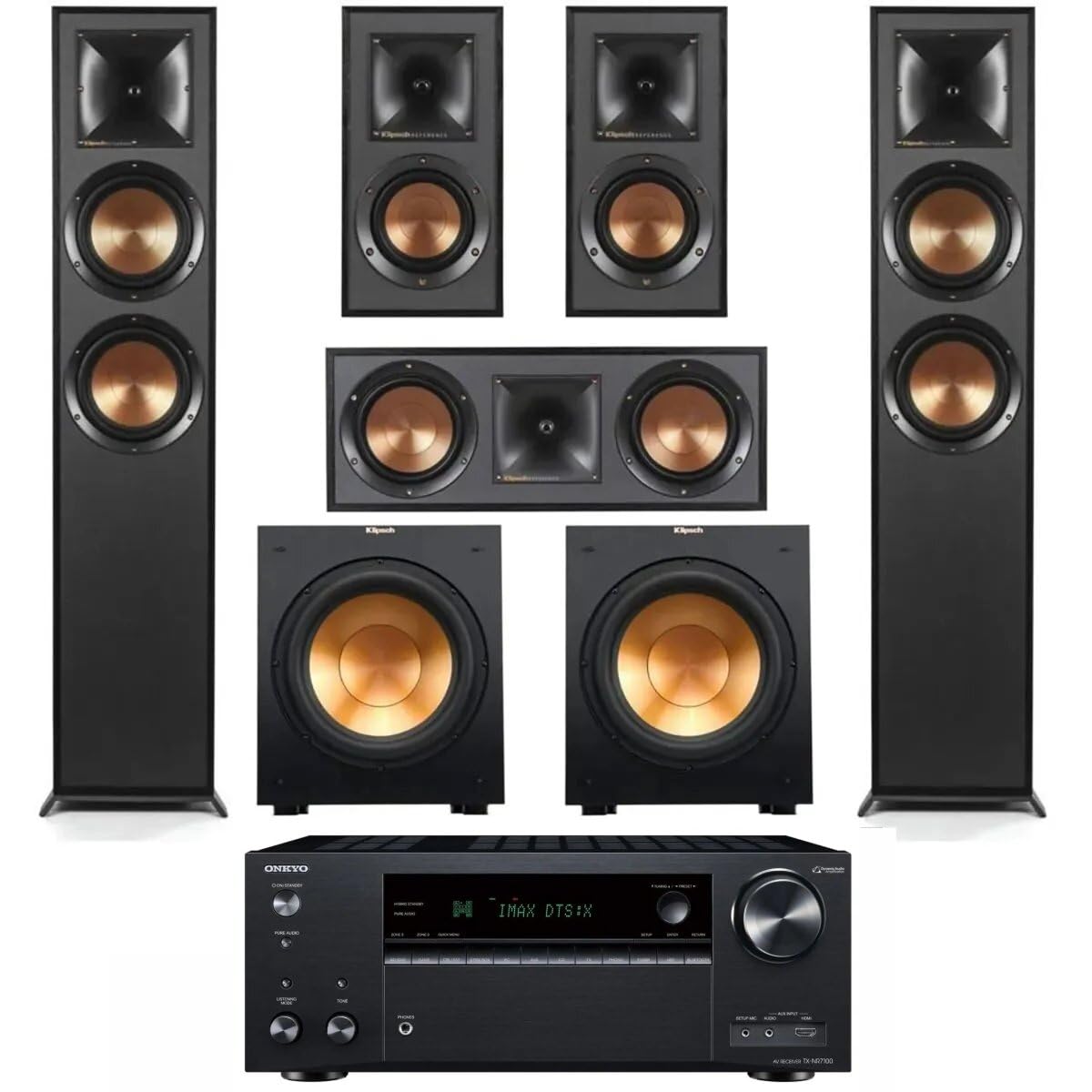
A 5.2 speaker package driven by a 9.2-channel receiver and two 12-inch powered subwoofers — this is a cinema room in a crate.
This bundle is the one to buy if you are building a dedicated movie room and want the speaker side already solved. The Onkyo TX-NR7100 is a 9.2-channel network receiver rated at 220W per channel at 6 ohms (6 ohms being the electrical load the speakers present — a common rating for home theater speakers). It handles 8K and 4K video pass-through, so your TV and console connect through the receiver and come out the other side intact. Meanwhile the five speakers and two subwoofers are all Klipsch Reference: two R-625FA floorstanding towers, an R-52C center channel, an R-41M bookshelf pair, and two R-12SW powered subwoofers, each with a 12-inch driver and a specified 400W all-digital powered configuration.
What wins people over is the sound itself — the sheer scale of it. Two powered 12-inch subwoofers do the low-end work you normally have to buy separately, and the floorstanding towers carry the front stage without needing stands. Buyers describe it as easy to set up relative to what it is, and the appearance gets noted as a finishing touch to a theater room — the black wood grain vinyl on the towers blends into a dark room instead of shouting. Value comes up often enough to matter: this is a coordinated package, not a stack of parts.
Here is the honest catch, and it is a practical one. This system weighs 50.4 pounds in the box, and the floorstanding towers need floor space either side of your screen. Compare it with the Pyle bundle at 9 pounds — that one you can carry under an arm, this one you plan around. The 9.2 receiver also leaves you channels to grow into if you later add height speakers, which is exactly the point of buying the bigger amplifier now.
Where this bundle earns its keep
- Two 12-inch, 400W powered subwoofers give you deep bass without buying a third-party sub.
- The Onkyo TX-NR7100 is a 9.2-channel network receiver at 220W per channel at 6 ohms — headroom for adding height channels later.
- Klipsch Reference towers, center, and bookshelf pair all come from the same Klipsch Reference lineup.
- 8K/4K receiver platform keeps your TV and console switching inside one box.
What to plan around
- At 50.4 pounds it is a two-person unpack, and the towers need real floor space.
- It is the most expensive way into the category — you are paying for the matched package.
Built for: anyone finishing a dedicated movie room who wants the speaker problem closed in one purchase.
Think twice if: your room cannot give two floorstanding towers a home — the bookshelf systems below suit tighter spaces.
2. Sony STRDH190 2-Channel Stereo Receiver with Phono Inputs & SSCS5 Bookshelf Speakers
A turntable input, a Bluetooth button, and a pair of bookshelf speakers that do not need a sub.
If your music mostly lives on vinyl and your TV is a secondary concern, this is the bundle to look at first. The STRDH190 is a 2-channel stereo receiver with a dedicated phono input — that is the built-in stage a turntable needs to be pre-amplified and equalised correctly. Plug a record player straight in and it sounds the way the record was cut. Bluetooth connectivity covers phone and laptop streaming, and the receiver carries four analog inputs plus one output, so a CD player or cassette deck has somewhere to go. The bundle also ships with the SSCS5, a 3-way 3-driver bookshelf speaker pair, plus 50 feet of 14AWG speaker wire and five pairs of banana plugs.
Setup is the part buyers talk about most fondly — it is a minutes-not-hours job, because a stereo receiver has far less to configure than a surround unit. The A+B speaker function is the quiet win here: it lets you run two sets of front speakers and switch between A, B, or both. So you can drive your main pair in the living room and a second pair out on a patio without buying another amplifier. Sound quality and value both come through strongly across the feedback, and the analog character gets called out by people who care about that specific warmth.
The trade-off is the one you would expect from a stereo receiver: this thing does not do surround, does not decode Dolby Atmos, and does not take HDMI. It is left and right, done well. If your plan is a five-speaker movie room, the Klipsch bundle and the Yamaha system above and below are built for that instead. But if two good speakers and a turntable are the whole point, nothing here fits the brief better.
The phono detail matters: a receiver without a proper phono stage forces you into an external preamp, and this one has it built in — one less box, one less cable, one less thing to get wrong.
Best fit: record collectors and music-first listeners who want two great speakers and a turntable-friendly amp.
Not the one: skip it if you want surround sound, Atmos, or HDMI switching — this receiver does none of those.
3. Yamaha YHT-4970U 5.1-Channel Home Theater System
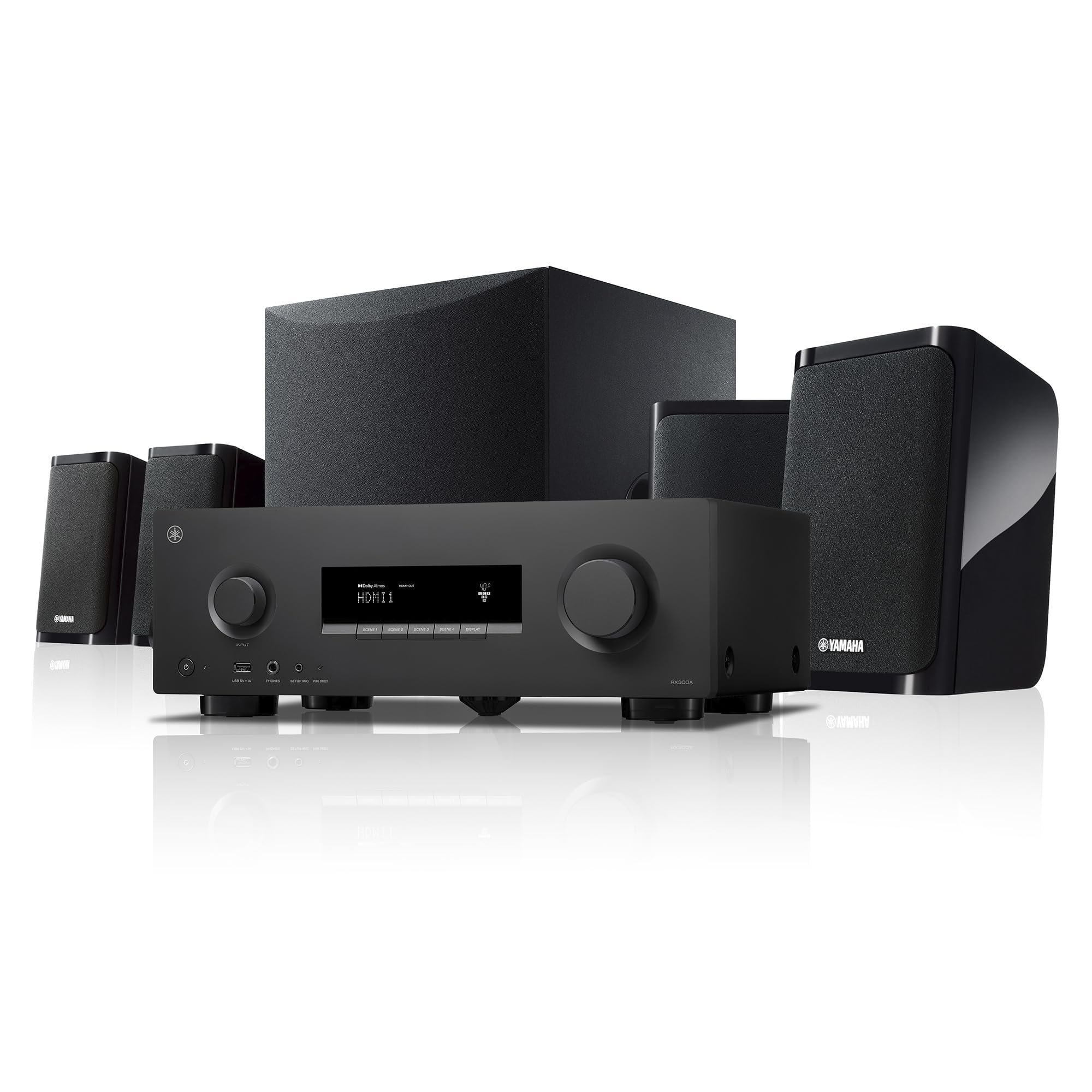
Everything in one box — receiver, five speakers, subwoofer, and even the cables.
The Yamaha YHT-4970U is the bundle for someone who has never wired a surround system and does not want to learn the hard way. Open the box and you get the RX300A Dolby Atmos receiver, two front speakers, a center, two surrounds, a powered subwoofer, an 80-foot speaker wire run, a 16-foot subwoofer cable, an FM antenna, and a setup microphone on a cardboard stand. That cable count is the underrated part — many bundles leave you to source wire and a sub lead separately. Here you are plugging in on day one.
On the video side it supports 4K/120 and 8K/60, with Dolby Vision and HDR10+ dynamic range (formats that adjust brightness scene by scene for a more natural picture), plus HDMI eARC/ARC so a single cable carries TV audio back to the receiver. Gaming features include ALLM and VRR — auto low-latency mode and variable refresh rate, the two settings that keep fast games feeling responsive. A supplied microphone measures your room’s acoustics and speaker characteristics, and the receiver tunes itself to compensate. Bluetooth Multipoint lets you pair two source devices and switch between them without re-pairing.
Where this one gets mixed feedback is the sound itself — some owners find the receiver does the heavy lifting and the speakers are the weaker half, with dialogue occasionally sounding hollow. Those notes sit alongside plenty of praise for the receiver as a piece of hardware. The fair read is that this is a starter surround package: the receiver has the features and the speakers are serviceable, and if you later want more, the receiver stays and the speakers can be upgraded around it. At 50.4 pounds it is a manageable one-person lift.
Why it is the low-stress choice
- Includes speaker wire and a subwoofer cable, so nothing is missing on arrival.
- Supplied setup microphone auto-tunes the receiver to your room.
- 4K/120 and 8K/60 with Dolby Vision, HDR10+, ALLM, and VRR for film and gaming.
- Bluetooth Multipoint pairs two devices and switches without re-pairing.
The realistic limits
- Dialogue can sound hollow on the included speakers — the receiver outclasses them.
- It is a 5.1 layout, so it leaves no headroom for height channels without a receiver upgrade.
Reach for this if: you want a working Atmos surround system this weekend without sourcing a single cable.
Look elsewhere if: dialogue clarity is your top priority — the higher-end bundle below was built around better speakers.
4. Sony STR-AN1000 7.2 Channel 8K AV Receiver Bundle

Six HDMI inputs, two 8K outputs, and a speaker package built entirely from the same family.
Step up here if you want object-based surround done properly and you are willing to pay for the whole chain to match. The STR-AN1000 is a 7.2-channel receiver with Dolby Atmos and DTS:X (DTS:X being the competing object-based format, so both major ones are covered). It carries six HDMI inputs with two supporting full 8K and 4K/120 video sources, plus two HDMI outputs that also support full 8K and 4K/120. Two of your sources get the high-bandwidth treatment, and two displays can run simultaneously — useful for a TV plus a projector in the same room. Against the Pyle bundle’s 2 channels, this is 7.2 — the difference between stereo and a sound field you sit inside.
The speakers are all Sony, all from the same design family: a pair of SSCS3 3-way floorstanding towers, an SSCS5 3-way 3-driver bookshelf pair, an SSCS8 2-way 3-driver center channel, a pair of SS-CSE Dolby Atmos-enabled height speakers, and a SACS9 10-inch active subwoofer. That Atmos pair is the piece most bundles skip — it is what makes the height effects in a film actually come from above. Sony’s 360 Spatial Sound Mapping builds a sound field that adapts to your room, and Digital Cinema Auto Calibration IX corrects distance, angle, sound pressure, and frequency response for every connected speaker. The redesigned power transformer uses a new core material and bobbin to lower distortion.
What owners consistently land on is that this sounds fantastic and represents real value once you total what is in the crate. Setup is the split opinion — the auto-calibration does the heavy lifting, but the first configuration takes a while, which is fair warning for a 7.2 system with height channels. And it is heavy: 153.9 pounds means you plan the delivery, not just the install.
The Atmos pair is the tell: height speakers are what separate a real object-based system from a 5.1 setup with a marketing sticker, and this bundle includes them rather than leaving them as an add-on.
One caveat worth knowing: budget a proper afternoon for first-time calibration — the receiver does the math, but you still have seven speakers and a subwoofer to place.
The pick for: a serious cinema build where Atmos height effects and dual 8K outputs are non-negotiable.
Save your money if: you have not yet wired a 5.1 room — start with the Yamaha package and grow into this.
5. Pyle PDA6BU 200-Watt 2-Channel Amplifier with 4 Enrock Box Speakers
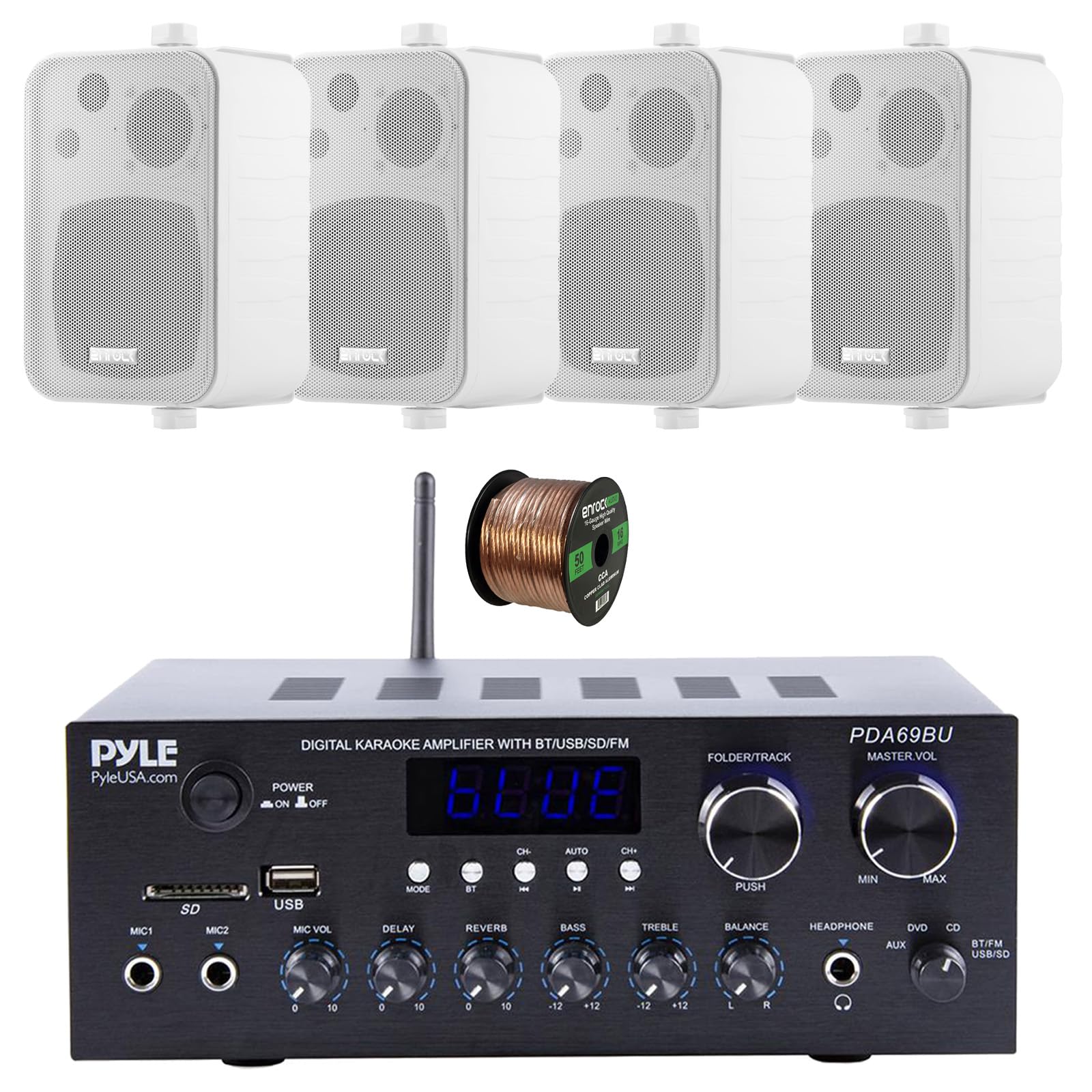
Four weatherproof box speakers and a 9-pound amp for the garage, the patio, or a karaoke night.
This is the bundle for a space that is not a theater. The Pyle PDA6BU is a 2-channel stereo amplifier with a 300W power output rating, Bluetooth, USB, RCA, and a 3.5mm jack, and it accommodates two sets of speakers. Around it you get four Enrock EKMR408W 4-inch 3-way box speakers — that is two pairs — plus 50 feet of 16-gauge speaker wire to reach them. The speakers are fully marinized and weatherproof with UV-coated plastic surfaces, which is the detail that makes them viable on a covered porch or in a boat rather than just indoors.
Portability is the whole argument here. At 9 pounds the amp is a one-hand carry, and the box speakers mount on a wall or bracket rather than occupying floor space. Compare that with the Kraken-sized Klipsch bundle at 50.4 pounds and the difference is not subtle — this is gear you move between locations. USB playback of WAV and WMA files means a thumb drive can be the source, with no phone or network involved.
Be clear-eyed about what you are buying. Sound quality and reliability both draw mixed feedback — some owners get clean, loud audio and others run into humming or a unit that does not behave. That is the pattern with budget amplification, and it is worth knowing before you order. What is not in doubt is the coverage: four speakers and a long wire run for a secondary space, where the goal is background music and backyard volume rather than critical listening.
Made for: a garage, patio, boat, or shop where loud and weatherproof beats refined and delicate.
Go another way if: you want a main-room system you will listen to critically — the mixed feedback on sound and reliability makes this a secondary-space tool, not a living-room centerpiece.
Understanding the Specs
Channels and What They Do
A channel is one independent speaker feed. Two channels give you left and right — the classic stereo pair, which handles music beautifully and TV adequately. A 5.1 system adds a center channel (which anchors dialogue to the screen), two surrounds behind you, and one subwoofer. A 7.2 or 9.2 receiver adds more surround and height feeds, which is what object-based formats like Dolby Atmos need to place a sound above your head rather than beside it. More channels means more speakers to buy and more wire to run, so pick the count that matches your room, not the one on the biggest box.
Watts and Ohms Together
A watt figure on its own tells you very little. Watts measure amplifier output power; ohms measure the electrical load the speaker presents. The two are quoted together for a reason — a receiver rated at 220W per channel at 6 ohms is delivering that power into a specific load. Speakers that are easier to drive (higher sensitivity) will play louder on less power. This is why a modest stereo receiver can sound fuller than a high-wattage surround unit driving inefficient speakers. Read the pair, not the single headline number.
HDMI eARC and 8K Pass-Through
HDMI eARC (enhanced Audio Return Channel) lets one cable send picture to the TV and send the TV’s audio back to the receiver, so you stop juggling optical cables. 8K and 4K/120 pass-through means the receiver can carry the highest-resolution and highest-frame-rate signals your console or player produces without downscaling them. If you own a current-generation console, look for ALLM (auto low-latency mode) and VRR (variable refresh rate) too — those two settings are what make fast games feel responsive through a receiver.
Phono Inputs and Why They Matter
A turntable outputs a very quiet signal that needs pre-amplification and equalisation before a receiver can use it. A phono input does that inside the receiver. Without one, you need an external preamp box, an extra power lead, and an extra set of cables. If vinyl is part of your listening, a phono input is the single spec that saves you the most hassle.
FAQ
Can I connect a turntable directly to a receiver without a separate preamp?
What is the difference between 5.1 and 5.2 speakers?
Will a 9.2-channel receiver work with only five speakers?
Do I need HDMI eARC if my TV has an optical output?
Are the Enrock box speakers actually safe outdoors?
How much speaker wire comes with each bundle?
What does Dolby Atmos need that a standard 5.1 setup does not?
Can a stereo receiver power speakers in two rooms at once?
Should I buy a bigger receiver or better speakers first?
What does room correction actually do on an AV receiver?
Final Thoughts: The Verdict
The audio receiver with speakers package that makes the most sense for a serious movie room is the Klipsch Reference 5.2 with Onkyo TX-NR7100, because a 9.2-channel receiver at 220W per channel paired with two 12-inch powered subwoofers is a complete cinema chain in one crate. If vinyl and stereo listening are the whole point, the Sony STRDH190 with SSCS5 speakers is the one to reach for — a phono input, Bluetooth, and 50 feet of 14AWG wire in the box. And for a patio, garage, or boat where loud and weatherproof matter more than refined, the Pyle PDA6BU with four Enrock box speakers covers four mounting points from a 9-pound amp.
How We Picked
We do not accept paid placement. Every pick is matched to a real buyer and a real use-case; we do not hands-on test units.
Sources & Methodology
Specifications: manufacturer listings and product documentation. Review insights: verified customer reviews, as of November 2026. Pricing: not shown on this page (it changes often); check the current price via the retailer link.
As an Amazon Associate, Gadgets Feed earns from qualifying purchases. This does not affect which products we feature.