
The difference between a recording that sounds amateur and one that sounds professional often comes down to a single piece of gear: the recorder and microphone combination you choose. A bad audio recorder mic setup introduces hiss, misses quiet dialogue, or distorts when someone raises their voice — instantly ruining interviews, lectures, or podcast takes that cannot be re-shot.
I’m Min — the co-founder and writer behind Gadgets Feed. I’ve spent countless hours comparing dynamic range specs, preamp noise floors, and bit-depth trade-offs across portable recorders to separate genuine pro tools from overpriced toys.
Whether you are recording field interviews, classroom lectures, or multi-track music sessions, picking the right tool prevents hours of painful post-production cleanup. This guide cuts through marketing noise to reveal the best audio recorder mic choices for every serious use case.
How To Choose The Best Audio Recorder Mic
Choosing an audio recorder mic is a compromise between portability, input flexibility, and recording fidelity. A handheld recorder with built-in microphones works for solo interviews and field notes, while a unit with XLR inputs supports professional microphones for multi-person podcasts or music recording. The decision hinges on your workflow — how many sources you need to capture simultaneously and whether you can tolerate post-production gain adjustments.
Bit Depth and Dynamic Range
The most critical specification is bit depth. Traditional 16-bit or 24-bit recorders require you to set recording levels correctly before each take — too loud and you clip (permanent distortion), too quiet and you introduce noise when boosting in post. The newer 32-bit float capture eliminates this worry entirely by recording a vastly wider dynamic range across two gain stages simultaneously, allowing you to normalize levels after recording without any clipping or added noise.
Inputs and Microphone Type
What you plug in determines your audio quality ceiling. Built-in stereo condenser microphones are convenient but pick up handling noise and are fixed in placement. XLR inputs let you use high-quality dynamic, shotgun, or lavalier microphones that isolate sound better in noisy environments. If you record only your own voice in a quiet room, built-in mics suffice. If you record interviews in public spaces or music with instruments, XLR inputs are non-negotiable.
Battery Life and Storage
Field recorders are useless when dead. Look for units offering at least 10 hours of continuous operation, ideally with user-replaceable AA batteries for long days. Internal memory is convenient but limited; microSD or SDXC support up to 1 TB gives you days of high-resolution WAV recording without needing to offload files. Remember that 32-bit float files are roughly twice the size of 24-bit files at the same sample rate, so ample storage matters.
Quick Comparison
On smaller screens, swipe sideways to see the full table.
| Model | Category | Best For | Key Spec | Amazon |
|---|---|---|---|---|
| Zoom H4 Essential | Premium | Multi-track music & pro field recording | 19.4mm X/Y mics, 4-track 192kHz | Amazon |
| Zoom H1 XLR | Mid-Range | XLR mic users on a budget | Two XLR/TRS combo inputs, 32-bit float | Amazon |
| OM SYSTEM LS-P5 | Premium | Discreet high-fidelity recording | 16GB internal, Bluetooth monitoring | Amazon |
| Hollyland Lark MAX 2 | Premium | Wireless lavalier with timecode sync | Full-chain 32-bit, 340m range | Amazon |
| TASCAM DR-05XP | Mid-Range | Beginners & backup recording | 32-bit float, 17.5hr battery | Amazon |
| OM SYSTEM DM-720 | Mid-Range | Voice dictation & meetings | TRESMIC 3-mic system, 985hr battery | Amazon |
| iFLYTEK Offline Recorder | Mid-Range | AI transcription & voice-to-text | 6-mic AI noise cancel, 190hr battery | Amazon |
In‑Depth Reviews
1. Zoom H4 Essential

The Zoom H4 Essential stands apart with the largest microphones on any handheld recorder — a 19.4mm X/Y capsule that captures a rich, wide stereo image with exceptional dynamic range. Combined with 32-bit float recording up to 192kHz across four simultaneous tracks, this unit handles anything from a whisper to a drum kit without any gain-staging anxiety.
Two XLR/TRS combo inputs with dedicated gain knobs give you hands-on control over external microphones, while the lightweight design makes it genuinely portable. Battery life reaches 20 hours with alkaline cells, and the USB-C interface doubles as an audio interface for direct computer recording.
Where this recorder truly shines is the peace of mind it delivers — you never lose a take to clipping. The preamp noise floor is exceptionally low, and the built-in X/Y mics rival standalone condenser pairs in clarity. For musicians, filmmakers, and podcasters who need one device that does everything well, this is the definitive choice.
Why it’s great
- Largest onboard X/Y mics on a handheld recorder deliver rich stereo detail
- Four-track simultaneous 32-bit float recording at up to 192kHz eliminates clipping worry
- Dual XLR/TRS inputs with dedicated gain knobs for pro external mics
Good to know
- Handling noise is noticeable; an external suspension rig is recommended for critical work
- Bulky for pocket carry compared to smaller voice-focused recorders
2. Zoom H1 XLR

The Zoom H1 XLR packs two XLR/TRS combo locking inputs into a compact, pocketable chassis — a rare and extremely practical feature for this price tier. With 32-bit float recording at 96kHz and an OLED waveform display for instant level confirmation, it offers professional audio capture without the bulk of larger recorders.
SDXC support up to 1 TB means you can record days of high-resolution material without swapping cards. The unit runs on two AA batteries for approximately 10 hours, and it automatically switches to USB-C bus power when connected to a laptop or phone charger, making it equally useful as a standalone field recorder and as a desktop audio interface.
Reviewers consistently note that the H1 XLR outperforms recorders costing twice as much in terms of preamp quality and overall audio clarity. The plastic build feels light but durable enough for regular use, though you will want to handle it carefully to avoid drops. For anyone needing professional XLR connectivity in the smallest possible package, this is the standout option.
Why it’s great
- Two locking XLR/TRS combo inputs in an ultra-compact body
- 32-bit float recording with no gain-staging required
- SDXC support up to 1TB for extended high-res sessions
Good to know
- Plastic build feels light; warranty recommended if you work in rough environments
- Requires reading the manual to fully understand menu navigation
3. OM SYSTEM Olympus LS-P5

The OM SYSTEM LS-P5 is a triumph of miniaturization, packing studio-grade 96kHz/24-bit PCM recording into a body roughly the size of a pack of gum. Its TRESMIC three-microphone system can be switched between directional modes — from a focused pickup for lectures to a wide stereo ambiance mode for musical performances.
With 16 GB of internal memory plus a microSD slot and Bluetooth connectivity for wireless monitoring and remote control via the companion app, this recorder is purpose-built for discreet, high-fidelity capture. The noise cancellation mode effectively reduces background hum, and the low-cut filter handles air conditioning rumble without affecting vocal frequencies.
The main trade-off is the micro-USB port instead of a slide-out USB connector, and the lack of a voice guide for menu navigation. However, for journalists recording courtroom proceedings, students capturing lectures, or anyone who needs a vanish-in-the-pocket recorder that punches above its weight, the LS-P5 delivers extraordinary sound quality in a remarkably small footprint.
Why it’s great
- Exceptional 96kHz/24-bit PCM audio in a tiny, discreet body
- TRESMIC system with adjustable directionality for different scenarios
- Bluetooth wireless monitoring and app-based remote control
Good to know
- Cannot record while operating as a USB audio interface
- High-quality Bluetooth monitoring requires a compressed audio format
4. Hollyland Lark MAX 2

The Hollyland Lark MAX 2 redefines wireless audio with full-chain 32-bit float transmission — from transmitter to receiver to recording file — meaning you get the same clipping-free headroom as a 32-bit handheld recorder, but without any cables. The system supports up to four transmitters and includes open-ear OWS earphones for real-time wireless monitoring with just 25ms latency.
AI-powered noise cancellation offers stepless adjustment from 5dB to 25dB, letting you dial in exactly how much background rejection you need without making voices sound hollow. The 340-meter line-of-sight range and 36-hour total battery life with the charging case make it viable for all-day film sets and destination shoots. Each transmitter also packs 8 GB of internal storage for a 10-hour 32-bit backup recording.
The timecode sync feature is a game-changer for multi-camera video workflows, and the compact 14-gram transmitters attach securely via clip or magnet. The included lavalier adapter provides flexibility for body-worn miking. For videographers and content creators who need pristine wireless audio with the safety net of internal recording, this system is currently unmatched in its class.
Why it’s great
- Full-chain 32-bit float wireless transmission prevents clipping anywhere in the signal path
- Open-ear wireless monitoring with ultra-low 25ms latency
- Timecode sync and 8GB internal backup per transmitter for redundancy
Good to know
- Power button can be accidentally pressed when transmitter is stored in tight clothing
- Printed manual is minimal; rely on online tutorials for advanced features
5. TASCAM DR-05XP

The TASCAM DR-05XP brings 32-bit float recording to a remarkably accessible price point, making clipping-free capture available to anyone. Its omnidirectional condenser microphones handle sound pressure levels up to 125dB SPL without distortion, and the 2-in/2-out USB-C audio interface functionality means it doubles as a computer microphone for podcasting or voiceovers.
Battery life is a standout feature at 17.5 hours from two AA alkaline cells, easily lasting through multi-day conferences or field trips. The unit is lightweight at 4.48 ounces and starts recording almost instantly when powered on, with the ability to save the current file if batteries die mid-recording — a thoughtful safety net for long sessions.
Some users report that the built-in stereo microphones produce relatively narrow channel separation compared to higher-end units, and the line input is sensitive to voltage, requiring careful pre-amp adjustment. For its price, however, the DR-05XP delivers a reliable 32-bit float workflow and excellent Japanese build quality that exceeds expectations for the budget-friendly tier.
Why it’s great
- Affordable entry point to 32-bit float recording with no clipping worry
- Excellent 17.5-hour battery life from standard AA batteries
- 2-in/2-out USB-C audio interface for direct computer recording
Good to know
- Built-in stereo mics have modest channel separation; consider external mics for critical stereo work
- Line input is voltage-sensitive and may require careful gain matching
6. OM SYSTEM Olympus DM-720
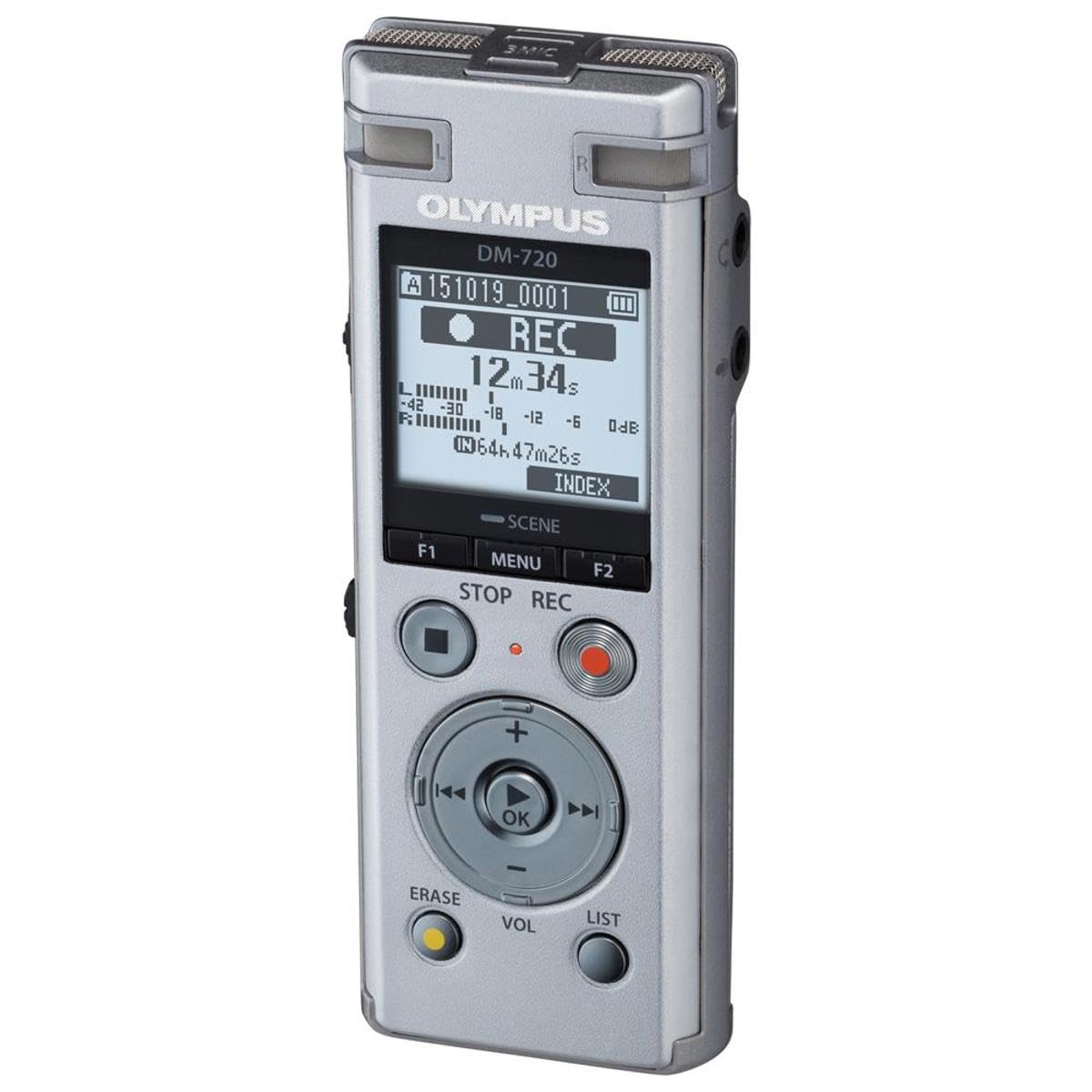
The OM SYSTEM DM-720 is a specialist tool for voice recording, built around the TRESMIC three-microphone system that captures a wide range of true-to-life sound with intelligent auto-mode sensitivity adjustment. It records in 48kHz/16-bit linear PCM format and includes a low-cut filter that eliminates frequencies below 300 Hz, cleaning up HVAC rumble and traffic noise during meetings or dictation sessions.
The headline specification is 985 hours of recording time on a single AAA battery — the result of efficient power management for its intended use case of extended lecture or meeting capture. The built-in 4 GB of memory holds roughly 70 hours of high-quality WAV audio, expandable via microSD card up to 32 GB, and the integrated USB connector slides out for easy file transfer and charging.
While this recorder is not suitable for music or situations requiring wide frequency response, it excels in its designed role. The metal body is thin and light, and the voice menu system makes operation straightforward. For journalists, students, and professionals who need reliable, long-duration voice capture with minimal fuss, the DM-720 is a proven workhorse with ten years of positive user feedback.
Why it’s great
- Exceptional battery life measured in hundreds of hours from one AAA battery
- TRESMIC system with intelligent auto sensitivity for consistent voice levels
- Built-in slide-out USB connector for convenient file transfer and charging
Good to know
- Slight hiss at high sensitivity levels when recording quiet sources
- Slow startup time compared to modern competitors
7. iFLYTEK Offline Voice Recorder

The iFLYTEK Offline Voice Recorder is the world’s first digital recorder with playback that transcribes speech to text offline in five languages — English, Chinese, Japanese, Korean, and Russian. Its six-microphone array with AI noise cancellation effectively blocks crowds and echoes, making it suitable for trade shows, courtrooms, and international conferences where precise audio capture is critical.
The 2-inch touchscreen provides intuitive menu navigation with four recording modes tailored for intelligent auto-adjustment, conference, interview, and speech scenarios. Battery life reaches 190 hours on a single USB-C charge, and the device can import external audio files in multiple formats for transcription, making it a versatile tool for media professionals who need to process existing recordings.
The offline AI transcription accuracy varies with strong accents and heavy background noise, as several users have noted. It is also important not to cover the microphones during recording, as this degrades noise reduction performance. For situations where voice-to-text transcription is the primary goal and you cannot rely on cloud services for security reasons, this recorder offers a unique and powerful capability.
Why it’s great
- Offline AI voice-to-text transcription in five languages for secure note-taking
- Six-microphone array with AI noise cancellation for crowded environments
- 190-hour battery life and fast USB-C charging for multi-day use
Good to know
- Transcription accuracy drops with strong accents and background noise
- No headphone jack for live monitoring during recording
FAQ
Does 32-bit float eliminate the need to set recording levels entirely?
Can I use an external microphone with a budget-friendly handheld recorder?
How important is sample rate — does 96kHz really sound better than 44.1kHz?
Final Thoughts: The Verdict
For most users, the best audio recorder mic winner is the Zoom H4 Essential because its 32-bit float recording, largest onboard X/Y microphones, and four-track simultaneous capture cover every scenario from field interviews to music production without compromise. If you want professional XLR inputs in a compact travel-friendly body, grab the Zoom H1 XLR. And for wireless video production where timecode sync and internal recording redundancy are non-negotiable, nothing beats the Hollyland Lark MAX 2.