
Our readers keep the lights on and my morning glass full of iced black tea. As an Amazon Associate, I earn from qualifying purchases.
Specs are compiled from manufacturer listings and verified buyer reviews and can change over time — please confirm the key details on the product page before buying.
You need to capture every word of a lecture, a meeting, or an interview, but the last thing you want is to end up with a muddy recording that sounds like it was made underwater. The difference between a good audio recorder and a great one depends on how well it handles real-world sound — whether that is your own voice across a conference table or a quiet conversation from several feet away.
I’m Min — the founder and writer behind Gadgets Feed. This guide is built by comparing the manufacturers’ published specifications and the patterns across verified customer reviews, so you get each pick’s real strengths and trade-offs instead of marketing spin.
Whether you are a student taping lectures, a journalist conducting interviews, or a musician capturing a live idea, finding the best audio recorders depends on matching your workflow with the right combination of sound clarity, storage capacity, and operational simplicity.
Our Picks at a Glance

How To Choose The Best Audio Recorder
A reporter doing one-on-one interviews needs different features than a musician recording a band or a student taping a large lecture hall. Here are the three main points to think through.
Recording Quality: Bitrate and Bit Depth
Recording quality depends on bitrate (kbps) and bit depth (16-bit, 24-bit, or 32-bit float). A higher bitrate means more detail in the sound, crucial for music or quiet dialogue. 32-bit float records at a low level to prevent clipping, letting you adjust volume later without distortion. For spoken word, a solid 16-bit WAV file or a high-bitrate MP3 is usually all you need.
Storage and Battery Life
Internal storage is measured in GB (4GB, 64GB, 128GB), and many recorders let you expand with a microSD card. A 4GB recorder at the lowest MP3 quality can hold over a hundred hours, but at high-quality WAV, it might only hold a few hours. Battery life matters for portability — a device that gets 33 hours from a single charge is far more useful for a week of classes than one that only lasts 10 hours, especially if you cannot always find an outlet.
Microphone and Connectivity
Most recorders have mono (one channel) or stereo (two channels) built-in mics. Some premium models have adjustable microphones (like the X-Y or A-B configurations on the Tascam DR-07X) that let you change the recording width. External inputs like a 3.5mm jack or XLR ports let you connect a professional lavalier or shotgun mic for higher quality. Connectivity features like a built-in USB port or Type-C OTG allow you to transfer files directly to a computer or phone without a separate cable, saving time.
Quick Comparison
| Model | Best For | Recording Quality | Storage | Battery Life | Amazon |
|---|---|---|---|---|---|
| Sony ICD-PX370★ Best Overall | Simple, long-lasting lectures | MP3 (128 kbps) | 4 GB + microSD | 57 hours | Amazon |
| YIVIDA L359 AI RecorderSmart Pick | AI transcription & large storage | 1536Kbps PCM HD | 128 GB | 33 hours | Amazon |
| NSRLO 64GB RecorderHigh Fidelity | Ultra-portable, high-bitrate clarity | 3072Kbps HD | 64 GB | — | Amazon |
| Yegolito Pen Recorder | Discreet, pen-style recording | DSP Noise Reduction | 128 GB | 35 hours | Amazon |
| TASCAM DR-05XP | Pro field recording & podcasting | 32-bit float / 24-bit / 16-bit | Up to 512 GB | 17 hours | Amazon |
| Tascam DR-07X | Adjustable stereo mics for music | Up to 24-bit / 96kHz | Up to 128 GB (microSD) | 17.5 hours | Amazon |
| Zoom H1 XLR | Budget-pro XLR recording | 32-bit / 96kHz | Up to 1 TB (SDXC) | 18.5 hours | Amazon |
| Zoom H4 Essential | Multi-track music & podcasting | 32-bit float | SD Card | 20 hours | Amazon |
| Roland R-07 | Hi-res playback & Bluetooth control | WAV up to 96kHz/24-bit | microSD (SD, SDHC) | 30 hours playback / 16 hours record | Amazon |
In‑Depth Reviews
1. Sony ICD-PX370 Mono Digital Voice Recorder
Our pick — 4.5★ from 6,500+ verified ratings; the strongest balance of quality and price.
The no-fuss champ of battery life that records lectures for days on end.
This Sony recorder is the crowd favorite for a simple reason: it does the core job with zero fuss and stays running. The defining spec here is the 57-hour battery life — that is enough for a full week of lectures or a multi-day conference without swapping batteries. It stores 4GB of MP3 audio internally, and you can expand with a microSD card if you need more, making it a very flexible workhorse for spoken word.
Buyers consistently praise the recording quality, with one noting it “picks up low-volume audio from feet away with crystal clarity.” The built-in USB connection flips out directly from the device, so you do not need a separate cable to get files onto your computer — it is about as simple as file transfer gets. It is light at 136 grams, though noticeably heavier than the 65-gram AI recorder below. Recording quality is the most-praised aspect by a large margin, and ease of use comes in a close second.
The mono microphone captures only one channel, losing stereo spatial separation. It is fine for a single speaker or dictation, but less ideal for a roundtable discussion where you want to distinguish who is talking from which side. The instructions also get called out as sparse.
Best for long recording sessions: Reach for this if you need a simple, reliable recorder you can set and forget for days of lectures or interviews. Think twice if you need stereo separation for music or multi-speaker meetings.
Reach for this if: your priority is maximum battery life and dead-simple operation for recording a single speaker or taking voice notes.
Look elsewhere if: you need stereo sound or a higher-quality recording format like 32-bit float for music production.
2. AI Digital Voice Recorder 128GB (YIVIDA L359)
The student’s secret weapon with AI that turns audio into instant notes.
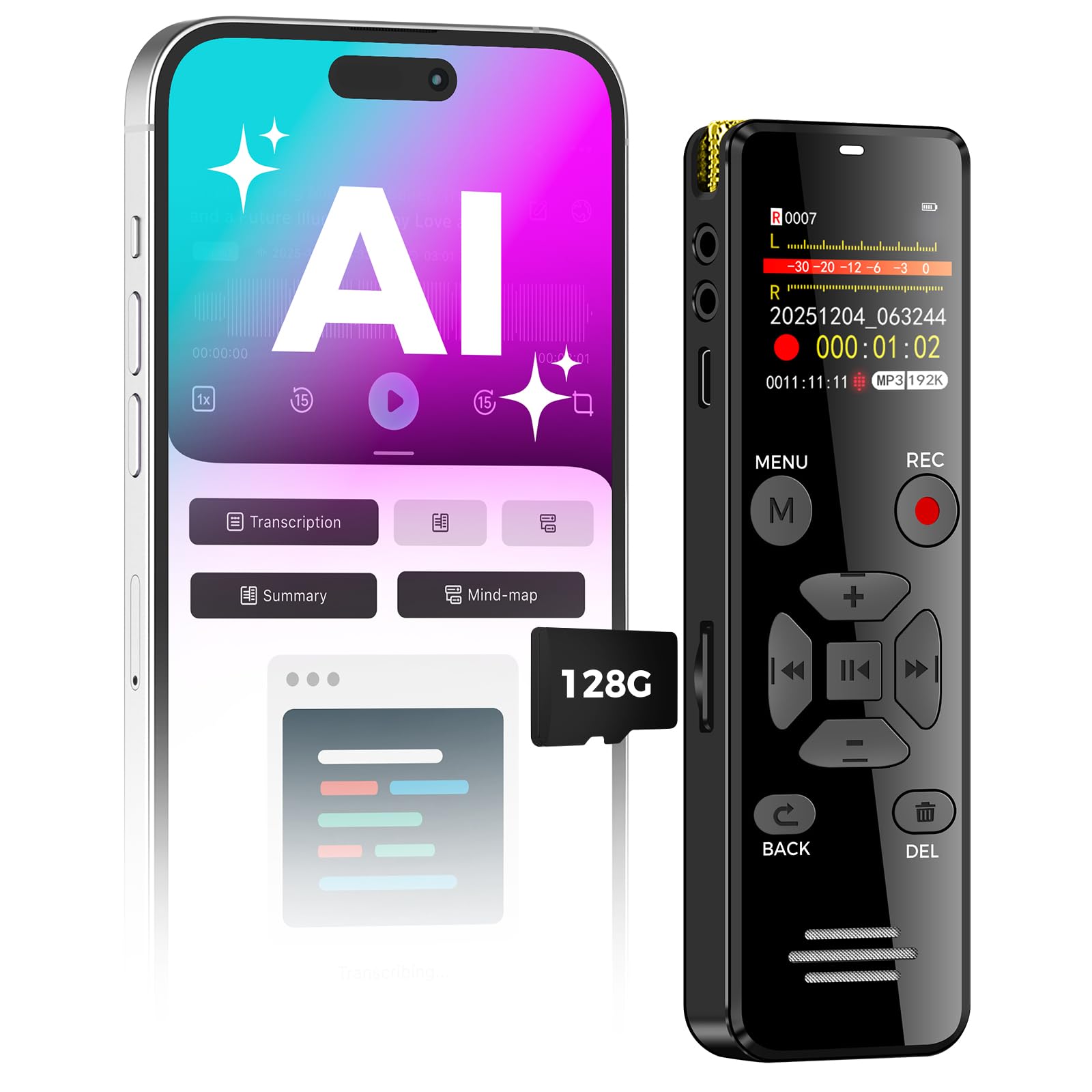
This recorder is the first on the list to combine traditional recording with modern AI smarts. Its headline feature is the “AI DVR Link” app, which provides high-accuracy transcription in 113 languages, plus structured summaries and even mind maps. For a student or professional drowning in meeting notes, this means you press record, capture 1536Kbps PCM HD audio, and let the app turn it into searchable text later.
The storage is another huge win: 128GB internal memory, which at the lowest bitrate can hold up to 9,216 hours of audio. That is essentially a multi-year archive of lectures on one device. Weighing only 65 grams, compared to the Sony ICD-PX370’s 136 grams, so it disappears into a shirt pocket. The battery runs for 33 hours of continuous use, which covers a full work week. Buyers report the “crisp audio in large rooms” and how easily it picks up distant voices.
The wired-only OTG connection lacks Bluetooth for file transfer. You connect the recorder to your phone or computer with the included USB-C cable to import files into the AI app. This is actually a plus for security (no wireless interception), but it is an extra step compared to the Sony’s direct USB plug. A few buyers also found the Bluetooth confusion frustrating, though the device does not actually rely on Bluetooth.
Best for students and note-takers: Choose this if you want AI-powered transcription and massive built-in storage in a featherlight package. skip it if you prefer the simplicity of a direct USB connection like the Sony.
Reach for this if: your main goal is to get recordings transcribed and summarized automatically without manual typing.
Look elsewhere if: you need a simple plug-and-play recorder with no app dependency and prefer AA batteries over recharging.
3. NSRLO 64GB Digital Voice Recorder
CD-quality audio in a pocket-sized metal body that clips anywhere.
This is the audio quality king of the mid-range picks. It records at a staggering 3072Kbps, compared to 1536Kbps for the YIVIDA L359 and 128Kbps for the Sony ICD-PX370. This means it captures incredibly detailed sound — buyers describe it as “CD-quality audio.” For musicians capturing an idea or a journalist in a noisy cafe, this extra detail is the difference between a usable recording and a messy one.
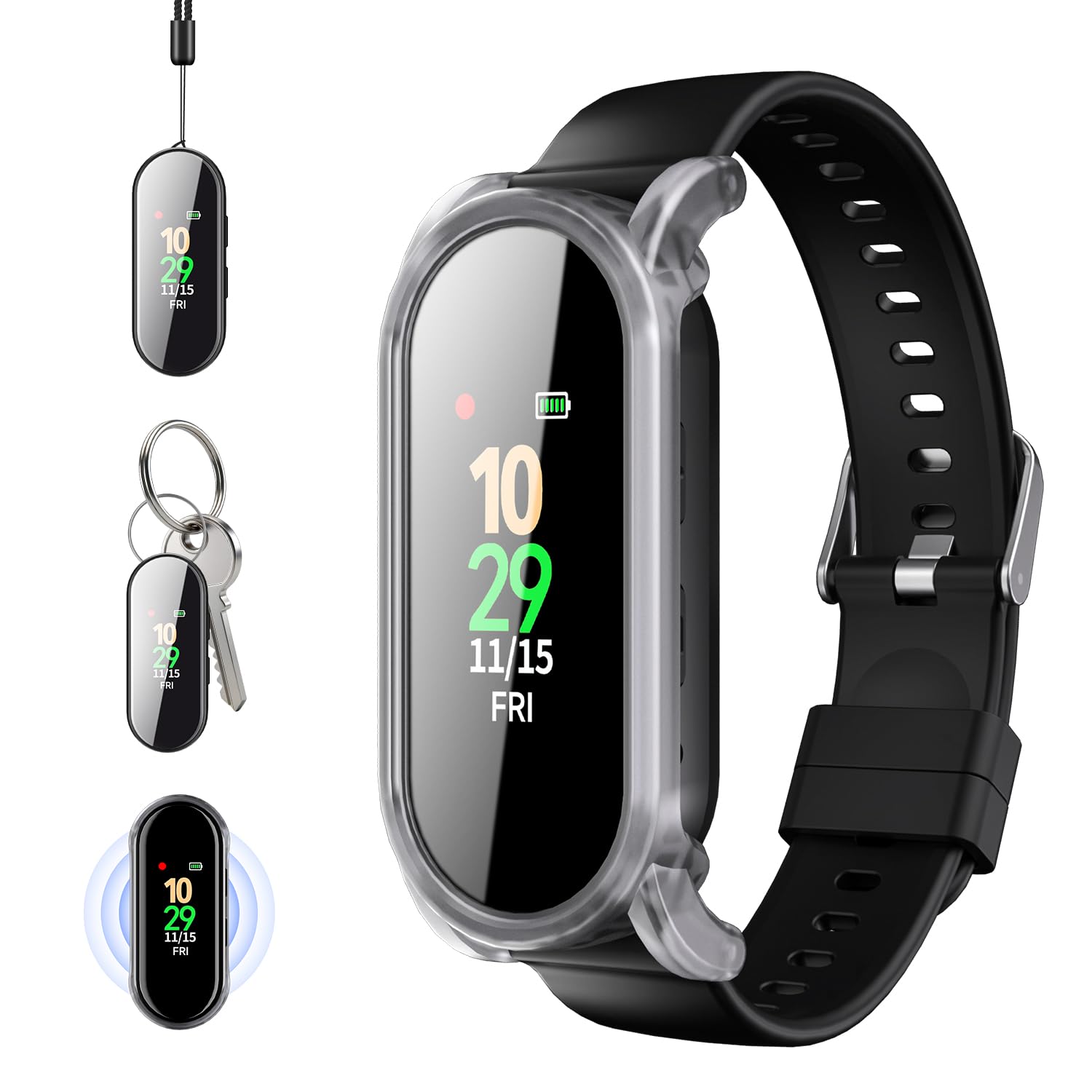
Beyond the audio, the NSRLO is a design standout. It has a premium metal construction that feels durable, and it comes with multiple carrying options: a wristband, a lanyard, a keychain ring, and even a magnetic back to attach to a refrigerator or a metal filing cabinet. It is genuinely compact and weighs almost nothing. The DSP 3.0 noise reduction is adjustable from levels 1 to 7, so you can dial in exactly how much ambient chatter to filter out.
One thing to note: the headphones jack uses a 2.5mm connection rather than the more common 3.5mm one, so you will need an adapter or specific headphones for private listening. The battery life is not specified in hours in the data, so you are trading the raw spec for the build quality and portability features.
What You Get
- top-tier 3072Kbps recording that rivals CD quality
- Versatile carry options: wear it like a watch, clip to keys, or magnet stick
- Premium metal housing that feels built to last
The Setup
- Uses a 2.5mm headphone jack — not standard on all headphones
- Exact battery life in hours is not listed in the specs
Best for audio purists: Go for this if recording detail is your top priority and you love a compact, multi-carry design. pass on it if you need a standard 3.5mm headphone jack or a stated battery life figure.
4. TASCAM DR-05XP Portable Handheld Recorder

Pro-level 32-bit float recording that forgives loud moments without distortion.
The TASCAM DR-05XP is a serious step up in recording technology. Its main feature is 32-bit float recording, which means you never have to worry about setting the recording level too high and clipping the audio. You can record a whisper and a shout in the same session and simply adjust the volume in post-production with zero distortion. It also records in 24-bit and 16-bit, and up to 96kHz, making it suitable for music and audio-for-video.
It doubles as a 2-in/2-out USB-C audio interface, meaning you can plug it directly into a computer and use it as a high-quality external microphone for podcasting or streaming. The omnidirectional condenser microphones can handle very loud sources up to 125dB SPL, which is loud enough for a rock concert. It supports microSD cards up to a massive 512GB, giving you enormous storage potential.
The built-in mics get good reviews, but the user interface is mixed — some find it intuitive, others find it difficult. The battery life is 17 hours on two AA batteries, compared to the Sony’s 57 hours. It is also larger and heavier than the pocket-sized options, at 4.48 ounces and 1.06 inches deep.
Best for musicians and filmmakers: Reach for this if you need the safety of 32-bit float and the flexibility of a USB-C audio interface. it’s not for you if you only need simple spoken-word recording and prioritize battery life.
Reach for this if: you record anything with unpredictable volume (live music, video sound) and want the freedom to fix levels later without distortion.
Look elsewhere if: you are a student needing a simple pocket recorder for basic lectures.
5. Zoom H1 XLR 2-Channel Recorder

Professional XLR inputs and 32-bit float in a compact package that just works.
The Zoom H1 XLR is the ideal bridge between consumer recorders and professional field gear. It has two locking XLR/TRS combo inputs, letting you plug in professional microphones (like a Shure SM58) or instruments without needing an adapter. It records in 32-bit float / 96kHz for that same clip-free safety as the TASCAM, making it a favorite for filmmakers and podcasters who need reliable, high-quality audio from external mics.
A standout feature is the built-in OLED waveform display, which gives you a visual, real-time look at your audio levels. This lets you make sure you are capturing a clean signal without relying on your ears alone. It supports SDXC cards up to a massive 1TB, giving you enough space for long-form projects. The “audio quality” is the most praised aspect, with 25 mentions in the reviews.
The most-discussed trade-off is the battery life — rated at 10 hours (or 18.5 hours in a different mode), it dips significantly compared to the Sony. When powering a 48V phantom-powered microphone, it drains even faster, with one reviewer noting that cheap batteries last only 10 minutes. The plastic build also feels less rugged than metal competitors, so you will want a case.
Pro Features
- Two professional XLR/TRS inputs for external mics and instruments
- 32-bit float / 96kHz recording prevents clipping
- Clear OLED waveform display for visual level monitoring
The Catch
- Battery life is significantly lower than non-XLR competitors
- Plastic body feels less durable; drop protection recommended
Best for entry-level pro work: Choose this if you need to connect professional XLR microphones for interviews or podcasts without a huge investment. look elsewhere if battery life is your absolute priority.
6. Tascam DR-07X Stereo Digital Recorder

Adjustable microphones that let you switch from a wide room to a focused source.
The Tascam DR-07X is built for anyone who needs to control the sound field. Its two built-in microphones are adjustable: you can set them to an A-B position for a wide, ambient stereo capture (great for a choir or a nature scene) or to an X-Y position for a narrower, more focused sound (better for a single instrument or a solo speaker). This flexibility is rare at this price and is a huge advantage over fixed-mic recorders.
It records up to 24-bit / 96kHz WAV quality, which is the standard for professional audio work. It also functions as a 2-in/2-out USB audio interface, allowing you to record directly into a computer for voiceovers or songwriting. The battery life of 17.5 hours is solid, and it can be powered via a USB mobile battery for even longer sessions. Recording quality is the most-praised aspect with 48 mentions, followed closely by sound quality.
The physical build is mostly plastic, which some find a bit flimsy. A few owners noted flimsy plastic construction and recommend a carry case. The operation requires two button presses to start recording, which can catch you out if you are used to a single-press recorder.
Best for flexible recording: Reach for this if you want the creative control of adjustable stereo mics for music or field recording. steer clear if you prefer a simpler, single-press start recorder for basic voice notes.
Reach for this if: you need to switch between wide ambient and focused stereo recording modes for different creative projects.
Look elsewhere if: you are a student who just needs a basic, durable recorder for lectures.
7. Zoom H4 Essential Portable Studio Recorder

A full studio in your hand for recording music, podcasts, and film with multiple sources.
The Zoom H4 Essential is the most capable recorder on this list. It records on 4 tracks simultaneously, combining its built-in stereo X/Y microphones with two external XLR/TRS inputs. This means you can record a stereo room sound and two separate microphone feeds at the same time — perfect for a podcast with two hosts and a room mic, or a musician recording vocals and an acoustic guitar.
It features 32-bit float recording for clipping protection, and a spoken menu guidance system that announces menu options for visually impaired users, making it the most accessible recorder here for visually impaired creators. It can also function as a USB-C audio interface and can simultaneously record to an SD card and stream to a computer, giving you an instant backup. The recording quality is the most-praised aspect with 52 mentions.
The trade-offs are related to power and portability. The bulkier body (243 grams) makes it less pocket-friendly. Some owners also note that recording at the highest quality will auto-save and split files every 40 minutes, which can be a small interruption.
Best for serious content creators: Reach for this if you need a portable multi-track recorder for music, interviews with multiple mics, or video production. skip it if you only need a simple mono recorder for voice notes.
Reach for this if: you plan to record with multiple microphones simultaneously and want the security of 32-bit float recording.
Look elsewhere if: you need a discrete pocket recorder for simple lectures and value battery life above all else.
8. Yegolito 128GB Pen Voice Recorder
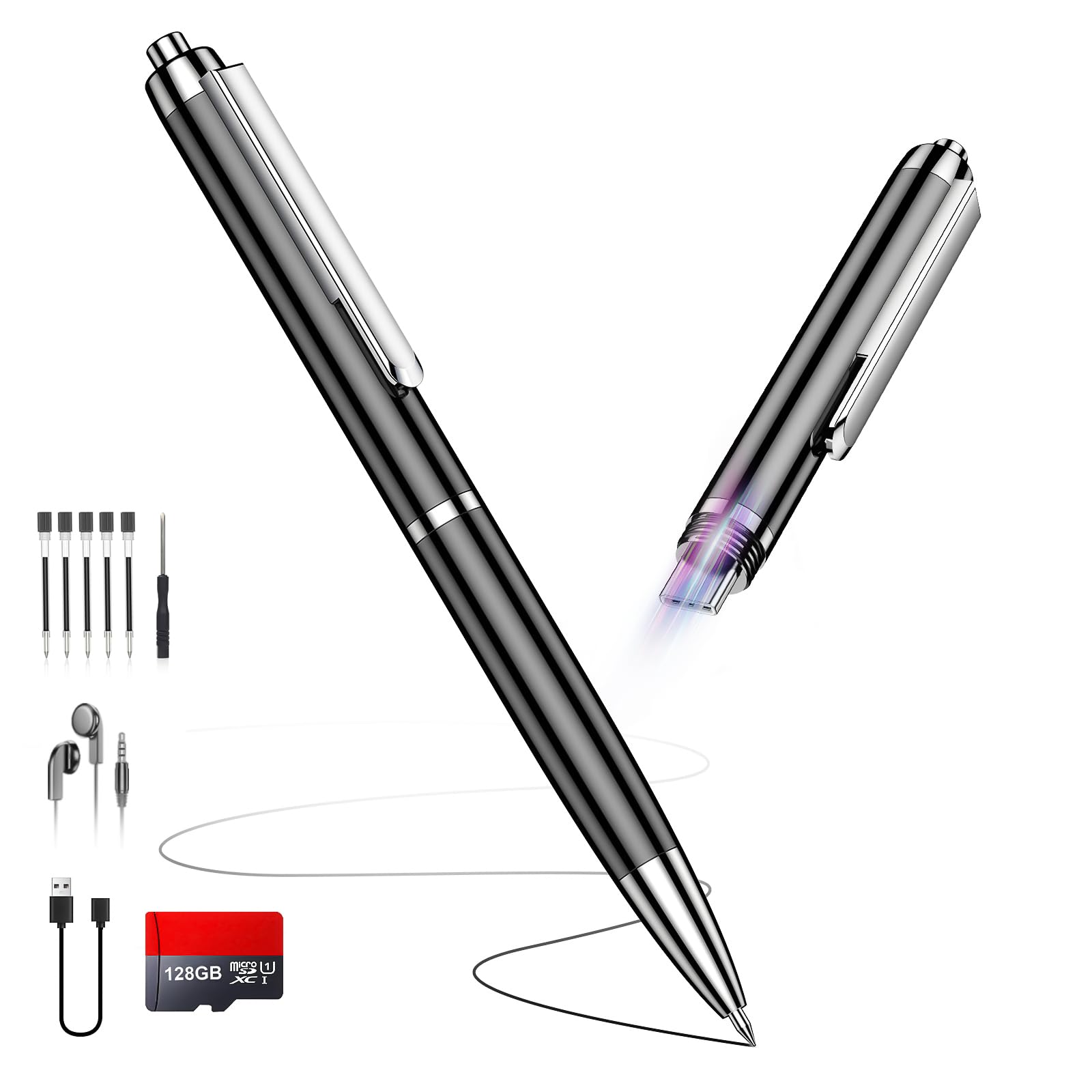
A pen that secretly records with a 360-degree mic, perfect for discreet note-taking.
This is a unique form-factor — it looks exactly like a regular pen, but it is also a fully functional voice recorder with 128GB of storage. The built-in microphone is 360-degree non-directional, so it captures sound from all directions around you. It is designed for situations where you do not want to draw attention to the recording, like in a business negotiation or a class where you want to be discreet.
It includes a Type-C port built into the pen body, so you can plug it directly into a phone or computer for file transfer without needing a separate data cable. This is a massive convenience over recorders that require a proprietary cable. The battery runs for 35 hours on a single charge, which is the best of the non-Sony picks. The voice-activated (VOR) feature also automatically skips silent gaps to save storage space.
There are a few critical things to know. Some owners mention that the storage capacity is not exactly 128GB as advertised (one measured it at 50GB). The build quality feels a bit mixed, and some users found the software interface is in Chinese characters, which can be confusing. It works best for recording your own voice or a close conversation, but the pickup for distant voices is less reliable.
Best for discreet recording: Reach for this if you need a covert recorder that looks like an everyday object and has direct Type-C connectivity. pass on it if you need guaranteed storage specs or a simple, language-neutral interface.
Reach for this if: discretion is your top priority and you want a pen-sized recorder to blend into meetings or classes.
Look elsewhere if: you need a straightforward, predictable device without potential setup hurdles or storage discrepancies.
9. Roland R-07 High-Resolution Audio Recorder

A high-res recorder that gets out of your way with Bluetooth control and scene templates.
The Roland R-07 is the most compact premium option here, designed for the user who wants excellent sound quality without the size of a traditional field recorder. It fits easily in a small bag or even a large pocket — smaller than an iPhone. It supports recording in WAV at up to 96kHz / 24-bit, which is high-resolution quality, and also offers flexible MP3 recording options.
A unique feature is its Bluetooth control. You can use a smartphone app to start and stop recording, adjust levels, and monitor audio wirelessly with supported Bluetooth speakers. This is a huge convenience if you want to leave the recorder on a table during a meeting and control it from your seat. It also has “one-touch templates” — preset scenes that instantly configure the recorder for specific scenarios like a meeting or a lecture. The quality is the most praised aspect with 25 mentions.
The main drawback is the interface, which several owners find “clunky” or dated. The battery life is decent at 30 hours for playback and 16 hours for recording, but this is lower than the Sony. The digital recording time is also limited to 3.82 hours for a single session at the highest quality, meaning you may need to adjust settings for longer meetings. The USB bus power introduces a clicking noise, which is a known issue.
Standout Features
- Bluetooth control with a smartphone app for wireless operation
- One-touch scene templates for instant, tune settings
- Hi-res WAV recording up to 96kHz/24-bit
Keep In Mind
- Short maximum recording time per file at highest quality (3.82 hours)
- USB power introduces a noticeable clicking noise
Best for the remote-control user: Reach for this if you love the convenience of starting a recording from your phone and want a compact, high-quality device. it’s not for you if you need a simple, one-press recorder or rely on USB power.
Understanding the Specs
32-Bit Float Recording
This is the biggest recent leap in audio recorder technology. A standard 16-bit or 24-bit recorder can easily “clip” (distort) if the sound is too loud. A 32-bit float recorder records the sound at such a wide dynamic range that it is practically impossible to clip. You can have a whisper and a shout in the same file, and later you can adjust the levels of both in your editing software with zero distortion. It gives you enormous safety and flexibility, especially for live music or unpredictable interview situations.
Bitrate and Sampling Rate
Bitrate is measured in kbps (kilobits per second) and describes how much data is used to store one second of audio. A higher number (e.g., 3072Kbps vs 128kbps) means more detail and better sound quality. The sampling rate is measured in kHz (e.g., 44.1kHz for CD quality, 96kHz for high-resolution). For spoken-word recordings like lectures or audiobooks, a lower bitrate (like 128kbps MP3) is perfectly fine and saves a lot of storage space. For music or any recording where you want to hear every detail of an instrument or voice, you want a high bitrate (1536Kbps or more) and a high sample rate (48kHz or 96kHz).
FAQ
How many hours can a 128GB voice recorder hold?
Is a 32-bit float recorder worth it for spoken word?
Can I use an audio recorder as a microphone for my computer?
What is the difference between mono and stereo recording?
How do I transfer recordings from my voice recorder to my phone?
What is voice-activated recording (VOR)?
How long does an audio recorder battery last in real use?
What size microSD card does a voice recorder need?
Can I use a voice recorder for music recording?
What does DSP noise reduction mean on a recorder?
Final Thoughts: The Verdict
If you want one dependable pick, the audio recorders winner is the Sony ICD-PX370 because it is the king of simplicity and battery life, perfect for lectures and interviews. If you want AI-powered transcription and a massive 128GB storage, grab the YIVIDA L359. And for the finest recording detail and a multi-carry design, the NSRLO 64GB is the one to reach for. The device that has earned the most trust from buyers is the Sony, with a crowd of thousands of satisfied owners backing its reputation over the YIVIDA’s smaller but growing community.
How We Picked
We do not accept paid placement. Every pick is matched to a real buyer and a real use-case; we do not hands-on test units.
Sources & Methodology
Specifications: manufacturer listings and product documentation. Review insights: verified customer reviews, as of July 2026. Pricing: not shown on this page (it changes often); check the current price via the retailer link.
As an Amazon Associate, Gadgets Feed earns from qualifying purchases. This does not affect which products we feature.