
Our readers keep the lights on and my morning glass full of iced black tea. As an Amazon Associate, I earn from qualifying purchases.
Specs are compiled from manufacturer listings and verified buyer reviews and can change over time — please confirm the key details on the product page before buying.
You want your home recordings to sound clear and professional, not like a phone call. The gear that gets you there is a chain: a microphone captures your voice, an audio interface converts that analog signal into digital for your computer, and headphones or monitors let you hear exactly what you recorded. This guide explains each essential piece so you know where to spend your money and what you can skip.
I’m Min — the founder and writer behind Gadgets Feed. This guide is built by comparing the manufacturers’ published specifications and the patterns across verified customer reviews, so you get each pick’s real strengths and trade-offs instead of marketing spin.
Whether you’re podcasting, streaming, or tracking vocals, the right audio recording equipment turns a noisy room into a clean, professional-sounding capture.
Our Picks at a Glance


How To Choose The Best Audio Recording Equipment
Every recording setup is a chain, and the chain is only as strong as its weakest link. You can own a world-class microphone, but if your interface adds hiss or your headphones color the sound, your final mix will suffer. Start by identifying where your current setup falls short — most beginners buy a microphone first, but the interface and monitoring gear matter just as much.
Microphone type: dynamic vs. condenser
The biggest fork in the road is choosing between a dynamic mic and a condenser mic. Dynamic mics are workhorses — they shrug off background noise and handle loud sources without distorting, which is why they dominate podcasting and streaming. Condensers are far more sensitive, capturing the subtle details of vocals and acoustic instruments, but they also pick up every room sound and almost always require 48V phantom power to operate.
Interface: your analog-to-digital translator
The interface is the box that takes your microphone’s analog signal and converts it into digital audio your computer can record. The numbers that matter here are the sample rate and bit depth — the higher the sample rate, the more snapshots of sound taken per second, and the higher the bit depth, the more headroom before distortion. A 24-bit/192kHz interface captures more detail and gives you more room to edit without artifacts than a budget 16-bit/44.1kHz model.
Monitoring: headphones vs. studio monitors
You can’t mix what you can’t accurately hear, which makes monitoring a critical part of the chain. Closed-back headphones are essential for recording sessions — they keep the sound from bleeding into your microphone. For mixing, you want either neutral-sounding headphones or a pair of powered studio monitors, which are speakers designed to reproduce audio flat without boosting the bass or treble to sound impressive.
Quick Comparison
| Model | Best For | Type | Key Spec | Connectivity | Amazon |
|---|---|---|---|---|---|
| Shure SM7B★ Best Overall | Broadcast vocals | Dynamic Mic | 20kHz response | XLR | Amazon |
| Universal Audio Volt 1Entry Value | Home studio entry | USB Interface | 192kHz quality | USB | Amazon |
| Audio-Technica ATH-M50XMonitoring Pick | Detailed monitoring | Closed Headphones | 45mm drivers | Wired | Amazon |
| Pyle PMXU46BT | Live mixing | Mixer | 4 channels | USB/Bluetooth | Amazon |
| PreSonus AudioBox 96 | All-in-one bundle | Interface Bundle | 96kHz sample rate | USB | Amazon |
| Yamaha HS4 | Compact monitoring | Studio Monitors | 4.5″ woofer | XLR/TRS/RCA | Amazon |
| Zoom H4 Essential | Field recording | Handheld Recorder | 32-bit float | XLR/USB-C | Amazon |
| SSL 2 MKII | Pro-grade clarity | USB Interface | 192kHz converters | USB | Amazon |
| beyerdynamic DT 770 Pro X | Isolation tracking | Closed Headphones | 48-ohm drive | Wired | Amazon |
| Shure MV7+ | USB/XLR hybrid | Dynamic Mic | DSP processing | USB-C/XLR | Amazon |
| Focusrite Scarlett 2i2 | Complete studio kit | Interface Bundle | 120dB dynamic range | USB-C | Amazon |
In‑Depth Reviews
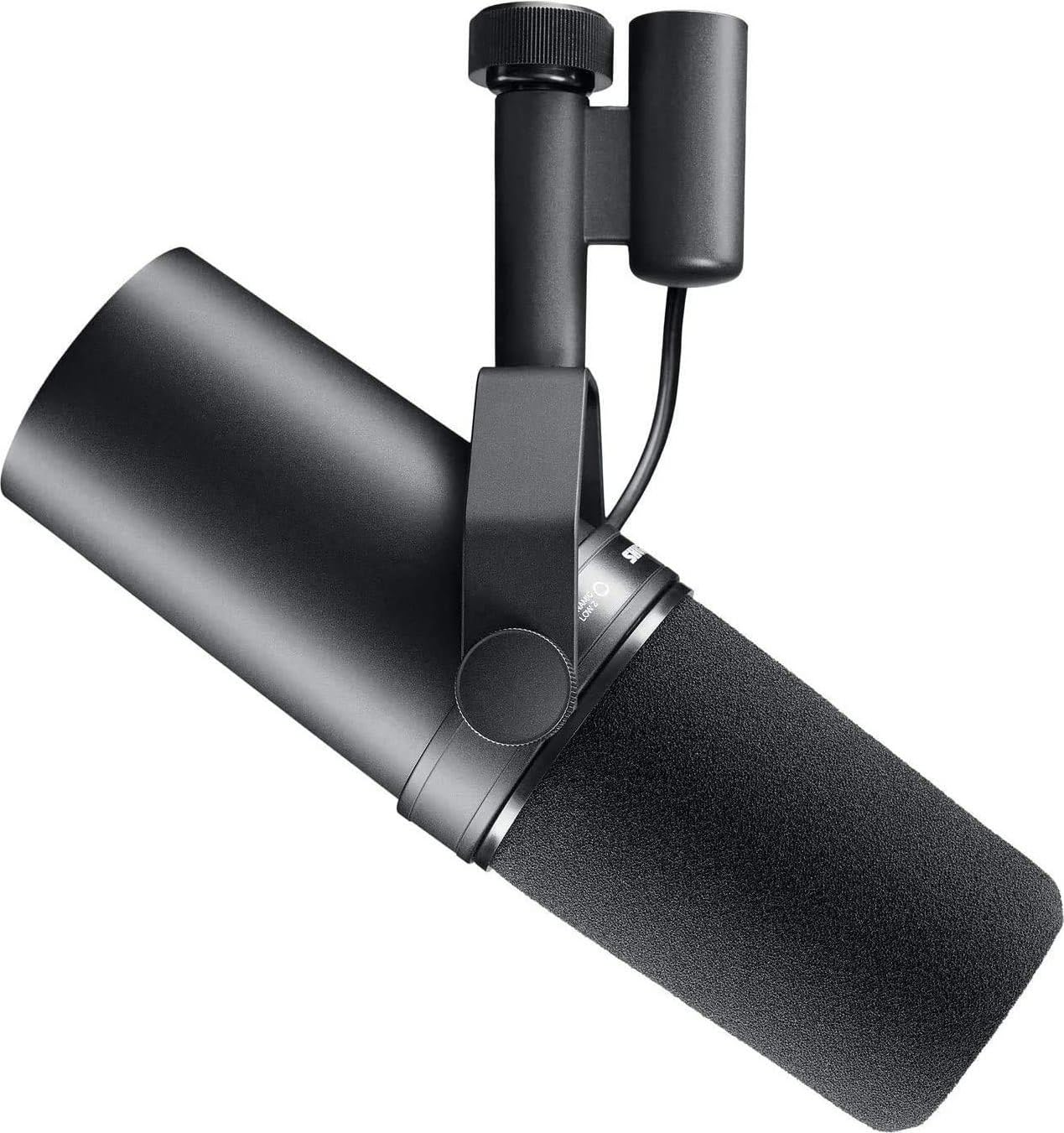
1. Shure SM7B Dynamic Vocal Microphone
Our pick — over 4.5★ from 12,000+ verified ratings; the strongest balance of quality and price.
The broadcast voice you’ve heard on countless podcasts, ready for your desk.
The SM7B’s defining trait is its warm, balanced vocal capture — the dynamic cartridge delivers exceptional clarity that makes it the default choice for podcasting, singing, and voiceover. What wins people over is the sound quality, which owners rave about more than anything else. The precise cardioid pickup pattern works with air suspension shock isolation to keep background noise and handling vibrations out of your recordings, so your voice stays front and center.
You get clean vocals without extra purchases: a built-in pop filter and detachable windscreen reduce plosives (the popping sounds from “p” and “b” sounds) and breath noise. The all-metal body with electromagnetic shielding blocks hum and interference, so your recordings stay quiet. Its 150-ohm impedance (a measure of electrical resistance) matches standard interfaces and mixers, letting you use full gain and EQ control without signal loss.
The catch is gain: this mic is quiet by nature, and buyers report it “requires 60dB+ clean gain” and “often needs Cloudlifter with entry interfaces” to sound its best. Plan for a cloudlifter or a high-gain interface in your budget. The frequency response reaches 20,000 hertz — that’s well beyond what human ears can hear at the top end, so you get every detail of your voice captured.
Why It’s The Benchmark
- Warm, studio-grade vocal clarity that flatters speech and singing alike
- Cardioid pattern rejects room noise and vibrations
- Metal build with electromagnetic shielding
Plan Your Gain
- Needs 60dB+ clean gain — budget for a Cloudlifter
- Not plug-and-play; pairs best with a quality interface
Reach for this if: you want the definitive broadcast vocal sound and are building a serious podcast or voiceover studio.
Know before you buy: you’ll need a clean preamp or inline booster to get the full performance.
2. Universal Audio Volt 1 USB Audio Interface
A compact interface that brings classic analog warmth to your home studio desk.
The Volt 1 earns its place as the entry-point champion because it delivers UA’s classic 610 preamp sound with the Vintage mode toggle, giving you rich, album-ready tone straight into your recordings. It captures up to 24-bit/192kHz quality, and owners consistently praise the clean, quiet preamp that works right from the start. Its compact, lightweight build feels premium in hand.
Compatibility is a standout: it runs on MacOS, Windows, iPad, and iPhone (iOS 14+), making it a travel-friendly companion for laptops, desktops, and mobile recording. The included LUNA Digital Audio Workstation and UAD plugins bring pro-grade software into the package, which buyers call a major value add.
There are a few trade-offs to know. It uses two USB ports and offers limited I/O, so you won’t be expanding much beyond a single mic and guitar. Buyers also note the Vintage mode can distort at high gain with a close mic — treat it as a tone-shaping tool, not a default setting. The 192kHz sample rate captures ultra-high-frequency detail that most entry interfaces miss.
What It Delivers
- Classic 610 preamp sound with Vintage mode
- Plug-and-play across Mac, Windows, iPad, iPhone
- LUNA DAW and UAD plugins included
Keep In Mind
- Limited I/O — one input only
- Vintage mode can distort at high gain
Best for: the home studio owner who wants a clean, easy interface with a premium software bundle from day one.
Look elsewhere if: you need multiple mic inputs for recording a band or group.
3. Audio-Technica ATH-M50X Professional Studio Monitor Headphones
The closed-back workhorse studio engineers reach for to hear every detail.
The ATH-M50X is celebrated for its critically acclaimed sonic performance, driven by proprietary 45-millimeter large aperture drivers with rare earth magnets and copper-clad aluminum wire voice coils. The result is exceptional clarity across an extended frequency range with deep, accurate bass — the thing owners praise most, with sound quality being the runaway favorite aspect. The circumaural design contours around your ears, giving excellent sound isolation in loud environments.
The 90-degree swiveling earcups make one-ear monitoring easy during recording sessions, and the detachable cable means you can swap in one of the three included cables depending on your setup. Owners specifically love the multiple cable options and find them worth the price. The foldable design simplifies packing for travel or location work.
Two honest caveats come up in the review pages. The fit is mixed — some find them snug and secure while others report they don’t stay on well, so try them if you can. Durability also gets mixed feedback over long-term use, particularly the ear pads. They offer passive isolation rather than active noise cancellation, which is actually what you want for monitoring anyway.
The Strengths
- 45mm drivers with deep, accurate bass
- Three detachable cables included
- Swiveling earcups for one-ear monitoring
The Trade-Offs
- Fit is polarizing — try before you buy
- Long-term durability mixed
Reach for these if: you need reliable closed-back monitoring for mixing and tracking while staying affordable.
Think twice if: you have a smaller head and struggle with headphones that don’t stay put.
4. Pyle 4-Channel Bluetooth Studio Audio Mixer

A channel-packed mixer that puts DJ-style control and Bluetooth into one affordable box.
The Pyle PMXU46BT stands apart because it’s a full mixer, not just an interface — it gives you 4 channels to route multiple devices simultaneously into one recording or PA output. The built-in USB soundcard lets you record directly to a PC or Mac, while Bluetooth streams wireless audio from your phone as an input to mix with other channels. Owners love the functionality, which is the most-praised aspect, noting it makes their 300-watt amplifier sound like a 3000-watt system.
It’s remarkably feature-dense for the price: 2 XLR/1/4″ combo line or microphone inputs, 1/4″ mono and stereo inputs, and a 1/4″ headphone jack. The +48V phantom power supply means you can use condenser microphones without a separate power source. LED indicator lights and rotary knobs keep the controls intuitive, and the 12-segment stereo output level meter gives you a clear visual of your signal.
The Bluetooth has a learning curve, as owners note, but once it’s paired it’s easy enough. The recording output is a single stereo track only — no multitracking here, so this suits live mixing and streaming more than complex studio production. It’s a 6.8-pound unit, so it’s portable for gigs but not pocket-sized.
The Big Wins
- 4 channels plus Bluetooth and USB recording
- +48V phantom power for condenser mics
- 12-segment output level meter
The Limits
- Bluetooth pairing takes some practice
- Single stereo track recording only
Choose this for: live bands, church setups, or podcasters who need to mix multiple sources on the fly.
Not for: producers who need to record each channel to a separate track.
5. PreSonus AudioBox USB 96 25th Anniversary Studio Recording Package

The rare bundle that includes everything — mic, interface, headphones, and software.
The AudioBox USB 96 25th Anniversary Package solves the biggest beginner headache: buying every piece separately. It includes the rugged AudioBox USB 96 audio/MIDI interface, the M7 large-diaphragm condenser microphone, HD7 monitoring headphones, and Studio One Artist with Studio Magic software — everything you need to record at home in a single purchase. The bundled software alone is a full production suite, adding significant value.
At its core, the interface records at up to 96kHz with 2 combo inputs, giving you room for a mic and an instrument simultaneously. The M7 mic is warm and versatile for vocals and acoustic instruments, and the HD7 headphones let you mix and monitor without disturbing anyone nearby. Owners confirm it’s easy to set up and works reliably with Windows and macOS.
The honest caveat: setup experience is mixed. While many find it plug-and-play, others report it frustrating to use, so patience is required for the first session. The bundled software can also have a learning curve — as one owner put it, “I am still struggling to use it,” though they noted two friends bought it after seeing theirs.
Why It’s A Steal
- Interface, mic, headphones, and DAW in the box
- 96kHz recording with 2 combo inputs
- Studio One Artist plus Studio Magic included
The Reality Check
- Setup can frustrate some beginners
- Software has a learning curve
Best for: the absolute beginner who wants one box with a complete working studio.
Consider the alternative if: you already own a mic or software and just need a better interface.
6. Yamaha HS4 Powered Studio Monitor in Black, Pair

Compact powered monitors that bring honest, flat sound to small desk setups.
The HS4 delivers Yamaha’s famous monitor accuracy in a desktop-friendly size, pairing a 4.5″ cone woofer with a 1″ dome tweeter for a 60Hz to 22kHz frequency response. That top end reaching 22,000 hertz means you’ll hear the air and detail in cymbals and high frequencies that cheaper speakers bury. Owners praise the sound quality above all, noting these are the popular choice for home studios and professional setups alike.
They’re genuinely made for small spaces — the compact size is a recurring point of praise, along with the classic white cone design that owners admire. The controls are practical: room control and high trim response switches let you tune the sound for wall placement, and the inputs are flexible with XLR/TRS combo, RCA, and stereo mini connections. The 26W output is ample for near-field desk listening.
The noise level gets mixed feedback — most owners mention a clean signal, but a few mention crackling. They’re best positioned as near-field monitors, meaning you sit close to them, which suits a home studio desk perfectly. The stainless steel enclosure boosts durability.
The Highlights
- 4.5″ woofer and 1″ dome tweeter
- 60Hz to 22kHz frequency response
- Room control and high trim switches
Watch For
- Occasional noise or crackling reported
- Best as near-field monitors, not room fillers
Grab these if: you’re setting up a compact home studio and want honest monitoring without massive speakers.
Skip if: you need earth-shaking volume to fill a large room.
7. Zoom H4 Essential Handheld Recorder

A pocket-sized powerhouse that records interviews, music, and film audio with pro-grade safety.
The H4 Essential’s headline feature is 32-bit float recording, which essentially eliminates the worry of distorted takes because you don’t need to set levels perfectly before hitting record. That’s a genuine safety net for capturing live performances or interviews where you can’t do a second take. Owners call it one of the best portable recorders, praising the clear, undistorted audio and the 44.1kHz to 96kHz sample rate options.
Versatility is the name of the game: it’s a 4-track recorder with built-in stereo microphones, plus two XLR/TRS inputs for plugging in external mics or instruments or tapping into a mixer. You can record to an SD card up to 1TB while simultaneously connecting to your phone, tablet, or computer via USB-C for streaming. The spoken menu guidance makes navigation accessible for visually impaired users.
Battery life is the recurring mixed point — some find it acceptable while others consider it inadequate, so carry spares or use the USB power option. The lightweight 243-gram design makes it easy to take anywhere, and owners note the built-in mics capture instruments like clarinet beautifully. It’s not a replacement for a dedicated interface at your desk, but it’s the best portable option on this list.
Why It Shines
- 32-bit float prevents clipping
- 4-track recording with XLR/TRS inputs
- Records to SD up to 1TB
The Gripes
- Battery life is polarizing
- Needs post-processing to set levels
Reach for it if: you’re a filmmaker, journalist, or musician recording on location where you can’t afford a blown take.
Look elsewhere if: you only record at a fixed desk and don’t need portability.
8. Solid State Logic SSL 2 MKII USB Audio Interface

SSL’s legendary console sound, condensed into a bus-powered desktop interface.
The SSL 2 MKII brings the SSL studio pedigree home with 32-bit/192kHz AD/DA converters and the Legacy 4K analog enhancement — a button that adds the presence and sheen SSL consoles are famous for. Owners call it a best upgrade, praising the professional-grade clarity and how clean their vocal recordings come out. The heavy metal chassis and solid gain knobs give it a premium, industrial feel.
You can record yourself and a guest at the same time with this 2×2 interface (meaning two inputs and two outputs). It has 2 XLR mic preamps, 2 1/4″ line or Hi-Z inputs (for guitars or keyboards), and 2 headphone outputs. The 48V phantom power (which powers condenser mics) and zero-latency monitoring (so you hear yourself without delay) are standard pro features, but the high-pass filters (which cut low-frequency rumble) are the standout: voice artists report it clears booth rumble and reduces mouth noise on Windows 11 with no driver issues. MIDI I/O on 5-pin DIN jacks is a bonus for connecting keyboards.
The one thing to know: this is not 32-bit float recording. The 32-bit here refers to the D/A converter, so you can still clip if your levels are too hot. Owners are quick to clarify it’s “not 32 bit float but VERY GOOD,” noting it outperforms its price point in clarity and build. The included SSL Production Pack software bundle is a genuine professional-grade bonus.
The Pro Perks
- 32-bit/192kHz converters
- Legacy 4K analog enhancement
- Stereo loopback and MIDI I/O
Know The Spec
- Not 32-bit float recording — you can still clip
- Bus-powered but heavier than rivals
Choose this if: you want pro-grade clarity and build without jumping to a rack-mount studio.
Pass if: you specifically need 32-bit float recording headroom for safety.
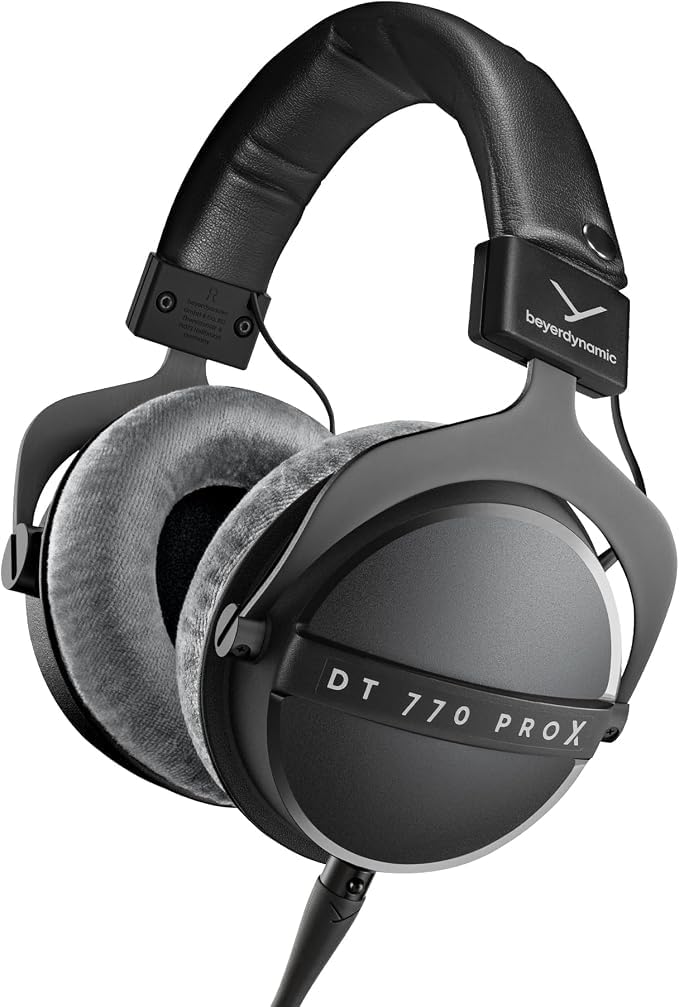
9. beyerdynamic DT 770 Pro X Closed-Back Studio Headphones
Serious isolation and replaceable parts, crafted for years of daily studio use.
The DT 770 Pro X is defined by its 48-ohm drive, which plugs straight into any source — laptop, interface, phone, or console — with no headphone amp needed. That’s a huge convenience advantage over higher-impedance studio headphones that demand extra gear. The STELLAR.45 driver is beyerdynamic’s flagship transducer, delivering precise, high-resolution sound across a 5Hz to 35,000Hz frequency range — well beyond the human hearing limit for that extra air and detail.
For recording, the closed-back isolation keeps headphone bleed out of your mic while you track, which is the whole point of closed-back headphones. The detachable mini-XLR cable swaps out in seconds, and the replaceable velour ear pads extend the lifespan for years of daily use. Owners consistently praise the sound quality, build quality, and suitability for gaming, calling them “the counter to obsolescence” with superb passive isolation.
The honest notes: the treble is pronounced, and while most find it detailed rather than harsh, sensitive listeners may want EQ. The out-of-box sound also benefits from a bit of EQ to bring up the mid-bass, as some owners note it sounds hollow until adjusted. They’re built for studio and desktop use rather than casual listening, so know your intended use before buying.
The Strengths
- 48-ohm drive needs no amp
- Detachable cable and replaceable pads
- Superb closed-back isolation
Consider
- Treble is pronounced — EQ may be needed
- Out-of-box sound benefits from adjustment
Get these for: tracking vocals without bleed and mixing with honest, detailed sound.
Reconsider if: you prefer a warmer, less analytical sound signature.
10. Shure MV7+ USB-C & XLR Podcast Dynamic Mic

The modern broadcaster’s mic — USB simplicity with XLR room to grow.
If you stream or record without wanting to learn an interface, the MV7+ gives you pro sound straight from the start. It’s OBS-certified (meaning it works directly with the free streaming software OBS), and its built-in DSP (digital signal processing) plus Voice Isolation Technology filters out ambient noise, fan hum, and room echo automatically. Owners call the sound quality “professional” and say it makes other mics sound inferior — the quality and sound are the most-praised aspects.
The party piece is the LED touch panel with mute control, letting you customize across 16.8 million hues and tap anywhere to mute instantly mid-stream. Auto Level Mode adjusts gain based on your distance and voice volume, while the virtual pop filter eliminates harsh plosives — meaning you get smooth audio without needing to learn gain staging. The USB-C and XLR connectivity means you can start plug-and-play and later upgrade to a pro interface without replacing the mic.
The MOTIV Mix app adds fine-tuned control, studio-quality reverb, and mic customization. It connects to both computer and phone, which owners appreciate. The trade-offs: it’s heavier and larger than USB-only competitors, and the audible noise sits at a low 20db — excellent for quiet recordings. The 50Hz low-end response keeps bass natural and uncolored.
What’s To Love
- USB-C and XLR dual connectivity
- Auto Level Mode and digital pop filter
- 16.8 million color LED touch panel
The Reality
- Heavier and larger than some rivals
- Pricier than USB-only mics
Reach for this if: you stream or podcast and want broadcast-grade sound with zero setup fuss.
Pass if: you already own a pro interface and want a mic with XLR only.
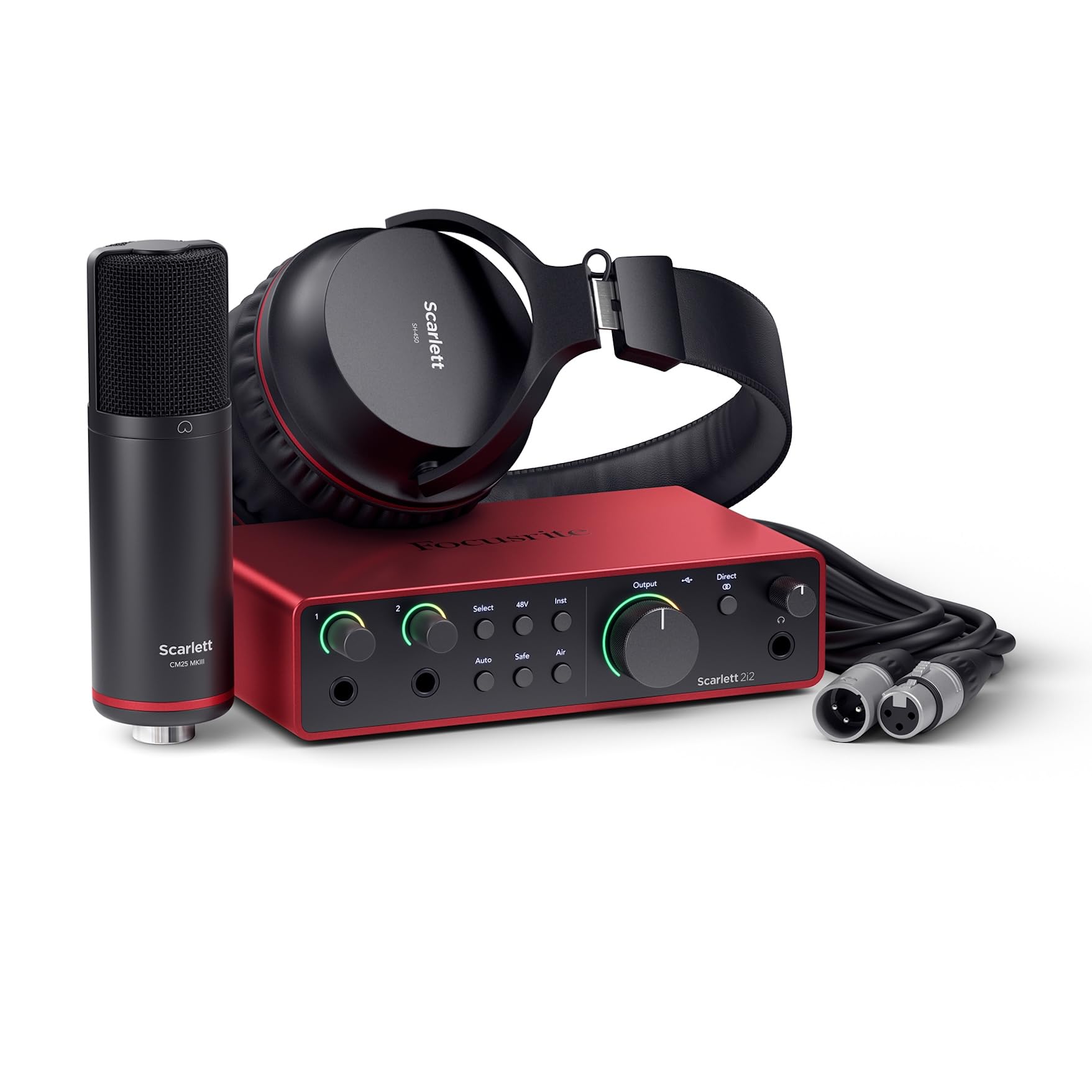
11. Focusrite Scarlett 2i2 Studio 4th Gen USB-C Audio Interface Bundle
The complete artist’s studio in a box — interface, mic, headphones, and pro software.
Musicians get everything in one box with the Scarlett 2i2 Studio 4th Gen: the Scarlett 2i2 interface, the CM25 MkIII condenser mic, and SH-450 headphones. The headline spec is the 120dB dynamic range (the span between your quietest and loudest recordable sound), which uses the same converters as Focusrite’s flagship interfaces found in the world’s biggest studios — giving you enormous headroom to avoid distortion. Owners call it “the best purchase ever,” with one even recording a whole album on it.
Two features make it genuinely beginner-proof: Auto Gain sets the perfect level for your mic or guitar automatically, and Clip Safe prevents clipping so you never lose a great take. The Air mode lifts vocals and guitars to the front of the mix, adding musical presence with rich harmonic drive. Everything you need to record, mix, and master is in the box — including Pro Tools Intro+, Ableton Live Lite, Cubase LE, and the Hitmaker Expansion suite of plugins.
The package records at 24-bit/192kHz and includes 2 mic preamps plus 2 Hi-Z inputs for guitars. Compatibility gets mixed feedback — most find it works flawlessly while some report issues, so check your system. The included software also splits opinion, with some loving it and others finding it overwhelming. At 3.5 pounds with the full bundle, it’s a substantial kit but worth every bit of desk space.
The Package
- 120dB dynamic range with flagship converters
- Auto Gain and Clip Safe prevent bad takes
- Full software suite included
The Fine Print
- Compatibility issues reported by some
- Software can feel overwhelming
Choose this if: you want one purchase that takes you from nothing to a complete, professional recording studio.
Skip if: you already own a mic, headphones, and software and just need a bare interface.
Understanding the Specs
Sample Rate and Bit Depth
These two numbers define how much detail your interface captures. The sample rate, measured in kilohertz (kHz), is how many snapshots of sound the converter takes each second — 192kHz captures far more than the 20kHz a basic mic’s frequency response suggests you need. The bit depth, like 24-bit, determines the headroom between your signal and distortion. Higher numbers in both mean cleaner, more editable recordings, so a 24-bit/192kHz interface is the gold standard for home studios.
Frequency Response
Frequency response is the range of pitches a microphone or speaker can reproduce, measured in hertz (Hz). Human hearing spans roughly 20Hz to 20,000Hz, so a mic with a 50Hz to 20kHz response covers the full vocal range cleanly. When you see a headphone rated to 35,000Hz, that extra range beyond human hearing isn’t wasted — it allows the driver to reproduce the upper harmonics that give music its air and realism, rather than rolling them off artificially.
FAQ
What is the difference between a dynamic and condenser microphone?
How much gain does the Shure SM7B need?
Can I use the Universal Audio Volt 1 with my phone?
Do the Yamaha HS4 monitors need a subwoofer?
What is 32-bit float recording on the Zoom H4 Essential?
Should I buy the Focusrite Scarlett 2i2 Studio bundle or build my own kit?
Can I connect the Pyle PMXU46BT mixer to my computer?
Do the beyerdynamic DT 770 Pro X headphones need a headphone amp?
Final Thoughts: The Verdict
For most people, the audio recording equipment winner is the Shure SM7B because it delivers the definitive broadcast vocal sound that professionals and podcasters alike trust, and its warm, balanced capture is the foundation of countless top-rated shows. If you want a complete studio in one box, grab the Focusrite Scarlett 2i2 Studio. And for a portable option that records on the go, the Zoom H4 Essential is the one to reach for.
How We Picked
We do not accept paid placement. Every pick is matched to a real buyer and a real use-case; we do not hands-on test units.
Sources & Methodology
Specifications: manufacturer listings and product documentation. Review insights: verified customer reviews, as of August 2026. Pricing: not shown on this page (it changes often); check the current price via the retailer link.
As an Amazon Associate, Gadgets Feed earns from qualifying purchases. This does not affect which products we feature.