
Our readers keep the lights on and my morning glass full of iced black tea. As an Amazon Associate, I earn from qualifying purchases.
Specs are compiled from manufacturer listings and verified buyer reviews and can change over time — please confirm the key details on the product page before buying.
Before you buy a stereo speaker pair, answer one question: do you want powered speakers that plug straight into your TV, turntable, or computer, or passive speakers that need a separate amplifier or receiver to drive them? This guide sorts through the most popular bookshelf and floor-standing options, explains the specs that actually change what you hear, and helps you pick the pair that fits your room, your gear, and your listening habits.
I’m Min — the founder and writer behind Gadgets Feed. This guide is built by comparing the manufacturers’ published specifications and the patterns across verified customer reviews, so you get each pick’s real strengths and trade-offs instead of marketing spin.
You’ll find clear ratings for powered versus passive designs, a head-to-head look at tower versus bookshelf performance, and a final verdict on the best audio stereo speakers for every kind of listener.
Our Picks at a Glance


How To Choose The Best Audio Stereo Speakers
The first fork in the road is powered versus passive. Powered speakers have their own built-in amplifier, so you just plug in a source like a TV, computer, or turntable and you are done. Passive speakers need you to supply that power with a separate receiver or amplifier, which gives you more control over the sound but adds a box to the system.
Match the speaker to your room size
Floor-standing towers are tall cabinets that stand on the floor, and their larger internal volume lets them produce deeper bass on their own. Bookshelf speakers sit on a desk, shelf, or stand, so they take up far less floor space but almost always benefit from a subwoofer for deep lows. A small room or desk setup is often better served by compact bookshelf models, while a dedicated living room or home theater leans toward towers.
Check the sensitivity and impedance
Sensitivity, measured in decibels (dB), tells you how efficiently a speaker turns power into volume. A higher number like 94dB means it gets loud with less amplifier power. Impedance, measured in ohms (Ω), is the electrical load the speaker places on your amplifier, and most home AV receivers are built to drive 8-ohm speakers comfortably, so matching that keeps things simple and safe.
Quick Comparison
| Model | Best For | Type | Power Handling | Woofer Size | Impedance | Amazon |
|---|---|---|---|---|---|---|
| Klipsch R-610F★ Best Overall | Big rooms & high volume | Floorstanding (Passive) | 85W cont / 340W peak | 6.5 inch | 8 ohm | Amazon |
| Polk XT70Home Theater Core | Home theater immersion | Floorstanding (Single) | — | Two 6.5 inch | — | Amazon |
| Edifier S2000MKIIIAudiophile Value | Audiophile streaming | Powered Bookshelf | 130W | 5.5 inch | — | Amazon |
| Klipsch RP-8000F II | Reference-grade clarity | Floorstanding (Passive) | — | 8 inch (dual) | — | Amazon |
| Fluance Ai81 | Simple powered towers | Powered Floorstanding | 150W built-in | 6.5 inch (dual) | — | Amazon |
| Dayton T65 | Budget tower power | Floorstanding (Passive) | 150W | 6.5 inch (dual) | — | Amazon |
| Sony SS-CS5M2 | Compact Hi-Res detail | Bookshelf (Passive) | — | 5.12 inch | 6 ohm | Amazon |
| JBL Stage 2 240B | Compact liveliness | Bookshelf (Passive) | — | 4.5 inch | — | Amazon |
| Edifier R1280T | Easy desktop value | Powered Bookshelf | 42W RMS | 4 inch | — | Amazon |
| PreSonus Eris Accent | Studio-tuned convenience | Powered Bookshelf | 50W | 4 inch | — | Amazon |
| Pyle 6.5″ | Budget home theater | Bookshelf (Passive) | 240W max | 6.5 inch | 6 ohm | Amazon |
In-Depth Reviews
1. Klipsch Reference R-610F Floorstanding Speaker, Black, Pair
Our pick — over 4.5★ from 600+ verified ratings; the strongest balance of quality and price.
Efficient 94dB towers that fill large rooms with clear, powerful sound.
What wins people over here is clarity — and there is a spec to back it up. The 94dB sensitivity means these towers convert amplifier power into volume very efficiently, so a modest receiver drives them to room-filling levels without strain. That efficiency pairs with 85W continuous and 340W peak power handling, so the speakers stay composed whether you are listening quietly or pushing them hard for a party.
The 1″ Aluminum LTS tweeter with a 90 x 90 Square Tractrix Horn delivers crisp highs, which owners say makes dialogue in movies and vocals in music noticeably clearer. The 45Hz – 21kHz frequency response gives you solid bass extension down to 45Hz, and buyers report the towers sound awesome with or without a subwoofer. At 8-ohm impedance, they are compatible with most AV receivers, which keeps setup simple for anyone wiring a traditional system.
Owners frequently use these as rear surrounds in a home theater, and owners mention they work beautifully with Denon and Marantz receivers. The build is solid at 36lbs each, though a few note the included leg screws feel cheap and suggest replacing them. The distinctively bright Klipsch treble can be adjusted via EQ, so pairing them with a receiver that has tone controls is a smart move.
horn-loaded dynamics
- 94dB sensitivity makes them easy to drive loud
- 85W continuous / 340W peak power handling
- 45Hz bass extension for a tower
- Versatile for stereo or home theater use
bright treble risk
- Bright treble needs EQ tuning for some tastes
- Included leg screws feel cheap
- Each tower weighs 36lbs, needing sturdy placement
for big rooms: you want big, efficient towers that fill a room and pair easily with a standard AV receiver.
if treble shy: your space is tiny, or you want a flat, neutral studio sound rather than Klipsch’s lively signature.
2. Polk Audio Monitor XT70 Large Home Tower Speaker (Single, Midnight Black)
Single tower with dual passive radiators for rich home theater sound.
This is a single tower, so you buy two for a stereo pair — and the payoff is a genuinely rich soundstage for movies, TV, and music. The 1″ tweeter and two 6.5″ Dynamically Balanced Woofers deliver open mid-range, while the two 8″ Passive Radiators add punchy, responsive bass without a powered subwoofer. Owners note an 80-watt amp drives them beautifully, delivering crisp highs and warm mids.
Polk designed the XT series for easy placement, and the rubber feet work on both carpet and hardwood floors for stability. The cabinet is clean and modern, blending with most décor. That said, a few owners found the vinyl finish and flimsy grill frames less premium than expected, and most agree a subwoofer still helps for deep, room-shaking lows.
For home theater builds, Polk’s timbre-matched family lets you add a bookshelf pair, center channel, height module, and sub to create a unified surround system. Customers note impressive midrange and high-frequency response, calling it an easy 5-star purchase when space allows.
wide soundstage: Anyone building a home theater who wants big, rich sound from a tower that handles movies and music with equal confidence.
needs power: The vinyl finish and grill quality feel mid-range, and you will likely want a subwoofer for the deepest bass.
for home theater: you have the floor space and want a tower that excels in a surround system.
if amp weak: you demand premium cabinet materials, or you are buying a single unit expecting full stereo.
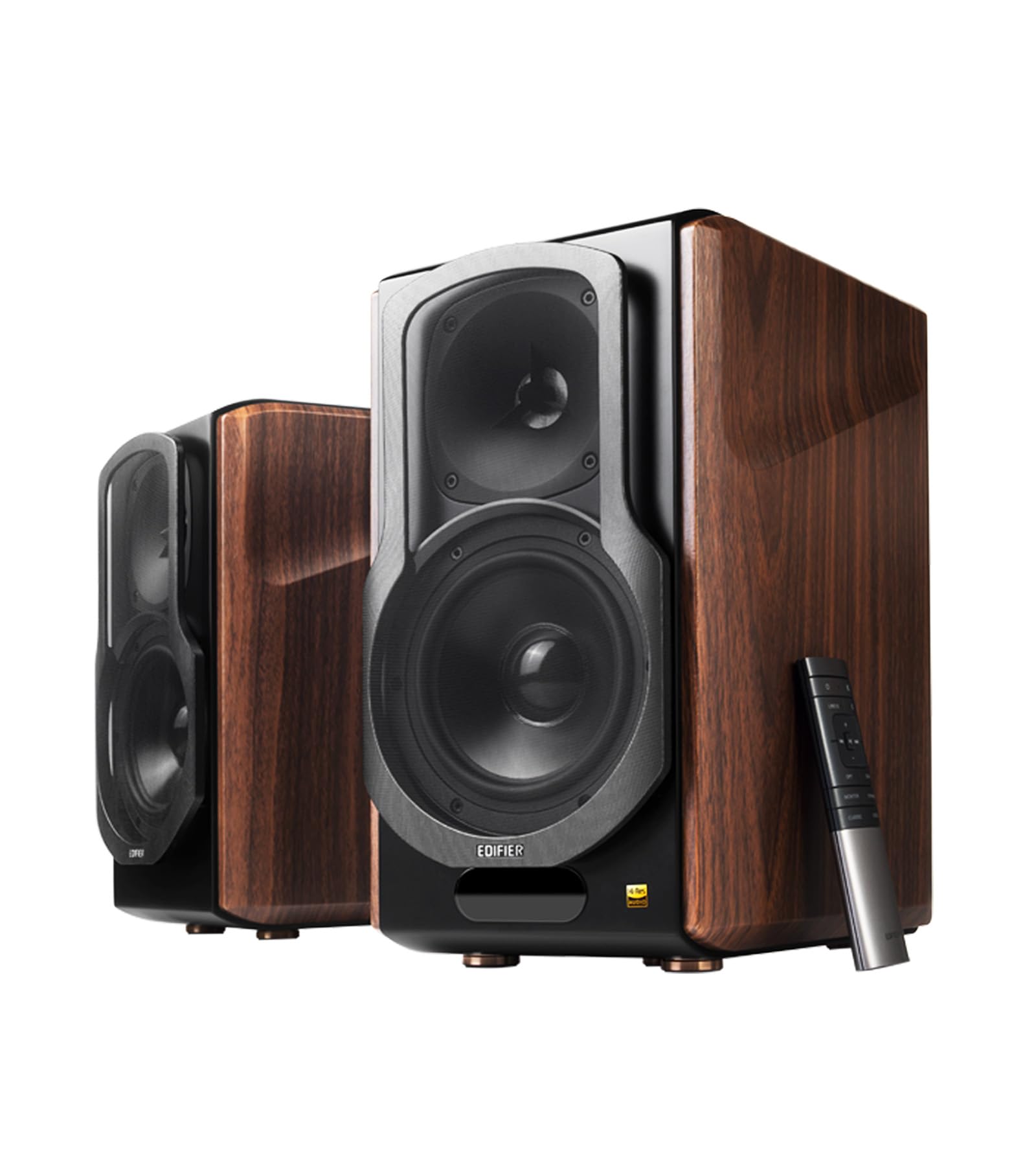
3. Edifier S2000MKIII Tri-Amped Bookshelf Speakers, 130W Studio Monitor
Tri-amped 130W bookshelf speakers with deep bass and a wide soundstage.
The thing everyone raves about is the bass. The 130W tri-amped design drives 5.5-inch woofers with planar diaphragm tweeters, and owners describe chest-thumping lows that hold up for hip-hop without any subwoofer. One buyer compared the sound to a system, noting the depth and clarity are exceptional at this level. The 40lb solid wood and metal build adds to the premium feel.
Bluetooth 5.0 with aptX HD decoding keeps latency low and stability high for wireless streaming, while line-in, optical, and coaxial inputs let you connect multiple sources without swapping cables constantly. The wireless remote controls playback and inputs on the fly. Owners find the balance requires some placement care — about 6 inches from the wall and 5 feet apart — and the sound opens up best above volume 40.
The recurring gripe is the remote, which a few owners call lackluster. There is also no subwoofer input, and the Bluetooth pairs with a single device at a time. For a powered bookshelf that delivers deep, clean bass and a wide soundstage, this remains a top pick that owners say still impresses after a year of daily use.
tri-amp clarity: Deep, warm, and detailed — the kind of sound that makes you re-listen to your favorite albums.
bulky footprint: The remote is basic, and placement genuinely matters for the best imaging.
for nearfield: you want a powered, audiophile-grade pair that handles music and movies with authority and no separate amp.
if space tight: you need a subwoofer connection or a more polished remote experience.
4. Klipsch Reference Premiere RP-8000F II 2.0 Dual Floorstanding Speaker Pair in Walnut
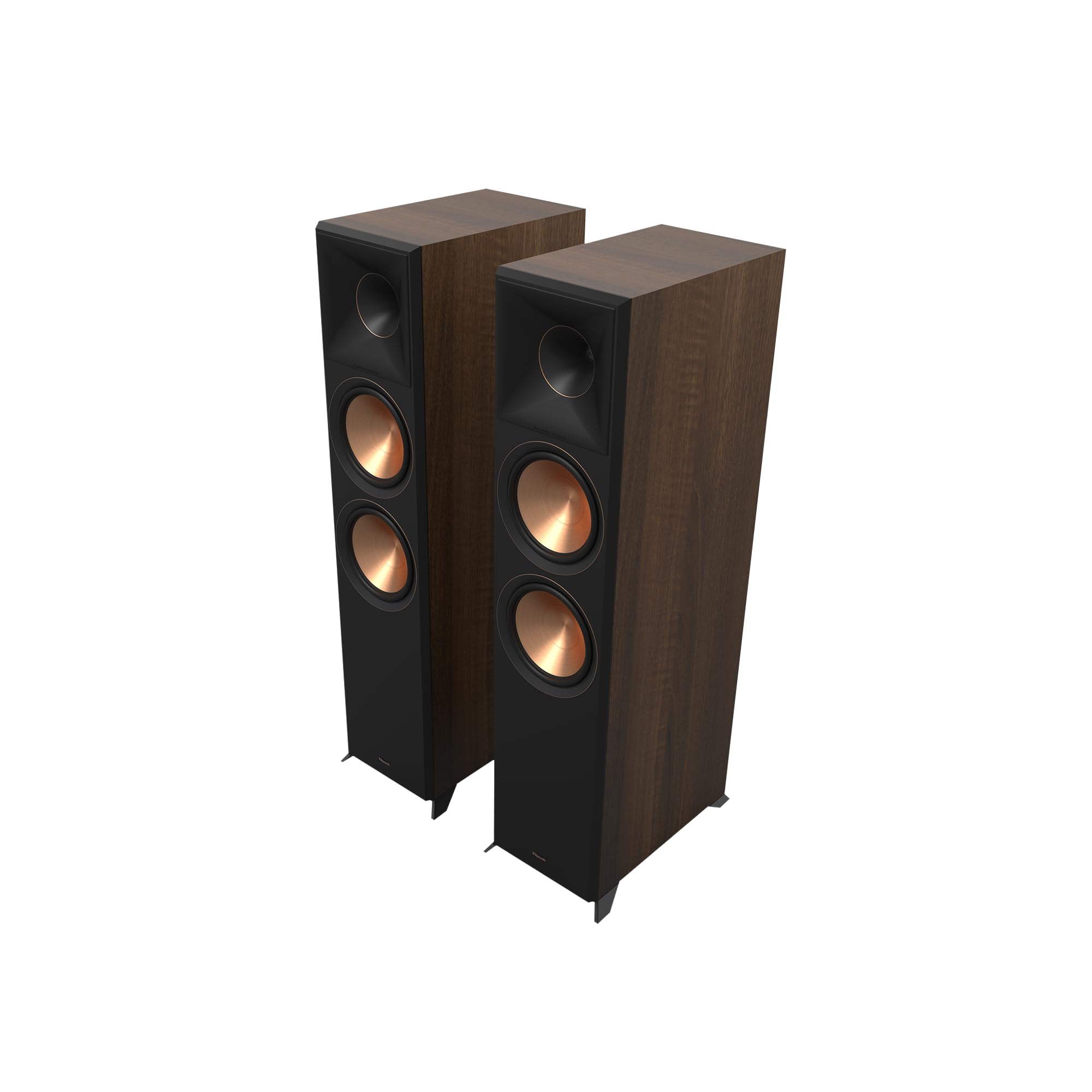
Flagship towers with 8-inch woofers that stay clean at high volumes.
This is the flagship Reference Premiere pair, and the 8-inch Cerametallic woofers deliver deep, heavy bass while the 1-inch LTS titanium diaphragm tweeter keeps highs detailed and distortion-free. Reviewers point out the speakers remain clean regardless of how much power you send them, paired beautifully with a Marantz 4300 playing vinyl. The larger 90° x 90° silicone composite hybrid Tractrix horn projects sound evenly across the room.
The dual input terminals allow bi-wiring or bi-amping, separating high and low-frequency currents for clearer midrange — a feature serious home theater builders appreciate. The walnut finish with copper accents looks genuinely premium, and owners call them solid and good-looking. A break-in period of 10-12 hours is recommended, after which the sound opens up significantly.
These are powerful towers, and a few owners note they can be too loud for small spaces. The feet look fragile despite the heavy build, and one owner replacing Polks found the mids and highs clear but lacked the oomph to fill a midsize room without pushing hard. For classical music and movie dialogue, the clarity is near perfect.
premium build
- 8-inch Cerametallic woofers for deep bass
- 1-inch LTS titanium tweeter minimizes distortion
- Bi-wiring / bi-amping capable terminals
- Premium walnut finish with copper accents
pricey upgrade
- Needs 10-12 hours of break-in
- Feet look fragile for the weight
- Very powerful — overkill for small rooms
for audiophiles: you want reference-grade clarity and deep bass from a pair that looks as good as it sounds.
on budget: your room is compact, or you prefer a warmer, less revealing sound signature.
5. Fluance Ai81 Elite Powered 2-Way Floorstanding Tower Speakers, 150W (Natural Walnut)

Powered 150W towers with built-in amp for receiver-free setup.
The integrated 150W amplifier means you never need a separate receiver — just connect your TV, turntable, or phone via RCA, Optical, or Bluetooth 5.0, and you are listening. The dual 6.5-inch woven glass fiber drivers deliver accurate midrange and deep bass, while the premium neodymium tweeters create a spacious soundstage with excellent off-axis dispersion. Owners describe crisp sound that fills a 24-foot room with crisp stereo separation.
The expertly tuned, internally braced MDF cabinets feature down-firing bass ports for deep, omni-directional bass, and the natural walnut finish looks genuinely upscale. The included remote controls bass and treble, and the subwoofer out lets you add a sub down the line. Buyers pairing these with a Fluance sub and turntable report an excellent vinyl listening experience, especially for Hip Hop, R&B, and Jazz.
A few owners note the midrange can feel slightly recessed until the speakers break in, and one called the value mixed. The powerful bass and simple setup win most people over, though the 150W rating is the real output — not the 350W some marketing implies. For a space-limited setup that wants tower presence without a receiver box, this is a compelling choice.
powered convenience: Vinyl lovers and minimalist setups who want room-filling towers without buying a separate amplifier.
bass boom: Midrange improves after break-in, and the bass is power-forward until you dial it in.
for simple setup: you want powered convenience with tower-sized sound and a clean walnut look.
if bass control: you prefer the flexibility of pairing your own amplifier with passive speakers.
6. Dayton Audio Classic T65 Floor-Standing Tower Speaker Pair (Black)

Budget 150W towers with dual woofers for punchy bass and ear-level tweeters.
The standout spec here is the 150W power handling, which means these towers can take a lot of amplifier power for easy listening or serious party volume. The dual 6-1/2-inch custom poly bass drivers pair with a large bass reflex cabinet to generate punchy, room-filling bass, while the 1-inch silk dome tweeter reproduces treble in detail without harshness. Shoppers say the sound quality improves over time, with a 30-plus hour break-in period smoothing out an initially strong bass response.
Standing over 39 inches tall, these put the tweeter at ear level for most seated listeners, and the true hi-fi crossovers accurately distribute the signal between the woofers and tweeter. The upgraded gold-plated binding posts accept banana plugs for clean connections, and buyers report the banana plugs make hooking them to an amp much easier. Vintage stereo owners mention great pairing with older Marantz receivers.
The value proposition is strong, but durability gets mixed feedback — one owner noted a small ding from assembly, and another coming from high-end JBLs found them just average. For anyone wanting the presence of floor-standing towers at a budget-friendly price, this pair delivers surprising value that owners genuinely love.
budget value
- 150W power handling for serious volume
- Dual 6-1/2-inch woofers for punchy bass
- 39-inch towers place tweeter at ear level
- Gold-plated binding posts for banana plugs
heavy cabinets
- Bass is strong initially, needs break-in
- Occasional assembly dings reported
- Not as refined as higher-end JBL or Polk
for tight budgets: you want tower-sized bass and volume on a budget and own a decent amplifier.
if moving often: you are upgrading from high-end speakers and expect that level of refinement.
7. Sony SS-CS5M2 3-Way 3-Driver Hi-Res Compact Bookshelf Speakers (Pair)

Compact three-way design that surprises with punchy bass and expansive sound
The 3-way, 3-driver design sets these apart from typical two-way bookshelves, with a 5.12-inch woofer for low-end punch, a high-precision tweeter, and a wide-dispersion super tweeter that creates an expansive sound stage. The Hi-Res Audio certification with a 53-50,000Hz frequency response means they reproduce detail beyond standard CD quality. Owners consistently note the punchy bass is surprising for the compact size, with clear mids and highs that avoid distortion.
The bass reflex enclosure keeps low frequencies clean, and the reinforced cellular cone prevents distortion at higher volumes. At 6-ohm impedance, they pair well with quality amplifiers, and customers note they sound like larger speakers with little power needed to move them. Jazz listeners specifically praise the superb detail that reveals new nuances in familiar recordings.
The compact size fits easily on a desk or shelf, though the rear port needs wall clearance to avoid muffled bass. A few owners suggest upgrading the flat feet to isolation feet for better bass response. They are a great value on sale, though most agree they are not worth full retail — wait for a discount and pair them with a quality amp for the best results.
hi-res capable: Desk setups and small rooms where you want Hi-Res detail and surprising bass from a compact footprint.
small bass: Rear port needs wall space, and deep sub-bass still calls for a subwoofer.
for desktop: you want reference-grade treble detail in a small, efficient bookshelf pair.
if deep bass: you need deep bass without a subwoofer or prefer a warmer sound signature.
8. JBL Stage 2 240B 4.5 Inch Bookshelf Speakers – Pair (Espresso)
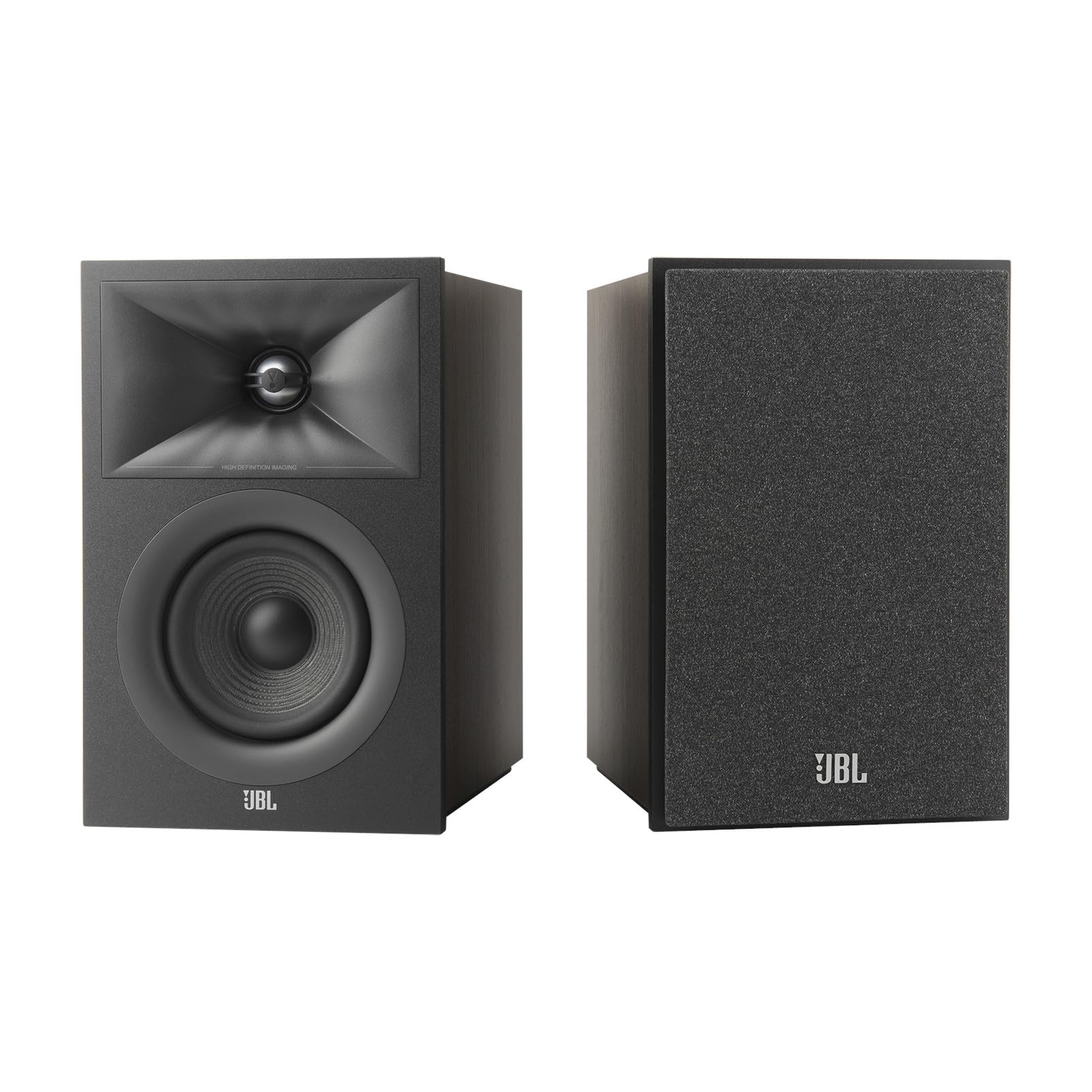
Small but potent — the compact pair with clear highs and great mids
The 4.5-inch (114mm) Polycellulose ribbed cone woofer and 1-inch (25mm) anodized aluminum tweeter combine for a lively, detailed sound that owners call “small but potent.” The precision 2-way crossover and next-generation HDI horn keep the treble smooth and clear, making these a solid upgrade for a TV room or desktop. One owner switched from Polk XT20s and found these outstanding, pairing them with Klipsch surrounds and a sub.
At 10.7″D x 8.5″W x 6.9″H, these are compact enough for wall mounting — one buyer mounted them and noted they look great in the living room, comparable to their Definitive Technologies speakers in a dedicated theater room. The 5-way binding posts offer flexible connection options, and the espresso finish looks sharp in modern spaces.
The honest trade-off is bass. Several owners note the small woofer produces limited low-end, with one saying “not much bass from these” and advising to go bigger for deeper sound. A listener with high-end JBL HDI-1600s found these dull in comparison, though that is a steep comparison. For clear highs and mids in a small package, these deliver, but plan on a subwoofer if you want low-end punch.
compact punch
- Clear highs and great mids from aluminum tweeter
- Compact size suits desks and wall mounting
- 5-way binding posts for flexible connections
limited lows
- Limited bass from the 4.5-inch woofer
- Needs a subwoofer for full-range sound
- Not a match for high-end JBL reference speakers
for small rooms: you want bright, clear sound in a compact pair for a TV room or desk and already have a subwoofer.
if floorstanders: you expect deep bass from the speakers themselves without any sub.
9. Edifier R1280T Powered Bookshelf Speakers – 2.0 Active Near Field Studio Monitor Speaker – Black – 42 Watts RMS

Affordable 42W powered bookshelf speakers with dual AUX inputs and rich sound.
The 2 x AUX input is the killer feature here — you can connect two devices at once and switch between them without plugging and unplugging. The 13mm silk dome tweeter and 4-inch full-range unit deliver natural sound reproduction that owners describe as “incredibly rich,” with lush, heavy bass and full highs. One buyer called the upgrade from cheap PC speakers “life-changing,” revealing new details in music and making gaming more rich.
The 42W RMS output is plenty for a desk or small room, and the classic wood-effect vinyl finish over MDF looks great in any décor. The side panel controls and included remote let you adjust bass, treble, and volume from your chair. Setup takes minutes, and the remote’s mute button works without any buzzing when muted — a detail owners appreciate.
For a budget pair, the bass is surprisingly full, though a few note it is not subwoofer-level and suggest pairing with a sub for the best sound. The sound is warm and enjoyable rather than flat and studio-accurate, which suits most people listening to streaming, movies, and casual music. If you want an easy, great-sounding desktop upgrade, this is the classic choice.
classic budget: Desktop computers and small rooms where you want rich, easy listening without an amp or receiver.
dated design: Bass is full for the size but not deep enough for bass-heads without a sub.
for casual listening: you want a proven, affordable powered pair with dual inputs and a remote.
if modern looks: you need flat, accurate studio monitoring or deep sub-bass.
10. PreSonus Eris Accent — 50W Powered Bookshelf Speakers (Pair)
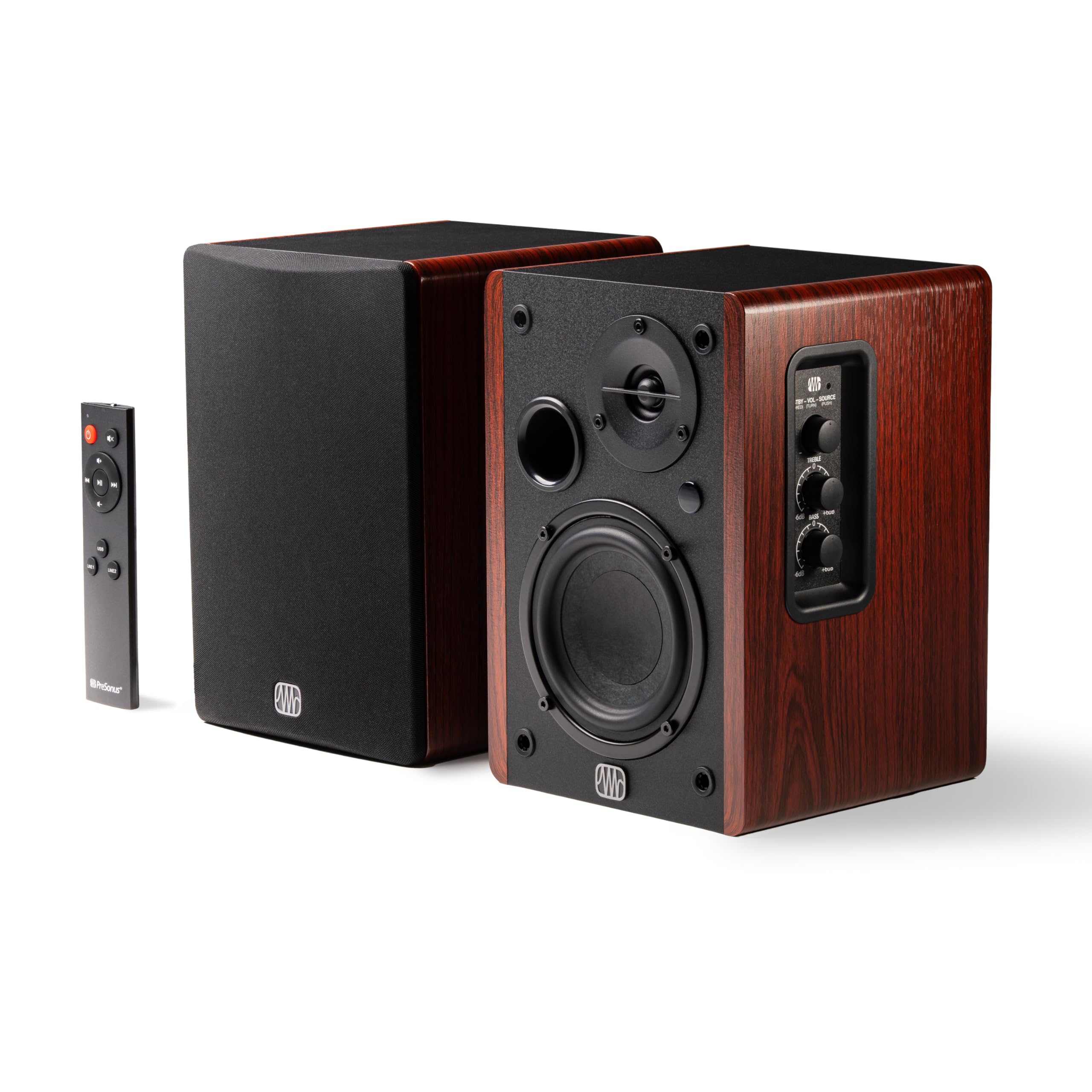
Studio-tuned powered speakers that get loud cleanly and shape to your room
The 50W powered design connects straight to record players, computers, TVs, and receivers via RCA or 1/8-inch AUX — no software, no fuss. The 4-inch woofer and silk-dome tweeter deliver natural highs, clear mids, and warm lows, and owners say the sound gets loud before it ever breaks up. Front-panel volume, bass, and treble controls let you shape the sound to your space, and the included remote makes adjustments easy from a distance.
The expandable RCA sub-out supports adding a subwoofer down the line, and the USB port provides a clean digital connection to a PC or laptop. The stained wood-grain finish and compact footprint — 7″D x 6.3″W x 9.2″H — suit any desk, shelf, or living room. Owners describe a simple 5-minute setup with a record player via AUX/RCA, perfect for amateur vinyl listeners.
The removable grills look good but muffle the sound when left on, so owners recommend removing them for critical listening. There is no Bluetooth, so wireless streaming requires the separate Eris Accent BT version. The speakers are slightly bass-heavy by default, but the EQ knobs balance it out. For a studio-tuned powered pair with a remote and sub-out at a budget price, this is a strong contender.
studio accuracy
- 50W gets loud without breaking up
- Remote, sub-out, 3 inputs, USB
- Front-panel bass and treble controls
- Compact wood-grain footprint
lean bass
- No Bluetooth — needs the BT version
- Grills muffle sound when left on
- Slightly bass-heavy until EQ is adjusted
for mixing: you want studio-tuned powered speakers with a remote, sub-out, and multiple inputs for a desk or vinyl setup.
for party: you need wireless Bluetooth streaming or a completely flat reference response.
11. Pyle 6.5″ Wired Bookshelf Speakers Pair – 2-Way HiFi Home Theater Stereo Speakers
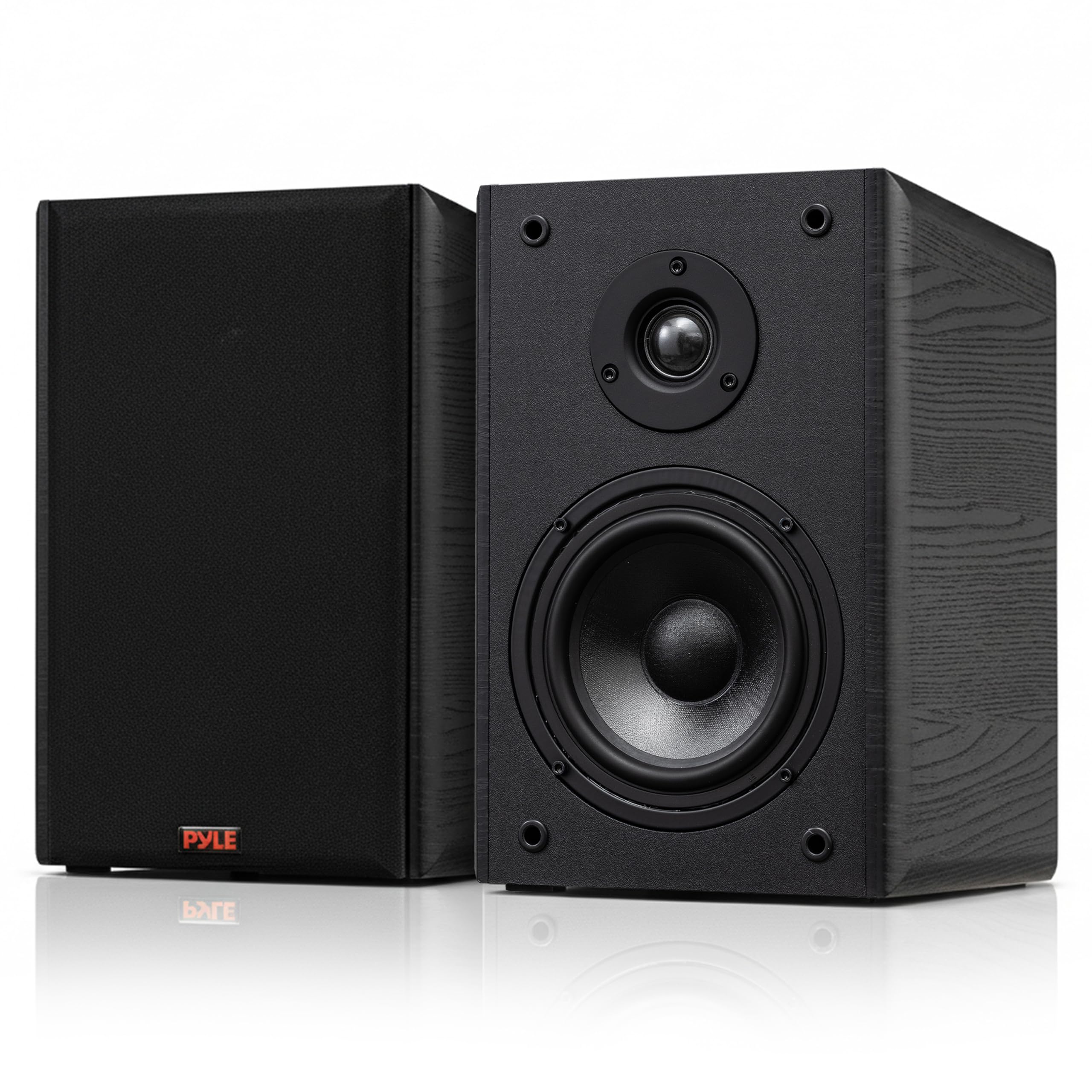
Budget 240W bookshelf speakers that deliver surprising loudness and clarity.
The 25mm soft dome tweeter and 6.5-inch dynamic woofer deliver clear highs and deep lows, with a 240W max power capacity that is remarkable for the price. Owners who compared these to much more expensive options report they nearly matched Klipsch speakers in loudness and clarity, though they lacked the bass and fullness of the pricier towers. That is high praise for a budget-friendly pair.
At 11.5″D x 8.5″W x 9.5″H and 18.5lbs, these are compact enough for small to medium rooms, and the gold-plated 5-way binding post terminals accept banana plugs, bare wire, and spade terminals. The detachable magnetic grill adds a clean look, and the included wall mount brackets let you place them on a shelf or mount them on a wall. The 12mm MDF cabinet with a wood grain finish looks more expensive than it is.
Buyers replacing decades-old speakers report impressive bass that rivals vintage 80s models, with clear performance across bass, treble, and mids. A slight subwoofer boost around 100Hz helps, but they perform well without one. The build quality gets mixed feedback, though several describe them as solid. For a home theater or small room on a tight budget, this pair delivers exceptional value that owners consistently rate five stars for the cost.
ultra cheap: Budget home theater and small rooms where you want surprising loudness and clarity for very little money.
flimsy build: Bass lacks the fullness of larger towers — add a subwoofer if you want deep lows.
for basic use: your budget is tight and you want the most sound per dollar with versatile mounting options.
if quality matters: you expect deep, full-range bass without a subwoofer or premium cabinet build.
Understanding the Specs
Sensitivity (dB)
Sensitivity measures how efficiently a speaker converts power into volume, expressed in decibels (dB). A speaker rated at 94dB, like the Klipsch R-610F, gets loud with less amplifier power than a lower-rated model. This matters if you have a modest receiver — higher sensitivity means you reach satisfying volume without pushing your amp to its limits.
Impedance (Ohms)
Impedance is the electrical load a speaker places on your amplifier, measured in ohms (Ω). Most home AV receivers are designed to drive 8-ohm speakers comfortably, which is why the Klipsch R-610F’s 8-ohm rating makes it easy to match with standard gear. A 6-ohm speaker like the Pyle or Sony is also common and works fine with most receivers, but it draws a bit more current.
FAQ
Do I need a receiver for powered speakers?
What is the difference between bookshelf and floor-standing speakers?
What does impedance mean and does 6 ohm vs 8 ohm matter?
What is sensitivity and why does 94dB matter?
Why does speaker size affect bass response?
Can I use a single Polk XT70 tower for stereo?
What is a subwoout and do I need one?
What is the difference between Bluetooth and wired connections?
Why does the frequency response matter?
Do these speakers need a break-in period?
Final Thoughts: The Verdict
Across the board, the audio stereo speakers winner is the Klipsch Reference R-610F because its 94dB sensitivity and 85W continuous power handling deliver room-filling clarity with a standard AV receiver, backed by the strongest owner consensus in this lineup. If you want powered convenience without a receiver, grab the Fluance Ai81 towers. And for a compact desk setup with rich sound and dual inputs, the Edifier R1280T is the one to reach for.
How We Picked
We do not accept paid placement. Every pick is matched to a real buyer and a real use-case; we do not hands-on test units.
Sources & Methodology
Specifications: manufacturer listings and product documentation. Review insights: verified customer reviews, as of August 2026. Pricing: not shown on this page (it changes often); check the current price via the retailer link.
As an Amazon Associate, Gadgets Feed earns from qualifying purchases. This does not affect which products we feature.