
The difference between a good audio streamer and a great one is invisible to the eye but unmistakable to the ear. It’s not about the box or the brand—it’s about how cleanly the digital signal reaches your amplifier without introducing noise, jitter, or distortion. Every millivolt of noise from a dirty power supply, every bit of jitter from a mediocre clock, every ground loop from mismatched connections chips away at the soundstage, compressing the air around instruments and flattening the depth of the recording.
I’m Min — the co-founder and writer behind Gadgets Feed. After spending months analyzing DAC chipsets, output stages, power supply topologies, and streaming platform compatibility across the entire range of dedicated network audio players, I’ve mapped out the landscape that separates a truly transparent streamer from one that merely plays music.
Whether you’re upgrading from a Bluetooth dongle or building your first dedicated two-channel system, this guide focuses on what actually matters in a audio streamer: signal purity, platform support, and real-world connectivity that integrates with your existing gear without compromise.
How To Choose The Best Audio Streamer
Not all streamers are built for the same purpose. Some prioritize multi-room convenience, others focus on pristine digital-to-analog conversion, and a few try to do everything at once. Before you commit, the three variables you need to get right are the DAC implementation, the connectivity map, and the streaming ecosystem you already depend on.
DAC Quality vs. External DAC Use
The DAC is the component that converts digital audio into an analog signal your amplifier can amplify. A premium chip like the ESS ES9038Q2M or AKM AK4493SEQ is a strong starting point, but the real differentiator is the analog output stage—the op-amps, capacitors, and voltage regulators that shape the sound after conversion. If you already own a high-end external DAC, you may prefer a streamer that functions purely as a digital transport (outputting via coax, optical, or USB) and bypasses its internal DAC entirely. Look for models with a dedicated “DAC bypass” or “fixed line out” mode.
Inputs and Outputs That Match Your System
Count the ports on your amplifier or receiver. If your system uses balanced XLR connections, you need a streamer with XLR outputs. If you want to connect your TV for improved stereo sound, HDMI ARC support is critical. For headphone listening, a dedicated 4.4mm balanced headphone output with adjustable gain is necessary to drive high-impedance planars or sensitive IEMs. Don’t forget subwoofer output—some streamers, like the WiiM Ultra, include a dedicated sub out with adjustable crossover, which eliminates the need for a separate bass management device.
Streaming Platform and App Ecosystem
The streamer’s value is tied directly to the software that controls it. The WiiM Home app, Bluesound BluOS, and Cambridge Audio StreamMagic all offer stable multi-room grouping and EQ control, but they vary in third-party integration. If you use Apple Music for lossless streaming, verify that the device supports AirPlay 2 (the Bluesound Node Nano and Sonos Port do; WiiM devices explicitly do not). For Roon users, Roon Ready certification is non-negotiable—the Cambridge Audio MXN 10 and EVERSOLO DMP-A6 Gen 2 both support it natively.
Quick Comparison
On smaller screens, swipe sideways to see the full table.
| Model | Category | Best For | Key Spec | Amazon |
|---|---|---|---|---|
| WiiM Ultra | Streamer + Preamp | All-in-one hub with room correction | ESS ES9038 Q2M DAC, 3.5″ touchscreen, Wi-Fi 6 | Amazon |
| EVERSOLO DMP-A6 Gen 2 | Premium Streamer + DAC | Audiophile with external DAC or active monitors | Dual-mono ESS DAC, 6″ LCD, native DSD512 | Amazon |
| Fosi Audio ZH3 | DAC + Headphone Amp | Desktop headphone users + preamp output | AKM4493SEQ, 2570mW @ 32Ω balanced | Amazon |
| Bluesound Node Nano | Compact Network Streamer | BluOS multi-room with external DAC | ESS ES9039Q2M, USB out, AirPlay 2 | Amazon |
| Cambridge Audio MXN 10 | Separate Network Player | Roon Ready, clean digital transport | ESS SABRE ES9033Q, StreamMagic Gen 4 | Amazon |
| WiiM Amp Ultra | Streaming Amplifier | One-box solution with built-in amplification | 100W/ch, ESS ES9039Q2M, RoomFit EQ | Amazon |
| Sonos Port | Multi-room Streamer | Sonos ecosystem with legacy gear | Line-in for vinyl, AirPlay 2 | Amazon |
| iFi Hip-dac 3 | Portable DAC/Amp | On-the-go hi-res listening | Burr-Brown DAC, 4.4mm balanced, 8h battery | Amazon |
| Fosi Audio ZD3 | Desktop DAC Preamp | Budget balanced XLR with HDMI ARC | ES9039Q2M, DSD512, XLR/RCA outputs | Amazon |
In‑Depth Reviews
1. WiiM Ultra Music Streamer & Digital Preamp

The WiiM Ultra is the most complete all-in-one streaming preamp available at its tier, combining a 3.5-inch color touchscreen, Wi-Fi 6, Bluetooth 5.3, and an ESS ES9038Q2M DAC inside a compact aluminum chassis. Its feature set is staggering for the category: HDMI ARC for TV audio, a dedicated subwoofer output with adjustable crossover, built-in MM/MC phono preamp, and a USB port that can handle external storage or drive a USB DAC. The THD+N of -116 dB and SNR of 121 dB are numbers pulled from high-end separates, not an integrated unit under four hundred dollars.
What makes the Ultra a category leader is the room correction and parametric EQ baked into the WiiM Home app. Each input—USB, optical, coaxial, HDMI, Bluetooth—can have its own independent 10-band PEQ profile, and the room correction algorithm automatically compensates for standing waves and boundary reflections using your phone’s microphone. Practical audiophiles report that bypassing the internal DAC via its SPDIF output to a higher-end external converter (like the Denafrips Ares 2) makes streaming indistinguishable from CD-quality playback.
The only significant limitation is the lack of AirPlay 2 support—WiiM has explicitly stated it cannot function as an AirPlay receiver. For users deep in the Apple ecosystem, this means using the WiiM app or Chromecast instead. Otherwise, the Ultra is a versatile hub that replaces a separate preamp, streamer, phono stage, and DAC, dramatically simplifying any system without sacrificing performance.
Why it’s great
- Rich feature set: HDMI ARC, phono input, sub out with crossover, room correction
- Excellent DAC performance with THD+N of -116 dB and 121 dB SNR
- Independent 10-band PEQ per input for precise system tuning
Good to know
- No AirPlay 2 support — incompatible with Apple lossless streaming via AirPlay
- Touchscreen is small for across-the-room use; phone app is more practical
2. EVERSOLO DMP-A6 Gen 2
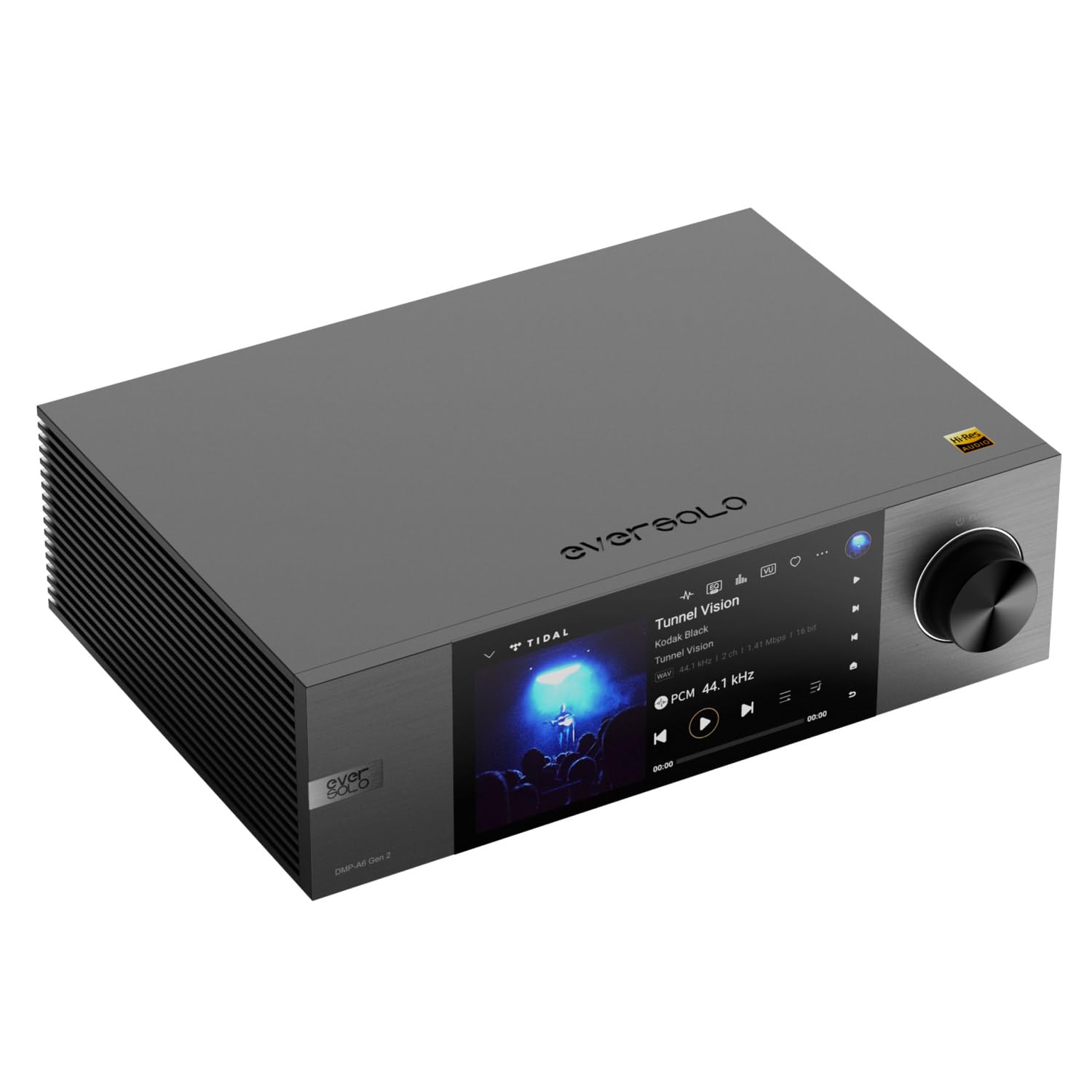
The EVERSOLO DMP-A6 Gen 2 is a dedicated music streamer and DAC that leaves little room for compromise. The Gen 2 upgrade focuses on the power supply—a newly designed linear supply with noise under 40 μV—and adds HDMI ARC and trigger functions for home theater integration. At its core sits a dual-mono ESS DAC implementation that supports native DSD512, MQA, and PCM up to 768 kHz. The 6-inch high-resolution LCD touchscreen is large enough to display album art and track metadata clearly from a listening chair, which is a step up from the smaller displays found on most competitors.
For users who want a complete digital transport without the internal DAC, the DMP-A6 Gen 2 offers both USB and coaxial/optical outputs alongside balanced XLR and single-ended RCA analog outputs. The inclusion of an internal NVMe drive bay allows you to store and browse a local music library directly on the device, and the dual USB ports support external drives and DACs simultaneously. The Android-based operating system is deeply customized for audio, with the EOS audio engine handling high-resolution output without resampling or mixing.
Where it stumbles is software polish. The mobile app, while functional, can feel less refined than BluOS or WiiM Home—Qobuz users have noted double audio playback and queue management issues. The lack of a bundled remote control (sold separately) and the absence of built-in room correction are notable omissions at this price. For those who prioritize sheer DAC performance, native DSD playback, and a large local library, the DMP-A6 Gen 2 delivers a level of transparency that justifies its premium position.
Why it’s great
- Superb dual-mono DAC with native DSD512 and 768 kHz PCM support
- Large 6-inch touchscreen with clear album art display
- NVMe drive bay and dual USB ports for local library storage
Good to know
- Remote control not included — must be purchased separately
- No built-in room correction; mobile app UI can be inconsistent
3. Fosi Audio ZH3 DAC Headphone Amp

The Fosi Audio ZH3 is a fully balanced desktop DAC, preamp, and headphone amplifier that punches well above its weight class. The core chipset pairs an AKM AK4493SEQ DAC with an XMOS XU316 processor, and the analog stage is built around four OPA1612 operational amplifiers in a self-developed dual-power balanced circuit. The measured noise floor sits at just 1.9 μV, which translates to an utterly black background even with sensitive in-ear monitors. Output power reaches 2570 mW per channel at 32 ohms through the 4.4mm balanced jack, enough to drive demanding planars like the Hifiman Arya or Sennheiser HD 660 S2 with authority.
Beyond headphone performance, the ZH3 functions as a full preamp with both XLR and RCA outputs, making it easy to connect to active speakers or a power amplifier. The 3-level gain switch accommodates headphones from 16 ohms to 300 ohms, and the built-in bass and treble EQ adjustments let you tailor the sound signature without leaving the signal path. Users have compared its headphone performance to the Chord Mojo 2, noting similar clarity and power delivery but in a more affordable, feature-dense package.
One quirk worth noting: the RCA and XLR preamp outputs differ significantly in output level, so you need to select the correct output for your backend equipment. Additionally, the EQ adjustments apply only to the headphone output, not the preamp outputs. These are design decisions rather than flaws, but they require awareness during setup. For desktop users who want a combined DAC, headphone amp, and preamp with genuine balanced architecture, the ZH3 is an exceptional value.
Why it’s great
- Exceptionally low noise floor (1.9 μV) for ultra-black background
- High power output: 2570 mW @ 32Ω balanced, drives demanding headphones
- Full balanced architecture with XLR and RCA preamp outputs
Good to know
- XLR and RCA output levels differ significantly — match to your amp correctly
- EQ only works on headphone output, not preamp outputs
4. Bluesound Node Nano

The Bluesound Node Nano is a compact, purpose-built network streamer designed to integrate with the BluOS multi-room ecosystem. At just 5.5 inches square and 1.4 inches thick, it’s one of the smallest dedicated streamers on the market, yet it packs a quad-core 1.8 GHz ARM Cortex A53 processor and an ESS ES9039Q2M SABRE DAC. It supports up to 24-bit/192 kHz resolution with MQA rendering and DSD playback (via a future firmware update), and offers stereo RCA, optical, coaxial, and USB outputs. The USB output is a standout feature at this size, allowing you to bypass the internal DAC and feed a clean digital signal to your preferred external converter.
What sets the Node Nano apart is the BluOS platform: seamless grouping with other Bluesound players, native support for Qobuz Connect, Tidal Connect, and Spotify Connect, and AirPlay 2 for Apple device streaming. Users upgrading from Raspberry Pi-based setups report a significant jump in reliability and sound quality, with clean imaging and a noise-free background even when using the internal DAC. The two programmable quick-touch presets on the front panel are genuinely useful for one-tap access to favorite playlists or radio stations.
The setup experience is not entirely frictionless. The quick start guide is minimal, and the app required several minutes to discover the device on first use. A small number of users report occasional WiFi dropout issues, which are resolved by switching to the Gigabit Ethernet port. The Node Nano is best appreciated as a digital transport—its internal DAC is a bonus, but its real strength is serving a clean, bit-perfect stream to an outboard DAC.
Why it’s great
- Compact size with USB digital output for external DAC use
- Full BluOS multi-room support with Tidal, Qobuz, and AirPlay 2
- ESS ES9039Q2M DAC with MQA rendering and high-res PCM support
Good to know
- Setup process requires patience; app discovery can be slow
- WiFi can be unreliable — Ethernet connection recommended for consistent performance
5. Cambridge Audio MXN 10

The Cambridge Audio MXN 10 is a dedicated network audio player built around the fourth-generation StreamMagic module, with an ESS SABRE ES9033Q DAC at its heart. Unlike many all-in-one streamers, the MXN 10 is designed as a separate component that integrates into a traditional hi-fi stack, with a clean, minimalist Lunar Grey chassis that measures 8.5 inches wide. It supports Internet Radio with MPEG-DASH, Spotify Connect, TIDAL, Qobuz, and is Roon Ready, making it a versatile digital hub for any existing system.
Where the MXN 10 truly shines is when used as a pure digital transport. Its coaxial and optical outputs deliver a clean, low-jitter signal to an external DAC, and reviewers consistently note that the soundstage opens up dramatically when paired with a high-end converter like the Schiit Modi Multibit 2 or a Chord Hugo 2. The analog output is competent but slightly thin through the RCA jacks without a tube preamp in the chain; partnering it with a warm-sounding preamp resolves this and reveals a holographic imaging quality that belies its mid-range price.
StreamMagic app is stable and responsive, though it lacks the depth of customization found in the WiiM Home app—there is no parametric EQ or room correction. Rare WiFi dropouts have been reported, but using the Ethernet connection resolves them entirely. For audiophiles who already own a high-quality DAC and want a reliable, Roon-certified network transport with a proven track record, the MXN 10 is a safe, sonically excellent choice.
Why it’s great
- Excellent as a pure digital transport with low-jitter coax/optical out
- Roon Ready certified with StreamMagic Gen 4 module
- Supports Spotify, TIDAL, Qobuz, and Internet Radio with MPEG-DASH
Good to know
- Analog output can sound thin without a warm preamp; best paired with external DAC
- No room correction or parametric EQ in StreamMagic app
6. WiiM Amp Ultra
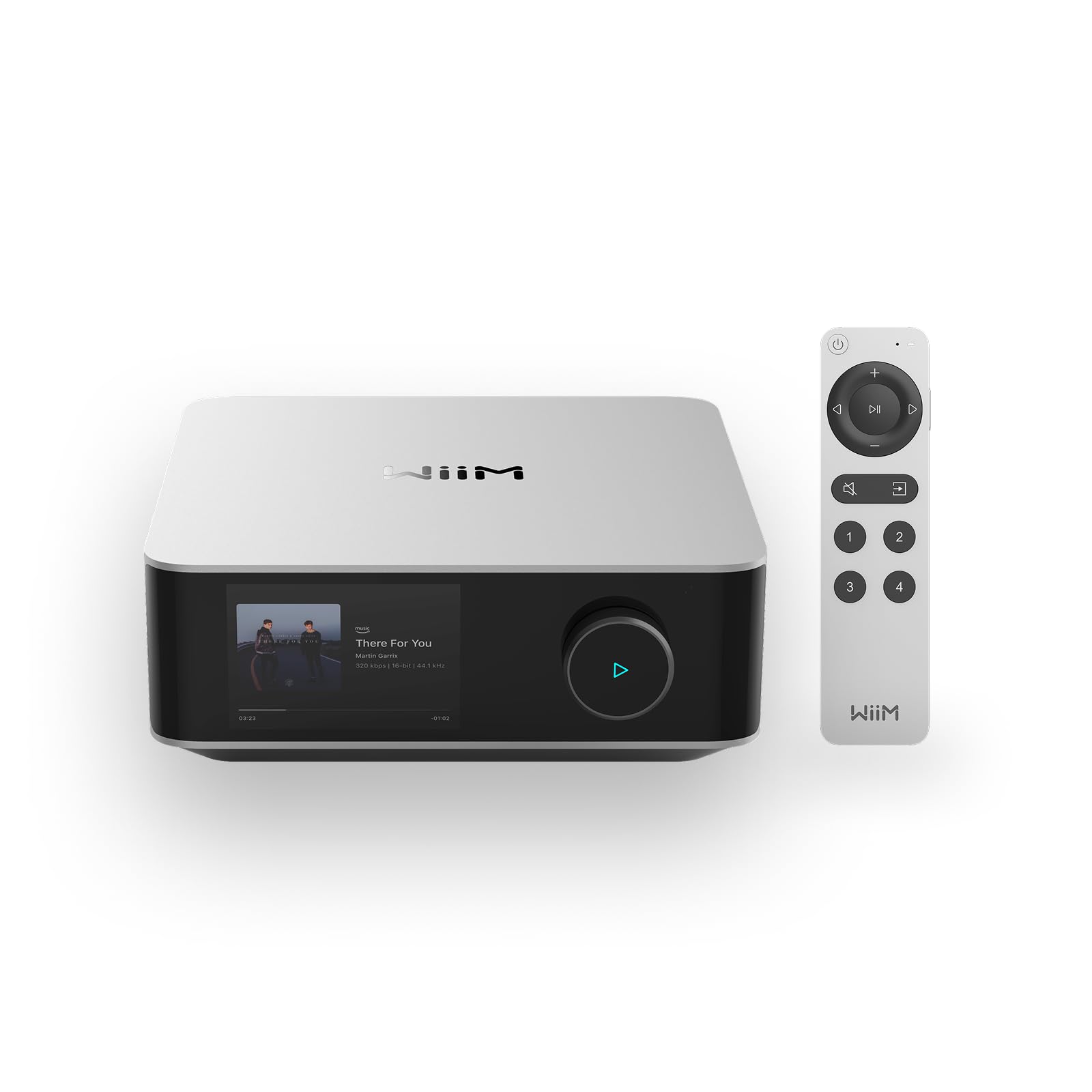
The WiiM Amp Ultra is a streaming amplifier that eliminates the need for a separate preamp, DAC, and power amp. It delivers 100 watts per channel into 8 ohms with a THD+N of -106 dB, using dual TI TPA3255 Class-D amps paired with an ESS ES9039Q2M SABRE DAC. The inclusion of PFFB (Post Filter Feedback) technology ensures load-independent frequency response, maintaining consistent sound quality regardless of speaker impedance swings. It powers up to four speakers and includes HDMI ARC for seamless TV integration, plus optical and RCA inputs.
The standout feature is the built-in RoomFit room correction, which uses your phone’s microphone to measure and compensate for room acoustics automatically. Reviewers upgrading from older receivers like the Sony STR-DH90 report a massive improvement in clarity, extension, and dynamic range, especially when paired with tower speakers and a powered subwoofer. The 3.5-inch touchscreen provides local control, but the WiiM Home app is where the real power lives: independent EQ per input, source-specific presets, volume limits, alarms, and Alexa/Google Assistant voice control.
One notable omission is the lack of a coaxial input, which may be a dealbreaker for users with older CD transports or TV sources that output only coaxial digital. The Bluetooth source switching also introduces a frustrating delay, though this can be mitigated by disabling Bluetooth as a selectable input in the app. For anyone building a new system from scratch or upgrading a basic receiver, the WiiM Amp Ultra delivers unparalleled integration and performance in a single, compact box.
Why it’s great
- Complete one-box solution: streamer, DAC, preamp, and 100W/ch amplifier
- Built-in room correction (RoomFit) with automatic calibration
- HDMI ARC, subwoofer output, and flexible EQ per input
Good to know
- No coaxial input for older digital sources
- No AirPlay 2 support — use WiiM app or Chromecast instead
7. Sonos Port

The Sonos Port is a single-purpose streaming component designed to connect legacy stereo systems to the Sonos ecosystem. It accepts line-level input from a turntable, CD player, or other analog source and streams it to any Sonos speaker in the house, while simultaneously receiving music streaming from the Sonos app and Apple AirPlay 2. In essence, it acts as a bridge between your traditional hi-fi and a modern multi-room wireless system, preserving your existing amplifier and speakers while adding network streaming capability.
Setup is handled entirely through the Sonos app, which is polished but notoriously opinionated about network configuration. The Port has no display—just a single LED status light—so all control happens via the app or voice assistants. For a straightforward multi-room integration, it works exactly as advertised: users report seamless integration with legacy Onkyo and Denon receivers, bringing them into the same streaming ecosystem as Sonos speakers in other rooms. The line-in function is particularly useful for streaming vinyl to other zones.
The main friction points are reliability and cost. Some units require periodic power cycling due to the Port dropping off the network, and Sonos’s support process can be slow. At its price point, the Port is expensive for what is essentially a network bridge with no internal DAC or headphone output. It also locks you into the Sonos ecosystem—if you ever leave Sonos, the Port becomes a paperweight. It’s the right choice only if you are already invested in Sonos speakers and want to bring a legacy amplifier into the fold.
Why it’s great
- Seamless integration with existing Sonos multi-room systems
- Line-in allows streaming vinyl or other analog sources to Sonos zones
- Polished app experience with AirPlay 2 and voice assistant support
Good to know
- High price for limited standalone functionality; no internal DAC or headphone out
- Requires periodic power cycling for some users due to network dropouts
8. iFi Hip-dac 3

The iFi Hip-dac 3 is a portable USB DAC and headphone amplifier designed for listeners who want audiophile-grade sound on the go. The third-generation model features a matte black aluminum chassis, revised internal power supply components for quieter operation, and iFi’s True Native DAC architecture that delivers bit-perfect performance for every digital format. It supports PCM up to 32-bit/384kHz, DSD256, and full MQA decoding, and includes separate USB-C ports for audio data and charging—a welcome upgrade that prevents power-draw conflicts.
The output section offers a fully balanced 4.4mm jack and an S-Balanced 3.5mm output, and iFi’s PowerMatch technology lets you adjust gain to match power-hungry headphones like the Sennheiser HD 600 or Sony MDR-MV1. The built-in battery provides approximately eight hours of playback at moderate volume levels, and the XBass button adds a subtle low-end lift that compensates for open-back headphones lacking bass extension. Users transitioning from a basic USB dongle report a dramatic improvement in clarity, separation, and dynamic range, especially with classical and EDM tracks.
The trade-offs for its portability are the lack of Bluetooth (wired USB connection only) and the fact that it functions purely as a headphone amp—there are no line-level outputs for connecting to speakers or a preamp. The Hip-dac 3 is best understood as a high-end replacement for a phone dongle or laptop headphone jack, not as a network streamer. For desktop or mobile use with high-impedance headphones and IEMs, it delivers a level of transparency that justifies its compact footprint.
Why it’s great
- Exceptional sound quality in a portable battery-powered form factor
- Fully balanced 4.4mm output with PowerMatch gain adjustment
- True Native DAC with MQA decoding and 32-bit/384kHz PCM support
Good to know
- No Bluetooth connectivity — requires USB wired connection from source device
- No line-level outputs for speaker/preamp use; purely a headphone amplifier
9. Fosi Audio ZD3 Desktop DAC Preamp

The Fosi Audio ZD3 is a fully balanced desktop DAC and preamp that punches well above its price point. It’s the first DAC from Fosi to support HDMI ARC, making it a compelling choice for TV audio integration without needing a separate HDMI audio extractor. The chipset pairs an ES9039Q2M DAC with an XMOS XU316 processor, supporting DSD512 and PCM up to 32-bit/768kHz. Inputs include Bluetooth 5.0, USB, optical, coaxial, and HDMI ARC, while outputs are handled via balanced XLR and single-ended RCA jacks.
Real-world use reveals a clear sonic upgrade over basic USB dongles and integrated sound cards. Users report that the ZD3 solved persistent noise issues with sensitive PreSonus Eris speakers when using balanced XLR connections, completely eliminating RF and electrical ground-loop hum. The separate USB power supply (not bus-powered) ensures that the DAC section is isolated from the source device’s noisy USB power rail. After a burn-in period of around 50 hours, listeners describe a wide, deep soundstage with clean tonality, effortless detail retrieval, and articulate bass response.
Op-amp rolling is supported, and the stock LME49720 chips deliver excellent performance, but swapping to Sparkos Labs SS3602 op-amps tightens and deepens the bass response noticeably. The included 1.5-inch OLED display and remote control are functional, and the 12V trigger input allows synchronized power-on with other Fosi Z-series components. The ZD3 lacks a standby mode (it idles at approximately 1W) and has no headphone output, but as a desktop preamp and DAC with HDMI ARC, it offers extraordinary value for the price.
Why it’s great
- HDMI ARC input for TV integration at a budget-friendly price
- Fully balanced XLR outputs eliminate noise and ground loops
- Swappable op-amps for customizable sound tuning
Good to know
- No standby mode — must be manually powered off when not in use
- No headphone output — preamp/DAC only, intended for amplifier or active speakers
FAQ
What is the difference between a DAC and a streamer?
Do I need an external DAC with my streamer?
What is HDMI ARC and why does it matter for a streamer?
How do balanced XLR outputs improve sound quality?
Final Thoughts: The Verdict
For most users, the audio streamer winner is the WiiM Ultra because it combines a premium ESS DAC, full preamp functionality, HDMI ARC, subwoofer output, room correction, and multi-room support into a single well-built chassis at a price that undercuts every competitor with comparable features. If you want a pure digital transport with Roon Ready certification and the ability to store a local library, grab the EVERSOLO DMP-A6 Gen 2. And for a complete one-box system that includes amplification, streaming, and room correction, nothing beats the WiiM Amp Ultra.