
Our readers keep the lights on and my morning glass full of iced black tea. As an Amazon Associate, I earn from qualifying purchases.
Specs are compiled from manufacturer listings and verified buyer reviews and can change over time — please confirm the key details on the product page before buying.
A surround sound system should pull you into the movie, not leave you fiddling with wires or straining to hear dialogue. The problem is that specs like Dolby Atmos, channel counts, and wattage can make every option sound the same on paper. This guide cuts through the noise and highlights the real-world differences — which systems actually fill a room with convincing sound, which ones make you feel the bass in your chest, and which ones set up without a headache. You’ll find nine systems that cover everything from a dedicated home theater room to a simple living-room upgrade.
I’m Min — the founder and writer behind Gadgets Feed. This guide is built by comparing the manufacturers’ published specifications and the patterns across verified customer reviews, so you get each pick’s real strengths and trade-offs instead of marketing spin.
These are the nine best options on the market right now, ranked by performance, value, and real owner feedback, so you can confidently choose the best audio surround sound system for your space and your budget.
Our Picks at a Glance
How To Choose The Best Audio Surround Sound System
Picking the right system depends on three things: your room size, your content (movies or music), and your tolerance for wires. These five points cover what changes the experience most.
Channel Count — What The Numbers Mean
A 5.1 system has five speakers and one subwoofer. The first number is the speakers placed around you, the second is the subwoofer, and a third number (like the “4” in 5.1.4) means upward-firing speakers for height effects. A 5.1.4 gives you sound coming from above — rain, helicopters — while a standard 5.1 stays at ear level. For most people, a 5.1 system is a huge step up from TV speakers. If you want that rich bubble of sound, look for the third number.
Subwoofer Size And Bass
The subwoofer driver size tells you the character of the bass. An 8-inch subwoofer, like the one in the ULTIMEA Skywave X50, delivers tight, controlled bass that works well in a medium room. A 10-inch subwoofer, like the one in the Bobtot system, moves more air and creates the deep, room-shaking rumble you feel during explosions. A bigger driver can play lower frequencies, which gives you that physical sensation in your chest.
Wireless vs Wired Rear Speakers
Wireless rear speakers free you from running cables across the room, but they still need a power outlet nearby. Systems like the JBL Bar 700MK2 have detachable, battery-powered rears you can place anywhere, even on a side table with no outlet. Wired rears, as found on the Bobtot, often have long cables (up to 31 feet) that you can hide along baseboards, but they are fixed in length and can be a tripping hazard.
Dolby Atmos and DTS:X
These are the two main surround sound formats. Dolby Atmos uses object-based audio to make sounds feel like they move around you in 3D space, including overhead. DTS:X does the same thing but with different processing. Most modern streaming services use Dolby Atmos, so it is the more important format to have. Many soundbars support both, which gives you wider compatibility with Blu-rays and games.
HDMI eARC — The One Connection
HDMI eARC (enhanced Audio Return Channel) sends high-quality surround sound from your TV to the soundbar through a single HDMI cable. It supports uncompressed formats like Dolby TrueHD and DTS-HD Master Audio, which you get from Blu-ray discs and some streaming services. If your TV is from the last few years, it likely has eARC, and it makes setup as simple as plugging one cable.
Quick Comparison
| Model | Best For | Channel Config | Subwoofer Size | Total Power | Amazon |
|---|---|---|---|---|---|
| ULTIMEA Skywave X50★ Best Overall | Best Overall | 5.1.4 | 8 inches | 760W peak | Amazon |
| Bobtot 5.1 SystemBudget Champ | Budget Champ | 5.1 | 10 inches | 1200W peak | Amazon |
| Hisense AX5140QValue Pick | Value Pick | 5.1.4 | 6.5 inches | — | Amazon |
| Amazon Fire TV Soundbar Plus | Ecosystem Integration | 5.1 | — | — | Amazon |
| Sony BRAVIA Theater System 6 | TV Brand Match | 5.1 | — | — | Amazon |
| ULTIMEA Skywave X70 | Premium Power | 7.1.4 | 10 inches | 980W peak | Amazon |
| Samsung HW-Q990D | Top-Tier Atmos | 11.1.4 | — | — | Amazon |
| JBL Bar 700MK2 | No-Wire Rears | 7.1 | 10 inches | 780W max | Amazon |
| Samsung HW-Q990C | Premium Value | 11.1.4 | — | — | Amazon |
In‑Depth Reviews
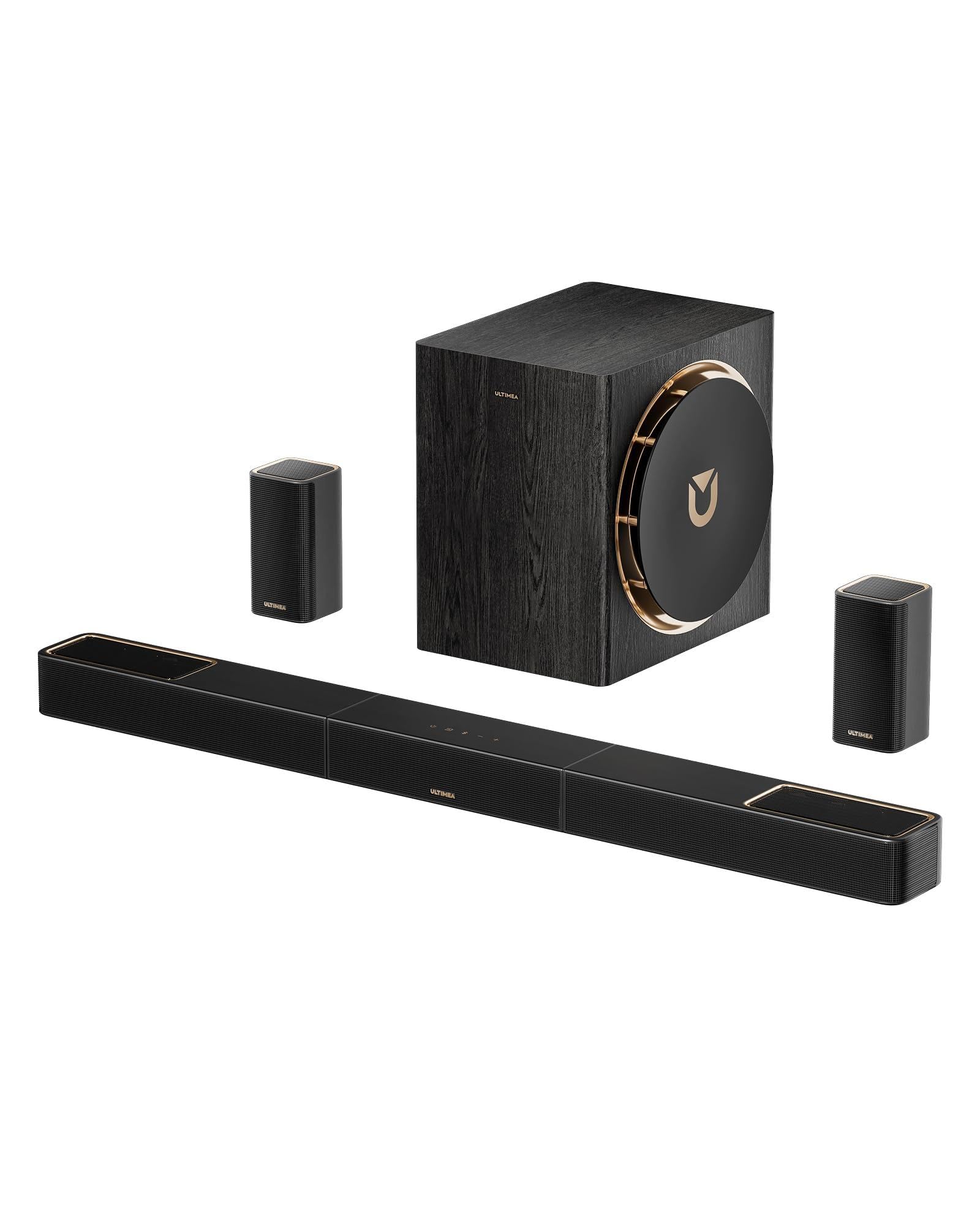
1. ULTIMEA Skywave X50 5.1.4ch Wireless Surround Sound System
Our pick — over 4.5★ from 250+ verified ratings; the strongest balance of quality and price.
A true 5.1.4 Dolby Atmos setup that an owner with music degrees called an upgrade from a Samsung flagship.
The Skywave X50 is the system buyers rave about for its balance of power and finesse. It uses a GaN amplifier that delivers up to 98% efficiency, meaning the 760W of peak power stays clean and distortion-free even when you push the volume. The 8-inch subwoofer with Gravus Ultra-Linear Bass technology hits down to 28Hz, which gives you that deep, physical rumble during action scenes without muddying the dialogue. The wireless rear speakers connect via dual 5GHz transmission, so setup is truly plug-and-play — just power them on and they sync.
The dedicated center channel and the up-firing drivers create a convincing overhead sound bubble. One buyer with formal music training reported replacing a Samsung HW-Q990F because the Skywave’s bass was punchier and the surround was more balanced. The NEURACORE multi-channel audio engine handles up to 17 channels of processing, which means this 5.1.4 system has room to breathe and place sounds precisely. The only consistent note is that the rear speakers need a nearby power outlet, and some TVs require a quick audio setting adjustment to passthrough mode.
The Performance Edge
- True 5.1.4 Dolby Atmos with up-firing drivers for overhead effects.
- 8-inch subwoofer delivers deep, clean bass down to 28Hz.
- GaN amplifier produces 760W of clean, undistorted peak power.
- Wireless rear speakers connect instantly with stable dual 5GHz.
- App control with individual level adjustments for each speaker.
The Practical Trade-offs
- Rear speakers require a power outlet nearby.
- TV audio settings may need switching to passthrough for best Atmos performance.
- Bass can overpower dialogue on some presets; Standard mode with midrange boost is recommended.
Reach for this if: you want a complete, future-proof Atmos setup that delivers clean power and rich height effects without the premium price tag.
Look elsewhere if: you need a battery-powered rear speaker for a room with no outlet near the listening position.
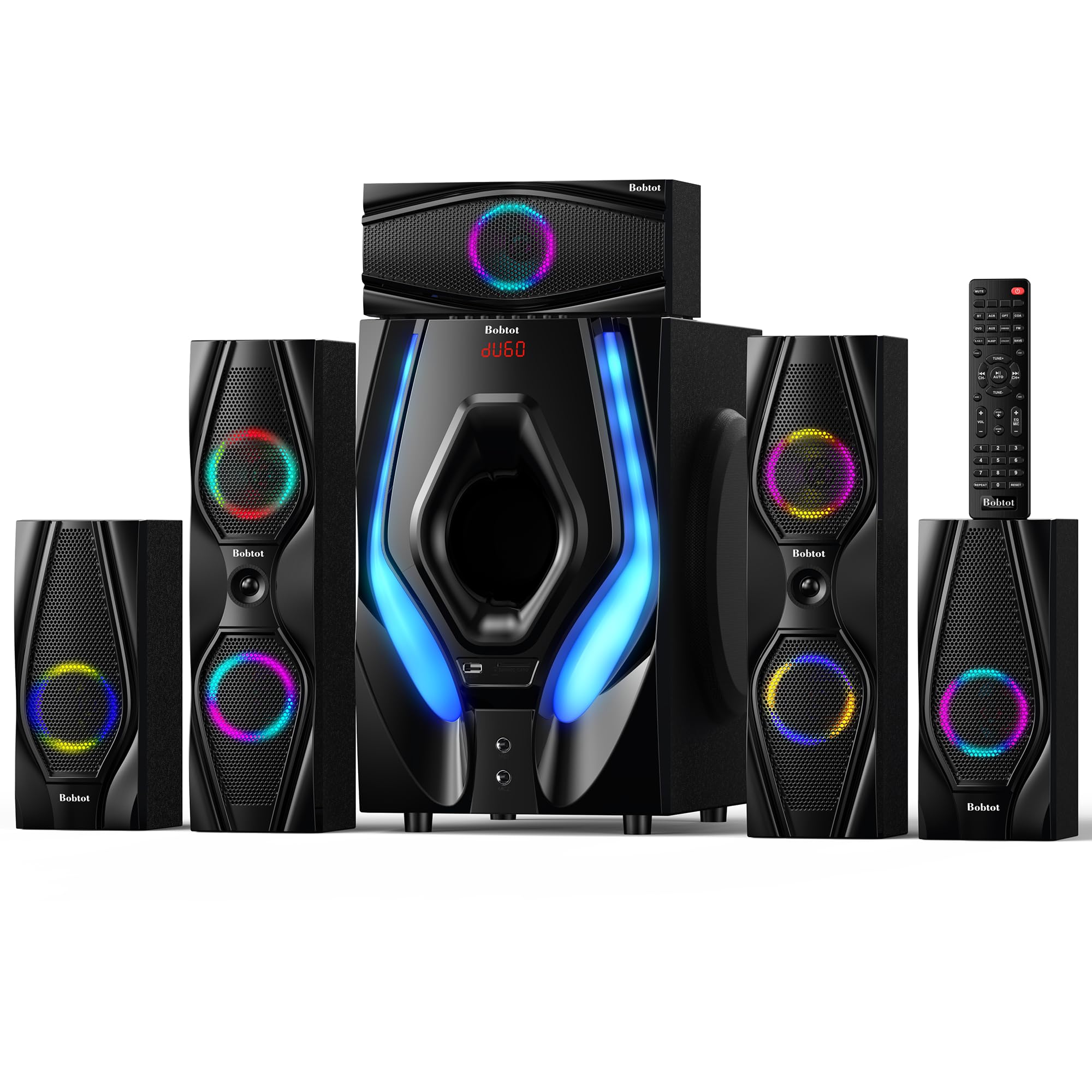
2. Bobtot Home Theater Systems Surround Sound Speakers, 1200W Peak
A traditional 5.1 speaker system with a 10-inch subwoofer that delivers room-shaking bass for a very low price.
This is the classic home-theater-in-a-box approach: a 10-inch subwoofer with a built-in receiver, five wired satellite speakers, and a 1200-watt peak power rating. The sound quality is what wins people over — the big subwoofer creates a booming, physical bass that fills the room. The system also includes LED lighting on the subwoofer with four modes (blink to the beat, solid on, spectrum EQ analyzer, or off), which adds to the party atmosphere. You get Bluetooth 5.3, ARC, optical, coaxial, auxiliary, and USB inputs, plus two ¼-inch microphone inputs with echo for karaoke.
The honest trade-off is in reliability over the long term. The speaker wires are fixed in length (13 feet for front, 31 feet for rear) and cannot be extended, which forces your room layout to fit the cables. A number of buyers report the subwoofer failing after about two years, and while customer service replaced one unit within two weeks, the pattern is mixed. The sound itself is impressive for the money — as one buyer put it, the bass is thunderous and dominates — but the highs and mids can distort slightly at very high volume. If you want a dirt-cheap way to get a real 5.1 setup with a huge subwoofer for parties, this delivers.
Best for the party room: the 10-inch sub and LED lights create an experience that feels bigger than the price tag suggests.
Know this going in: reliability is mixed, with some subwoofers failing after two years; the fixed-length cables will dictate your speaker placement.
Grab it if: you want loud, deep bass for parties or a large room on a tight budget and can work around fixed speaker wires.
Pass if: you need a system that will last half a decade without a potential failure, or you want wireless rear speakers.
3. Hisense AX5140Q 5.1.4ch Soundbar with Wireless Subwoofer
A budget-minded 5.1.4 system that gives you Dolby Atmos and DTS:X without the flagship cost.
With six front-firing, two up-firing, and four surround speakers, the AX5140Q creates a true 5.1.4 sound field. The 6.5-inch wireless subwoofer produces bass down to 40Hz, which owners describe as deep and punchy without overwhelming the dialogue. The seven touch EQ modes let you switch between tune sound for music, movies, and news with a single remote press. HDMI eARC keeps it to one cable for full audio and control.
Hisense TV owners note that this soundbar pairs nearly smoothly with their sets, and the setup is straightforward. The Dolby Atmos and DTS:X support adds height channels that create a convincing overhead bubble, though some note the rear speakers can feel underpowered in larger rooms. A rare negative review mentions dialogue being inaudible, but this is an outlier — the overwhelming consensus is that the AX5140Q offers strong value for an rich home audio upgrade.
Solid, simple Atmos: the seven EQ modes and one-cable eARC setup make this a low-fuss upgrade for a Hisense TV owner who wants height channels.
Worth noting: the rear speakers may not fill a very large room, and occasional Bluetooth quirks with iPhones have been reported.
Choose this for: a clean, affordable 5.1.4 Atmos/DTS:X experience, especially if you own a Hisense TV.
Think twice if: your room is larger than 20×20 feet where rear speaker volume might feel thin.
4. Amazon Fire TV Soundbar Plus with Subwoofer and Surround Speakers

An Amazon-native 5.1 system that prioritizes crisp dialogue and smooth Fire TV integration.
This system is built for the Fire TV owner. The dedicated center channel, combined with a five-level dialogue boost, makes voices cut through even the loudest action sequence. It supports Dolby Atmos and DTS:X for 3D sound, and the subwoofer uses a tuned resonance chamber to produce crisp bass. Setup is about as simple as it gets — plug the subwoofer and rear speakers into power, and they pair with the soundbar automatically over HDMI eARC.
The stereo separation without the surround speakers is poor, but with the included rears, the soundstage opens up. Some owners mention that rear speaker output can be low, even at maximum setting, which limits the surround effect in medium rooms. The system lacks up-firing speakers, so you get virtual height from Dolby Atmos rather than physical drivers. This is a strong pick for anyone who wants a reliable, dialogue-focused system that integrates with their Fire TV remote.
Dialogue is the star: the five-level dialogue boost and dedicated center channel make this the best pick for anyone who struggles to hear voices over action.
The catch: rear speaker volume is limited, and there are no physical up-firing speakers for Atmos height effects.
Best for: Fire TV owners who prioritize clear dialogue and want a straightforward, affordable 5.1 setup.
Skip if: you want room-filling rear surround sound or physical Atmos height channels.
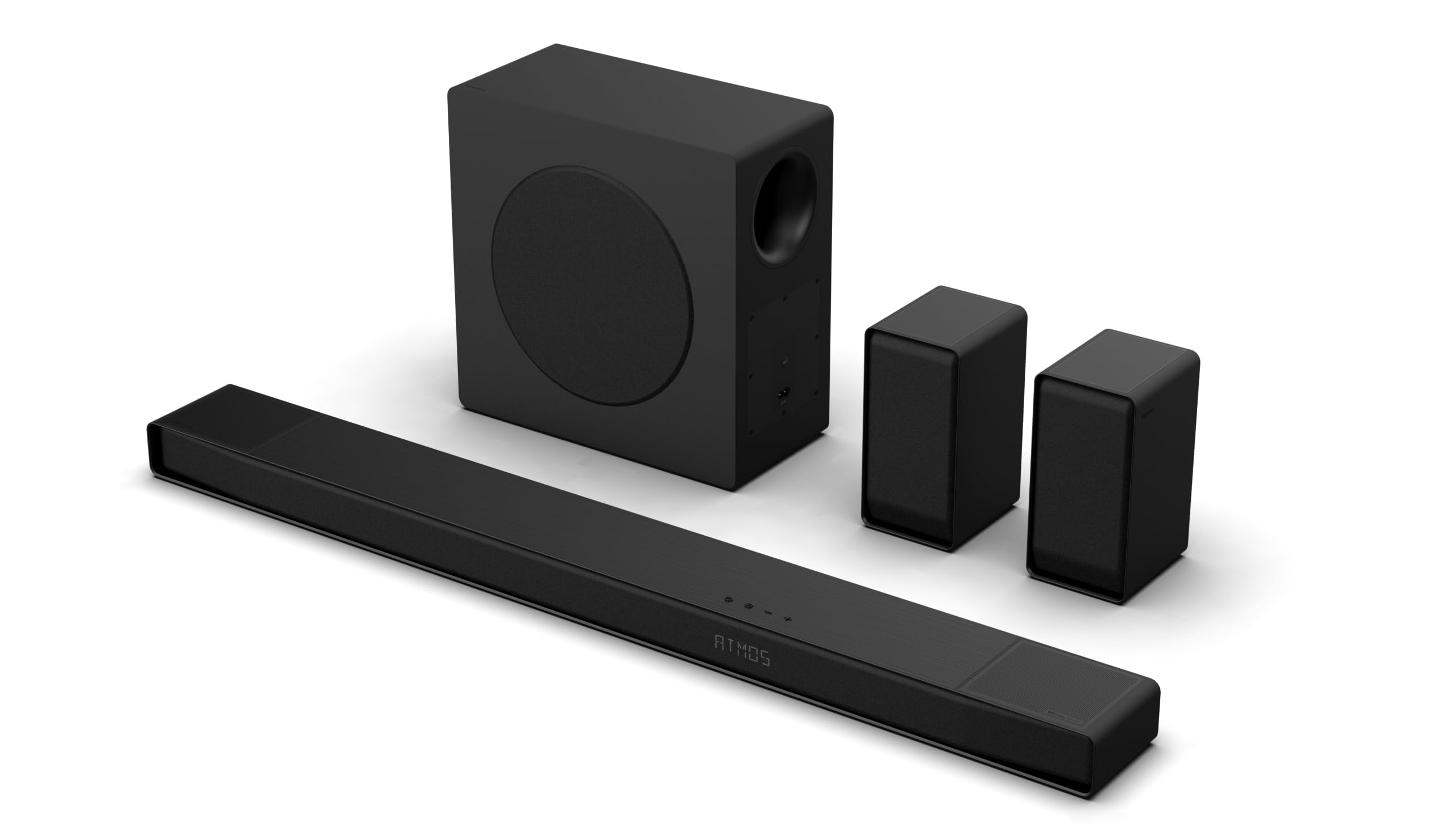
5. Sony BRAVIA Theater System 6 5.1ch Soundbar (HT-S60)

Sony’s 5.1 system that works like magic with a Brava TV, open up exclusive features like Voice Zoom 3.
When paired with a compatible Sony Brava TV, this system open up Voice Zoom 3, which enhances dialogue beyond the standard center channel. The 5.1 setup includes three front-firing speakers, two rear speakers, and a subwoofer. Multi Stereo mode plays the same sound from all speakers to fill the room. The Brava Connect app lets you adjust volume, sound profiles, and settings from your phone.
Setup is famously easy — one owner described it as “works like magic with my Sony Brava TV” after four failed attempts with other brands. The sound quality is clean and bass is powerful, though some note the subwoofer must be placed near the TV and the rear speakers have wired connections that can be a trip hazard. The frequency response starts at 20Hz, which gives the subwoofer deep extension. For anyone with a Brava TV, the integration and exclusive features make this the best match.
Sony synergy: the exclusive Voice Zoom 3 feature and Brava Connect app give Brava TV owners a smooth experience no other system can match.
The reality check: the subwoofer is wired to the TV area, and rear speaker cables can be a tripping hazard in a high-traffic room.
Grab this if: you own a Sony Brava TV and want a perfectly integrated system with exclusive dialogue enhancement.
Look elsewhere if: you don’t have a Brava TV, as the main selling point is lost, or you need fully wireless rear speakers.
6. ULTIMEA Skywave X70 7.1.4ch Professional Wireless Sound System
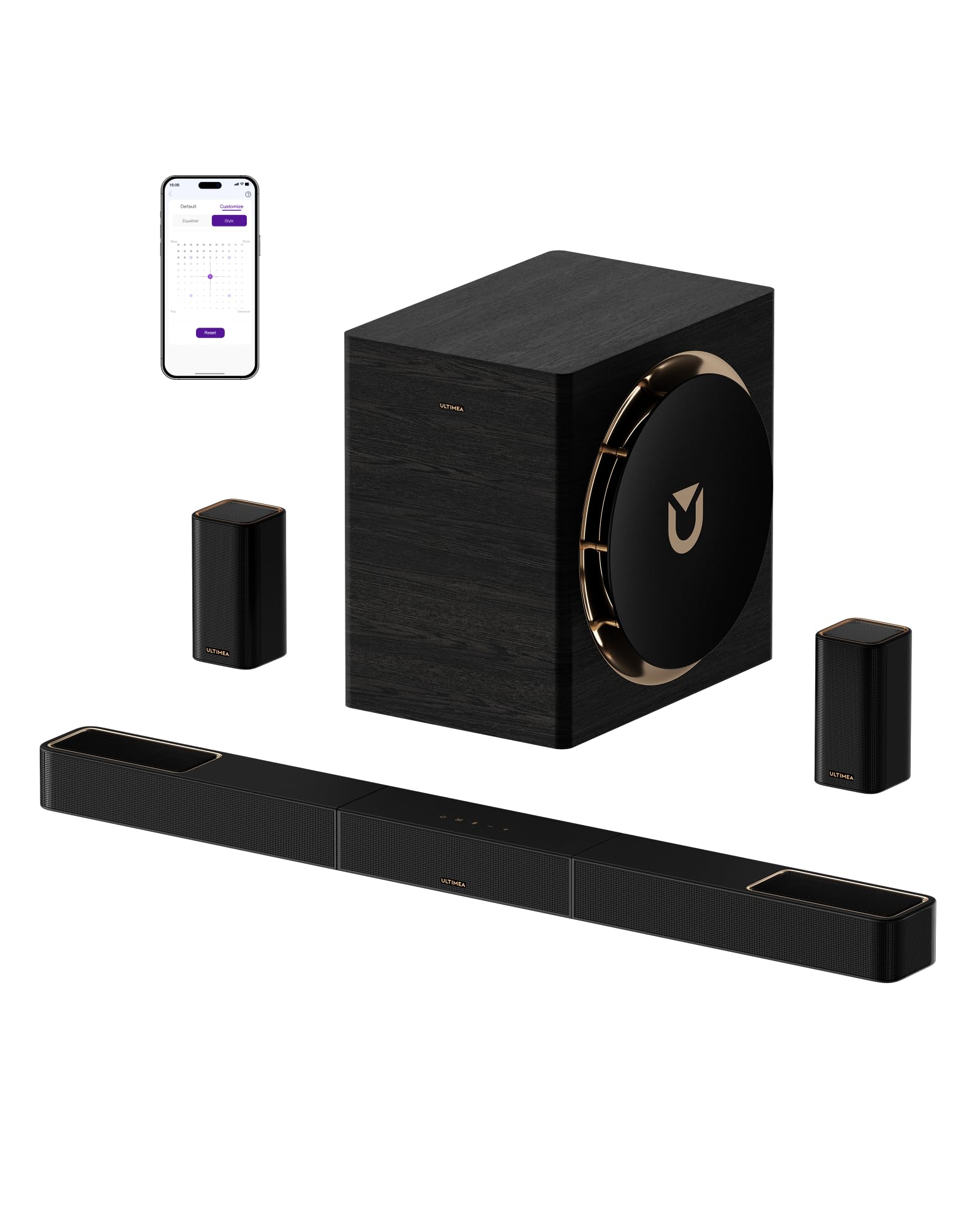
A 7.1.4 powerhouse with a 10-inch subwoofer that hits 20Hz and fills even a 20-foot room with ease.
The Skywave X70 is the larger sibling of the X50, stepping up to a 7.1.4 channel configuration and a 10-inch subwoofer. The 10-inch driver reaches down to 20Hz, which is the threshold of human hearing — you feel this bass as much as you hear it. The 980W peak power, driven by the same GaN amplifier as the X50, stays clean even at reference level. The soundbar itself is a three-piece unit that snaps together, making it manageable to move while keeping a long profile for wide soundstage.
Owners are unanimous about the bass — “thundering, clean, and punchy” is how one described it. The system uses the same NEURACORE engine and dual 5GHz wireless for stable rear speaker connection. The ULTIMEA app gives you a 10-band EQ and 121 sound presets. A consistent point is that the system lacks DTS support, and there is no auto-calibration, so you will need to adjust EQ and speaker levels manually via the app or remote. For a 20×20 foot room, the X70 can fill the space with authoritative sound that one owner says “makes the living room feel like a movie theater.”
What Stands Out
- 7.1.4 channels with a 10-inch subwoofer reaching 20Hz for deep, physical bass.
- 980W peak power from a GaN amplifier that stays cool and clean.
- Three-piece soundbar design for easy handling and a wide soundstage.
- App control with 10-band EQ and 121 presets for fine tuning.
Things to Know
- No DTS support, which limits compatibility with some Blu-ray discs.
- No auto-calibration; you adjust speaker levels and EQ manually.
- Subwoofer placement is critical to avoid boominess.
Choose this for: a large room where you want chest-thumping, 20Hz bass and a full 7.1.4 Atmos setup with wireless rears.
Skip if: you need DTS support or prefer an auto-calibrating system that sets itself up.
7. Samsung HW-Q990D 11.1.4ch Soundbar

An 11.1.4 channel beast that one owner called the “king of soundbars” after it beat a Yamaha tower system.
The Q990D is Samsung’s flagship soundbar, with 11 front-facing speakers, 1 subwoofer, and 4 up-firing channels. The included rear speakers have drivers that fire forward, to the side, and up toward the ceiling, creating incredibly dense surround layers. Q-Symphony lets the soundbar work with compatible Samsung TV speakers as one unified system, which amplifies the soundstage beyond what the soundbar alone can do. Wireless Dolby Atmos removes the need for an HDMI cable to the rear speakers.
Owners consistently highlight the dialogue clarity — one reviewer noted they no longer need subtitles. The Adaptive Sound mode analyzes scenes in real time to tune audio, and SpaceFit Sound Pro calibrates the audio to your room’s acoustics. The bar is long, so make sure it fits your TV stand. A small number of customers note units failing after months of light use, and Samsung’s warranty process has been described as frustrating. When it works, though, reviews say it beats systems like the Sonos Arc Ultra and Sony Quad that require separate subwoofer purchases.
The Flagship Experience
- 11.1.4 channels create the most rich Atmos bubble in a soundbar.
- Q-Symphony pairs with Samsung TVs for a unified, expanded soundstage.
- Wireless Dolby Atmos eliminates HDMI cable clutter to the rear speakers.
- SpaceFit Sound Pro and Adaptive Sound tune audio to your room and content.
The Real-World Risks
- Some units fail within months of light use; warranty support can be difficult.
- The soundbar is very long; measure your TV stand before buying.
- Automatic firmware updates can cause issues; manual USB updates are recommended.
Reach for this if: you want the absolute best soundbar-based Atmos experience and own or plan to own a Samsung TV.
Proceed with caution if: you are risk-averse about early unit failures and warranty process friction.
8. JBL Bar 700MK2 Soundbar with Subwoofer

A 7.1 system with detachable, battery-powered speakers you can place anywhere — no wires, no power outlet needed.
The defining feature of the JBL Bar 700MK2 is its detachable wireless surround speakers. You lift them off the ends of the soundbar and place them behind you. They run on rechargeable batteries, so there are zero wires and no need for a nearby power outlet. This makes it the easiest system to set up in a rental or a room where running cables is impossible. The 10-inch wireless subwoofer pumps out 780W max power, and MultiBeam 3.0 technology projects sound across the whole room so every seat is the balance.
PureVoice 2.0 automatically tune dialogue based on the scene and volume, which works well during action sequences. The rear speakers pair with the TV remote instantly. The battery life on the rear speakers is a recurring point — some owners find it low, and the speakers need to be docked back onto the soundbar to charge. One owner docked them permanently via USB-C to keep them charged and connected. The surround effect from the detachable speakers is good but not as room-filling as a wired rear system; owners rate the surround mode around a B-minus but appreciate the convenience.
Maximum flexibility: the battery-powered detachable rears let you create surround sound in any room layout with zero cable management.
The battery reality: battery life on the rear speakers is modest, and you’ll need to remember to dock them or connect USB-C for continuous use.
Perfect for: apartments, rentals, or anyone who hates running cables and wants a true wireless rear setup with no outlet requirement.
Pass on this if: you want constant, high-volume rear surround output without ever thinking about battery charging.
9. Samsung HW-Q990C 11.1.4ch Soundbar

The previous-generation Samsung flagship that offers nearly identical performance to the Q990D at a significantly lower price.
The Q990C shares the same 11.1.4 channel configuration as the Q990D, with 11 front-facing speakers, 1 subwoofer, and 4 up-firing channels. It includes the same up-firing and side-firing rear speakers, Q-Symphony for Samsung TV integration, SpaceFit Sound Pro for automatic room calibration, and Adaptive Sound for real-time audio optimization. The subwoofer is wireless, and the rear speakers connect wirelessly, so the only cable you need is the HDMI eARC to the TV.
Owners praise the setup as simple — one said it was “easy to set up without the manual.” The sound quality is rich, with clear dialogue and powerful bass for both movies and games. The subwoofer is adequate for most rooms, though some note it can feel underpowered in very large spaces, and music can sound a bit flat compared to dedicated stereo systems. Connectivity is generally reliable, though a subset of reviewers point out occasional disconnections. At its price point, the Q990C delivers the same core experience as the newer model, making it the value play for Samsung’s top-tier sound.
The smart buy: identical channel count and features to the Q990D for a lower price, especially if you own a Samsung TV and want Q-Symphony.
A fair trade-off: the subwoofer may struggle to pressurize a very large room, and some shoppers say connectivity hiccups.
Choose this for: a Samsung TV setup where you want the full 11.1.4 Atmos experience without paying a premium for the newest model.
Think twice if: your room is very large and you need the subwoofer to fill it, or you want the absolute latest generation hardware.
Understanding the Specs
Dolby Atmos and DTS:X
These are the two most common object-based surround sound formats. Dolby Atmos allows sounds to be placed anywhere in 3D space, including above you, so a helicopter can feel like it is flying over your head. DTS:X does the same thing with a slightly different processing approach. Having both covers you whether you are streaming from Netflix (which uses Atmos) or playing a Blu-ray (which often uses DTS:X). The up-firing speakers in a soundbar bounce sound off your ceiling to create the height effect, which works best with a flat, standard-height ceiling.
HDMI eARC
HDMI eARC (enhanced Audio Return Channel) is the single-cable connection between your TV and soundbar. It sends high-bandwidth, uncompressed audio formats, including Dolby TrueHD and DTS-HD Master Audio, from your TV to the soundbar. This is important because compressed audio can lose detail in the surround channels. If your TV has HDMI eARC, you plug one cable in, and the soundbar handles everything. Older HDMI ARC can only carry compressed Dolby Digital, so the improvement with eARC is noticeable on Blu-ray discs and high-bitrate streaming.
FAQ
Will a 5.1.4 soundbar work with any TV?
Do I need up-firing speakers for Dolby Atmos?
How long do wireless rear speakers last on battery?
Can I add rear speakers to a soundbar later?
What does the GaN amplifier do differently?
How do I know if my TV supports HDMI eARC?
Is a 10-inch subwoofer always better than an 8-inch?
Can I use a surround sound system for music?
What is the difference between peak power and RMS power?
Final Thoughts: The Verdict
For the majority of shoppers, the best audio surround sound system is the ULTIMEA Skywave X50 because it delivers true 5.1.4 Dolby Atmos with wireless rears and a GaN amplifier in a package that is easy to set up and loved by owners. If you want deeper, more physical bass and have a larger room, grab the ULTIMEA Skywave X70 for its 10-inch, 20Hz subwoofer. And for the ultimate no-compromise Atmos experience with Samsung TV integration, the Samsung Q990D is the one to reach for.
How We Picked
We do not accept paid placement. Every pick is matched to a real buyer and a real use-case; we do not hands-on test units.
Sources & Methodology
Specifications: manufacturer listings and product documentation. Review insights: verified customer reviews, as of July 2026. Pricing: not shown on this page (it changes often); check the current price via the retailer link.
As an Amazon Associate, Gadgets Feed earns from qualifying purchases. This does not affect which products we feature.