
Our readers keep the lights on and my morning glass full of iced black tea. As an Amazon Associate, I earn from qualifying purchases.
Specs are compiled from manufacturer listings and verified buyer reviews and can change over time — please confirm the key details on the product page before buying.
Getting genuinely good sound in your car is not about buying the biggest box or the loudest amp. It is about matching three things correctly: how hard your speakers push air, how much clean power feeds them, and whether the head unit that sends the signal actually fits your dash. Get those three right and a modest system will embarrass a sloppy expensive one. Get them wrong and you will spend a weekend on your back in the footwell chasing a ground loop.
I’m Min — the founder and writer behind Gadgets Feed. This guide is built by comparing the manufacturers’ published specifications and the patterns across verified customer reviews, so you get each pick’s real strengths and trade-offs instead of marketing spin.
Before you buy, decide which part of your sound is actually missing: a head unit (the main radio and screen unit in your dash), a subwoofer package (the box and amp that add bass), or a speaker-and-amp kit (new door speakers plus the amplifier that powers them). That one choice anchors the right audio system for cars.
Our Picks at a Glance


How To Choose The Best Audio System For Cars
The single most common mistake is buying components that do not fit your car or do not talk to each other electrically. Before you spend anything, figure out which of the three system types you actually need — a head unit, a subwoofer-and-amp package, or a speaker-and-amp kit.
Match the kit to the gap in your car
If your factory stereo still works fine but sounds flat and thin, you want a speaker-and-amp kit. That replaces the weak door speakers and feeds them real power. If your dash screen is ancient and you want CarPlay or Android Auto, you want a double DIN head unit. If your bass is missing entirely, a loaded subwoofer enclosure with its own amp is the fastest fix. Only one of these solves your actual problem, so diagnose first.
Watch the impedance and the wiring gauge
Impedance (the electrical resistance your sub or speaker presents to the amp) decides how much power the amp can push before it overheats. A 2-ohm load draws more power than a 4-ohm load from the same amplifier. Wiring gauge is the thickness of the power cable, and thinner wire (a higher gauge number) creates heat and voltage drop that triggers protect-mode shutoffs. A complete kit with the right gauge saves you a second shopping trip.
Confirm the dash opening before the head unit
A double DIN head unit is the standard rectangular opening size, and most aftermarket receivers are built to that shape. Some vehicles still need a separate dash kit (the plastic frame that adapts the opening), a wiring harness adapter, or an antenna adapter. Check your dash size first — a screen that does not physically fit is a non-starter no matter how good it sounds.
Quick Comparison
| Model | Best For | System Type | Power (RMS / Peak) | Driver Size / Screen | Amazon |
|---|---|---|---|---|---|
| Rockville DK58 Sub + dB11 Amp★ Best Overall | Deep bass in a sedan or SUV | Loaded subwoofer package | 400W RMS / 1600W peak (subs); 350W RMS / 1400W peak (amp) | Dual 8-inch | Amazon |
| CLES ZYZ 4-Channel Amp + 6.5″ CoaxialsBest Value | Reviving blown factory door speakers | Amp + speaker kit | 4-channel amp (RMS not stated) | 6.5-inch coaxials | Amazon |
| Kissound KS9702 7″ Double DinBudget Champion | Budget CarPlay head unit | Head unit | 240W max | 7-inch IPS (1024×600) | Amazon |
| Kissound KS1001 10.1″ QLED | Big screen with a real volume knob | Head unit | 4×60W peak | 10.1-inch QLED | Amazon |
| BELVA BPKG210v2 Dual 10″ | All-in-one bass package | Loaded subwoofer package | 500W RMS / 1000W peak | Dual 10-inch | Amazon |
| Crunch PX-1000.2 + MTX 12″ Enclosure | Hard-hitting sealed-box bass | Amp + sub enclosure bundle | 400W RMS / 1200W peak (subs) | Dual 12-inch | Amazon |
| Harmony Audio HA-SUBPACK205 | Entry-level vented bass bundle | Loaded subwoofer package | 800W output / 1200W max | Dual 12-inch | Amazon |
| BEAUTYTREES 12.1″ Ford F150 Radio | Ford F150/F250/F350/F450 upgrade | Vehicle-specific head unit | Not stated | 12.1-inch touchscreen | Amazon |
| Sony XAV-AX7000 | High-power head unit with no external amp | Head unit | 180W RMS high power | 6.95-inch bezel-less | Amazon |
| JVC KW-Z1000W | Audiophile-grade floating display | Head unit | 6-channel preamp (5V front/rear/sub) | 10.1-inch HD floating | Amazon |
| Stinger HEIGH10+ | Jeep Wrangler JK off-road builds | Vehicle-specific head unit | 4.5V 8-channel RCA outputs | 10.1-inch HD (1280×800) | Amazon |
In‑Depth Reviews
1. Rockville DK58 Package Dual 8″ Loaded Car Subwoofer Enclosure with dB11 Amp
Our pick — over 4★ from 300+ verified ratings; the strongest balance of quality and price.
A complete dual 8-inch sub-and-amp package that installs in one afternoon.
If your music feels flat and you want the fix in a single purchase, this is the package to look at first. You get two 8-inch K5 subwoofers rated at 1600W peak and 400W RMS, mounted in a finished enclosure, plus the dB11 amplifier at 1400W peak and 350W RMS at 2 ohm. The 2-ohm impedance matters because it lets a compact Class D amp draw serious power without needing a monster power supply. Both subs sit at 8 inches versus the 6.5-inch coaxials in the CLES ZYZ kit, so you are moving noticeably more air per stroke.
The enclosure itself is built from 3/4-inch MDF, bonded, stapled and braced, with computer-designed vents tuned at 37 Hz and 0.80 cu ft of air space per sub. That tuning is what pushes deep notes forward instead of letting them turn muddy. The 15% angled alignment aims the bass toward the cabin. Wiring is already handled: an 8-gauge kit with copper RCA cables, power and ground cables comes included, and the amp adds a bass remote plus adjustable crossover. The 1.5-inch four-layer aluminum voice coils wound with Japanese OFC copper and gold-plated push terminals are the kind of internals that usually cost more.
What wins people over is the sheer amount of hardware for the money — the sound is genuinely strong, the build feels substantial, and almost nothing is left to buy. As owners put it, this is “a lot larger than a pair of 8’s,” and it retains usable trunk space in a full-size sedan while still rattling the trunk lid at high volume. The honest catch: a few buyers found the kit missing a fuse and terminal connectors, and one felt the seller only offered a return rather than parts once the install was already done. Pair it with upgraded door speakers if you want the bass to sit in a balanced mix.
What You Get In The Box
- Two 8-inch K5 subs at 1600W peak / 400W RMS with 2-ohm impedance
- dB11 amp at 1400W peak / 350W RMS at 2 ohm with bass remote
- 3/4-inch MDF enclosure, braced and tuned at 37 Hz
- 8-gauge wiring kit, copper RCA cables, power and ground cables included
Where It Falls Short
- Some kits have shipped without the fuse and terminal connectors
- The enclosure is bulky, so check trunk clearance first
- Strong bass can overwhelm stock door speakers unless you upgrade them
Reach for this if: you want maximum thump and a complete install kit without assembling parts yourself.
Look elsewhere if: you need a slim enclosure for a tight trunk, or you prefer buying each component separately.
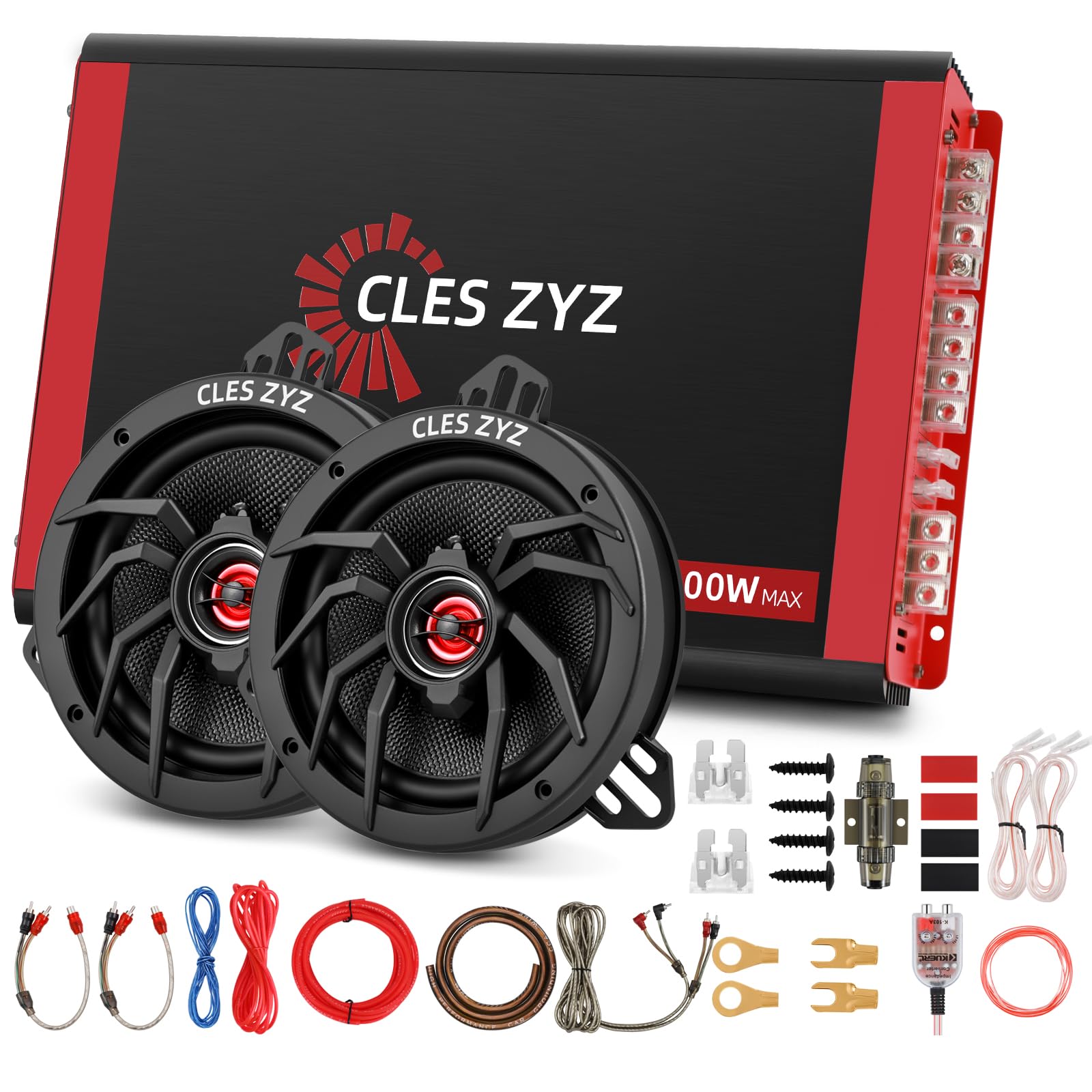
2. Car Speaker & Amplifier Combo Kit, 4 Channel Amp + 6.5″ Coaxial Speakers (a Pair) with Wiring Kit
A 4-channel amp and 6.5-inch coaxial pair that replaces blown factory door speakers.
This one exists for a very specific situation: your factory door speakers are blown or sound thin, and you want them replaced with real power behind them. The Class AB amplifier feeds a pair of 6.5-inch coaxial speakers — a coaxial design means the tweeter is built into the center of the woofer, so one unit covers both highs and mids. Those coaxials run at 4 ohm impedance, which is exactly half the 2-ohm load the Rockville sub package above presents, so the amp in each kit is built to match its own speakers rather than swap between them.
You get tight, punchy bass from the glass fiber woofer (a speaker cone made of woven glass strands) and clear highs from the Mylar dome tweeter (a small high-frequency speaker with a plastic dome). It is designed to work with your stock head unit directly, so no extra converters are needed. The pre-matched kit uses labeled ports, so you connect power, ground and RCA cables (the standard plugs that carry audio signal) instead of soldering anything. Push-in terminals remove polarity confusion (no guessing which wire is positive). A complete 8-gauge wiring kit (a thicker wire size that carries more current safely) sits inside the single box: power and ground wire, fuse holder, RCA signal cable, speaker wire and even an impedance converter (a part that matches electrical load so the amp stays stable). The 6.5-inch size replaces stock speakers in most sedans, SUVs, trucks and vans without cutting anything.
The trade-off is honest and it is real: the amp does not deliver the power its label implies. A detailed buyer review reported that it “went into protect at 50W; only worked at 25W RMS and sounded terrible” when pushed hard. Another owner simply replaced blown speakers in a 90s Jeep Grand Cherokee and was happy with clean, clear sound at moderate volume. So this is a good-value swap for casual listeners, not a competition build. If you want the speakers to keep up at high volume, plan to add a stronger amp later.
The straight answer: for a daily-driver speaker replacement at sane volume, this kit gets the job done cheaply and completely. For a basshead chasing loud clean output, the amp is the weak link and you will outgrow it.
Fits best when: your factory speakers are blown and you want a same-day replacement without a pro install.
Not the right call if: you plan to run the system near its limit — the amp shuts down well before the speakers do.
3. Double Din Car Stereo with 7″ HD Touchscreen, Wireless Apple CarPlay & Android Auto, Bluetooth, 240W
A 7-inch wireless CarPlay double DIN that modernizes an older dash on a budget.
The defining number here is the 7-inch IPS touchscreen at 1024×600 resolution — an IPS panel is a screen type that keeps colors and contrast readable from an angle, so the passenger can still see the map. It runs wireless and wired CarPlay and Android Auto, with the phone reconnecting automatically when you start the car. Voice control through Siri or Google Assistant handles navigation, calls, messages and music without you touching the screen.
Sound is handled by a built-in DSP processor and 4.1-channel output rated at 240W max, with a 10-band EQ for tuning and a subwoofer RCA output if you later add bass. A dedicated Bluetooth chip handles faster pairing, and the unit ships with both a built-in mic and an external mic port to keep calls clear at highway speed. A large rear heat sink keeps the amp section stable over long drives. Support for both a rear camera (an 8-LED unit is included) and a front camera is built in, with automatic switching when you shift into reverse.
Owners with older trucks keep landing on the same theme: it fits standard double din openings, the install is clear and well documented, and it punches far above its price for features. One 2000 Toyota 4Runner install went smoothly with responsive touch and bright display; another owner who replaced a Pioneer unit said wireless CarPlay was actually faster than the factory unit it replaced. The recurring gripes are small and specific — a handful of buyers find the customization limiting, though this brand is quick to send boot logo files when asked. The Bluetooth connection speed is where this beats the pricier BEAUTYTREES Ford unit above, which leans on its vehicle-specific fit rather than snappy pairing.
Editor’s read: the feature count and connectivity here are the reason this earns its spot. Wireless CarPlay that reconnects on its own is the single daily-use win you will notice most.
Snap it up if: you want modern smartphone projection on a budget and your dash already has a double din opening.
Pass if: you want a screen larger than 7 inches, or you want your sound customization baked in from the start.
4. 10.1″ QLED Double Din Car Stereo with Wireless Carplay & Android Auto, Music Sync Luminous Bar
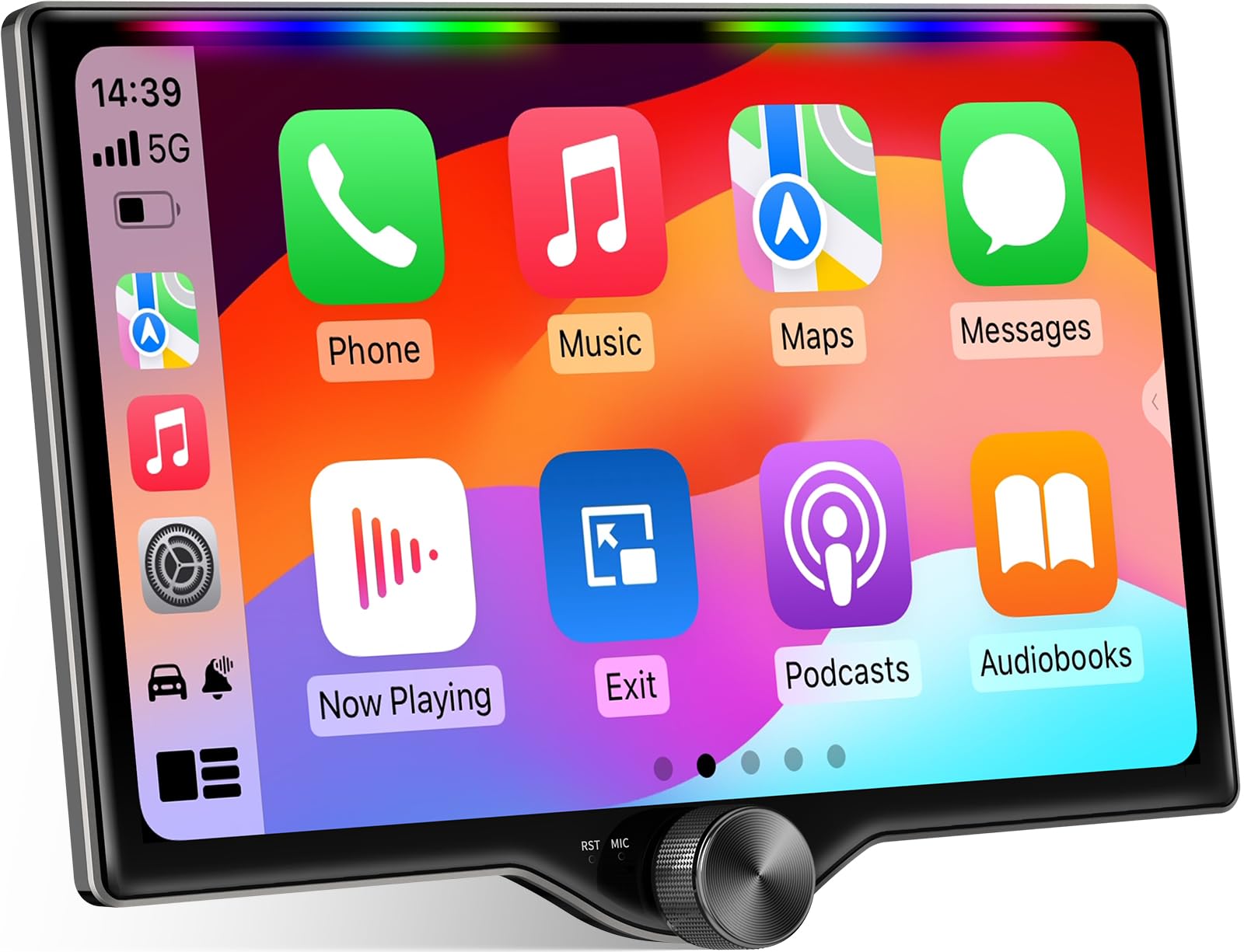
A 10.1-inch QLED double DIN with a physical volume knob on the bezel.
What sets this unit apart instantly is the 10.1-inch full QLED display — a QLED panel is a screen technology that stays sharp and colorful even when sunlight hits it. It fits most single and double din dash openings, and unlike the 7-inch Kissound head unit above, this screen is large enough to make maps and split-screen navigation genuinely readable at a glance. A built-in DSP chip and 10-band EQ handle tuning, with 4×60W peak power and dual subwoofer support for those chasing deeper bass.
The controls are where it earns real daily-use credit. A large physical volume knob (press it to mute) lives on the bezel, so you are not hunting for a touch target while driving. Dynamic LED ambient lighting above the screen pulses with your music, and users note it has a dim or off setting for night driving. Two rear USB ports, a 3.5mm mic jack, RCA connectors and support for both a rear camera (19.7ft extension cable included) and front camera round out the connections. Steering wheel control works through a compatible interface module, sold separately.
Owners describe the display as crisp with iPad-like resolution, and the install as straightforward enough to slide into a double din receiver without drama. A professional installer called it a six-star unit for the money, highlighting the QLED brightness, the standard 16-pin harness, two camera inputs, and wireless CarPlay and Android Auto that stayed flawless over weeks. The fair caveats worth knowing: a couple of buyers mention the USB-C port placement is inconvenient, and screen mirroring works for some apps but not for major subscription streaming services. The flimsy mic and thin wires also drew a mention.
Why It Stands Out
- 10.1-inch QLED panel with a large physical volume knob
- Built-in DSP with a 10-band EQ and dual subwoofer output
- Two camera inputs plus a 19.7ft rear camera cable included
- Light bar syncs to music with a dim or off option
Keep In Mind
- Steering wheel control needs a separate interface module
- Screen mirroring does not work with all streaming apps
- Some units ship with a flimsy mic and short cables for large trucks
The best match for: anyone who wants a big, bright screen plus the tactile safety of a real volume knob.
Think twice if: you need mirroring across every streaming platform, or you want steering wheel controls without buying an extra module.
5. BELVA BPKG210v2 1000W Dual 10″ Car Subwoofer with Ported Enclosure, Monoblock Amplifier and Remote Bass Knob

A ported dual 10-inch enclosure with a monoblock amp and remote bass knob.
You get serious low end from 1000W peak and 500W RMS total (RMS is the continuous power the amp can deliver, not just a brief burst), split across two 10-inch drivers in a ported enclosure (a box with a tuned opening that boosts bass). That ported design gives more bass output per watt than a sealed box of the same size, so you feel the kick drum in your chest. The trade-off: ported boxes are physically larger and need more airspace. The polypropylene cone (a tough plastic speaker cone) keeps each driver light but strong, which helps it reproduce accurate mid and low notes. It is an all-in-one package compatible with any vehicle, and it stays usable whether you drive a hatchback or a trunk-heavy sedan.
Setup is where the honest picture appears. The amplifier in this kit has no vents or fans, so it runs hot and needs clearance when mounted. One experienced buyer recommends mounting it an inch above the panel and tuning with an oscilloscope (a tool that reads voltage waveforms) at around 50% gain to avoid overheating shutdowns. It performs best in a hatchback or SUV with the subs facing rearward, where the cabin traps the bass. It struggles in a convertible, where there is no cabin to pressurize. The included remote bass knob lets you dial the low end from the driver’s seat.
The bass itself is what most people celebrate — descriptions of it running the car and shaking the driver are common, and buyers flag that for the money the low end is hard to argue with. The mixed note is long-term reliability: some units keep working for years, while others stop after months, so cooling and conservative gain settings matter here. That cooling dependency is the practical gap versus the Crunch and MTX bundle below, which uses a heat-dissipating heatsink design.
Setup matters more here: give the amp airflow and tune it sensibly, and this package performs like it costs more. Max it out and the lack of ventilation will bite.
Worth grabbing if: you drive a hatchback or SUV and want a turnkey ported box with a remote bass knob.
Skip if: you drive a convertible, or you want to run the amp flat-out without giving it breathing room.
6. Crunch 1000 Watt 2 Channel Amplifier with MTX 12 Inch Subwoofer Enclosure
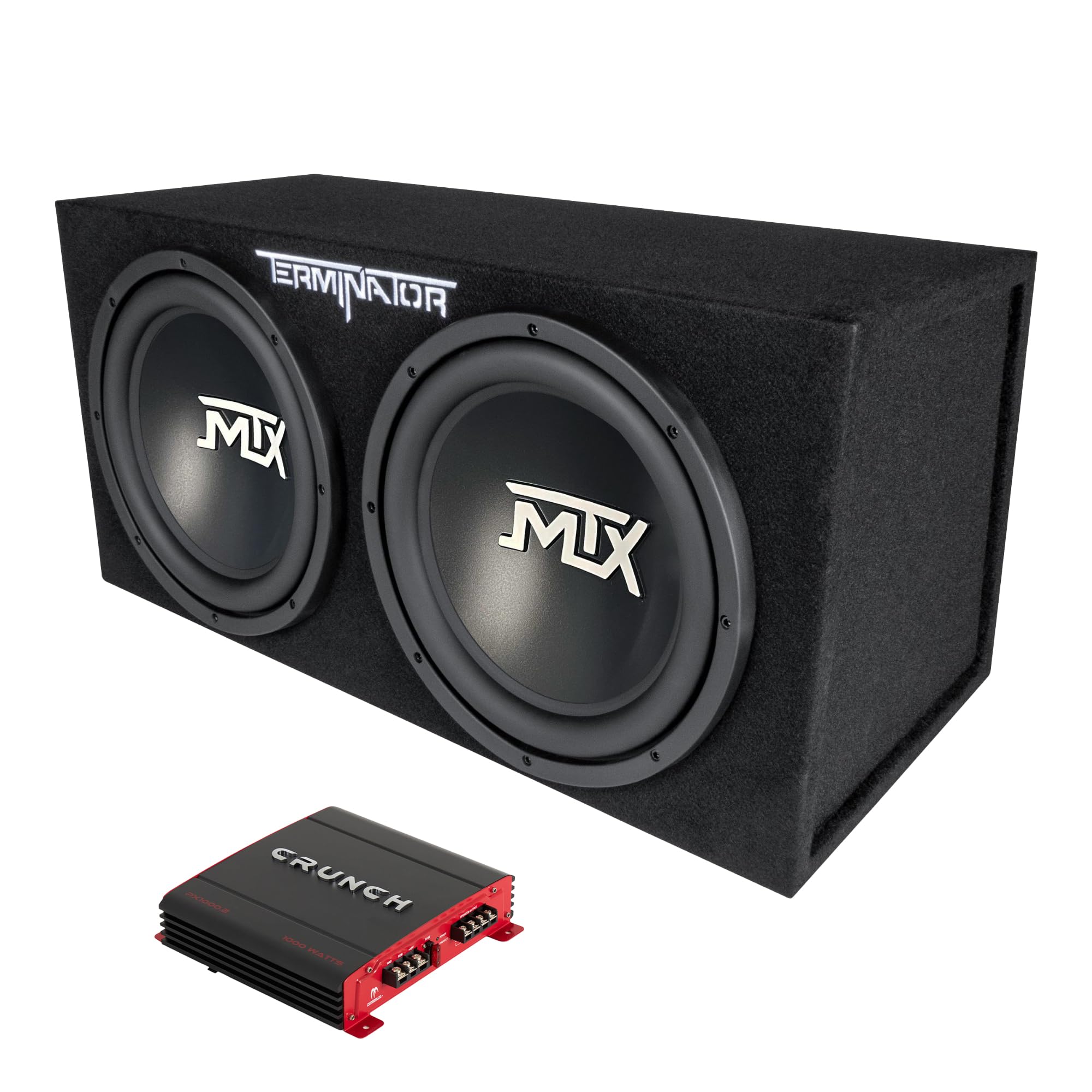
Dual 12-inch subs in a sealed box, paired with a Crunch amp using Quick Thermal Dispersion.
The first thing to understand is the wattage split, because it explains the whole package. The Crunch amp is rated 500W at 2 ohm, 250W at 4 ohm, and 1000W mono bridged at 4 ohm at 14.4 volts. The dual 12-inch Terminator subs in their sealed enclosure handle 1200W max and 400W RMS. A sealed box trades some raw output for a tighter, more controlled low end than a ported design, which is why this setup suits rock and punchy bass as much as anything else.
Where the amp earns its keep is thermal design. It uses Quick Thermal Dispersion Technology, which places more aluminum on the heatsink than a standard amplifier to pull heat away and keep performance stable. The subs themselves run a rubber surround and polypropylene cone, a 2-inch aluminum single 4-ohm voice coil and a 48-ounce magnet for deep bass. Those 12-inch drivers are the largest sub size in this roundup, and the enclosure measures 29.69 x 14 inches, so it takes real trunk space.
Owners who got a clean unit love it — distortion-free bass that rivals more expensive custom builds, and an install that is easy with a wiring kit. The pattern worth knowing before you commit is amp pairing. The amp does not push the full advertised 1000W, and more than one rig has gone into protect mode after extended hard play, sometimes needing a power capacitor to stay stable. The subs themselves get far more praise than the amp, so if you plan to hammer this setup, budget for a stronger amplifier down the line.
Where the value lives: the MTX subs do the heavy lifting and sound excellent; the amp is the component you may outgrow. Buy it for the box and drivers.
A smart pick for: builders who want quality 12-inch subs and plan to run them at moderate power or upgrade the amp later.
Go another route if: you want to bridge the amp to full output and play for hours without a protect-mode interruption.
7. Loaded Dual 12″ Vented Sub Box with Amp and Wiring Kit – Harmony Audio
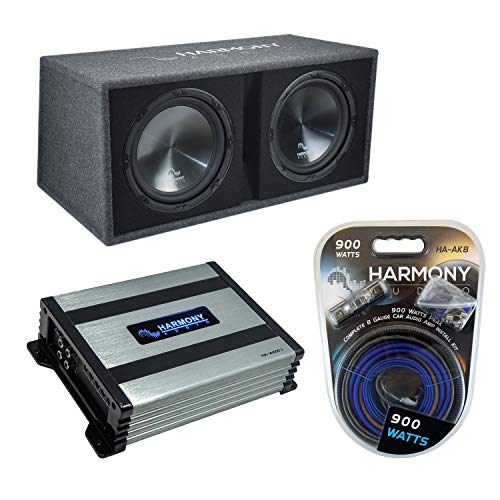
A vented dual 12-inch box with a Class D monoblock amp and wiring kit.
This package pairs a loaded dual 12-inch vented enclosure with a Harmony Audio HA-A400.1 Class D monoblock amplifier and a wiring kit. “Monoblock” simply means the amp has one channel, built explicitly to drive subwoofers rather than full-range speakers. The system is rated at 1200W max output with 800W output, running on a 14.4-volt supply. The box is built from 5/8-inch MDF, a lighter material than the 3/4-inch board used in the Rockville enclosure above.
The enclosure is vented, meaning a tuned opening boosts lower frequencies for a louder, deeper sound than a sealed box. It comes as a complete three-piece bundle — enclosure, amp and wiring — so you are not sourcing parts separately. Buyers regularly describe it as an entry-level package that still delivers genuine output. One owner was skeptical because the listing had few reviews, then found the subs impressive after a month of use. Another reported his Durango hitting harder than a system that cost far more. That pattern — modest price, surprisingly strong bass — is the reason it earns a spot here.
The catch is the wiring and the power expectations. The included 8-gauge power wire is thin for this class of amp, and hauling current through it costs you efficiency, so upgrading to 4-gauge is a smart move. The advertised 800W figure is optimistic; wired in series, the 4-ohm woofers present a 2-ohm load that realistically delivers far less RMS power, so this is not a competition-grade setup. Treat it as a value entry into real bass rather than a system that will shake buildings.
Reasons Buyers Like It
- Complete bundle: dual 12-inch vented box, Class D monoblock amp and wiring kit
- Vented design boosts low-end output over a sealed box
- Consistently described as delivering more than expected for the money
Plan Around This
- Included 8-gauge power wire is thin for the amp’s class
- Real-world RMS output is well below the advertised peak figure
- Vented 12-inch box takes up significant trunk space
A good fit for: first-time sub buyers who want a complete bundle and strong bass on a tighter budget.
Look further if: you need competition-level output or want a premium-quality wiring kit included from the start.
8. 12.1 Inch Android 13 Car Radio for Ford F150 2015-2022 F250 F350 F450 2017-2022, Snapdragon 665 Car Stereo Upgrade
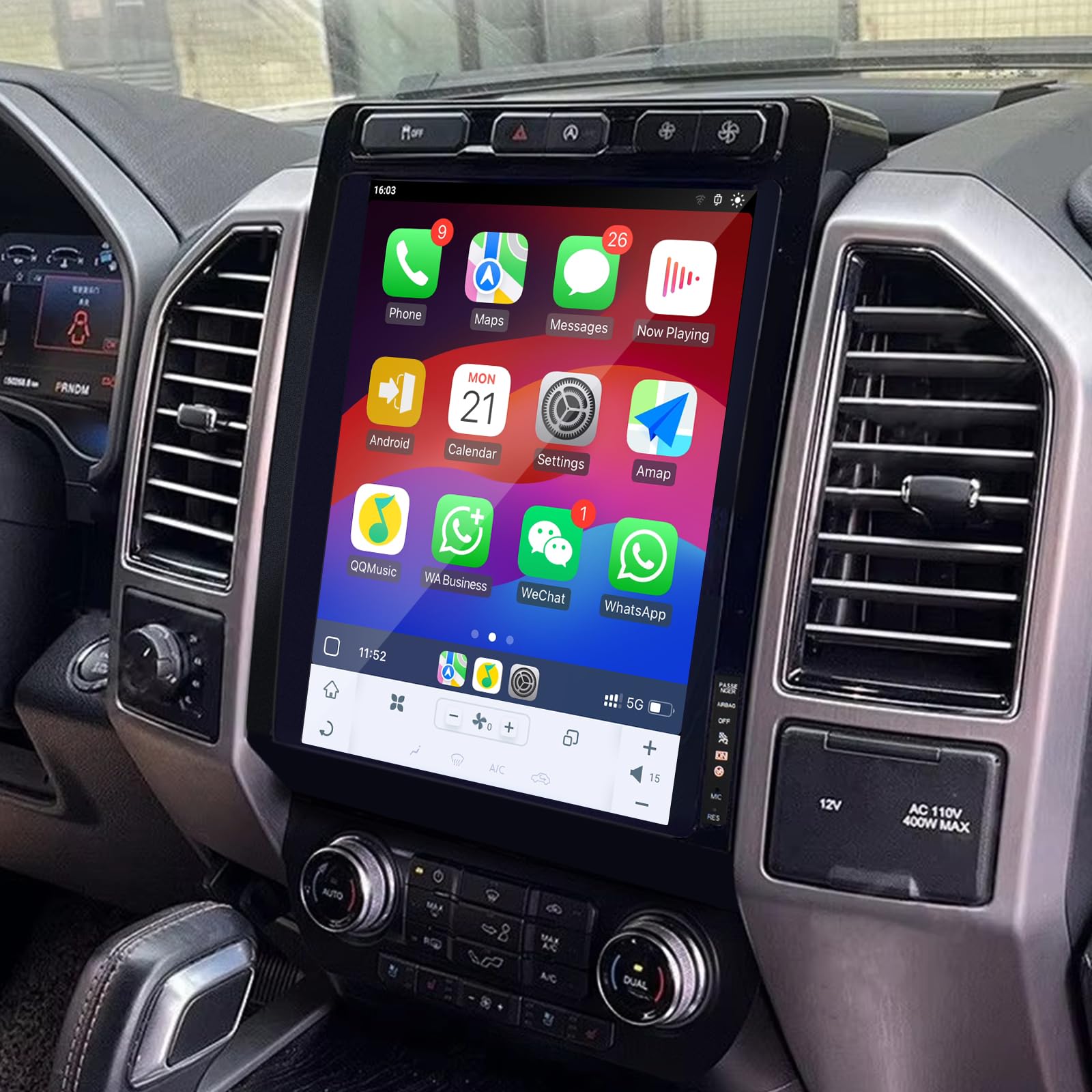
A giant Tesla-style screen built to drop into specific Ford truck dashes.
This is a vehicle-specific unit, not a universal one, and that is the whole point. It is designed for Ford F150 models from 2015 to 2022 and F250, F350 and F450 models from 2017 to 2022, compatible with SYNC1, SYNC2 and SYNC3 systems. The hardware is a step above a cheap tablet-in-a-dash: a Qualcomm Snapdragon 6125 octa-core processor with 4GB RAM and 64GB storage, running Android 13. A 12.1-inch touchscreen is the largest display in this roundup.
Connectivity is broad. Wireless and wired CarPlay and Android Auto are supported, so your music, directions and calls route through the screen. It has a stable built-in Wi-Fi module with 4G SIM card support, GPS plus GLONASS positioning for online and offline navigation apps like Google Maps and Waze, and Bluetooth 5.1 for hands-free calls and phone book downloads. The packaging includes the head unit, wires and accessories, and the maker offers a one-year warranty with a free returns window.
Honesty matters most with this one, because it has the lowest owner satisfaction of any pick here. Several installs hit real friction: one buyer found the unit needed excessive extra work to function, and another reported fitment issues that required trimming plastic. Audio quality drew complaints too, with one owner saying the built-in amp was weak enough that an external amp became necessary. It is included here because for the right Ford owner who wants a massive factory-look screen and accepts the fitment work, it delivers that unique result — just go in with realistic expectations.
The bottom line: the screen size and hardware are genuinely appealing for a Ford truck dash, but this unit demands patience and possibly extra amp spending. It is a fit-with-effort pick, not a drop-in.
Consider it if: you own a compatible Ford truck and prize a 12.1-inch screen over a friction-free install.
Steer clear if: you expect a plug-and-play fit or want strong built-in audio without adding an amp.
9. Sony XAV-AX7000 6.95″ Apple Carplay/Android Auto High Power Media Receiver
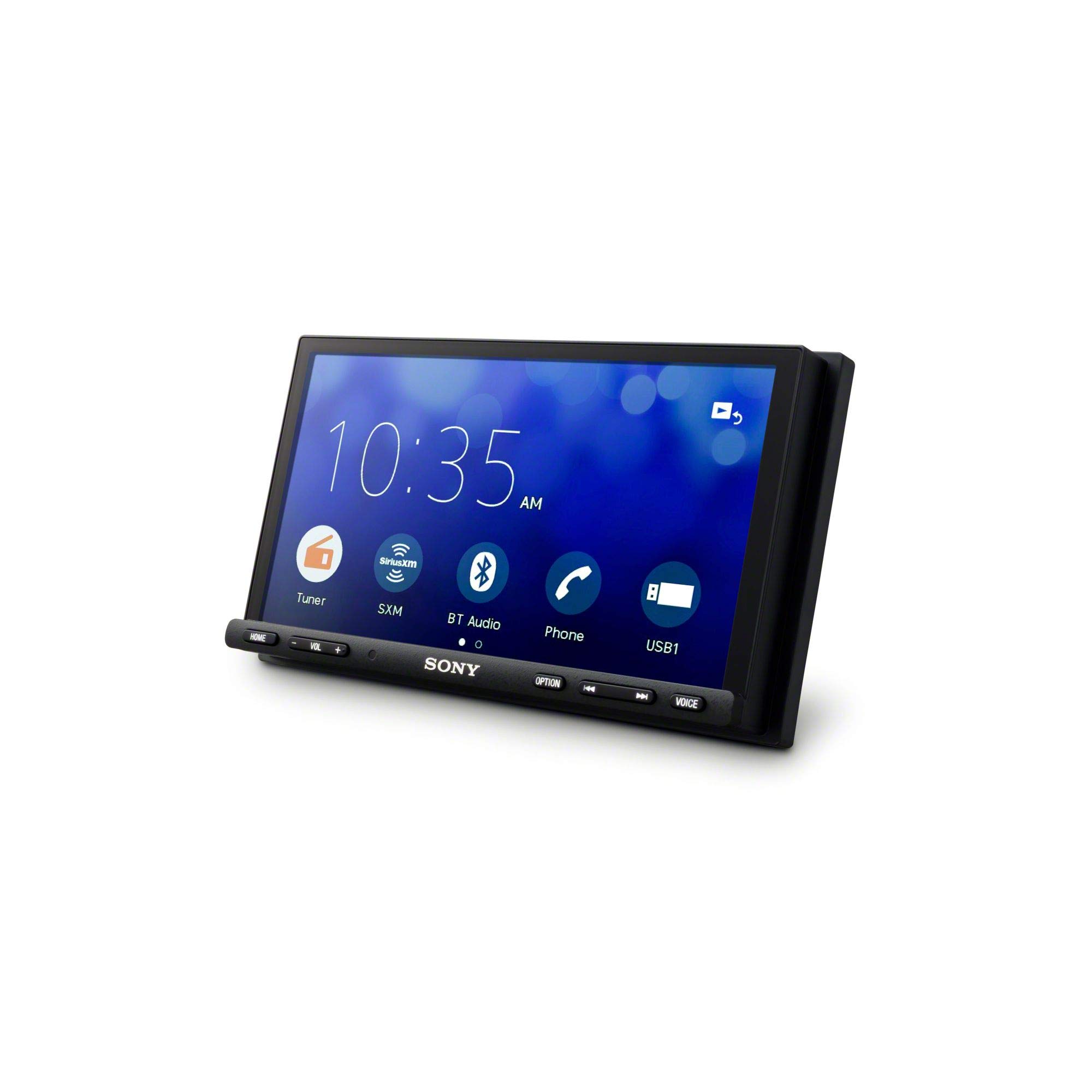
A head unit built to drive speakers hard with its own muscle, not an add-on amp.
Power is what separates this Sony from every other head unit here: it runs a high-output 180W RMS internal amplifier (RMS is the continuous power it can deliver, not just a brief peak), so you can push upgraded speakers with real authority and even drive a subwoofer without a separate inline amp. That is a different approach from the 240W max Kissound or the 4×60W peak Kissound 10.1-inch, both of which lean on their own amp sections but without the same rated RMS output. The 6.95-inch bezel-less panel (a screen with almost no frame around it) has a touch-friendly surface and an intuitive interface.
On the tech side you get voice-activated CarPlay and Android Auto for music, navigation and messages. The dynamic reality amp 2 technology reduces external noise, and EXRABASS handling adds deep low frequencies. Bluetooth audio streaming is onboard, and double USB ports let you connect multiple devices. Three pre-outs give you expandability for additional amplifiers down the road, so it scales if you build out the system later.
What owners consistently report is strong build quality and a powerful internal amp that holds its own with upgraded speakers — a proper Sony unit that delivers. The honest notes: the display runs bright, and some drivers find it too bright at night in a dark cabin. CarPlay navigation while an incoming call arrives has caused glitches for some users, and one owner reported Android Auto connection drops after a firmware update. For most buyers running music and maps daily, none of that is a dealbreaker, and the fit can be tidy — one owner dropped it into a 2014 Subaru WRX dash with no drama.
Why It Earns Its Keep
- 180W RMS high-output internal amplifier drives speakers without a separate amp
- Dynamic reality amp 2 and EXRABASS for cleaner, deeper sound
- Three pre-outs for future amplifier expansion
- Double USB ports for multiple device connections
Straight Talk
- Screen brightness can be too much at night for some drivers
- Occasional CarPlay navigation glitches when a call comes in
- One report of Android Auto drops after a firmware update
Made for: drivers who want serious internal amplification and would rather avoid the cost of an external amp.
Look past it if: you need a screen bigger than 6.95 inches or you want the latest connectivity firmware without any hiccups.
10. JVC KW-Z1000W Bluetooth Car Stereo Receiver with 10.1″ Floating Touchscreen HD Display

A tuning-focused receiver for people who want to shape their sound, not just stream it.
The 10.1-inch floating HD capacitive touchscreen is the most visible feature, but the audio tools underneath are the real story. A 13-band equalizer with digital time alignment lets you adjust individual frequencies and correct for speaker placement in the cabin. K2 technology improves the digital sound for all music sources, which matters if you stream or play compressed files. That is a deeper tuning suite than the 10-band EQ on the Kissound 10.1-inch above, aimed squarely at listeners who want to dial in the sound themselves.
Expandability is where this JVC pulls away from simpler units. The rear panel offers a USB input, a mini A/V input, an HDMI input, four camera inputs, a mini A/V output and 6-channel preamp outputs rated at 5 volts across front, rear and subwoofer. It works with the iDataLink Maestro module for integrated vehicle functions. The manual tilt adjustment moves from minus 10 to plus 45 degrees to fight glare, and it is compatible with a SiriusXM tuner. Wireless or wired CarPlay and Android Auto are both supported, with hands-free calling and dual phone connection.
The install reality here is worth flagging plainly: a wired connection to the parking brake is required to access settings and video display, so that connection has to be made. Owners who upgraded older Toyota systems loved the added control and the clean, powerful sound — one Tacoma owner installed it after a factory stereo died and found the onboard power revived the speakers already in the truck. One recurring note: call quality can suffer, with a caller reporting an echo on the other end. It is not an issue for music listening, but it is a real one for phone-heavy drivers.
The audio-first answer: if your priority is shaping the sound with deep EQ tools and expanding later with amps and cameras, this is the better-provisioned head unit here. If clear hands-free calls are a top priority, test that side carefully.
Right for you if: you want a floating 10.1-inch screen with serious EQ and preamp expandability.
Reconsider if: you mostly take calls in the car, or you want a receiver that needs only basic wiring.
11. Stinger HEIGH10+ 10.1″ Wrangler JK Car Stereo with Wireless Apple CarPlay

A rugged, vehicle-specific head unit that adds off-road gauges to a factory-look Jeep dash.
This one is built for exactly one vehicle family: the Jeep Wrangler JK from 2011 to 2018. It is designed to look factory-fresh in that dash, and the maker notes it is not compatible with 392 or Wrangler 4XE models. The display is a 10.1-inch HD panel at 1280×800 resolution with anti-glare, anti-reflection and anti-fingerprint film, so it stays readable under trail glare. MFi-certified wired and wireless Apple CarPlay, plus Android Auto and Bluetooth, give you hands-free navigation, calls, messages and voice apps.
The signature feature is the off-road instrument cluster. It monitors pitch and roll, GPS coordinates, compass heading, altitude, transfer case position, steering angle and more, turning your screen into a trail gauge display. Audio tuning runs through 4.5V 8-channel RCA outputs with subwoofer control, a 15-band EQ, six presets and built-in HPF and LPF crossovers — a serious tuning suite. You also get two USB-A ports, a USB-C port with 3A fast charging, an HDMI input, HD AM/FM radio, and support for up to four AHD or CVBS cameras including backup, dash, blind spot and front. Optional offline iGO GPS navigation is available through a separately sold SD card.
Owner feedback centers on the upgrade factor: Jeep drivers moving off an outdated Uconnect that could not support newer phones found this unit solved every one of those problems, and the step-by-step instructions were praised as clear enough for a careful DIY install. The screen is larger than some buyers expected, and Bluetooth phone pairing was straightforward. The real caution is about the install kit rather than the radio itself. At least one buyer received a kit with wrong or missing parts and could not get a small replacement cable from the seller, which forced a return. For most buyers the radio does its job well, but it is worth confirming your kit contents on arrival.
Trail-Ready Strengths
- Purpose-built fit for Jeep Wrangler JK 2011-2018 with a factory-style look
- 10.1-inch 1280×800 HD display with anti-glare and anti-fingerprint film
- Off-road gauges for pitch, roll, GPS, compass, altitude and steering angle
- 4.5V 8-channel RCA outputs with 15-band EQ and six presets
- Two USB-A, one USB-C with 3A charging, HDMI and four-camera support
Before You Commit
- Install kit contents have occasionally shipped with wrong or missing parts
- Does not fit 392 or Wrangler 4XE models
- Offline iGO navigation requires a separately sold SD card
The clear pick for: Jeep Wrangler JK owners who want a factory-look screen plus real off-road instrumentation in one unit.
Not your unit if: you drive anything other than a Wrangler JK, or you want every accessory cable confirmed in the box before it ships.
Understanding the Specs
RMS vs Peak Power
Peak power is the number a manufacturer prints in big letters — it is the maximum burst a component can survive for a fraction of a second. RMS power is the number that actually matters for daily listening because it is the continuous power a component handles without strain. The Rockville sub package lists 400W RMS against 1600W peak, and the Crunch amp is 400W RMS versus 1200W peak — that wide gap is normal and expected. When you compare sub kits, compare the RMS figures side by side; a bigger peak number with a similar RMS tells you nothing extra about real output.
Impedance and Ohm Matching
Impedance is measured in ohms and describes how much electrical resistance a speaker or sub presents to an amplifier. A lower number means the amp can push more current, which usually means more volume — but the amp has to be stable at that load. The Rockville subs run at 2 ohm, while the CLES ZYZ coaxials run at 4 ohm. Feeding an amp a load it was not built for is the fastest route to protect-mode shutdowns and overheating. Always confirm your amp’s rated impedance range before wiring, and never assume two components will pair just because the connectors fit.
Wiring Gauge and Power Delivery
Wiring gauge describes the thickness of the power cable, and it runs inversely to the number — 8-gauge is thinner than 4-gauge. A thin cable restricts current flow, creating heat and voltage drop that can starve a high-power amp. That is why the Harmony Audio bundle’s included 8-gauge wire is a limiting factor for its amp class, and why upgrading to a thicker gauge is a common recommendation. A kit that ships with the factory-suggested gauge saves you a second order and avoids a bottleneck you might never diagnose otherwise.
Head Unit Screen and Amplifier Output
A head unit’s built-in amp wattage decides how hard it can drive your door speakers without adding an external amp. The Sony XAV-AX7000 runs a high-output 180W RMS internal amplifier that can drive a subwoofer directly, while the Kissound 10.1-inch is rated 4×60W peak and the 7-inch model delivers 240W max. Screen size and resolution also vary widely — from 6.95 inches up to a 12.1-inch display — and the largest screens are often vehicle-specific rather than universal double din. Pick the screen that fits your dash first, then confirm its amp output can drive the speakers you plan to run.
FAQ
Do I need a separate amplifier if my head unit already has one built in?
What is the difference between 2 ohm and 4 ohm for car audio?
Will a double din head unit fit my car?
How much RMS power do I really need for a car subwoofer?
Should I buy a sealed or a ported subwoofer enclosure?
Does the wiring kit gauge really matter in a car audio system?
Can I install a car audio system myself or should I hire a professional?
Do I need CarPlay or Android Auto in a car stereo?
Will adding a subwoofer require me to upgrade my door speakers too?
How long do car audio amplifiers and subwoofers usually last?
Final Thoughts: The Verdict
For most drivers chasing real bass without assembling parts, the audio system for cars winner is the Rockville DK58 Package with dB11 Amp, because it bundles the subs, the enclosure, the amp and the wiring into one kit with strong RMS output. If you want to modernize your dash with a large screen and a physical volume knob, reach for the Kissound 10.1-inch QLED head unit. And if your factory door speakers died and you just need them back cheaply, the CLES ZYZ amp-and-speaker kit is the practical fix.
One last thing worth saying plainly: match the right component to your actual gap. A head unit if the dash is the problem, a sub package if the low end is missing, or a speaker kit if the factory cones are done. Get the impedance (the electrical load the amp sees), the wiring gauge (wire thickness) and the dash fit right, and even a modest build sounds like it costs far more.
How We Picked
We do not accept paid placement. Every pick is matched to a real buyer and a real use-case; we do not hands-on test units.
Sources & Methodology
Specifications: manufacturer listings and product documentation. Review insights: verified customer reviews, as of September 2026. Pricing: not shown on this page (it changes often); check the current price via the retailer link.
As an Amazon Associate, Gadgets Feed earns from qualifying purchases. This does not affect which products we feature.