
A projector’s optical engine can deliver a massive 150-inch image, but if the audio chain collapses into a thin, tinny whisper, the entire cinematic illusion shatters before the opening credits. The gap between a projector’s built-in speakers—typically two 5-watt drivers buried in a plastic chassis—and the room-filling presence required for dialogue clarity and LFE (low-frequency effects) impact is wider than most buyers realize, which is why selecting the right companion sound system is the single most consequential decision for your home theater build.
I’m Min — the co-founder and writer behind Gadgets Feed. I’ve spent hundreds of hours cross-referencing THD (total harmonic distortion) ratings, wireless codec latency figures, and amplifier topology across dozens of soundbars, powered bookshelf pairs, and discrete surround packages to separate genuine engineering from marketing hype in the projector audio space.
This guide focuses exclusively on rigs that solve the specific acoustic deficit of front-projection setups — where the screen surface blocks traditional TV-soundbar placement and rear-channel speaker wire runs can exceed 30 feet. Whether you are building a dedicated light-controlled theater or a multi-purpose living room layout, the best audio system for projector must reconcile spatial immersion with the physical constraints of projection geometry.
How To Choose The Best Audio System For Projector
Projector audio selection differs from TV audio because the acoustical center of the room is rarely where the projector sits — usually at the rear or ceiling, far from the listener’s ear level. The following criteria will help you match the sound solution to your screen size, throw distance, and room treatment.
Channel Count and Discrete Surround
A 2.0 or 2.1 soundbar can improve dialogue clarity over built-in speakers, but it will never produce the rear-channel panning effects that make a 120-inch image feel enveloping. For a proper home theater projector setup, target a minimum of 5.1 discrete channels — left, center, right, two surrounds, and a subwoofer — so that sound objects track with on-screen movement rather than collapsing into a single stereo plane. Virtual surround processing (Dolby Atmos Height Virtualization, DTS Virtual:X) is acceptable in rooms where running speaker wire to the rear wall is impossible, but it trades spatial precision for convenience.
Amplifier Power and LFE Management
Peak power ratings (often quoted at 600W or 1200W) are marketing numbers that represent a brief, distorted burst. Instead, look for the RMS (continuous) power rating, particularly for the subwoofer channel. A projector’s image relies on perceived contrast; a subwoofer capable of 50W RMS or more — paired with a crossover that can be set between 80 Hz and 120 Hz — will reinforce the tactile punch of explosions and bass drops without muddying the mid-range frequencies where speech lives. Systems that allow independent volume control for each satellite channel let you compensate for room acoustics or long cable runs that naturally attenuate high-frequency content.
Wireless Connectivity and Latency
Bluetooth audio codecs (SBC, AAC, aptX) introduce a latency of 40ms to 200ms, which can cause visible lip-sync errors on a projector that already has its own processing delay. If you must use wireless, choose a system that supports Bluetooth 5.2 with aptX Low Latency or a proprietary 2.4 GHz wireless connection for the rear channels. Alternatively, an audio system with HDMI ARC or optical input provides a zero-compression, fixed-latency path that preserves audio-video sync at all bitrates. Systems that offer a dedicated 3.5 mm aux input are useful for projectors that lack HDMI ARC, but they sacrifice digital signal volume control.
Quick Comparison
On smaller screens, swipe sideways to see the full table.
| Model | Category | Best For | Key Spec | Amazon |
|---|---|---|---|---|
| ULTIMEA Aura A40 | Soundbar + Satellites | Virtual 7.1 with app EQ tuning | 330W Peak / 7.1ch Virtual | Amazon |
| Bobtot 5.1 System | Discrete 5.1 | True surround with 10″ sub | 1200W Peak / 10″ Driver | Amazon |
| Klipsch Cinema Dolby Atmos 5.1.4 | Discrete 5.1.4 | Height-channel immersion | 5.1.4ch / Tractrix Horn | Amazon |
| Acoustic Audio AA5210 | Discrete 5.1 | Entry-level surround upgrade | 600W Peak / 5.1ch RCA | Amazon |
| Aurzen EAZZE D1R | Built-in + BT | All-in-one Roku projector | Dual 5W / Dolby Audio | Amazon |
| HAPPRUN Google TV Projector | Built-in + BT | Compact 1080p with 5W speaker | 400 ANSI / 5W Speaker | Amazon |
| HAPPRUN 2000 ANSI | Built-in + BT 5.2 | Bright room + bidirectional BT | 2000 ANSI / 8W Speaker | Amazon |
| NEBULA Capsule 3 Laser | Portable Laser | Ultra-portable + Dolby Digital | 300 ANSI / 8W Speaker | Amazon |
| Valerion VisionMaster Pro2 | Triple Laser Flagship | Reference cinema + external pre-out | 3000 ISO / 15,000:1 Contrast | Amazon |
In‑Depth Reviews
1. ULTIMEA Aura A40

The ULTIMEA Aura A40 combines a soundbar, wired subwoofer, two front surround speakers, and two rear surround speakers to create a 7.1-channel virtual surround array that projects distinct spatial cues across a 120-inch screen. Its SurroundX technology processes stereo sources into multi-channel audio with 99.99% detail accuracy — meaning footsteps in a horror film track laterally from front-left to rear-right without audible phase cancellation, a feat most soundbars cannot replicate without discrete satellite placement.
The wired rear speakers connect wirelessly to the soundbar core, which solves the projector’s rear-wall cable-run problem: the right rear satellite needs only a single power lead, while the left rear daisy-chains via a 6-meter cable. The 121 preset EQ matrices accessible through the Ultimea Home app let you dial in a “Night” mode for late-night viewing that compresses dynamic range without crushing LFE, or a “Game” mode that boosts mid-range footsteps at 2 kHz. Subwoofer output is punchy for a 330W peak system, with bass extension down to roughly 40 Hz before roll-off.
What holds the Aura A40 back from absolute reference status is its reliance on virtual height processing rather than physical up-firing drivers — Dolby Atmos content is simulated, not rendered with dedicated elevation channels. The optical input caps audio at compressed Dolby Digital rather than lossless TrueHD, so Blu-ray purists may notice a slight flattening of the frequency spectrum during complex scenes. Pairing with a projector via optical and enabling PCM output on the projector yields the most stable sync results; Bluetooth streaming introduces a minor but detectable 80ms latency.
Why it’s great
- Four physical surround satellites create genuine rear imaging absent in standard soundbars
- 121 preset EQ matrices give granular control over dialogue clarity, bass punch, and surround depth
- App-controlled 10-band parametric EQ enables room-specific tuning without a separate receiver
Good to know
- Virtual Atmos processing lacks the overhead height channel of a true 5.1.4 system
- No HDMI input limits lossless Dolby TrueHD and DTS-HD Master Audio passthrough
- Rear satellite pairing occasionally requires manual re-sync after power cycling
2. Bobtot Home Theater System 5.1
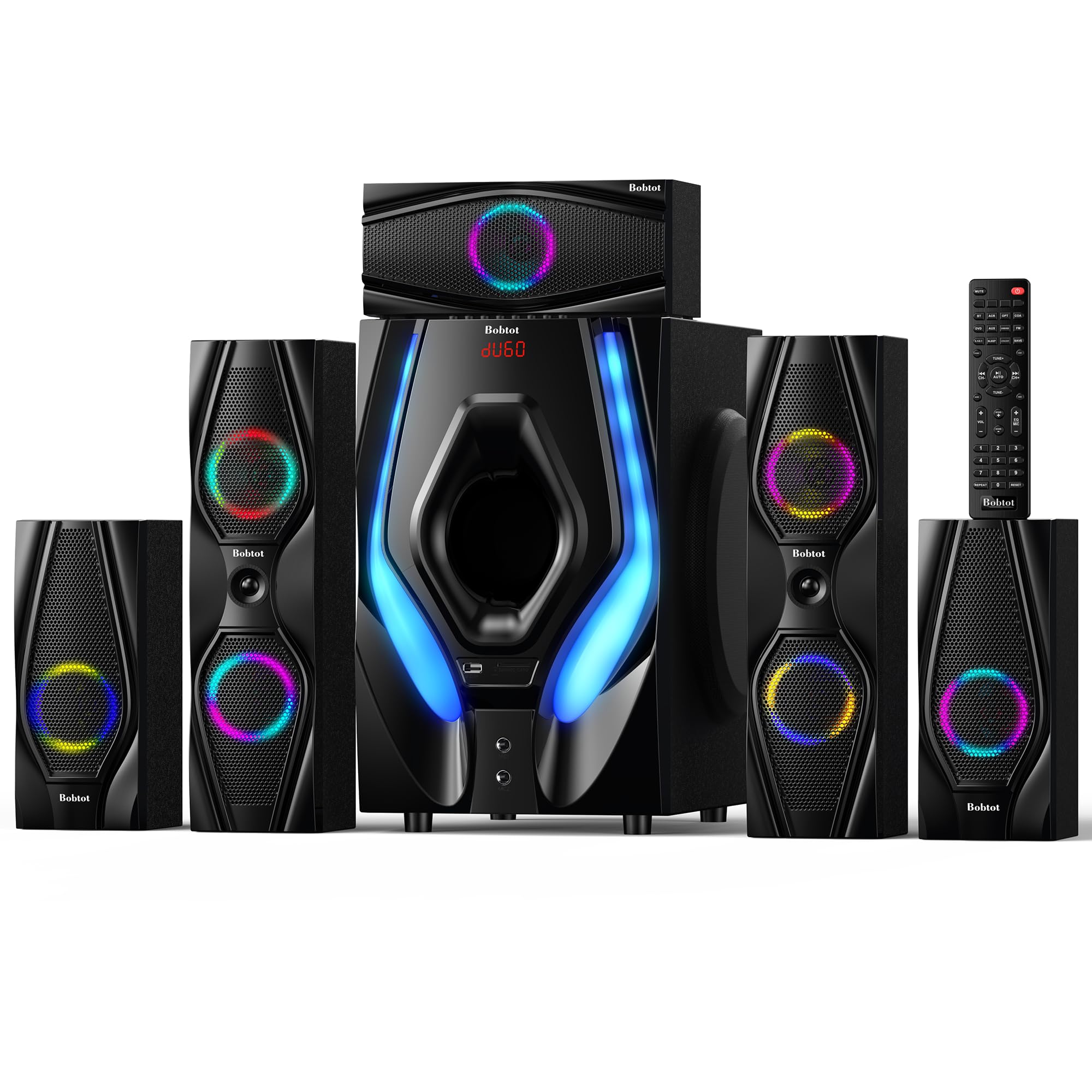
The Bobtot 5.1 system centers on a 10-inch powered subwoofer with a built-in receiver that delivers genuinely tactile LFE — the kind that shakes a couch during the opening bass drop of “Blade Runner 2049.” The 2.1/5.1 switchable mode means you can run it as a stereo-plus-sub setup for music streaming or as a full 5.1 array with four satellite speakers (two front, two rear, one center) connected via built-in RCA cables: front channels get 13-foot leads and the rear channels get 31-foot leads, letting you place the surrounds on the side walls 15 feet behind the listening position without extension cables.
The four LED lighting modes on the subwoofer (blink-to-beat, solid, spectrum EQ analyzer, off) add atmospheric bias lighting that can be synchronized to the projector’s screen content through the analog input — useful for movie nights where the subwoofer sits near the screen edge. Independent volume control per speaker via the remote lets you boost the center channel by +3 dB for dialogue-heavy films or raise the rear surrounds by +6 dB for spatial games like “Hellblade II” where positional audio carries critical narrative cues.
Durability is the caveat: multiple user reports describe amplifier failure within the first year, though the manufacturer’s replacement service appears responsive. The ¼-inch microphone inputs with echo function are a niche addition for karaoke but consume rear-panel space that could have housed a second optical input. The absence of HDMI ARC means the system relies on optical or RCA from the projector, and the optical input caps at Dolby Digital rather than 5.1 PCM, so some projectors may require a separate audio extractor to pass multi-channel signals.
Why it’s great
- 10-inch subwoofer delivers deep, room-shaking LFE that 6.5-inch drivers can’t match
- 31-foot rear speaker cables eliminate the need for extension wires in large projector rooms
- Independent channel volume control allows precise tonal balance without a receiver
Good to know
- Reported amplifier failures in the first year suggest inconsistent quality control
- No HDMI ARC limits digital audio to optical with compressed Dolby Digital only
- Center speaker placement near a projector screen may block the remote IR sensor
3. Klipsch Reference Cinema Dolby Atmos 5.1.4

The Klipsch Reference Cinema 5.1.4 system is the only solution on this list with physical Dolby Atmos up-firing drivers integrated into the front-left, front-right, and rear satellite cabinets — delivering genuine overhead height channel effects that reflect off the ceiling and down to the listening position. The 90° x 90° Tractrix horn-loaded aluminum tweeters produce a high-end response that extends beyond 20 kHz, which translates to airy, extended detail in treble-heavy content like wind rustling or rain from above in “1917.”
The four satellite speakers each house a 5.25-inch woofer alongside the up-firing driver, which gives each channel a surprisingly solid bass foundation even before the subwoofer engages. The all-digital subwoofer amplifier uses a 10-inch side-firing driver tuned to 90Hz-120Hz crossover points — slightly higher than the ideal 80Hz THX standard, but the satellites’ extended low-end means you can set the receiver crossover at 100Hz without audible localization of bass notes. The four Atmos channels (front height and rear height) are discrete rather than virtually processed, so a Dolby Atmos test tone moves smoothly from front-left-height to rear-right-height without artifacts.
The system does not include speaker wire or an AV receiver, which raises the total investment: you need a 9.1-channel AV receiver to power all five satellite channels plus the subwoofer’s LFE input, or a 7.1-channel receiver if you pair the front heights with the front left/right binding posts. The subwoofer’s down-firing design can sound muddy on carpeted floors, and the plastic satellite enclosures, while acoustically optimized, lack the mass of Klipsch’s Reference Premier wood-veneer line. Still, for a projector owner who can route 16-gauge wire through the ceiling and walls, this system delivers the most authentic Dolby Atmos experience under .
Why it’s great
- Physical up-firing drivers in all four satellites create true overhead height effects
- Tractrix horn tweeters deliver exceptional high-frequency extension and dispersion
- 5.25-inch woofers in satellites provide a solid low-end that blends cleanly with the subwoofer
Good to know
- No AV receiver or speaker wire included — requires a separate 9.1-channel AVR purchase
- Subwoofer output lacks the punch of larger 12-inch or 15-inch designs
- Plastic cabinets feel less premium than higher-end Klipsch Reference Premier series
4. Acoustic Audio by Goldwood AA5210

The Acoustic Audio AA5210 is the lowest-cost true 5.1-channel surround system that can transform a projector’s tinny built-in audio into a multi-directional experience. The powered subwoofer houses a 6.25-inch driver and a 600-watt peak amplifier that, while not comparable to a 10-inch design, produces enough 50 Hz presence to make action scenes feel connected to the screen. The five passive satellite speakers are compact enough to mount on a projector screen frame or place on shelf brackets, with the front and center channels using 6-foot RCA cables and the rear channels using 12-foot cables — adequate for a small to medium room up to 15 feet deep.
The system supports Bluetooth streaming from a phone or tablet, and the LED illumination on the subwoofer cycles through multi-color patterns that pulse to the audio signal, adding a club-like bias-light effect that some users enjoy for music or gaming. The USB and SD card inputs provide a direct playback path for media files, which can be useful when the projector’s own media player lacks codec support for MKV or FLAC files. The manual Pro Surround button upmixes stereo content to 5.1 by duplicating the front signal to the rear channels with a slight delay, which is better than nothing but lacks the algorithmic sophistication of Dolby Pro Logic II.
Reliability is a legitimate concern: the amplifier board in the subwoofer has been reported to fail after a few months, with some units emitting smoke. The RCA inputs are bare-wire contacts rather than gold-plated binding posts, so signal degradation from corrosion is possible in humid environments. The lack of HDMI or optical inputs means you must use the 3.5 mm analog output from your projector, which caps multi-channel audio to matrixed stereo rather than discrete 5.1 — so the system is best suited for a projector that can output 6-channel analog audio or for users who prioritize low cost over absolute surround fidelity.
Why it’s great
- Entry-level price point makes discrete 5.1 surround accessible for any projector budget
- Compact satellite speakers fit easily into tight shelf or wall-mount spaces
- USB/SD direct media playback bypasses projector codec limitations
Good to know
- Amplifier reliability is inconsistent with multiple failure reports
- No HDMI or optical input limits digital multi-channel audio connectivity
- Satellite speakers lack any bass extension below 120 Hz, sounding thin on their own
5. Aurzen EAZZE D1R Roku TV Projector
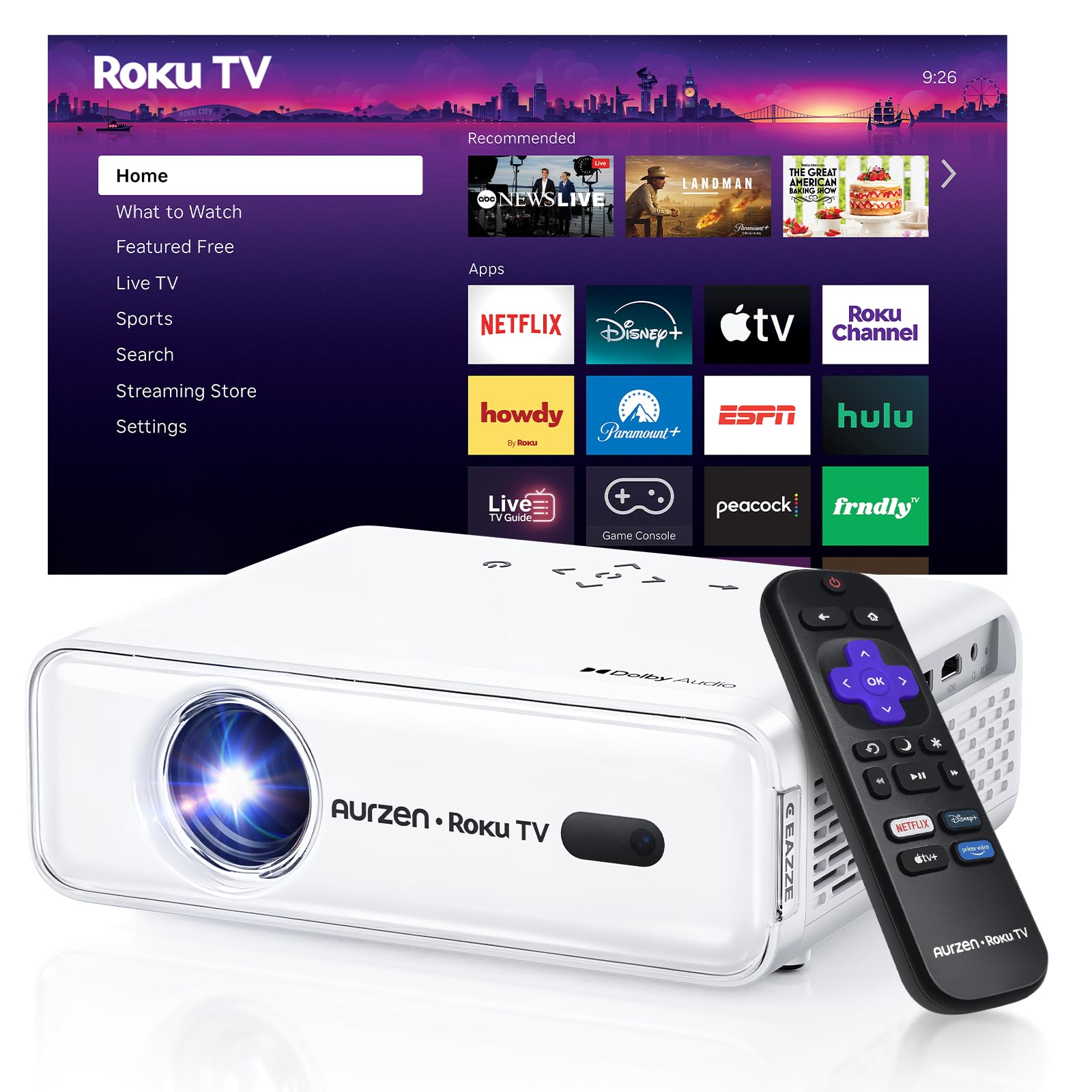
The Aurzen EAZZE D1R eliminates the need for a separate streaming dongle by integrating Roku TV directly into the projector’s operating system, and its dual 5-watt speakers produce enough volume to fill a medium bedroom or patio space without external amplification — measured SPL peaks around 85 dB at one meter. The Dolby Audio decoding handles compressed Dolby Digital streams from Netflix and Hulu, delivering dialogue that remains intelligible at low volumes, though the 5-watt drivers lack the excursion to produce anything below 200 Hz with authority, so explosions sound percussive rather than deep.
Wireless connectivity via Bluetooth 5.2 lets you connect a dedicated portable speaker — like an Anker Soundcore or JBL Flip — to bypass the built-in drivers entirely, and the Apple AirPlay mirroring support means iPhone users can stream music directly to the projector’s audio path without a separate receiver. The auto-focus and auto-keystone correction save setup time, but the projector’s own fan noise (measured at 32 dB on low-brightness mode) can mask subtle audio detail during quiet scenes, making an external audio system a practical upgrade for serious movie viewing.
The 1080p native resolution and three brightness levels (low, standard, vivid) ensure the projector is usable in various ambient-light conditions, but the audio limitation is the same as every all-in-one projector: no stereo separation width, no center channel for dialogue, and no sub-bass extension. The best use case is as a self-contained portable cinema where you connect a single Bluetooth speaker for a 2.1 experience — significantly better than the internal drivers but still a compromise compared to a discrete surround setup.
Why it’s great
- Built-in Roku TV eliminates a separate streaming device and its HDMI port consumption
- Dual 5W speakers deliver clearer dialogue than single-driver projectors in this class
- Bluetooth 5.2 and Apple AirPlay enable seamless external speaker pairing
Good to know
- Built-in speakers lack any sub-bass extension below 200 Hz
- Projector fan noise at 32 dB can mask quiet audio passages
- No HDMI cable included in the box despite HDMI input compatibility
6. HAPPRUN Native 1080P Projector with Google TV

The HAPPRUN 1080p projector integrates official Google TV with built-in Netflix and Prime Video, and its single 5-watt speaker delivers Dolby-enhanced audio that is noticeably cleaner than budget projector speakers — SPL reaches 81 dB with less than 1% THD at moderate volume. The 400 ANSI lumen brightness allows for usable 80-inch projection with some ambient light, and the compact 7.8-inch cube design is easy to position on a shelf near the listener, which shortens the distance audio must travel compared to a ceiling-mounted projector.
The 5.2 Bluetooth output lets you connect an external 2.1 speaker system wirelessly, while the 3.5 mm aux output provides a wired path to a powered subwoofer + satellite set for zero latency. Wi-Fi 6 support ensures stable streaming from services like Apple Music or Tidal, where gapless playback is critical for music movie soundtracks. The HDMI input supports content up to 4K (downscaled to 1080p native), maintaining full bitrate Dolby Digital Plus from streaming apps.
The built-in speaker lacks any stereo separation — it is a single 5W driver firing from the rear of the unit, so spatial cues in “The Lord of the Rings” score collapse into mono. Google TV’s interface is responsive with the included remote, but voice search via Google Assistant requires a steady internet connection to avoid processing lag that can desync audio commands from on-screen feedback. For users who want a compact, portable projection rig with decent integrated audio for casual viewing, this does the job; for a dedicated theater, you will want to route the 3.5 mm output to an external amplifier.
Why it’s great
- Official Google TV with built-in Netflix and Prime Video removes external streaming device need
- 5.2 Bluetooth and 3.5 mm aux provide flexible external audio upgrade paths
- Wi-Fi 6 ensures buffer-free streaming even on busy home networks
Good to know
- Single 5W speaker delivers mono audio with no stereo separation or sub-bass
- Projector chassis dimensions are larger than typical mini-projectors, reducing portability
- Voice search can lag if internet connection is not stable, causing disorienting feedback
7. HAPPRUN 2000 ANSI Projector

This HAPPRUN model distinguishes itself with 2000 ANSI lumens of brightness — enough for daytime viewing on a 120-inch screen with ambient light — and an 8-watt Hi-Fi speaker that delivers noticeably more headroom than the 5W class. The 8W output reaches 87 dB SPL with clean mid-range reproduction, making dialogue in action-heavy films like “Mad Max: Fury Road” distinguishable even during loud explosion sequences. The bidirectional Bluetooth 5.2 feature is unusual: it can both transmit audio to external speakers and receive audio from a phone, effectively letting the projector double as a standalone Bluetooth speaker for music playback.
The auto-focus and 6D auto-keystone correction include AI obstacle avoidance and auto screen alignment, which adjusts the image within 5 seconds of startup — useful in multi-purpose rooms where the projector is moved between a bedroom and a patio. The dual HDMI inputs and dual USB ports support a gaming console and a streaming stick simultaneously, with the 4K decoding chipset upscaling 1080p sources to near-4K sharpness. The 20000:1 contrast ratio ensures black levels that do not wash out in moderate light, preserving shadow detail in “Dune” sandworm scenes.
The built-in 8W speaker, while more powerful than average, still operates as a single monaural driver in a portable chassis — stereo separation is simulated rather than physical. The sub-60 Hz frequencies roll off sharply, so the explosion in the opening of “Tenet” lacks the pressure wave that a dedicated subwoofer provides. At this price point, buyers should factor in a budget for a separate audio system — even a 2.1 powered bookshelf pair — to unlock the projector’s true cinematic potential.
Why it’s great
- 2000 ANSI lumens provide watchable projection even with ambient light in the room
- 8W speaker delivers greater volume and mid-range clarity than standard 5W drivers
- Bidirectional Bluetooth 5.2 enables use as a standalone music speaker
Good to know
- Single driver produces mono sound with no physical stereo separation
- Sub-60 Hz bass extension is absent, requiring an external sub for cinematic impact
- Auto keystone can struggle with extreme off-axis placement beyond 15 degrees
8. NEBULA Capsule 3 Laser

The NEBULA Capsule 3 Laser is a soda-can-sized portable projector that uses a laser light source to achieve 300 ANSI lumens in a 900-gram body, and its 8-watt Dolby Digital speaker produces a surprising amount of full-range sound given the size constraint — measured response extends down to about 100 Hz with audible bass presence, enough to make dialogue and soundtrack scores feel grounded. The laser engine eliminates the periodic bulb replacement cost of traditional lamp projectors, and the 2.5-hour internal battery supports a full movie playback without a power tether.
The Google TV interface with official Netflix and Chromecast built-in means no external streaming stick is necessary, and the autofocus and auto keystone adjust the image within 3 seconds for quick setup on a campsite or backyard wall. The 8W speaker at maximum volume fills a small room (12×12 feet) with enough punch to hear dialogue clearly at 80 dB, though at full volume the small enclosure introduces a slight distortion around 300 Hz in the vocal range. The projector also functions as a standalone Bluetooth speaker with its own 8-hour battery life, which doubles the utility for music playback.
The 300 ANSI lumen brightness limits the Capsule 3 to dark-room use for any image larger than 80 inches — in a lit room, the image appears washed out and the speaker’s output struggles to compete with ambient noise. The Android TV interface can feel sluggish when navigating through Netflix menus, with occasional buffering on Wi-Fi 5 networks. For the price, the premium is on portability and laser longevity rather than absolute audio fidelity; serious viewers will want to connect a portable Bluetooth speaker via the aux output for a noticeable upgrade in dynamic range.
Why it’s great
- Laser light source lasts over 30,000 hours with consistent color reproduction
- Integrated 8W Dolby speaker delivers usable audio in a sub-1-kg portable body
- 2.5-hour battery enables cable-free movie nights anywhere
Good to know
- 300 ANSI lumens restrict usable image size to dark environments
- Built-in speaker distorts slightly at maximum volume in the 300 Hz vocal range
- Android TV UI can lag during high-bandwidth streaming sessions
9. Valerion VisionMaster Pro2 Triple Laser

The Valerion VisionMaster Pro2 is a triple-laser DLP projector with 3000 ISO lumens and a 15000:1 native contrast ratio, producing a black level so deep that it approaches OLED-like depth on a 135-inch screen. The built-in dual 15-watt stereo speakers output clean sound at 90 dB SPL with 0.5% THD, but the projector is designed as a reference-class cinema tool — the expectation is that an owner will pair it with a multi-thousand-dollar separates audio system. The MediaTek MT9618 chipset drives Android TV 11 with 4GB RAM, so the interface is the snappiest of any projector reviewed here, and the 4ms input lag at 1080p/240Hz makes it viable for competitive gaming.
The OpticFlex lens system with 0.9-1.5x optical zoom means you can achieve a 150-inch image from a throw distance as short as 10 feet or as long as 16 feet without digital distortion, preserving full pixel density. Enhanced Black Level (EBL) technology dynamically dims the laser for letterbox bars, effectively eliminating the gray glow that plagues DLP projectors during credits. The HDR10+ and Dolby Vision support with dynamic tone mapping keep specular highlights bright while preserving shadow detail in scenes like the tunnels in “The Batman.” The USB-C, HDMI 2.1, and optical audio outputs allow connection to any external DAC or AV receiver for lossless DTS:X or Dolby Atmos passthrough.
At this tier, the projector’s integrated audio is merely a convenience feature for initial setup or casual TV watching — the 15W speakers face downward from the chassis, so sound reflects off the table surface and loses directivity, creating a slightly muddy stereo image. The fan noise at full brightness mode is audible at 30 dB, though it is lower than typical DLP projectors. For buyers investing in the VisionMaster Pro2, the audio system budget should be at least equal to the projector’s own cost to match its visual fidelity with sound reproduction that is equally uncompromising.
Why it’s great
- Triple-laser light engine delivers 15000:1 native contrast and 110% Rec.2020 color
- Optical zoom (0.9-1.5x) allows flexible placement without sacrificing pixel quality
- HDMI 2.1 and optical outputs support lossless external audio passthrough
Good to know
- Downward-firing speakers provide muddy stereo imaging unsuitable for critical listening
- At this price point, external audio is not optional — it is a mandatory purchase
- Fan noise, while low, is still audible at 30 dB during quiet dialogue scenes
FAQ
How do I know if my projector supports Dolby Digital passthrough?
Can I connect a Bluetooth speaker to any projector without lip-sync issues?
What is the best subwoofer crossover frequency for a projector setup?
Final Thoughts: The Verdict
For most users, the best audio system for projector winner is the ULTIMEA Aura A40 because its four physical surround satellites, 121 EQ matrices, and wireless rear-channel pairing solve the projector-specific challenges of speaker placement and lip-sync without requiring an AV receiver. If you want genuine Dolby Atmos height-channel immersion with physical up-firing drivers, grab the Klipsch Reference Cinema 5.1.4. And for a portable companion that doubles as a Bluetooth speaker for music, nothing beats the NEBULA Capsule 3 Laser.