
Our readers keep the lights on and my morning glass full of iced black tea. As an Amazon Associate, I earn from qualifying purchases.
Specs are compiled from manufacturer listings and verified buyer reviews and can change over time — please confirm the key details on the product page before buying.
If your PC’s built-in speakers sound thin and muffled, a dedicated speaker set is the quickest upgrade you can make. The right pair makes games, movies, and calls feel rich without taking over your desk — but the spec sheet jargon (watts, DACs, drivers) can make it hard to know what is actually worth your money.
I’m Min — the founder and writer behind Gadgets Feed. This guide is built by comparing the manufacturers’ published specifications and the patterns across verified customer reviews, so you get each pick’s real strengths and trade-offs instead of marketing spin.
Whether you prioritize near-studio monitor accuracy for music production or deep, punchy bass for gaming, these are the audio systems for pc that consistently deliver real-world performance across every budget tier.
Our Picks at a Glance

How To Choose The Best Audio Systems For PC
Pick a system based on your desk size, your listening habits, and how much bass you actually want. A compact 2.0 set is perfect for small desks, while a 2.1 setup with a subwoofer under the desk adds rumble for games and movies.
Power: Understanding Watts and Drivers
Watts measure loudness, but the driver size (the speaker cone) determines how full that loudness sounds. A 20W peak system with small drivers will sound thinner than a 60W peak system with larger 3-inch woofers. Check both numbers before deciding.
Connectivity: How You Plug In
Your connection method dictates sound quality and ease of use. USB-C provides a clean digital signal straight to the speaker, optical bypasses your PC’s sound card, and Bluetooth frees you from wires — just know that wireless options add a slight delay for gaming.
Quick Comparison
| Model | Best For | Power | Connectivity | Driver Size | Amazon |
|---|---|---|---|---|---|
| Ortizan C7★ Best Overall | Home Studio & Precision | Powered Monitors | BT 5.3, USB-C, RCA, TRS | 3.5″ + 0.75″ | Amazon |
| H1 Computer SpeakersBest Value | Versatile Wired Ups | 60W | BT, USB-C, Optical, AUX | Dual 3″ + 1″ | Amazon |
| Creative T60Dialog Master | crisp Dialog | 30W RMS / 60W Peak | BT 5.0, USB-C, AUX | 2.75″ | Amazon |
| Bluedee 2.1 | Deep Bass Value | 80W Peak | BT 5.4, USB, USB-C, AUX | Satellites + Sub | Amazon |
| Creative Pebble X Plus | Compact 2.1 Upgrade | 15W RMS / 30W Peak | BT 5.3, USB-C, AUX | 2.75″ + Sub | Amazon |
| Logitech Z623 | Room-Filling THX Power | 200W RMS / 400W Peak | RCA, 3.5mm | Satellites + Sub | Amazon |
| Klipsch ProMedia 2.1 | Legendary Horn Clarity | 200W Peak / 110dB | 3.5mm (Wired) | 3″ + 6.5″ Sub | Amazon |
| Edifier G2000 Pro | RGB Gaming Immersion | 64W Peak / 32W RMS | BT 5.4, USB-C, AUX | 3″ Full-Range | Amazon |
| Bluedee 20W | Budget Desk Simplicity | 20W Peak | BT 5.4, USB-C | Tweeter + Full-Range | Amazon |
In‑Depth Reviews
1. Ortizan C7 Powered Studio Monitors
Our pick — over 4.5★ from 850+ verified ratings; the strongest balance of quality and price.
Near-flat studio tuning that reveals layers in your music a regular desktop speaker hides.
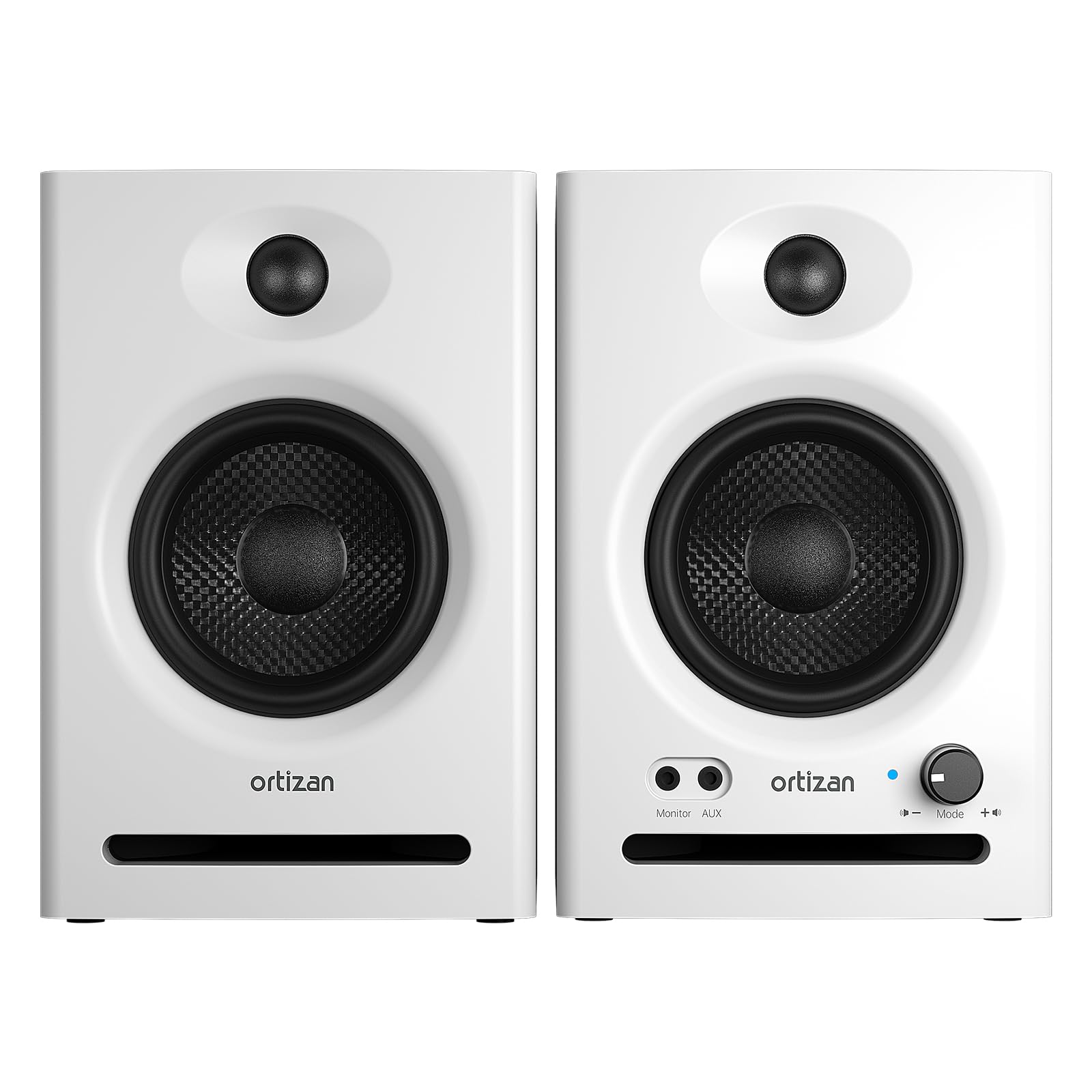
The thing that wins people over here is the sound quality — the most-praised aspect by far, with hundreds of owners singling it out. These monitors aim for accuracy, not boosted bass, so vocals sit spot-on and treble stays smooth and transparent. Buyers report a near-flat response with precise treble and midrange, and bass that reaches down to roughly 45Hz.
Connectivity is where this pair stands apart from the budget crowd. You get Bluetooth 5.3 with a generous 18-meter range — 80% more reach than the Bluedee 20W set’s 10 meters — plus USB-C, RCA, and a 6.35mm TRS balanced input for hooking up a mixer or electric piano. A built-in 24-bit DAC captures digital audio straight from USB to minimize signal loss.
The trade-offs are honest ones: there is no deep sub-bass rumble and no remote control, and some owners found the volume dial a bit choppy. The recurring functional gripe is the RCA input occasionally stopping work, so keep that in mind if RCA is your primary hookup.
Accuracy first: If you produce music, edit video, or just want to hear your files the way they were mixed, this is the pick. It delivers studio-style neutrality for less than most monitors cost.
Keep expectations in check: Seekers of window-rattling bass or a wireless remote should look at a subwoofer-equipped 2.1 system instead.
Reach for this if: you work on audio or crave honest, uncolored sound on a desk.
Look elsewhere if: you want deep low-end thump or a remote control; this is about precision, not party volume.
2. H1 Computer Speakers 60W Powered 2.0
One compact pair with triple the pure wattage, plus optical and USB-C inputs most rivals skip.
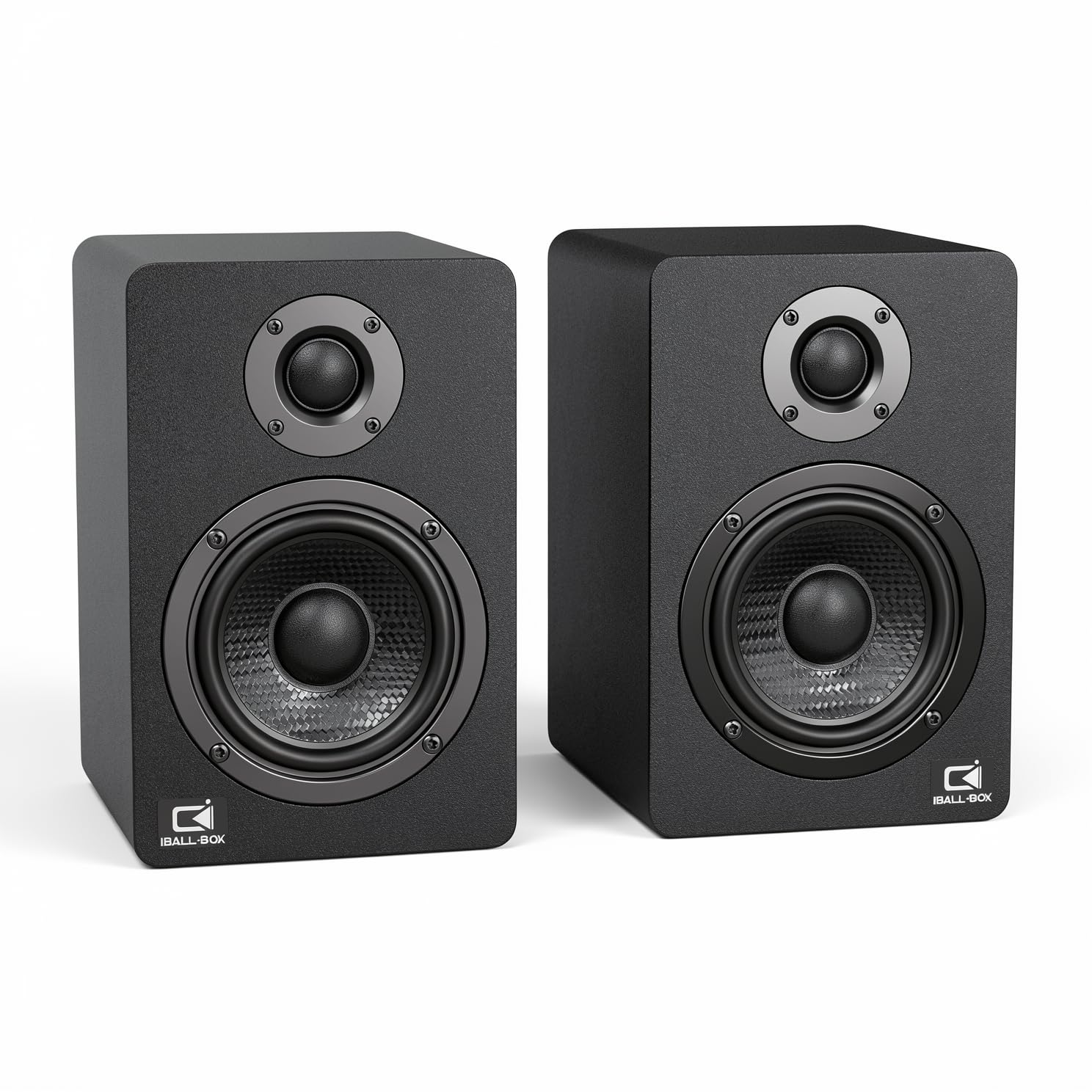
This is a serious wired upgrade dressed in a modest look. It kicks out 60W in a 2.0 stereo setup — triple the 20W peak of the budget Bluedee — and the power shows in fuller vocals and tighter bass than you expect from two box speakers. Dual 3-inch carbon-fiber woofers, dual 1-inch silk-dome tweeters, and a rear bass reflex port cover a 40Hz-20KHz range.
What makes it so versatile is the input panel: a 24-bit USB-C DAC, optical input, and 3.5mm AUX sit alongside Bluetooth. Owners often praise the optical connection for delivering superb sound on movies and music. Front-panel bass and treble knobs let you tune the tone without opening any software.
The common theme across the reviews is surprise at the value — clean sound, easy setup, and multiple ways to connect for a very reasonable price. It fits neatly on a desk as a compact replacement for a bulky Logitech-style setup.
Forty to twenty thousand: The 40Hz-20KHz frequency coverage gives you the full audible range, so music feels complete rather than hollow. This is a true all-rounder for work, streaming, and gaming.
Wired wisdom: If you want one speaker pair that handles everything — console, PC, TV — and you are fine managing inputs with a knob, this is your best value move.
Pick it up for: a wired, high-power upgrade with optical and USB-C flexibility.
Pass if: you need wireless streaming as the main connection or want a subwoofer in the box; this is a pure 2.0 pair.
3. Creative T60 Compact 2.0 Speakers
A dedicated dialogue-boosting mode that makes movie conversations and Zoom calls genuinely easier to follow.
Clear Dialog and Surround technologies, powered by Sound Blaster, are the defining reason to buy the T60. A single button on the speaker sharpens spoken words so you can stop re-reading subtitles, and the Surround mode adds immersion for gaming sessions. It is a rare feature at this size and a genuine daily benefit.
Under the hood sit two 2.75-inch full-range drivers delivering 30W RMS, with peak power up to 60W. The BasXPort design enhances bass enough to skip a separate subwoofer for most listeners. On the side, you get USB-C audio, Bluetooth 5.0, a 3.5mm AUX-in, plus dedicated headset and microphone jacks.
The standout convenience is the one-button switch between speakers and your headset — owners repeatedly mention how nice it is to take a call privately without unplugging anything. The main caveats are a Bluetooth connection that some find unreliable and a volume knob with a slight delay, so wire it via USB-C for the most predictable experience.
Voice clarity champion: If video calls, movies with tricky accents, or game chatter dominate your desk time, the T60’s dialogue mode is worth the price of admission alone.
Sound before price: It is a bit pricier than similar 2.0 sets, and bass lovers will still want a subwoofer. Buy it for the features, not the raw power.
Choose this for: easy call-to-speaker switching and clearer spoken audio on a tidy desktop.
skip it if: you expect heavy bass or need multi-device wireless stability; this favors wired desktop use.
4. Bluedee 2.1 Computer Speakers with Subwoofer
A dedicated subwoofer and 80W peak power deliver the deepest bass for the lowest price in this lineup.
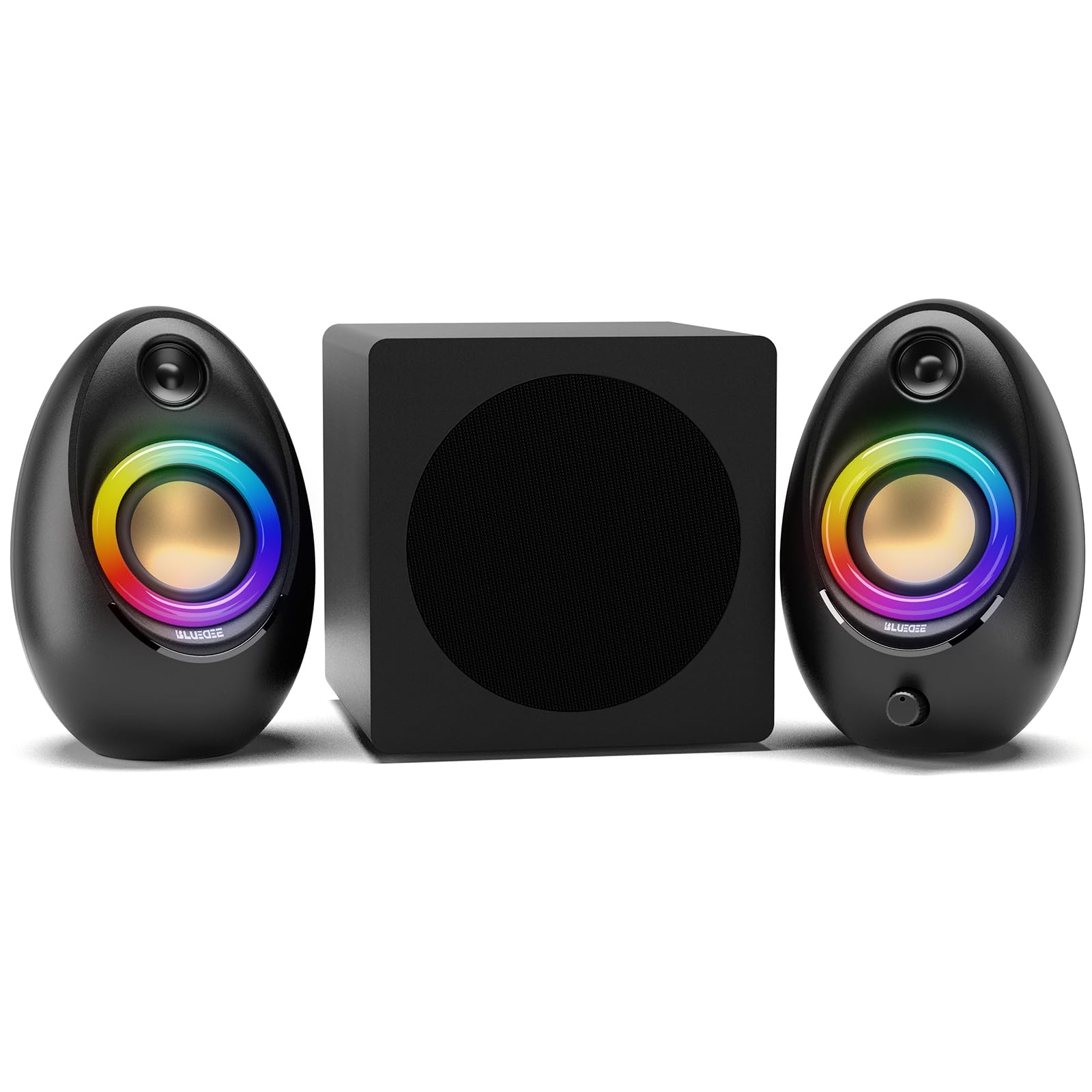
This 2.1 system splits the work: independent satellite speakers handle clear vocals and highs while the subwoofer unit takes over low frequencies. The result is deep, punchy bass without muddying the mids — exactly what movies and music need. The subwoofer is the most-praised feature, with owners loving how it enhances their listening experience.
You connect any way you like: Bluetooth 5.4, USB, USB-C, or 3.5mm AUX, all powered by an included adapter so it is true plug-and-play. The single control knob manages volume, playback, lighting effects, and mode switching. Desk-friendly RGB lighting rounds out the modern look.
Sound quality dominates the positive feedback — it stays clear even at high volume for most content. The honest limitations: crank it too high on bass-heavy tracks and it distorts slightly, and a couple of owners noted the egg-shaped satellites like to roll if bumped. Still, for the money, the bass-to-price ratio is hard to argue with.
Most bang per watt: This is the affordable way to get real subwoofer thump without stepping up to the premium tier. It balances punchy bass with clear vocals well.
Mind the extremes: Pushing maximum volume on heavy bass will reveal distortion, and the round satellites need a stable spot. A fair trade for 2.1 depth at this level.
Reach for this if: you want genuine bass depth on a budget and appreciate multiple connection options.
Think twice if: you listen at extreme volumes or need the most compact footprint; a 2.0 pair suits that better.
5. Creative Pebble X Plus 2.1 USB-C Speakers

A spherical 2.1 system that runs everything off a single USB-C cable — even the subwoofer.
Simplicity is the superpower here. One USB-C cable powers the satellites and the compact subwoofer, so there is no power brick cluttering your desk. That single-cable design delighted owners, who call it plug-and-play perfection and praise the wide soundstage and perfect subwoofer crossover.
The satellites pack upgraded 2.75-inch drivers with 15W RMS and 30W peak output. Plug into a 30W or higher USB PD adapter and it amplifies to 30W RMS with a 60W peak — that is when the system really opens up. Bluetooth 5.3 handles wireless streaming, and the 16.8-million-color RGB with six presets dresses up the matte black spheres.
Owners describe the sound as rivaling far pricier bookshelf speakers, with the passive-radiator sub delivering felt bass in small rooms. The honest nits: it needs wall power to perform at its best, the subwoofer cable could be longer, and there is no remote or rear mounting option. Max volume also leaves a little on the table.
Clean desk champion: Single-cable power plus a real subwoofer makes this the sleekest 2.1 route for a tidy setup. It sounds bigger than its footprint suggests.
Needs its juice: Run it off a proper USB-PD adapter to hear the full 60W peak; on basic ports it won’t reach its potential volume.
Reach for this if: you value a clean, wire-free desk and want an easy 2.1 upgrade with great sound.
Look elsewhere if: you need maximum loudness for a large room or want remote control; this shines as a near-field desktop system.
6. Logitech Z623 400 Watt 2.1 System

THX-certified power with a subwoofer so punchy you barely turn the knob halfway.
This renewed 2.1 system (two satellite speakers plus a subwoofer) is built to fill a large room with sound. It delivers 400 watts of peak power and 200 watts RMS (continuous power), so it can easily handle a big living room or home theater setup. The THX certification (a rigorous audio quality standard) means it is designed to reproduce studio-quality sound. The subwoofer is the standout — buyers who have owned it for six years still call it the best bass they have had for a PC.
On-speaker controls let you dial in volume and bass directly, and the RCA and 3.5mm inputs handle up to three devices at once — computer, console, and a phone or DVD player. Two satellite speakers plus the powerful sub deliver sound big enough to rattle windows at moderate volume.
Sound quality and value dominate the praise, with the flexible inputs and bass control getting consistent love. Since this is a renewed unit, the caveat is packaging: some arrive with minor cosmetic damage, and the subwoofer’s cardboard-like frame is prone to corner dings in transit. The bass can also overpower if you do not tune it down a notch.
The Power Payoff
- Massive 200W RMS / 400W peak output fills large rooms easily.
- THX certification for rich, studio-quality audio.
- Bass knob on the speaker for quick tuning without software.
- Three simultaneous inputs (RCA + 3.5mm) for PC, console, and more.
Before You Buy
- Renewed unit packaging can be rough, risking minor cosmetic scuffs.
- Subwoofer cabinet feels less sturdy than the electronics justify.
- Bass easily overpowers the mids until you dial it down.
Best for: gamers and movie fans who want theatrical bass and volume without stepping into audiophile territory.
The catch: it is wired only and renewed, so budget for a possible cosmetic imperfection in exchange for the power.
7. Klipsch ProMedia 2.1 THX Certified System

The horn-loaded tweeter (a driver that projects high frequencies efficiently) delivers crisp, clear highs that stay distinct even in busy game soundtracks or action movie mixes.
Klipsch’s MicroTractrix Horn technology is the reason these speakers sound different from everything else in this list. The horn design reproduces more sound from every watt and controls the dispersion, sending the audio straight to your ears with razor-sharp clarity. This system holds the strongest reputation in the category — sound quality is praised thousands of times over, making it the crowd favorite.
Two-way satellites with 3-inch midrange drivers pair with a solid 6.5-inch side-firing, ported subwoofer for full-bandwidth bass you can feel. Maximum output hits 200 watts of peak power at 110dB in-room — comparable to the volume of live rock music. The wired setup uses simple 3.5mm input and a control pod for volume and subwoofer gain.
Buyers consistently report crisp highs, full mids, and theater-like deep bass. The trade-offs are real: there is no on/off power switch (a bright LED stays lit until you unplug the unit), and some owners note durability issues after extended use. The horn tweeters can also sound slightly aggressive until you adjust the high end with an equalizer (EQ).
Clarity royalty: For music lovers who want to hear every instrument precisely located in the soundstage, the horn-loaded highs are in a class of their own.
Embrace the quirk: No power switch means a power strip with a switch is almost essential, and the LED stays on. Plan for that before buying.
Choose this for: the clearest high-frequency detail in this list, plus a long-standing reputation for rich sound in games, movies, and music.
pass on it if: you dislike managing a powered strip for the missing on/off switch or want modern wireless inputs.
8. Edifier G2000 Pro 2.0 RGB Gaming Speakers
Virtual 7.1 surround and a 270-degree light show built specifically for competitive gaming.
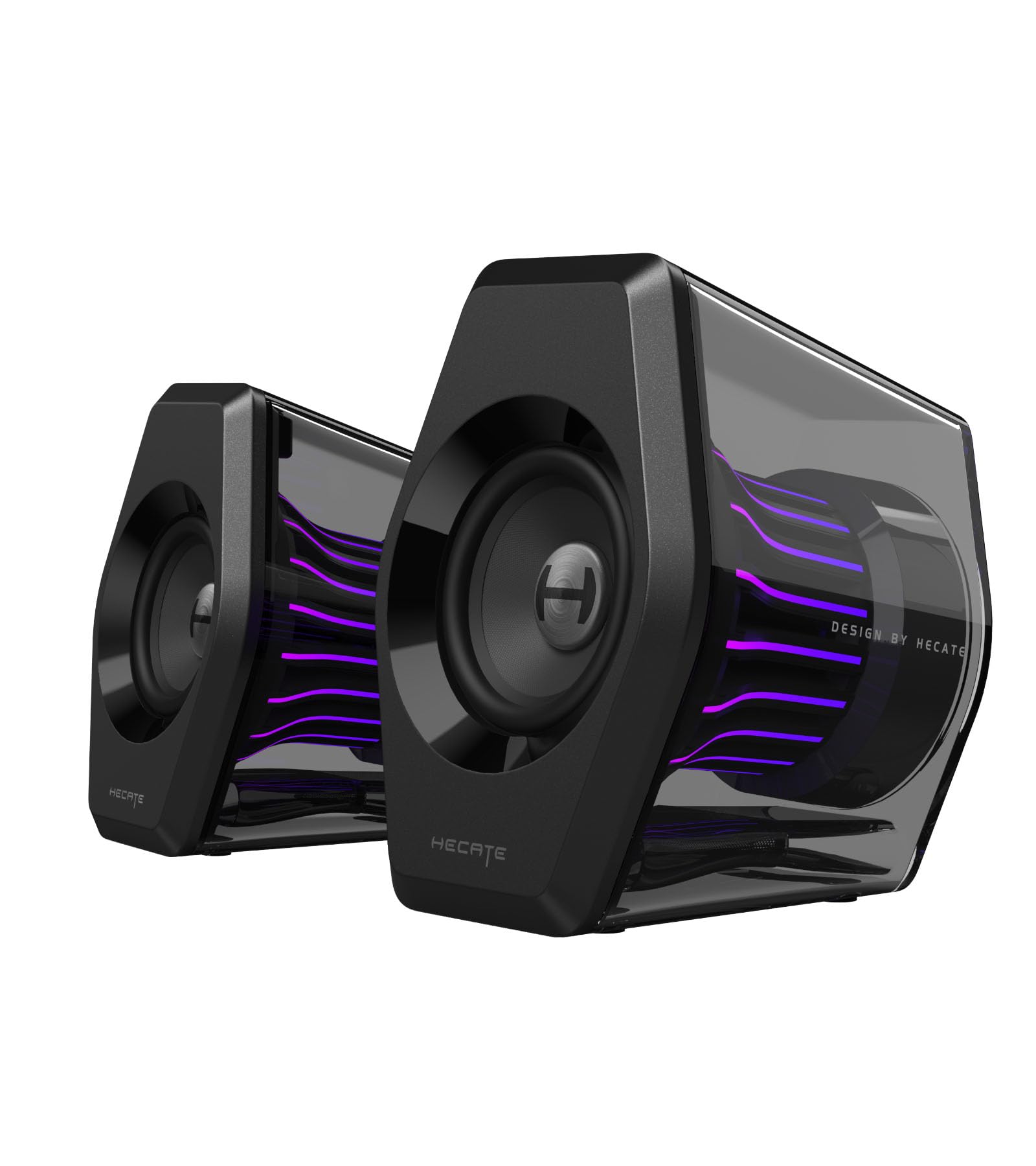
This is the dedicated gamer’s pick in the lineup. Virtual 7.1 surround sound, active over USB with HECATE software, sharpens footsteps and helps you pinpoint enemy positions in shooters. With 64W peak and 32W RMS from 3-inch full-range drivers, it delivers explosive bass for a 2.0 system — no subwoofer required for most players.
The 270° TempoFlow lighting is the visual headline: 20 LED strips with 100 RGB beads sync with gameplay across 7 modes. A transparent enclosure amplifies the glow, and you control it all via buttons or the HECATE software. Game, Movie, and Music modes let you switch presets instantly, and Bluetooth 5.4 with a 33-foot range handles wireless play on PC or PS5.
Praise focuses on the strong sound quality, punchy bass for the size, and the slick angled design. The honest catches: a few owners mention units stopping work after about a month, and there is no expansion port to add a subwoofer later. The permanently attached cable between speakers is also short, which can complicate wide monitor setups.
Built for the arena: If positional audio and a light show that reacts to gameplay are your priorities, the G2000 Pro delivers both in a compact 2.0 footprint.
Consider the caveats: No subwoofer output limits future upgrades, and the short inter-speaker cable needs planning. Test it early in the return window.
Reach for this if: competitive edge and RGB atmosphere matter more to you than a subwoofer’s rumble.
Look elsewhere if: you plan to add a sub later or want a simpler, more predictable wire-free experience.
9. Bluedee Computer Speakers 20W Peak
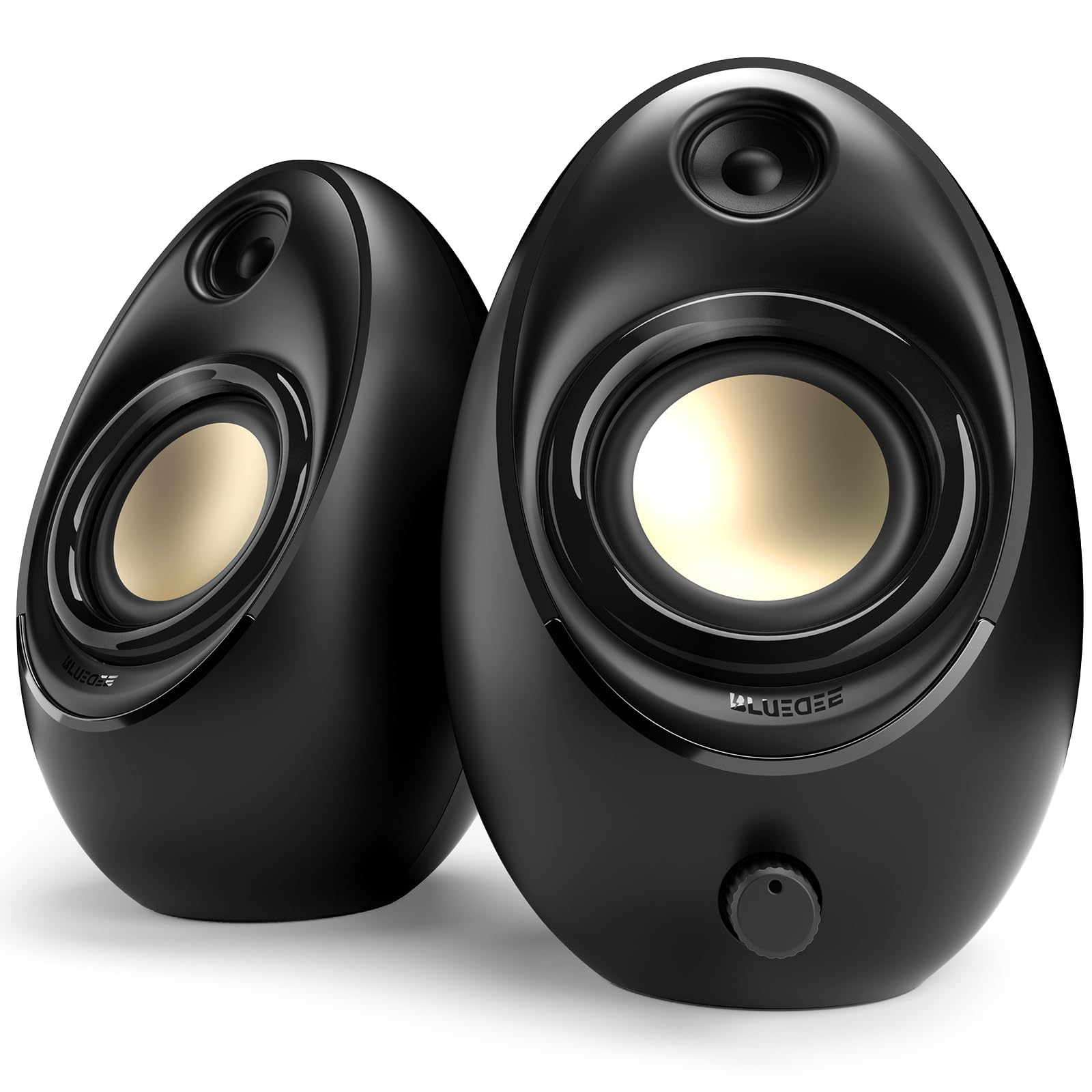
The most affordable entry point here, pairing two tweeters and two full-range drivers with deep DSP-tuned bass.
This is the starter set that does the basics brilliantly. At 20W peak power, it is a modest rating — but DSP tuning smooths harsh highs and the dual tweeters plus dual full-range drivers deliver crisp vocals and balanced stereo that easily outclasses built-in monitor audio. Owners sum it up: “I can’t believe these are so easy to install and so simple to use.”
Setup is genuinely easy. Plug into USB or USB-C and it works instantly — no drivers, no software — or stream wirelessly over Bluetooth 5.4, which reaches 10 meters, half the range of the Ortizan C7’s 18-meter connection. The all-in-one knob controls volume, playback, lighting, and connection mode with clear feedback.
The 8 selectable RGB lighting effects add a stylish touch to a compact, space-saving design. Sound quality and value lead the praise, with owners noting the volume goes high without distortion, and it handles Zoom meetings well. The one recurring complaint is the 50-inch inter-speaker cable being too short for dual 24-inch monitor setups — so measure before you buy.
Why It Wins
- True plug-and-play via USB or USB-C with zero software needed.
- Compact footprint replaces a bulky subwoofer setup cleanly.
- 8 RGB lighting effects plus an off option to match any mood.
- Clear sound at high volumes without distortion.
The Limits
- Short 50-inch cable between speakers challenges wide dual-monitor rigs.
- 20W peak power suits desktop near-field listening, not large rooms.
Best for: a first-time upgrade on a tight budget who wants simple USB power and clean sound for work and light gaming.
it’s not for you if: your monitors sit far apart or you need room-filling volume; measure the desk first.
Understanding the Specs
Watts and RMS vs Peak
Power is measured two ways: RMS (the continuous, sustainable power) and Peak (the maximum burst). A system rated 30W RMS / 60W peak plays cleanly at moderate volume and only hits 60W on loud peaks. Compare RMS numbers first — they tell you how loud the speaker can stay without distorting.
The DAC and Bluetooth Codecs
The DAC (digital-to-analog converter) turns your PC’s digital audio into sound. A quality DAC, like the 24-bit one on the Ortizan C7, reduces hiss and harshness. For wireless, Bluetooth 5.3 and 5.4 offer better range and stability than older versions — the Ortizan C7’s 18-meter range beats the Bluedee 20W set’s 10 meters.
FAQ
Is a 2.1 system with a subwoofer always better than a 2.0 setup?
Will USB-C speakers work with my older PC that only has USB-A ports?
What is the difference between optical and USB-C audio connections?
How long do computer speakers typically last before needing replacement?
Can I use Bluetooth computer speakers for gaming without lag?
Do I need a separate sound card for a good PC audio system?
What does THX certification actually mean for PC speakers?
How important is RGB lighting when choosing desk speakers?
Final Thoughts: The Verdict
For the majority of shoppers, the audio systems for pc winner is the Ortizan C7 because its near-flat studio response (accurate, uncolored sound), dual balanced inputs (for clean connections to multiple devices), and 18-meter Bluetooth range (about 59 feet) offer the most flexibility for the price. Hundreds of owners praise its sound quality above all else. If you want deep, room-shaking bass, the Logitech Z623 with its 400W peak power is the pick. And for a compact desk with clear dialog in movies, the Creative T60 is the one to reach for.
How We Picked
We do not accept paid placement. Every pick is matched to a real buyer and a real use-case; we do not hands-on test units.
Sources & Methodology
Specifications: manufacturer listings and product documentation. Review insights: verified customer reviews, as of August 2026. Pricing: not shown on this page (it changes often); check the current price via the retailer link.
As an Amazon Associate, Gadgets Feed earns from qualifying purchases. This does not affect which products we feature.