
Our readers keep the lights on and my morning glass full of iced black tea. As an Amazon Associate, I earn from qualifying purchases.
Specs are compiled from manufacturer listings and verified buyer reviews and can change over time — please confirm the key details on the product page before buying.
If your room colors the sound, your mixes, measurements, and calibrations will lie to you. An audio testing microphone is built to hear the truth—a flat frequency response that captures what is actually happening instead of flattering your voice or instrument. The right one turns a boomy, uneven room into a measurable problem you can fix, not a mystery you fight by ear.
I’m Min — the founder and writer behind Gadgets Feed. This guide is built by comparing the manufacturers’ published specifications and the patterns across verified customer reviews, so you get each pick’s real strengths and trade-offs instead of marketing spin.
You need a microphone that measures your room or speakers accurately, and the right audio testing microphone depends on how it connects to your gear, how it is calibrated, and whether it works with the software you already use.
Our Picks at a Glance

How To Choose The Best Audio Testing Microphone
Testing microphones are a different breed from the condenser you sing into. Instead of flattering a source, they aim for a flat frequency response so the signal reaching your software is a faithful copy of the acoustic event. A vocal mic that boosts presence will corrupt an RTA (real-time analyzer) reading, so you need a mic designed for measurement first.
Know your connection and software
The interface dictates your entire workflow. A USB mic like the Dayton Audio UMM-6 plugs straight into a PC or Mac, making it simple for home tuners and car-audio enthusiasts using apps like Room EQ Wizard or audiotools. An XLR mic like the dbx RTA-M needs an audio interface with phantom power, which is normal for live-sound engineers who already own a mixer. A 3.5mm jack mic is built for a very specific ecosystem, like Audyssey room calibration on select AVRs.
Check for individual calibration
Even measurement mics have tiny manufacturing variances. Individually calibrated units, like the Audyssey ACM1-X, ship with a unique correction file that flattens each mic’s specific quirks. Without this file, your readings are only as trustworthy as the factory average. Some manufacturers, like Dayton Audio, offer calibration data via a serial number lookup.
Match the mic to the task
A live sound engineer tuning a church PA needs a rugged XLR mic they can leave wired to a DriveRack. A home studio owner correcting monitor placement needs a system like the IK Multimedia ARC Studio that includes a processor and software. A car-audio hobbyist needs something portable and USB-friendly. Buy for the specific room and gear you are fixing, not for the most expensive option on the shelf.
Quick Comparison
| Model | Best For | Connection | Polar Pattern | Weight | Amazon |
|---|---|---|---|---|---|
| dbx RTA-M★ Best Overall | Live sound & DriveRack setups | XLR | Omnidirectional | Not specified | Amazon |
| Audyssey ACM1-X | AVR room calibration with MultEQ-X | 3.5mm Jack | Omnidirectional | 2.96 ounces | Amazon |
| Dayton Audio UMM-6 | USB measurement for PC & Mac | USB | Omnidirectional | Not specified | Amazon |
| IK Multimedia ARC Studio | Studio monitor correction | XLR, USB-C | Omnidirectional | 1.05 g | Amazon |
In‑Depth Reviews
1. dbx RTA-M Driverack Series Reference Microphone
Our pick — 4.5★ from 300+ verified ratings; the strongest balance of quality and price.
The wired workhorse that stays permanently connected so your VU meter never stops measuring.
For live sound engineers and church techs, the dbx RTA-M is the reference standard because it simply gets out of the way. Its flat frequency response and omnidirectional pattern mean it picks up sound evenly from all directions without coloring the reading, so the data your DriveRack 360 sees is honest. Buyers report leaving it hardwired so the VU meter is constantly active, turning every service into a chance to verify the room.
The trade-off here is that this is a pure measurement tool, not a general-purpose mic. It connects via XLR, so you need a mixer or interface with phantom power to feed it, and its large 12 x 3.5 x 7-inch body makes it a permanent install rather than a portable gadget. Owners mention it gets the job done for analyzing and measurements, but note it is PIN-3 Hot—so if you measure with multiple mics from different brands, you will want to flip the polarity. The metal enclosure feels sturdy enough for rack life, though one buyer found durability varies. Its higher 78 db audible noise spec means it expects a quiet, controlled environment to shine.
Buyers praise this mic for reliable performance—over two dozen reviewers highlight it—and value for money is the second most-mentioned plus, making it a dependable pick for professionals needing consistent readings.
Professional’s Choice
- Flat frequency response up to 20 KHz for honest readings
- Omnidirectional pattern captures from all angles evenly
- Metal enclosure built for permanent rack installation
Setup Considerations
- XLR connection requires an interface with phantom power
- PIN-3 Hot wiring means you may need to flip polarity
Reach for this if: you work in live sound or own a DriveRack system and want a dependable, always-on reference mic for room tuning.
Look elsewhere if: you need a portable plug-and-play USB mic for quick laptop measurements.
2. Audyssey Official ACM1-X Individually Calibrated Microphone

The individually tuned mic that makes a Marantz or Denon receiver calibrate itself with unprecedented accuracy.
Home theater owners who take room correction seriously will find the Audyssey ACM1-X a revelation. Each unit is individually analyzed and assigned a unique calibration file tailored to that specific mic, correcting measurements to match Type 1 reference mics. That means when you run MultEQ-X on your PC, the microphone’s own quirks are mathematically removed, so the distance and level settings your AVR calculates are genuinely accurate.
The 250 ohm impedance and omnidirectional capture from all directions make it precise for acoustics measurement. Customers note night-and-day differences compared to the stock mics packed with their receivers. One owner described an “excellent” calibration with a Marantz SR8015, noting the results are “way different and accurate” versus the included mic. The catch: it is exclusively designed for the MultEQ-X app on PC—there is no Mac version—and you need an in-app purchase to open up it. Its lightweight 2.96-ounce build connects via a 3.5mm jack, so it will not work with generic audio interfaces.
Buyers rave about its performance, with calibration precision and sound quality close behind. If you own a MultEQ-compatible AVR and want professional-grade room tuning, this is the upgrade that makes your receiver sound like a much more expensive one.
The Accuracy Upgrade: Individual calibration files push readings toward Type 1 reference accuracy, so your AVR corrects real acoustic problems instead of mic flaws.
Ecosystem Lock-In: This mic only works with Audyssey MultEQ-X on Windows PCs, so it is a dedicated tool, not a general-purpose meter.
3. Dayton Audio UMM-6 USB Measurement Microphone

The USB plug-and-play meter that turns a laptop into a serious acoustic analysis rig.
Car audio tuners and home hobbyists get a fast path to real measurements with the Dayton Audio UMM-6, which connects to a PC or Mac via USB with no interface needed. It has a true omnidirectional pattern and a calibrated flat frequency response, so when you run pink noise and read the results, what you see is what the room is doing. Its 600 ohm impedance and compact 0.98 x 0.98 x 8.62-inch body make it easy to position, and it ships in a sturdy carrying case with foam insert for travel between car and home.
Reviewers point out readings on audiotools are “much more stable and I assume accurate” after switching to this mic. One owner used it to tune a car stereo after an SUV purchase, identifying frequency dips and compensating with a 13-band EQ for the best-sounding setup they had owned. The company provides calibration data via serial number lookup on their website, which you should save a copy of. The honest limit is its slender, extended shape—some find it large for certain setups—and the included Dayton calibration file does not work with SMAART software unless modified. Its 40 db sensitivity and 70 db audible noise figures mean it is tuned for close, controlled measurement work rather than distant field use.
Compatibility wins people over; over twenty buyers praise how easily it works with their software. For the price, it is the smart entry point into serious acoustic measurement.
Hobbyist Friendly
- USB connection works with PC and Mac instantly
- Calibrated flat response for dependable readings
- Sturdy carrying case with foam insert included
Know Before Buying
- Dayton calibration file needs modification for SMAART
- Extended body size can be awkward in tight spaces
Grab this if: you want a portable, affordable USB mic for car-audio tuning or home measurement without buying an interface.
Think twice if: you rely on SMAART professionally and need its calibration format to work from the start.
4. IK Multimedia ARC Studio Room Correction System
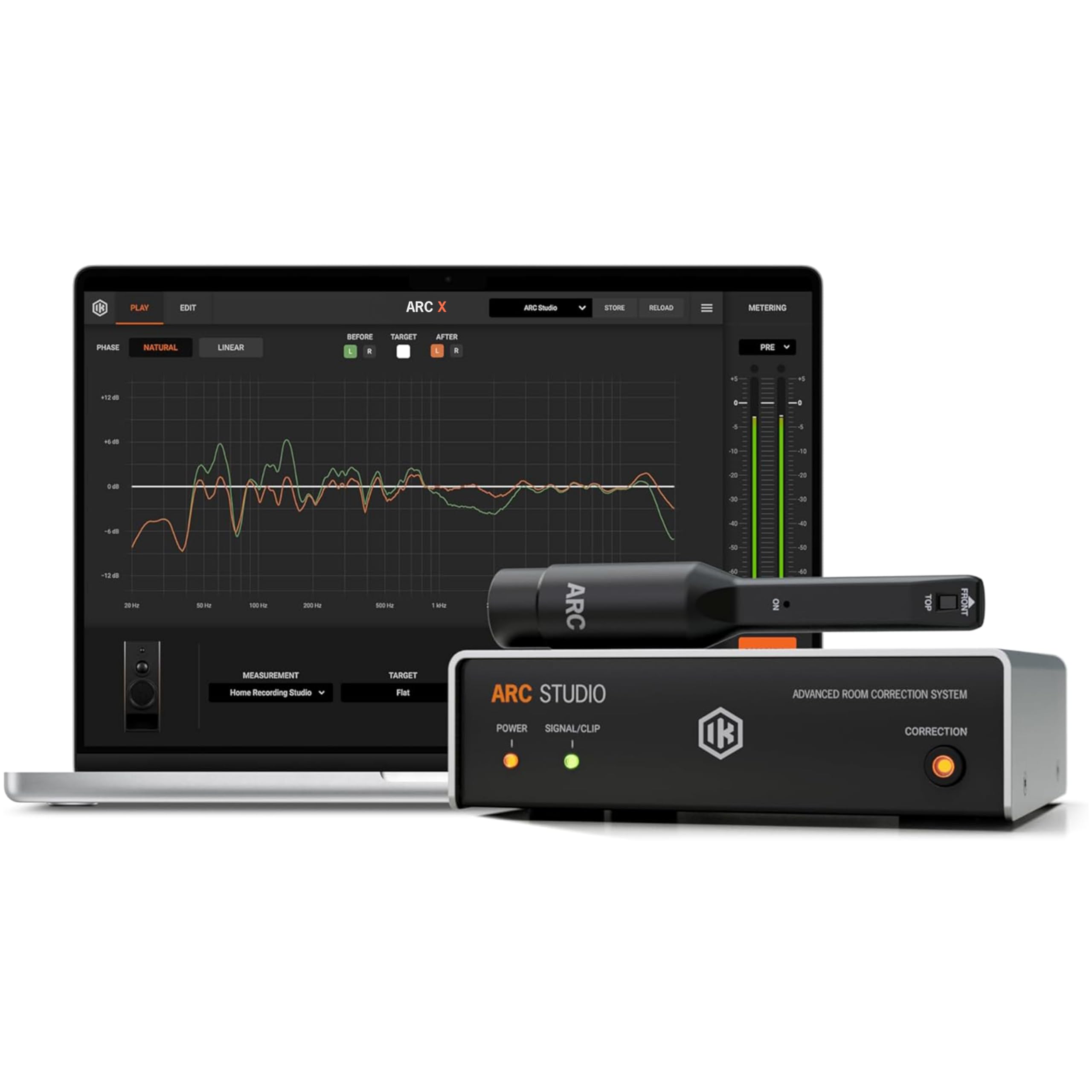
The full studio correction kit that lifts a blanket off your monitors and tightens your mixes.
The box includes a high-precision measurement mic, ARC 4 calibration software, and a stand-alone hardware processor that corrects all computer audio, not just what runs inside a plugin. It connects via XLR for the mic and USB-C for the processor, and it simulates the tonal character of top-tier studio monitors so your mixes translate reliably.
Shoppers say dramatic before-and-after results. One vintage speaker enthusiast watched the tweeter roll-off on Klipsch Heresy I speakers extend from roughly 9kHz to 14kHz, describing it as a “blanket lifted.” Another engineer in a minimally treated rental room ran a 21-point measurement in about ten minutes, then heard the soundstage and separation drastically improve with lows tightened and vocals clearer. The recurring note is that the mic needs phantom power from a separate USB interface, which is not obvious at first. Frequency control also draws mixed feedback because the software limits correction below 2000Hz in some setups, so it will not fully fix deep bass issues on its own.
Sound quality wins people over, with mixing translation and value close behind. This is the pick for anyone who prefers electronic room correction over acoustic panels and wants every audio source—not just their DAW—to benefit.
The Studio Fix: A hardware processor plus measurement mic corrects frequency imbalances and tightens imaging across all computer audio, not just your DAW.
The Setup Reality: You will need a separate USB interface with 48V phantom power for the mic, and the software limits correction below 2000Hz in some cases.
Understanding the Specs
Frequency Response
This is the range of pitches a mic captures accurately, measured in Hertz. A flat frequency response means the mic treats all frequencies equally—it does not boost bass or sparkle. For testing, you want flat, because any coloration becomes a lie in your measurement data. The dbx RTA-M and Dayton UMM-6 both reach 20 KHz, covering the full human hearing range.
Polar Pattern & Calibration
An omnidirectional pattern captures sound equally from all directions, which is essential for measuring a room’s actual acoustic behavior rather than just one speaker. Individual calibration takes this further by correcting each mic’s unique manufacturing variances against a reference standard. Without a calibration file, your readings carry the mic’s imperfections baked in.
FAQ
What is the difference between a measurement mic and a regular vocal mic?
Can I use an audio testing microphone for recording vocals or podcasts?
Will the Audyssey ACM1-X work with my Denon or Marantz receiver?
Does the Dayton UMM-6 need phantom power?
What software works with these measurement microphones?
How do I get the calibration file for my Dayton UMM-6?
Is a higher sensitivity rating better for a testing microphone?
Can I use the IK Multimedia ARC Studio without an audio interface?
What does omnidirectional mean for room correction?
Final Thoughts: The Verdict
For most buyers, the audio testing microphone winner is the dbx RTA-M because it pairs a flat response with the XLR reliability that live sound engineers trust for permanent installs and DriveRack tuning. If you want precise home theater calibration, grab the Audyssey ACM1-X for its individually tuned accuracy. And for a USB plug-and-play option that fits any laptop workflow, the Dayton Audio UMM-6 is the one to reach for, while the IK Multimedia ARC Studio delivers the most complete studio correction experience.
How We Picked
We do not accept paid placement. Every pick is matched to a real buyer and a real use-case; we do not hands-on test units.
Sources & Methodology
Specifications: manufacturer listings and product documentation. Review insights: verified customer reviews, as of September 2026. Pricing: not shown on this page (it changes often); check the current price via the retailer link.
As an Amazon Associate, Gadgets Feed earns from qualifying purchases. This does not affect which products we feature.