
That moment when a Zoom call erupts, game audio spikes from a distant grenade, or a Spotify ad blasts at 3x the volume of your playlist — fumbling for a tiny slider buried in a system tray breaks workflow and immersion. A dedicated audio volume control places that adjustment under your fingertips with a single tactile rotation, no mouse hunting required.
I’m Min — the co-founder and writer behind Gadgets Feed. I’ve spent countless hours analyzing the internal components, connectivity restraints, and real-world latency of desktop and studio volume controllers to separate gimmicks from genuinely useful hardware.
The guide ahead breaks down the best audio volume control devices across every tier — from passive studio monitors to programmable USB knobs — so you can pick the one that solves your specific listening pain without overspending on features you won’t use.
How To Choose The Best Audio Volume Control
Selecting the right volume controller depends entirely on whether you need it for a desktop PC, a passive stereo system, or whole-house overhead speakers. The three core variables are connection type, signal pathway (active vs. passive), and physical form factor.
Connection Type: USB vs. 3.5mm vs. RCA vs. Speaker Wire
USB volume knobs plug directly into a computer and control the operating system’s digital volume — ideal for gamers, remote workers, and casual listeners who want plug-and-play simplicity with application-level control. RCA and XLR passive controllers sit between your DAC and amplifier, handling analog signal without introducing noise. Speaker-wire in-wall controls are designed for multi-room audio systems where the volume knob physically reduces the voltage reaching the speakers.
Passive vs. Active Circuitry
Passive volume controllers use only a potentiometer or stepped attenuator to reduce signal level — they require no external power and introduce zero distortion or coloration. Active controllers incorporate a powered buffer stage, which can drive longer cable runs but may add a tiny noise floor. For studio monitoring and high-fidelity listening, passive is almost always the cleaner path. For desktop use where you need mute, media keys, or multiple channel grouping, an active USB controller with software support becomes more practical.
Impedance Matching and Power Handling
If you are adding an in-wall volume control between an amplifier and speakers, impedance matching is non-negotiable. An impedance-matching volume control presents a stable load (typically 8 ohms) to the amplifier regardless of the volume setting, preventing overheating and damage. For passive preamps between a DAC and a power amp, the input impedance of the controller should be at least 10x the output impedance of the source to avoid high-frequency roll-off. For USB knobs, impedance is irrelevant — the controller sends digital commands, not analog voltage.
Quick Comparison
On smaller screens, swipe sideways to see the full table.
| Model | Category | Best For | Key Spec | Amazon |
|---|---|---|---|---|
| BEACN Mix | Streaming Mixer | PC Gamers & Streamers | 4 channels, 5″ display | Amazon |
| Nobsound Passive Preamp | Passive Preamp | Hi-Fi & Stereo Systems | ALPS A50K potentiometer | Amazon |
| Behringer MONITOR1 | Studio Monitor Controller | Recording Studios & Producers | XLR combo inputs, passive | Amazon |
| DROK USB Volume Knob | USB Desktop Controller | Multi-OS Desktop Users | ALPS rotary shaft, breathing LED | Amazon |
| VAYDEER USB Volume Knob | USB Desktop Controller | Budget Desktop Builds | All-metal shell, 3 control modes | Amazon |
| Pyle PVC1 Wall Mount | In-Wall Speaker Control | Whole-House Audio | 20-20kHz frequency response | Amazon |
| OSD Audio VMS100 | In-Wall Speaker Control | Multi-Room Impedance Safety | 100W peak, 12-step slider | Amazon |
In‑Depth Reviews
1. BEACN Mix

The BEACN Mix sits at the top of the list because it redefines what a desktop volume controller can do. Its 5-inch full-color display labels each of the four smooth push-button encoders — assign game audio, voice chat, music, and microphone to separate knobs and never dig through a system tray again. The 192 kHz maximum sample rate ensures you are not degrading audio quality for the sake of convenience.
Setup is genuinely plug-and-play on Windows: drag-and-drop which applications feed which channel in the companion software, then swap between two listening device outputs (headphones versus speakers) with a single press. The aluminum body and responsive encoder detents give it a premium desk presence that justifies its position as the flagship in this roundup.
Software stability has been a known pain point — earlier firmware versions required occasional app restarts to prevent channel dropouts. Recent updates have largely resolved these issues, but buyers should be comfortable with periodic driver updates. The magnetic swappable faceplates and programmable RGB lighting add personalization without adding complexity.
Why it’s great
- Four independent channels eliminate alt-tab volume hunting.
- High-resolution 5″ color display makes source identification instant.
- Support for dual listening device outputs (headset + speakers) with hardware toggle.
Good to know
- Companion software can be finicky after major Windows updates.
- Knobs have slight lateral wobble under heavy finger pressure.
- Premium price reflects the display and multi-channel flexibility, not raw audio quality.
2. Nobsound High Precision Passive Preamp

The Nobsound passive preamp is built around a single philosophy: introduce nothing between your DAC and amplifier except clean, continuous attenuation. Its ALPS A50K dual potentiometer delivers frictionless rotation with zero channel imbalance across the entire sweep — no stepped detents, no audible pops. The CNC-machined aluminum chassis measures just 3.7 by 2.05 inches, fitting easily beside a desktop amp stack without dominating the workspace.
Gold-plated CMC-816U RCA terminals made from oxygen-free copper minimize signal degradation at the connection points. This matters most in systems where the DAC lacks its own volume control — the Nobsound lets you run the DAC at its optimal output level while trimming the signal downstream, preserving dynamic range even at whisper-quiet listening levels.
Because it is entirely passive with no gain stage, you need a source with a strong enough output (typically 2V RMS or higher) and a power amplifier with sufficient input sensitivity. Connect a low-output DAC into this and the maximum volume may be too quiet. Reviewers consistently praise its ability to tame overly hot preamp signals while maintaining a black noise floor.
Why it’s great
- ALPS potentiometer provides buttery-smooth analog attenuation without stepping artifacts.
- Gold-plated, oxygen-free copper RCA jacks preserve signal purity over long-term use.
- Compact aluminum housing integrates cleanly into desktop and shelf Hi-Fi rigs.
Good to know
- Requires a high-output DAC or preamp driving stage; not ideal for weak source signals.
- No mute function or extra inputs — single-function design only.
- Short RCA cables may be needed to avoid bulky connectors touching each other in tight spaces.
3. Behringer MONITOR1

The Behringer MONITOR1 solves a specific studio pain: monitor volume knobs located on the back of powered speakers or buried behind a desk. Its large central knob offers precise, repeatable level adjustments without the scratchy noise that plagues cheap potentiometers after a year of use. Two XLR combo inputs accept both balanced and unbalanced sources, while a 3.5mm stereo input accommodates smartphones or tablets for quick A/B referencing.
Passive circuitry means zero power supply noise, zero ground loops, and zero coloration — the MONITOR1 simply attenuates what you feed it. The mono summing switch lets you check mix compatibility in mono without rewiring, and the mute button cuts output instantly for those unexpected phone calls during a session. XLR outputs connect directly to most studio monitors without adapter cables.
The build uses lightweight plastic at the enclosure junction points, so it feels less substantial than its price suggests. Mounting it securely on a desk or rack shelf prevents the unit from sliding when you press the mute button. For the price, it delivers professional-grade connectivity (balanced in/out plus 3.5mm) that competing units at double the price sometimes omit.
Why it’s great
- Balanced XLR combo inputs and outputs maintain professional signal integrity over long cable runs.
- Large, smooth knob enables fine volume adjustments without overshooting the target level.
- Built-in mono summing and mute switches are practical tools for mix checking and quick silence.
Good to know
- Plastic housing feels less durable than all-metal alternatives in its price range.
- Lightweight chassis slides on the desk when pressing the mute button firmly.
- No independent left/right channel controls — only a single stereo knob.
4. DROK USB Volume Knob
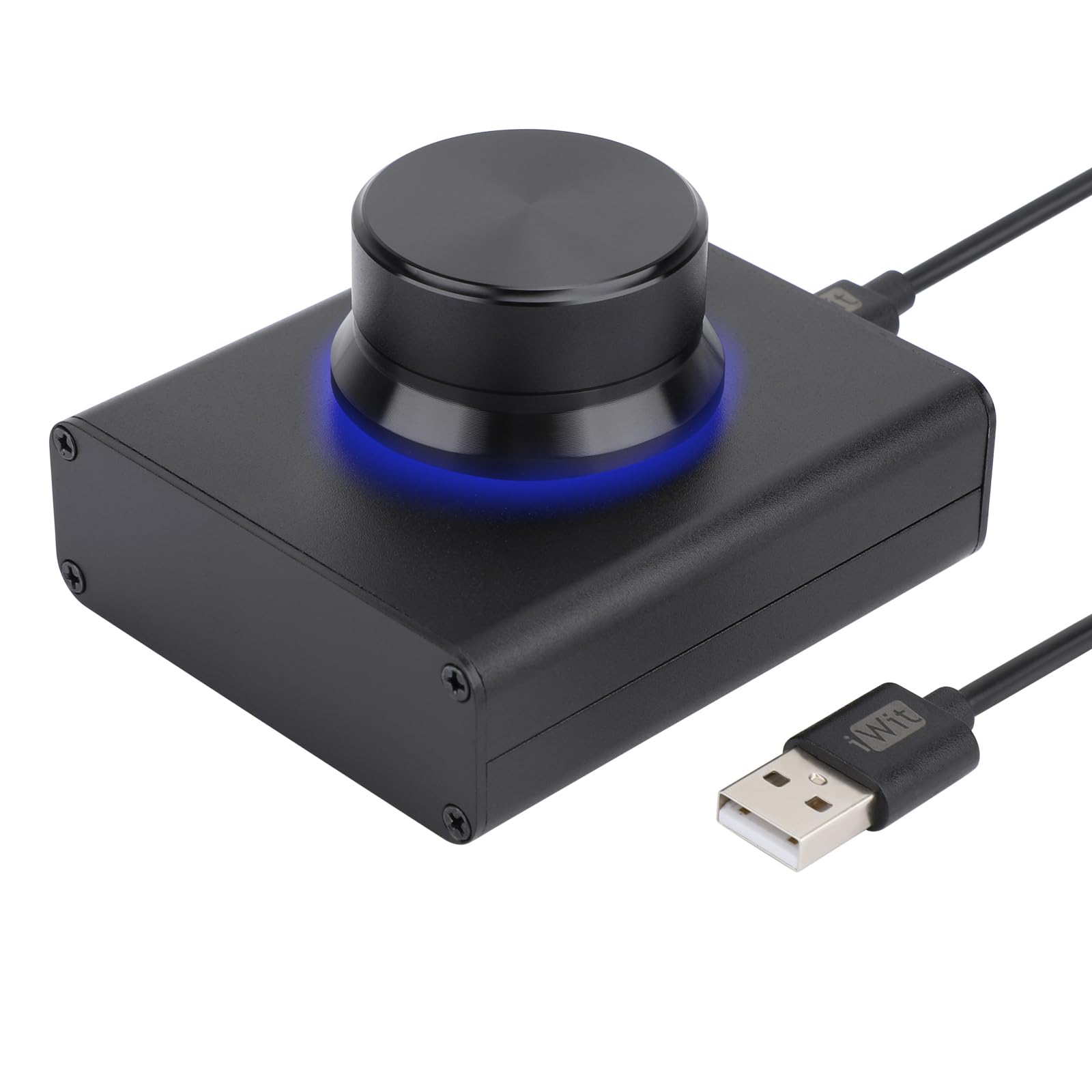
The DROK USB Volume Knob distinguishes itself with an ALPS rotary shaft — the same potentiometer mechanism found in premium audio gear — encased in a heavy aluminum body that stays planted during one-finger operation. Its interactive blue breathing light provides visual feedback: a slow pulse during normal use, brighter glow when turning, and a night mode that dims the LED to near-invisibility after eight seconds of inactivity.
Programmability is the hidden depth here. Hold the encoder button while plugging into a Windows machine, open Notepad, and the knob enters a key-mapping mode that lets you assign scroll actions, play/pause, mute, or even macros to different rotation directions and press combinations. This makes it adaptable beyond volume: adjust brush size in Photoshop, scrub video timelines, or control OBS scene transitions.
Two size options let you choose between a portable 30mm unit and a heftier 45mm version for a more substantial desktop feel. The detachable 1.5m USB cable is longer than the VAYDEER’s fixed cord, giving more routing flexibility behind a monitor. The only notable compromise is the instruction manual — it is nearly nonexistent, and first-time users will need to watch a YouTube walkthrough to unlock the programming features.
Why it’s great
- ALPS rotary shaft delivers smooth, long-term durability compared to generic carbon potentiometers.
- Programmable key-mapping via Notepad enables custom shortcuts beyond simple volume control.
- Breathing LED with night mode reduces desk glow distraction in dark environments.
Good to know
- Programming workflow is unintuitive and poorly documented in the included guide.
- Knob top can sit slightly skewed on some units — minor cosmetic variance.
- Only one knob means you cannot control multiple channels simultaneously without software grouping.
5. VAYDEER Volume Control Knob

The VAYDEER knob proves that a sub- volume controller does not have to feel like a toy. Its all-aluminum housing with internal metal weights gives the base serious heft — four anti-slip silicone pads keep it locked in place even when you spin the knob aggressively. The 3-level control mode lets you choose coarse, medium, and fine stepping, meaning you can crank volume fast during a gaming firefight then switch to fine mode for precise podcast-level adjustments.
One-click mute via a firm press on the knob works across Windows and macOS without any driver installation. The removable USB cable is a practical touch if you ever need to replace a damaged cord, though the connection point on the unit uses a micro-USB port rather than the more modern USB-C. Several users report that the blue LED accent on the bottom is extremely bright in a dark room — a small piece of electrical tape solves it in seconds.
It works immediately when plugged into a USB-A port — no configuration, no software, no hidden setup wizard. This simplicity makes it an excellent first desktop volume controller for non-technical users. The main tradeoff versus the DROK is the lack of programmability: you get volume and mute, period. No media playback control, no application routing.
Why it’s great
- Weighted metal base with anti-slip pads stays stationary during rapid knob rotation.
- Three-level stepping mode adapts between coarse volume sweeping and fine precision adjustment.
- True plug-and-play on Windows and Mac — no drivers, no configuration required.
Good to know
- Blue bottom LED is excessively bright and has no software dimming option.
- Micro-USB port feels outdated and may require a specific cable orientation for secure connection.
- No media transport controls (play/pause, skip) — strictly volume and mute.
6. Pyle PVC1 Wall Mount Volume Control

The Pyle PVC1 is the go-to solution for adding a clean, flush-mounted volume knob to any room with passive speakers. Rated for a 20-20kHz frequency response, it integrates with most Hi-Fi four-pair speaker selectors without introducing audible roll-off in the high frequencies. The rotary switch clicks through distinct positions and reaches total silence at the minimum setting — no residual hum leaking through to bedroom speakers at night.
Installation requires some creativity: the electronics board is large enough that standard single-gang low-voltage brackets need modification. You will likely need to cut the clamp inside the bracket or notch a 2-gang box to fit the PCB, then cover with a blank plate. This is not a beginner DIY project — expect to break out a jigsaw or rotary tool for existing drywall installations. Once wired with 16 AWG or thicker stranded speaker wire, the stereo output remains clean with no audible crosstalk between channels.
The PVC1 ships with a white decorative finishing frame and mounting ring, plus wire nuts and installation hardware. Because it is a purely resistive attenuator, it works with any amplifier regardless of power rating. The main limitation is that it does not offer impedance matching — if you run multiple pairs of speakers in parallel, you must calculate the total load yourself to avoid overworking the amplifier.
Why it’s great
- Full 20-20kHz frequency response preserves audio fidelity without high-frequency attenuation.
- Rotary switch reaches completely silent minimum position — no audible signal bleed.
- Works with standard speaker wire gauges up to 14 AWG for versatile in-wall installation.
Good to know
- PCB dimensions require creative box mounting — does not fit standard single-gang boxes without modification.
- No impedance matching circuitry, so multi-pair parallel setups risk amplifier loading issues.
- Plastic enclosure feels less premium than the all-metal options in the USB category.
7. OSD Audio VMS100 Slider Volume Control

The OSD Audio VMS100 solves the single biggest risk of in-wall volume controls: amplifier damage. Its built-in impedance matching circuitry presents a stable 8-ohm load to the amplifier regardless of how many speaker pairs are connected or where the slider is set. This allows up to eight pairs of 8-ohm speakers to run simultaneously without overheating the amp — critical for whole-house installations where volume adjustment is spread across multiple zones.
The 12-step linear slider control is pop-free, meaning you will not hear a crackle or thump when sliding between levels. The 100-watt peak power rating handles most residential speaker systems, and the frequency response remains ruler-flat across the stereo bandwidth. Installation fits a standard single-gang box with a minimum depth of 2.9 inches — no box modification needed, unlike the Pyle PVC1. Screw terminals accept up to 14 AWG wire, and the included trim plates let you match white, ivory, or almond wall plates.
The slider mechanism itself feels slightly wobbly when set to the lowest position, but it tightens up as you move upward. This is a cosmetic rather than functional issue — the electrical contact remains solid across the entire range. For the price, the VMS100 is the only in-wall option here that actively protects your amplifier, making it the smarter choice for anyone wiring multiple rooms on a single receiver.
Why it’s great
- Impedance matching circuitry prevents amplifier overheating when connecting multiple speaker pairs.
- 12-step pop-free slider provides silent, discrete volume adjustment without crackling.
- Fits standard 1-gang wall boxes with 2.9-inch depth — simpler installation than oversize rotary units.
Good to know
- Slider feels loose at the very lowest volume position.
- 100-watt peak rating limits use with high-power PA or outdoor speaker systems.
- Only one zone per unit — multi-room setups require one VMS100 per listening area.
FAQ
Can I use a passive volume control between my DAC and powered speakers?
Why does my USB volume knob have a bright LED that cannot be turned off?
Can an in-wall volume control handle both left and right speaker channels simultaneously?
Final Thoughts: The Verdict
For most users, the best audio volume control winner is the BEACN Mix because its four-channel display-based system eliminates the single biggest pain of PC audio — alt-tabbing to balance game, voice, and music levels. If you want pure analog transparency for a Hi-Fi system, grab the Nobsound Passive Preamp. And for whole-house speaker safety with multiple zones, nothing beats the OSD Audio VMS100 with its impedance matching circuitry.