
Our readers keep the lights on and my morning glass full of iced black tea. As an Amazon Associate, I earn from qualifying purchases.
Specs are compiled from manufacturer listings and verified buyer reviews and can change over time — please confirm the key details on the product page before buying.
Most desktop speaker setups flatter your music instead of telling you the truth about it. If you produce, mix, edit dialogue, or just want to hear the decay of a piano note instead of a muddy blur, the speakers on this list are the ones that actually resolve detail at arm’s length. The picks below span compact near-field monitors, Bluetooth-capable bookshelf systems, and a full streaming hi-fi pair — each chosen because it does one specific job well at a desk.
I’m Min — the founder and writer behind Gadgets Feed. This guide is built by comparing the manufacturers’ published specifications and the patterns across verified customer reviews, so you get each pick’s real strengths and trade-offs instead of marketing spin.
What separates a true near-field monitor from a loud computer speaker is how honestly it reproduces what you feed it. Below you’ll find the audiophile computer speakers worth clearing desk space for.
Our Picks at a Glance


How To Choose The Best Audiophile Computer Speakers
Desk listening is its own discipline. You sit close, off to one side or the other, and the room around you is usually small and untreated. That changes which specs matter and which ones are just numbers on a box. Here is what to think about before you buy.
Driver size sets your bass ceiling
A bigger woofer (the cone that produces low notes) moves more air, so it goes deeper without straining. A 5-inch woofer like the one in the JBL 305P MkII reaches noticeably lower than a 4-inch driver at the same volume. If you work with kick drums, bass lines, or cinematic sound design, this single measurement matters more than any wattage figure.
Amplifier class and honest power
Active monitors have the amplifier built into the cabinet, so you never buy a separate receiver. Class D amplifiers run cool and efficient; Class A/B amplifiers run warmer but some listeners prefer how they separate channels. The wattage number tells you headroom, not loudness — a well-built 41-watt-per-side design can play cleaner at your desk than a cheap high-wattage set.
Connections that keep the noise out
XLR and 1/4-inch TRS are balanced connections, meaning they cancel interference over the cable run — the fix for the hum and hiss a 3.5mm headphone jack often drags in from a PC. If you also want to stream from your phone, look for Bluetooth, and check whether it carries a high-resolution codec like aptX HD rather than basic SBC.
Room tuning and placement controls
Most near-field monitors give you switches or app controls to trim the low and high frequencies. These compensate for the fact that a speaker shoved against a wall or sitting on a wooden desk gets boomy. On the ADAM D3V and Edifier MR5, that adjustment lives on the back panel or in an app, which is how you stop a small room from sabotaging an otherwise accurate speaker.
Quick Comparison
| Model | Best For | Driver Size | Amplification | Connectivity | Amazon |
|---|---|---|---|---|---|
| JBL 305P MkII (Pair)★ Best Overall | Honest reference sound at a desk | 5 inches | Dual 41W Class-D | XLR / ¼-inch TRS | Amazon |
| Edifier MR5Top Performer | Three-way detail with app tuning | 5 inches | 110W RMS Class D | Bluetooth 6.0, XLR, TRS, RCA, AUX | Amazon |
| ADAM Audio D3VCompact Pick | Small-desk precision with USB-C | 3.5 inches | 80W per pair | USB-C, ¼-inch TRS, RCA | Amazon |
| Edifier S1000MKII | Room-filling bookshelf system | 5.5 inches | 60W x 2 Class D | Bluetooth 5.0, Optical, Coaxial, AUX | Amazon |
| Audioengine HD5 | Multiple sources at once | 5.5 inches | 150W total | Bluetooth 5.0 aptX HD, Optical, RCA, 3.5mm | Amazon |
| Audioengine HD6 | Class A/B warmth, all-in-one | 5.5 inches | 150W total (50W RMS per channel) | Bluetooth 5.0 aptX HD, Optical, RCA, 3.5mm | Amazon |
| KEF LSX II | True hi-fi streaming at a desk | — | Built-in amplification | Wi-Fi, HDMI ARC, USB-C, AirPlay 2 | Amazon |
| Pioneer DJ DM-50D-BT | DJ monitoring and wireless listening | 12.7 centimeters | Built-in amplification | Bluetooth, app control | Amazon |
| Pioneer DJ DM-40D | Compact DJ and streaming desk | 10.16 centimeters | Built-in amplification | RCA, Bluetooth | Amazon |
In‑Depth Reviews
1. JBL 305P MkII 5″ 2-Way Active Powered Studio Reference Monitors Speakers
Our pick — over 4.5★ from 950+ verified ratings; the strongest balance of quality and price.
A 5-inch woofer and 1-inch tweeter per cabinet, tuned for flat, uncolored playback at arm’s length.
If your work involves hearing exactly what’s on the track — dialogue edits, demos, reference listening — this is the pair to start with. A 5-inch woofer and 1-inch tweeter are driven by two 41-watt Class-D amplifiers per cabinet, one for each driver, so neither is starved. That’s why the low end stays controlled instead of smearing into the midrange, which is the thing that ruins cheap desk speakers for any critical listening.
You get a wide balance, so you don’t have to sit clamped dead-center to hear a proper stereo picture. That comes from the patented Image Control Waveguide (JBL’s shaped surround around the tweeter that spreads high frequencies evenly). Sound quality is the standout here, with the wide balance and deep bass response the two things owners bring up again and again. A dialogue editor who uses these daily described how the neutral midrange exposes mouth clicks, breaths, and room-tone mismatches that flattering speakers would smooth over. Another owner called them a phenomenal upgrade over audiophile-grade headphones for a home office, paired with a reasonable DAC.
The catch is a quiet floor. Several listeners report audible white noise at very close range even with no signal playing — a power-supply artifact that’s masked once music is up, but noticeable in very quiet, very dynamic material. The Boundary EQ and HF Trim switches on the back are your fix for the opposite problem, a desk or wall making them boomy, and each speaker has its own power switch. Feed them from a proper audio interface rather than a headphone jack and they behave like the monitors they are meant to be.
What earns the top spot
- 5-inch woofer plus dual 41W Class-D amps per cabinet for controlled, deep low end
- Image Control Waveguide widens the balance so off-center listening still holds up
- XLR and ¼-inch TRS balanced inputs keep the hum out of your signal chain
- Boundary EQ and HF Trim let you correct for a desk and wall that would otherwise boom
Where it asks something of you
- Audible white noise at close range when nothing is playing
- Two separate power switches mean two things to reach for
- XLR or TRS only — no Bluetooth, no 3.5mm convenience
Take these if: you’ll feed them from an interface or DAC and want an honest reference for editing or mixing.
Look past them if: you mostly stream from a phone and want wireless built in.
2. Edifier MR5 2.0 Studio Monitor Bookshelf Speakers, 110W RMS, Black
A 5-inch woofer, 3.75-inch mid, and 1-inch silk dome tweeter split the work three ways for cleaner separation.
Splitting the audio into three jobs instead of two is what makes this pair stand out. A 5-inch long-throw woofer handles the low notes, a 3.75-inch mid driver carries voices and instruments, and a 1-inch silk dome tweeter looks after the highs. That three-way active crossover system lets each driver do less work, and the result is separation you can hear — a voice stays put instead of being smeared up into the cymbals.
You get more ways to connect and tune than the JBL 305P MkII, which keeps things bare-bones. There’s a 110W RMS Class D amplifier (a power rating for continuous output), a 46Hz–40kHz frequency response (that upper number covers detail well above what human hearing tends to reach), support for 24-bit/96kHz wired and wireless LDAC audio (a high-quality Bluetooth codec), and Bluetooth 6.0 for streaming from your phone. Rear knobs for high and low frequency let you tune by hand, and the EDIFIER ConneX App adds room compensation with Low Cut-Off, Desktop Control, and Acoustic Space presets. A front-panel 3.5mm headphone output means you can mute the room and keep working.
The trade-offs are real but manageable. The adjustability is the most-discussed weak point — several owners find the EQ controls bare-bones for fine shading, and the input options draw mixed notes beside the strong praise for sound quality and value. One listener said these work beautifully as PC movie speakers with theater-like bass and no muddiness, and another described upgrading from Edifier’s smaller MR3 because it lacked power — these sound like larger speakers than they are. It’s a desk-sized system that behaves like a bigger one, provided you’re not trying to fill a large room with it.
The three-way advantage: a dedicated 3.75-inch mid driver is the rare feature at this size, and it is the reason dialogue and vocals hold their position instead of blurring into the bass.
The honest caveat: the app and rear-knob tuning covers the basics, but owners who want surgical EQ control find it limited — treat the presets as correction, not a full mixing tool.
Reach for these if: you want Bluetooth streaming and app-based room tuning on top of genuine monitor detail.
Skip these if: your priority is a pure, no-frills signal path with nothing between you and the drivers.
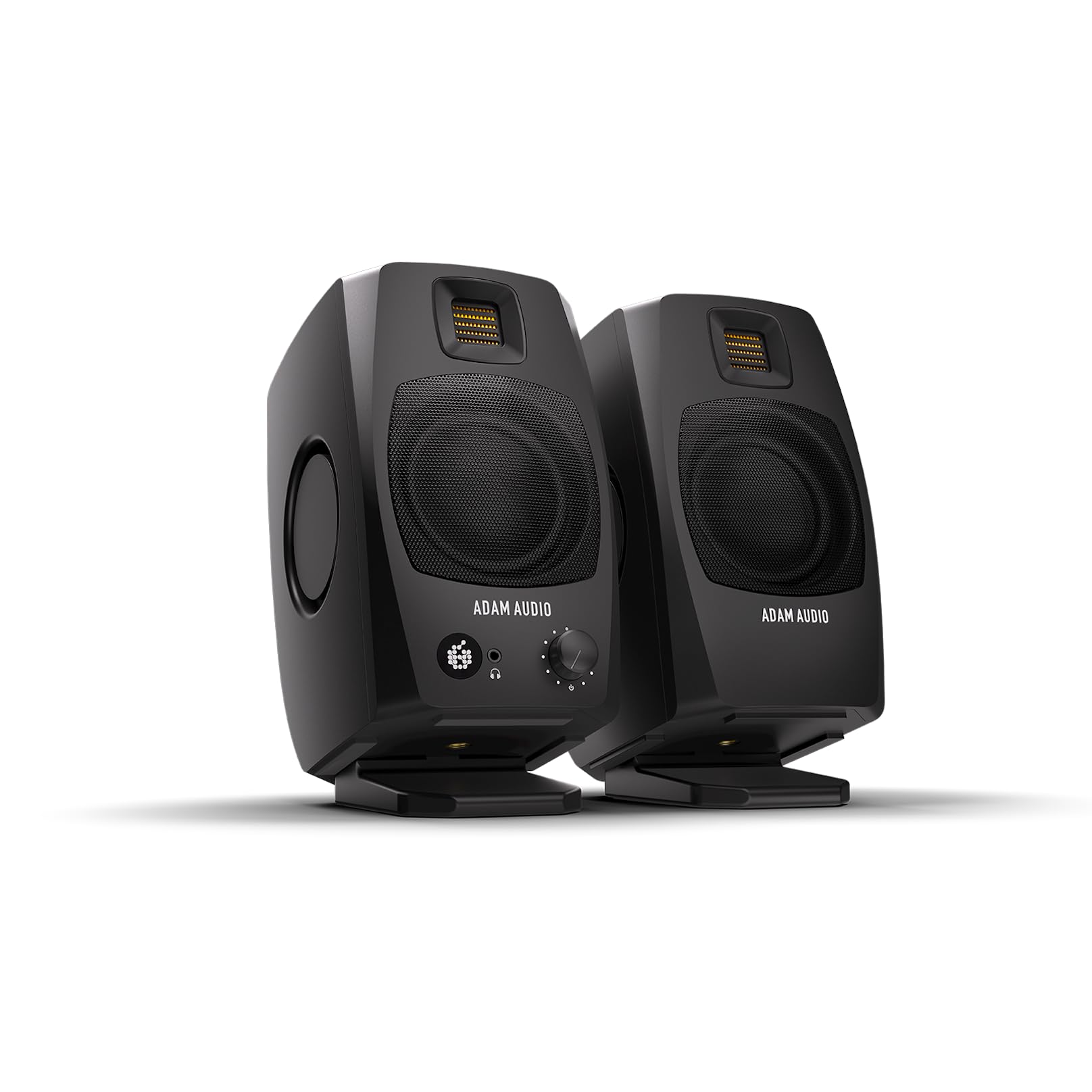
3. ADAM Audio D3V Active Desktop Studio Monitor Speakers – Black
3.5-inch cabinets with a D-ART ribbon tweeter and USB-C input that skips the audio interface entirely.
If desk space is your binding constraint, this is where to look. Each pair runs 3.5-inch aluminum woofers with ferrite magnet systems, driven by 80W amplifiers, and dual-sided 3.5-inch passive radiators (unpowered cones that move with the air inside the cabinet) push the low end down to 45 Hz. That’s how a speaker this small produces bass you can feel rather than just hear.
You get clear highs that don’t tire your ears over long sessions, thanks to a 1.5-inch D-ART ribbon tweeter (a folded, pleated diaphragm rather than a dome). That’s the kind of part you normally find in ADAM’s larger studio monitors. Connectivity is the other headline: the left speaker’s backplate carries balanced ¼-inch inputs, and you can run a USB-C cable straight from your computer or mobile device with no interface in between. There are DSP-powered switches (digital signal processing that fixes acoustical problems from where the speakers sit), plus a headphone socket and volume knob up front. The included stands angle the speakers 15° toward your ears.
The catch is what’s missing. There’s no Bluetooth, and the USB input is basic enough that critical listeners report it sounds dry and boxy compared to feeding the balanced inputs from a dedicated DAC — if you have one, use it. The auto-shutoff is also a known annoyance, though a firmware update lets you flip the 20-minute sleep mode on or off, which settles the long-session complaint. Sound quality is the metric these win on, consistently described as clean and tight with well-controlled bass that punches above its size.
Best for tight setups: the 15° angled stands and front headphone jack suit a crowded desk, and USB-C means one cable to your laptop.
One honest limit: the tweeter’s tight cone rewards on-axis placement — it’s built for near-field, single-listener listening rather than filling a room.
These are for you if: you work close to the screen and want reference-grade sound without adding a separate DAC.
Choose something else if: wireless streaming from your phone is part of how you listen.
4. Edifier S1000MKII Audiophile Active Bookshelf 2.0 Speakers – 120w Speakers Bluetooth 5.0 with aptX HD – Optical Input

60W per speaker, optical and coaxial inputs, and Bluetooth 5.0 aptX HD for a desk that also feeds a TV or CD player.
This pair earns its place by being a complete system in two boxes. A high-efficiency Class D amplifier rated at 60 watts per speaker is built in, so there’s no receiver to buy or find space for — you plug into a source and play. Each cabinet holds a 5.5-inch aluminum alloy midrange bass driver and a 1-inch titanium dome tweeter, and the quoted frequency response spans 45 Hz to 40 kHz. Bluetooth 5.0 with Qualcomm aptX HD decoding means wireless streaming from a compatible phone carries more data than standard Bluetooth, so less detail gets left behind on the way to the speakers.
Around the back you get optical, coaxial, and AUX inputs plus a wireless remote, and you can adjust volume, bass, and treble right on the speaker. That breadth is why it suits a home office that doubles as a listening room — a computer on one input, a TV, Blu-ray player, or CD player on another. A long-time audiophile listener who usually prefers passive speakers found these better for movies and orchestral material, and praised the wired connections especially.
Where it pushes back is desk fit. This is a genuinely large, heavy set of cabinets, and owners admit they’d call it overkill sitting on a small desk. The remote also demands a direct, close aim at the sensor to register a press, and the input indicator lights take some learning — one listener found only one light color produced sound. Reliability draws mixed mentions too. If you want a pair that anchors a room rather than hugs a monitor stand, the trade is worth it; if you want tiny, this isn’t it.
Where it holds an edge: optical and coaxial inputs alongside Bluetooth 5.0 with aptX HD give you more ways in than most monitor pairs, with separate bass and treble controls that are rare at this level.
What to expect: the low-end is full rather than neutral, so it flatters movies and music more than it judges a mix.
Pair this with: a room where the speakers can sit on proper stands and serve a TV or turntable too.
Pass if: you need your speakers to disappear into a small desk footprint.
5. Audioengine HD5 Powered Bookshelf Speakers – Bluetooth Speakers

A 24-bit/192kHz DAC plus optical, RCA, 3.5mm, and aptX HD Bluetooth let a computer, turntable, and phone stay connected at once.
Where a strict studio monitor wants one clean feed, this pair of 5.5-inch woofers and 1-inch silk dome tweeters, stretching across a 50Hz–22kHz range, welcomes everything. The reason to pick it is what it does behind the drivers: a built-in 24-bit digital-to-analog converter handles digital signals up to 24-bit/192kHz, which is a meaningful step up from the sound card inside most computers. An optical input, RCA, 3.5mm, and Bluetooth 5.0 with aptX HD round out the ways in, and the Bluetooth carries a 100-foot range.
For a desk that also holds a synthesizer or a drum machine, the ability to run multiple sources at once is the whole point. One owner highlighted that they can play music alongside a synth or drum machine at the same time, and others note the optical input surfaces background instruments and vocal detail they hadn’t heard before. Cabs come in real wood veneer with a hand-polished finish, and Audioengine backs the pair with a 3-year warranty and US-based support.
These speakers need break-in and good placement to sound their best. This is a small sample of reviews, and one buyer returned theirs calling the sound dull and shrill with no EQ controls to fix it — that’s an outlier, but the pattern points to the same truth. Another listener found the balance for vocals is narrow and height-sensitive, so plan to position them at ear level rather than on the floor. If you want rawness and zero fiddling, look at a monitor instead.
The reason to choose it: a 24-bit DAC, optical, RCA, 3.5mm, and aptX HD Bluetooth all in one cabinet so nothing in your desk setup gets left out.
The one to accept: it asks for placement patience — get the speakers at ear height and the sound locks in; leave them low and it won’t.
Worth it for: a multi-source desk where streaming, a turntable, and a computer all need a home.
Not the pick if: you’d rather buy a bare monitor and a separate DAC and wire it yourself.
6. Audioengine HD6 Powered Bookshelf Speakers – Bluetooth Speakers
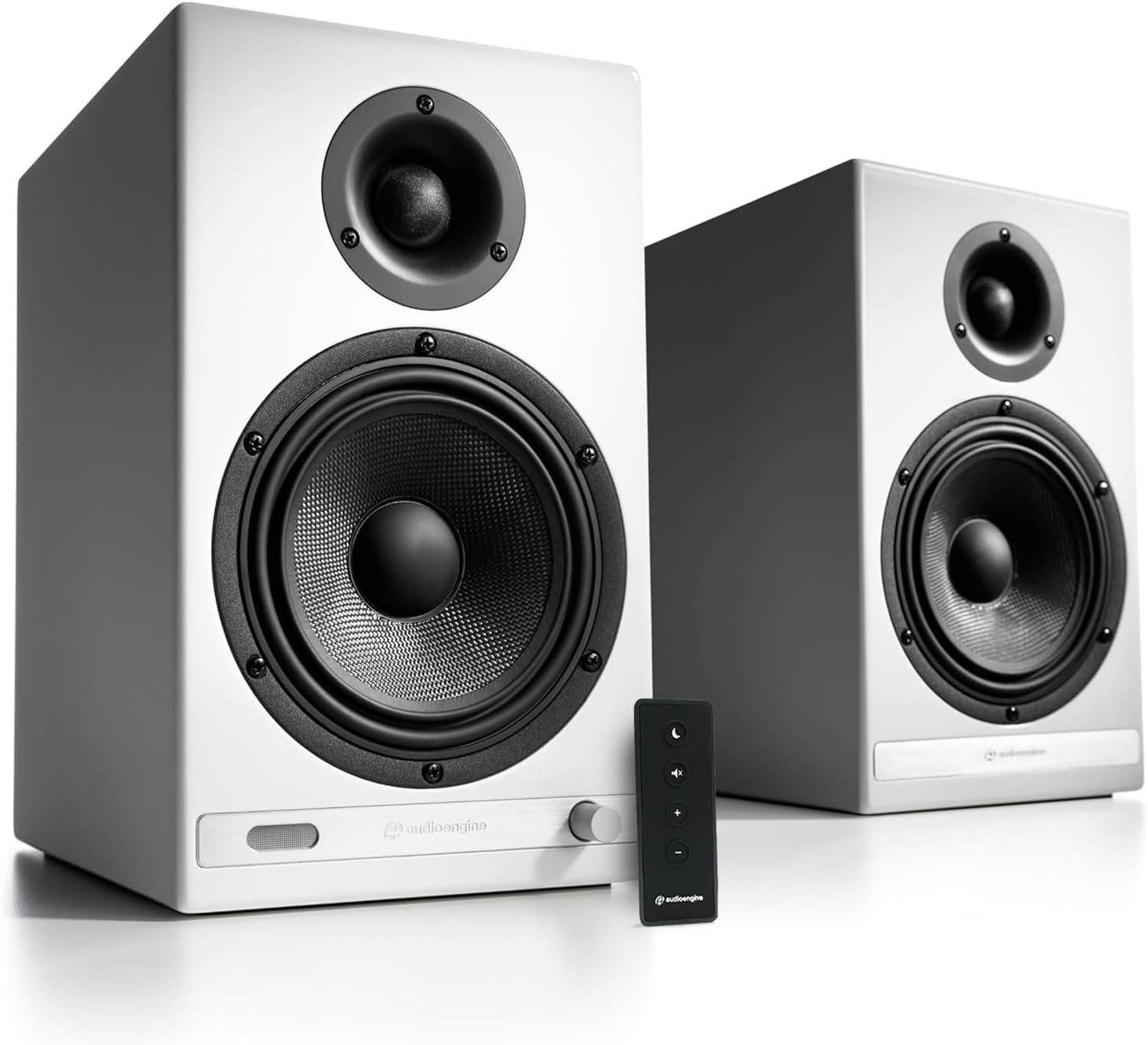
A Class A/B amplifier rated 150W total (50W RMS per channel) drives 5.5-inch woofers and 1-inch silk dome tweeters.
You get better channel separation and staging, according to at least one listener who chose this pair for its amp. Most powered speakers use a Class D amplifier, but this one runs a Class A/B design — the older, warmer type. Custom 5.5-inch woofers and 1-inch silk dome tweeters cover a 50Hz–22kHz range, and 150W of total power (50W RMS per channel) drives them without a separate receiver. A 24-bit DAC (digital-to-analog converter) handles digital signals up to 24-bit/192kHz, with optical, RCA, 3.5mm, and Bluetooth 5.0 aptX HD inputs.
Owners describe a speaker that lets you add a powered subwoofer into the chain later to fill out the low end, which is a flexibility the all-in-one design usually gives up. The matching of the built-in amp, DAC, and aptX Bluetooth is consistently praised as sounding comparable to a wired connection, and the wood-veneer cabinets with magnetic grilles read as furniture, not gear. It’s a system for someone who wants serious sound without a rack of components.
Two things the buyer should know. This pair needs a break-in period — more than one owner described the sound as flat and disappointing from the start and then transformed after a few dozen hours of playing. And at this size it’s genuinely overkill on a small desk — it wants a mid-sized room and a stand or shelf to sit on. Owners also note it can lose composure at very high volumes, so it’s a rich everyday system rather than a party rig.
What makes it different: a Class A/B amplifier in a powered speaker is unusual, and owners who value staging and channel separation pick this pair specifically for it.
The practical reality: budget a break-in period before judging the sound, and make sure you have the room and surface for a set this size.
Choose it if: you want a self-contained hi-fi system and are willing to let it settle in.
Think twice if: your desk is small or you judge a speaker within the first hour.
7. KEF LSX II Wireless HiFi Speaker System (Carbon Black)

Built-in amplification, a preamp, a DAC, and a network streamer for Spotify, Tidal, and Qobuz in two desk-sized cabinets.
You get a compact stereo system that fits beside a monitor, not just a set of computer speakers. The LSX II streams audio up to 24bit/384kHz, which is well into high-resolution territory, and it takes HDMI ARC and USB-C inputs — the HDMI connection means your TV sends it sound with one cable and lets your remote control the volume. Inside the cabinets you get separate amplification, a preamp, a high-end DAC, and a network streamer that pulls from Spotify, Tidal, Amazon Music, Qobuz, Deezer, and QQ Music, plus AirPlay 2, Chromecast, and Roon for multi-room use.
You can plug in a turntable, a laptop, and a TV and still stream losslessly from your phone. That breadth of connectivity is the whole pitch, and one owner summed it up as not just great speakers but “a compact audiophile stereo system with tons of inputs.” The sound is described as a wide, deep soundstage with crisp highs and present mids. The speakers can sit on a desk, a bookshelf, or a wall mount, and the KEF app offers EQ and placement adjustments for your room. An owner who compared them to a much larger reference system called them a bargain by comparison.
What you accept in return is real. Owners note a steeper learning curve than a simple pair of monitors, and the app draws mixed feedback — useful, but clunky. Wireless pairing over Wi-Fi can introduce dropouts; the fix owners recommend is running a wired ethernet connection, which also raises the stream quality to 96/24. The bass is described as balanced and punchy rather than deep, so a subwoofer helps if you want weight. Value and setup both draw mixed reactions here, so buy it for the streaming feature set and desk-sized footprint, not for plug-and-play simplicity.
The full-system case: separate amps, a DAC, and a network streamer are built into two small cabinets, so the LSX II replaces an entire hi-fi stack on your desk.
The honest friction: wireless setup and app control are the weakest links — a wired ethernet run steadies the connection and improves the stream to 96/24.
This is the one to buy if: you want lossless streaming from your phone and your computer off a single desk-sized pair.
You’ll be happier elsewhere if: you want a plain monitor with no app, no network, and no setup steps.
8. Pioneer DJ DM-50D-BT 5-inch Active Monitor Speakers, Bluetooth, Pair

A 12.7-centimeter woofer with DJ-voiced DSP tuning and Bluetooth for streaming after practice.
The driver here measures 12.7 centimeters, and that extra cone area over the smaller Pioneer model is the reason this one earns the step up. Compared with the 10.16-centimeter woofer in the DM-40D, the larger driver brings more low-end weight for a desktop or small room, and DSP tuning keeps the sound balanced. Built-in amplification means no separate amp, and Bluetooth lets you stream from a phone once you’re done monitoring.
You get plenty of volume with great sound when you run these as desktop speakers over a stereo Y cable to the 3.5mm audio jack rather than Bluetooth, buyers report. The auto-off after 20-30 minutes behaves fine in that setup, resuming instantly when audio returns. A DJ switch adds extra bass for that kind of listening, and the compact size suits a Mac desk upgrade. The verdict from one long-time listener: “Wirecutter was right, these things are awesome.”
Two things to keep on your radar. This pair carries mixed reliability signals in the reviews — some units reportedly stop working soon after purchase, so buy from a seller with a solid return path. And the automatic sleep mode is fussy over Bluetooth specifically, where some speakers fail to auto-reconnect and need a manual power cycle and re-pair. Over the wired connection most buyers use, that issue doesn’t bite. Volume sits at about the 12 o’clock position with the computer controlling the rest.
What the larger driver buys you: 12.7 centimeters of woofer rather than 10.16 means noticeably fuller bass at the same desk volume.
The catch to weigh: the Bluetooth sleep-and-reconnect behavior is the recurring complaint, but it fades when you run the wired Y cable instead.
Suits you if: you split your time between DJ practice and casual streaming and want one pair to do both.
Look at the more neutral options above if: you need surgical accuracy for critical mixing.
9. Pioneer DJ DM-40D 4-inch Active Desktop Monitor Speakers, Pair, Black

The compact starter pair that leaves room on the desk for the rest of your rig.
For a first set of powered desktop monitors, the size is the selling point. A 4-inch active driver and built-in amplification keep the footprint small enough to share a desk with a controller or keyboard, and the DSP tuning delivers a clear, balanced sound. A 2-way mode is tune separately for DJing and for music production, and the low end is voiced by the DJ audio team for a punchy, defined character even at this compact size. RCA and Bluetooth connections get you up and running with a laptop, controller, mixer, or phone.
What buyers value most is the sound for the money. The reviews consistently call it reliable and worth the price, and it suits a range of uses — an ultimate home DJ setup for one, background music around the house for another. Owners describe it as loud and clear, with strong highs and lows and a solid build for the cost, and many treat it as the natural partner for a DDJ controller. It also comes in white if you want the finish to match the rest of your desk.
The honest limit is neutrality. Bass is punchy and highs are pronounced, but the upper mids dip, which softens vocal and instrument detail — so it’s a great DJ monitor and a tiring one for long mixing sessions. Some listeners wanted more bass for video, and the DJ setting helps without fully solving it. Also worth knowing: the wire joining the two speakers is only 6 feet long, so if your desk layout needs a longer run, plan to buy one. A crossover and polyfill upgrade is a popular tweak for owners who want more from them.
Where it wins: a compact 4-inch active cabinet with DJ-voiced bass suits a small desk and a controller far better than a bulky bookshelf pair.
Know before you buy: the response is lively rather than neutral, and the 6-foot linking cable sets a hard limit on how far apart the speakers can sit.
This is your pair if: you’re starting a DJ or home studio desk and want low-end punch without spending much.
Go bigger if: neutral, detailed monitoring is what your mixing depends on.
Understanding the Specs
Driver size and how low it goes
The woofer measurement, given in inches or centimeters, is the single best predictor of bass depth on a desk. A larger cone moves more air, which is why a 5-inch or 5.5-inch driver reaches lower than a 3.5-inch or 4-inch one at the same listening volume. It also shapes what the speaker is for: compact drivers suit close near-field work, while larger ones fill more of a room. That’s why the 12.7-centimeter Pioneer DM-50D-BT produces fuller bass than the 10.16-centimeter DM-40D — the bigger cone is doing the work.
Tweeter type and long listening sessions
The tweeter handles high frequencies, and its design affects how fatiguing the speaker feels after hours. A silk dome tends to sound smooth and forgiving, which suits long sessions. A titanium dome, like the one in the Edifier S1000MKII, produces a crisper high end. An ADAM D-ART ribbon tweeter is a folded diaphragm that ADAM designs to reproduce highs precisely without tiring your ears. None of these is strictly better — a smoother tweeter flatters casual listening, and a more revealing one exposes exactly what’s in the recording, which is what you want for editing.
FAQ
Can I connect audiophile computer speakers straight to my PC without extra gear?
Do I need a separate amplifier for powered desktop monitors?
Will XLR or TRS inputs actually reduce noise compared to a 3.5mm jack?
Is a built-in Bluetooth connection good enough for critical listening?
How much bass should I expect from a 4-inch driver versus a 5-inch one?
Can these speakers sit on a wooden desk, or do I need stands?
What is a passive radiator and does it really extend the bass?
Should I add a subwoofer to desktop speakers?
Do these speakers need a break-in period before they sound right?
Can I use audiophile computer speakers for watching TV?
Final Thoughts: The Verdict
For most desks, the audiophile computer speakers winner is the JBL 305P MkII pair because it delivers an honest, neutral reference with controlled bass, a wide balance from the Image Control Waveguide, and balanced XLR and ¼-inch TRS inputs that keep the signal clean. If you want a three-way design with Bluetooth streaming and app-based room tuning, grab the Edifier MR5. And for a genuinely small desk, the ADAM Audio D3V is the one to reach for, thanks to its USB-C direct connection, 45 Hz low-end from a 3.5-inch pair, and angled stands that aim the sound at your ears.
How We Picked
We do not accept paid placement. Every pick is matched to a real buyer and a real use-case; we do not hands-on test units.
Sources & Methodology
Specifications: manufacturer listings and product documentation. Review insights: verified customer reviews, as of September 2026. Pricing: not shown on this page (it changes often); check the current price via the retailer link.
As an Amazon Associate, Gadgets Feed earns from qualifying purchases. This does not affect which products we feature.