
Our readers keep the lights on and my morning glass full of iced black tea. As an Amazon Associate, I earn from qualifying purchases.
Specs are compiled from manufacturer listings and verified buyer reviews and can change over time — please confirm the key details on the product page before buying.
You are looking for speakers that do not just play music — they reveal it. Every breath of the vocalist, the scrape of a bow across a cello string, the exact placement of a snare drum in the studio. That is the promise of serious audio gear, but the path is littered with overpriced boxes that look impressive and sound flat. The real difference between a so-so speaker and one that makes you rediscover your entire music library depends on a handful of measurable specs: driver size, amplifier power, and the crossover design that splits the sound. You need a pair that turns your living room into a front-row seat.
I’m Min — the founder and writer behind Gadgets Feed. This guide is built by comparing the manufacturers’ published specifications and the patterns across verified customer reviews, so you get each pick’s real strengths and trade-offs instead of marketing spin.
Whether your goal is a desktop workstation upgrade or building a dedicated listening room, finding the right pair means matching a speaker’s physical design to your space and your taste — and this guide to the best audiophile speakers will show you exactly which models deliver where it counts.
Quick Picks
- Edifier S2000MKIII Coaxial — Best Overall
- Fluance Ai81 Elite Powered 2-Way Floorstanding — Room-Filling
- DALI KUPID Premium Compact Passive Hi-Fi — Compact Style
- Polk Audio Reserve R200 Large Bookshelf Speaker — Home Theater
- HiVi-Swans M300MKII Bluetooth & WiFi — Tech-Filled
- Monitor Audio Silver 100 New 7G in Black Gloss — Bass King
- SVS Ultra Evolution Bookshelf Speakers — Reference Class
- Klipsch Reference Premiere RP-8000F II 2.0 Dual — High-Efficiency
- SVS Prime Pinnacle Floorstanding Speakers — Triple-Woofer
- KEF R3 Meta (Indigo Gloss, Pair) — Three-Way
- KEF LS50 Wireless II (Pair, Carbon Black) — Wireless Hi-Fi
- Klipsch Heritage Series Heresy IV Floorstanding — Heritage
How To Choose The Best Audiophile Speakers
Jumping into high-end speakers can feel like stepping into a room full of numbers with no context. The three specs that truly determine whether a speaker will sound good in your home — not just on paper — are driver size, amplifier requirement, and the cabinet design. Here is what real-world buyers need to focus on.
Driver Size and Bass Response
The woofer (the larger driver cone) directly controls how low the speaker can go. A larger cone moves more air, which means deeper, more physical bass without needing a separate subwoofer. A 4.5-inch driver in a compact bookshelf like the DALI KUPID can reach down to 63Hz, while an 8-inch driver in the Monitor Audio Silver 100 7G stretches down to 35Hz. Your room size dictates the right choice — a massive 8-inch driver can overwhelm a small office, but it fills a large living room with easy depth.
Active vs. Passive: The Amp Question
An active (powered) speaker has a built-in amplifier — you plug it into a wall and connect your source directly. The Edifier S2000MKIII and Fluance Ai81 are active, meaning you skip the separate receiver. A passive speaker, like the KEF R3 Meta or the Polk Reserve R200, needs an external amplifier or receiver. The upside is flexibility: you can pair a passive speaker with a high-end amp and upgrade components over time. The downside is you are not buying a complete system in one box.
Crossover Design and Soundstage
The crossover splits the audio signal so the tweeter plays only high frequencies and the woofer plays lows and mids. A 2-way crossover uses one tweeter and one woofer; a 3-way design (like the HiVi-Swans M300MKII) adds a dedicated midrange driver. That third driver gives vocals and strings their own dedicated driver, which often results in a more open, holographic soundstage where you can pinpoint each instrument in space. If imaging — the feeling that the drummer is three feet left of center — is important to you, a 3-way or a well-executed coaxial driver (like KEF’s Uni-Q) is worth the extra cost.
Quick Comparison
| Model | Best For | Driver Size | Type | Frequency Response | Amazon |
|---|---|---|---|---|---|
| Edifier S2000MKIII | Near-field desktop listening | 5.5 in | Active | — | $594.99$699.99Amazon |
| Fluance Ai81 Elite | Plug-and-play floorstanding | 6.5 in | Active | — | $599.98Amazon |
| DALI KUPID | Compact near-field with wall mounting | 4.5 in | Passive | 63–25,000 Hz | $600.00Amazon |
| Polk Reserve R200 | Dynamic home theater and music | 6.5 in | Passive | — | $799.00Amazon |
| HiVi-Swans M300MKII | 3-way studio monitors with Wi-Fi | 6.5 in | Active | 38 Hz – 40 kHz | $854.99$899.99Amazon |
| Monitor Audio Silver 100 7G | Full-range bookshelf with 8-in driver | 8 in | Passive | 35 Hz – 35 kHz | $1,049.00$1,495.00Amazon |
| SVS Ultra Evolution | Reference-class bookshelf | 6.5 in | Passive | — | $1,199.00Amazon |
| Klipsch RP-8000F II | High-efficiency floorstanding home theater | 8 in | Passive | — | Amazon |
| SVS Prime Pinnacle | Full-range floorstanding with triple woofers | 5.25 in (mid); 6.5 in x3 (woof) | Passive | — | $1,998.00Amazon |
| KEF R3 Meta | 3-way bookshelf with MAT absorption | 6.5 in | Passive | 58Hz – 28kHz | $2,499.99Amazon |
| KEF LS50 Wireless II | All-in-one wireless high-res system | 5.25 in | Active | — | $2,999.00Amazon |
| Klipsch Heresy IV | High-efficiency heritage listening | 12 in (woofer) | Passive | — | $3,599.98Amazon |
In‑Depth Reviews
1. Edifier S2000MKIII Coaxial, Bluetooth, Optical and RCA Bookshelf 2 Speakers
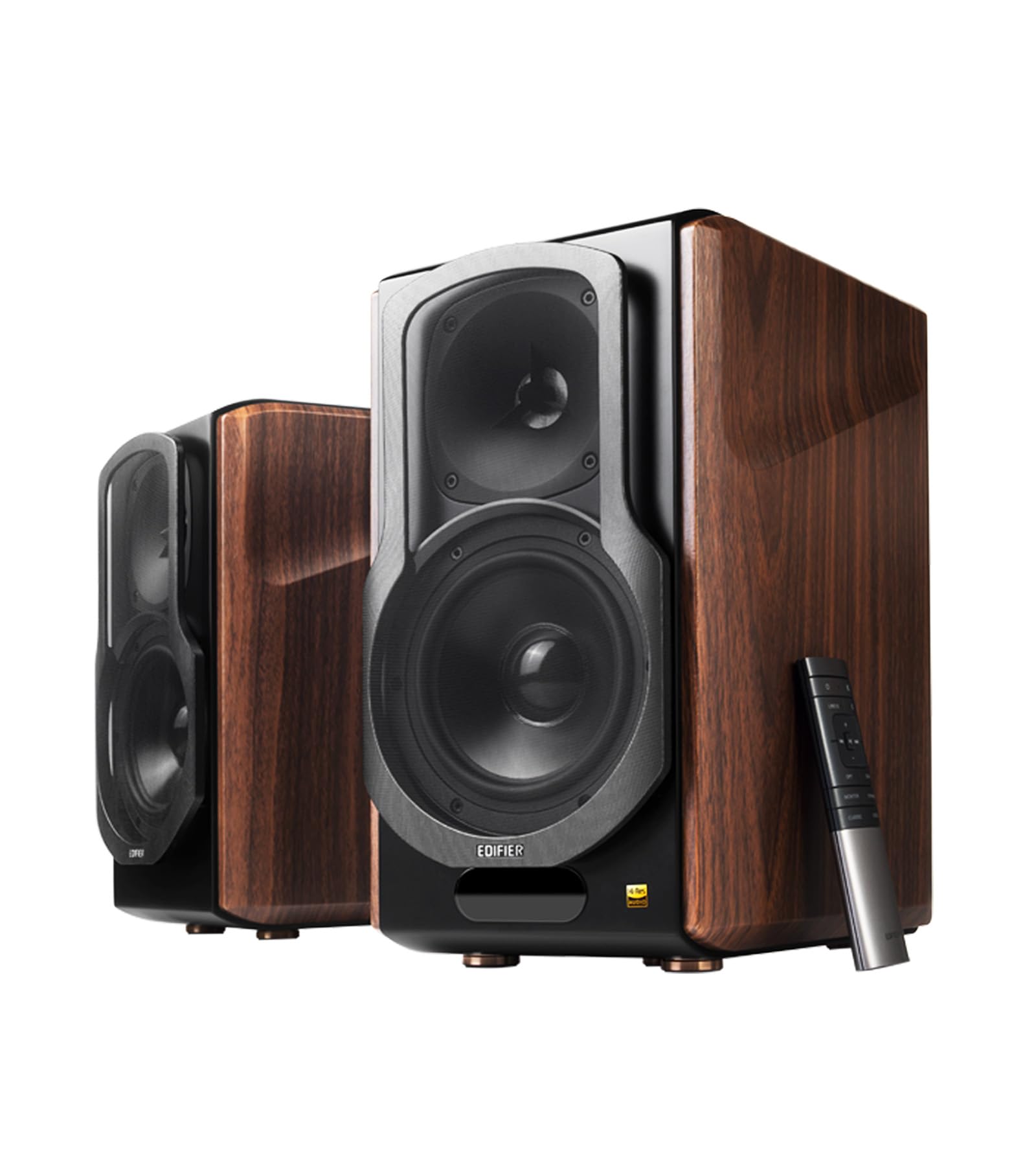
A near-field marvel that pulls detail from streaming sources without demanding floor space.
These active bookshelf speakers pack a planar diaphragm tweeter (a type of flat driver that creates very clean, low-distortion highs) and a 5.5-inch aluminum woofer, all driven by a tri-amped 130-watt system — meaning each driver gets its own dedicated amplifier channel. Buyers report the compact bookshelf speakers deliver deep bass, clear mids and treble, and sound best at volume 40 to 47. The bass output is so tight that some owners mention it rivals 12-inch subwoofers, but only if you place the speakers six inches from the wall and five feet apart with a slight toe-in angle.
The Bluetooth 5.0 with aptX HD decoding lets you stream high-resolution audio wirelessly without the lag or compression that plagues older Bluetooth versions. You also get optical, coaxial, and dual RCA inputs, so you can connect your TV, turntable, and PC simultaneously without swapping cables. The included remote has tiny symbols that are hard to read in dim light — a minor ergonomic stumble on an otherwise polished package.
Unlike the passive DALI KUPID which requires a separate amplifier, the Edifier is ready to play straight from the start, making it a low-maintenance entry point for someone new to serious audio.
The Case for It
- Tri-amped 130W active design — no separate receiver needed
- Planar diaphragm tweeter delivers clean, extended highs
- Multiple inputs (optical, coaxial, RCA, Bluetooth 5.0 aptX HD)
The Catch
- Requires precise placement (6 in from wall, 5 ft apart, toed-in) for ideal imaging
- Remote control symbols are nearly unreadable in low light
Ideal for: desktop listeners and streaming fans who want a complete, high-resolution system in one box.
skip it if: you prefer passive speakers and the flexibility to pair with your own amplifier.
2. Fluance Ai81 Elite Powered 2-Way Floorstanding Tower Speakers

Floorstanding power for those who want a complete stereo without a separate receiver.
These towers integrate a 150W amplifier directly into the cabinet — plug in the power cable, connect your source via Bluetooth 5.0, optical, or RCA, and you are listening within minutes. The dual 6.5-inch woven glass fiber woofers (a stiff, lightweight cone material that resists breakup) combine with a neodymium tweeter (a small, powerful magnet type that gives cleaner high-frequency extension) to create a stereo soundstage that buyers describe as “crisp” and “wide.” One reviewer who downsized from a house to a condo noted the AI81 paired with a Fluance subwoofer delivers clean, powerful sound that easily fills a 24-foot room.
A notable feature is the subwoofer output, which lets you add a powered sub for deeper low-end extension — a path several buyers recommend, especially after noting the midrange can sound slightly scooped (a bit recessed) on its own. The down-firing bass port (the opening that vents air is on the bottom) helps the bass feel more natural and omnidirectional, which is useful if you need to place the speakers close to a wall.
Compared to the Edifier S2000MKIII, the Ai81 fills a larger space with more physical bass presence, though it lacks the same level of micro-detail in the treble.
Why It Stands Out
- True plug-and-play floorstanding towers — no amp or receiver needed
- Subwoofer output lets you expand bass later
- Down-firing port design gives flexible room placement
Where It Falls Short
- Midrange is slightly scooped (recessed) compared to dedicated 3-way designs
- Non-replaceable amplifier section means the whole speaker is out of service if the amp fails
Best for: new home or condo owners who want big tower sound without buying a separate amplifier.
Look elsewhere if: you demand pinpoint vocal articulation — the midrange is not as forward as 3-way designs.
3. DALI KUPID Premium Compact Passive Hi-Fi Bookshelf Speakers
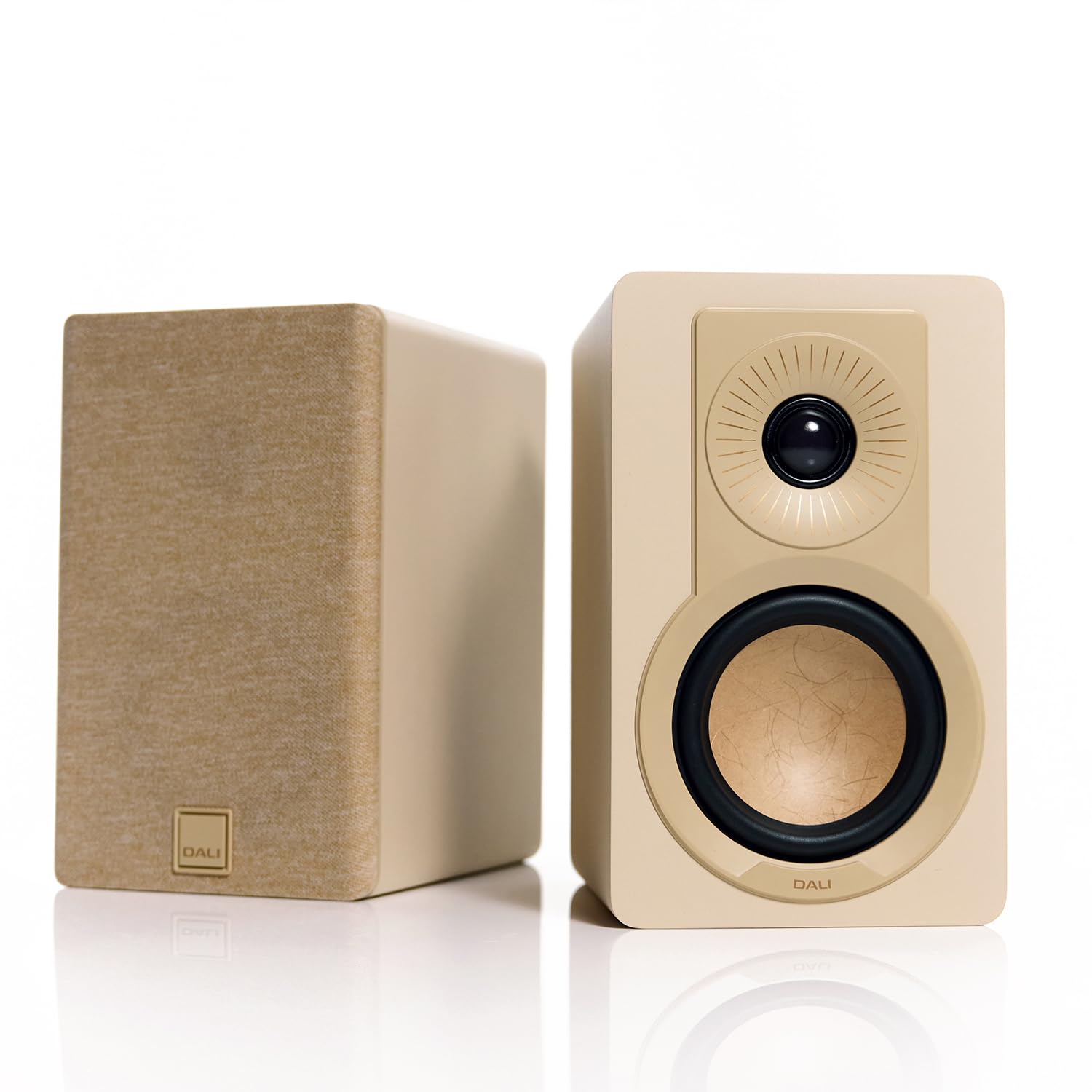
Tiny cabinets that challenge the assumption that bigger drivers always sound better.
At just 4.5 inches, the woofer on the KUPID is the smallest in this roundup, yet its low-loss design (a method of reducing mechanical resistance in the cone suspension) delivers a frequency response down to 63Hz — enough to feel the low end of an upright bass. The 26mm soft dome tweeter handles highs up to 25,000 Hz, extending well beyond the 20kHz limit of human hearing to create a sense of air and space. One buyer came to these from a pair of ELAC DB63 speakers and was skeptical that a speaker this size could outperform them; after listening, they reported being “blown away” by the soundstage, calling the price tag absolutely worth it.
The passive design means you need an external amplifier — the manufacturer recommends 40 to 120 watts at 4 ohms — and the included wall-mount brackets make them a strong option for tight bookshelves or wall-mounted near-field setups. Unlike the larger Polk Reserve R200, the KUPID is easier to place close to a wall without getting a boomy, muddy low end, because its smaller driver produces less rear-firing bass energy.
Reviewers consistently praise the cosmetic appeal, with one noting the Caramel White finish looks fantastic on an entertainment center, and another using a Wiim Amp Ultra to drive them for a minimalist desktop system.
What Works
- Remarkable soundstage for a 4.5-inch driver
- Includes wall-mount brackets for flexible placement
- Danish engineering pedigree with over 40 years of design heritage
What to Consider
- Requires a separate amplifier (40–120W at 4 ohms) — not a self-contained system
Right for you if: space is tight and you value a wide soundstage over chest-thumping bass.
Choose differently if: you need deep sub-bass for electronic or hip-hop music without adding a subwoofer.
4. Polk Audio Reserve R200 Large Bookshelf Speaker

A dynamic bookshelf that demands serious amplification to show its full range.
The R200 uses a 1-inch Pinnacle Ring Radiator tweeter (a ring-shaped diaphragm that pushes air more evenly at high frequencies) and a 6.5-inch Turbine Cone woofer, all tuned for Dolby Atmos and IMAX Enhanced certification. The driver gap between the DALI KUPID and the Polk is significant — 6.5 inches versus 4.5 inches that translates into noticeably deeper bass and higher maximum output. Customers note the R200 delivers a full, non-fatiguing sound with a wide soundstage and imaging that bested more expensive competitors, including the KEF LS50 and Elac UB52.
That dynamic performance comes with a catch: the tweeter is very directional, with a balance that is roughly 20 degrees wide. Step outside that window and the highs drop off sharply. More importantly, one reviewer notes the R200 sounds underwhelming with a standard 75W receiver, but transforms when paired with a high-power amp delivering 260 watts at 4 ohms. If you are not ready to invest in a beefy external amplifier, a powered option like the HiVi-Swans M300MKII may serve you better.
What It Nails
- Excellent imaging and soundstage for near-field listening
- Dolby Atmos and IMAX Enhanced certified
- Clean, detailed mids with expansive female vocals
What Holds It Back
- Narrow listening balance (~20 degrees)
- Needs high-power amplification (up to 260W at 4 ohms) to shine
Perfect for: dedicated near-field listeners with a powerful external amplifier who want to outperform speakers twice the price.
Not your match if: you plan to use a standard AV receiver (under ~100W) or want a wide off-axis sound for parties.
5. HiVi-Swans M300MKII Bluetooth & WiFi Bookshelf Speakers
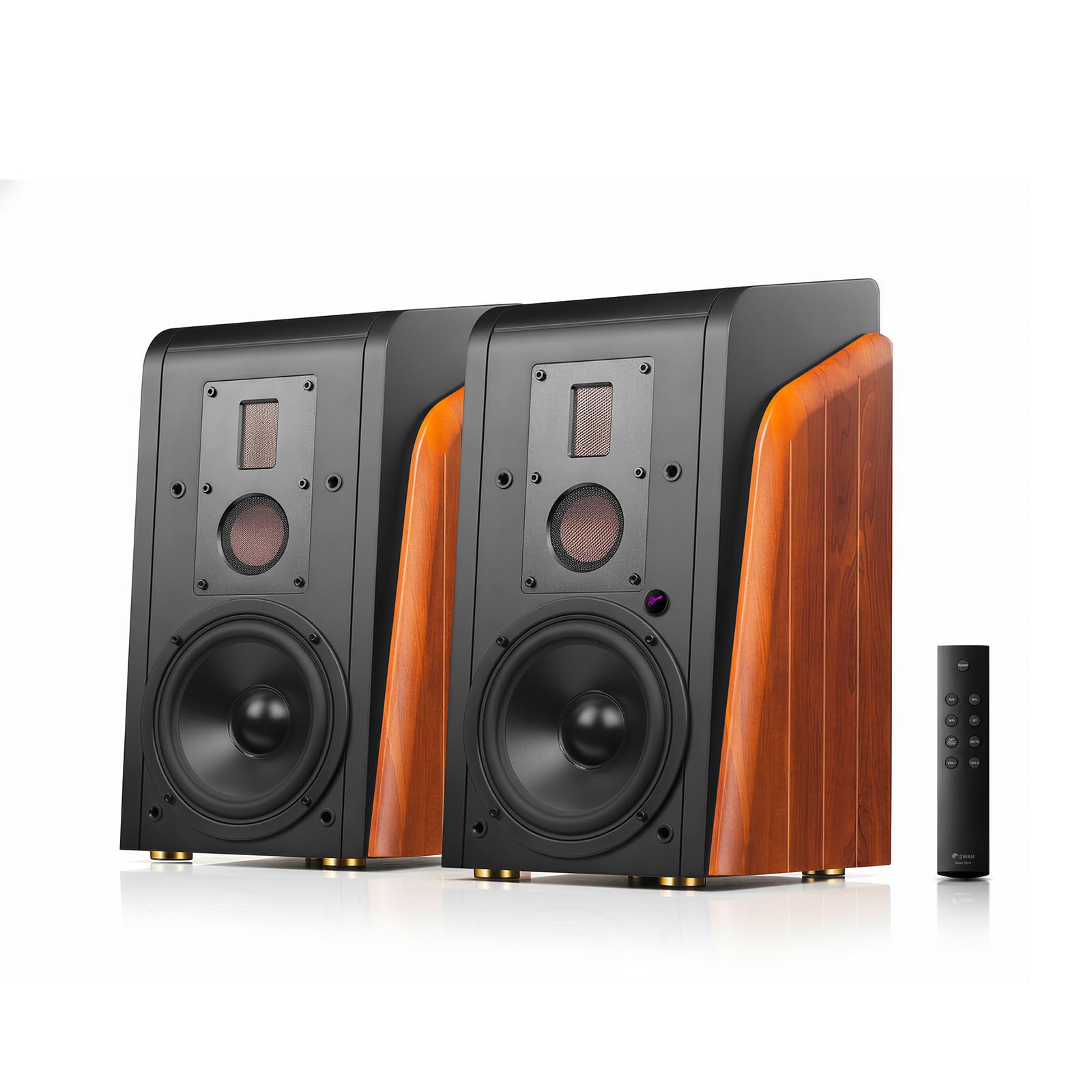
A rare 3-way active design that gives vocals and strings their own dedicated driver.
Most bookshelf speakers cram everything into a single woofer and tweeter, but the M300MKII separates the audio into three distinct bands: an isodynamic ribbon tweeter (a thin, folded diaphragm that produces very fast, detailed highs up to 40kHz), a 2-inch metal midrange driver for vocals and strings, and a 6.5-inch woofer for bass. That dedicated midrange is the key difference from a 2-way like the Edifier S2000MKIII — it means voices and acoustic instruments get their own dedicated cone, avoiding the smearing that can happen when one driver handles both midrange and bass. One reviewer, an experienced audio enthusiast, called this the best 6.5-inch system they have heard, praising the driver integration and superior clarity over every two-way they own.
Connectivity is generous: Wi-Fi, Bluetooth 5.0, optical, coaxial, line-in, balanced XLR, and AUX all sit on the back panel. You also get bass and treble controls with ±3dB adjustment. The 4-degree angled front panel is a thoughtful touch — it aims the drivers upward slightly so all frequencies reach your ears at the same time. Two real-world complaints: the included speaker connecting cable is too short for wide placements, and the cabinet uses a plastic structure with an easily scratched veneer, not solid wood.
The Big Wins
- True 3-way active design with dedicated midrange driver for pinpoint vocal clarity
- Wi-Fi, Bluetooth, optical, coaxial, balanced XLR — broadest input selection in this guide
- Isodynamic ribbon tweeter extends to 40kHz for ultra-detailed highs
The Shortfalls
- Short speaker connecting cable limits placement options
- Plastic cabinet with thin veneer feels less premium than solid wood rivals
Choose this if: you want a complete, high-resolution active system with the vocal clarity of a 3-way design.
pass on it if: a solid wood cabinet and fuss-free placement are non-negotiable.
6. Monitor Audio Silver 100 New 7G in Black Gloss (Pair)

A bookshelf that hits 35Hz — deep enough to feel like a floorstander in all but name.
An 8-inch C-CAM (Ceramic-Coated Aluminium/Magnesium) mid-bass driver with Rigid Surface Technology (RST) II gives this bookshelf a frequency response that dives to 35Hz in-room, which is flat enough to reproduce the full range of a bass guitar without a subwoofer. The 1-inch C-CAM Gold Dome tweeter uses a Uniform Dispersion (UD) Waveguide II — a specially shaped horn surface that spreads high frequencies more evenly across the room, so the balance is wider than the Polk R200’s narrow 20-degree window. One reviewer replaced 14-year-old Bowers & Wilkins floorstanders with these, reporting a noticeable increase in clarity without any loss of bass weight, and they called the cabinet finish “gorgeous.”
Rear-ported design means you need at least a few inches of clearance behind the speaker to avoid boomy bass. The recommended amplifier power is 40 to 100 watts, making them less demanding than the power-hungry Polk R200. Weighing 10 pounds 12 ounces each, they are solid but still manageable on a sturdy bookshelf or speaker stand.
Strengths
- 8-inch woofer delivers contrabass depth (35Hz) without a subwoofer
- Gold dome tweeter with waveguide gives wide, even sound dispersion
- High-quality cabinet construction with excellent finish options
Weaknesses
- Rear port requires careful placement away from walls
- Gloss finish shows fingerprints and dust easily
Reach for these if: you want floorstanding bass extension from a bookshelf footprint.
Think twice if: your listening room is small (under 150 sq ft) — the 8-inch driver can overpower a tiny space.
7. SVS Ultra Evolution Bookshelf Speakers

A technology tour-de-force that one reviewer says beats both B&W 705 S3 and Focal Aria Evo X No1.
The Ultra Evolution employs a diamond-coated aluminum dome tweeter — a microscopic layer of diamond on aluminum, which combines the stiffness of diamond with the damping of metal — allowing frequencies to extend well beyond human hearing without measurable distortion. The cabinet architecture is time-aligned, meaning the mounting points of the drivers are shifted so the sound from each reaches your ear at the exact same instant, improving phase coherence and imaging. Buyers who compared this directly to the B&W 705 S3 and Focal Aria Evo X No1 rated the SVS higher overall: bass depth scored 10/10 vs 7/10 for B&W, and cost value was 10/10 vs 7/10, though the B&W won on soundstage width (10/10 vs 8/10) and build quality (10/10 vs 9/10).
Dual opposing active woofers — one on top and one on the bottom of the cabinet — cancel out each other’s vibration forces, reducing cabinet resonance and spreading bass evenly across the room. Placement can be finicky due to the rear-firing port; one reviewer draped a towel behind the speakers to break up a 200Hz standing wave, which worked well.
Stellar Points
- Diamond-coated tweeter provides easy, airy highs with zero distortion
- Dual opposing woofers cancel cabinet resonance and spread bass evenly
- Outperformed B&W 705 S3 and Focal Aria Evo X No1 in direct comparison
Room for Improvement
- Rear bass ports make placement sensitive — can cause 200Hz standing waves if too close to walls
- Piano Gloss finish shows fingerprints and dust readily
Ideal for: uncompromising listeners who want near-reference performance from a bookshelf form factor.
Not ideal if: you need a plug-and-play active system — the SVS Ultra Evolution is passive and needs quality amplification.
8. Klipsch Reference Premiere RP-8000F II 2.0 Dual Floorstanding Speaker Pair

Horn-loaded efficiency that produces massive, easy sound with even modest amplifiers.
The RP-8000F II features a larger 90 x 90 degree silicone composite Hybrid Tractrix horn — a specially shaped horn that matches the tweeter’s output to the room, improving efficiency and clarity. The 1-inch LTS (Linear Travel Suspension) titanium diaphragm tweeter minimizes distortion, and the dual 8-inch Cerametallic woofers (a ceramic-coated aluminum cone that resists flexing) produce deep bass with minimal distortion. At 95dB sensitivity, these are among the most efficient speakers here — they can reach room-filling volume with as little as 95 watts per channel, unlike the Polk R200 which demands much more power. Buyers upgrading from older Klipsch R-26FA towers report dramatically clearer dialogue and more detailed sound, with clean highs that never sound harsh even at extreme listening levels.
Dual input terminals support bi-amping and bi-wiring — you can run separate amplifier channels to the woofers and tweeters, reducing interference for even cleaner midrange. The furniture-grade ebony veneer and magnetic grilles give a premium appearance that blends into a living room.
Why It Works
- High 95dB sensitivity means any quality receiver can drive them to concert levels
- Dual 8-inch Cerametallic woofers deliver deep, distortion-free bass
- Bi-amp/ bi-wire terminals let you separate power between highs and lows
The Downside
- Horn-loaded tweeter has a characteristic “Klipsch sound” that may sound forward to some listeners
- Large floorstanding footprint demands significant floor space
Perfect for: home theater and rock music fans who want dynamics, clarity, and efficiency from a modest amplifier.
Look elsewhere if: you prefer a neutral, laid-back sound signature — the horn tweeter is lively and forward.
9. SVS Prime Pinnacle Floorstanding Speakers

A music-first floorstander with three 6.5-inch woofers that plays cleanly without a subwoofer.
Instead of deploying one large woofer, the Prime Pinnacle uses three 6.5-inch woofers in a vertical array, paired with a dedicated 5.25-inch midrange driver and a 1-inch aluminum dome tweeter. This arrangement, called a 3.5-way design, lets the lower woofers handle only the deepest bass while the upper woofer covers the lower midrange, reducing distortion across the whole frequency band. One owner who runs a large vintage stereo system was skeptical of modern floorstanders but reported these deliver stunning clarity and are not bright — they come to life when the volume goes up. The same reviewer noted the speakers need a break-in period of about seven days before the sound fully opens up, and they recommend giving them plenty of breathing room because the ports are on the back.
The prime pinnacle drops off at about 27Hz, so adding a subwoofer for that last octave of ultra-deep bass is common. Pairing with two 12-inch subs, cut off at 40Hz, yields a smooth system, as one reviewer described. The black ash finish is straightforward and handsome, without the glossy fingerprint magnet effect of the SVS Ultra Evolution.
Highlights
- Triple 6.5-inch woofers with dedicated midrange driver for low distortion
- Excellent clarity at lower volumes; comes alive with more power
- 3.5-way design reduces crossover artifacts for smooth frequency response
Limitations
- Drops off at ~27Hz — users seeking ultra-deep bass will want a subwoofer
- Rear ports require careful placement away from walls
Ideal for: listeners who want a full-range floorstander that excels with acoustic music, jazz, and classic rock.
Not the best fit if: your room is small (under 200 sq ft) — the triple woofers need volume to stretch their legs.
10. KEF R3 Meta (Indigo Gloss, Pair)

A true 3-way bookshelf that uses Metamaterial Absorption Technology to silence unwanted resonances.
The R3 Meta is the first bookshelf to share the 12th-generation Uni-Q driver array with KEF’s flagship R11 Meta floorstander. The Uni-Q driver places the tweeter at the acoustic center of the woofer cone, so both high and low frequencies radiate from the same point in space — this eliminates the off-axis phase cancellation that plagues traditional separate-driver designs. Metamaterial Absorption Technology (MAT) is a precisely shaped disc behind the tweeter that absorbs 99% of unwanted rear-wave sound, resulting in what KEF calls the most pure and natural sound they have ever produced. The frequency response is rated at 58Hz to 28kHz (±3dB).
One experienced buyer who has owned ten pairs of speakers calls the R3 Meta superior to the LS50 Meta in every way — ultra-smooth, refined highs, extreme resolution — and says you will not find a better speaker for less than seven to ten thousand dollars. Another owner describes the bass as fast and tight, the midrange as deep, and the highs as shimmering without harshness. The Indigo Gloss finish is a special edition that looks striking on KEF’s optional sand-fillable S2 stands.
True Strengths
- MAT technology absorbs 99% of unwanted sound for distortion-free audio
- Uni-Q driver creates a single-point sound source for pinpoint imaging
- Build quality and finish match speakers costing three times as much
Honest Trade-offs
- If you already own LS50 Meta, the upgrade is not dramatic
- No included stands — the recommended S2 stands are a significant extra expense
Best for: purists who want the most advanced driver technology available at this price tier.
Skip if: you already own LS50 Meta and want a substantial upgrade — the gains are real but incremental.
11. KEF LS50 Wireless II (Pair, Carbon Black)

True hi-fi without the hassle — a complete high-resolution wireless system in two compact cabinets.
Each LS50 Wireless II speaker contains its own amplification: 280 watts for the mid/bass driver and 100 watts for the tweeter, totaling 380W per speaker. The 5.25-inch Uni-Q driver array is the same 12th-generation design as the R3 Meta, but with MAT and the dedicated 100W tweeter amp, the highs are driven with total control. Streaming support is deep: Spotify Connect, Tidal, Amazon Music, Qobuz, Deezer, Apple AirPlay 2, Google Chromecast, and ROON Ready. Resolution goes up to 384kHz/24bit depending on the connection. Inputs include HDMI eARC, TOSLINK optical, digital coaxial, analog 3.5mm, RJ45 Ethernet, and Wi-Fi.
One reviewer replaced 170 pounds of separates with 40 pounds of LS50 Wireless IIs and reported a setup that took minutes, with sound that is clearer, richer, and more dynamic than their old separates. The KEF Connect app includes an equalizer for room correction and subwoofer integration. The single major complaint across reviews is Wi-Fi connectivity — frequent disconnects and source switching issues that sometimes require a power reset. If you can hardwire via Ethernet or tolerate occasional app glitches, the sound quality is widely described as “insane.”
The Benefits
- Complete active system with 380W total amplification — no separate gear needed
- Extensive streaming platform support (Tidal, Qobuz, AirPlay 2, Chromecast, ROON)
- HDMI eARC input for TV connection
The Drawbacks
- Wi-Fi connectivity can be unreliable, requiring occasional power reset
- You are paying for the amps and streaming — not just the drivers
Best for: listeners who want the simplest possible high-resolution system — just plug in, stream, and listen.
Not right for: someone who wants a long-term upgradable path with separate components.
12. Klipsch Heritage Series Heresy IV Floorstanding Speaker Pair

A legendary three-way horn speaker designed and assembled in the USA with a sound that reveals your room.
The Heresy IV uses a 12-inch woofer, a new K-702 midrange compression driver with a polyimide diaphragm (a heat-resistant plastic film that holds shape under high output), and a K-107-TI titanium diaphragm high-frequency driver with a wide dispersion phase plug. The midrange driver is mated to the K-704 Tractrix horn, which controls the pattern of sound dispersion. The result is very high efficiency — the speakers do not need powerful amplification to produce detailed, room-filling sound. One reviewer, listening with a Yamaha RXA6A and a pair of Klipsch SPL12 subs, called these “one of my best purchases ever,” describing how they replaced Klipsch R820F towers and delivered superior clarity and detail.
The high efficiency also means the speakers will faithfully reproduce the acoustics of your room — if your room is lively, the Heresy IV will let you hear it. Reviewers point out the bass is on-point but not heavy, making these best for critical listening with classic rock, jazz, and acoustic music. The satin black ash finish on a floorstanding cabinet with a tilt base is handsome, with a wood grain that one owner says is “flawless.”
Standout Features
- High-efficiency three-way design — plays loud with modest amplification
- Designed and assembled in the USA with premium materials
- Reveals detail in recordings that lesser speakers gloss over
Things to Know
- Full-size floorstanding cabinet — requires dedicated floor space
- Extremely revealing — room acoustics and poor recordings will be exposed
Right for: purists who want a high-efficiency, American-made speaker that lays bare every detail of the recording.
Not for: listeners who want heavy bass from the start without a subwoofer — the Heresy IV is fast and tight, not thumping.
Understanding the Specs
Driver Size and Bass Extension
Driver size (measured in inches across the cone) is the main factor in how low a speaker can play. A larger woofer pushes more air, so it produces deeper bass without straining. A 4.5-inch driver like the one in the DALI KUPID reaches about 63Hz, suitable for small rooms. An 8-inch driver like the one in the Monitor Audio Silver 100 7G hits 35Hz, which is deep enough to feel the lowest notes of a bass guitar or kick drum. If you listen to a lot of electronic music or movie soundtracks, go for a speaker with at least a 6.5-inch woofer.
Sensitivity and Amplifier Power
Sensitivity is measured in decibels (dB) and tells you how much volume a speaker produces from one watt of power. A speaker with 95dB sensitivity (like the Klipsch RP-8000F II) will play very loud with a 50-watt receiver. A speaker with lower sensitivity (around 86dB) needs more watts to reach the same volume. If you have a modest receiver under 75 watts, look for a speaker with sensitivity of 90dB or higher. The Polk Reserve R200, despite its high-quality drivers, needs a beefy 260-watt amp at 4 ohms to fully come alive.
FAQ
Do I need a subwoofer with these audiophile speakers?
What is the difference between active and passive speakers?
How much amplifier power do I need?
What is a 3-way speaker and why does it matter?
Is Bluetooth good enough for high-quality audio?
Will bookshelf speakers sound as good as floorstanding speakers?
What is the break-in period for new speakers?
Can I use these speakers for home theater?
Final Thoughts: The Verdict
For most buyers, the best audiophile speakers is the Edifier S2000MKIII because it delivers near-flawless sound, a tri-amped active design, and versatile connectivity at a price that does not require separate amplification. If you want a powerful, plug-and-play floorstanding system, grab the Fluance Ai81 Elite. And for purists chasing the most advanced driver technology in a compact package, the KEF R3 Meta is tough to top.
How We Picked
We do not accept paid placement. Every pick is matched to a real buyer and a real use-case; we do not hands-on test units.
Sources & Methodology
Specifications: manufacturer listings and product documentation. Review insights: verified customer reviews, as of July 2026. Pricing: not shown on this page (it changes often); check the current price via the retailer link.
As an Amazon Associate, Gadgets Feed earns from qualifying purchases. This does not affect which products we feature.
Related Guides
Product prices and availability are accurate as of the date/time indicated and are subject to change. Any price and availability information displayed on Amazon at the time of purchase will apply to the purchase of this product. As an Amazon Associate I earn from qualifying purchases.
CERTAIN CONTENT THAT APPEARS ON THIS SITE COMES FROM AMAZON. THIS CONTENT IS PROVIDED "AS IS" AND IS SUBJECT TO CHANGE OR REMOVAL AT ANY TIME.
Amazon and the Amazon logo are trademarks of Amazon.com, Inc. or its affiliates.