
Selecting the right communication aid for a non-verbal individual on the autism spectrum means navigating a landscape that ranges from simple laminated picture cards to sophisticated tablet-based AAC apps. The fundamental choice—between a battery-free, tactile system and a high-tech, customizable device—often determines whether the tool gets used consistently or gets abandoned. The wrong pick can stall language development, while the right device unlocks genuine connection.
I’m Min — the co-founder and writer behind Gadgets Feed. I’ve spent hundreds of hours analyzing the technical specifications, user feedback, and therapeutic applications of AAC tools to separate marketing claims from real-world utility. This guide is built on deep cross-referencing of features like recording duration, activation force, battery life in hours, and screen resolution.
Whether you need a classroom-ready picture exchange system, a durable single-message button, or a full-featured speech tablet, this breakdown of the best autism communication devices will help you match the tool to the user’s motor skills, cognitive level, and daily environment.
How To Choose The Best Autism Communication Device
Every non-verbal individual communicates differently—some need a durable, tactile button for a single request, while others require layered vocabulary across dozens of pages. The device must match the user’s fine motor control, visual processing skills, and daily communication demands.
Low-Tech vs. High-Tech — The Core Trade-Off
Low-tech options like PECS binders and AAC folders never need charging, survive drops and water exposure, and force the user to slow down and select each card intentionally. High-tech devices like the TalkingTiles tablet offer voice output, unlimited pages, and customizable icons, but require battery management and screen tolerance. For early-stage learners, a low-tech folder often builds more foundational skills; for users ready for robust vocabulary, a dedicated tablet with AAC software provides faster, more natural interaction.
Durability and Portability
A communication device that stays in the backpack isn’t useful. Look for laminated plastic cards (minimum 5-mil thickness) or rugged tablet builds that can survive drops from a wheelchair tray. The AbleNet QuickTalker FT 23 weighs 2 pounds and includes a carrying handle, while the PicSeePal folder is battery-free and waterproof for poolside or mealtime use. For school and therapy settings, portability means the device moves between rooms without setup time.
Customization and Growth
The best devices grow with the user. The Smile4Autism binder starts with 162 pre-categorized cards and includes five blank cards for personalization. The TalkingTiles tablet allows unlimited pages with up to 56 custom tiles per page, plus 3,436 pre-configured images. A device that cannot adapt as vocabulary expands will eventually become a ceiling, not a scaffold.
Quick Comparison
On smaller screens, swipe sideways to see the full table.
| Model | Category | Best For | Key Spec | Amazon |
|---|---|---|---|---|
| TalkingTiles AAC Tablet | High-Tech Tablet | Comprehensive vocabulary with custom pages | 10.1-inch screen, 6000 mAh battery, 8-hour life | Amazon |
| AbleNet QuickTalker 23 | Multi-Message | Structured classroom communication with 23 messages | 20 main cells + 3 core, 18-min recording time | Amazon |
| AbleNet BIGMack | Single Button | Simple request-making for early learners | Record up to 120 seconds, 1.6 lbs, 5-inch button | Amazon |
| PicSeePal Folder | Low-Tech Folder | Battery-free communication in any environment | Battery-free, waterproof, age range 2–12 | Amazon |
| Smile4Autism Binder | PECS System | Structured picture exchange with 162 ready-to-use cards | 162 plastic cards, 5 dividers, 172-piece total kit | Amazon |
| NuVois III Digital | Electrolarynx | Adults with laryngectomy who need pitch control | 9V battery, tone/pitch buttons, 5-year warranty | Amazon |
| TruTone Plus | Electrolarynx | Adults seeking single-button intonation and waterproof design | Micro-USB charging, waterproof, 2-year warranty | Amazon |
In‑Depth Reviews
1. TalkingTiles AAC Device
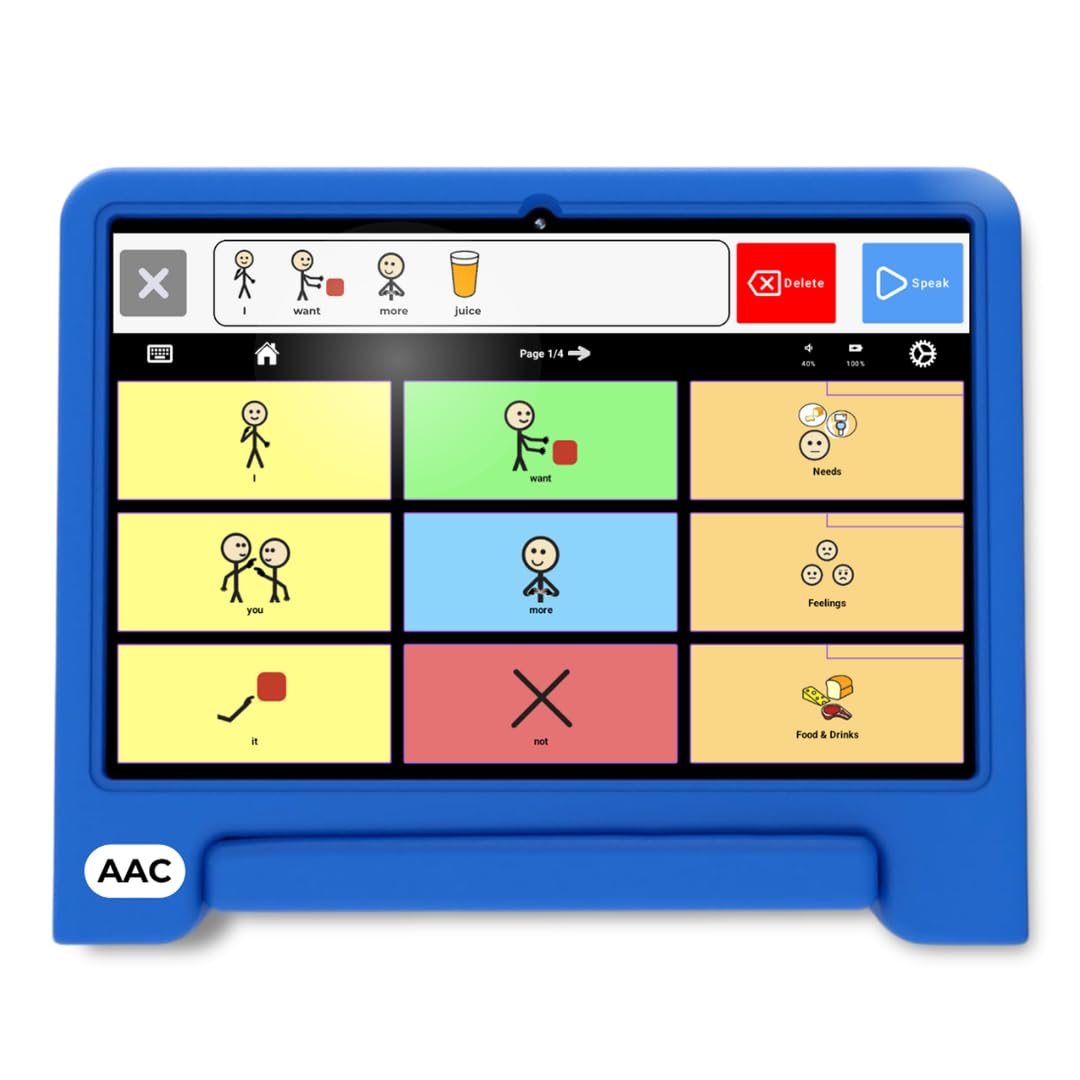
The TalkingTiles tablet is a dedicated AAC solution that eliminates the password prompts and app restrictions of a general-purpose iPad. It ships with a pre-loaded AAC app, over 3,436 pre-configured images, and supports unlimited custom pages with up to 56 tiles each—enough vocabulary for even advanced communicators. The 10.1-inch LED screen at 1024 x 800 resolution renders icons clearly for users with visual processing challenges, while swipe gestures encourage fine motor skill development.
A 6000 mAh lithium-ion battery delivers a full 8 hours of active use, covering a school day plus therapy sessions without needing a mid-day charge. Customer feedback confirms the device survives toddler drops and being stepped on, though one report noted a screen crack within two hours of setup—the manufacturer replaced it at no cost. The lack of a bundled charger in some shipments is an inconvenience worth noting.
For families seeking a self-contained AAC tablet that doesn’t require buying an iPad plus a separate subscription app, this device offers a turnkey experience at a fraction of the cost. The built-in speaking typewriter feature adds a text-to-speech layer for users who progress to letter-based communication, making this a device that grows with the learner.
Why it’s great
- Pre-loaded with thousands of AAC images, no app setup required
- 6000 mAh battery provides 8 hours of continuous use
- Durable build withstands drops and rough handling from children
Good to know
- Some units shipped without a charger—verify contents upon arrival
- Settings menu could be more locked down to prevent accidental tile additions
2. AbleNet QuickTalker 23

The QuickTalker FT 23 packs 20 individual message cells plus 3 core locations into a rugged, portable device that weighs 2 pounds and includes a built-in carrying handle. The FeatherTouch membrane requires 70% less activation force than traditional AAC buttons, making it accessible for users with limited fine motor control or low muscle tone. With 18 minutes of total digital recording time spread across 5 recording levels, this device supports 103 possible message combinations—enough for a classroom morning routine, mealtime requests, or story participation.
The 3.5mm headphone jack allows private listening during one-on-one therapy, while the USB hardware connection enables computer-based programming. However, the companion app that the QR code links to is incompatible with the latest iOS versions, forcing users to create custom overlays using Photoshop or Publisher—a significant workflow barrier. The open-source icon library at opensymbols.org provides free alternatives, but the setup process is not plug-and-play for non-technical families.
Despite the software friction, the hardware itself is built to survive daily classroom use. Deep well boundaries around each cell prevent accidental presses—a common issue with flat membrane devices—and customer support has a strong track record of replacing glitched units quickly. This is the right choice for SLPs and teachers who can invest time in overlay creation for a device that will last for years.
Why it’s great
- FeatherTouch membrane requires 70% less force, suitable for motor challenges
- 5 recording levels give 103 message combinations in one device
- Deep cell wells reduce accidental activations
Good to know
- Companion app is outdated and incompatible with modern iOS
- Creating custom overlays requires graphic design software
3. Smile4Autism Visual Communication Book

This 172-piece kit arrives ready to use—no cutting, laminating, or printing required. The 162 plastic photo cards measure 1.5 x 1.5 inches with rounded corners safe for little hands, and they’re organized across eight categories (Food, Toys, School, Places, Home Activities, Signs, Emotions, Actions) with color-coded poly dividers. Each divider has three rough strips that hold up to 30 cards on both sides, and the small binder (9 x 7 inches) fits easily into a child’s backpack.
The system is built on the PECS (Picture Exchange Communication System) methodology, starting with single-icon exchange and progressing to sentence strips like “I want apple” or “I see park.” The included pamphlet walks caregivers through six steps of implementation. Cards are 5-mil laminated on 110lb cardstock—thick enough to survive repeated handling but not waterproof. The binder includes five blank cards for customization and a bonus reward card for tablet or phone time.
Teachers report this kit is equally effective for newcomer ESL students and non-verbal autistic children because the real-photo-style images are concrete and immediately recognizable. One reviewer noted the entire binder is already assembled, saving hours of prep time. For early intervention at home or in a classroom where a therapist is guiding PECS implementation, this comprehensive bundle eliminates the biggest barrier: setup.
Why it’s great
- Fully assembled and organized, ready to use out of the box
- 162 cards across 8 functional categories for broad vocabulary
- Rounded plastic cards safe for young children with oral-motor exploration
Good to know
- Cardstock-based cards are not waterproof—avoid mealtime or pool use
- Small 1.5-inch size may be difficult for users with severe motor challenges
4. PicSeePal AAC Communication Folder
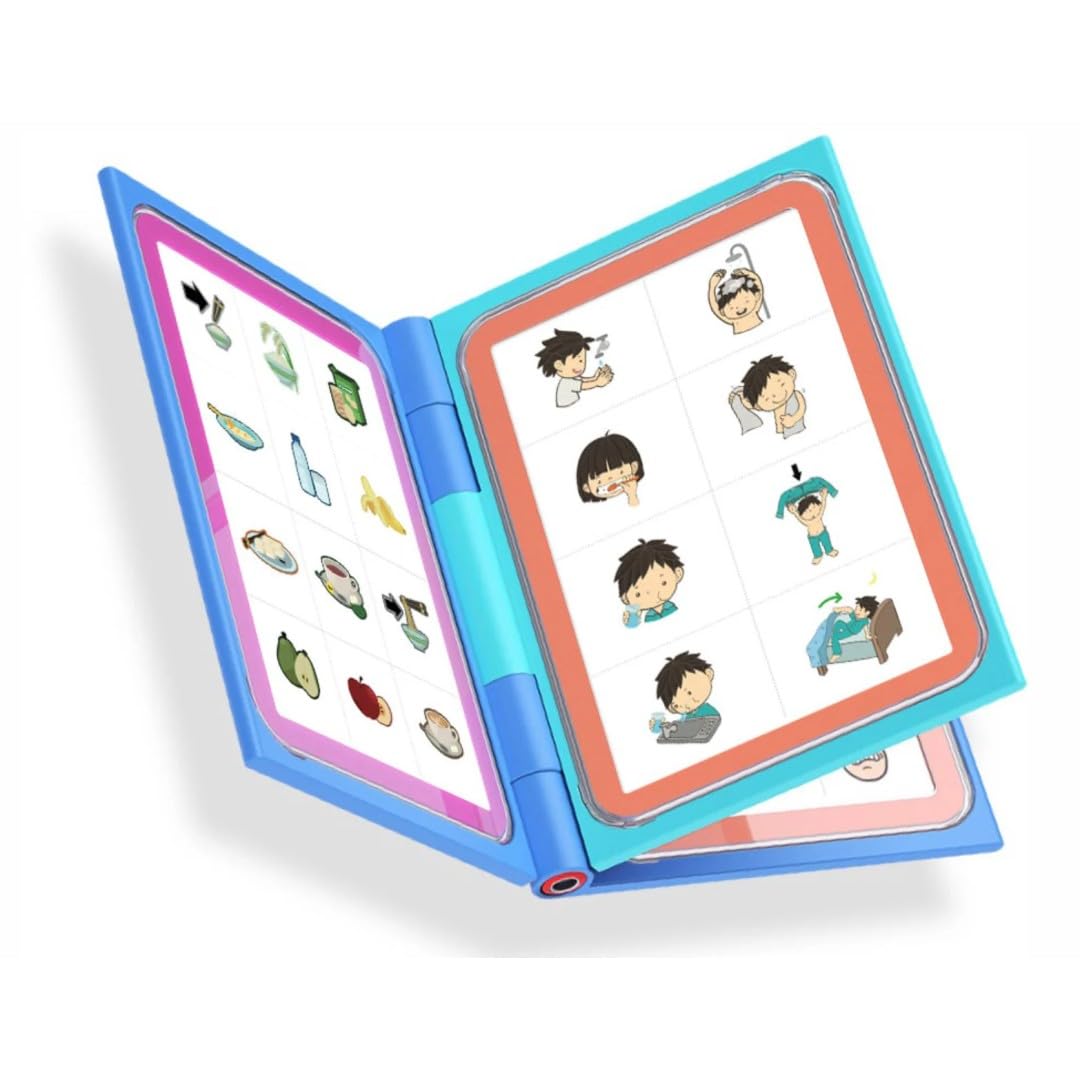
The PicSeePal is a low-tech AAC folder designed by a special education teacher with 22 years of classroom experience. It accepts any flat item—photographs, drawings, food packaging, magazine clippings—making it uniquely customizable with materials the user already recognizes. The folder ships with printed visual support templates from major AAC providers including PRC-Saltillo, Smartbox, AssistiveWare, CoughDrop, Avaz, LessonPix, and Forbes AAC, giving families a jumping-off point without needing to design from scratch.
With zero batteries and a waterproof build, this folder works in environments where electronics fail: messy play, mealtime, the swimming pool, bath time, and community outings. It mimics the size and feel of an iPad but is static, which helps some users focus without screen distractions. The included carrying strap makes it easy to attach to a wheelchair or stroller. However, the pre-printed icons are small, and larger icons require the caregiver to download, print, laminate, and cut their own—adding setup labor.
Speech-language pathologists praise this as an emergency backup device that survives tantrums and serves as a bridge while families wait for a funded high-tech AAC evaluation. For a child who chews or throws objects, the absence of electronics means no device-destroying damage. The trade-off is that every picture swap is manual, and the folder’s capacity for visual density is limited by page space rather than digital storage.
Why it’s great
- Completely battery-free and waterproof for any environment
- Accepts real photographs and packaging for immediate recognition
- Includes pre-printed templates from leading AAC software providers
Good to know
- Pre-printed icons are small; larger icons require DIY printing and laminating
- Manual picture swapping can be time-consuming for busy caregivers
5. AbleNet BIGmack AAC Device

The BIGmack is the gold standard for single-message AAC. Its large 5-inch activation surface requires a simple press to play back a recorded message of up to 120 seconds—enough for a full sentence, a song verse, or a social greeting. The rugged plastic construction weighs 1.6 pounds and includes a built-in mounting plate for wheelchair attachment, tabletop placement, or wall mounting. Audio output is stereo-quality for the category, ensuring the recorded voice is clear rather than muffled.
This device is intentionally limited: one message, one button. For early learners who are just beginning to understand cause and effect in communication—”I press this, someone responds”—that simplicity is a feature, not a bug. Speech therapists routinely use BIGmack for requesting, greeting, and choice-making in structured activities. The USB connectivity allows the recorded message to be uploaded from a computer, though most caregivers find the onboard recording sufficient.
The main limitation is the single-message constraint; users who need multiple vocabulary options must carry several BIGmack units, which becomes impractical. The cost per unit also adds up quickly if you need a full communication board’s worth of options. For its intended use—establishing the foundational skill that a button press equals communication—this device is proven and reliable.
Why it’s great
- Large 5-inch button ideal for users with motor planning difficulties
- Records up to 120 seconds of clear, high-quality audio
- Rugged build with mounting plate for wheelchair or wall attachment
Good to know
- Single-message only—requires multiple units for expanded vocabulary
- Cost per message is high compared to multi-cell devices
6. NuVois III Digital Speech Aid

The NuVois III is an electro-larynx designed specifically for adults who have lost their natural voice due to laryngectomy or other medical conditions. Unlike AAC devices for autism that rely on picture selection, this device generates speech through neck-placed vibration with adjustable pitch and volume controls that allow the user to add inflection for a more natural-sounding voice. The 5-year limited warranty reflects the manufacturer’s confidence in the device’s long-term reliability.
The device runs on a single 9V battery, and customer reports indicate that using non-recommended battery brands reduces sound quality—stick with the advised type for consistent output. Finding the correct placement on the neck takes practice; reviewers note that initial intelligibility is low but improves significantly once the user learns the optimal position. The tone/pitch buttons are critical for differentiating statements from questions, adding emotional nuance that flat electro-larynxes lack.
This device serves a different population than the other products on this list—it is not a tool for nonverbal autism but rather for acquired speech loss. For adults who need to communicate after surgery or injury, the NuVois III offers a proven, straightforward solution with a strong warranty. The learning curve is real, but the payoff is regaining the ability to hold a conversation.
Why it’s great
- Adjustable tone and pitch buttons allow vocal inflection for natural speech
- 5-year limited warranty provides long-term peace of mind
- Lightweight at 4.5 ounces, easy to carry in a pocket
Good to know
- Requires practice to find optimal neck placement for clear sound
- Sound quality degrades with non-recommended battery brands
7. TruTone Plus Electrolarynx

The TruTone Plus elevates the electro-larynx category with a single-button voice intonation system that allows pitch variation with a thumb press—a significant upgrade over devices requiring separate tone switches. The waterproof construction is a standout feature, enabling use in bathrooms, during showers, or in wet conditions without damage concerns. Micro-USB charging replaces the older 9V battery model, allowing the user to charge via car, hotel, or power bank without removing the battery.
Griffin Laboratories offers an exclusive 2-year Drop & Soak Warranty valid within the USA, covering accidental drops and water exposure—two of the most common failure modes for electrolarynxes. The sound quality is consistently rated as better than the Servox by users with 25+ years of experience using artificial larynxes. However, the instruction manual is sparse, and first-time buyers report confusion over proper placement and intonation technique without more precise guidance.
For adults who need a durable, waterproof electrolarynx with on-the-go charging and refined intonation control, the TruTone Plus justifies its higher cost through build quality and warranty protection. The learning curve is real, but the improved intelligibility and convenience of USB charging make it a worthwhile upgrade for daily users. Consider the TruTone Emote for even more advanced features if budget allows.
Why it’s great
- Single-button intonation allows natural pitch variation during speech
- Waterproof design and 2-year Drop & Soak Warranty
- Micro-USB charging eliminates the need to remove batteries
Good to know
- Instruction manual lacks clear guidance for first-time users
- Requires practice to master placement and intonation technique
FAQ
Should I start with a low-tech PECS binder or a high-tech AAC tablet?
What does activation force mean for an AAC device and why does it matter?
Can an electrolarynx like the NuVois III be used as an autism communication device?
Final Thoughts: The Verdict
For most users, the best autism communication devices winner is the TalkingTiles AAC Tablet because it combines turnkey setup, 8-hour battery life, and unlimited customizable pages in a package that costs less than an iPad with a subscription AAC app. If you want a portable, battery-free system that works in any environment, grab the PicSeePal AAC Folder. And for early learners establishing cause-and-effect communication, nothing beats the simplicity of the AbleNet BIGmack.