
Our readers keep the lights on and my morning glass full of iced black tea. As an Amazon Associate, I earn from qualifying purchases.
Specs are compiled from manufacturer listings and verified buyer reviews and can change over time — please confirm the key details on the product page before buying.
You hook up your manifold gauges to check a weak car AC, and the fitting hisses—refrigerant escapes, vacuum is lost, and your afternoon is gone. The right quick couplers and adapters seal tight, so your gauge readings stay accurate for a proper diagnosis.
I’m Min — the founder and writer behind Gadgets Feed. This guide is built by comparing the manufacturers’ published specifications and the patterns across verified customer reviews, so you get each pick’s real strengths and trade-offs instead of marketing spin.
This roundup covers the quick couplers, conversion adapters, and hose fittings that determine whether your recharge holds pressure or leaks it away — the complete guide to the best auto ac fittings for DIY and pro work alike.
Our Picks at a Glance

How To Choose The Best Auto AC Fittings
Before you spend money, you need to know which refrigerant your vehicle uses — R134a or R1234yf. The fittings for these two systems are not interchangeable, and forcing the wrong coupler onto a port can damage the valve core. Check the sticker under your hood or the year of your car; newer models almost always use R1234yf.
Match the coupler to the refrigerant
R134a couplers have a standard twist-on design, while R1234yf couplers use a different snap-down mechanism that prevents cross-contamination between the two refrigerants. The majority of these sets are sold as either R134a or R1234yf specific, though some kits include conversion adapters to bridge between them. If you work on a mix of vehicles, look for a kit that explicitly includes both adapter types.
Look for the ball-bearing lock and control knob
The number of ball bearings inside the coupler determines how evenly it grips the service port — 5-ball and 6-ball designs are the most common and the most secure. Alongside that, a built-in control knob opens and closes the internal valve, which lets you depress the Schrader valve (the small pin in the port) for controlled flow. That knob is what lets you purge lines safely instead of venting refrigerant everywhere.
Consider the material and thread type
Fittings made from aluminum, brass, or nickel-plated bronze resist the chemical corrosion that comes from repeated refrigerant exposure. You also need to match the thread size — the standard manifold connection is a 1/4″ male flare, but hose-end fittings come in sizes like #6 and #8. A kit that includes 45° and 90° angled adapters is a lifesaver for tight ports on modern engines.
Quick Comparison
| Model | Best For | Refrigerant | Coupler Style | Weight | Amazon |
|---|---|---|---|---|---|
| OMT 9Pc Adapter Kit★ Best Overall | DIY universal service | R134a | 5&6-ball snap | 1.08 lb | Amazon |
| Wisscool Coupler SetPro Connection | Gauge set upgrade | R134a | 6-ball snap | 8.4 oz | Amazon |
| OMT R1234yf Set | Modern cars | R1234yf | 5&6-ball snap | 14.08 oz | Amazon |
| maXpeedingrods LS Adapters | Engine swaps | N/A (hose fitting) | #8AN & #10AN | 5.3 oz | Amazon |
| Wisepick #6 Set | Custom hose lines | N/A (hose fitting) | Beadlock, 3 angles | — | Amazon |
| Lichamp Adapter Kit | Dual-refrigerant garages | R134a & R1234yf | Snap lock | 45 g | Amazon |
| YMXFAWO Recharge Kit | Modern car recharge | R1234yf | 6-ball snap | 1.19 lb | Amazon |
In-Depth Reviews
1. OMT AC Adapter Tool Kit, 9Pc R134a & R410a Gauge Hose Conversion Fittings
Our pick — over 4.5★ from 800+ verified ratings; the strongest balance of quality and price.
One tool kit that bridges home HVAC and car AC service while staying affordable
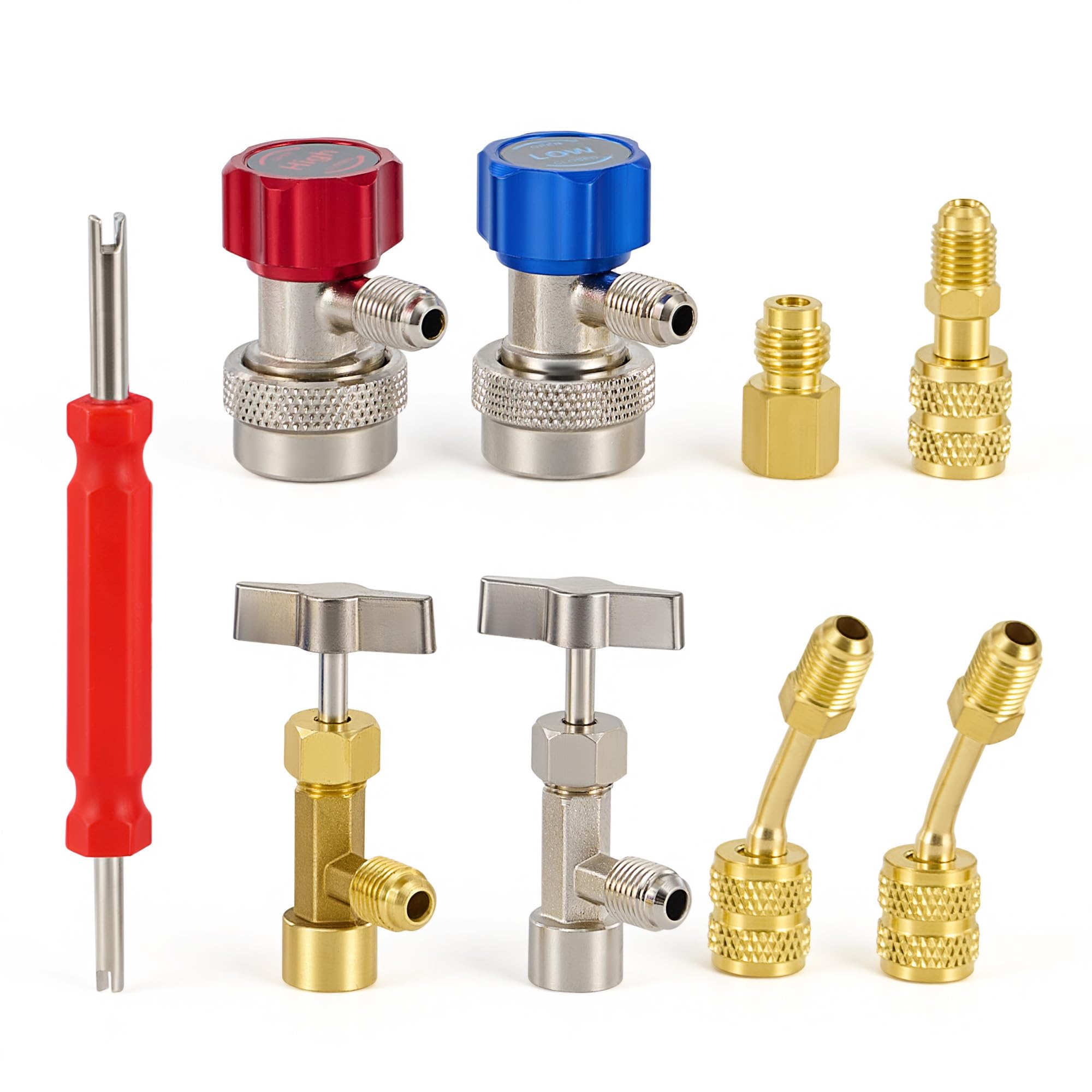
This is the kit for the person who works on everything — a 9-piece set that tackles both vehicle refrigerant recharges and home mini-split repairs. Its defining feature is the dual R134a compatibility: you get both Self-Sealing and Puncture-Style can taps plus a 1/4″ to 1/2″ adapter, so you can hook up either Freon can style to your vacuum pump or HVAC hoses. It also includes two 45° angled adapters (5/16″ female to 1/4″ male) that reach the awkward service ports on R410a home systems.
Owners consistently say these quick couplers work exactly as advertised. The 5&6-ball quick couplers (fittings with five and six internal balls that grip the port) snap onto domestic and import AC ports, and an adjustable gripping mechanism locks tight for accurate pressure monitoring. For a DIY user, this set balances capability and price, but note the can adapter fits pierced cans only—not valve-type cans—so check your refrigerant can style before buying.
Buyers report “I nitrogen tested my A/C system for several days and these sealed perfectly,” confirming the O-rings hold vacuum. The trade-off is mixed fit reports, plus one owner noted the valve indicators are labeled in reverse—a cosmetic quirk. Some owners mention small leaks, so treat the seals as serviceable parts rather than permanent ones.
Why the versatility wins
- Covers R134a can taps in both self-sealing and puncture styles
- 45° angled adapters reach tight R410a ports
- Good value for a full 9-piece set
Where it trips up
- Can adapter only fits pierced cans, not valve-type cans
- Indicator labels can be reversed on some units
- Mixed reports on seal tightness over time
Reach for this if: you want one affordable kit that covers both car and home AC service without juggling multiple purchases.
Look elsewhere if: you only work on R1234yf vehicles — this kit is R134a-focused and won’t cover newer systems.
2. Wisscool R134a Quick Coupler Set, High Low Adapters, 1/4″ SAE
A featherweight pair that makes gauge connections feel reassuringly solid
This set earns its place as the upgrade pick for anyone who wants cleaner connections than a generic kit provides. It includes high- and low-side quick couplers for evacuating, testing, and recharging R134a systems, with integrated 1/4″ male flare connections that attach directly to manifold gauges without needing separate port adapters. At just 8.4 ounces it’s noticeably lighter than the OMT R1234yf set’s 14.08 ounces, so it handles more delicately on the port.
What everyone raves about is the top control knobs, which open and close the internal valves for controlled refrigerant flow and easier connection or disconnection. Customers note they “attach perfectly to your refrigerant gauges and are air tight,” a key win for leak-prone connections. The six-ball snap-lock mechanisms paired with knurled grips give a firm attachment and quick installation on vehicle service ports.
The sturdy metal valve bodies and thick rubber O-rings help create tight connections and reduce refrigerant loss. The catch is that opinions split on whether these connectors are truly leak-proof; some owners find them leak-free while others don’t. Quality is the clear headline, though — the skepticism about an unfamiliar brand tends to dissolve once the couplers are in hand.
The solid pick: a premium-feeling R134a coupler pair with excellent machining and adjustable flow that snaps on confidently.
The honest limit: it’s a two-coupler set only — no can taps or angled adapters included, so pair it with your existing hose kit.
3. OMT R1234yf Quick Coupler Adapters High Low Pressure Connectors Set

The two-piece set that lets you pull a deep vacuum on newer R1234yf systems
If your vehicle is a 2020s model, this is the coupler set you need. Built for R1234yf coolant ports, these 5 and 6-ball quick couplers snap down and seal with easy-grip knurled rings, opening valves via their top control knobs. The standout material choice — aluminum and nickel-plated bronze — offers high resistance to both wear and chemical corrosion, which is exactly what you want from parts that live in a harsh engine bay.
The detachable flares are a clever touch: they provide reliable connections to 1/4″ HVAC hoses or adapters and come off easily for cheap replacement when they wear out. Reviewers point out “I was able to pump down my system to below 500 microns using my existing gauge set,” proving the O-rings seal tight. Fit is the most-discussed point here, with some owners finding compatibility issues on certain R1234yf systems.
The one recurring gripe is the lack of grip on the valve — it can be tough to turn — and the flange is sharp enough to nearly cut an owner. It’s a small price to pay for the seal quality, but worth wearing gloves. Quality tops the feedback with 47 owners praising it, followed closely by functionality.
Choose this for: maintaining modern R1234yf cars where a true vacuum-tight seal is non-negotiable.
Think twice if: you work mostly on older R134a vehicles — you’d be buying the wrong refrigerant standard.
4. maXpeedingrods LS AC Compressor Adapter Fittings for 10S17F 10S20F

The bolt-on solution that makes custom LS swap AC lines dramatically easier
This is a specialized pick—not a coupler set, but a pair of adapters that let you install a 10S17F or 10S20F compressor (two common GM compressor models) on an LS engine swap with truck accessories like the LQ4, LQ9, and most other truck 4.8, 5.3, and 6.0 engines. Cut from billet aluminum with a finish that resists rust and corrosion, and with all welding seams tested, these are built to handle engine-bay abuse.
Each package includes one #8AN and one #10AN fitting (AN sizes for custom hose ends), plus 2 sealing washers, 2 O-rings, and 2 steel socket head cap screws. Shoppers say using these across “a lot of LS swaps” with perfect results—the adapters make custom AC lines much easier to connect. The included lifetime technical support and 1-year limited warranty add real confidence for a project part.
There’s an important specification note: these do NOT have AN fitting ends. They use AC type ends like older vehicles, sometimes called “-8 and -10” or “#8 and #10,” but they are not beveled Army/Navy compression fittings. If you need true AN fittings, buy pre-made hose ends instead. Also verify your compressor isn’t paired with the performance #19155066 serpentine drive kit for Chevrolet, since these won’t work with that setup.
Swap-ready convenience
- Billet aluminum resists corrosion
- Includes washers, O-rings, and bolts
- Lifetime technical support
Know before you buy
- Not AN fittings — AC type ends instead
- Won’t work with performance #19155066 drive kit
Built for the builder: anyone plumbing an LS swap with truck accessories who wants clean, tested adapter fittings.
Skip if: you need true AN compression fittings for a custom hose setup — this is the wrong interface.
5. Air Conditioning #6 AC Fitting Set Female Oring Beadlock 5/8-18UNF

Three angles in one set so you can route custom lines around any obstruction
This set is all about solving routing problems in custom AC line work. You get three fittings — straight, 45 degree, and 90 degree — all in a #6 hose size with a 5/8-18UNF thread. Each fitting has one side with an iron jacket that connects to the hose and another side that connects to the compressor or condenser, giving you the flexibility to bend around tight engine bays.
Owners consistently praise the steel shells with a hole that confirms the hose is fully seated, and they note the threads engage easier than some alternatives. The catch is that these do not come with O-rings, so you’ll need to source those separately. The construction uses an aluminum tube with an iron screw and iron jacket, finished with color zinc-plated coating for corrosion resistance.
The beadlock design (a mechanical grip that locks the hose onto the fitting) is what makes these feel secure in hand. They’re a solid value for anyone building custom AC lines from scratch. Since these are hose-end fittings rather than quick couplers, they’re best paired with crimped hose and a proper manifold setup.
The flexible choice: a three-angle set that covers straight, 45°, and 90° routing so you’re not hunting for a single adapter mid-project.
The small catch: O-rings aren’t included, so budget a few extra minutes to pick those up before installation.
6. Lichamp Car A/C R1234YF R134A Adapters, AC R134 R1234 R 134A 1234YF Quick Couplers Connectors Kit

The bridge kit for garages that service both old and new refrigerants
For a shop or serious DIYer dealing with a mixed fleet, this kit solves the compatibility puzzle. It comes with a pair of high and low pressure quick couplers with 1/4 inch male fittings, adapters that convert between 134a and 1234yf, and a dual head valve core remover. It’s built from copper, aluminum, and steel with H/L temperature resistance and corrosion resistance to stand up to heavy garage use.
Buyers report the kit got their AC running in a day and saved refrigerant by sealing properly. The easy operation comes from the accurate snap lock and knurled grip ring, plus a removable pure copper adapter with O-ring seals for longer maintenance. The no-leakage design uses precise fine threads and thick rubber seals on the interface.
The mixed feedback centers on fit—several owners mention the 1234yf to 134a adapter (which converts between two refrigerant types) not seating properly, and one found the install confusing until realizing you need to lift on the engaging coupler part to push the adapter in, sometimes with a rubber mallet. It’s a learning curve, not a defect. Quality and value are the clear positives, with owners describing it as “10 outta 10” for covering all R134 and others.
Garage versatility
- Covers both R134a and R1234yf refrigerants
- Includes dual head valve core tool
- All-metal construction for heavy use
The learning curve
- 1234yf to 134a adapter can be finicky to seat
- Some owners find the instructions unclear
Best for mixed fleets: if your driveway holds both older R134a cars and newer R1234yf ones, this kit saves you from owning two separate setups.
Not ideal if: you want a zero-friction, no-learning-curve connection — this one rewards patience on the first install.
7. R1234yf Quick Coupler and Can Tap Kit, Auto AC Recharge Tools
An all-in-one R1234yf service kit that arrives ready for real diagnostic work
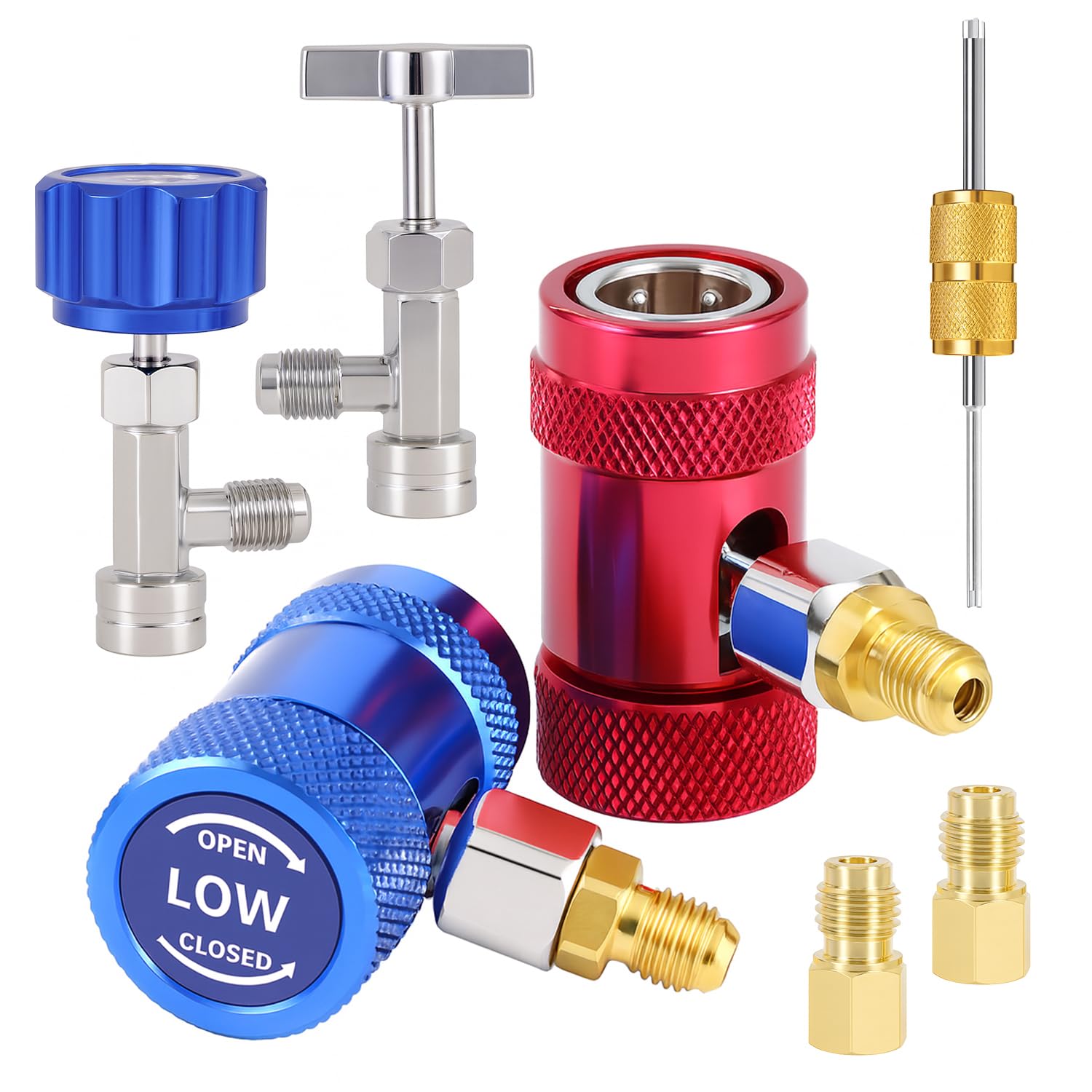
This is the kit that goes beyond basic couplers to include everything you need for professional diagnostics and vacuum evacuation on modern R1234yf systems. It bundles high and low-side quick couplers, both self-sealing and puncture can taps, 1/4″ to 1/2″ adapters, and a valve core tool. The couplers feature a precision-engineered 6-ball snap lock for a firm grip on service ports, paired with high-grade internal O-rings for a vacuum-tight connection.
The dual-style can taps use the necessary left-hand (LH) threading specific to R1234yf canisters — and the kit notes it’s not compatible with right-hand threaded R134a units, so know your refrigerant. Owners confirm they “have shut off valves incorporated” and work on 1234yf ports as expected. The solid brass construction with knurled high-torque knobs offers a non-slip grip even with oily hands.
The included 1/4″ female to 1/2″ male adapter lets you switch to standard 1/2″ hoses, and the dual-ended valve core tool handles two different core sizes. This is a well-rounded package for someone who wants a single purchase to cover modern car recharging rather than assembling pieces piecemeal. Fit reports are minimal, which is a good sign — customers note it simply works.
The complete package: couplers, can taps, adapters, and valve tool in one box — the shortest path from purchase to a completed recharge.
The constraint: strictly R1234yf only; R134a units won’t fit the left-hand threading, so this isn’t for mixed fleets.
Understanding the Specs
Ball-bearing count in quick couplers
The number of ball bearings inside a coupler determines how evenly it grips the service port. A 5-ball or 6-ball design distributes pressure around the entire circumference, reducing the chance of a lopsided seal that leaks. When you snap a coupler on and feel it click, you’re relying on these bearings to hold the connection against the system’s high pressure.
Control knob and Schrader valve
The top control knob on a coupler opens and closes the internal valve, letting you depress the Schrader valve (the small spring-loaded pin in the service port) for controlled flow. This is what lets you purge lines safely before evacuation — without it, you’d vent refrigerant every time you disconnected. A smooth-turning knob makes the difference between a clean service and a frustrating one.
Thread size and flare type
The standard manifold connection is a 1/4″ male flare, which fits most gauge sets directly. Hose-end fittings come in sizes like #6 and #8, referring to the nominal hose diameter in eighths of an inch. The thread pitch matters too — a 5/8-18UNF thread is common on AC fittings, and mismatch here means a connection that won’t seat fully.
Beadlock vs compression fittings
A beadlock fitting uses a mechanical grip that locks the hose onto the fitting, often with a visible hole to confirm the hose is fully seated. Traditional compression fittings (sometimes called AN or Army/Navy) use a beveled surface and a nut to compress the hose. Knowing which interface your hoses and adapters use prevents the classic mistake of buying fittings that look right but won’t connect.
FAQ
What is the difference between R134a and R1234yf fittings?
Will R134a couplers work on R1234yf ports?
How do I know which thread size I need for my gauge set?
What is a Schrader valve and why does it matter?
Does the ball-bearing count really affect the seal?
Can I use a puncture-style can tap on any refrigerant can?
What does beadlock mean on an AC hose fitting?
Are AN fittings the same as AC hose fittings?
Final Thoughts: The Verdict
For most buyers, the auto ac fittings winner is the OMT 9-piece Adapter Kit because it covers both car and home AC service with dual can tap styles at a fair price. If you need a vacuum-tight seal on modern R1234yf systems, grab the OMT R1234yf Coupler Set. And for a garage juggling both refrigerants, the Lichamp Adapter Kit is the one to reach for.
How We Picked
We do not accept paid placement. Every pick is matched to a real buyer and a real use-case; we do not hands-on test units.
Sources & Methodology
Specifications: manufacturer listings and product documentation. Review insights: verified customer reviews, as of August 2026. Pricing: not shown on this page (it changes often); check the current price via the retailer link.
As an Amazon Associate, Gadgets Feed earns from qualifying purchases. This does not affect which products we feature.