
A vehicle break-in often goes unnoticed until you return, leaving you with a shattered window and a missing stereo. A shock sensor changes that by detecting the physical force of an intrusion and triggering a siren before the thief can finish the job. The right sensor distinguishes a harmless bump from a real threat, giving you genuine peace of mind in any parking situation.
I’m Min — the co-founder and writer behind Gadgets Feed. I’ve spent countless hours analyzing shock sensor specifications, decibel ratings, and sensitivity adjustment ranges to identify which models actually protect your vehicle versus those that simply add false alarms to your day.
After evaluating dozens of units across different price tiers, I’ve assembled a definitive list of the best auto alarm shock sensor options that deliver real protection without breaking your budget.
How To Choose The Best Auto Alarm Shock Sensor
Selecting the right shock sensor is about matching its trigger characteristics to your vehicle’s environment. A sensor that’s too sensitive will turn every passing truck into a false alarm, while one that’s too insensitive might miss a real break-in attempt. Understanding a few key specs will help you dial in the perfect balance.
Sensitivity Adjustment Range
Look for a sensor with a mechanical or digital adjustment screw that lets you set the impact threshold. The best units offer at least 7 distinct levels, allowing you to tune out ambient vibration (a busy street) while still catching a hard impact like a window punch. Single-level sensors are often too rigid for real-world use.
Alarm Trigger Stages
Premium shock sensors use a dual-zone design. A light impact triggers a brief warning chirp, while a hard impact triggers the full siren. This two-stage system reduces annoyance from accidental bumps while ensuring a real break-in attempt gets the loud response it deserves. Single-stage sensors skip the warning, so every bump is a full siren event.
Power Source and Connectivity
Decide between hardwired sensors that integrate into an existing alarm system and standalone wireless units with built-in sirens. Hardwired models (like the Directed 504D) draw under 1 mA and rely on the car’s battery, while wireless units (like the PADONOW) use rechargeable batteries and are easier to install but need periodic charging. Your vehicle’s existing alarm infrastructure determines which path is best.
Quick Comparison
On smaller screens, swipe sideways to see the full table.
| Model | Category | Best For | Key Spec | Amazon |
|---|---|---|---|---|
| BlueFire Motorcycle Security Kit | Mid-Range | Motorcycle anti-hijacking | 125 dB siren; remote engine start | Amazon |
| Directed Electronics 504D | Premium | Universal add-on for existing alarms | Dual-zone (warn/alarm); <1mA draw | Amazon |
| PADONOW Wireless Bike Alarm | Mid-Range | Bicycle/ebike without existing alarm | 115 dB; USB-C rechargeable; IPX5 | Amazon |
| WSDCAM Trailer Alarm | Mid-Range | Screw-mounted trailer/truck box | 113 dB; 7 sensitivity levels; 130ft remote | Amazon |
| LNKERCO Car Alarm System | Premium | Magnetic mount for quick install | 108 dB; 3D accelerometer + AI; red flash | Amazon |
| BANVIE Car Alarm System | Premium | Full keyless entry + shock/microwave | 110 dB; engine kill switch; auto lock | Amazon |
| Directed 508D Motion Sensor | Premium | Convertible/custom installs | RF field disturbance; dual-zone; 4-pin plug | Amazon |
In‑Depth Reviews
1. Directed Electronics Install Essentials Dual Zone Motion Sensor 508d

The Directed 508D represents a different philosophy in vehicle protection — instead of relying on physical vibration, it uses RF field-disturbance technology to detect moving high-density objects within its zone. This makes it ideal for convertibles where a thief can reach inside without jostling the vehicle. The sensor mounts easily to the ceiling using the included 4-pin wiring harness and plugs directly into compatible Viper, Python, or Auto Page systems.
Users report excellent coverage from the front doors forward when ceiling-mounted near the dome light, with dual-zone logic providing a warning upon approach and a full alarm when an arm enters the cabin. The only noted limitation is reduced sensitivity toward the rear of larger vehicles like cargo vans, and the field can shift slightly without manual adjustment. Still, for high-value vehicles or soft-top cars, this add-on provides a layer of protection that no shock sensor alone can match.
At its price point, the 508D is a specialized tool — it requires an existing alarm system with a 4-pin MUX port and some installation know-how. But for those who need proximity detection rather than impact sensing, it is the most effective upgrade available.
Why it’s great
- Detects motion through windows without physical contact
- Dual-zone logic reduces false alarms while maintaining security
- Includes 4-pin harness for easy integration with major alarm brands
Good to know
- Requires existing alarm system with compatible port
- Detection field may need re-tuning in cargo-heavy vehicles
2. BlueFire Motorcycle Security Kit Alarm System

The BlueFire kit delivers serious motorcycle-specific protection with a 125 dB siren that is genuinely uncomfortably loud. It works with any 12V battery and includes two remotes, an adjustable shock sensor, and an anti-hijacking feature that cuts engine power when triggered. The install is straightforward — connect the red and black wires to the battery and find space for the brain unit and piezo buzzer under the seat or tank.
User feedback highlights the adjustable sensitivity as a strong point: the sensor can be tuned to detect vertical movement (seat tampering) while ignoring lateral shaking from wind. The 125 dB output is consistently described as ear-piercing, and the backup 9V battery ensures the alarm still sounds if the main battery is disconnected. However, the lack of clear instructions means you’ll need basic wiring knowledge or a willingness to watch YouTube tutorials.
The main trade-offs are the cheap-feeling remotes and occasional random false alarms after months of use. For the price, though, this kit offers more features — remote start, flashing light warning, and anti-hijacking — than any standalone sensor could.
Why it’s great
- Ear-piercing 125 dB siren that effectively deters thieves
- Adjustable shock sensor tuned for vertical vs. lateral motion
- Includes anti-hijacking engine kill and remote start
Good to know
- No printed instructions — wiring diagram may not match wire colors
- Some units arrive faulty; test before final installation
3. PADONOW Wireless Remote Bike Alarm

The PADONOW is a compact, self-contained alarm that doesn’t require any hardwiring. It uses a built-in motion sensor and a 115 dB piezo siren, all powered by a 400 mAh USB-C rechargeable battery that lasts up to 3 months on standby. The remote offers 3-level sensitivity adjustment and a panic button, making it equally useful on a bicycle, scooter, trailer, or even a door at home.
Users consistently praise its loudness — the 115 dB siren is described as ear-piercingly loud and effective at scaring off potential thieves. The sensitivity settings allow you to dial in the trigger point: low sensitivity ignores gentle bumps while high sensitivity catches even a slight touch. The IPX5 rating means it survives rain without issue, and the included zip ties and double-sided tape make installation tool-free.
The main drawbacks are the need to split open the key fob to install a small battery, and the limited 20-meter remote range. Programming the different sound effects can also be confusing without the manual. For a wireless, no-drill solution that works across multiple vehicles, this is the most versatile option available.
Why it’s great
- No wiring required — installs with zip ties or double-sided tape
- USB-C charging and IPX5 waterproof rating for outdoor use
- 3-level sensitivity adjustment to fine-tune trigger threshold
Good to know
- Key fob requires disassembly to install battery
- Remote range limited to 20 meters (66 feet)
4. WSDCAM Screw-Mounted Trailer Anti-Theft Alarm
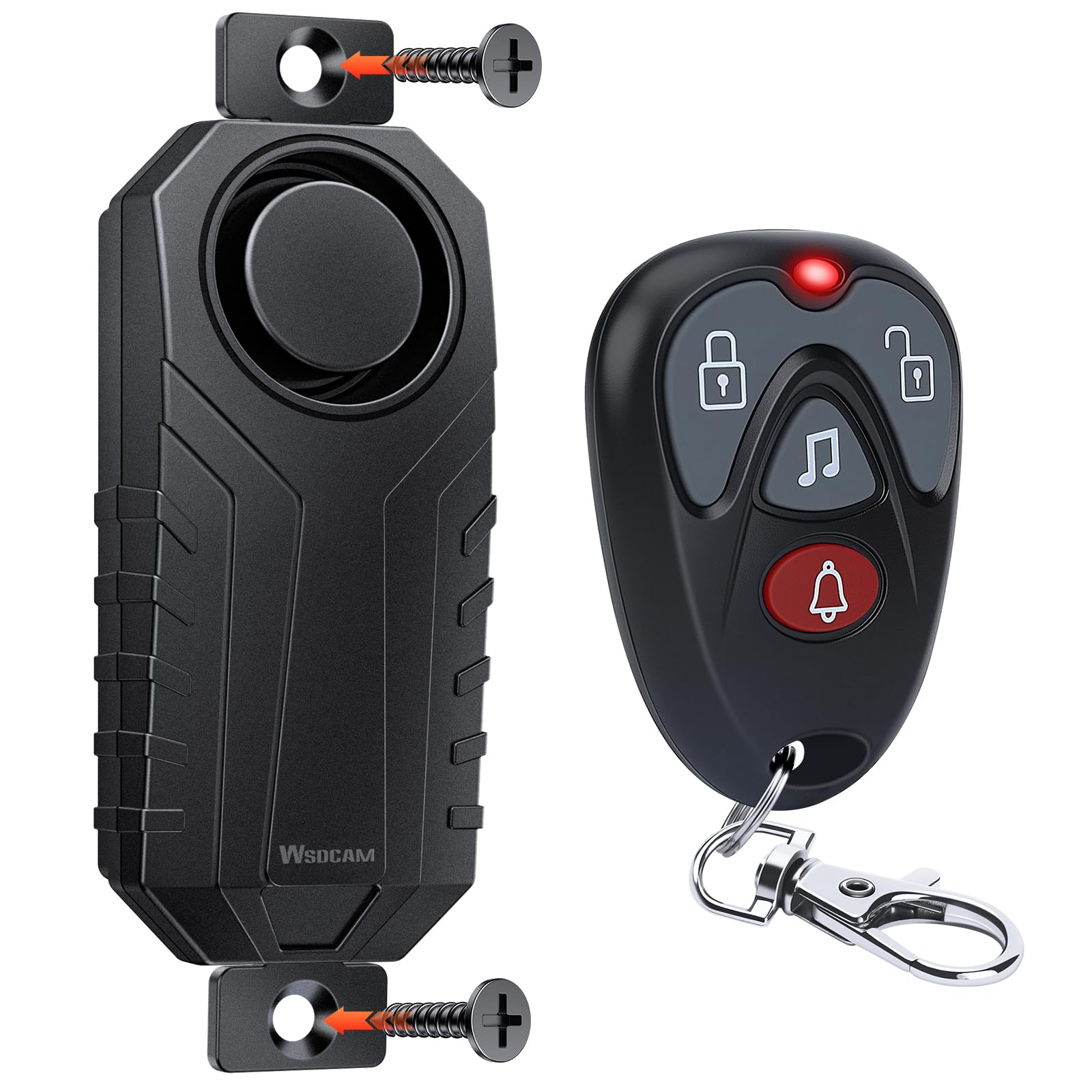
The WSDCAM is purpose-built for outdoor gear that can’t rely on a vehicle’s electrical system. Its screw-mounted design uses a T-plate and screws to permanently attach to trailers, truck boxes, rooftop cargo, or camping gear. The unit offers 7 sensitivity levels and 3 adjustable volumes ranging from 96 dB to 113 dB, giving you granular control over when and how loud the alarm responds.
The 700 mAh USB-C rechargeable battery charges in 2 hours and lasts up to 3 months on standby, making it ideal for seasonal storage. The 130-foot remote range is significantly better than most wireless competitors, allowing you to arm/disarm from a practical distance. The IP65 waterproof rating means it withstands rain, dust, and extreme outdoor conditions without failure.
Some users note the plastic build feels less robust than premium hardwired sensors, and the alarm can be muffled by hand if a thief reaches it. The included double-sided tape and zip ties are weak — the screw mount is the only reliable option for permanent installation. For protecting a trailer or tool box in storage, this is the most feature-complete wireless solution.
Why it’s great
- 7 sensitivity levels allow fine-tuning from light touch to heavy impact
- 130-foot remote range for convenient arming from distance
- 700 mAh battery with 3-month standby and IP65 waterproofing
Good to know
- Plastic housing feels less durable than metal sensors
- Screw mount required for reliable installation; tape/zip ties are weak
5. LNKERCO 108dB Car Alarm System
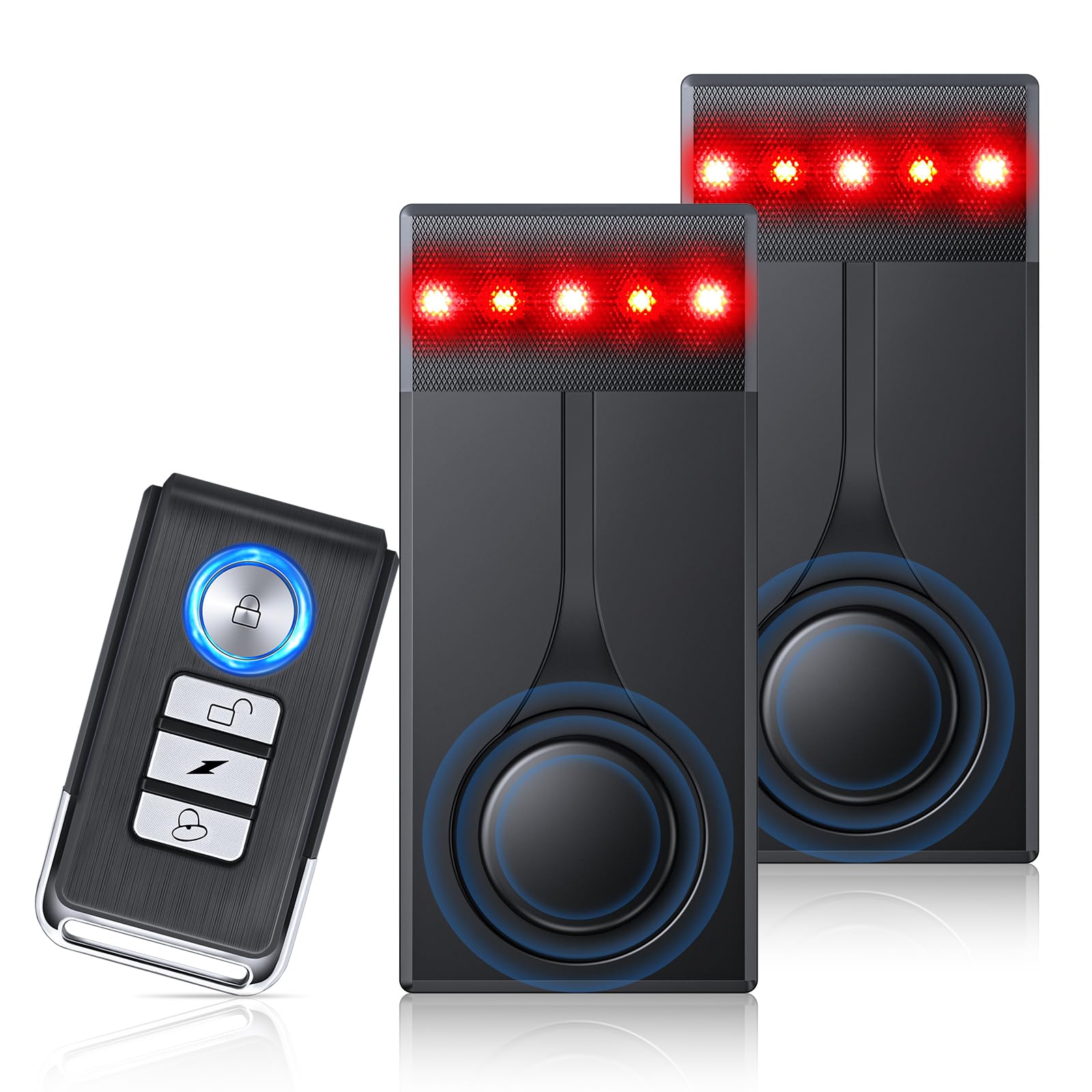
The LNKERCO system takes a modern approach to shock detection by combining a 3D accelerometer with an AI algorithm that distinguishes between genuine impacts and ambient vibration. This reduces false alarms significantly compared to older piezoelectric sensors. The unit mounts magnetically, so no tools or permanent installation are required — you can move it between vehicles or use it on home doors.
The 108 dB output has 3 volume levels (96 dB, 102 dB, 108 dB) and is accompanied by a red flashing light that provides a visual deterrent even when the siren isn’t sounding. The dual-stage logic means a light vibration triggers a 2-second warning chirp with flashing light, while a second vibration within the window triggers a 30-second continuous alarm. Two units are included in the package, allowing you to place one inside and one outside the vehicle.
Some users report the magnet can detach from the housing over time, and the unit relies entirely on the remote for disarming — losing the remote means you have to remove the batteries to silence it. The AAA battery life of 1-3 months is decent but requires periodic replacement. For a no-wire, adaptable alarm that works across multiple scenarios, this is the most intelligent option.
Why it’s great
- 3D accelerometer + AI algorithm reduces false alarms significantly
- Magnetic mount allows tool-free installation and relocation
- Dual-stage alarm logic (warning chirp then full alarm) improves usability
Good to know
- Magnet housing may separate from the unit over time
- No backup disarming method if remote is lost
6. BANVIE Car Alarm System with Keyless Entry

The BANVIE system is a complete alarm solution that includes both a shock sensor and a microwave proximity sensor for layered protection. It also features keyless entry, an engine cut-off relay for anti-hijacking, and automatic door locking when driving. The 110 dB siren with 6 tones provides a distinctive sound that sets your vehicle apart from others in the lot.
Installation is the major consideration here — it’s a full hardwired system that requires several hours and solid wiring knowledge. Users report the provided wiring diagram may have incorrect polarity for door locks, and the thin aluminum wires can be brittle. However, once installed correctly, the system works reliably with good remote range and all features functioning as intended.
The dual sensors (shock and microwave) mean the alarm can detect both physical impact and proximity intrusion, providing comprehensive coverage. The engine kill switch adds a critical layer of protection against hot-wiring. For those comfortable with DIY automotive wiring, this is the most complete alarm system available at this price point.
Why it’s great
- Combined shock + microwave sensor for dual-layer detection
- Engine cut-off relay prevents hot-wiring and enables anti-hijacking
- Automatic door locking while driving adds safety
Good to know
- Installation requires several hours and advanced wiring knowledge
- Thin aluminum wires are brittle and may break during installation
7. Directed Electronics 504D Double Guard Stinger Shock Sensor

The Directed 504D is the gold standard for adding a secondary shock sensor to an existing alarm system. It uses patented electromagnetic technology rather than mechanical parts, meaning no springs to wear out or degrade over time. The dual-zone design provides a warning response on light impact and a full alarm trigger on hard impact, and the plug-in 4-pin harness makes it compatible with all major alarm brands including Viper, Python, and Clifford.
Users consistently describe it as easy to install — typically under 5 minutes — with an internal adjustment screw for sensitivity tuning. The current draw is under 1 mA, so it won’t drain your battery even in long-term parking. The 115 dB output is handled by the existing siren, so the sensor itself is purely the detection component.
The only recurring issue is that some units ship without the included 4-pin harness wire, which requires a return. Additionally, the plug design means it’s only useful if your alarm has a standard 4-pin sensor input port — non-standard systems will need the plug cut off and wires spliced. For a proven, reliable dual-zone sensor that integrates seamlessly with existing systems, this is the professional’s choice.
Why it’s great
- Patented electromagnetic design eliminates mechanical wear and tear
- Dual-zone logic provides warning on light impact, alarm on hard impact
- Ultra-low current draw (<1mA) prevents battery drain
Good to know
- Some units missing the 4-pin harness wire at delivery
- Requires existing alarm with standard 4-pin sensor input port
FAQ
Will an auto alarm shock sensor drain my car battery if left armed for a week?
Can I install a shock sensor myself or do I need a professional?
What sensitivity setting prevents false alarms from rain or passing traffic?
How do I know if my existing alarm system is compatible with an add-on shock sensor?
Final Thoughts: The Verdict
For most users, the best auto alarm shock sensor winner is the Directed 508D Motion Sensor because its RF field detection catches thieves before they even touch your vehicle, providing a level of protection that impact-based sensors cannot match. If you want a wireless, tool-free solution for a bicycle or trailer, grab the PADONOW Wireless Bike Alarm. And for a complete DIY alarm system with shock and microwave sensors plus engine kill, nothing beats the BANVIE Car Alarm System.