
Nothing drains the joy from owning a car, boat, or RV faster than a dead battery that wasn’t even in use. A hidden parasitic draw from a clock, alarm system, or infotainment unit can silently kill a battery in days, leaving you stranded with no recourse but a jumpstart or a replacement. The solution is brutal in its simplicity: a mechanical or remote-activated knife that physically severs the circuit, guaranteeing zero current flow and zero drain.
I’m Min — the co-founder and writer behind Gadgets Feed. I’ve spent countless hours comparing the current ratings, contact materials, mounting hardware, and real-world failure rates of these switches to separate the ones that actually last from the ones that will corrode or fail mid-winter.
Whether you need to stop parasitic drain on a weekend classic car or lock out the starting circuit of a work truck, the right best auto battery shut off switch delivers total isolation with the ampacity and durability your system demands.
How To Choose The Best Auto Battery Shut Off Switch
An auto battery shut off switch isn’t just a simple on/off knob — it’s a safety-critical component that must handle the full surge of your starter without welding itself closed. Choosing the wrong one means either a melted switch or a battery that still drains. Focus on three non-negotiable factors before you buy.
Current Rating: Continuous vs. Crank
Every switch lists multiple current numbers. The continuous rating (typically 125A to 500A) is the load it can carry indefinitely — this matters for RVs and boats running inverters or multiple accessories. The intermittent or crank rating (often 1000A to 5000A) is the brief burst the switch must survive when you turn the key. If you drive a diesel truck or have a high-compression V8, never accept a switch with a crank rating below 1000A.
Contact Material and Corrosion Resistance
The contact material determines how many years the switch will last before developing high-resistance hot spots. Tinned copper is the standard for marine and outdoor use because the tin layer resists oxidation far better than bare brass. Silver contacts offer the lowest possible resistance but cost more. Avoid unbranded brass-on-brass contacts — they corrode quickly in any humid environment and will eventually cause voltage drop and heat.
Mounting Type and Physical Size
Rotary top-mount switches (like the classic Blue Sea and QuickCar) require a panel cutout and are best for permanent installation on a dashboard or battery box. Side-mount bracket switches (like the Joinfworld) clamp directly onto the battery terminal and are faster to install but bulkier in tight engine bays. Remote-operated switches eliminate the need to open the hood at all but add a solenoid and wiring complexity — perfect for anti-theft applications.
Quick Comparison
On smaller screens, swipe sideways to see the full table.
| Model | Category | Best For | Key Spec | Amazon |
|---|---|---|---|---|
| Blue Sea Systems 9003e | Premium | Marine & high-amp 48V systems | 350A continuous, tinned copper studs | Amazon |
| FEITON 500A Lock-Out | Premium | Heavy-duty truck & equipment | 500A continuous, waterproof + padlock | Amazon |
| AWBLIN Volt Meter Switch | Mid-Range | Monitoring battery voltage at a glance | 250A continuous, built-in LED voltmeter | Amazon |
| RVMARINEPAT 300A Waterproof | Mid-Range | Marine & RV ignition-protected use | 300A continuous, IP54, flame-retardant | Amazon |
| FEITON Remote Kill Switch | Mid-Range | Anti-theft & convenient remote cutoff | 200A continuous, wireless remote control | Amazon |
| QuickCar Racing 55-010 | Mid-Range | Racing & street rod panel mounts | 125A continuous, aluminum/panel mount | Amazon |
| Joinfworld Side Mount Switch | Budget | Quick direct battery terminal install | 200A continuous, side post bracket | Amazon |
In‑Depth Reviews
1. Blue Sea Systems e-Series 9003e
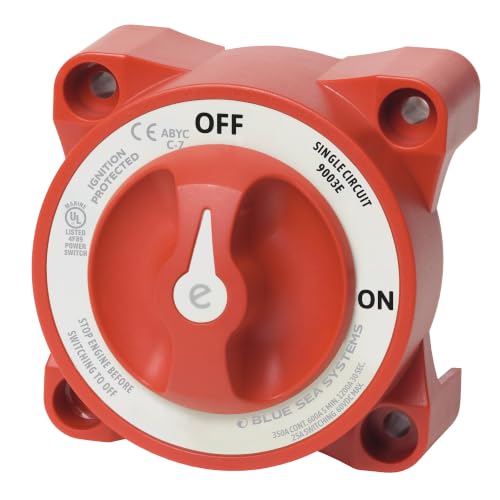
The Blue Sea Systems 9003e is the gold standard for marine-grade battery isolation. Its 350A continuous rating and 48V DC compatibility make it equally capable on a sailboat, a camper van, or a 48V golf cart. The tinned copper studs resist corrosion even in salt-air environments, and the textured knob lets you operate it by feel in dim engine bays.
Installation requires a 3 5/8-inch hole saw for flush mounting, and the compact footprint — just 2.83 inches square — fits into tight dash panels where bulkier switches won’t. The single-circuit On/Off design is dead-simple: twist clockwise to connect, counter-clockwise to kill. No parasitic drain pathways, no standby current.
Users consistently report flawless function after years of exposure to moisture and vibration. The only real complaint is the lack of a back cover plate to shield the studs, but heat-shrink terminals solve that easily. For a permanent, worry-free disconnect on any 12V to 48V system, this is the benchmark.
Why it’s great
- 350A continuous handles any battery bank safely
- Tinned copper studs stay corrosion-free in marine air
- Flush-mount looks professional and saves space
Good to know
- Requires specific 3 5/8″ hole saw for flush install
- No included stud cover for the rear terminals
2. FEITON 500A Lock-Out Switch
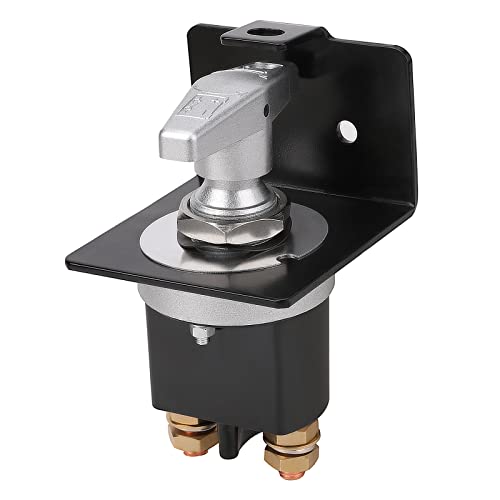
When your system demands 500 amps of continuous current — think dump trucks, heavy agricultural equipment, or large off-grid battery banks — the FEITON 500A lock-out switch is the only choice that won’t become a failure point. Its 5000A instantaneous crank rating laughs at the starter draw of a diesel V8, and the waterproof housing keeps salt and mud out of the contact chamber.
The integrated lock-out plate accepts a standard padlock, preventing accidental activation or theft of service equipment. The large rotary handle is easy to grab even with thick work gloves, and the 10mm threaded studs accept multiple cable lugs for parallel battery banks. It replaces the common 20247 form factor, so it retrofits into existing cutouts.
Users on heavy trucks and RVs praise the build density — this switch has real heft. The only downside is its size: it’s noticeably larger than a typical 300A switch, so pre-measure your mounting panel before ordering. For raw ampacity in industrial-grade environments, nothing in this class touches it.
Why it’s great
- 500A continuous with 5000A crank surge rating
- Lock-out plate accepts padlock for safety lockout
- Waterproof construction handles weather extremes
Good to know
- Bulky dimensions require generous panel space
- No remote control option — manual twist only
3. AWBLIN Voltmeter Disconnect Switch

The AWBLIN switch solves two problems with one knob: it isolates the battery and displays real-time voltage on a built-in LED screen. That voltmeter lets you spot a failing battery or excessive parasitic draw the moment you flip the switch on — before you even turn the key. The 250A continuous and 300A for 30-minute rating covers most RV, marine, and car applications.
The housing is molded from nylon 66 rather than standard ABS, giving it higher heat resistance and better mechanical strength. Copper-plated silver contacts keep resistance low, and the 5V-60V operating range means it works on everything from a 6V classic car to a 48V solar array. The rotational On/Off action has a firm detent that won’t shake loose on rough roads.
Some users note that the blue LED screen is hard to read in direct sunlight, and the included instructions are minimalist. But the voltage display is a genuine diagnostic tool that saves you from buying a separate multimeter. If you want a single component that both disconnects and monitors, this is the smartest upgrade for your panel.
Why it’s great
- Integrated voltmeter shows battery health instantly
- Nylon 66 shell resists heat better than ABS
- Copper-plated silver contacts for low resistance
Good to know
- Blue LED screen washes out in bright sunlight
- Installation instructions could be more detailed
4. RVMARINEPAT 300A Waterproof Switch
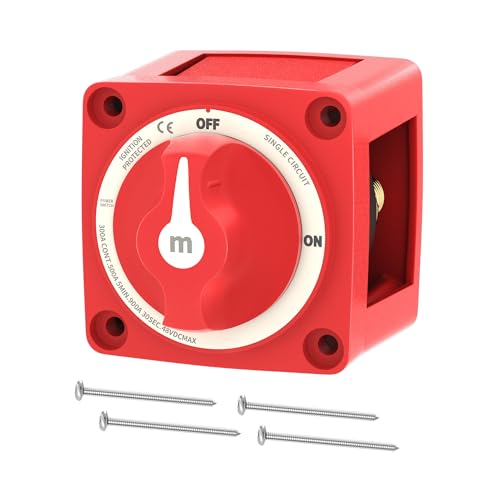
The RVMARINEPAT 300A switch packs ignition protection and a 300A continuous rating into a compact, flame-retardant housing. Ignition protection means it won’t spark-explode in the presence of fuel vapors — mandatory for boat engine compartments and any gasoline-adjacent installation. The crank rating of 900A for 30 seconds handles most V8 and diesel starters without stress.
The 2 x 3/8-inch tinned copper studs provide excellent conductivity, and the internal partition design keeps positive and negative wiring separated to reduce short-circuit risk. The shell disassembles easily for wiring, and the base includes mounting screws so you’re not hunting for hardware. The simple ON/OFF knob is intuitive even for family members who aren’t mechanically inclined.
Marine users repeatedly mention how well it holds up to bilge moisture and salt spray. The only catch is the IP54 rating — it’s splash-resistant but not submersible, so keep it above the waterline. For budget-conscious buyers who still need proper marine safety certification, this is where the value line ends.
Why it’s great
- Ignition-protected for boat and fuel-exposed areas
- 300A continuous with 900A crank burst
- Flame-retardant shell adds safety margin
Good to know
- IP54 resists splashes but not submersion
- No voltmeter or remote option available
5. FEITON Remote Battery Disconnect Switch

The FEITON remote disconnect switch lets you kill battery power from inside the cabin or even 50 feet away using a key fob. Two remotes are included, and the installation requires no permanent modifications — just clamp the ring terminals onto the battery posts. This is ideal for vehicles with hidden parasitic draws you don’t want to open the hood for every night.
The silver contacts and pure copper wiring handle 200A continuous, enough for most passenger cars, trucks, and SUVs. The anti-theft benefit is obvious: flipping the relay cuts all power, and the thief can’t start the car even with the key. A 6-second delay after reconnection before starting is normal, as the ECU and stereo need to reinitialize.
The most common complaint is longevity — a few units stopped working after a few months. For a permanent solution on a daily driver, a mechanical rotary switch may be more reliable. But for seasonal vehicles, weekend projects, or as a theft deterrent on an older car, the convenience of a button press is transformative.
Why it’s great
- Remote control eliminates need to open hood
- Dual remotes included with key fob range
- Silver contacts for reliable conductivity
Good to know
- Some units have reported early failure after months
- 6-second reconnection delay may confuse first-time users
6. QuickCar Racing 55-010

The QuickCar Racing 55-010 is built for exactly one job: provide a clean, reliable battery disconnect on a race car or street rod where space is tight and aesthetics matter. The red anodized aluminum panel and handle look professional on a dashboard or firewall, and the total height is just 2.5 inches. At 125A continuous, it’s not intended for high-amp inverters or diesel trucks — it’s a proper starter circuit isolator.
Mounting requires a panel cutout slightly larger than the switch body, and the included black backing plate fits panels up to 1/4-inch thick. The rotary action is crisp with no slop, and the handle has a satisfying mechanical stop at On and Off. It accepts standard ring terminals on the studs, and the aluminum contacts are adequate for 12V systems under 125A.
Off-road and hot rod owners love the clean look and the sheer ruggedness. The biggest limitation is the current rating — if you plan to run any heavy accessory through this switch, look elsewhere. For a simple starter kill or battery isolation on a low-draw vehicle, it’s an elegant, durable solution that’s earned its place in restoration shops.
Why it’s great
- Compact aluminum panel fitment on dashboards
- Crisp rotary action with mechanical stop
- Professional race-car aesthetic
Good to know
- 125A limit excludes high-amp inverters or big diesels
- Panel cutout must be larger than switch body
7. Joinfworld Side Mount Disconnect Switch

The Joinfworld switch proves that a budget-friendly option doesn’t have to be flimsy. It includes a heavy-duty steel side-post mounting bracket that bolts directly to your battery’s side terminals, so no panel cutting or drilling is required. The 200A continuous and 1000A crank rating cover most standard cars, boats, and ATVs without breaking a sweat.
The M10 tinned copper studs and included brass lugs ensure solid connections, and the IP65 rating means it can handle rain and wash-downs without internal corrosion. The package even includes rubber terminal insulators to prevent accidental shorting against the chassis. The rotary knob has a clear On/Off embossing, though some users note the detent feels less defined than more expensive switches.
If your application is a simple parasitic drain fix on a daily driver, weekend boat, or project car, this is the most cost-effective path. The plastic housing and lighter knob action won’t inspire the same confidence as a Blue Sea switch, but for the vast majority of 12V systems under 200A, it works perfectly and reliably. No dead batteries, no hassle.
Why it’s great
- Side post bracket mounts directly to battery
- IP65 resistant to rain and splash
- Tinned copper studs with included terminal insulators
Good to know
- Knob detent feels light compared to premium switches
- Plastic housing less durable than metal/PA66 options
FAQ
Will a battery shut off switch reset my car’s ECU or stereo?
What gauge wire do I need for a 200A battery disconnect switch?
Is it better to install the switch on the positive or negative terminal?
Can a remote battery kill switch drain my battery when it’s off?
Final Thoughts: The Verdict
For most users, the best auto battery shut off switch winner is the Blue Sea Systems 9003e because it combines 350A continuous capacity, tinned copper marine-grade construction, and a compact flush-mount design that works in nearly any application. If you want to monitor your battery voltage at a glance, grab the AWBLIN voltmeter switch. And for the convenience of remote kill without opening the hood, nothing beats the FEITON wireless switch.