
Every driver knows that sinking feeling when a car materializes in the mirror’s blind zone during a merge — but most aftermarket fixes are either useless ceiling-mounted convex stickers or systems that false-alarm on every guardrail. The difference between a usable blind spot monitor and a frustrating paperweight comes down to radar frequency, detection range, and how the system handles stationary objects versus genuine threats.
I’m Min — the co-founder and writer behind Gadgets Feed. I’ve spent hundreds of hours cross-referencing radar specifications, installation requirements, and user-reported false-alarm patterns to separate the few properly engineered automotive blind spot detection kits from the ones that will just annoy you with constant beeps.
This guide focuses strictly on systems using microwave or millimeter-wave radar (24GHz or 77GHz) that actually track moving vehicles in adjacent lanes — not ultrasonic parking sensors repurposed for a job they cannot do. The result is a curated list of the best auto blind spot sensor options currently available for both cars and motorcycles.
How To Choose The Best Auto Blind Spot Sensor
Not all blind spot sensors work the same way. The core differentiator is the radar technology inside the module — cheap kits use 58kHz ultrasonic sensors that cannot distinguish between a moving car and a stationary concrete barrier, while proper automotive-grade systems use 24GHz or 77GHz millimeter-wave radar that measures relative speed and distance. Understanding a few key parameters will save you from buying a system that triggers false alerts every time you pass a parked truck.
Radar Frequency: 24GHz vs 77GHz
24GHz millimeter-wave radar is the industry standard for aftermarket blind spot monitoring. It provides reliable detection up to roughly 10–12 meters and handles rain, fog, and nighttime conditions well. The newer 77GHz radar operates at a shorter wavelength, offering higher resolution and longer detection ranges — typically 30–55 meters — with better object classification that reduces false alarms from roadside infrastructure. The trade-off is cost and complexity; 77GHz systems tend to be more expensive and may require more careful installation.
Detection Range and Speed Thresholds
Every radar system has a minimum relative speed requirement to filter out stationary objects. Most quality units require the detected target to be moving at least 10 km/h faster than your vehicle before triggering an alert. This prevents false warnings from parked cars, trees, and guardrails. Detection range matters too — a system that only sees 5 meters behind the vehicle is barely useful for highway lane changes, while a 30-meter range gives you real reaction time. Look for systems that explicitly state both the maximum detection distance and the speed threshold.
Installation Requirements: Plastic vs Metal Fascia
Millimeter-wave radar cannot penetrate metal. If your vehicle has a metal bumper or a steel rear crash bar, the radar sensors must be mounted behind a plastic fascia or in a location with clear line-of-sight to the rear quarter zones. Many aftermarket blind spot systems explicitly warn against installation on vehicles with metal bumpers. For motorcycles, the sensors are typically mounted to the rear subframe or tail section, and the IP67 waterproof rating becomes critical since they are fully exposed to road spray.
Alert Types: Visual Only vs Visual + Audible
Basic systems use LED indicators mounted on the A-pillar or side mirrors — a steady light when a vehicle is in the blind spot and a flashing light when the turn signal is activated. More advanced systems add an audible buzzer for lane change scenarios where the driver might not see the LED. Premium setups integrate with the vehicle’s CAN bus to mute the buzzer below a certain speed, preventing nuisance beeps in stop-and-go traffic. Decide whether you want only visual cues or the extra layer of audio warnings before choosing your system.
Quick Comparison
On smaller screens, swipe sideways to see the full table.
| Model | Category | Best For | Key Spec | Amazon |
|---|---|---|---|---|
| Brandmotion RDBS-1600 | Premium | OEM-quality integration with cross-traffic alert | 76–77 GHz radar, 40 ft range | Amazon |
| AlienRider M7 | Premium | 55-meter detection for motorcycles | 77 GHz radar, 55 m range | Amazon |
| BlueDex BSD Kit | Mid-Range | Universal car fit with dual 24GHz sensors | 24 GHz radar, 32.8 ft range | Amazon |
| EASYGUARD EBS001 | Mid-Range | 12-meter detection with lane change assist mode | 24 GHz radar, 12 m range | Amazon |
| Weuaste BSD01 (Motorcycle) | Mid-Range | 130° rear coverage with 30-meter detection | 24 GHz radar, 30 m range | Amazon |
| WEUASTE BSD01 (Radar Detector) | Mid-Range | Motorcycle radar with adhesive mirror mount | 24 GHz radar, 30 m range | Amazon |
| Wilove BSM System | Budget | Entry-level ultrasonic detection with LED alert | 58 kHz ultrasonic, 5 m range | Amazon |
In‑Depth Reviews
1. Brandmotion Radar Blind Spot System with Cross Traffic Detection RDBS-1600

The Brandmotion RDBS-1600 is the closest aftermarket blind spot system to factory OEM quality available today. It uses a 76–77 GHz millimeter-wave radar — the same frequency band as many production vehicle sensors — paired with a CAN-BUS integration module that reads vehicle speed from the OBD II port. This allows the system to suppress alerts below 15 mph, preventing nuisance beeps in parking lots or stop-and-go traffic. The detection range reaches 40 feet behind the vehicle, and the system includes built-in rear cross-traffic alert that senses vehicles approaching from the sides when backing out of parking spaces.
Installation is demanding, as the radar sensors must be mounted behind plastic fascias and wired into the turn signals and CAN-BUS. Professional installation is strongly recommended and can add several hundred dollars in labor. The system includes bright day/night LED indicators that mount at the bottom of the windshield trim with no exposed wires, giving a clean integrated look. Users report that once properly installed, the RDBS-1600 delivers zero false alarms and missed alerts, with some owners noting it performs as well as their vehicle’s factory blind spot monitoring system.
The RDBS-1600 is compatible with vehicles from 2007 and newer that have plastic fascias — it explicitly will not work on metal pickup truck bumpers. The system is inactive below 15 mph and ignores stationary objects, so it will not alert on parked cars or guardrails. While the price is significantly higher than other aftermarket options, the combination of 77GHz radar, cross-traffic detection, and CAN-BUS integration makes this the most capable and reliable blind spot sensor for drivers who want true factory-like performance.
Why it’s great
- 77 GHz radar provides OEM-grade resolution and 40-foot detection range
- CAN-BUS integration enables speed-dependent alert muting below 15 mph
- Integrated rear cross-traffic alert covers backing-out scenarios
- Clean LED indicators mount at windshield base with no exposed wires
Good to know
- Requires professional installation — not a DIY project for most owners
- Incompatible with vehicles with metal bumpers or fascias
- Support from manufacturer is inconsistent, per several user reports
2. AlienRider M7 Motorcycle BSD Blind Spot Detection System
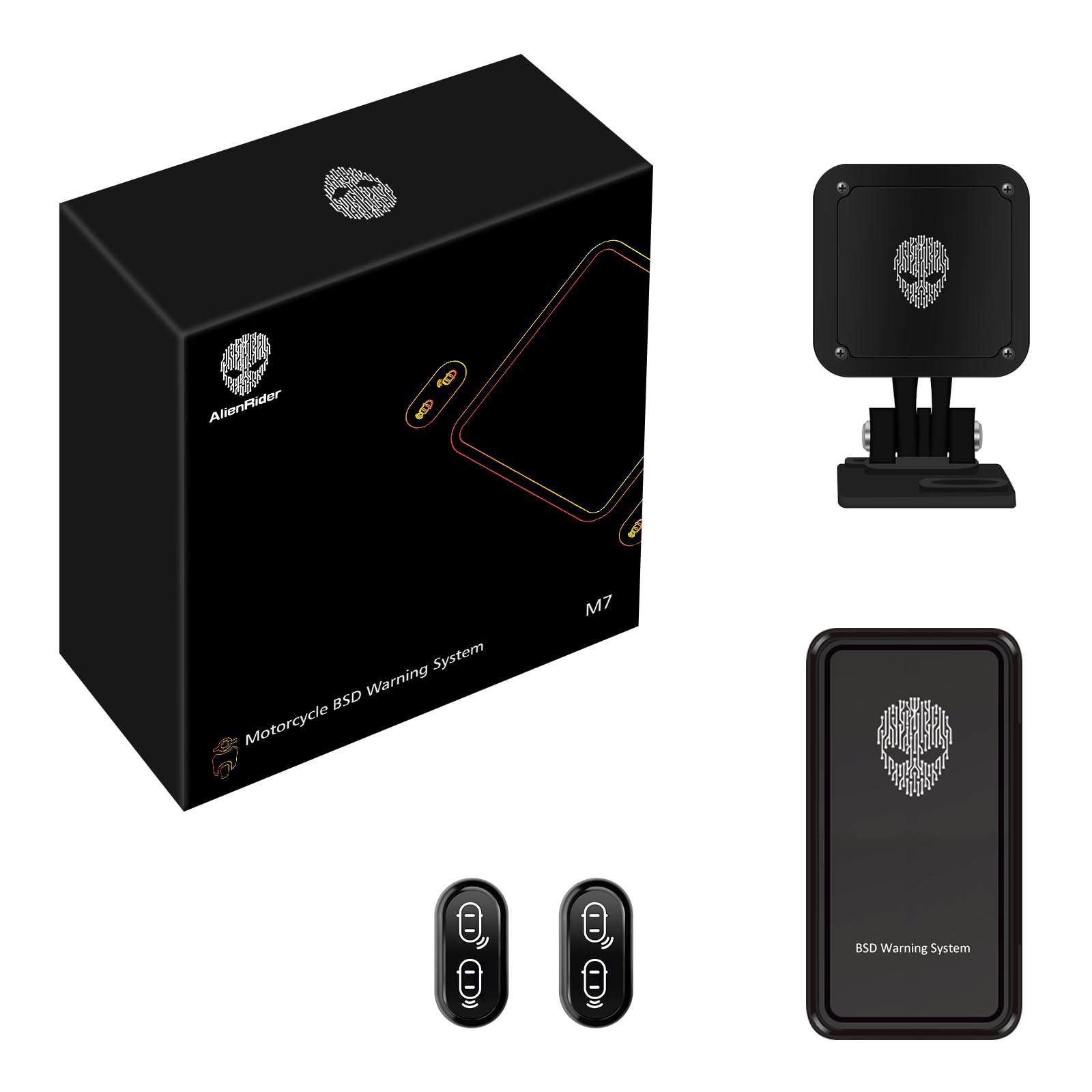
The AlienRider M7 brings 77 GHz millimeter-wave radar to the motorcycle segment, delivering an exceptional 55-meter maximum detection range — far beyond what any 24GHz system can achieve. This frequency provides high resolution that allows the system to distinguish between vehicles in your blind spot and those two lanes over, reducing false alerts from irrelevant traffic. The M7 supports both Lane Change Assistance (LCA) and Rear Collision Warning (RCW): LCA triggers a flashing yellow LED when a vehicle rapidly approaches in the adjacent lane, while RCW illuminates a red warning when a vehicle is closing from behind at high speed.
The main unit is remarkably compact at 36 x 36 x 16 mm, making it easy to hide under motorcycle bodywork without affecting the vehicle’s appearance. Installation connects to the motorcycle’s ACC power line so the system powers on and off with the ignition, preventing battery drain. Users report that the system works well in cool weather, though one verified reviewer experienced continuous LED flashing when ambient temperatures exceeded 75°F — an issue that was resolved after a replacement transceiver. The system includes left and right LED indicators that mount on the handlebars or mirror stems for clear visibility.
While the 55-meter range is impressive, the M7 requires careful mounting to ensure the radar sensors have a clear line of sight to the rear quarter zones. The system ships with wiring that connects to key-on power, not constant battery power, which can be confusing if the manual does not explicitly state this. Some users have reported missing brackets or quality control issues with indicator mounts. Despite these concerns, the M7 remains the longest-range motorcycle blind spot system available and provides genuine collision prevention capability that can significantly reduce the risk of lane-change accidents.
Why it’s great
- 77 GHz radar with 55-meter detection range — best in class for motorcycles
- Dual LCA and RCW alerts with distinct yellow/red LED indicators
- Ultra-compact 36mm main unit for discreet under-bodywork mounting
- ACC power connection prevents battery drain when parked
Good to know
- Some units have exhibited heat-related performance issues above 75°F
- Quality control concerns reported with missing brackets and indicator hardware
- Installation requires key-on power identification — not explicitly documented
3. BlueDex Blind Spot Monitoring System for Cars

The BlueDex Blind Spot Monitoring System strikes an excellent balance between performance and cost, using dual 24 GHz millimeter-wave radar sensors that provide a detection range of 1 to 32.8 feet (0.3 to 10 meters). This is a true radar-based system — not ultrasonic — so it can distinguish moving vehicles from stationary objects better than the cheapest options on the market. The system offers three alert modes: turn signal off (steady LED when vehicle in blind spot), turn signal on (flashing LED with three buzzer beeps), and hazard lights on (continuous LED flash with three beeps for maximum awareness).
Installation is moderate in difficulty. The radar sensors must be mounted inside the rear bumper on plastic fascias — they cannot penetrate metal surfaces. The kit includes a radar angle alignment tool and an installation manual to help position the sensors correctly. One user with a 2018 Malibu noted that the brake and turn signal share the same wire on that model, causing beeps when passing at stop lights — they resolved it with a normally-closed relay. Most users with standard wiring found the install manageable using fuse taps and chassis grounding, though professional installation is recommended for those unfamiliar with automotive electrical work.
Verified buyers report that once properly installed, the BlueDex system works reliably with consistent detection patterns and bright warning lights that mount on the A-pillar or windshield posts. A professional shop owner who installed multiple units described the performance as “every single time” reliable, unlike a competitor brand with intermittent detection. The system includes a remote control for toggling settings. The main downside is the 10-meter detection range — adequate for most lane changes but shorter than premium competitors — and the requirement for plastic-only fascia compatibility.
Why it’s great
- True 24 GHz millimeter-wave radar — not ultrasonic — for reliable vehicle detection
- Triple alert modes with LED and buzzer for different driving scenarios
- Includes radar angle alignment tool for accurate sensor positioning
- Reliable detection performance verified by professional installers
Good to know
- 10-meter range is shorter than premium 30–55 meter systems
- Not compatible with vehicles with metal bumpers or fascias
- Brake and turn signal wire sharing can cause false beeps on some models
4. EASYGUARD EBS001 Blind Spot Monitor System

The EASYGUARD EBS001 is an established aftermarket blind spot system that has been on the market since 2019, with a mature installation base and well-understood performance characteristics. It uses two 24 GHz microwave sensors to monitor the rear corners of the vehicle, with a detection range of 6–12 meters depending on mounting angle and vehicle profile. The system includes lane change assist mode — when the turn signal is activated with a vehicle in the blind spot, the LED flashes rapidly and the buzzer emits three beeps to alert the driver. In normal mode with no turn signal, the LED stays steady illuminated when a vehicle is detected.
Installation requires mounting the sensors at a 45-degree angle on plastic bumper surfaces — the system explicitly does not work with metal bumpers as they interfere with radar signals. The EBS001 fits most DC 12V sedans, compacts, SUVs, and MPVs. One experienced user noted that the instructions recommended a 20-degree sensor angle, which produced false alarms from cars behind and roadside objects; adjusting to 35 degrees eliminated the false alerts entirely. This highlights the importance of careful sensor positioning during installation. The system has been used as a replacement for faulty OEM blind spot units, with one user disabling their factory system entirely in favor of the EASYGUARD.
User feedback is generally positive, with many 4- and 5-star ratings from buyers who successfully installed the system. However, there are reports of inconsistent performance — one user found that the lights activated randomly during driving but failed to stay on when a car was actually in the blind spot, and the unit was beyond the return window. The manufacturer has not been responsive to support inquiries for some customers. The EBS001 is a capable system when installed correctly but requires patience and mechanical skill to dial in the sensor angles, and buyers should be prepared for minimal post-purchase support.
Why it’s great
- Mature 24 GHz radar design with long track record since 2019
- 12-meter detection range with lane change assist and buzzer alerts
- Can be used to replace faulty OEM blind spot monitoring systems
- Wide compatibility with DC12V sedans, SUVs, and MPVs
Good to know
- Requires precise sensor angle adjustment — default 20° angle may cause false alarms
- Incompatible with metal bumpers — plastic fascia only
- Manufacturer support has been unresponsive for some buyers
5. Weuaste BSD01 Motorcycle BSD Blind Spot Detection System
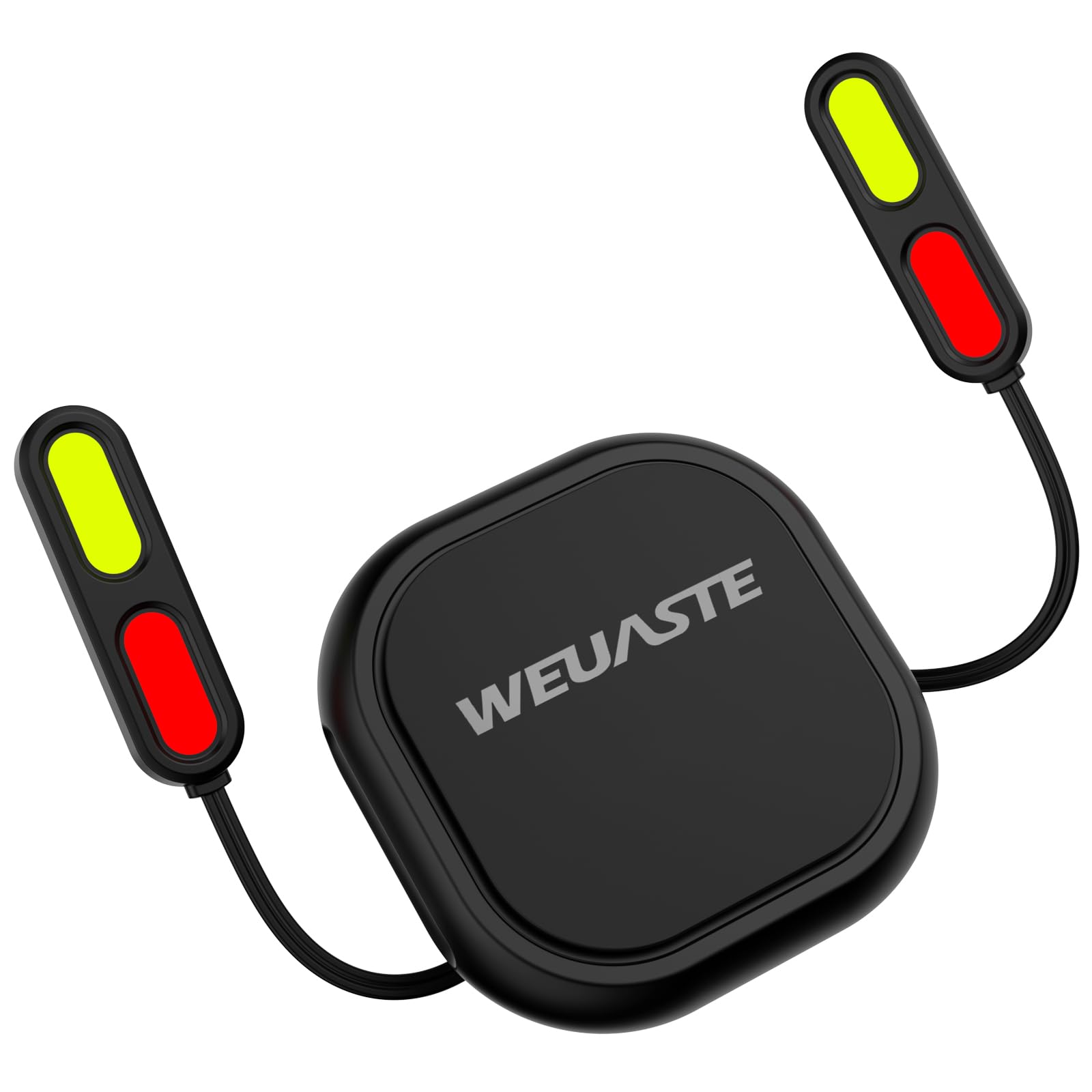
The Weuaste BSD01 is a purpose-built motorcycle blind spot detection system using 24 GHz multi-antenna millimeter-wave radar. Its key differentiator is the IP67 waterproof rating — fully dust-tight and protected against immersion in 1 meter of water for 30 minutes — making it suitable for riders who encounter rain, snow, or pressure washes. The system provides 130-degree rear blind spot coverage with a 30-meter detection range, and it features a dual-stage warning system: a steady LED when a vehicle enters the detection zone, and a faster flash when the vehicle is closer or approaching at higher speed.
Installation connects to the motorcycle’s ACC power line, with the positive wire to ACC and negative wire to battery terminal. The system powers on and off with the motorcycle, drawing no current when parked. The BSD01 requires the detected target to be moving faster than 10 km/h before triggering an alert, which filters out stationary objects and reduces false alarms from parked cars and roadside furniture. Users find the installation straightforward and report that the system provides genuine peace of mind during highway riding and lane changes, particularly in rain or fog where mirrors are less effective.
The package includes left and right LED indicators, radar sensors, wiring harness, and mounting hardware. Some users have reported that the LED indicators are bright enough to be clearly visible even in direct sunlight. The system operates reliably across an extreme temperature range from -40°F to 176°F, ensuring consistent performance in severe winter and summer conditions. The 12-month warranty and responsive technical support add confidence, though some buyers have noted the electronic manual (accessed via QR code) can be cumbersome compared to a printed booklet.
Why it’s great
- IP67 waterproof rating for all-weather motorcycle use in rain and spray
- 30-meter detection range with 130-degree rear blind spot coverage
- 10 km/h minimum speed threshold reduces false alarms from stationary objects
- Wide operating temperature range from -40°F to 176°F
Good to know
- Electronic manual via QR code — no printed booklet included
- Cannot be tested in stationary state; requires road riding to confirm function
- Requires ACC power identification correct or system will not power on
6. WEUASTE BSD01 Radar Detector for Motorcycle
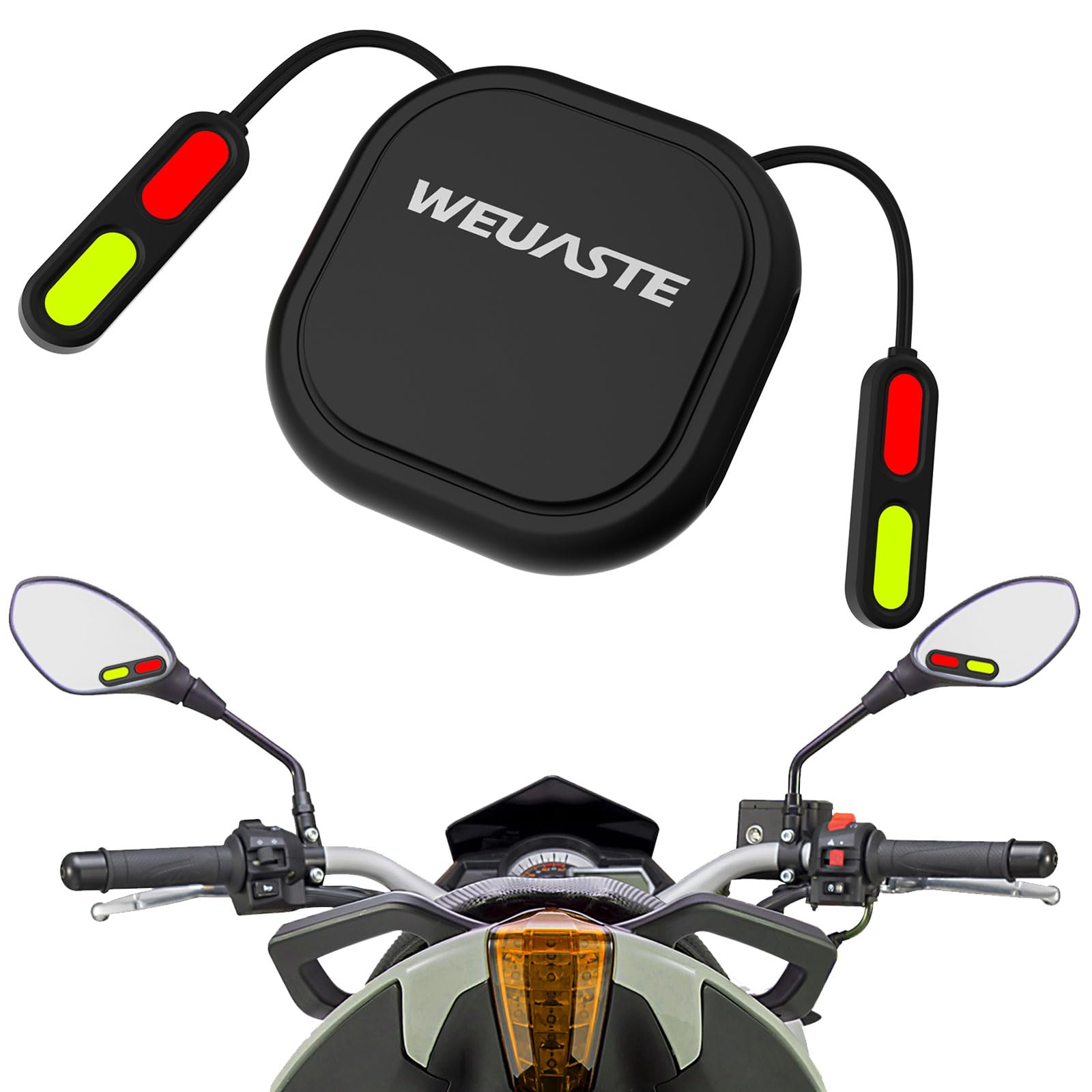
This variant of the Weuaste BSD01 is marketed as a radar detector for motorcycles but functions identically to the blind spot detection system — it uses the same 24 GHz millimeter-wave radar module with 30-meter detection range and 130-degree rear coverage. The key difference is that this package emphasizes simpler DIY installation with LED warning lights that attach to the motorcycle’s rearview mirrors using strong adhesive backing. The goal is to minimize wiring and drilling so riders without mechanical experience can install the system themselves.
The system monitors three directions simultaneously — behind, left, and right — and alerts the rider when a vehicle enters the 30-meter safety perimeter. Like the other Weuaste BSD01 unit, it requires the detected target to be moving faster than 10 km/h to trigger an alert, preventing false warnings from parked vehicles. The IP67 waterproof rating is retained, so the system continues functioning in heavy rain, fog, or snow. Power connection is via the motorcycle’s ACC line — the positive wire connects to ACC and the negative to the battery terminal — and the system automatically powers on and off with the ignition.
Verified user feedback is limited since this variant was released in May 2025, but the underlying radar hardware is the same as the proven Weuaste BSD01 platform. The adhesive mirror mount design is the main differentiator — it avoids drilling holes in the motorcycle bodywork, which is a significant advantage for riders who lease their bikes or want a reversible installation. The trade-off is that adhesive mounts may be less secure than bolted brackets on rough roads, and the warning lights could vibrate or detach over time. This is the best choice for riders who want blind spot detection without permanent modifications.
Why it’s great
- Simple no-drill installation with adhesive mirror mounts for reversible fit
- Same 30-meter, 130-degree detection as the hardwired Weuaste BSD01
- IP67 waterproof rating for all-weather riding conditions
- 10 km/h speed threshold filters out stationary object false alerts
Good to know
- Adhesive mounts may loosen over time on rough roads or in extreme heat
- Cannot be tested while stationary — must be ridden to verify function
- No printed manual; uses electronic manual via QR code
7. Wilove Car Blind Spot Monitoring System

The Wilove Blind Spot Monitoring System sits at the entry-level end of the market, using 58 kHz ultrasonic sensors instead of millimeter-wave radar. Ultrasonic sensors emit sound waves and measure the echo return time — they detect any object within range, regardless of whether it is moving or stationary. This fundamental limitation means the Wilove system cannot distinguish between a car in your blind spot and a guardrail, tree, or parked vehicle. The detection range is limited to 0–5 meters, barely enough to cover the rear door area of most sedans.
Installation requires drilling a hole in the vehicle’s bumper or fascia to mount the sensors, with five wiring points: power, ground, backup lights, left turn signal, and right turn signal. The system sends an audio buzzer alert when an object is detected — but as multiple users have reported, the buzzer can sound continuously when passing curbs, trees, or even parked cars, making it effectively unusable in urban environments. One user tested the sensor before drilling and found it only detected vehicles at extremely close range, barely enough to open the door. Another owner reported the buzzer never sounded at all after installation, and customer support was unresponsive.
The Wilove system is suitable only for very small compact cars, per the manufacturer’s specifications, and professional installation is recommended. However, even when installed correctly, the ultrasonic detection method is fundamentally incompatible with the blind spot monitoring task — it lacks the Doppler shift processing that radar uses to filter stationary objects. The overwhelmingly negative user feedback (multiple 1-star reviews citing false alerts, no support, and poor detection) makes this system difficult to recommend for any real-world driving scenario. Buyers should consider this an educational example of why ultrasonic sensors are not appropriate for blind spot detection.
Why it’s great
- Lowest-cost option for buyers who want to experiment with blind spot detection
- Works with most DC12V cars, SUVs, and MPVs
- Includes LED indicators and buzzer for dual alert modes
Good to know
- 58 kHz ultrasonic technology cannot distinguish moving cars from stationary objects
- 5-meter range is too short for highway lane change warnings
- Requires drilling holes in the vehicle bumper for sensor mounting
- Multiple users report false alerts from curbs, trees, and guardrails
FAQ
Can I install an aftermarket blind spot sensor on a vehicle with a metal bumper?
How do I prevent false alarms from guardrails and parked cars?
Can I use a motorcycle blind spot sensor on my car, or vice versa?
What is the difference between blind spot monitoring and rear cross-traffic alert?
Final Thoughts: The Verdict
For most users, the best auto blind spot sensor winner is the Brandmotion RDBS-1600 because it combines 77 GHz radar resolution, 40-foot detection range, and CAN-BUS integration for a truly OEM-like experience with rear cross-traffic alert. If you want the longest detection range for a motorcycle, grab the AlienRider M7 with its 55-meter 77 GHz radar. And for the best value in a car system, nothing beats the BlueDex BSD Kit, which delivers reliable 24 GHz radar performance at a mid-range price point that avoids the false-alarm headaches of ultrasonic systems.