
Our readers keep the lights on and my morning glass full of iced black tea. As an Amazon Associate, I earn from qualifying purchases.
Forget the sparks, the grinding, and the heat distortion of a welder — a modern structural adhesive for automotive body panels delivers a bond that is often stronger than a stitch weld, while leaving the backside of the panel’s factory coating completely intact. The right formula turns a rust-prone, hours-long metalwork job into a clean, 30-minute bonding session that won’t burn through paint or warp a door skin.
I’m Min — the co-founder and writer behind Gadgets Feed. I’ve spent hundreds of hours analyzing technical data sheets, cure-time charts, and shear-strength test results across dozens of polyurethane and epoxy panel adhesives to understand which formulations truly replace welding and which are only good for trim pieces.
This guide evaluates seven top-tier urethane and epoxy bonding systems to find the best auto body panel adhesive for your repair. You will learn exactly which two-part or single-component formulas work on steel, aluminum, and SMC, what working time and clamp pressure you actually need, and which cartridge gives you the most structural hold for your dollar without sacrificing OEM quality.
How To Choose The Best Auto Body Panel Adhesive
The single biggest mistake DIY body repairers make is grabbing a general-purpose construction adhesive instead of a dedicated two-part structural urethane or epoxy. A panel bonder must survive thermal expansion, road vibration, and moisture — three conditions that cause standard adhesives to fail within a season. Focus on the formulation type, the cartridge volume, and the open working time before you squeeze the trigger.
Two-Part Epoxy vs. Single-Component Urethane
A two-part epoxy requires a static mixing nozzle and a dispensing gun to combine resin and hardener as it leaves the cartridge. The cured bond is extremely rigid and can be ground, sanded, and painted — ideal for structural panel seams. Single-component polyurethane adhesives cure by reacting with moisture in the air; they remain somewhat flexible, which makes them better for windshield and glass work where vibration dampening matters more than sheer rigidity.
Cartridge Volume and Dispensing Gear
Standard 50 mL cartridges work for spot repairs and small brackets, but a full quarter-panel skin or a roof replacement will drain a 200 mL or 400 mL cartridge. The larger the cartridge, the more pressure you need from the gun. Many premium 400 mL kits require a specific heavy-duty caulking gun — a standard hardware-store tube gun often breaks when pushing that much viscous epoxy through a mixing nozzle. Always check the “compatible dispensing tool” note before you buy.
Working Time and Clamp Pressure
Most panel adhesives give you 5 to 15 minutes of open time before the chemical reaction makes repositioning impossible. Beginners should look for a formulation that offers at least a 45-minute working window — products like the Buck Panel Bonding Adhesive offer that kind of forgiving setup time. Clamp pressure should be uniform and sustained; sheet-metal screws or Cleco fasteners work better than spring clamps for holding two panels together while the bond cures.
Quick Comparison
On smaller screens, swipe sideways to see the full table.
| Model | Category | Best For | Key Spec | Amazon |
|---|---|---|---|---|
| 3M 07333 Impact Resistant | Premium Epoxy | OEM-level structural bonding | 200 mL cartridge, purple cure indicator | $85.61$99.12Amazon |
| Buck Panel Bonding Epoxy | Premium Epoxy | Large panels, floorboards | 400 mL cartridge, 45-minute working time | $64.99Amazon |
| SEM 39747 Panel Adhesive | Multi-Purpose | Door panels and composites | 7 oz can, syringe-style applicator | $55.93Amazon |
| Maxi-Bond MB-835 | Mid-Range Epoxy | Collision repair, mixed substrates | 200 mL cartridge, non-sag formula | $39.99Amazon |
| Polymix Metal Bond 60 | Mid-Range Urethane | Quarter panels, door skins | 200 mL cartridge, self-sealing adhesive | $35.97Amazon |
| 3M 38315 Panel Bonding | Standard Epoxy | Pinpoint repairs, brackets | 50 mL cartridge, glass bead technology | $36.95Amazon |
| Berkland Windshield Adhesive | Budget Urethane | RV windows, glass seals | Polyurethane, 2-pack, no primer needed | $27.99Amazon |
In‑Depth Reviews
1. 3M Impact Resistant Structural Adhesive, 07333
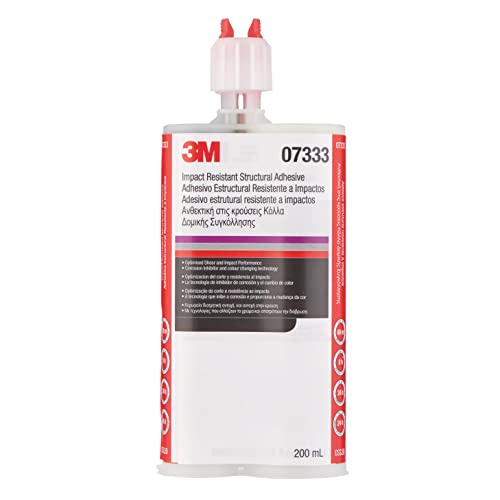
The 3M 07333 is the adhesive that many OEMs specify for structural panel bonding — and for good reason. Its two-part epoxy formulation delivers higher impact strength than standard bonding adhesives, meaning the joint can absorb collision forces without shearing. The paste dispenses as a silver ribbon and changes to purple during curing, giving you a visual confirmation that the chemical reaction is proceeding correctly inside the bond line.
This product was specifically engineered as a welding alternative for steel and aluminum substrates. It provides corrosion protection backed by a lifetime warranty, which is rare in the adhesive world. The 200 mL cartridge is appropriate for one full door skin or a pair of quarter-panel patches, and the high viscosity prevents the epoxy from running down vertical surfaces before it sets.
The main trade-off is the price — this is the single most expensive cartridge on the list. You are paying for the impact resistance rating and the OEM pedigree. For a structural repair like a floor pan replacement or a rocker panel, the cost is justified. For a cosmetic trim piece, a less expensive epoxy will work fine.
Why it’s great
- OEM-specified impact resistance for crash-critical joints
- Color-changing cure indicator removes guesswork
- Grindable and sandable after full 24-hour cure
Good to know
- Requires a compatible pneumatic or manual epoxy dispensing gun
- High per-cartridge cost compared to standard 3M 38315
2. Buck Panel Bonding Adhesive, 400 mL

The Buck Panel Bonding Adhesive is a direct, drop-in replacement for the 3M 08115 epoxy at roughly half the cost per ounce. The math is simple: you get 400 mL of two-part epoxy versus the 200 mL you would get from 3M’s equivalent, and the working time stretches to a very comfortable 45 minutes — long enough to clamp up a complex multi-panel assembly before the epoxy starts to gel.
The formula bonds equally well to steel, aluminum, plastic, and fiberglass. It cures at room temperature with no external heat source required, and the final bond resists water, chemicals, and corrosion. The kit includes three static mixing nozzles, which is generous — most competitors give you one. Reviewers consistently report using this for floorboard replacements in classic Chevys and roof skin swaps on trucks.
The catch is the dispensing gun. A 400 mL cartridge requires a dedicated gun with a longer plunger rod. Standard caulk guns cannot push this volume of epoxy. Buy the gun at the same time or the cartridge sits unused. Also, the epoxy is messy during application — tape off surrounding areas and have lacquer thinner ready for cleanup.
Why it’s great
- 400 mL of product — double the volume of standard 200 mL cartridges
- 45-minute working time gives beginners room to position panels
- OEM-grade strength at a much lower per-milliliter cost
Good to know
- Needs a heavy-duty 400 mL cartridge gun — standard guns won’t work
- Application is messy, requires careful masking and solvent cleanup
3. SEM 39747 Multi-Purpose Panel Adhesive
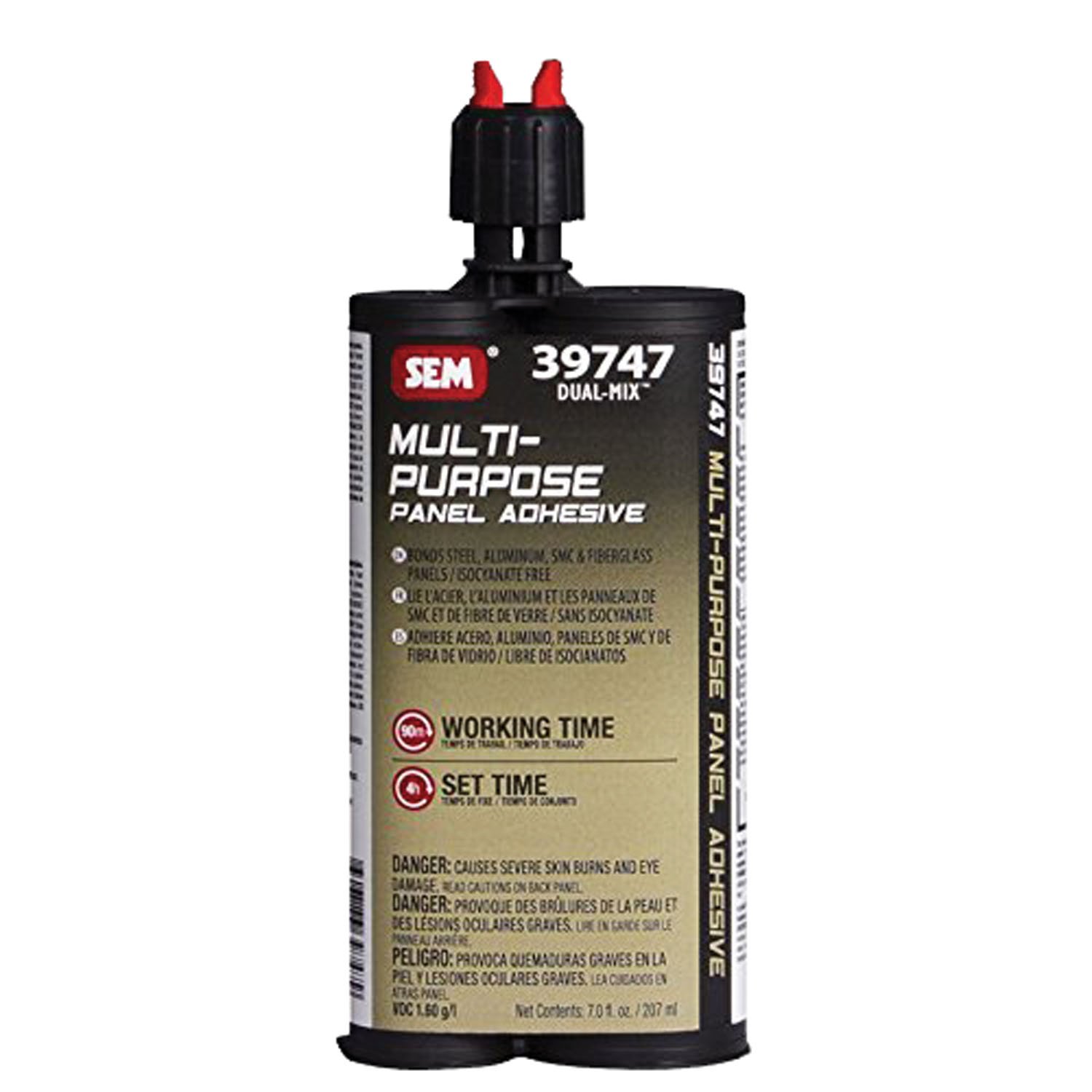
SEM’s 39747 is a different breed from the other entries in this guide. It is a two-component adhesive packaged in a proprietary can-in-bag system rather than a coaxial cartridge. You activate the adhesive by breaking an internal seal and shaking, then dispense it through a supplied nozzle. This system is ideal for smaller repairs — cracked door panels, composite bumpers, and broken headlight brackets — where a full 200 mL cartridge would be wasteful.
The adhesive is thick and non-dripping, which solves one of the biggest frustrations of liquid urethanes: gravity. SEM’s formula stays exactly where you put it, even on vertical plastic trim. The glass microspheres in the mix prevent the bond line from squeezing out under clamp pressure, leaving a clean, strong joint. For interior panel repairs and composite bonding, this is hard to beat.
The downside is the volume. At 7 ounces (about 207 mL), the SEM looks comparable to a 200 mL cartridge, but the dispensing method means you cannot apply it continuously in a bead the way you can with a gun-and-mixing-nozzle system. It works best for spot repairs and small patches rather than full panel skins. It is also a little thinner in consistency than 3M’s 38315, which some experienced techs note affects how far the adhesive stretches.
Why it’s great
- No dispensing gun required — shake-and-squeeze system is tool-free
- Thick, non-sag formula stays put on vertical surfaces
- Glass microspheres prevent squeeze-out for a cleaner bond line
Good to know
- Less continuous application volume than a 200 mL cartridge system
- Thinner viscosity than 3M panel bond, less product per repair
4. Maxi-Bond Panel Bonding Adhesive MB-835
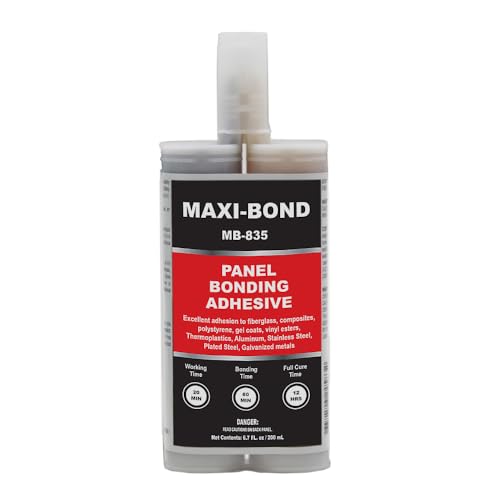
Maxi-Bond’s MB-835 is a thixotropic two-part epoxy that was formulated specifically to stay put on curved body lines. “Non-sag” in adhesive terminology means the paste will not drip or run when applied to a vertical or contoured surface — critical when you are laying a bead along a door edge or a wheel arch.
The 200 mL cartridge bonds steel, aluminum, fiberglass, plastic, and composite materials. It is designed primarily for collision repair shops, so the performance ceiling is high. The thixotropic nature also means you can build up multiple passes on a joint without the adhesive slumping. Reviewers have used it to attach fiberglass fender flares and fill body holes, with results that look like factory work after sanding and painting.
The one thing buyers consistently flag is the dispensing tool. Like most two-part epoxies, the MB-835 requires a manual or pneumatic gun with a 1:1 ratio pusher. If this is a one-time repair, the gun cost can sting. Also, this epoxy has a relatively fast working time — around 10 minutes — so you need to work quickly once the mixing nozzle is attached.
Why it’s great
- Thixotropic, non-sag formula ideal for curved body panels
- Bonds steel, aluminum, fiberglass, plastic, and composites
- Sands and paints cleanly for a factory-finish appearance
Good to know
- Requires a 1:1 ratio epoxy dispensing gun (not included)
- Short 10-minute working time — less forgiving than Buck’s 45 minutes
5. Polymix Metal Panel Bond 60 Adhesive

Polymix Metal Bond 60 is a two-part urethane adhesive purpose-built for attaching quarter panels, roofs, box sides, van sides, and door skins. The primary advantage over epoxy is that urethane remains slightly flexible after curing — this flexibility helps absorb road vibration and thermal expansion without cracking the bond line.
The formula is self-sealing, which means you do not need a separate seam sealer after the bond cures. That saves one entire step in the repair process. Polymix also emphasizes the elimination of welding-related headaches: no burned paint on the backside of the panel, no grinding of spot welds, and no need to disconnect the car’s electronics (a common precaution when MIG welding on modern vehicles).
The 200 mL cartridge includes two mixing nozzles and is compatible with a standard caulking gun. Customer reviews repeatedly mention that this adhesive performs as well as the big-name brands at a friendlier price. The trade-off is the 24-hour full cure time, which is standard for urethane but slower than some fast-acting epoxies that can be handled in 45 minutes.
Why it’s great
- Self-sealing adhesive eliminates the need for a separate seam sealer
- Flexible urethane bond resists vibration and thermal cycling
- Eliminates heat distortion and paint damage from welding
Good to know
- Full structural strength requires 24 hours of undisturbed curing
- Urethane can be more difficult to sand than cured epoxy
6. 3M Panel Bonding Adhesive, 38315

The 3M 38315 is the classic two-part epoxy that has been used in body shops for decades. The 50 mL cartridge is small — about the size of a tube of toothpaste — but it is packed with glass bead technology, which maintains a consistent bond-line thickness when you clamp two panels together. This prevents the joint from becoming glue-starved under pressure.
This adhesive is incredibly aggressive. It grabs immediately upon contact, and it is nearly impossible to slide the mating panels into alignment once the two parts of the epoxy touch. That is great for bond strength, but it means you must have your fitment absolutely perfect before you bring the surfaces together. It works on steel, aluminum, SMC, and fiberglass non-structural components — think door shells, trunk lids, and hood reinforcements.
The 50 mL volume is the biggest limitation. For a full quarter panel, you will need two or three cartridges, which makes the per-project cost add up. The tubes are also tiny, which some buyers find surprising when they unbox. For small repairs like headlight brackets or patch panels, however, this is the stickiest, most reliable epoxy you can buy.
Why it’s great
- Glass bead technology ensures consistent bond-line thickness
- Extremely tacky — grabs instantly for a strong initial hold
- Proven 3M reliability, trusted by body shops for years
Good to know
- 50 mL volume is small — multiple cartridges needed for large panels
- Almost no repositioning time once adhesive makes contact
7. Berkland Polyurethane Windshield Adhesive

The Berkland polyurethane adhesive is a single-component, moisture-curing formula — not a two-part epoxy. That makes it chemically different from the panel bonders above. It is designed for glass-to-metal and glass-to-painted-surface applications, which means it excels at sealing windshields, rear windows, RV windows, and side glass rather than bonding structural body panels.
The adhesive comes as a 2-pack of standard caulking-gun cartridges. No primer is needed for most applications, and the black urethane cures to a flexible, waterproof seal that handles the constant vibration of a vehicle. The included gloves and spreader tool are thoughtful additions that save you a trip to the hardware store. Multiple reviewers report using this to fix leaks around RV windshields and to replace side glass on older SUVs.
Because this is a moisture-cure urethane, it does not offer the shear strength of a two-part epoxy. You cannot use it to weld-replace a door skin or to bond structural floor pans. It is also messy — the uncured adhesive is greasy and migrates onto paint if you are not careful. For glass and trim work, it is an excellent value; for load-bearing panel repairs, you need an epoxy.
Why it’s great
- No primer required — applies directly to clean glass and paint
- 2-pack gives you a spare cartridge for future jobs
- Flexible waterproof seal ideal for RV and windshield applications
Good to know
- Moisture-cure urethane lacks the shear strength of a two-part epoxy
- Not suitable for structural panel bonding or weld replacement
FAQ
Can I use auto body panel adhesive to replace a structural weld?
What is the difference between a 50 mL and a 400 mL cartridge?
Do I need a special gun for two-part epoxy cartridges?
Final Thoughts: The Verdict
For most users, the best auto body panel adhesive winner is the 3M Impact Resistant Structural Adhesive 07333 because it offers OEM-specified impact strength, a visual cure indicator, and a proven track record of replacing welds in crash-critical body seams. If you want maximum product volume and a forgiving 45-minute working time, grab the Buck Panel Bonding Adhesive. And for smaller repairs or composite parts where you do not want to buy a special gun, nothing beats the SEM 39747 Multi-Purpose Panel Adhesive.
Product prices and availability are accurate as of the date/time indicated and are subject to change. Any price and availability information displayed on Amazon at the time of purchase will apply to the purchase of this product. As an Amazon Associate I earn from qualifying purchases.
CERTAIN CONTENT THAT APPEARS ON THIS SITE COMES FROM AMAZON. THIS CONTENT IS PROVIDED "AS IS" AND IS SUBJECT TO CHANGE OR REMOVAL AT ANY TIME.
Amazon and the Amazon logo are trademarks of Amazon.com, Inc. or its affiliates.