
Our readers keep the lights on and my morning glass full of iced black tea. As an Amazon Associate, I earn from qualifying purchases.
Specs are compiled from manufacturer listings and verified buyer reviews and can change over time — please confirm the key details on the product page before buying.
Tracking your blood pressure at home is one of the smartest health moves you can make, but picking the wrong monitor can give you numbers that look fine one day and scary the next — a headache nobody needs. The real difference between a useless box and a tool you can trust depends on accuracy, a cuff that actually fits your arm, and a display you can read without hunting for your glasses.
I’m Min — the founder and writer behind Gadgets Feed. This guide is built by comparing the manufacturers’ published specifications and the patterns across verified customer reviews, so you get each pick’s real strengths and trade-offs instead of marketing spin.
if you need a simple way to keep a daily log or a medical-grade tool with heart-rhythm alerts, this breakdown of the best auto bp monitor will show you exactly which model fits your life and why.
Our Picks at a Glance
How To Choose The Best Auto BP Monitor
Picking the right home blood pressure monitor isn’t about fancy apps or flashy screens — it’s about getting a reading you can trust every single time. Here are the three things that will save you from buying a dud.
Cuff Size is Everything
A cuff that is too small will squeeze your arm too tightly and give you a falsely high reading. A cuff that is too loose will give you a falsely low one. Measure the circumference of your upper arm and compare it to the cuff range listed on the monitor. Many monitors now come with multiple cuffs (small, medium/large, and extra-large) to fit a wider range of arm sizes.
Memory and Multi-User Support
If you are tracking your numbers over weeks, you need a monitor that stores past readings so you don’t have to scribble them in a notebook. Some models store 90 readings, while premium ones can hold 500 per user. If two people in your home need to monitor their pressure, look for a monitor with separate user profiles and enough storage for each of you.
Advanced Detection Features
Some monitors include an irregular heartbeat detector or even Atrial Fibrillation (AFib) detection — a feature that flags a heart rhythm disturbance right after your reading. If you have a history of heart concerns or your doctor has asked you to watch for arrhythmia, these extra alerts make the monitor more than just a pressure tracker.
Quick Comparison
| Model | Best For | Cuff Size Range | Memory Capacity | User Support | Amazon |
|---|---|---|---|---|---|
| iHealth Track Smart★ Best Overall | App-centric tracking | 8.7″ – 16.5″ | 99 readings | 1 user | Amazon |
| OMRON Gold BP5360Pro Grade | Advanced heart monitoring | 9″ – 17″ | Unlimited (app) | 2 users | Amazon |
| Medline Digital | Budget reliability | 8.6″ – 11.8″ | 90 readings per user | 2 users | Amazon |
| Braun ExactFit 2 | Comfort during reading | 8.6″ – 16.5″ | 30 readings | 1 user | Amazon |
| Acenis Automatic | Extra-large color screen | Large adjustable | 2 users | 2 users | Amazon |
| AQESO 3-Cuff | Multiple arm sizes | 7″ – 21″ | 1500 readings | 3 users | Amazon |
| FDA-Cleared URION | Seniors and low light | Adjustable wide range | 199 readings per user | 2 users | Amazon |
In‑Depth Reviews
1. iHealth Track Smart Upper Arm Monitor
Our pick — 4.5★ from 64,500+ verified ratings; the strongest balance of quality and price.
If you prefer to track your blood pressure trends on your smartphone rather than flip through a device’s memory, the iHealth is your best bet.
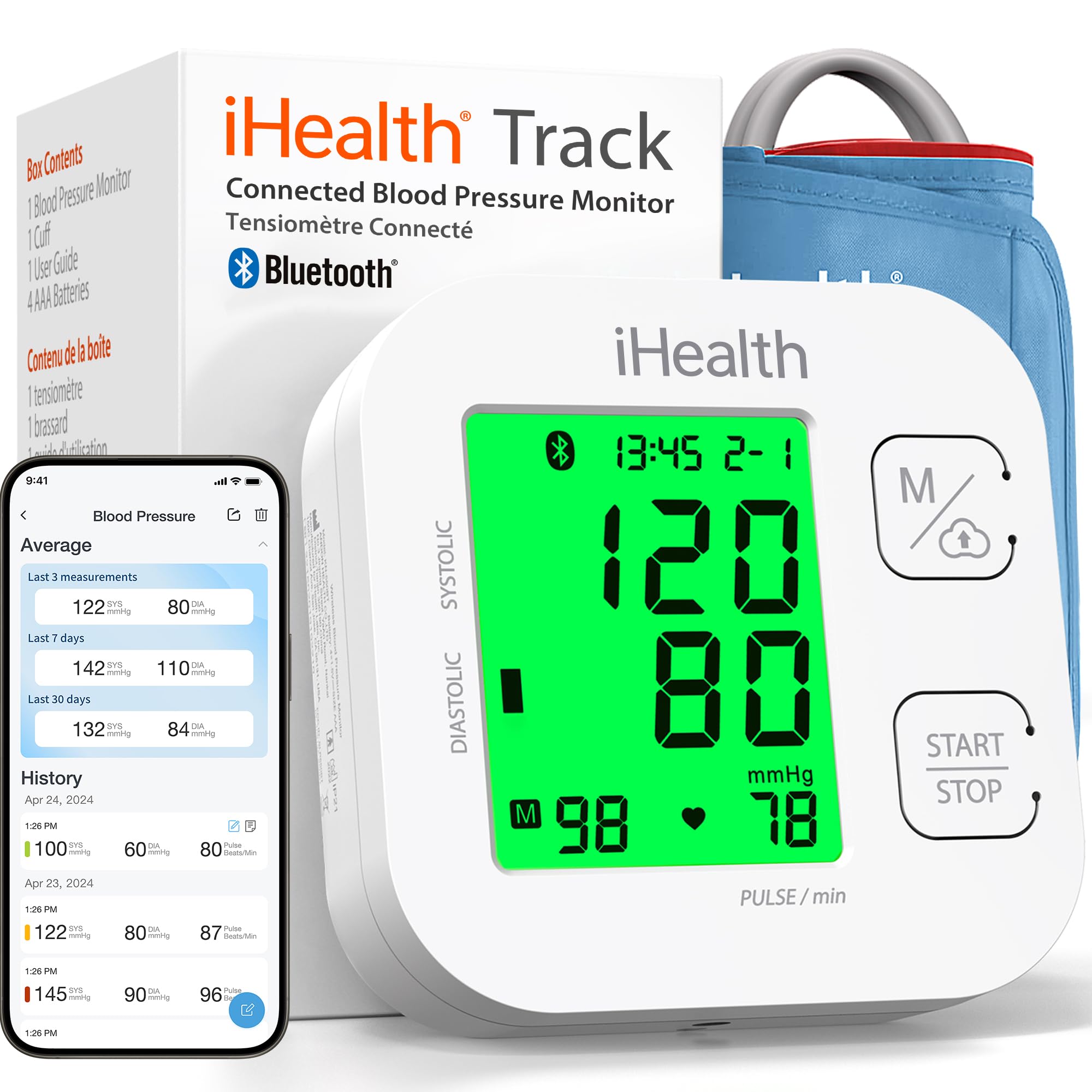
It connects via Bluetooth (a short-range wireless standard) to the free iHealth app (iOS 12.0+ and Android 9.0+ with Bluetooth 4.0) to store unlimited readings. The large multi-color backlit display uses green, yellow, and red coding so you instantly know whether your reading is optimal, improve, or in a danger zone.
It also automatically detects and alerts you to any heart rhythm disturbances, a feature usually found on more expensive monitors like the OMRON Gold. The cuff fits arms with a circumference of 8.7″ to 16.5″. Buyers consistently say this monitor is accurate and works just like the one at the doctor’s office, easy to use, with quick testing and clear reading. One buyer mentioned the cuff is rather large if you have small arms, but still manageable. At only 15.45 ounces (just under 1 pound), it is lighter than the 1.2-pound Braun and much slimmer at 3.9 x 3.9 x 1.6 inches.
No calibration is required, and it meets ESH 2010 performance standards.
Why data-trackers love it
- Bluetooth sync to iHealth app for unlimited storage
- Multi-color backlit display (green/yellow/red)
- Heart rhythm disturbance detection built in
Where it falls short
- Single-user only (no separate profiles)
- Smaller cuffed arms may find the cuff loose
- Cuff must align with artery for accurate readings
Best for: app-savvy users who want automatic data syncing and heart rhythm alerts at a budget-friendly price point.
Not ideal for: households where two people need separate tracking — this monitor supports one user only.
2. OMRON Gold Blood Pressure Monitor (BP5360)
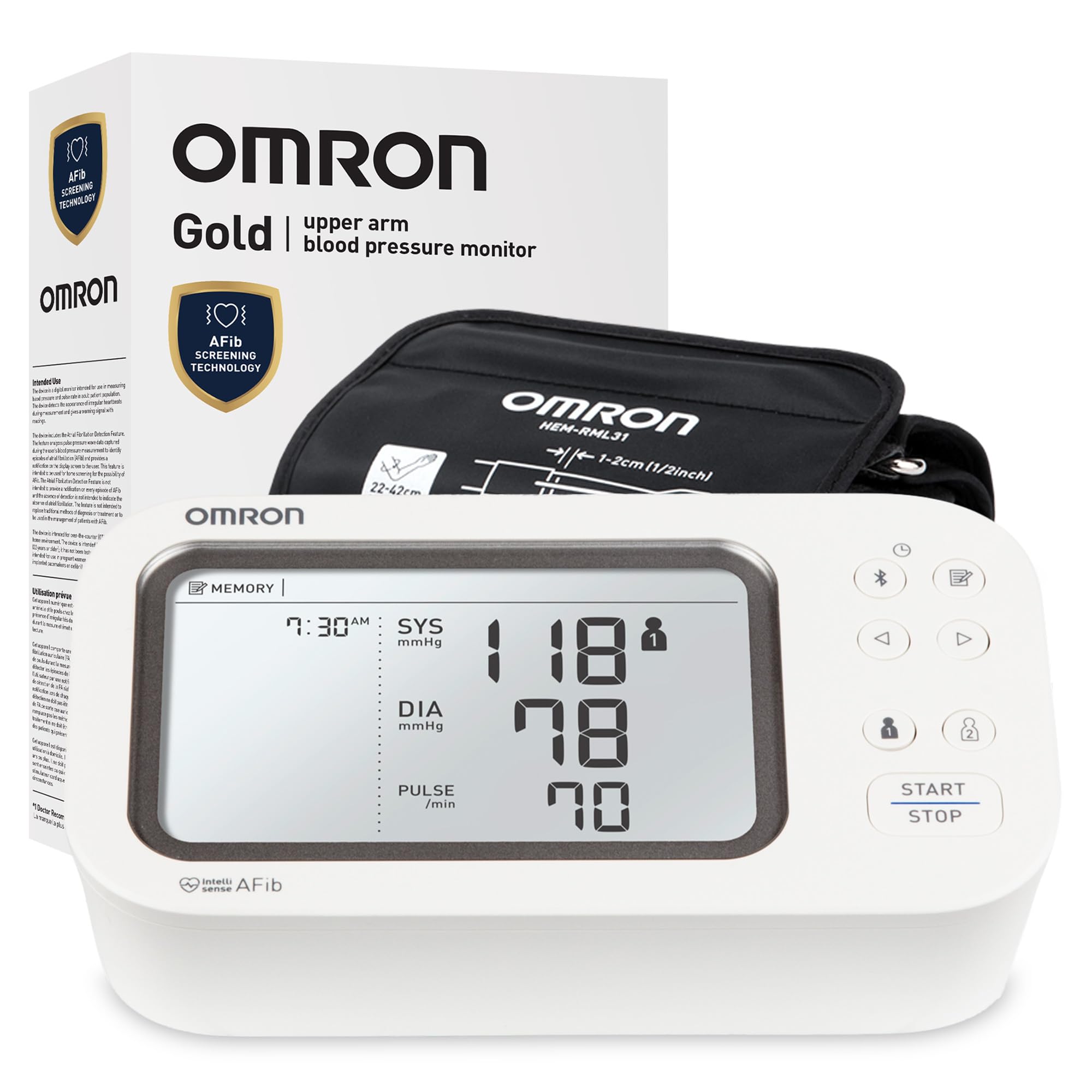
The OMRON Gold BP5360 catches heart-rhythm changes — specifically Atrial Fibrillation (AFib, an irregular heartbeat) — each time you take a reading, which is a feature most models here skip.
OMRON is the #1 doctor and pharmacist recommended brand for blood pressure monitors. The BP5360 uses TruRead technology, which takes three consecutive readings and averages them for a reliable result. It also includes a High Morning Average Indicator that flags early-hour surges linked to cardiovascular risk. You get a wide-range D-ring cuff that fits arms 9″ to 17″, and the free OMRON connect app stores unlimited readings and works with Apple Health and Google Fit.
One reviewer noted that if you already have atrial fibrillation, the device may refuse to give a reading or throw an E2 error, making it less practical for that exact scenario. The app can also be buggy and may delete un-backed-up history. But for anyone with a family history of heart issues who wants professional-level oversight at home, this OMRON leads the list. It is 1.37 pounds compared to the 1.1-pound Acenis below — noticeably heavier but packed with more clinical features.
Reviewers consistently report easy setup and consistent readings. The dual-display screen shows your current and previous reading side by side, so you can see trends instantly without scrolling through menus.
The Heart-Smart Verdict: You should pick this over the AQESO if AFib detection and doctor-shareable data from a brand trusted by medical professionals matter more than multiple cuff sizes.
The One Caveat: If you have diagnosed persistent atrial fibrillation, this monitor may not complete a reading — check with your cardiologist first.
3. AQESO Blood Pressure Machine (3 Cuffs)

The AQESO solves the one-cuff-fits-some problem by including three separate cuffs: a small for arms 7″ to 9″, a medium/large for 9″ to 17″, and an extra-large for 13″ to 21″.
That 7 to 21-inch span covers nearly every adult arm size, so nobody in the house gets left out — unlike the Medline, which tops out at 11.8″. It supports three users with 500 stored readings each (1,500 total), which is more memory than any other pick here except the unlimited-app OMRON.
The large, backlit LCD (liquid-crystal display, a standard screen type) is easy on older eyes, and the WHO classification bar color-codes your reading (green for normal, yellow for improve, orange/red for high) so you know at a glance where you stand. Unlike the iHealth below, the AQESO offers a USB Type-C power option alongside batteries, though it is not rechargeable — you need a continuous USB connection for power. One reviewer noticed the Velcro can wear down fast because it snags the cuff material, and battery life drains quickly if you rely on AAA cells.
Buyers report it works well for people whose arms are too big or too small for standard cuffs, and the included case keeps everything neat for travel.
What makes it a family favorite
- Three cuff sizes cover arms from 7″ to 21″
- Stores 500 readings per user for 3 users (1,500 total)
- Large backlit LCD with WHO color bar
What to watch for
- Velcro fastening can fray over time
- Battery life drains fast with frequent use
- USB power needs a continuous connection (not rechargeable)
Reach for this if: you have multiple family members with different arm sizes who all need to monitor their blood pressure.
Look elsewhere if: you want a rechargeable monitor or prefer a brand name with a bigger clinical track record.
4. FDA-Cleared Upper Arm Blood Pressure Monitor (URION)
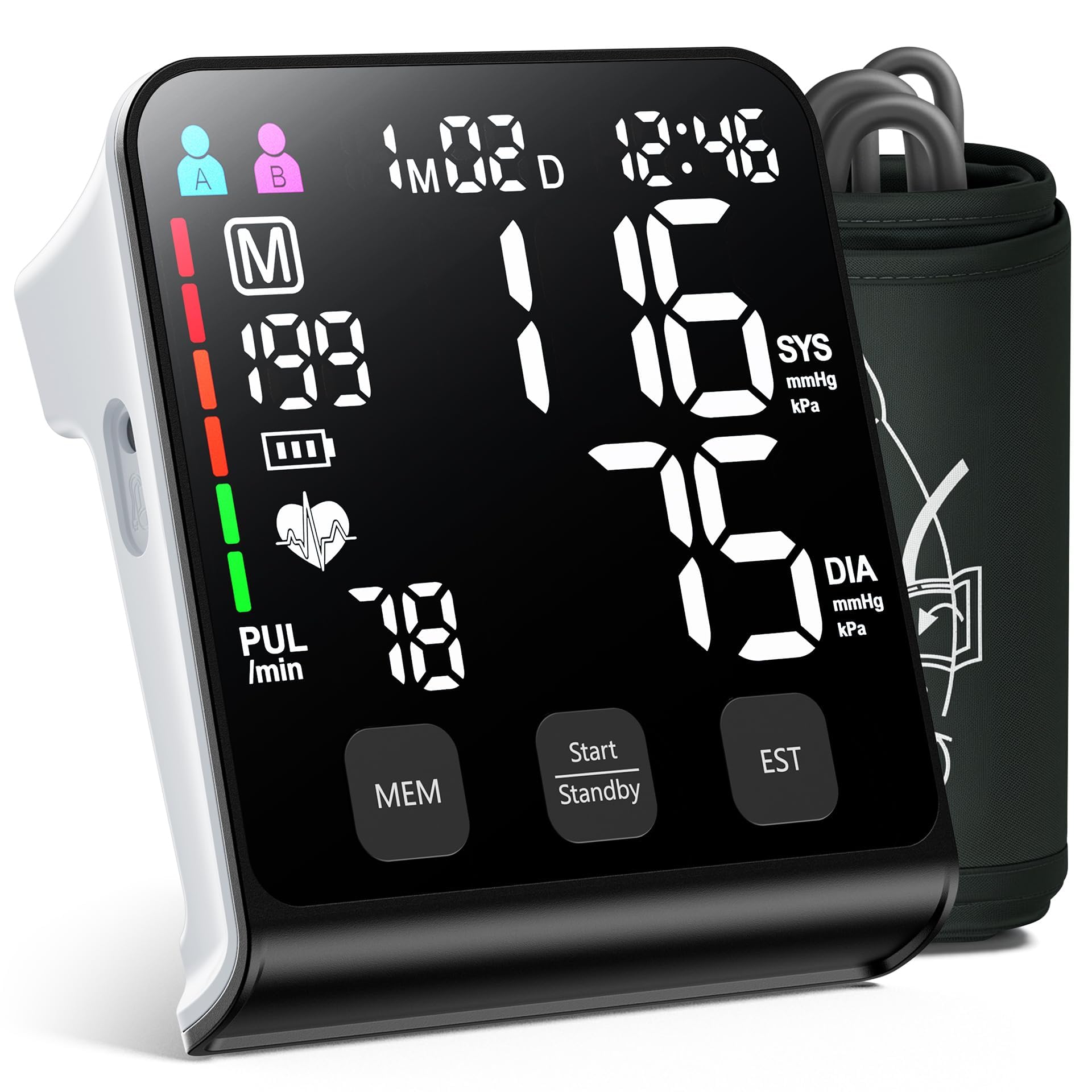
A 4.5-inch LED (light-emitting diode) screen with oversized digits — that is the first thing you notice about this monitor, and for older users or anyone with tired eyes, it makes all the difference.
The reading is displayed in bold numbers with a blood pressure classification indicator, so you know if your systolic (the top number, pressure during a heartbeat) and diastolic (the bottom number, pressure between beats) values fall in a normal, improve, or hypertensive range without memorizing any numbers. The monitor is FDA-cleared (the U.S. Food and Drug Administration has reviewed it for safety and accuracy) and FSA/HSA eligible (you can use pre-tax health dollars to pay for it), which matters if you want to use pre-tax health dollars to cover the cost.
It stores up to 199 readings for two different users, which is a solid amount of memory for a household couple. The adjustable wide-range cuff fits a variety of arm sizes, and the intelligent pressure algorithm claims an error margin of just ≤±3mmHg (meaning the brand says your reading will be off by no more than 3 points in either direction). One-touch operation means you wrap the cuff, press a single button, and get results in seconds. Owners mention it is simple to set up, the backlit screen is easy on the eyes, and readings are consistent and fast. It is 1.28 pounds, a touch heavier than the iHealth but lighter than the OMRON.
One downside: the monitor is not rechargeable — it runs on batteries or USB power (continuous connection required), so you cannot simply plug it in to charge between uses.
The Screen-First Verdict: Ideal for seniors or anyone who struggles with small fonts — the 4.5-inch LED is the clearest display in this lineup, outshining the 3-inch-ish screen on the Medline.
The Catch: No built-in rechargeable battery; you will need to keep AA batteries handy or plug it in via USB every time.
5. Braun ExactFit 2 Blood Pressure Monitor
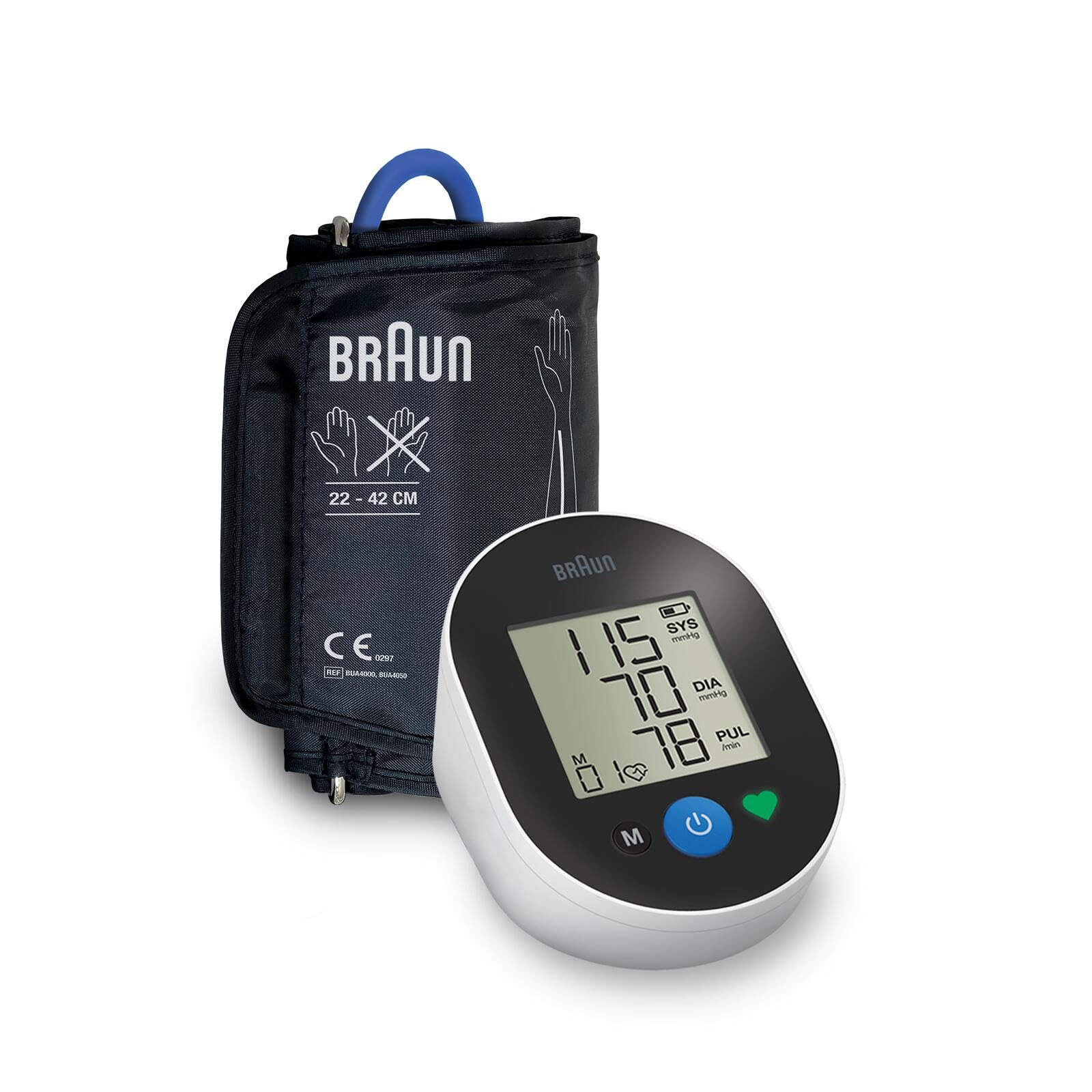
Most blood pressure monitors inflate the cuff first, then release pressure slowly while taking a reading — which can be uncomfortable. The Braun ExactFit 2 works differently: it measures your blood pressure as the cuff inflates, so it stops tightening the moment it gets a clear reading and deflates immediately.
This makes the experience faster and more comfortable, especially for people who find the squeeze unpleasant. The universally-sized cuff fits arms from 8.6″ to 16.5″, covering most adults.
The color-coded indicator instantly shows you whether your systolic and diastolic values are in a healthy range. It is clinically validated following internationally recognized testing protocols. One owner reported they just wish it was backlit for use in a darker room, which is a valid point since the display lacks a backlight — the Acenis and URION monitors below have brighter screens. It stores only 30 readings in memory, which is the smallest capacity in this lineup, and supports a single user. At 1.2 pounds, it is slightly heavier than the iHealth’s 1.1 pounds.
Reviewers find it small enough for travel, easy to use with large numbered display, and accurate with color-coded results.
The Comfort Pick: Great for anyone wincing at the thought of a tight cuff — the inflation-based reading is noticeabley gentler than the standard squeeze of the Medline or AQESO.
The Trade-off: Only 30 memory slots and no backlight, so you will need good lighting to read results at night.
6. Acenis Automatic Blood Pressure Monitor
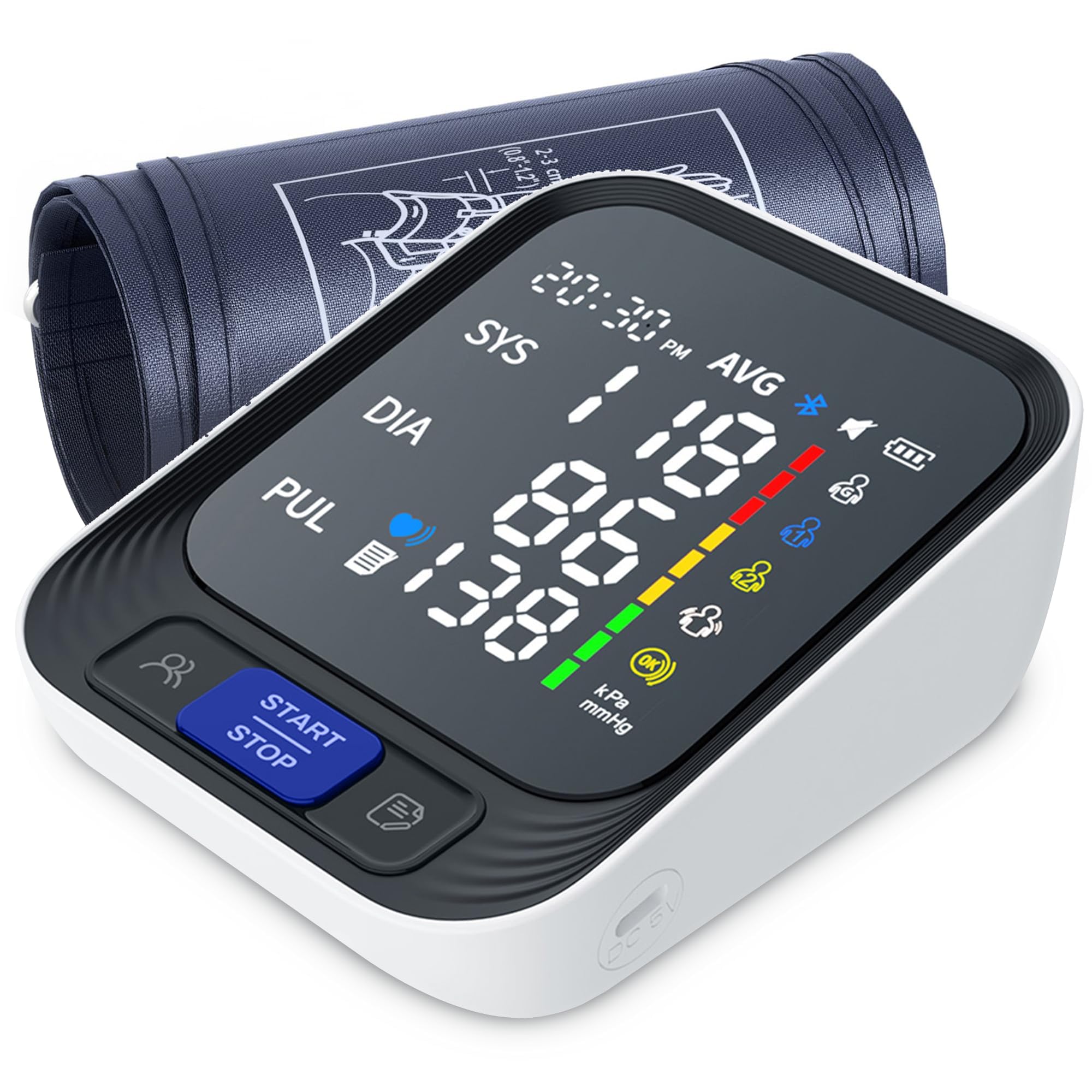
The Acenis screen is specifically designed for seniors or anyone with poor eyesight — the big digits and color interface make it easy to read without squinting, and it weighs only 1.1 pounds.
The large adjustable cuff is meant to provide a snug, comfortable fit for “all shapes and sizes,” which buyers confirm — one customer observed “works well and doesn’t hurt your arm.” It takes about 40 seconds to get a reading.
The Acenis uses oscillometric technology to deliver reproducible results. At 1.1 pounds and 5 x 2.87 x 3.66 inches, it is the lightest and slimmest of the mid-range options here — a full 28% smaller in one dimension than the Braun ExactFit 2. It supports up to three memory slots for different users. However, the manual clock setup is a bit fiddly (one user highlighted they just skipped setting it), and there is no Bluetooth or app connectivity for automatic tracking.
Customers note the display is very good and easy to set up, and the unit is accurate for trending your blood pressure.
Why it punches above its weight
- Large color screen that is genuinely senior-friendly
- Extra-comfortable XL cuff that doesn’t pinch
- Tracks up to two users with individual memory
Small compromises
- No backlight on the display
- No Bluetooth or app for data sharing
- Clock setup is less intuitive than the rest
The Budget-Friendly Verdict: A solid, no-frills monitor ideal for seniors who just need a big clear screen and comfortable cuff without paying for smartphone integration.
skip it if: you need Bluetooth tracking or prefer a brand with a longer clinical history in the medical space.
7. Medline Digital Blood Pressure Monitor

Medline is a trusted name in hospital and clinical supplies, and this digital monitor brings that same medical-quality approach to your home — one shopper added that an off-brand monitor consistently read lower, while the Medline matched their doctor’s office.
That is a crucial difference when you are making health decisions based on those numbers. It stores up to 90 measurements for two separate users, so a couple can track their data independently.
The adult cuff fits arms from 8.6″ to 11.8″ (22-30cm), which is a narrower range than the iHealth or AQESO — if your arm is larger than 11.8 inches, you will need to look at one of the picks with a wider cuff. The large digital LCD (liquid-crystal display) shows systolic and diastolic blood pressure plus pulse rate, with a colored scale beside the display to help interpret results. Advanced error detection prevents inaccurate readings if the cuff is placed wrong or moved. It runs on 4 included AA batteries and comes with a 1-year warranty.
Reviewers call it easy to use, dependable, and a good deal for the money, with good battery life compared to other budget monitors they had tried.
The Trusted Basic Pick: Perfect for someone who wants a no-app, no-fuss monitor from a company healthcare providers actually use. If your arm measures over 11.8″, the AQESO is a better fit.
The Limitation: Cuff only fits arms up to 11.8″ — larger arms will need a different model with a wider cuff range.
Understanding the Specs
Cuff Fit and Measurement
The cuff is the most important part of any blood pressure monitor. If it is too tight, your reading will be falsely high; if it is too loose, falsely low. Measure the circumference of your upper arm (midway between your elbow and shoulder) before buying, and match it to the monitor’s listed cuff range. Monitors with multiple cuffs, like the AQESO with three sizes covering 7″ to 21″, give you the best chance of a perfect fit for everyone in your home.
Memory Capacity and Multi-User Support
Tracking your blood pressure over time is how you spot real trends — a single reading is just a snapshot. Look for a monitor that stores at least 90 readings per user. Models with dual-user profiles, like the Medline and OMRON Gold, let two people track separately without mixing up data. The AQESO goes further with 500 readings per user for three people. If you want to share data with your doctor, Bluetooth models like the iHealth and OMRON can export your history directly to a smartphone app.
FAQ
How do I know if a blood pressure monitor is accurate enough for home use?
Can I use a wrist blood pressure monitor instead of an upper arm monitor?
What does the WHO color classification bar mean on blood pressure monitors?
Is it normal for my blood pressure reading to change between two back-to-back measurements?
How do I clean and maintain my blood pressure monitor cuff?
Does the Braun ExactFit 2 really measure during inflation?
Can I use an FSA or HSA card to buy a blood pressure monitor?
What does an irregular heartbeat alert mean on a blood pressure monitor?
Final Thoughts: The Verdict
Across the board, the best auto bp monitor winner is the OMRON Gold BP5360 because it combines AFib detection, unlimited app storage, TruRead averaging, and the most trusted brand name in the category into one polished package. If you want a monitor that fits every arm in the house and stores a mountain of data, grab the AQESO 3-Cuff. And for the sharpest screen for seniors at the most approachable price, the Acenis Automatic is a great choice.
How We Picked
We do not accept paid placement. Every pick is matched to a real buyer and a real use-case; we do not hands-on test units.
Sources & Methodology
Specifications: manufacturer listings and product documentation. Review insights: verified customer reviews, as of July 2026. Pricing: not shown on this page (it changes often); check the current price via the retailer link.
As an Amazon Associate, Gadgets Feed earns from qualifying purchases. This does not affect which products we feature.