
Our readers keep the lights on and my morning glass full of iced black tea. As an Amazon Associate, I earn from qualifying purchases.
Specs are compiled from manufacturer listings and verified buyer reviews and can change over time — please confirm the key details on the product page before buying.
Soft brake pedal, trapped air, and no second person to pump the pedal while you crack the bleeder screw — that is the exact frustration that drives you here. This guide ranks the best auto brake bleeders for solo use, from pneumatic shop tools to compact hand pumps. We break down the two main styles — vacuum and pressure — and tell you which one fits your compressor (or lack of one) and your skill level.
I’m Min — the founder and writer behind Gadgets Feed. This guide is built by comparing the manufacturers’ published specifications and the patterns across verified customer reviews, so you get each pick’s real strengths and trade-offs instead of marketing spin.
Whether you’re a pro or a weekend DIYer, this breakdown helps you pick the right one-person brake bleeder the first time.
Our Picks at a Glance


How To Choose The Best Auto Brake Bleeder
You use a brake bleeder to pull old fluid out of your brake lines or push new fluid in, which forces trapped air out with it. Your best pick depends on whether you own an air compressor, which vehicles you drive, and if you value speed over simplicity.
Vacuum vs. Pressure Bleeders
A vacuum bleeder sucks fluid out through the bleeder screw, which is great for quick flushes but can pull air past the screw threads if you don’t seal them. A pressure bleeder pushes fresh fluid from the master cylinder down through the whole system, which is gentler on ABS modules and often the preferred method for European and modern cars because it moves a larger, steadier volume.
Pneumatic vs. Manual Operation
Pneumatic bleeders run off your air compressor and pull fluid continuously, so they are fast and ideal for shops or frequent DIYers. Manual hand pumps need no compressor and work anywhere, but they demand steady pumping and move less fluid per stroke, which makes them slower and more tiring on a full system flush.
Reservoir Size and Adapter Fit
A larger fluid reservoir capacity lets you pull more old fluid before you must empty and refill it, so you face fewer interruptions. The adapter fit is the make-or-break detail: pressure bleeders need a cap that seals your exact master cylinder, while vacuum kits use cone adapters that grip the bleeder screw, so check the included sizes against your vehicle before you buy.
Quick Comparison
| Model | Best For | Method | Reservoir | Weight | Amazon |
|---|---|---|---|---|---|
| Mityvac MV6830★ Best Overall | Shop-grade speed | Pneumatic Vacuum | 1.9 Qt | 2.1 lb | Amazon |
| EWK 22-PieceBest Value | Versatile pneumatic kit | Pneumatic Vacuum | 2 L | 2.91 lb | Amazon |
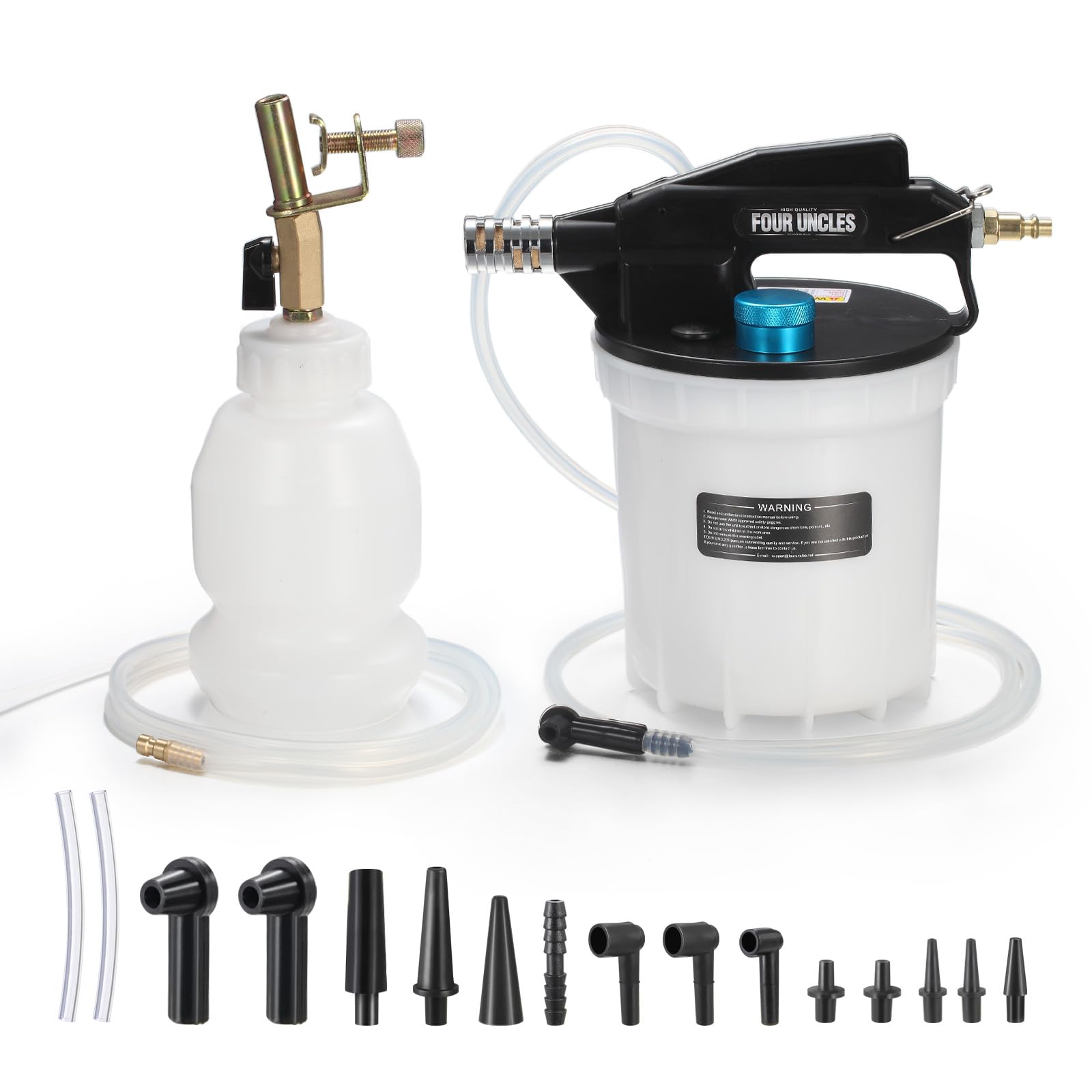
| FOUR UNCLES 2LAlso Great | Quiet shop use | Pneumatic Vacuum | 2 L | 4.09 lb | Amazon |
| OMT 2-in-1 Kit | Brake job all-in-one | Manual Vacuum | — | 8.32 lb | Amazon |
| Wzyblixo 2L | Budget pneumatic | Pneumatic Vacuum | 2 L | 3.96 lb | Amazon |
| DURATECH 3L | Large capacity value | Pneumatic Vacuum | 3 L | 4.6 lb | Amazon |
| SMOTIVEPRO 2L | Pressure bleeding fit | Manual Pressure | 2 L | 3.75 lb | Amazon |
| OMT 2.5L Pressure | Ford/Nissan pressure | Manual Pressure | 2.5 L | 3.09 lb | Amazon |
| Performance Tool W87030 | Budget diagnosis | Manual Vacuum | — | 1.3 lb | Amazon |
In‑Depth Reviews
1. Mityvac MV6830 Pneumatic Brake and Clutch Bleeding Kit
Our pick — over 4.5★ from 250+ verified ratings; the strongest balance of quality and price.
The air-powered vacuum unit that turns a two-person chore into a 15-minute solo job.
This is the tool that convinced seasoned techs and track-day owners alike. The pneumatic design sips from a 1.9-quart reservoir and moves fluid at 2 quarts per minute — you’re bleeding a full corner before a helper would even find the pedal. Because it sucks fluid out rather than pushing it, there’s no electric pump to worry about, which makes it safe around flammable fluids like gas when you repurpose it for tank draining.
Refinements like a variable thumb throttle, automatic shutoff valve, and 360-degree swivel air inlet show real engineering intent. A variable control thumb throttle on the handle lets you dial suction precisely, the automatic shutoff valve stops the reservoir from overfilling so you can run it hands-free, and the 360-degree swivel air inlet keeps the hose from binding in tight wheel wells. Buyers report it “bled Mini Cooper clutch in ~5 min solo, no air bubbles” — a level of speed and cleanliness that encourages you to actually flush that three-year-old fluid more often.
The one honest requirement: this is a pneumatic tool, so it needs an air compressor. Reports note it runs fine on 50 psi with a small compressor, but you’ll want around 4.5 cfm of flow to keep it happy. The build is thick, durable plastic that has survived professional use.
What Owners Rave About
- Quality and function are the two most-praised points by far — this is a pro-grade unit, not a toy
- Complete kit includes hoses, tips, auto-refill kit, and bench base
- Works without master cylinder adapters, so it fits nearly anything
Know Before You Buy
- Requires a compressor — not for pure hand-tool owners
- A few units arrive with a minor air-line leak that needs snugging
Reach for this if: you bleed brakes more than once a season and want speed without risking your ABS module’s internals.
Look elsewhere if: you don’t own an air compressor and have no plans to get one.
2. EWK 22-Piece Pneumatic Brake Fluid Bleeder Kit
A budget-friendly pneumatic kit that a 36-year pro bought for a stubborn truck.
This kit earns its place with sheer usefulness: 17 adapters and two hoses cover cars, motorcycles, trucks, and ABS systems. The 22-piece set bundles 17 adapters and two hoses so it covers cars, motorcycles, trucks, and ABS systems — you’re not hunting for a missing fitting mid-job. Vacuum suction runs up to 0.5L per minute, which is enough speed for a home mechanic prepping for a track day or just doing a yearly flush.
It won over a professional mechanic with 36 years of experience who — after hours of trying the two-person method on one stubborn truck — found this was the only thing that finally got pressure back. The check valve system prevents fluid backflow, so you skip the soaked rags and stained floors that normally come with the job.
There is a learning curve though. Ease of use gets mixed feedback — owners note it takes practice and some research to get the technique right, and a few hit air-intake or fitting issues when setup wasn’t perfect. Running it around 50 psi on a Honda Civic ABS bleed did the trick after opening bleeder screws 3/4 of a turn or more.
You’ll need an air compressor to run it, but the quality and bleed performance are exactly what owners praise most.
Why it wins: the sheer adapter count means one kit handles your whole fleet, and the quality/bled-performance combo justifies the low cost for a pneumatic tool.
The catch: expect a short practice session before you nail the airflow technique — this one rewards patience.
Pick it if: you want shop-level speed on a budget and already own a compressor.
Think twice if: you want a grab-and-go tool with zero learning curve.
3. FOUR UNCLES 2L Vacuum Brake Bleeder Pump Kit
The pneumatic bleeder with a built-in silencer that won’t yell back at you.
Owners single out functionality most here, and with good reason: the pneumatic vacuum pulls a strong, consistent draw through a 2L tank. The pneumatic vacuum system pulls a strong, consistent draw through a 2L tank, and the adjustable thumb throttle gives you precise control so you don’t suck air past the threads. One owner was so skeptical they said “no way this will work” — then flushed the entire system in one sitting because it was that easy.
This kit is built for the workshop floor. The integrated silencer cuts operating noise while keeping vacuum efficiency, which matters if you bleed cars all day. The 16 adapters cover more fitting sizes across cars, trucks, motorcycles, UTVs, and ATVs, and the two 60-inch silicone hoses reach awkward bleed points without you contorting around the wheel well.
The crowd favorite — roughly 4.3 stars across 500+ owners — lands here because it balances professional-grade performance with approachable design. A shop using it multiple times daily reports it holds up perfectly. The main durability note is an occasional quick-connect coupling that failed after storage, though the company’s customer service reportedly made it right.
Why People Love It
- Functionality and quality lead owner feedback — strong vacuum, no leaks, firm pedal results
- One-person full flush in under 30 minutes per vehicle
- Quieter than typical pneumatic bleeders thanks to the silencer
Fair Warning
- Air-flow and connectivity complaints exist for some units with fitting issues
- Quick-connect coupling can fail after a long storage period
The verdict: the best overall pick for DIYers who want pneumatic speed without the jet-engine noise.
Who skips it: anyone without a compressor — this stays grounded without one.
4. OMT 2-in-1 Brake Caliper Compression Tool and Vacuum Pump Bleeder Kit
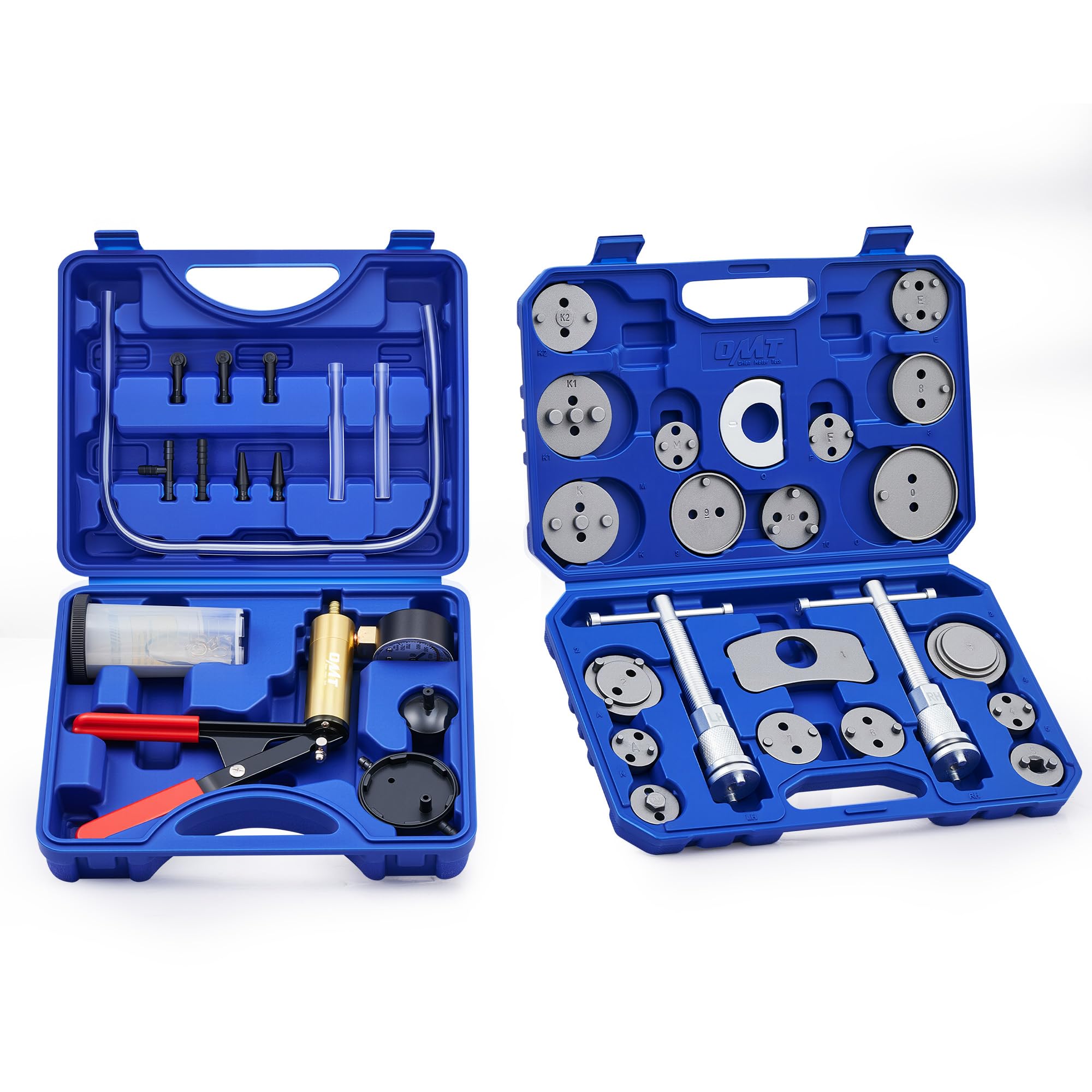
A manual bleeder and caliper rewind tool that covers the entire brake job in one box.
Most bleeders only bleed, but if you’re replacing pads this kit does both halves of the job. The comprehensive set pairs a one-person handheld vacuum bleeder with a disc brake pad service tool with magnetic thrust bolts, so you can compress the caliper piston, swap the pads, and bleed the system without buying a second tool. It handled a Ford Ranger pickup without drama.
The kit brings 18 adapters to fit a wide range of makes and models for the caliper side, while the vacuum bleeder handles cars, trucks, and motorcycles. At 8.32 pounds it’s the heaviest pick here by a wide margin — the caliper tool brings real metal — but that weight translates to the sturdy, corrosion-resistant build owners describe as designed to last for years. Both the bleed pump and the compression/rewind kit set up quickly and work as expected.
Quality is the consistent theme across owner feedback — sturdy, durable, well-made, and performs exactly as expected. If you’re a DIY enthusiast doing your own pad-and-rotor jobs, this collapses multiple tools into one purchase.
The whole-job angle: bleeding and caliper compression in one kit means fewer tool purchases and a smoother workflow start to finish.
The honest limit: this is a manual vacuum pump, so expect slower full-system flushes than air-powered options.
Grab it if: you’re doing complete brake jobs — pads, rotors, and fluid — and want one toolkit.
Pass if: you only need a quick fluid flush and don’t want to haul 8.32 pounds around.
5. Wzyblixo 2L Vacuum Brake Bleeder Kit

A solid, affordable pneumatic bleeder that paid for itself after one boat trailer brake job.
The value case is strong: owners mention this paid for itself in a single use. Customers note this one paid for itself in a single use — a claim backed by the quality-focused feedback that dominates the review pool. The large 2-liter collection reservoir holds plenty of old fluid, and the included automatic master cylinder filling kit with its own 1-liter cup handles the refill side, so one person can run the whole flush solo.
This is the rare pneumatic kit that fits shop compressor fittings without modification and includes a wide spread of 21 adapters plus a 60-inch silicone hose with a universal rubber adapter. One owner bled freshly-installed boat trailer brake lines alone without a second pair of hands — exactly the scenario this tool was built for. The variable thumb throttle keeps airflow at a steady 2 cfm, and a fixing ring lock lets it run continuously without you holding the trigger.
The ABS-material construction is durable, and a 40-inch extension tube reaches further for awkward master cylinder positions. It’s a straightforward, no-frills tool that gets the job done and leaves no air in the system.
What wins people over: quality and value-for-money lead the feedback — it works as designed, every time.
The trade-off: fewer owners have stress-tested it over years, so long-term durability is less proven than the pricier Mityvac.
Choose it if: you want a capable pneumatic bleeder without spending flagship money.
skip it if: you need the proven track record of a decades-established brand.
6. DURATECH 3L Pneumatic Brake Bleeder Kit

The biggest reservoir in the budget tier so you extract a full system in one go.
Capacity is the headline: the 3L vacuum tank is the largest in this comparison. The 3L vacuum tank is the largest in this comparison, which means you pull the entire old fluid volume before you need to empty — no mid-job juggling. Functionality leads owner feedback, with one professional C-tech noting the tool essentially “paid for itself” doing brake flushes.
Where it beats bigger-name tool-truck gear is price and versatility. Owners have used it not just for brakes but as an excellent fluid extractor that successfully pulls power steering, transmission fluid, engine oil, coolant, and gas. It ships with both American and European air couplers for broader compressor compatibility, plus rubber work gloves. Multiple bleed screw adapters fit small cars, SUVs, light trucks, and motorcycles without needing specialized master cylinder caps.
Set expectations on airflow, though. The pump is happy on a small compressor at 15-20 lb, but for a full flush you’ll want serious volume — one owner ran a 150 psi compressor at 140 psi hose pressure dropping to 90. Teflon tape on drum cylinder threads prevents air leaks. The recurring durability gripe is a connector that can stick after a couple uses.
What Stands Out
- Functionality and quality are the top owner themes — it does the job cleanly
- 3L capacity means fewer stops on full fluid replacement
- Doubles as a multi-fluid extractor for shop use
What You Give Up
- At 4.6 pounds it’s the heaviest vacuum unit here — 3.5x the hand pump’s 1.3 lb
- Air-demanding — needs a high-volume compressor for best results
- Occasional connector failure after 1-2 uses
Buy it for: budget-conscious DIYers who want maximum fluid capacity and multi-system versatility.
Be aware: this one wants a real compressor — don’t pair it with a puny pancake unit and expect full power.
7. SMOTIVEPRO 2L Manual Brake Bleeder Kit
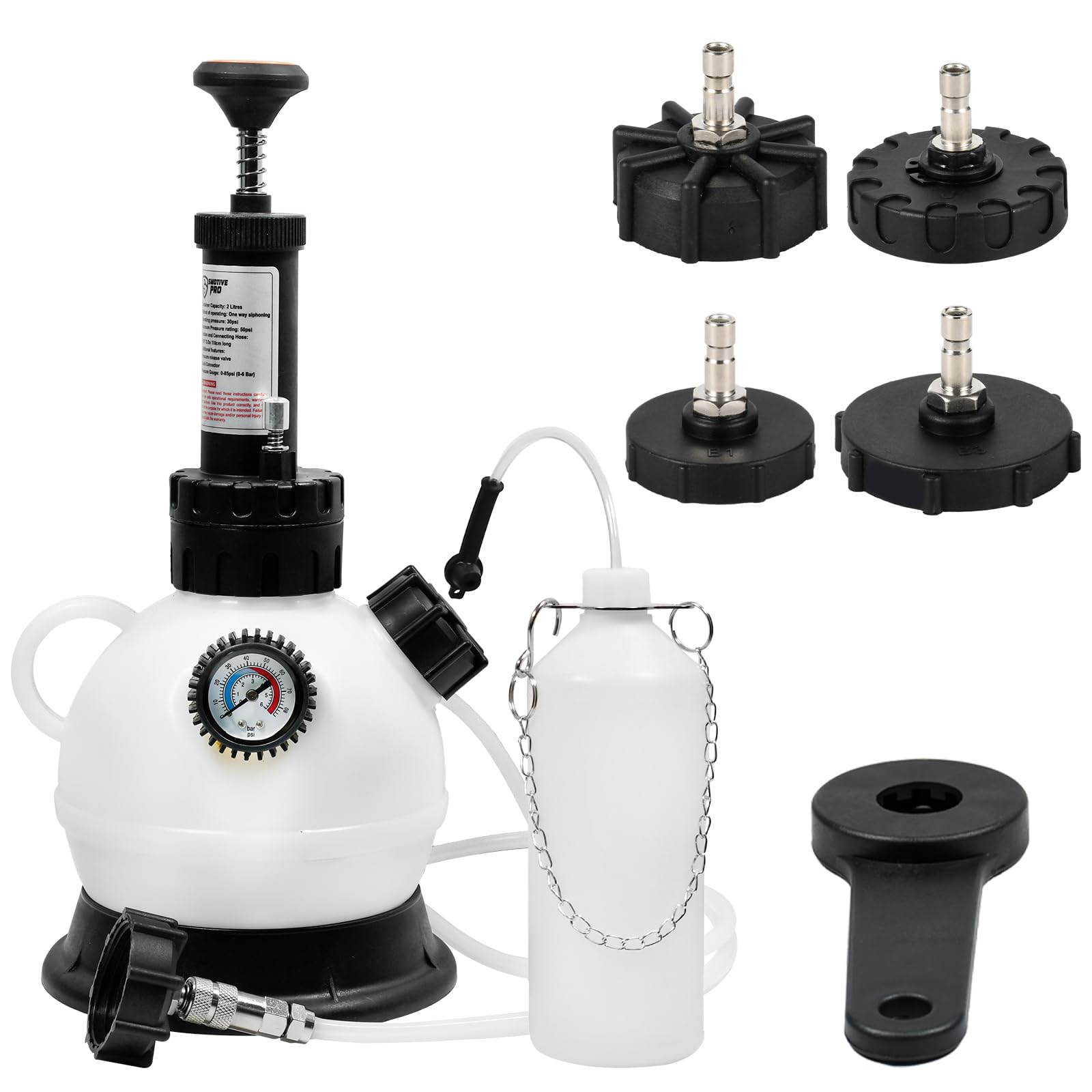
A manual pressure bleeder with four OEM-style caps that European owners swear by.
This is the pressure-bleeding route done right: it pushes fresh fluid from a 2L pressurized tank down through the master cylinder. Instead of pulling fluid from the bleeder screw, it pushes fresh fluid from a 2L pressurized tank down through the master cylinder and out, which is the gentler, more complete method for ABS-equipped modern cars. The 4 included adapters — E20 for BMW/Mercedes/Audi/VW, J for Ford/Dodge/Nissan/Honda/Subaru/Hyundai, B1 for Chrysler/Dodge/Jeep, and B3 for GM/Chevy/GMC — give real OEM-style sealing rather than generic cones.
The proof is in the bleeding. Owners have used it flawlessly on a 981 Porsche Boxster and a 2007 BMW Z4, held pressure well, and cleared a 2001 Chevy Suburban after master cylinder and hose replacement. One MGB owner bled clutch hydraulics in under 10 minutes. Functionality is the most-praised aspect by a wide margin, followed by quality and ease of use.
The honest caveat: quick-connect fittings here are proprietary, not universal, which means the included caps may not swap onto another brand’s adapter. Some reviewers point out universal caps failing to seal and needing to DIY an adapter from an old reservoir cap. Check your exact master cylinder against the four included sizes before ordering.
The Pressure Advantage
- Functionality and quality dominate owner feedback — held pressure, removed air pockets, dark fluid gone
- Built-in pressure gauge and safety relief valve prevent over-pressurization
- 2L refill tank plus 1L waste bottle completes most fluid jobs in one go
The Fit Caveat
- Quick-connect fittings are proprietary, not cross-compatible with other kits
- Adapter fit gets mixed reviews — only four caps included, and universal seals can fail
Best for: European and Asian car owners who want a true pressure bleed without the Motive price tag.
Not for: those with rare or older master cylinders not covered by the four included cap sizes.
8. OMT 2.5L Pressure Brake Bleeder Kit
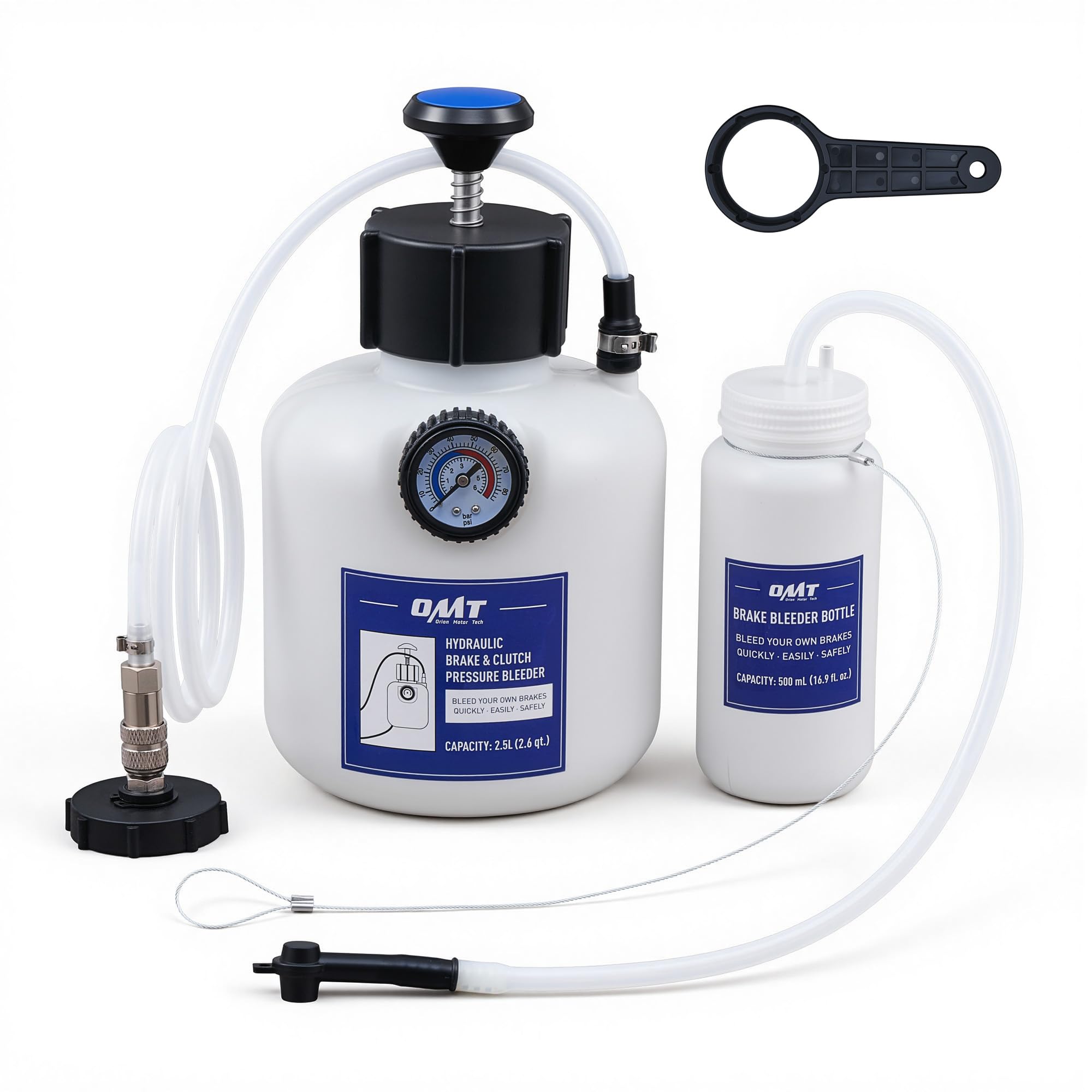
A pressure bleeder purpose-built for Ford, Nissan, and Subaru master cylinders with a 2.5L tank.
This one targets a specific audience with a specific cap. The included 50.7mm (2″) adapter makes it compatible with most Ford vehicles plus Nissan, Infinity, Mitsubishi, Subaru, Kia, and Hyundai — and owners confirmed a perfect fit on a 1991 Ford Explorer and a 2015 Nissan Rogue. If that’s your driveway, this is the rare bleeder that seals to your actual reservoir.
The 2.5L reservoir is genuinely large — enough to service an entire brake system in one go with the 500mL bleeder bottle catching the waste. A former aircraft mechanic praised the consistent pressure and firm pedal results, completing a full flush in under 30 minutes. The polyethylene bottle and silicone hoses resist heat, wear, and chemical corrosion for a long service life.
Pressure retention is the mixed bag here. Many shoppers say perfect sealing and no leaks, but leakage is also the most-cited negative — a cap that can leak if not pushed down firmly toward the master cylinder, and the lack of a quick-release valve makes depressurizing awkward. One owner had the cap blow off entirely, so seat it carefully and never exceed 10 PSI.
Why it’s a specialist: the exact 50.7mm adapter fit makes it a drop-in solution for Ford/Nissan/Subaru families — no rigging required.
The reliability question: quality is praised but pressure retention is inconsistent — some units seal perfectly, others need a firm hand and careful seating.
Reach for it: if you own a Ford, Nissan, or Subaru and want a one-person pressure flush in one fill.
Be cautious if: you’re outside that adapter range — universal caps here are the weak point.
9. Performance Tool W87030 Hand Vacuum Pump Brake Bleeder Kit

The featherweight 1.3-pound hand pump that needs no compressor and doubles as a diagnostic tool.
This is the grab-and-go option for the occasional DIYer. At just 1.3 pounds — the lightest pick here by a wide margin versus the 4.6-pound DURATECH — it’s small enough to live in a drawer and pull out twice a year. The hand pump develops and holds up to 25 inches of mercury vacuum, and the built-in gauge scales in Inches of Mercury for accurate brake bleeding and general automotive vacuum testing.
It’s genuinely dual-purpose. Beyond bleeding, the kit tests and diagnoses vacuum-actuated parts on any vehicle — owners have used it to check vacuum-powered 4-wheel-drive systems. The included hose and multiple adapters fit most applications, with one owner successfully replacing a 40-year-old Mityvac with this unit and finding it pulled and held vacuum well after proper lubrication.
The honest trade-off at this price: pumping takes effort. As one owner put it, it “requires an excessive amount of pumping to pull a decent amount of vacuum,” and durability is the biggest concern — the handle is the weak point for owners who push it hard. This is best for occasional fluid top-offs and vacuum testing, not full-system flushes on a busy schedule.
The Budget Angle
- Serves double duty as a brake bleeder and a vacuum diagnostic gauge tool
- No air compressor needed — works anywhere, stores anywhere
- Multiple adapters included cover most hose sizes
The Effort Cost
- Manual pumping to reach good vacuum is slow and tiring on full flushes
- Durability is the biggest concern — the handle can break under heavy use
Who it’s for: the one-car owner who wants a cheap, no-compressor tool for occasional bleeding and vacuum testing.
Who it’s not for: anyone flushing brakes more than a couple times a year — step up to pneumatic.
Understanding the Specs
Pneumatic vs. Manual Operation
Pneumatic bleeders connect to your air compressor and pull fluid continuously, which makes them fast and hands-free — but they’re useless without a compressor that has enough airflow (measured in cfm, or cubic feet per minute). Manual bleeders run on your own arm power: they need no compressor and work anywhere, but you pump by hand and move less fluid per stroke. Choose pneumatic for speed and volume; choose manual for portability and simplicity.
Reservoir Capacity
This is the tank that holds the old fluid you extract (on vacuum kits) or the fresh fluid you push in (on pressure kits). A larger reservoir like 2L to 3L means you can finish most full-system jobs without stopping to empty or refill, while smaller 1-quart units force more interruptions. If you flush multiple vehicles or big trucks, size up; if you only top off one car, a smaller tank is fine.
FAQ
What is the difference between a vacuum and a pressure brake bleeder?
Do I need an air compressor to use a pneumatic brake bleeder?
Will a pressure bleeder fit my car’s master cylinder?
Can one person really bleed brakes with these tools?
Is manual pumping very tiring compared to pneumatic operation?
Can I use a brake bleeder to extract other fluids?
What PSI should I use with a pneumatic brake bleeder?
How do I stop air from getting sucked in around the bleeder screw?
Final Thoughts: The Verdict
For most people, the auto brake bleeder winner is the Mityvac MV6830 because its air-powered speed, automatic shutoff, and professional build quality make solo bleeding genuinely easy. If you want the best blend of price and versatility for a home shop, grab the EWK 22-Piece, and for European and Asian cars needing a true pressure bleed, the SMOTIVEPRO is the one to reach for.
How We Picked
We do not accept paid placement. Every pick is matched to a real buyer and a real use-case; we do not hands-on test units.
Sources & Methodology
Specifications: manufacturer listings and product documentation. Review insights: verified customer reviews, as of September 2026. Pricing: not shown on this page (it changes often); check the current price via the retailer link.
As an Amazon Associate, Gadgets Feed earns from qualifying purchases. This does not affect which products we feature.