
Our readers keep the lights on and my morning glass full of iced black tea. As an Amazon Associate, I earn from qualifying purchases.
Specs are compiled from manufacturer listings and verified buyer reviews and can change over time — please confirm the key details on the product page before buying.
You want a car charger that actually keeps up with your phone, not one that barely nudges the battery bar while you drive. The short answer: the Anker 320 24W is the safest all-round buy for most people, and the UGREEN 130W is the one to get if you need to run a laptop from your cigarette socket. Everything below explains why, and which one fits your dashboard.
I’m Min — the founder and writer behind Gadgets Feed. This guide is built by comparing the manufacturers’ published specifications and the patterns across verified customer reviews, so you get each pick’s real strengths and trade-offs instead of marketing spin.
Charging speed, port count, and heat are where these units really differ. The trick is matching wattage to your devices instead of grabbing the biggest number on the box, which is the whole point of this auto charger 12v breakdown.
Our Picks at a Glance


How To Choose The Best Auto Charger 12V
Every one of these chargers plugs into the same 12-volt cigarette socket, so the socket is not the decision. The decision is what comes out of the other end. Start by counting how many devices ride with you on a normal commute — phone alone, phone plus passenger phone, or a full laptop-and-tablet setup.
Match wattage to the device, not the number on the box
A 24W charger is plenty for a phone. A laptop wants far more, and it will simply charge slowly or not at all on a low-wattage port. If your car is a mobile office with a MacBook or a Steam Deck in the bag, look at the 120W-and-up group instead of the mini phone chargers.
Understand what PD and QC actually promise
PD (Power Delivery) and QC (Quick Charge) are fast-charging agreements between the charger and your device. They only work when both ends support them. A charger that lists 30W PD will not force 30W into a phone that tops out lower — it just has the headroom to do it when the phone asks.
Decide if you want a voltmeter built in
Some of these units show your car battery’s voltage on a small display. That readout turns the charger into a basic electrical gauge for the car. On an older car it is a genuinely useful extra; on a newer one you can skip it.
Check the fit before anything else
A long-bodied plug can foul on console trim or knock against a passenger’s leg. A low-profile body sits flush and keeps the socket area clear. Reviewer feedback across these models keeps coming back to fit, so measure the space around your socket before buying a bulky charger.
Quick Comparison
| Model | Best For | Total Power | Ports | Voltmeter Display | Amazon |
|---|---|---|---|---|---|
| Anker 320 24W★ Best Overall | Everyday phone top-ups | 24W | 2x USB-A | No | Amazon |
| Belkin BoostCharge 42WCable Included | Fast phone charge with cable included | 42W | 1x USB-C, 1x USB-A | No | Amazon |
| Bangfun 3 Pack 65WTriple Pack Value | Whole-family charging plus battery check | 65W | 4 ports per unit | Yes | Amazon |
| Anker 30W 2-Port | Fast iPhone charging in a tiny body | 30W | 1x USB-C, 1x USB-A | No | Amazon |
| UGREEN 130W 3-Port | Laptop plus phone on the road | 130W | 3 ports | No | Amazon |
| JUNVANG 130W 3-Port | Fast charging with voltage readout and cable | 130W | 2x USB-C, 1x USB-A | Yes | Amazon |
| BESTEK 125W 6-Port | Charging a crowd in an older car | 125W | 6 ports | No | Amazon |
| NOCO XGrid XV65 65W | Premium two-device balance | 65W | 2x USB-C | No | Amazon |
| DEWALT 120W 2-Port | Rugged high-power use | 120W | 2x USB-C | No | Amazon |
In‑Depth Reviews
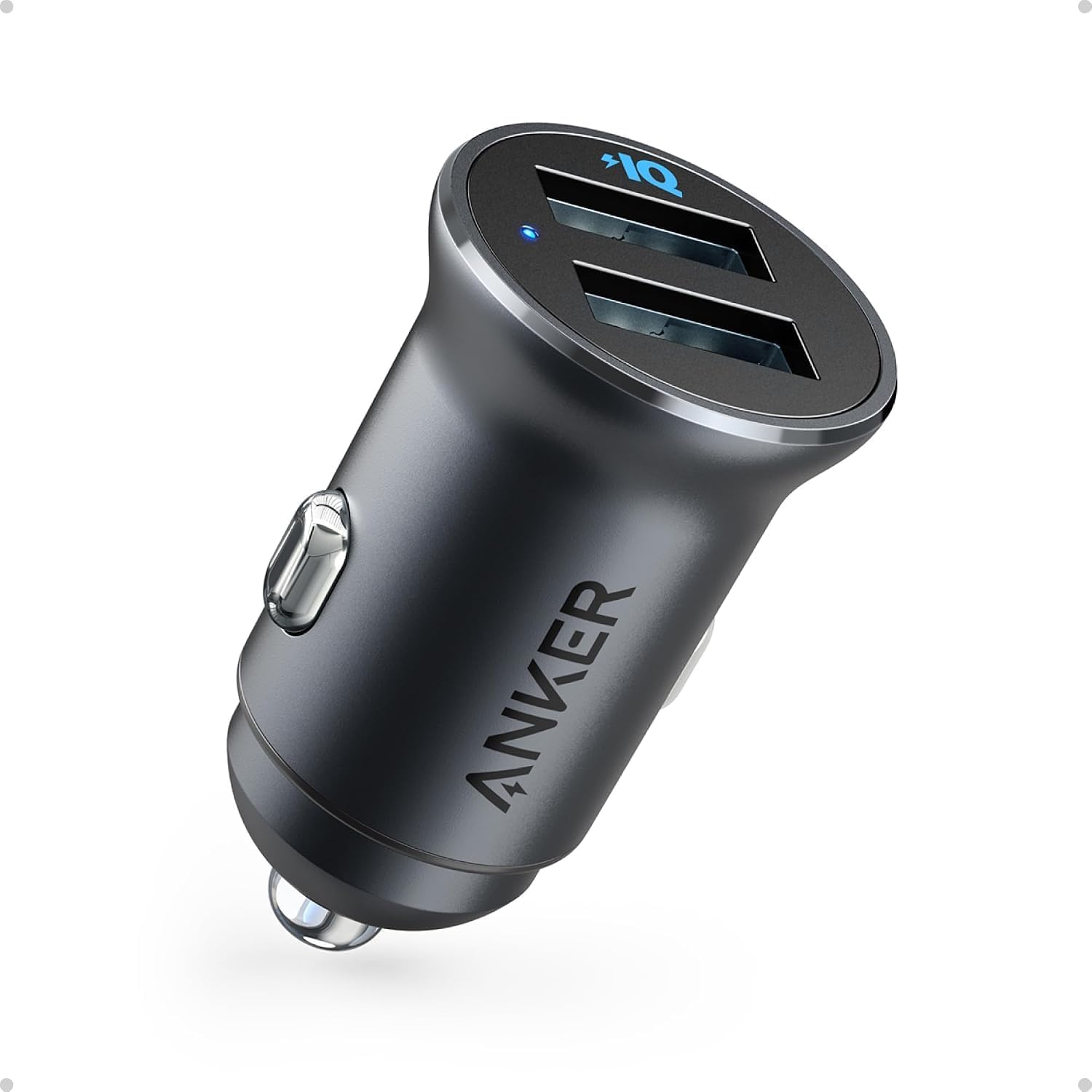
1. Anker 320 24W Dual-USB Mini Aluminum Car Charger with Blue LED
Our pick — 4.5+★ from 63,500+ verified ratings; the strongest balance of quality and price.
The plug that vanishes into your dash and still gets two phones home charged.
The number that decides this one is 24W, split across two USB-A ports. That is a combined figure, so two phones share it rather than each getting 24W. For a daily commute with a driver’s phone and a passenger’s phone, it is exactly enough to walk in the door with a topped-up battery.
What wins people over is the build. It is a scratch-resistant aluminum alloy body with gold-plated circuitry, which keeps heat down while it works. The same small shell that houses all that is why it fits so snugly that it stays clear of passenger legs — the low-profile shape simply disappears into the console once it is seated.
Here is the honest catch: it does not support Qualcomm Quick Charge, so an Android phone that leans on QC will charge at a normal pace, not a fast one. Some owners also report units that gave out after about a month, which is a small share against a 4.5+ star record but worth knowing. skip it if you need laptop-grade wattage or QC speeds.
The Case For The Anker 320
- 24W across two USB-A ports covers two phones on one commute
- Aluminum alloy shell with gold-plated circuitry for lower heat
- Sits so flush that it stays out of the way of passenger legs
- Works with a long roster of iPhone, Samsung, Pixel, and LG models
Where It Stops Short
- No Qualcomm Quick Charge support
- 24W is shared, so two devices split the output
- USB-A only, no USB-C port at all
Reach for this: if your car carries two phones and nothing heavier, this is the plug that just works.
Look elsewhere: if an Android handset on your dash needs Quick Charge, or you charge a tablet in the car.
2. Belkin BoostCharge 42W Car Charger with USB-C to C Cable
A phone charger you can plug in the moment you unbox it, cable and all.
The Belkin’s headline is speed with a purpose: the maker says it takes an iPhone from 0-50% in 21 minutes, or a Galaxy from 0-50% in 26 minutes. That is a PD 3.0 charger talking — Power Delivery, the fast-charging handshake Apple and Samsung phones use. The catch on paper is the 2.4 A rating, which sounds modest next to the Anker 320’s 4.8 A, but amperage alone does not tell you charging speed here.
What you actually get in the box is a 3.3-foot USB-C to USB-C cable, so there is no extra shopping trip. There is one USB-C port and one USB-A, which covers a modern phone and an older accessory at the same time. Belkin also builds in PPS (Programmable Power Supply), a feedback loop that adjusts voltage and current to match what the receiving phone can safely take.
Owners consistently land on charging performance as the reason they are happy with it, which lines up with the fast-charge claim rather than contradicting it. The trade-off is simple: 42W is a two-phone charger, not a laptop charger. If you carry a MacBook in the car, this is the wrong pick.
What the cable changes: buying a charger and then hunting down a USB-C cable is the quiet cost of a cheap plug. Belkin bundles a 3.3-foot one, and PD 3.0 handles the fast-charge conversation for you.
The short version: a tidy, cable-included 42W unit for a phone-first dashboard.
Not your fit: if you expect to charge a tablet or laptop alongside a phone.
3. Bangfun 3 Pack USB C Car Charger, 4-Port 65W Cigarette Lighter Adapter with Voltmeter
Three chargers, a battery voltmeter, and enough ports for the whole family’s phones.
The one to lead on here is the voltmeter. That small display shows your car battery’s live voltage, which turns the charger into a rough electrical health gauge. On a long road trip or an older car, watching that number is a genuinely useful early warning before a battery leaves you stranded.
Power is 65W spread across four ports — dual USB-C and dual USB-A — with 30W PD 3.0 on the USB-C side and 18W QC 3.0 for Android phones. The aluminum alloy body and internal chip guard against over-current, over-voltage, short-circuit, and over-heating.
The wide 12V-24V input means it suits cars and light trucks alike. Owners key on exactly that voltmeter, noting it helps them watch battery health and how the alternator behaves. What you get are three chargers in one pack, which means one for the car, one for a partner’s, and a spare in the glovebox. That is real value if you run more than one vehicle.
The voltmeter readout: a live voltage number on the plug is a smart extra in a car you plan to keep, and it costs nothing to glance at.
Pick this if: you want multiple chargers plus a battery gauge without stretching your budget.
Consider the limit: a single high-power laptop charge is beyond a 65W shared setup.
4. Anker 30W 2-Port PowerIQ 3.0 USB C Car Charger

Anker’s second act: 30W through USB-C in a plug smaller than most charging bricks.
The headline is the 30W USB-C port, which Anker says charges three times faster than a standard 5W charger. That is a big jump for an iPhone 15 or 15 Pro, and it turns a 30-minute drive into a meaningful top-up instead of a token one. PowerIQ 3.0 is Anker’s own fast-charging workaround that negotiates with the phone to find the highest speed it will accept.
The second port is USB-A, so you can still power an older phone or accessory at the same time. Anker adds overvoltage, undervoltage, overcurrent, and over-temperature protection, plus intelligent power allocation that splits the 30W sensibly between ports. This is a real step up from the Anker 320 above — 30W through USB-C rather than 24W shared across two USB-A ports.
The recurring caveat is simultaneous charging: when two devices are plugged in, output is split, and some buyers report less than they hoped from the pair. On its own, the USB-C port is the star. It is a compact body that takes almost no console space, and pairing it with a good cable is the only extra you need.
Why It Earns A Spot
- 30W USB-C port charges an iPhone 15 at triple 5W speed, per Anker
- USB-A second port for a passenger’s older handset
- Overvoltage, undervoltage, overcurrent, and over-temperature protection
- Ultra-compact body that tucks away in any console
The Fine Print
- Splits its 30W when both ports are in use
- No voltmeter and no 65W-plus headroom for laptops
Your charger if: one fast phone charge is the goal and port size is a real constraint.
Keep looking if: you routinely need two devices charging at full speed together.
5. UGREEN 130W 3-Port USB C Car Charger

The one that turns your cigarette socket into a proper laptop charging station.
At 130W across three ports, this is the first pick here that can genuinely run a MacBook, an iPad, and a phone without straining. The 14.6 A rating is the raw current behind that 130W headline, a different league from the 30W and 42W chargers above. If you are charging a Steam Deck, a Switch, or a work laptop while you drive, this is the bracket to be in.
The USB-C2 port supports up to 45W of PPS charging, which is the fast standard Samsung’s Galaxy S24 Ultra and S23 Ultra use. A soft blue LED makes the ports findable at night without throwing glare across the windshield. The PC body carries a scratch-resistant finish, and the whole thing wraps in protection against overheating, short-circuit, over-voltage, and over-current.
Quality is the theme owners keep returning to, and it backs up with fast charging and real power output as close runners-up. Two honest caveats: no cable is included, so budget for a good one, and a few owners note heat during hard, sustained use — normal for a unit pushing this much power. Compatible with most 12V/24V sockets, but seat it fully and keep the socket clean for a stable connection.
The wattage reality: 130W is not a phone-charger upgrade, it is a category change. It replaces the laptop brick in your bag for road trips and work vehicles.
Buy it for: a car that doubles as a workspace, with a laptop and a fast-charging Galaxy in the cabin.
The one snag: you need to supply your own cable, and it is bigger than a pocket plug.
6. JUNVANG 130W 3-Port USB C Super Fast Car Charger with Voltage Display
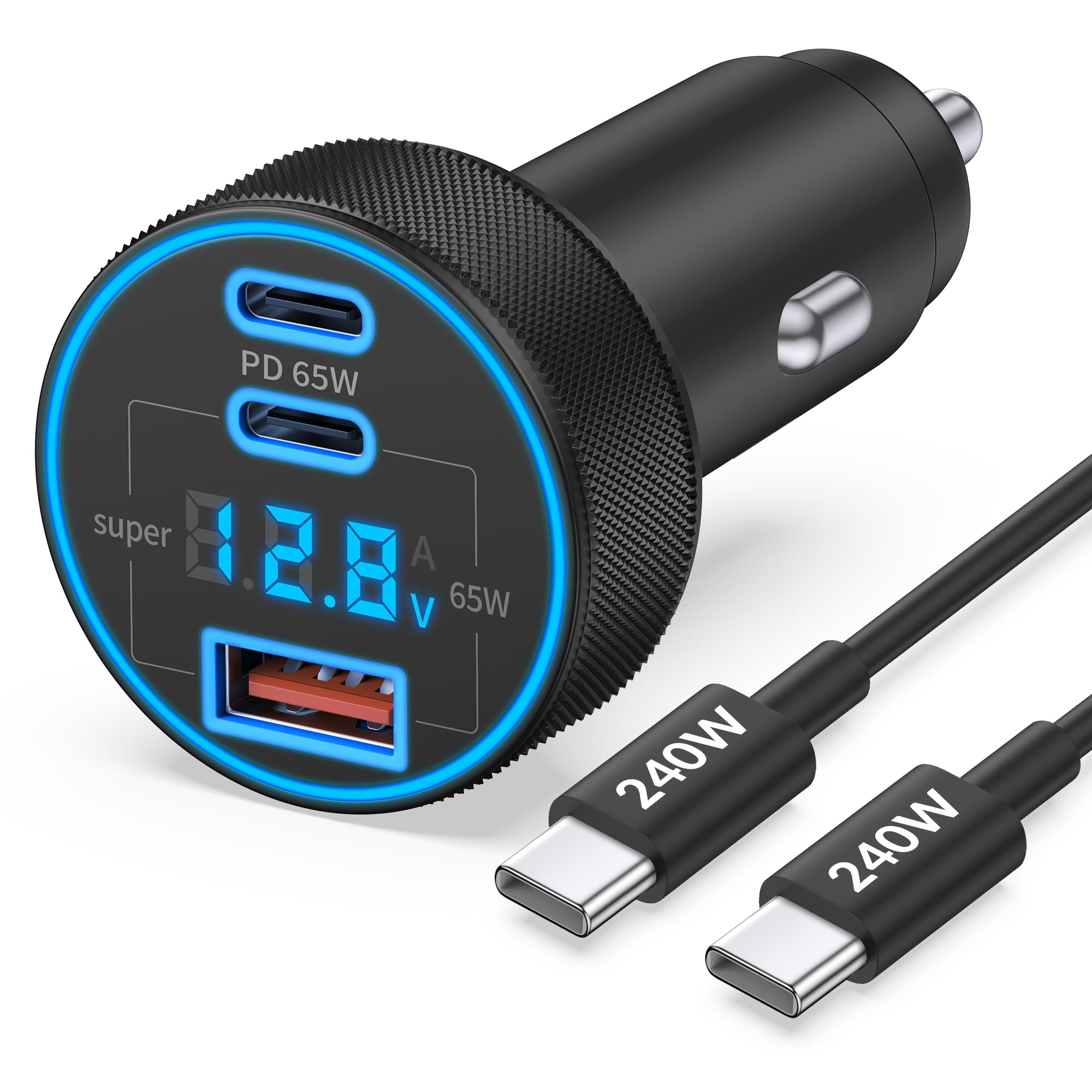
A 130W charger that ships with the beefy cable and shows your battery voltage.
Where the UGREEN makes you buy your own cable, this JUNVANG hands you a 240W USB-C to USB-C cable in the box. That cable carries an E-Marker chip, a small identity chip that tells the charger what the cable can safely handle so it does not overdrive it.
The second standout is the LED digital voltmeter, which shows your car battery’s voltage in real time. JUNVANG pitches the voltmeter as an early warning for electrical trouble, and owners treat the display as a useful gauge rather than a gimmick. Ports break down as two USB-C and one USB-A, with PPS/PD/QC fast charging and intelligent power distribution dipping output to whatever the attached device can take.
JUNVANG’s fast-charge claim is specific: up to 80% on a Galaxy S26/S25/S24/S23 Ultra and up to 70% on an iPhone 18/17/16/15 within 30 minutes. Its 6.5 A rating trails the UGREEN’s 14.6 A, but the metal body is the sturdier shell of the two. It is a premium unit for a premium dashboard, and the built-in cable removes one more thing to remember.
The complete package: charger plus a 240W cable plus a voltage readout is the most self-contained setup in this group.
For the road warrior: phones, tablets, and a laptop all covered, with the cable already in the box.
Think twice if: you want the smallest possible footprint, since a display and metal body add bulk.
7. BESTEK Multi Ports USB Car Charger, 125W 14A with Quick Charge 3.0
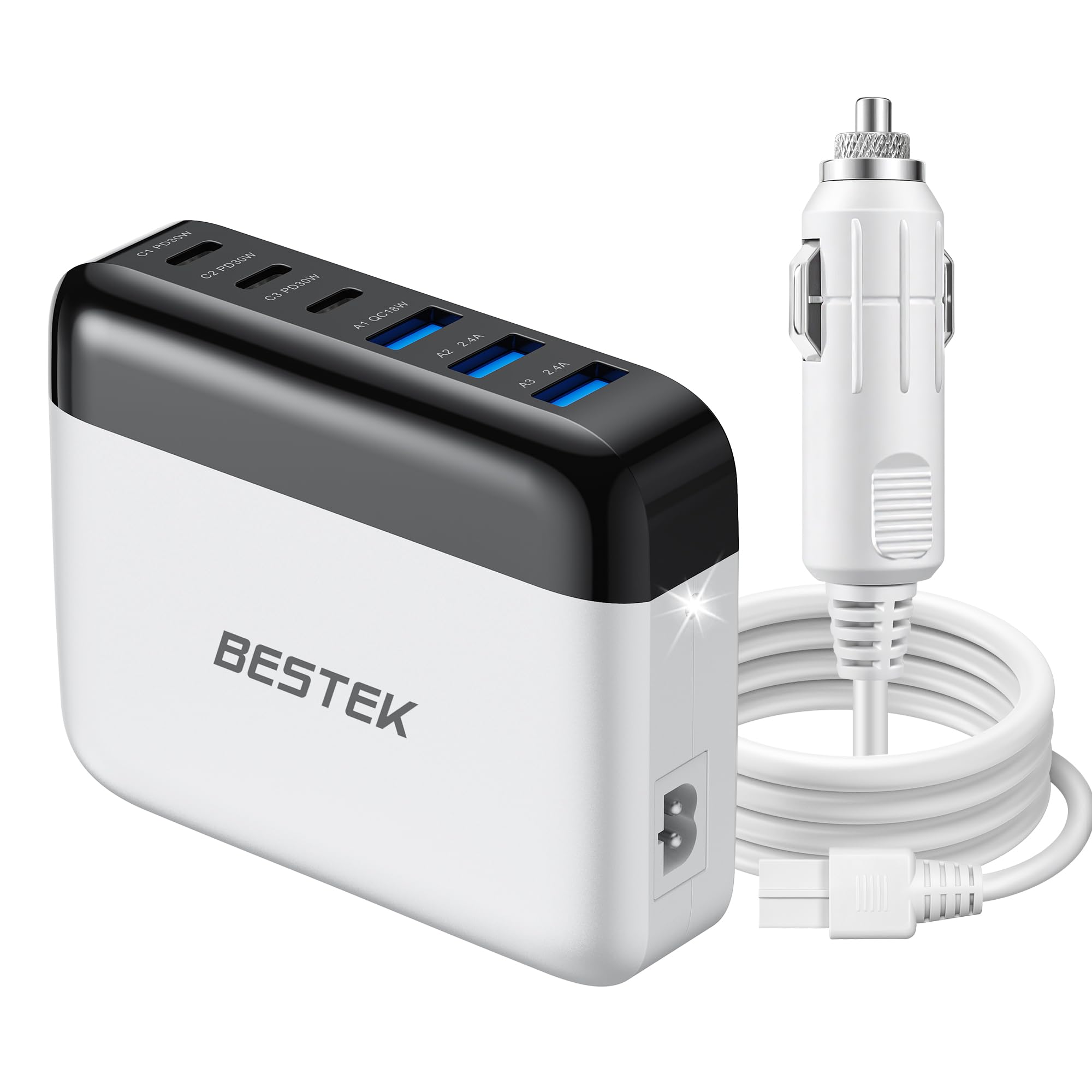
Six ports and a long power cord for the car that hauls a full crew of devices.
Count the ports and the point is clear: six. That is more than any other charger here, and it comes with a 2.6-foot cigarette lighter power cord so the socket stays free while the hub sits where you want it. For a family road trip or a carpool full of phones, tablets, and a dash cam, that arrangement is what you want.
Power sits at 125W with a 14A rating, and Quick Charge 3.0 handles Android fast charging while USB-C PD covers the newer phones. The enclosure is ABS and PC fireproof material, and BESTEK notes ETL certification — an independent electrical safety mark. An internal chip detects each device and pushes the fastest speed it will accept, with overcurrent, over-load, and short-circuit protection built in.
The one detail to note honestly is the light. A few owners find the brightness more than they want at night, so if you drive in the dark a lot, be ready to tuck it low on the console. Beyond that, quality and charging capability are the things owners praise most, and the long cord’s reach is a practical win for anyone who has ever cursed a short built-in plug.
Why The Crew Pick Wins
- Six ports — the most in this lineup
- 2.6-foot cord frees up the socket so the hub can sit elsewhere
- ETL-certified electrical safety marking
- Quick Charge 3.0 plus USB-C PD cover old and new phones
What To Weigh
- Brightness draws mixed feedback — a nuisance on night drives
- A corded hub is bulkier to stow than a flush plug
Made for: big vehicles, big families, and anyone tired of taking turns at the socket.
Down the list if: you want one tiny plug and no extra cord to manage.
8. NOCO XGrid XV65 65W 2-Port USB-C Fast Charging Car Charger
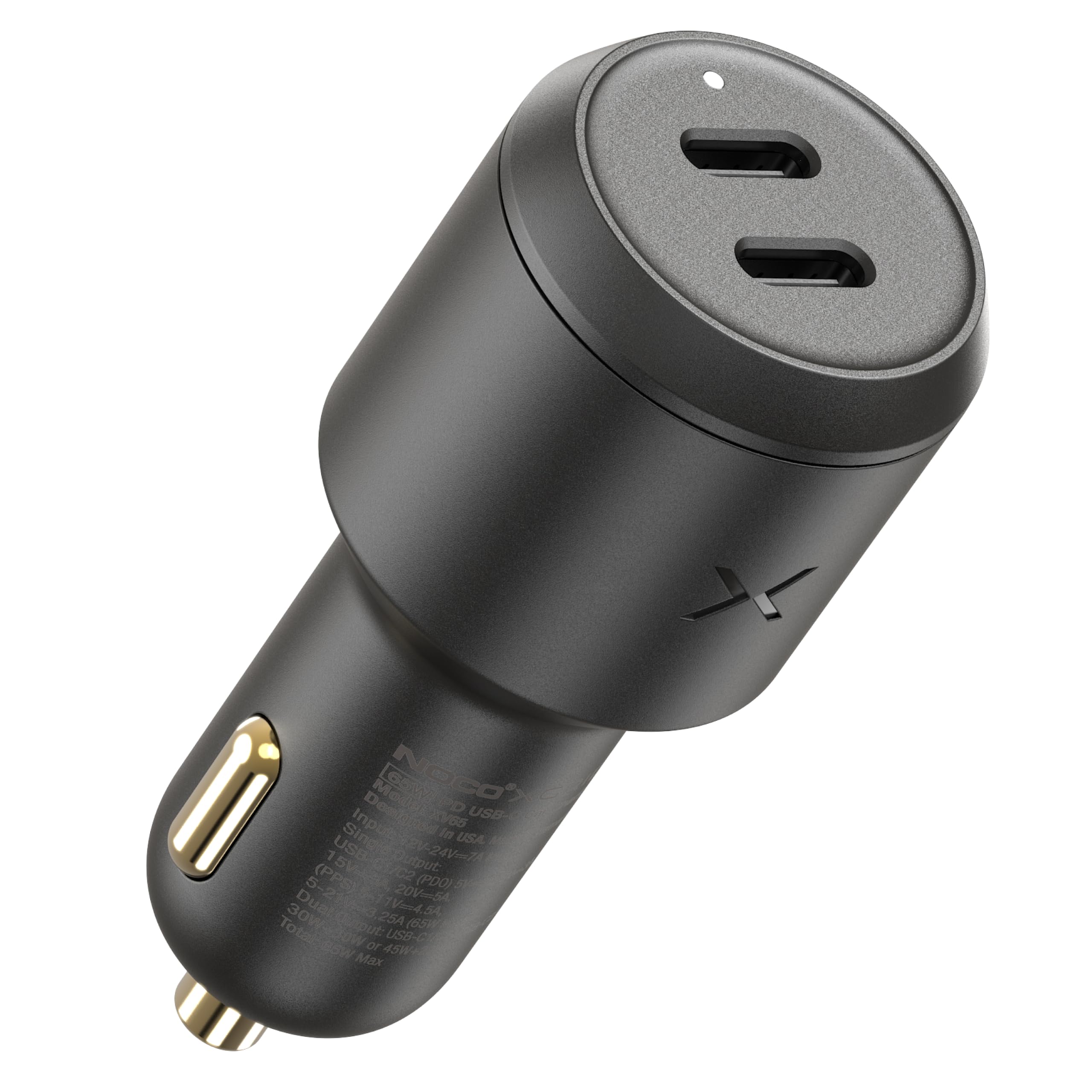
Two USB-C ports that keep arguing politely over who gets the most watts.
What makes this NOCO interesting is the math it does on the fly. One port can pull the full 65W, but plug in a second device and the charger rebalances to 45W/20W, 30W/30W, or 20W/45W automatically. That means a laptop on one side and a phone on the other each get a sensible share without you choosing which one suffers.
The compact size comes from GaN technology — gallium nitride, a semiconductor that handles power with less bulk than the older silicon parts. NOCO pairs that with an anti-wobble fit so the plug stays locked in over bumps. It also draws near-zero power in cars that cut the 12V socket when the engine is off, so it does not quietly drain your battery between drives.
Two USB-C ports and no USB-A is a deliberate modern choice: it works cleanly with phones, tablets, and laptops but leaves a legacy USB-A accessory behind. Its 7 A rating matches the JUNVANG’s, though 65W is well below either 130W unit. It also handles a long list of devices — Steam Deck, laptops, earbuds, and more. Solid thinking for a car with two modern devices.
The balancing act: dynamic power sharing is the whole reason to buy this one — you never pick a loser port.
Choose this for: two USB-C devices that both deserve a fair share of power.
The trade-off: no USB-A port, and 65W is not laptop-plus-laptop territory.
9. DEWALT Heavy Duty USB C Car Charger, 120W 2-Port PD 3.0
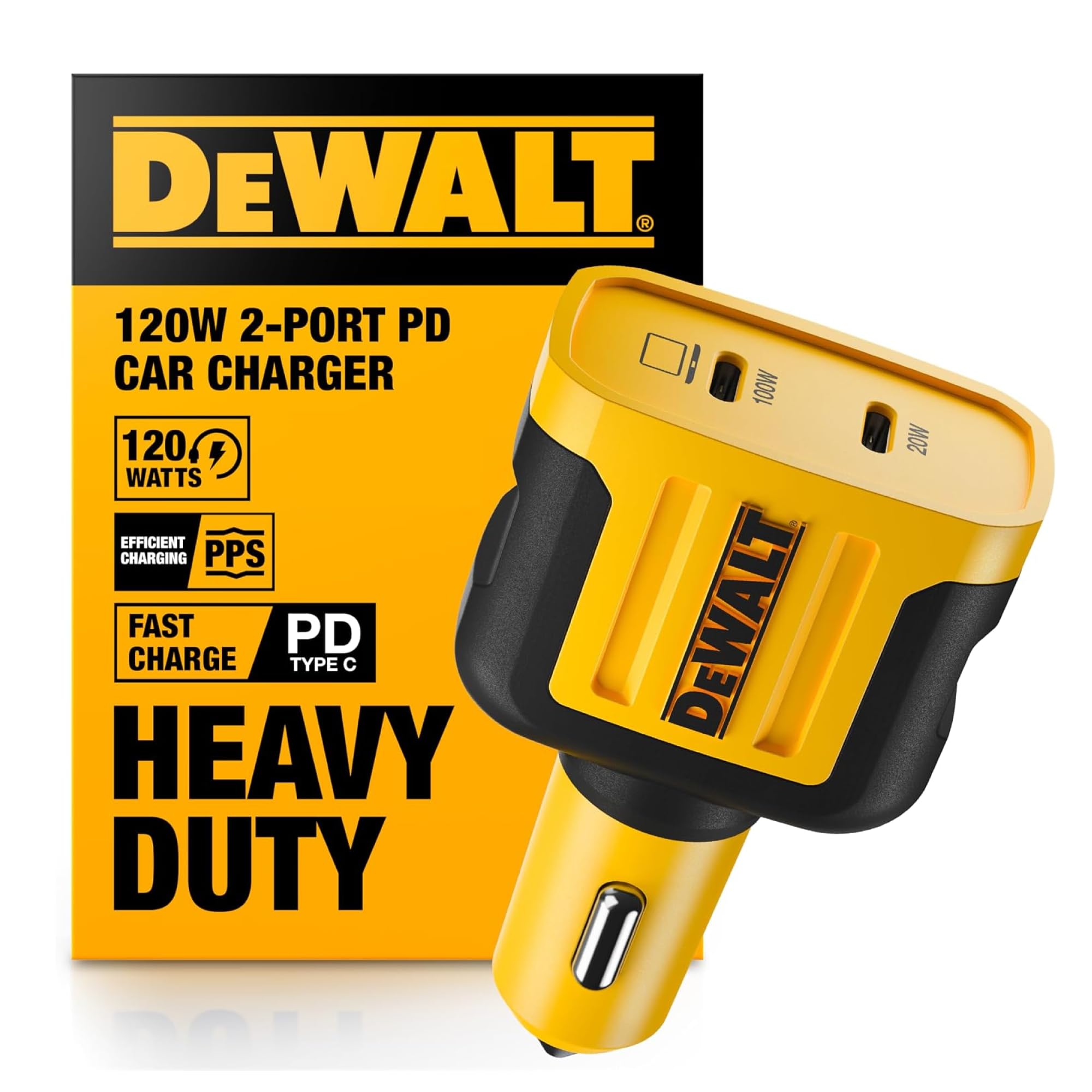
The one built for a work truck — heavy duty by name and by 120W output.
You get one plug that charges a laptop and a phone at the same time, and it is built to take a knock. It pushes up to 120W through two USB-C ports, using PD 3.0 (a fast-charging standard) and PPS (a fast-charging mode that fine-tunes voltage for some phones). DEWALT claims 70% faster charging than a standard 12V car charger, but you need a 100W cable to hit that speed. Its 13.5 A rating sits just behind the UGREEN’s 14.6 A, so it belongs in the high-power group, not the phone-only one.
The heavy-duty framing is not just a name tag. It is built to work with the DEWALT USB Charging Kit (DCB094K) and comes in the brand’s yellow-and-black finish. The compatible-device list runs to MacBook Pro, tablets, and both iPhone and Android handsets — two devices at once, including a MacBook and a Galaxy S23 Ultra together.
Here is the catch, and it is a real one: owners mention the plug gets very warm in 100W mode. That is the trade of pushing this much power through a compact body, and it is note if your socket sits in a hot console. Quality and functionality are the strengths owners highlight most. Pair it with the recommended 100W cable and it holds up well for demanding devices.
Why It Fits A Work Vehicle
- Up to 120W across two USB-C ports with PD 3.0 and PPS
- Maker claims 70% faster charging than a standard 12V charger
- Heavy-duty build in DEWALT’s yellow-and-black finish
- Powers a MacBook and a Galaxy flagship together
The Heat Reality
- Runs very warm in 100W mode, per owner reports
- Wants a 100W cable for full speed, which is not included
Reach for this if: you want a tough 120W plug in a truck or work car and can add the matching cable.
Skip the full-power mode if: your socket lives in a hot console, since it runs warm at 100W.
Understanding the Specs
Total Wattage vs. Per-Port Wattage
Check what the big number on the box really means before you buy. A charger’s headline number is the total across all ports, so a 65W four-port unit shares that 65W. One phone alone then gets far more than two phones charging at once. Ask whether the number is the total or a single port’s ceiling. The UGREEN 130W spreads its output across three ports, while the NOCO 65W gives one port the full 65W until a second device arrives.
What PD, QC, and PPS Mean For Your Phone
These are fast-charging agreements, not raw power. PD (Power Delivery) is the standard Apple and most Android phones follow. QC (Quick Charge) is Qualcomm’s version, favored by many Android handsets. PPS (Programmable Power Supply) refines PD by adjusting voltage in finer steps, which is what Samsung’s Ultra phones lean on. A charger that supports all three simply plays nicely with a wider range of phones.
Amperage: Current, Not Speed
Amps measure current flow, not charging speed on their own. The Anker 320 shows 4.8 A, the Bangfun 2.25 A, and the UGREEN 130W 14.6 A — yet a 30W USB-C charger like the Anker Play can charge a phone faster than a 24W shared pair. Read amperage alongside wattage and port layout, never by itself.
The Voltmeter and Battery Health
A voltage display shows your car battery’s live reading. It is a simple electrical gauge: a healthy battery holds a steady voltage, and a sagging one reacts with a dip under load. On older vehicles and long trips, that readout is a quiet early warning. The Bangfun and JUNVANG both build one in; the rest of these do not.
FAQ
Will a 130W car charger damage a regular phone?
Can I charge a laptop from my car’s 12V socket?
What does the PD or QC label actually guarantee?
Why do some chargers get warm in use?
Is a USB-C port better than USB-A in a car charger?
How do I use the voltage display on a car charger?
Do these chargers work in trucks and 24V vehicles?
Will a car charger drain my battery when the engine is off?
Does a multi-port charger slow each device down?
Can I use a charging cable from a different brand?
Final Thoughts: The Verdict
For most drivers, the auto charger 12v that fits best is the Anker 320 24W because its aluminum body, snug fit, and two-port simplicity cover the everyday phone top-up without fuss. If you want fast USB-C charging that handles an iPhone or Galaxy quickly, grab the Anker 30W 2-Port PowerIQ. And for the car that has to run a laptop and a phone at once, the UGREEN 130W is the one to reach for.
How We Picked
We do not accept paid placement. Every pick is matched to a real buyer and a real use-case; we do not hands-on test units.
Sources & Methodology
Specifications: manufacturer listings and product documentation. Review insights: verified customer reviews, as of November 2026. Pricing: not shown on this page (it changes often); check the current price via the retailer link.
As an Amazon Associate, Gadgets Feed earns from qualifying purchases. This does not affect which products we feature.