
Our readers keep the lights on and my morning glass full of iced black tea. As an Amazon Associate, I earn from qualifying purchases.
Specs are compiled from manufacturer listings and verified buyer reviews and can change over time — please confirm the key details on the product page before buying.
A dash cam’s real job is capturing clear evidence before a fender-bender or parking-lot hit-and-run becomes a he-said-she-said dispute. The hard part is that every model claims 4K and “night vision,” so picking one feels like guessing. This guide cuts through the spec-sheet noise and tells you which cameras actually capture a readable license plate at night, which apps you will not hate, and which ones are worth mounting in your car.
I’m Min — the founder and writer behind Gadgets Feed. This guide is built by comparing the manufacturers’ published specifications and the patterns across verified customer reviews, so you get each pick’s real strengths and trade-offs instead of marketing spin.
Whether you commute daily, drive for work, or just want protection on road trips, finding the right auto dash cam depends on matching sensor quality, storage, and parking features to your actual driving habits.
Our Picks at a Glance
How To Choose The Best Auto Dash Cam
Before you compare megapixels, decide what you actually need to capture. A front-only camera covers the road ahead, a 2-channel system adds the rear view, and a 3-channel setup watches the cabin too — which matters if you drive for a rideshare service or worry about smash-and-grab theft. Your vehicle type, your driving hours, and your tolerance for wiring will all shape the right pick.
Sensor Quality Beats Resolution Hype
A camera can say 4K on the box and still blur every plate at dusk. The spec that actually predicts night clarity is the image sensor, and the current gold standard is the Sony STARVIS 2 line — sensors like the IMX678 and IMX675. These sensors capture usable light in dark conditions, so you get full-color detail instead of grainy black-and-white shapes when the sun goes down. If you drive at night regularly, prioritize a STARVIS 2 sensor over a higher resolution number.
Storage, Loop Recording, and the G-Sensor
Every dash cam overwrites its oldest footage when the card fills up, which is called loop recording. The safety net is the G-sensor (a small motion sensor that detects a bump), which locks the current clip so it cannot be overwritten after a crash. Cards matter too: most cams arrive with a 64GB or 128GB card, but many support expansion up to 256GB or even 512GB. More capacity means more driving time stored before the oldest clips get recycled.
Parking Mode and the Hardwire Reality
If you want your camera to record while the car is parked and off, be ready to buy a hardwire kit — it is almost never included. That kit taps into your fuse box so the camera draws power with the engine off. The trade-off is battery drain, which is why premium models use radar or motion detection to wake up only when something moves nearby. If parking protection is your priority, seek out a camera with a dedicated parking mode and budget for the install.
Quick Comparison
| Model | Best For | Front Resolution | Max Memory | Included Card | Amazon |
|---|---|---|---|---|---|
| TERUNSOUl 3CH★ Best Overall | Triple coverage on a budget | 4K UHD | 512 GB | 128 GB | Amazon |
| WOOLAACOO C5Compact Pick | Tiny footprint, dual view | 4K | 256 GB | 64 GB | Amazon |
| FAIMEE F6Wide View Pick | Wide 6-lane capture | 4K UHD | 256 GB | 64 GB | Amazon |
| 70mai A800SE | Wi-Fi 6 speed and ADAS alerts | 4K | 512 GB | 128 GB | Amazon |
| 70mai T800E | Rideshare cabin coverage | 4K | 512 GB | 64 GB | Amazon |
| ROVE R2-4K | Proven crowd favorite | 4K @30fps | 1 TB | 128 GB | Amazon |
| REDTIGER F17 Elite | Full-color night parking | 4K | 512 GB | 128 GB | Amazon |
| VIOFO A229 Pro | Cinematic HDR across 3 channels | 4K | 512 GB | — | Amazon |
| THINKWARE U3000 PRO | Radar parking with battery saving | 4K | 512 GB | 64 GB | Amazon |
In‑Depth Reviews
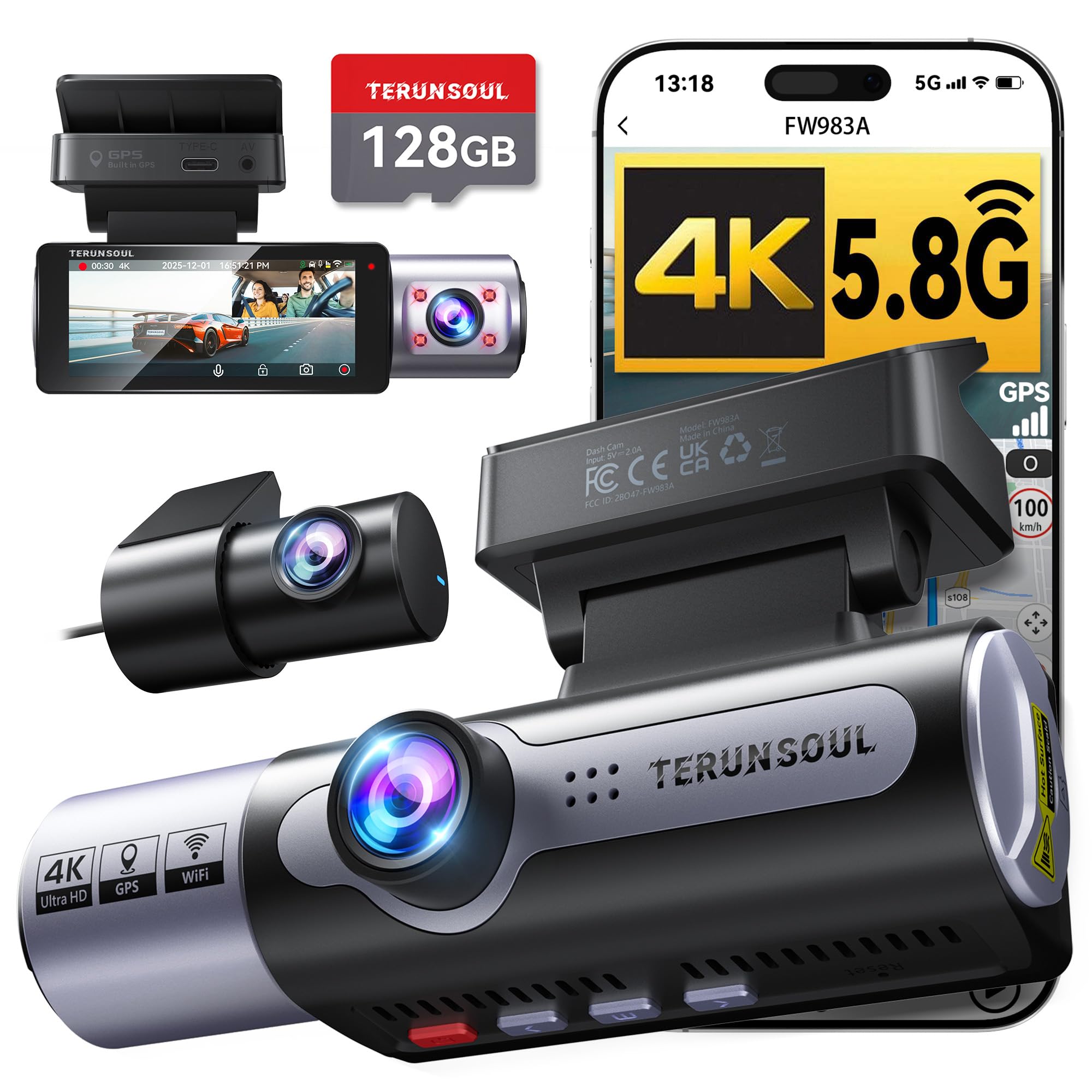
1. TERUNSOUl 4K 3-Channel Dash Cam
Our pick — over 4.5★ from 350+ verified ratings; the strongest balance of quality and price.
The triple-lens setup that gives every angle of your drive its own dedicated camera.
This is the rare dash cam that covers the road ahead, the road behind, and the inside of your car all at once — the front shoots in true 4K UHD while the rear and cabin cameras each record in 1080P. The front camera’s 170° ultra-wide angle plus 165° views from the rear and cabin cameras get you as close to a near-360° panoramic picture as any single system on this list. For rideshare drivers or families who want to see everything, that means no blind spot in your footage.
Night performance leans on a starlight-grade five-layer lens with a large F1.6 aperture and HDR (a technique that balances bright and dark areas in one frame), so low-light details stay visible instead of dissolving into black. A built-in G-sensor (a small motion sensor that detects a bump) auto-locks collision footage, and the pre-installed 128GB card overwrites the oldest clips when it fills up. It also has dual-band 5.8GHz and 2.4GHz WiFi, so grabbing a 20MB/s download through the app is quick when you need to share a clip with insurance.
Buyers report the setup process is genuinely fast and the menus are simple, with the video quality described as “sharp day and night” and the 3-channel coverage giving real “confidence.” The built-in GPS embeds your route, speed, and timestamp directly into the video, which is the kind of evidence that settles disputes before they start. The one honest catch is that a working 24H parking mode requires a separate hardwire kit — the camera itself has the feature, but you will need to buy the wiring to use it.
Setup champion: the ease-of-installation praise outnumbers every other talking point, which tells you this is one of the friendlier first-time dash cams you can mount.
Who it’s for: anyone who wants the fullest coverage picture without stepping up to the premium price tier.
Reach for this if: you want front, rear, and cabin coverage plus crisp night footage and GPS evidence — all for a mid-range price.
Look elsewhere if: you need parking mode from the start, since that requires buying a hardwire kit separately.
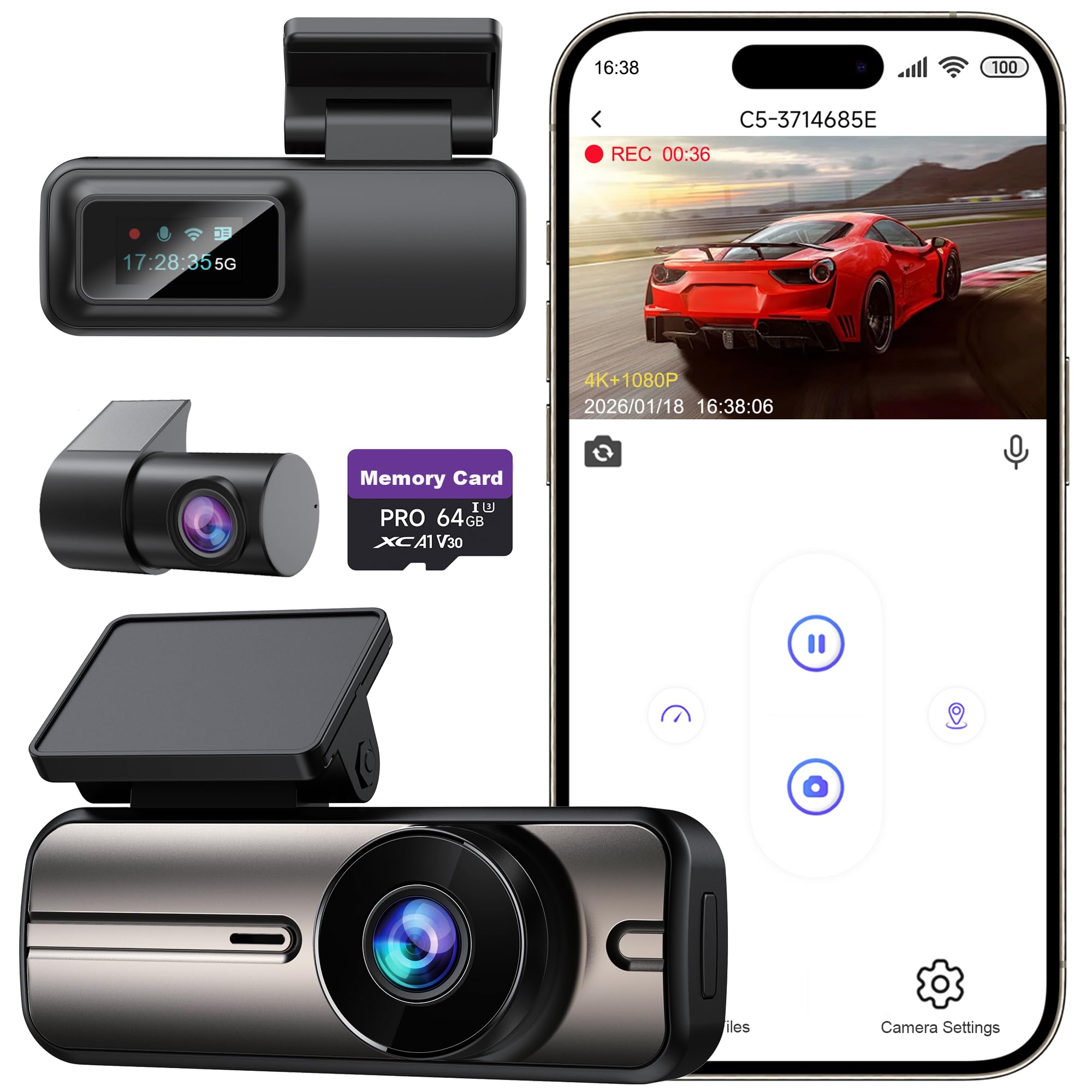
2. WOOLAACOO C5 Dash Cam
The pint-sized dual cam that hides behind your mirror and still reads plates up front.
At just 65 grams and roughly the size of a thick stick of gum (0.78″D x 3.35″W x 1.18″H), this is the smallest camera on the list — and it is about one-quarter the weight of the bulkier 3-channel TERUNSOUl above. The front camera records 4K while the rear handles 1080P, giving you crisp road signs and license plates in the front view without a giant box blocking your windshield. Its compact, unobtrusive design is the thing owners consistently point to first.
Low-light capture gets help from an F1.8 aperture (the lens opening that lets light in), and the included 64GB card supports expansion up to 256GB. The built-in 5GHz WiFi pairs with a dedicated app for viewing, downloading, and sharing clips, and owners mention the connection is easy to use and quick to set up. It also has a G-sensor that locks important footage after a collision, plus a manual lock button for when you want to save something yourself.
The parking mode here runs for 24 hours when you connect the separately-sold 3-Lead Hardwire Kit, with both collision detection and time-lapse options. One honest limitation: the WiFi range is only 3-5 meters, so you cannot pull footage from inside your house — you need to be near the car. But as buyers put it, this one offers “pretty easy install and honestly good quality with an easy to use app,” which is a fair summary of its value.
What wins people over
- Featherweight design slips out of sight and never obstructs the view
- 4K front footage keeps plates and signs readable
- Included 64GB card works right from the start
Keep in mind
- WiFi reaches only about 3-5 meters from the car
- Hardwire kit sold separately for parking mode
Best for: drivers who want a discreet, budget-friendly dual cam that disappears behind the mirror and still records sharp front footage.
Not ideal if: you want remote viewing from inside your home, since the WiFi range is short.
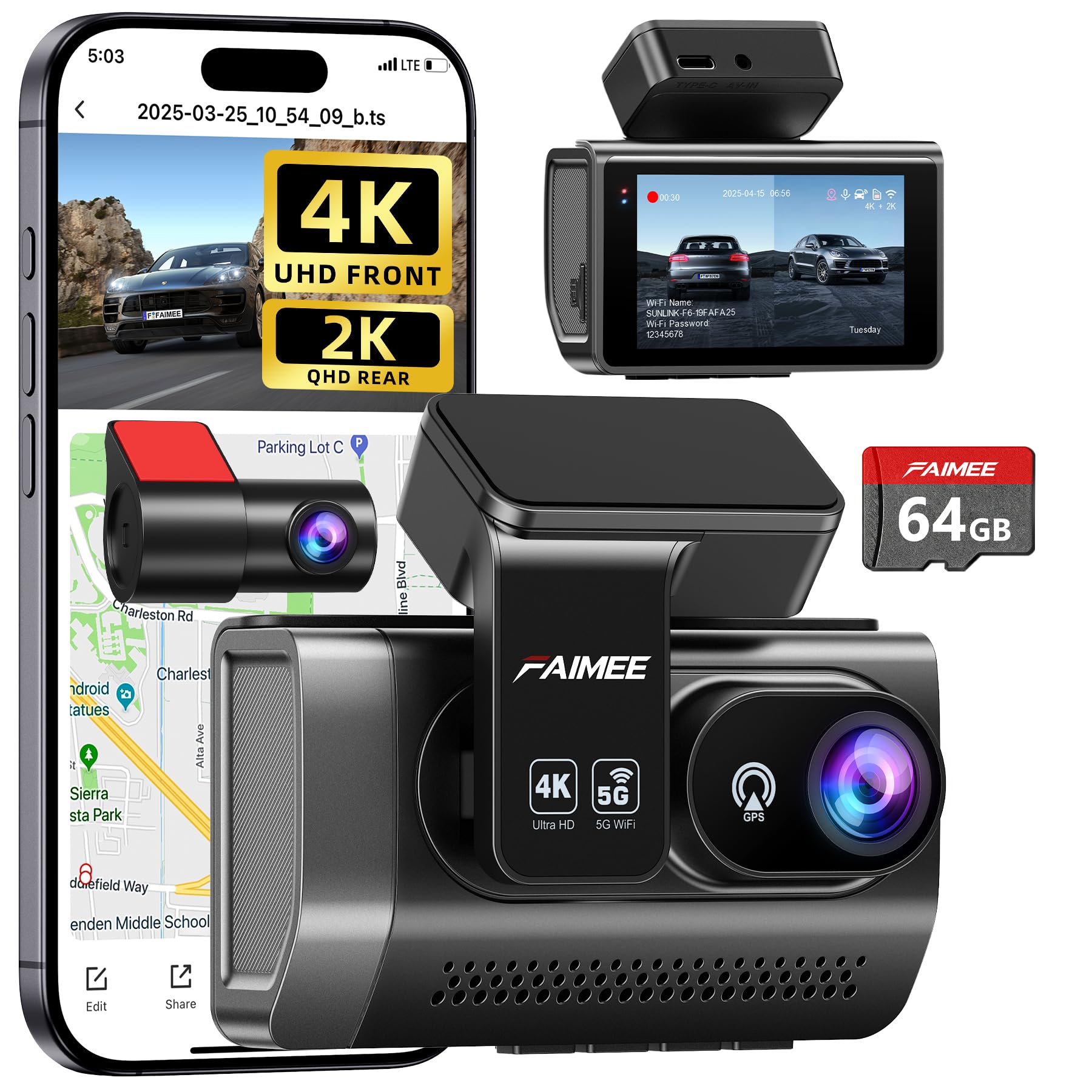
3. FAIMEE F6 4K + 2K Dash Cam
The 170-degree front lens that can sweep across six lanes of traffic at once.
Very few cameras on this list can claim a field of view wide enough to track six lanes, but the FAIMEE F6 hits that with its 170° front lens — a meaningful advantage on multilane highways where a car can cut you off from two lanes over. The front camera records in 4K UHD (3840×2160P) while the rear bumps up to 2K (2304x1296P), which is sharper than the typical 1080P rear camera you find on cheaper dual cams. Together with the F1.8 aperture and WDR (wide dynamic range, which balances bright and dark areas), the footage stays balanced in high-contrast conditions like tunnels and glare.
It ships with a 64GB high-endurance card and supports expansion up to 256GB, using smooth loop recording to overwrite the oldest clips. The built-in GPS logs your real-time speed, route, and coordinates, and dual-band 5.8GHz/2.4GHz WiFi pairs with the FAIMEE app for live view and quick downloads. A G-sensor locks the current video the instant it detects a sudden collision, so the critical moment stays safe from overwriting.
Time-lapse recording mode runs at a low frame rate with minimal power draw, enabling 24/7 parking surveillance when you add a hardwiring kit (not included). Buyers describe the setup as fairly easy and the coverage area as good, though some note the on-screen text cannot be removed when connected to the phone and the menus take a little learning. It is backed by an 18-month warranty and 24/7 technical assistance, which adds real confidence for a mid-range purchase.
Coverage king: the 170° front view is the widest in this lineup, making it the strongest choice for highway drivers who want to see the full picture ahead.
The trade-off: the app and menu system have a small learning curve before everything clicks.
Choose this if: you spend time on wide multilane roads and want a rear camera that records sharper than 1080P.
skip it if: you want a zero-learning-curve app experience right from the first drive.
4. 70mai A800SE 4K Dash Cam
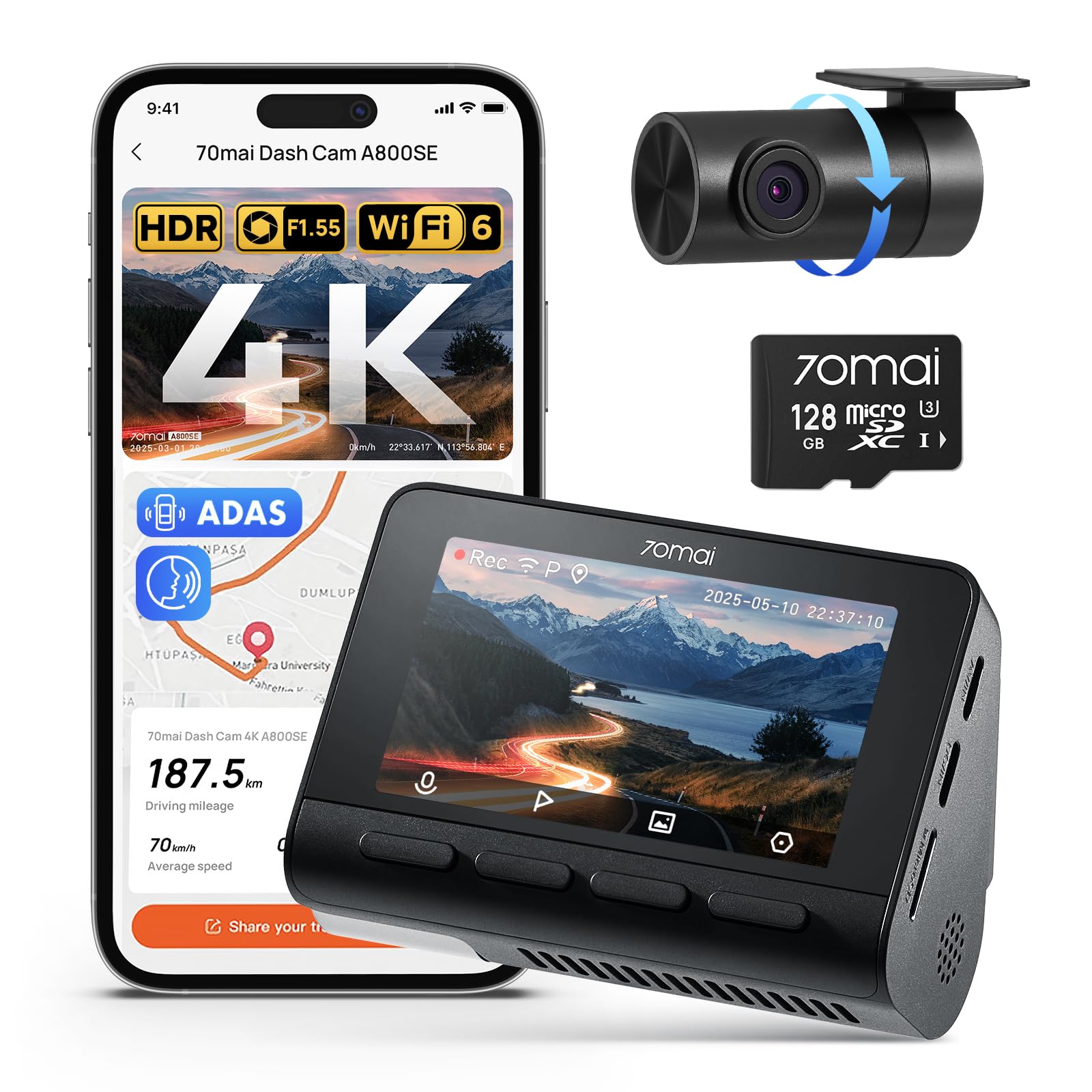
The dual cam with Wi-Fi 6 transfer speeds and driver-safety alerts built right in.
This 70mai records 4K up front and 1080P in the rear, but the rear camera stands out because its lens is adjustable — you can angle it to watch the cabin or point it straight back to watch the road behind you. That flexibility makes it a genuine 2-in-1 for owners who want the option of interior coverage without committing to a full 3-channel system. The front camera’s 140° field of view and 7-layer glass lens with an F1.55 aperture (a very wide lens opening) pull in more light for brighter low-light footage, boosted further by Dual HDR.
Where this camera really separates itself is connectivity: built-in Wi-Fi 6 transfers files quickly, so pulling a clip onto your phone is quick and painless. It also includes ADAS (Advanced Driving-Assistance System), which issues voice alerts for lane departures and forward collisions — a safety layer most dash cams simply do not have. The pre-installed 128GB microSD card supports expansion up to 512GB, and a G-sensor locks critical footage during impacts.
Owners consistently rave about the crisp daytime 4K footage and how easy the app is to navigate, and the system runs on a 30 FPS frame rate for smooth motion. The recurring honesty note: the rear camera struggles in very low light or with heavily tinted windows, and a few units have been reported to stop working over time. Parking protection runs 24 hours with the optional hardwire kit and includes time-lapse mode. It is backed by an 18-month warranty, with optional in-person installation available at service centers in New York and California.
The strong points
- Wi-Fi 6 makes phone downloads faster than older Wi-Fi standards
- Adjustable rear lens can watch the cabin or the road
- ADAS voice alerts warn you about lane drift and potential front collisions
The honest limits
- Rear camera is weak in low light or behind dark tint
- Some customers note units failing after months of use
Grab it for: the fastest file transfers in this price range plus useful driver-safety alerts that go beyond plain recording.
Think twice if: you need strong rear footage at night, since the rear camera is the weak link here.
5. 70mai T800E 3-Channel Dash Cam

The 3-channel system built for rideshare drivers who need eyes on the cabin and the road.
If you drive for Uber or Lyft, the 70mai T800E is aimed squarely at you: a 4K front camera, a 1080P interior camera, and a 1080P rear camera all record at once with ultra-wide lenses and an F1.55 aperture. What makes the interior camera special is its switchable infrared recording — you can turn on IR for clearer night footage inside the vehicle or turn it off when you do not want it. That is a real feature for rideshare drivers who want passenger visibility without permanently recording the cabin in IR.
Hands-free voice control lets you snap photos, start recording, or lock footage without taking your hands off the wheel, and the built-in 5-mode GPS tracks ultra-accurate location, speed, and route. File transfer over Wi-Fi 6 reaches speeds up to 10 MB/s. It comes with a 64GB SD card and supports up to 512GB, and the super capacitor (a power component that handles heat far better than a lithium battery) keeps it stable in extreme temperatures from 14°F to 140°F — no battery swelling worries in a hot parked car.
The 24/7 parking monitoring with G-sensor collision detection works with a hardwire kit sold separately (options listed as UP06 or UP03), and 4G connectivity is not supported. Owners note the app works well for setup but file transfer can be slow, with PC connection being the faster route for big batches. Some report the app connection can be a little unreliable. It is backed by an 18-month warranty, and for those who want help, in-person installation is available at service centers in New York and California.
Rideshare ready: the switchable IR cabin camera plus voice control makes this the most passenger-focused 3-channel cam here.
The catch: app-based file transfer is slow, so grab clips via USB cable when you want speed.
Built for: rideshare and family drivers who want cabin visibility on demand plus strong heat tolerance.
Pass if: you want fast app downloads, since the WiFi transfer speeds here lag the ROVE’s 20MB/s.
6. ROVE R2-4K Dual Dash Cam

The crowd-proven dual cam whose night footage and 20MB/s downloads set the bar.
This is the dash cam that tens of thousands of owners have already put through real-world testing, and the consensus is loud: the ROVE R2-4K delivers excellent day and night video with no glare, an easy install, and an intuitive app. Its secret weapon is the Sony IMX675 STARVIS 2 sensor up front, paired with an F1.5 aperture — that combination captures vivid colors and sharp details even in challenging light. The front camera records 3840x2160P at 30fps, the rear handles 1920x1080P at 30fps, and the 150° front angle plus 140° rear angle covers more of the road than typical dual cams.
File handling is where this unit flexes: downloads to your phone run at up to 20MB/s over dual-band 5GHz and 2.4GHz WiFi, and it supports microSD cards up to a massive 1TB, while most competitors support up to 512GB. A free 128GB ROVE PRO card is included, so it is ready to record from the start. The built-in supercapacitor (a heat-safe power component) extends product life in hot cars, and thermal protection safeguards the device in high temperatures. GPS stamps your route, speed, and location directly onto the video, viewable through the free ROVE GPS Player on PC or Mac.
The custom-designed 24-hour parking mode offers three options — 1fps timelapse, motion detection, and collision detection — and will record a full 1-minute video, lock it in an event folder, and give you a voice alert next time you start the car. A hardwire kit is required but not included. The occasional note about WiFi connectivity being finicky appears in the feedback, but the sheer volume of positive owner experiences — including one who called it “still the best dash-cam for the money” a year later — makes this the safest all-around bet on the list.
Why owners love it
- STARVIS 2 sensor delivers genuinely sharp night footage
- 20MB/s downloads over WiFi beat most rivals
- Supports up to 1TB microSD for maximum recording time
Minor gripes
- Occasional WiFi pairing hiccups reported
- Parking mode needs a separately purchased hardwire kit
The safe pick: if you want proven reliability with a huge owner base behind it, this is the dual cam to beat.
Consider the alternative: if you need cabin coverage too, step up to a 3-channel model instead.
7. REDTIGER F17 Elite 3-Channel Dash Cam
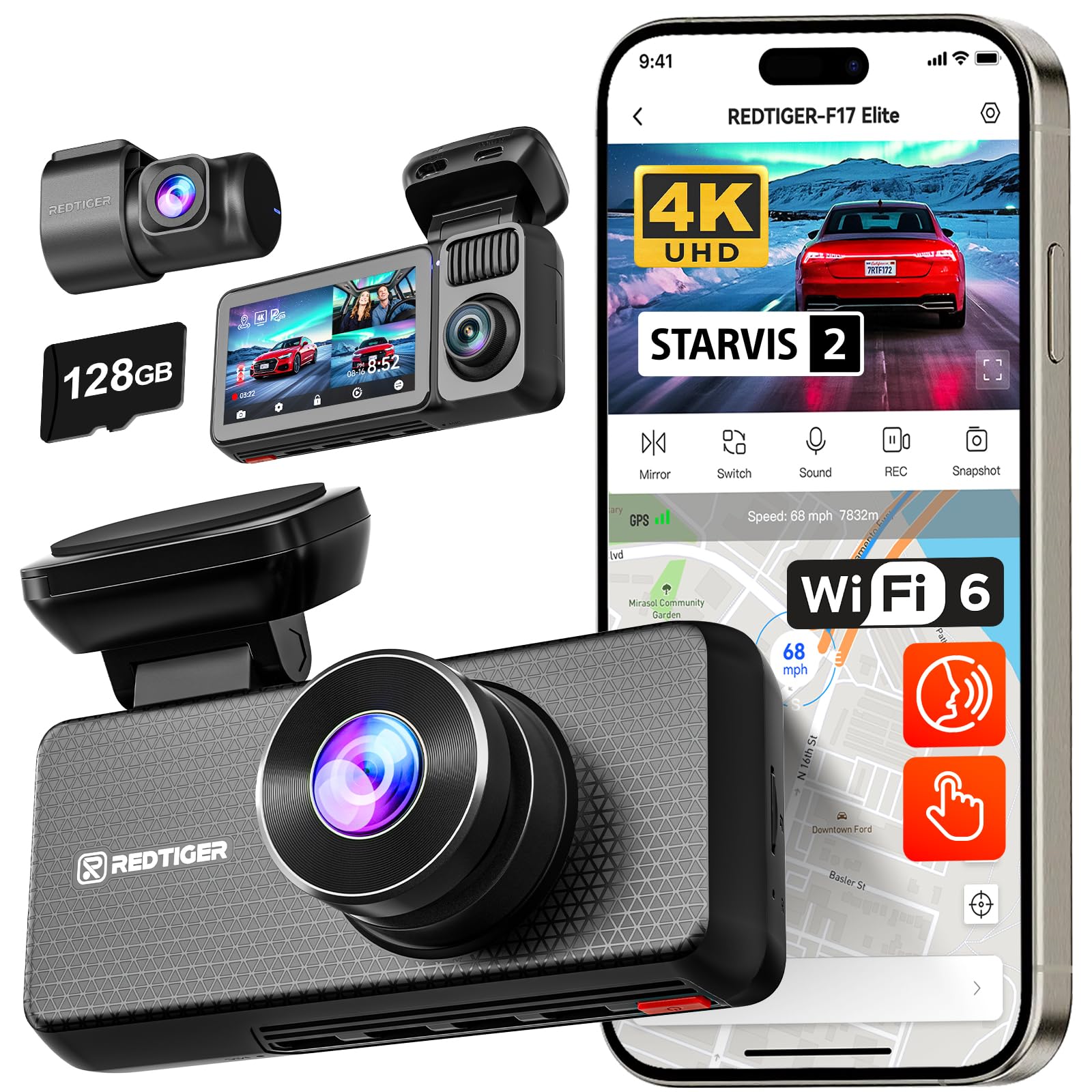
The 3-channel system that keeps full color at night instead of going grainy black-and-white.
Most dash cams switch to black-and-white infrared at night, but the REDTIGER F17 Elite keeps recording in full color after dark — on both the front and cabin cameras. That is powered by dual STARVIS 2 sensors (an 8MP IMX678 up front and a 4MP IMX675 in the rear) delivering true 4K front, 2.5K rear, and 1080P cabin footage. When a hit-and-run happens in a dark parking lot, this camera gives you color detail of faces and plates instead of murky silhouettes. HDR (high dynamic range, balancing bright and dark areas) reduces glare and keeps the image natural.
The practical extras stack up: 5.8GHz WiFi 6 for live preview and downloads up to 30MB/s (the fastest transfer speed on this list), built-in GPS for speed and route data, and voice control plus a touchscreen for managing recording modes. A customizable in-car camera toggle lets you switch the cabin camera off for privacy when you want it. The full-color parking protection mode uses time-lapse and G-sensor auto event detection to capture suspicious activity in vivid detail while parked.
It arrives with a pre-installed 128GB microSD card and supports expansion up to 512GB, with a super capacitor for stable power in extreme temperatures. The honest counterweight: heat sensitivity is the recurring theme in negative feedback — some units shut down in extreme heat during parking mode with the windows closed, and a couple of reviewers point out units failing entirely. Owners who got a good unit call the night footage excellent and the install simple. The 18-month warranty covers you, but if you park in brutal summer heat, this camera demands the AC running or a habit of switching it off.
What stands out
- Full-color night vision on front and cabin cameras
- Fastest downloads here at 30MB/s over WiFi 6
- Pre-installed 128GB card with expansion to 512GB
The heat reality
- Some units shut down in extreme heat while parked
- A few shoppers say complete failures
Pick it for: the best full-color night recording in this lineup, especially if identifying faces and plates in the dark matters most.
Be cautious if: your car sits in extreme summer heat, since heat shutdowns are the most-reported issue.
8. VIOFO A229 Pro 3-Channel Dash Cam

The triple-cam with HDR on all three sensors and 12 hands-free voice commands.
The VIOFO A229 Pro is engineered around two flagship STARVIS 2 sensors (IMX678 and IMX675) and, critically, applies HDR to all three channels — front, rear, and cabin. That wider dynamic range captures details in the highlights and shadows simultaneously, which is exactly what you need to read a license plate during high-speed driving or in mixed lighting. The front records 4K, the rear 2K, and the cabin 1080P, with a 160° front field of view. A built-in CPL (Circular Polarizing Lens, which cuts glare and reflections) is included and pre-affixed to the front lens to reduce windshield and road glare.
The cabin camera activates four infrared LED lights automatically when it detects low light, recording sharp black-and-white details even in complete darkness. Hands-free control is a highlight here with 12 voice commands — you can take photos, lock video, or toggle WiFi and audio without touching the unit. The advanced Quad-Mode GPS module supports four satellite systems (GPS, BEIDOU, GALILEO, and GLONASS), giving you precise location, speed, and timestamp data when reviewing footage. Three parking modes — Auto Event Detection, Low Bitrate, and Time Lapse — offer flexibility, with the camera storing 15 seconds before and 30 seconds after a detected event.
Here is the honesty you need: there is no SD card included with this camera at all, and the manufacturer explicitly recommends buying VIOFO industrial high-endurance cards for reliability. Reliability is genuinely the most-discussed topic in the feedback — a solid group of buyers report the camera stops working without warning, though many resolved it by using the included 12V adapter rather than a phone charger. The overheat protection that triggers automatic shutdown in extreme temperatures is a design safety feature, not a defect, but it means hot-climate owners may see the unit power down. Buyers who get it running well call the video quality great and the night vision very good — one family runs three of them across two cars and an RV.
The engineering wins
- HDR on all three channels for balanced day and night footage
- 12 voice commands keep hands on the wheel
- Quad-Mode GPS uses four satellite systems for accuracy
Know before you buy
- No SD card included — you must buy one separately
- Reliability is mixed, with some units failing without warning
Choose this for: the most technically advanced HDR triple-cam experience with voice control and CPL included.
Think carefully if: you want out-of-the-box recording with a card included, or if maximum reliability is your top priority.
9. THINKWARE U3000 PRO Dash Cam
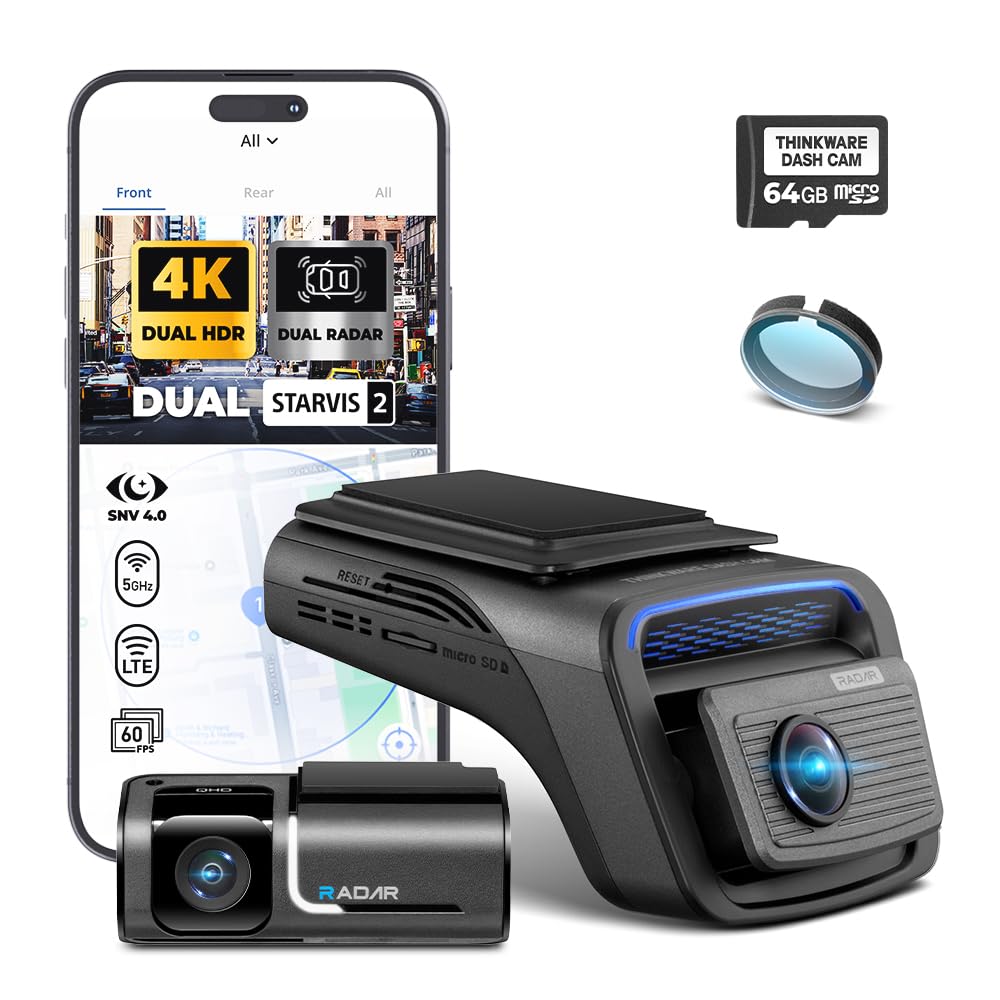
The premium 4K-and-2K system whose radar parking mode sips battery instead of draining it.
THINKWARE is a name that serious dash cam owners trust for reliability, and the U3000 PRO is designed to justify its premium price with a truly different parking solution: dual radar. Instead of recording constantly while parked, radar detects motion and wakes the camera to record a 20-second clip — a smarter approach that extends coverage without draining your car battery. For EV owners, owners mention this low-power radar parking mode is ideal at charging stations. The front camera records 4K and the rear 2K, both driven by Sony STARVIS 2 sensors and an Ambarella CPU for clear evidence day or night.
Event capture is precise: motion and impact sensors trigger 20-second event files that include 10 seconds before and 10 seconds after the incident, giving you full context. WDR (wide dynamic range) and smart auto-exposure balance harsh lighting for natural images, and the 147.2° front field of view covers the road ahead effectively. Setup runs through dual-band 2.4GHz/5GHz WiFi with quick pairing via the Dash Cam Link app, and the included 64GB microSD card allows immediate recording. It is also LTE compatible — a feature that can send alerts when paired with a compatible LTE module.
Safety extends beyond recording: forward collision and lane departure warnings, plus speed camera notifications via GPS, keep you aware on the road. Owners praise the sharp night video (plates and signs readable with ease), cleaner footage with less glare, and natural colors. The trade-offs are real: the setup is not intuitive for everyone, some report the rear radar parking mode not functioning, and app connectivity gets mixed feedback. One owner switched from a camera that had reliability issues and called the THINKWARE “a huge upgrade in reliability and confidence” — which is exactly the reputation this brand carries.
Smartest parking mode: the radar-based system is the standout feature here, protecting your battery while keeping your car guarded.
The premium cost: you pay significantly more for this level of engineering, and the app experience is not as polished as the hardware.
Invest in this if: parking protection without battery drain is your #1 priority and budget is not the deciding factor.
Look elsewhere if: you want a simpler setup process or a smoother app experience at a lower price.
Understanding the Specs
Image Sensor: The Real Night Vision Engine
The image sensor is the chip that converts light into the picture you see, and it matters more than the resolution number on the box. Sony’s STARVIS 2 series (like IMX678 and IMX675) is currently the best consumer option because it captures usable light in very dark conditions. A camera with a STARVIS 2 sensor will produce full-color, readable footage at night where a cheaper sensor turns to grainy black-and-white shapes. When you compare models, check the sensor name before you trust the “4K” claim.
Parking Mode: Continuous Watch or Smart Wake-Up
Parking mode lets your camera record while the engine is off, but it is not free — every camera on this list needs a hardwire kit (sold separately) to power it that way. Basic parking modes record continuously or in time-lapse, draining your battery over time. Premium systems use radar or motion detection to wake only when something moves, capturing a short clip and saving power. If you park on the street nightly, a radar-based parking mode is worth the premium.
FAQ
Do I need a 2-channel or 3-channel dash cam?
What does the G-sensor actually do?
How much storage do I really need?
Is a hardwire kit required for parking mode?
Will a dash cam drain my car battery?
What is the difference between WiFi and WiFi 6 in a dash cam?
Is night vision actually better with a STARVIS 2 sensor?
Can I use any SD card in my dash cam?
What does GPS do in a dash cam?
Is a dash cam worth it for the price?
Final Thoughts: The Verdict
For most buyers, the auto dash cam winner is the TERUNSOUl 3-Channel because it delivers front, rear, and cabin coverage with sharp 4K night footage and built-in GPS at a mid-range price — the most complete protection per dollar here. If you want the fastest downloads and proven reliability from a massive owner base, grab the ROVE R2-4K. And for parking protection that does not drain your battery, the THINKWARE U3000 PRO with radar-based motion waking is the one to reach for.
How We Picked
We do not accept paid placement. Every pick is matched to a real buyer and a real use-case; we do not hands-on test units.
Sources & Methodology
Specifications: manufacturer listings and product documentation. Review insights: verified customer reviews, as of August 2026. Pricing: not shown on this page (it changes often); check the current price via the retailer link.
As an Amazon Associate, Gadgets Feed earns from qualifying purchases. This does not affect which products we feature.