
Our readers keep the lights on and my morning glass full of iced black tea. As an Amazon Associate, I earn from qualifying purchases.
Specs are compiled from manufacturer listings and verified buyer reviews and can change over time — please confirm the key details on the product page before buying.
If you can feel a scratch with your fingernail, a wax or a “scratch remover” from the auto parts store isn’t going to touch it. You need a cutting compound—an abrasive liquid that actually removes a thin layer of clear coat around the scratch to level it out. This guide ranks the nine best auto deep scratch removers by their abrasive grit and real-world cut, so you can match each to your paint’s damage depth.
I’m Min — the founder and writer behind Gadgets Feed. This guide is built by comparing the manufacturers’ published specifications and the patterns across verified customer reviews, so you get each pick’s real strengths and trade-offs instead of marketing spin.
For paint that’s beyond a simple polish, you need the best auto deep scratch remover that matches your tool and skill level, and this guide breaks down the top nine.
Our Picks at a Glance

How To Choose The Best Auto Deep Scratch Remover
Match the compound’s grit rating to your scratch depth: lower numbers cut deeper, higher numbers finish finer. A fine polish won’t remove a deep scratch, and a heavy compound can haze your paint if you use it for a light swirl. Three factors separate a deep scratch remover from a surface polish: grit rating, application tool, and clear coat safety.
Match the Grit Number to the Damage
The grit number in the specs tells you how coarse the abrasive is. A higher number (1200, 1500, 2000) is finer and safer for light swirls and haze, while lower numbers (40, 120, 800, 1000) cut faster and remove deeper scratches but carry more risk of leaving your own micro-marring behind. For a scratch you can catch with a fingernail, you need a low-number heavy cut first.
Check Your Machine
Your tool—rotary, dual-action, or hand—determines how aggressively the compound can cut. Rotary buffers spin fast and cut aggressively, dual-action (DA) polishers are more forgiving for beginners, and hand application is the slowest and least effective for deep damage. Some compounds are designed specifically for rotary machines, while others are marketed as beginner-friendly for pads and drills.
Know Your Paint’s Clear Coat
Every heavy compound removes a microscopic clear coat layer to level the scratch, so use sparingly. This limits you to a few corrections per panel before risking burn-through to the color coat. On older lacquer or enamel paints, or on very thin clear coats, you want a product that is labeled safe for those finishes and calls for the gentlest effective approach.
Quick Comparison
| Model | Best For | Grit Rating | Size | Key Strength | Amazon |
|---|---|---|---|---|---|
| Griot’s Garage BOSS Correcting Cream★ Best Overall | Moderate defects without dust | 120 | 16 oz | Extended work time | Amazon |
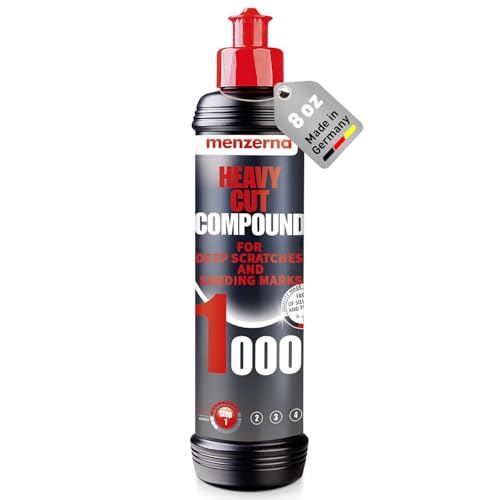
| Menzerna Heavy Cut 1000DIY Champion | DIY drill-and-pad fixes | 1000 | 8 oz | Fast cut, easy use | Amazon |
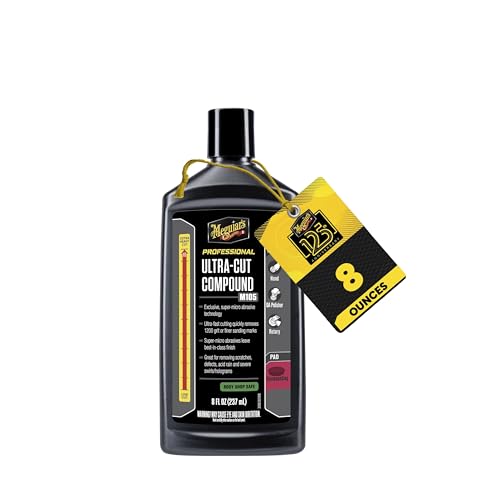
| Meguiar’s M105 Ultra CutPro Finish | Sanding marks up to 1200 grit | 1200 | 8 oz | High gloss finish | Amazon |
| Meguiar’s M04 Heavy Cut | Old lacquer and enamel paints | 40 | 16 oz | Rotary buffer formula | Amazon |
| SONAX Ultimate Cut | Dust-free heavy cutting | 800 | 250ml | Zero dust, water-based | Amazon |
| 3D One Hybrid Compound | One-step correction on daily drivers | 1500 | 8 oz | Zero-dust hybrid formula | Amazon |
| Turtle Wax Scratch Repair Kit | Full kits with resin filler | Fine | Kit | Clear coat resin fill | Amazon |
| Carfidant Scratch & Swirl Remover | Quick light-scratch touch-ups | Fine | Kit | Included pad and towel | Amazon |
| Chemical Guys C4 & P4 Kit | Show-quality two-step finishing | 2000 | 2 x 16 oz | Cut and polish combo | Amazon |
In‑Depth Reviews
1. Griot’s Garage BOSS Correcting Cream
Our pick — over 4.5★ from 850+ verified ratings; the strongest balance of quality and price.
The heavy hitter that stays wet long enough to actually finish the job.
This is the one to reach for when swirls and light scratches have dulled your paint. It’s a medium-cut cream with a 120 grit rating, which places it firmly in the aggressive-but-safe zone for clearing moderate defects while adding depth and clarity. The standout trait is its extended buff cycle—it won’t dry out or dust on you mid-panel, which is exactly when most compounds turn into a chalky mess.
Buyers report a dramatic real-world win: one restored a 12-year-old black Acura MDX from dull to a mirror finish in just 4-5 passes. The formula is designed to pair with the BOSS Fast Correcting Foam Pad, but owners note it works fine with any orange pad, and many skip a separate polishing step entirely because the finish is already that clean. The bottle’s design also makes it easier to apply without waste.
It can’t erase fingernail-catching scratches; those require wet sanding first. For daily-driver swirls and surface scratches, it delivers more cut with less dust than lighter polishes.
What wins people over
- Extended work time means up to 8 passes without drying, so you don’t rush.
- Minimal dust means less cleanup and a cleaner final wipe.
- Wipes off easily and often removes the need for a separate polish step.
- Trusted for boat gel coat scratches, not just car paint.
Who should think twice
- Deep scratches that catch a fingernail will still need wet sanding first.
- Some owners found value-for-money opinions split, so compare sizes before committing.
The confident pick: best for the home detailer who wants pro-level correction of moderate defects without fighting dust.
Know the limit: this restores and levels paint beautifully, but it can’t fill a gouge down to the primer.
2. Menzerna Heavy Cut Compound 1000
A fast-cutting 1000-grit compound that turns a drill and pad into a scratch fixer.
For the budget-minded DIYer, this is the proof that you don’t need a full garage setup. That “polish like a pro” claim holds up because it’s a heavy cut that removes holograms, uneven matting, and light-to-medium deep-set scratches.
You can use it with the brand’s red Heavy Cut Foam Pad, but it also works by hand for minor details—one owner removed scratches with just a cloth, avoiding the hassle of a buffer. The 1000 grit (a measure of abrasive coarseness, where lower numbers cut faster) puts it in the balance for heavy correction, leaving paint glossy and flat again.
The trade-off is dust. Multiple buyers mention it dusts like crazy no matter what they try, which means more cleanup after your passes. It’s also a single-stage product, so heavy users will want a follow-up polish to chase away any haze.
Fast and furious: cuts quickly and impresses with how much it removes for the price.
The messy side: dust builds up fast during buffing, and a finishing polish is recommended after heavy use.
3. Meguiar’s M105 Ultra Cut Compound
The sanding-mark specialist that cuts up to 1200 grit and still leaves a gloss.
This is the compound for people who wet-sand first. M105 is engineered to remove moderate to heavy paint defects—scratches, oxidation, swirls, acid rain—and it specifically cuts through up to 1200 grit sanding marks, which is a very aggressive spec for an 8-ounce bottle. Buyers verified it under tough conditions: one removed garage paint and scratches completely using a drill and buffing sponge, while another hand-applied it after wet sanding panels up to 7000 grit and achieved a factory-like, shiny finish.
It’s clear coat safe on all glossy finishes, and it works with a hand, dual-action polisher, or rotary buffer. The super micro-abrasive technology is what lets it leave a high-gloss shine instead of the dull haze heavier compounds often leave behind. That finish is exactly why after heavy cut passes, many owners follow with a polish and sealant to lock in the gloss.
The honest limitation is that it’s a one-time heavy cut—it removes a layer of clear coat, so you use it sparingly. Deeper scratches remain for the heavy users, and some owners note it dusts more with wool pads or a rotary, which can be managed by misting water to reactivate it.
The versatile cutter: works by hand, DA, or rotary and is the standard follow-up after wet sanding.
Respect the cut: it’s abrasive by design, so it’s a “use once per correction” product, not a daily polish.
4. Meguiar’s M04 Heavy Cut Cleaner
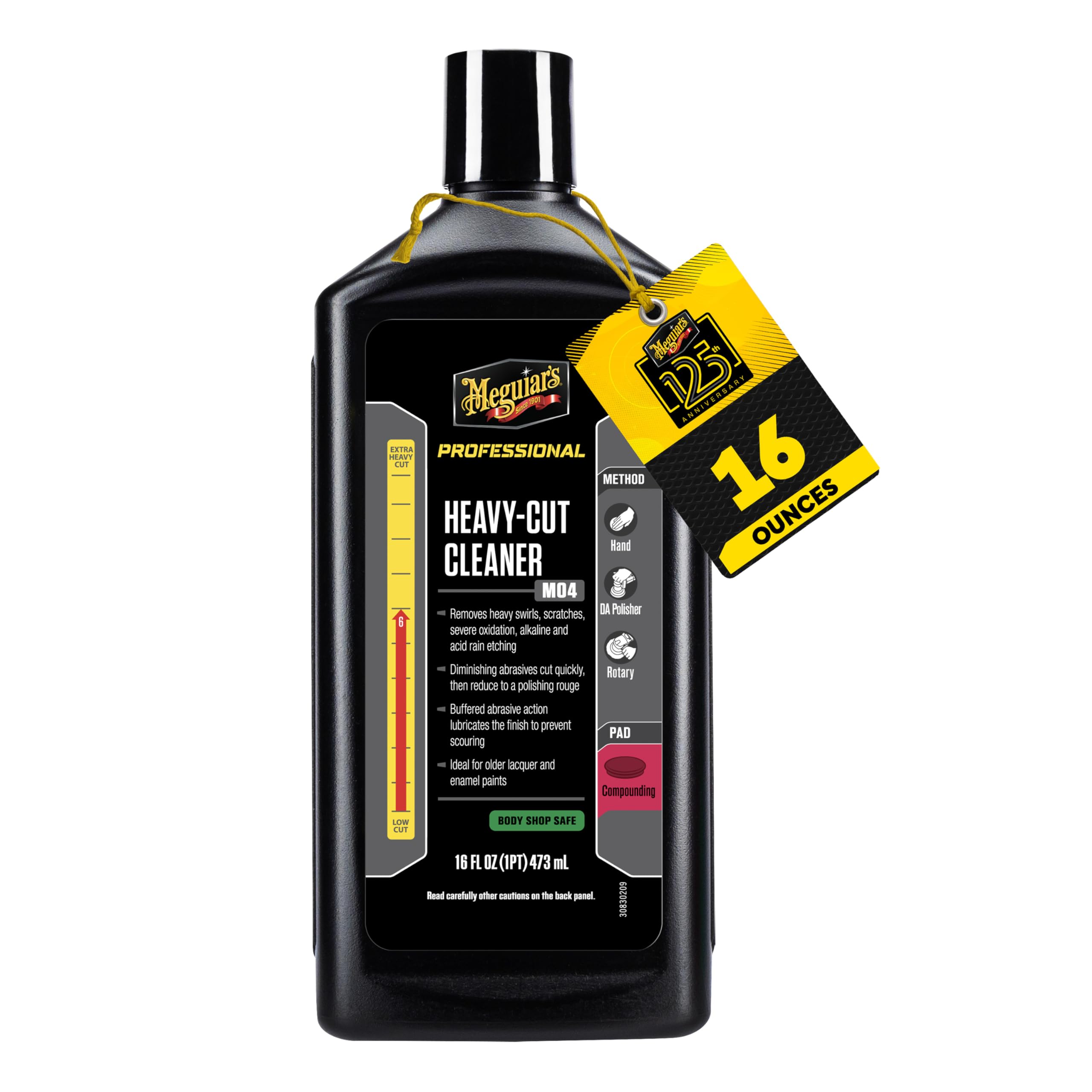
The 40-grit brute that rescues old lacquer and enamel paint.
This is the most aggressive bottle in the lineup, and it’s built for a very specific job: seriously damaged older finishes. With a 40 grit rating and a body-shop-safe formula designed for rotary buffers, it handles heavy swirls, scratches, severe oxidation, and even alkaline and acid rain etching. It’s especially recommended for older lacquer and enamel paints that softer polishes bounce right off.
Its buffered abrasive action cuts quickly at first, then turns into a buffing rouge (a fine polish) to reduce new swirls. Buyers saw this on real cars: one cleared stubborn oxidation on a classic car to reveal original paint, and another used it on an Audi to remove mineral deposits that chemical decontamination missed. The 16-ounce jug is generous, so one bottle lasts through a full correction.
The catch is that it’s a rotary-buffer product at heart. It cuts fast and can burn through thin clear coats if you’re not careful, so beginners with a DA polisher should look at the finer compounds in this list instead.
The old-school cutter: it excels on severe oxidation and etching (acid or water spots that eat into the clear coat) that finer polishes can’t handle.
Skill required: designed for rotary machines, so novices need to be careful not to over-cut.
5. SONAX Ultimate Cut
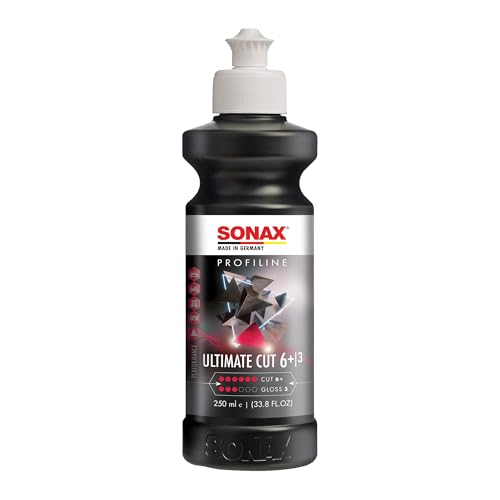
A heavy 800-grit cut that creates zero dust and zero dryness.
This German compound solves the two biggest annoyances of heavy cutting: dust and drying. It’s a water-based formula with a strong 800 grit abrasive that removes P1000-or-finer marks, and it creates no dust during compounding, so your pads stay clean longer and your garage doesn’t get coated in powder. One owner tested it against other brands after wet-sanding to 2k grit and found it cleared up almost every pigtail and scratch that the others couldn’t touch.
It uses cerium oxide as the abrasive, which is a finer-cutting agent that leaves a medium gloss OEM finish with minimal holograms. The single-step process saves real time compared to traditional clay-and-compound routines, and it’s recommended for rotary polishers with a 6-inch orange pad. Owners call it forgiving and easy to clean up, making it a go-to polish for most vehicles.
The small bottle is the main compromise—250ml won’t cover a full car correction—and a few owners found its cutting level slightly lower than expected on the deepest scratches. But for the dust-free, haze-free cutting it does deliver, it’s a premium step up.
Clean cutting: the water-based formula means no dust and no drying mid-pass.
Watch the size: at 250ml it’s best for spot-correction, with other products finishing full panels.
6. 3D One Hybrid Compound & Polish

A hybrid 1500-grit formula that cuts and polishes in a single pass.
Here’s the anti-multi-step argument in a bottle. 3D One is a hybrid that works as both a cutting compound and a finishing polish, removing swirls, scratches, and oxidation in one step. It uses a 1500 grit ceramic abrasive and is specifically engineered for true paint correction with flawless clarity, making it ideal for bringing faded paint back to life with minimal time. Owners confirm a stunning result: a metallic black Explorer came out with a glass-like wet shine, and the product removed about 20 scratches completely in seconds.
Its zero-dust formula is a major convenience, and it doesn’t dry fast, giving you more working time on the panel. It’s adaptable too—you can spot-correct by hand or polish full panels with a DA polisher, and it’s made in the USA. The ceramic abrasive gives it a slightly finer finish than traditional aluminum-oxide compounds.
The catch is depth. While it’s excellent for swirls and surface scratches, multiple owners mention it doesn’t remove deep ones that have penetrated the clear coat. It’s also a single 8-ounce bottle, so full-car jobs will need a second bottle.
One and done: the hybrid formula saves time by combining cut and polish in a single bottle.
Depth check: outstanding on moderate defects, but true gouges will still require a wet-sand step.
7. Turtle Wax Hybrid Solutions Scratch Repair Kit

The complete kit that fills scratches with clear coat resin, not just polish.
This boxed kit takes a different approach for deep damage: instead of only grinding down paint, it uses a clear coat resin that fills and protects the affected area for instant gloss. That’s a crucial difference from the pure compounds above—it can actually hide the scratch physically rather than leveling the paint around it. The kit includes a polishing compound, clear coat resin, foam applicator block, three non-linting cloths, and gloves, so everything you need is in the box.
Buyers found it extremely versatile, even calling it an industrial resin/solvent clear coat restorer that removes worn clear coat and oxidation. The recommended two-step method—wipe on and off the resin first, then compound—gives durable results lasting over a year, and the kit covers roughly half a four-door car. On a Jeep, it effectively minimized brush scratches until they were nearly invisible.
The honest limit: a deep scratch becomes less noticeable, not gone—one owner said it reduced visibility but didn’t eliminate it. For surface-level damage, this all-in-one convenience is tough to top.
Everything in the box: the resin-fill approach tackles scratches that pure compounds can’t level away.
Expectations set: deep gouges fade to “less noticeable” rather than disappearing completely.
8. Carfidant Scratch and Swirl Remover Kit
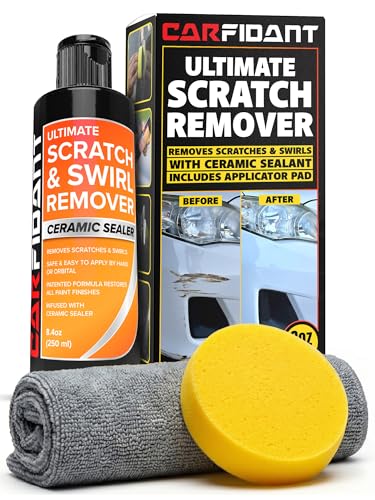
A ready-to-use kit for erasing light scratches in under five minutes.
For light surface scratches and swirls, this is the quickest fix on the list. The kit includes a spray bottle of compound, a foam pad, and a microfiber towel, so you start immediately without extra tools. Buyers found it effective right away: one removed garage door scratches from a back panel completely, and another cleared side-swipe scratches off a passenger door until it looked new—all in under five minutes.
The fine-grit rubbing compound is professional-grade but easy for any novice to handle, and it’s safe for clear coat, single-stage, and multi-stage paints. It also restores gloss and shine, removing water spots and oxidation along with the scratches. The kit is made in the USA and comes with a satisfaction guarantee that underscores the maker’s confidence.
The manual is honest about the limit: if you can feel the scratch with your fingernail, this product won’t help much. A few owners found it comparable to hand-applied wax on deeper damage, so treat it as a surface-level eraser, not a heavy-cut compound.
Instant results: removes light scratches and restores gloss in minutes with the included pad.
Surface only: the fingernail test is your guide—if it catches, you need a heavier product.
9. Chemical Guys C4 & P4 Paint Correction Kit
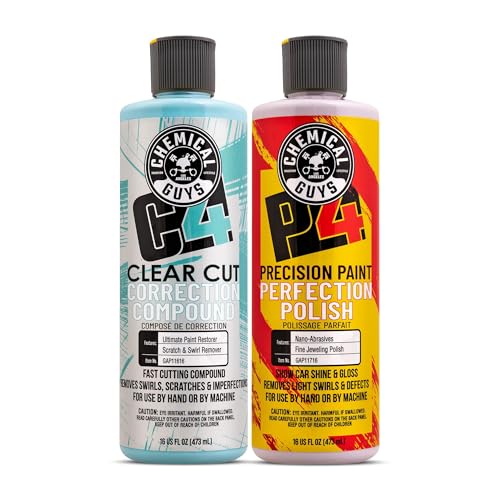
The proper two-step kit that cuts with C4, then polishes to a show gloss with P4.
This is the full-system answer for enthusiasts who want body-shop quality at home. You get two 16-ounce bottles: C4 Clear Cut Compound for removing defects like scratches, swirls, oxidation, and etching, then P4 Precision Polish to refine the paint to a flawless high-gloss finish. It’s a true two-step approach—the C4 cuts, the P4 finishes—which is the professional method that single-bottle products can’t replicate. With a 2000 grit ultra-fine rating, it’s calibrated for a show-quality result.
Real-world results are impressive: one owner reported removing 95% of off-road bush scratches with the remaining ones barely visible, and another saw a 7-year-old black truck come back to life with swirls gone. It’s safe on clear coat, single-stage, and ceramic-coated vehicles, and works with dual action, rotary, or hand application. Both bottles together mean a serious amount of product for the money, and owners often have half the kit left after a full correction.
The only note is that on very hard clear coats, the C4 cut can be slightly less aggressive than hoped—one owner found it needed more pressure on a ’99 Corvette. But as a complete, user-friendly correction system, it’s the most thorough answer here.
The pro method: separate cut and polish steps deliver a deeper, more durable gloss than one-step bottles.
Hard paint patience: on ultra-hard clear coats, budget more passes to reach the full cut.
Understanding the Specs
Grit Number & Abrasive Material
The grit number tells you how coarse the abrasive particles are—lower numbers like 40 and 120 cut fast for deep scratches, while higher numbers like 1200 and 2000 are finer for light haze and final finishing. The material matters too: aluminum oxide is the common workhorse, while cerium oxide (in SONAX) and ceramic abrasives (in 3D One and Chemical Guys) leave a finer finish with less micro-marring (tiny scratches you can see in bright light).
Work Time & Dusting
Work time is how long a compound stays wet on the panel before drying out. A longer work time means more passes per application and less product wasted to dusting. Dusting is the chalky powder that forms when a compound dries mid-buff, and it’s the #1 frustration with heavy-cut products—it resettles on the paint and requires extra cleanup. Water-based formulas are the fix, staying wet longer and leaving zero dust.
Clear Coat Safety
Every compound physically removes a microscopic layer of clear coat to level the scratch around it. That’s why heavy cuts are a “use once per correction” tool. Products labeled clear coat safe—like Meguiar’s M105 and M04—are formulated to avoid etching or marring the clear layer. If your paint is old, thin, or already corrected multiple times, you risk cutting through to the color coat, so gentler products are the safer route.
Application Method
Rotary buffers spin fast and cut hardest but require skill to avoid burning paint. Dual-action (DA) polishers oscillate and are more forgiving, making them the beginner’s choice. Hand application is the slowest and least effective for deep damage. Match the compound to your tool: heavy 40-grit cuts like Meguiar’s M04 are designed for rotary, while hybrids like 3D One are marketed specifically for DA and hand use.
FAQ
Can I remove a scratch that I can catch with my fingernail?
What is the difference between a compound and a polish?
Which grit number should I choose for deep scratches?
Will heavy compound damage my clear coat?
Can I use these compounds by hand instead of a machine?
What is the difference between a rotary buffer and a dual-action polisher?
Why do some compounds create so much dust and others create none?
Is a scratch repair kit with resin better than a pure compound?
How much area will a single bottle of compound cover?
Final Thoughts: The Verdict
For serious cut and easy use, the Griot’s Garage BOSS Correcting Cream is the crowd favorite—it stays wet through 8 passes, dusts minimally, and delivers mirror finishes that convert owners to the brand. If you want show-quality gloss with a two-step system, the Chemical Guys C4 & P4 Kit is the complete answer. For the budget DIYer fixing scratches with a drill pad, the fast-cutting Menzerna Heavy Cut 1000 delivers big results from a small bottle.
How We Picked
We do not accept paid placement. Every pick is matched to a real buyer and a real use-case; we do not hands-on test units.
Sources & Methodology
Specifications: manufacturer listings and product documentation. Review insights: verified customer reviews, as of August 2026. Pricing: not shown on this page (it changes often); check the current price via the retailer link.
As an Amazon Associate, Gadgets Feed earns from qualifying purchases. This does not affect which products we feature.