
Our readers keep the lights on and my morning glass full of iced black tea. As an Amazon Associate, I earn from qualifying purchases.
Specs are compiled from manufacturer listings and verified buyer reviews and can change over time — please confirm the key details on the product page before buying.
An auto dimming welding hood is the one piece of gear that decides whether you can actually see your weld puddle — or whether you spend the afternoon squinting at a green blur. The lens has to darken the instant the arc strikes, clear up fast enough to position your next tack, and hold true color so you can read the puddle instead of guessing. This guide cuts to the nine hoods worth your money and explains, in plain terms, which ones suit a weekend garage project and which ones survive a full fabrication shift.
I’m Min — the founder and writer behind Gadgets Feed. This guide is built by comparing the manufacturers’ published specifications and the patterns across verified customer reviews, so you get each pick’s real strengths and trade-offs instead of marketing spin.
Every pick here uses a true auto-darkening filter, so your eyes stay covered the moment the arc lights up. Below you’ll find the honest breakdown of the best auto dimming welding hood options for shop work, hobby welding, and tight-space jobs.
Our Picks at a Glance

How To Choose The Best Auto Dimming Welding Hood
A welding hood is a filter you wear on your face, so the three things that actually change your day are how fast the lens goes dark, how wide and clear the window is, and how the headgear sits after hour three. Everything else — graphics, brand hype, extra decals — is decoration. Get those three right and you stop getting flashed, stop lifting the hood to see, and stop fighting the headband.
Switching Speed: The Number That Protects Your Eyes
Switching speed is how long the lens takes to go from clear to fully dark after the arc starts. It’s written as a fraction of a second, like 1/25,000 or 1/30,000, or in decimals like 0.00003 seconds. Faster is safer, because the gap before the lens darkens is exactly when your eyes take the hit. The models on this list sit in the 0.00003-to-1/23,000 second range. For most hobby and shop welding, anything at or below 1/20,000 is doing its job — and all nine picks clear that bar easily.
Optical Class and True Color Explained
You’ll see a four-number code like 1/1/1/1 stamped on the lens spec. It grades optical clarity, scattered light, variation in shade, and how the lens looks at an angle. A 1 is the best score in each slot. True color (sometimes called 1/1/1/1 optics with true color technology) means the lens tints your view in realistic color instead of the old green haze, which makes the puddle and the seam far easier to read. A couple of picks here — the TOOLIOM and the Jackson Safety — carry a full 1/1/1/1 rating.
Viewing Area, Shade Range, and Power Source
Viewing area is the size of the clear window, measured in inches or square inches. It runs from a 6-square-inch lens up to a 3.94″ x 7.06″ panoramic screen on the ARCCAPTAIN. Shade range is the darkness you can dial in — 5-9/9-13, 8-13, or 3/5-14, depending on the hood. A wider range lets you go light for low-amp TIG and dark for heavy arc. On power, solar panels with battery backup are standard at this tier; some hoods run on standard AAA or CR2 batteries you can swap at any hardware store, and a few use coin cells. That last detail matters more than people expect once a battery dies mid-project.
Quick Comparison
| Model | Best For | Shade Range | Viewing Area | Arc Sensors | Amazon |
|---|---|---|---|---|---|
| Hobart 770890★ Best Overall | All-day shop welding | Weld & Grind modes | 9.3″ widescreen | 4 | Amazon |
| TOOLIOM TL-31800HBest Value | Weld, cut, and grind jobs | 5-9/9-13 (DIN 3 light) | 3.94″ x 3.66″ | 4 | Amazon |
| ARCCAPTAIN LY800JWidest View | Panoramic field of view | 5-9/9-13 (DIN 4 light) | 3.94″ x 7.06″ | 4 | Amazon |
| Lincoln Electric K4983-1 | Multi-process hobby welding | 7-13 + grind | 4.33″ x 3.54″ | — | Amazon |
| Antra DP9-01 | Low-amp TIG and precision work | 5-14 (shade lock) | 3.86″ x 3.23″ | 4 | Amazon |
| Lincoln Electric K3419-1 | Occasional and beginner welding | 7-13 + grind | — | — | Amazon |
| ESAB Savage A40 | Clear-view TIG and stick | Variable + grind | Full-plate clarity | 4 | Amazon |
| Miller Classic ClearLight | Precision welding below 5 amps | 8-13 / cut 5-8 / grind 3 | 6 sq in | 2 | Amazon |
| Jackson Safety Insight | Tight-space and overhead work | 9-13 + torch/grind | 3.94″ x 2.36″ | 4 | Amazon |
In‑Depth Reviews
1. Hobart 770890 Auto-Darkening Welding Helmet, Large, Black
Our pick — over 4.5★ from 850+ verified ratings; the strongest balance of quality and price.
A 9.3-inch PureColor widescreen with four arc sensors and a 1.25-pound polyamide nylon shell that survives drops and rain.
If you weld most days of the week, this is the hood that stops being a decision. It runs a PureColor lens, which means the view through it is colored accurately rather than the faded green you get on older filters — so the puddle reads the way it actually looks, not through a tint. The viewable area is a 9.3-inch widescreen, one of the larger windows in this group, and four independent arc sensors (small detectors that each watch a different zone for the arc) mean the lens darkens reliably even when your hand blocks part of the helmet. An auto-on/auto-off power control triggers the lens the moment the arc strikes, so there’s no button to remember before you pull the trigger.
The controls are analog knobs rather than digital buttons — shade, sensitivity, and delay, each adjusted with a turn. If you switch between stick, MIG, and grinding in one session, the Weld-to-Grind mode switch saves you from swapping helmets mid-job. That’s the reason this one sits at the top of the list: it’s set up for how a working welder actually moves through a day. In the words of one long-term owner, it’s held up after being “dropped, rained on some and still going strong” for 11 months of daily use — a durability note that lines up with the polyamide nylon shell and 1.25-pound build.
The honest catch is optional: there’s no external grind button, so switching to grind mode means popping the helmet up to flip the internal control. That’s a non-issue if you’re welding in long stretches, but it’s the thing to know if you grind and tack in rapid alternation. Otherwise the build, view, and price point are the reasons this earned its spot at #1.
what separates it
- 9.3″ widescreen view with PureColor lens for accurate color
- Four independent arc sensors for reliable triggering
- Analog shade, sensitivity, and delay knobs for quick tuning
- Weld/Grind mode switch built in
- Runs on standard CR2 lithium batteries (included)
- 1.25-pound polyamide nylon shell that shrugs off drops and rain
Worth Knowing
- Grind/weld switch is internal — no external button
- Analog controls lack the digital precision of premium rivals
- Some owners find headgear comfort average over long shifts
Buy it if: you weld most days of the week and want a widescreen, accurate-color hood that survives drops and rain without needing replacement four months in.
Look elsewhere if: you’re a hobby welder who only fires up the machine a few times a year and doesn’t need a 9.3-inch view to see your work.
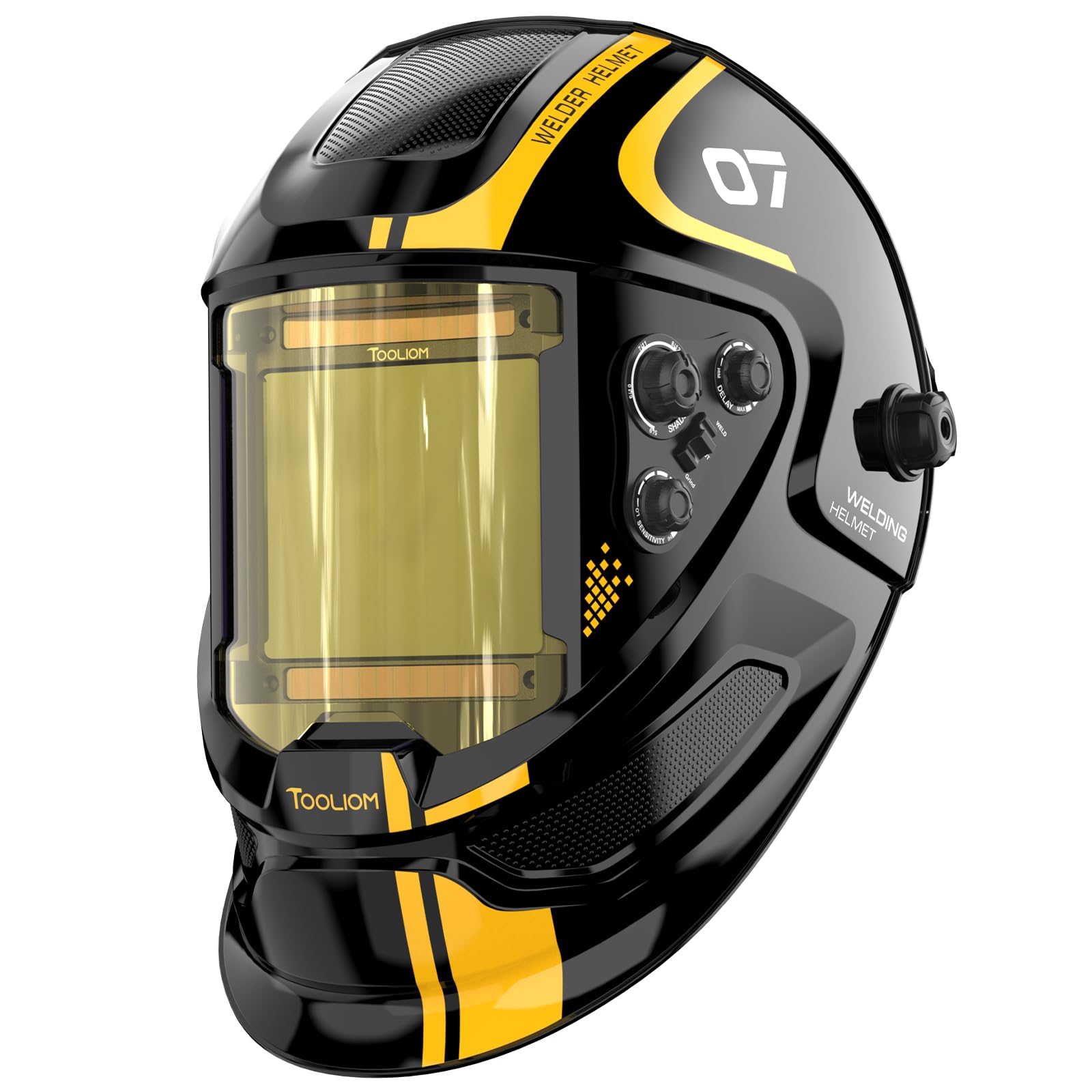
2. TOOLIOM Auto-Darkening True Color Welding Helmet with 3.94 x 3.66 View
A 0.00003-second filter with full 1/1/1/1 optics and a 14.4-square-inch true-color view for under.
Start with the spec that matters most on a budget hood: switching speed. This one darkens in 0.00003 seconds — the fastest number in this entire group, matching the Miller’s 1/23,000-second time from the opposite price tier. Combine that with a 1/1/1/1 optical class rating (the top score across all four clarity categories) and true color technology, and you get a lens that’s genuinely easy to read through rather than a green smear. The 3.94″ x 3.66″ viewable area — that’s 14.4 square inches — gives you more glass to work with than the Lincoln K4983-1’s 4.33″ x 3.54″ window for a fraction of the cost.
Shade range spans 5-9 and 9-13 in dark state with DIN 3 in light state, and the four arc sensors track the arc across Weld, Cut, and Grind modes. Power runs on both a replaceable lithium battery and solar energy, which means the battery is a backup rather than the primary — no mid-job death from a drained cell. The headgear is a butterfly-style sweat-absorbing design with adjustable joints, so you can dial in the fit without fighting a stiff band.
Where the honest limits sit: the shade retention and auto-darkening feedback is mixed — some welders find the shades spot-on, a few don’t. And an occasional unit’s headpiece has cracked under hard use. That’s not a pattern, it’s the trade for the price, and it’s why this hood reads best as the everyday choice for hobby and mid-volume work rather than a full-fabrication-shop daily driver. If you weld a few hours a week or are learning, the value is very hard to argue with.
Why this ties the top: a 0.00003-second switch and full 1/1/1/1 optics is the spec combo that usually costs multiples of what this hood goes for — and it’s why so many welders step up from an older flip-lens model the moment they try this view.
Reach for this if: you want true-color clarity and the fastest switching speed here while keeping budget on your side — it’s the smart first auto darkening hood.
Think twice if: you weld eight-hour shifts where a single cracked headpiece would leave you without a backup.
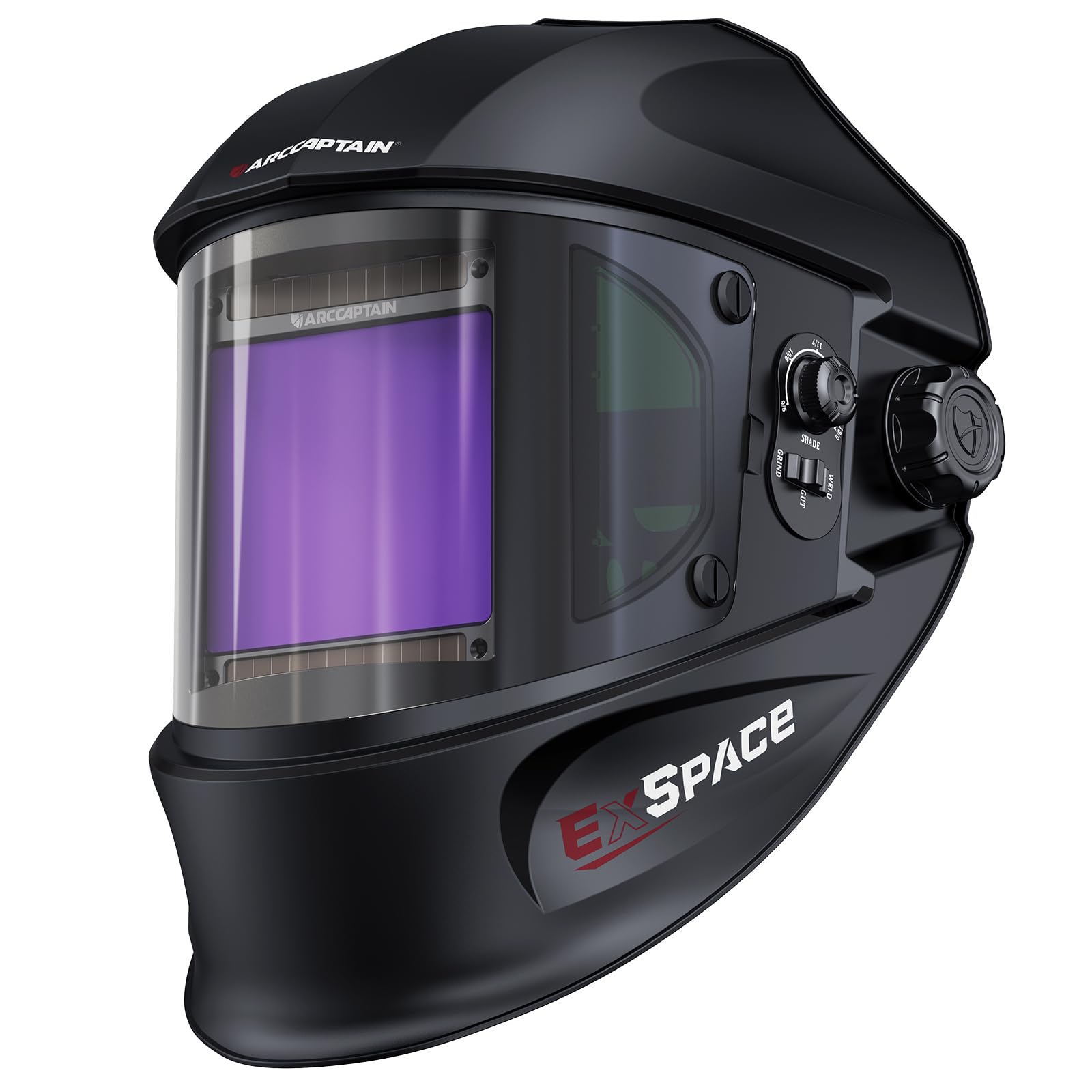
3. ARCCAPTAIN Welding Hood, 180° Panoramic View Auto Darkening Welding Helmet
A 3.94″ x 7.06″ screen with two DIN 5 side views, so you can see around the joint without turning your head.
Most hoods give you one window. This one gives you a screen that spans 3.94″ x 7.06″ — that’s a 3.94″ x 3.66″ auto-darkening center (DIN 16 protection) flanked by two 3.94″ x 1.70″ non-auto-darkening side views at DIN 5, so you can see around the weld without craning your neck. The wider view matters most in tight fabrication work where you need context around the joint, not just the puddle itself. Four arc sensors switch the lens in 1/25000 seconds, and the shade range runs 5-9/9-13 with a DIN 4 light state — that light-state number being higher than the TOOLIOM’s DIN 3 means the ARCCAPTAIN tints slightly more when you’re not welding, which some like and some don’t.
Power comes from two solar panels on the front plus two CR2450 lithium batteries on the back, which the maker says gives several years of working time. The knob section was redesigned so you can adjust settings with gloves on — a real convenience on a cold jobsite. The shell is eco-friendly PP material with a stated operating range of -5°C to 55°C and a flexural modulus of up to 4000 MPa, all of which just means it flexes without cracking in cold or hot shops.
The recurring gripe is fit: this hood runs small, and several welders report it — one owner actually said it was “a bit big for my head but it works, wish it had more adjustment,” while others found it snug. If you wear a cap under your hood or have a larger head, that’s the piece to consider before buying. The headgear locking mechanism also drew a durability concern from one welder who returned to a Miller Elite. For hobbyists and light-fabrication work, the panoramic view is genuinely hard to match at this tier — for all-day pro use, the Lincoln and ESAB options hold up better.
Best Use Case
- 180° panoramic screen with side views for wide field of vision
- 1/25000-second switching speed across four arc sensors
- Dual solar panels plus two CR2450 batteries for years of service
- Glove-friendly knob adjustment while wearing the hood
- Comes with replacement lens and a storage bag
Before You Buy
- Runs small — several welders report it fits snug or too tight
- Headgear locking mechanism drew a durability complaint
- DIN 4 light state is darker than some welders prefer between arcs
The right fit: welders who need peripheral vision in cramped positions — pipe work, vehicle frames, tight fabrication jigs — and can work with a snug headband.
skip it if: you have a large head or wear a cap under your helmet, because the small shell is the one consistent complaint.
4. Lincoln Electric K4983-1 No Rules No Limits Welding Helmet

Stick, TIG, MIG, Flux Core, and Gouging in one shell, with an external shade dial you can turn with gloves on.
Run down the process list on this one and you’ll see why it earned a spot: Stick, TIG, Pulsed TIG, MIG, Pulsed MIG, Flux Core, and Gouging, all with a variable shade of 7-13 plus a separate grind shade. Fewer hoods on this list carry that range in one shell. What welders actually notice day-one, though, is the external adjustment switch — you change the grid setting without popping the hood or fumbling for internal dials. That’s the difference between a quick tack and a stalled weld. The 4.33″ x 3.54″ viewing area is generous for the price tier, and the solar-plus-battery-backup power runs on two included AAA batteries rather than the short-lived coin cells that cheaper hoods often use.
Lincoln rates this for TIG as low as 5 amps, so thin-material work doesn’t leave you guessing whether the sensor will fire. ANSI Z87.1 certification, a nylon shell at 17.5 ounces, adjustable ratchet headgear, and an oversized absorbent sweatband round out the practical package. It ships with two extra impact-resistant inside and outside clear lenses, so you have spares from day one.
What you won’t get is a wide-sweep auto-darkening lens or the extreme clarity of a 1/1/1/1-rated filter. This is a basic, dependable helmet with a fast response — the welders who like it for hobby and light-duty work call that trade a good deal, especially since it’s backed by a 2-year warranty and available replacement parts. A couple of owners came here after two import helmets failed in a year, and it stuck.
What it wins on: process flexibility plus an external shade adjuster you can work with gloves on — you’re not flipping the whole helmet up just to change from Stick to TIG.
Built for: the welder who switches processes constantly and wants a name-brand hood with spare lenses, AAA batteries, and a warranty behind it.
Not for: dedicated TIG welders at very low amperage who need the widest possible view and a full optical-class rating.
5. Antra True Color Top Optical 1/1/1/1 Wide Shade 3/5-14 Auto Darkening Welding Helmet DP9-01

A 5-14 shade range with a >2 A DC TIG rating, so even the lightest TIG arc triggers the filter.
Wider shade range is the single reason this hood exists on a shortlist. The Antra DP9-01 covers 5 to 14 versus the 7-13 on the Lincoln models and the 8-13 on the Miller Classic, so it’s the flexible pick for a shop that runs everything from low-amp DC TIG to heavy plasma cutting. The full 1/1/1/1 optical class and true color technology mean the 3.86″ x 3.23″ view (12.5 square inches) shows you a clear, accurate puddle rather than a green-tinted frame. Four premium redundant arc sensors provide coverage that also helps when your hand or work blocks one sensor’s view.
The features that set this one apart for precision work: a Shade Lock that freezes the lens at a fixed shade temporarily, a Shade Test button to verify the lens responds before you commit, and inside shade settings with memory to keep your tuned values from getting knocked out of place. The low DC TIG rating is notable — the maker’s spec reads “> 2 A” — so even very light TIG triggers the filter. Corner-spread arc sensors overcome positions with blockage, which is what fabricators want when working around tubing. Power runs on solar with replaceable batteries in easy-access compartments, and there’s no reverse-charge drain on the cell.
The catch is the headgear. Several owners swap it out — one big-headed buyer moved to a Lincoln Viking headgear with minor mounting-hole modification and said it was “no fault of Antra.” For everyone else, the fit is comfortable and adjustable from the start. If you already know you’ve got a larger-than-average head, factor that into the decision. Otherwise, this is among the most capable precision lenses on the list.
Why pros pick it: the 5-14 shade spread and > 2 A DC TIG rating put it in the same specialist league as much pricier lab-grade hoods, at a mid-range price point — and its corner-spread sensors handle blockage from awkward angles.
Pick this if: you work a mix of plasma cutting, low-amp TIG, and grinding, and want a precision lens with shade memory and a shade-lock feature.
Skip if: you know you need headgear that fits a larger head straight from the box and don’t want to modify the mounting holes.
6. Lincoln Electric K3419-1 Glossy VAR 7-13 W/Grind ADF Helmet

A 1.5-pound Lincoln with variable 7-13 shade, nod-to-drop headgear, and standard AAA batteries.
If you’re learning to weld or only pull out the machine on weekends, this Lincoln K3419-1 is the mid-range pick that keeps the project moving without asking you to fight the gear. The polycarbonate shell weighs in at 1.5 pounds — the lighter end of this group — and the adjustable ratchet headband with an oversized absorbent sweatband lets you dial in the fit and keep the hood up on your head between tacks. Variable shade 7-13 covers Stick, TIG, Pulsed TIG, MIG, Pulsed MIG, Flux Core, and Gouging, so one hood sits over all of them. The nod-to-drop headgear has audible and tactile gears, so you know when the lens has closed without looking.
The undimmed view reads bright and clean — one welder stepping up from an Antra found this one brighter before darkening — and dimming feels fast and smooth when the arc lights up. It uses standard easy-to-replace batteries rather than cramped coin cells, which matters when you’re swapping on-site. The field of view scores well with owners and the digital adjustability across shade, sensitivity, and delay lets you tune each process.
The honest trade: dimming speed gets mixed feedback, and a couple of buyers report occasionally getting flashed during consistent long-stretch welding. The headband also drew a comfort note after hour-long sessions. For a hood that handles every common process in one shell and wears a name-brand label, though, it earns its keep for hobby and infrequent use. Not the pick for someone welding eight hours a day, six days a week.
The Strong Points
- Sits at 1.5 pounds — one of the lighter shells here
- Variable shade 7-13 covers Stick, TIG, MIG, Flux Core, and Gouging
- Nod-to-drop headgear with audible and tactile gear feedback
- Bright, clear undimmed view with standard easy-swap batteries
- Oversized absorbent sweatband and ratcheting fit
The Catches
- Dimming speed is mixed — long stretches of welding occasionally cause a flash
- Digitized controls for shade, delay, and sensitivity
- Headband comfort after hours of wear gets a mention
Good fit for: weekend welders and beginners who need one hood to cover every common process and don’t want to spend on a pro-tier filter.
Skip if: you weld full shifts daily and need dimming that never misses on long stretches.
7. ESAB 0700000480 Black Savage A40 Welding Helmet
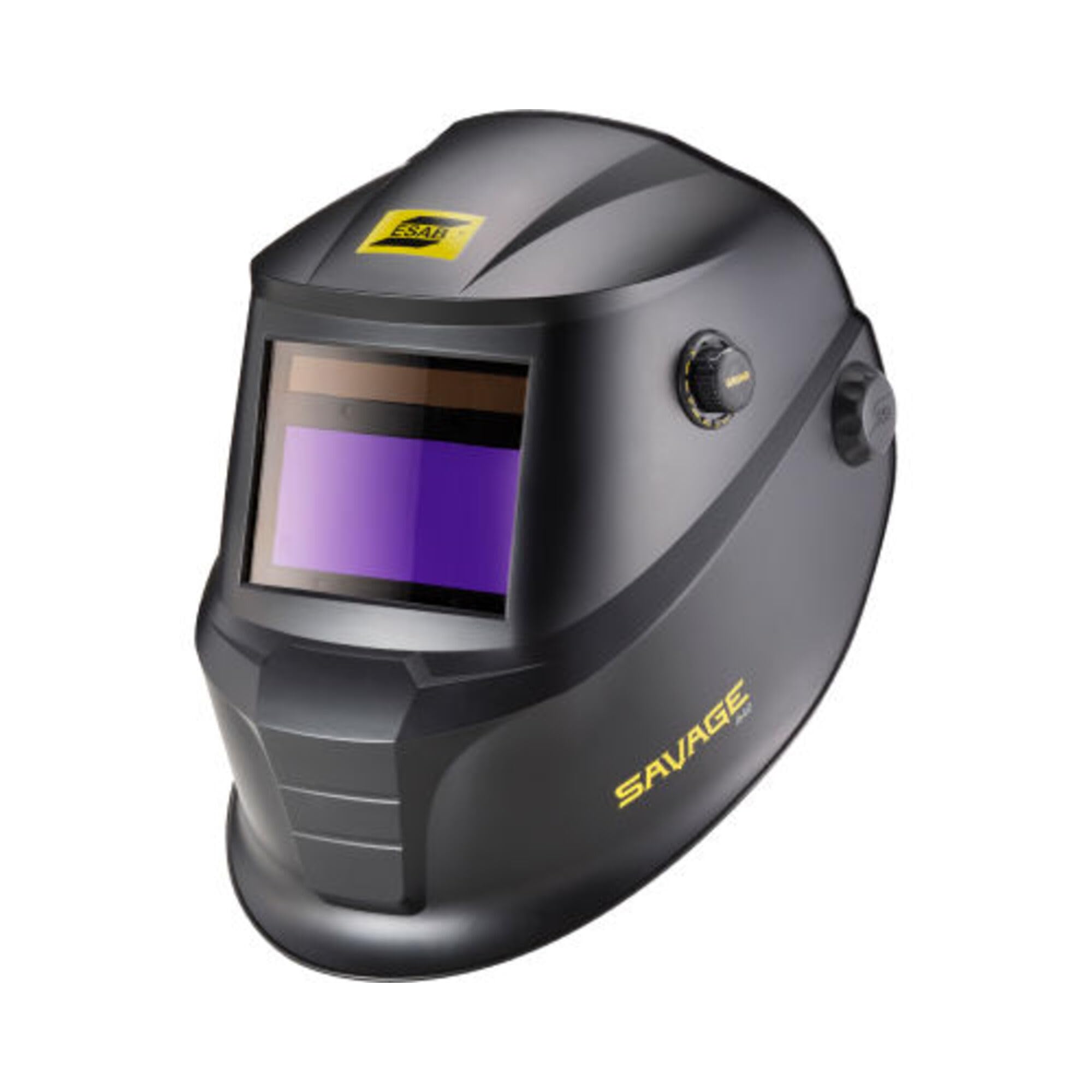
Full-plate clarity with four arc sensors, an external grind button, and adjustable delay for tack welding.
Clarity is the ESAB Savage A40’s whole pitch. Welders stepping up from budget hoods describe the view like welding without the tint — puddle, arc, and bead all legible at once. One novice said the switch instantly showed them the puddle and seam that a cheaper hood had hidden completely. A more experienced welder traded a Lincoln Viking 3350 for it and calls it the best hood they’ve owned. That level of clarity is why this hood is worth its tier. The lens runs on four arc sensors for quick darkening response.
The controls are built around real workflow. Sensitivity adjusts for low-amp TIG so the filter reacts to darker arc light. Delay control lets you set how long the lens stays dark after the arc stops — short delay speeds up tack welding, longer delay suits high-amp work. There’s an external grind button you can hit without lifting the hood, which matters when you bounce between welding and grinding in the same pass. The lens also stays lit enough that you can position the first tack without raising the shield.
The knock is the external shade knob on the A40 — it can get bumped in tight spaces. ESAB fixed that on the A41, so if you work exclusively in tight quarters, that’s the honest caveat. It also runs on a CR2 battery plus a solar panel, so dead-battery surprises are rare. Short of that shade knob, this hood is a strong full-plate performer for anyone running MIG, TIG, or Stick in normal shop conditions.
The scene in one line: a hobbyist who nearly walked away from welding because they couldn’t see the puddle through a budget hood put this one on and saw the seam immediately — clarity like this changes what you’re able to learn.
Recommended for: welders who prioritize seeing the puddle above all else and want an external grind button and short-delay tack welding control in one hood.
Consider carefully if: you work mostly in tight, cluttered spaces where the external shade knob could get bumped.
8. Miller Classic Series Welding Helmet, ClearLight, Shade 8-13, Black
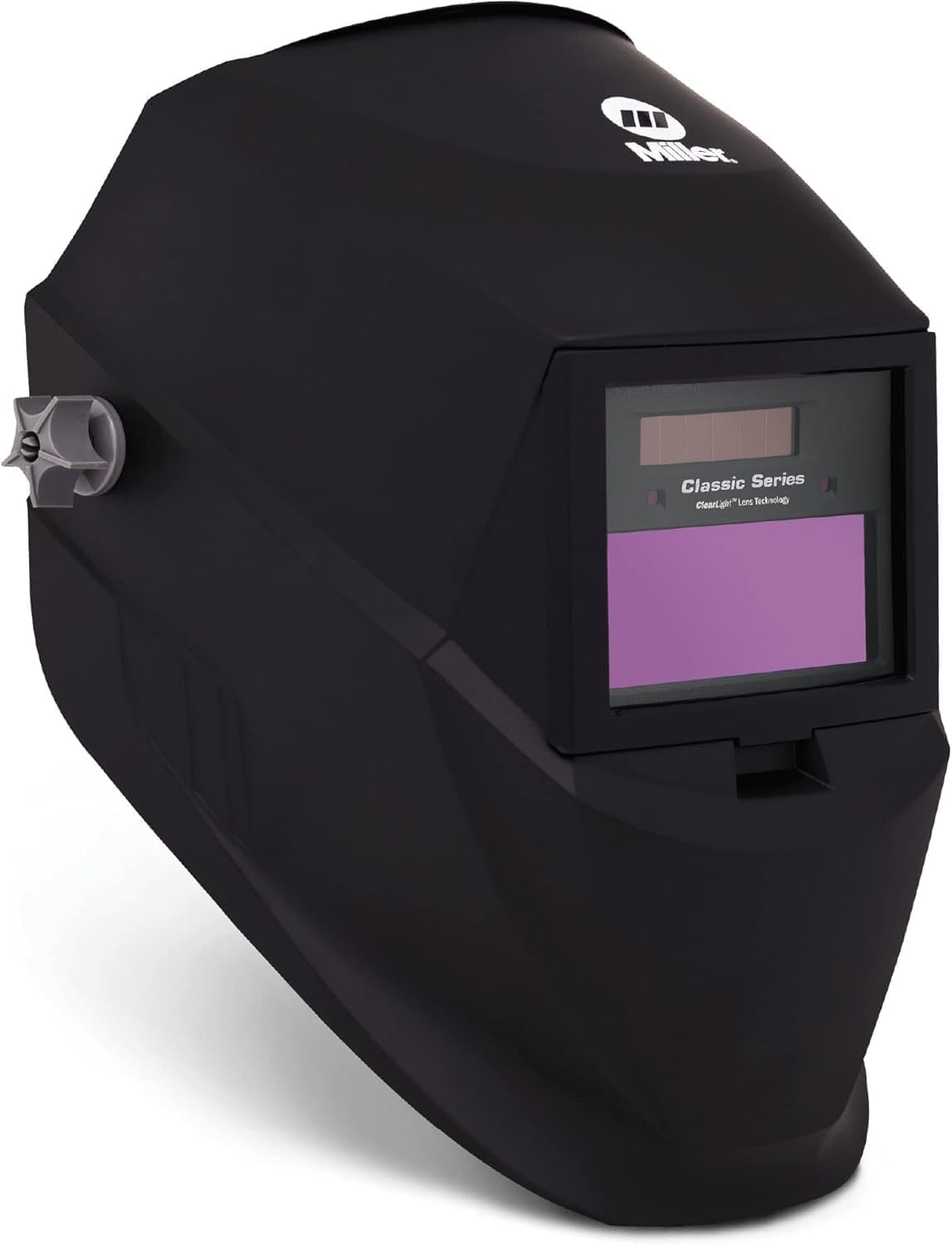
ClearLight optics rated for five amps and below, with a 3.0 light state you can leave down between tacks.
Miller’s Classic carries the ClearLight lens technology, and the spec that matters most for its buyer is right there in the rated amp floor: this hood is built for welding at five amps or below. That makes it the fit for precision TIG work where cheaper auto-darkening filters struggle to fire. Shade range runs 8-13 in weld, 5-8 in cut, and 3 in grind, with a 3.0 light state that lets you keep the hood down between welds instead of flipping it up — a real time-saver on multi-tack work. Two arc sensors switch the filter in 1/23,000 seconds (0.0000435 seconds), and an auto-on power control activates the lens at the strike of the arc.
Adjustability is digital — shade, delay, and sensitivity are button-controlled rather than dial-turned, and the ratchet headgear holds the fit where you set it. The 6-square-inch viewing area is the smallest on this list, but the ClearLight lens makes the most of the space with high-definition optics. Safety standards cover ANSI Z87.1+, CSA, and CE, and Miller backs it with a three-year warranty — the longest in this group.
The honest trade-offs: fewer arc sensors than the four-sensor hoods on this list, and a couple of owners mention the lens needing frequent replacement. The plastic headband also drew a “doesn’t hold when sweating” note from one welder. Where it wins is on the low-amp TIG work that most budget hoods can’t handle and on Miller’s warranty support. Definitely the hood for precision welding, not the all-day fabrication-shop grinder.
Best trick up its sleeve: the 3.0 light state and the below-five-amps rating — you keep the hood down between welds without raising it, which is the productivity story this Miller tells most clearly.
Ideal owner: precision TIG welders who work below five amps and want ClearLight optics, digital controls, and a three-year warranty backing it.
Look elsewhere if: you need a wider viewing area or a headband that stays put through heavy sweating.
9. Jackson Safety Insight Auto Darkening Welding Helmet, ADF Hood — ANSI Z87.1
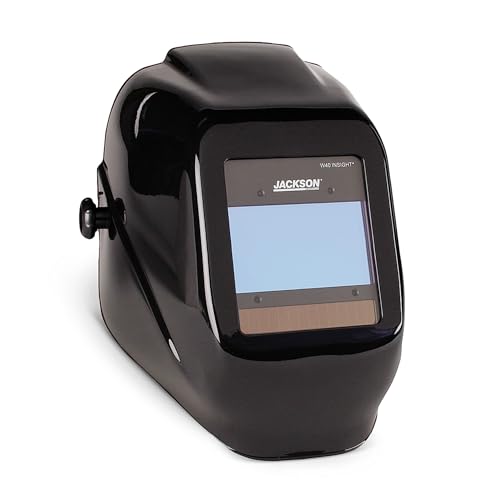
Six ounces on your head and full 1/1/1/1 optics — the lightweight hood that keeps your neck from complaining.
Six ounces. That’s the number that separates the Jackson Safety Insight from the pack — it’s the lightest shell here, and it’s why welders who work overhead or in tight positions keep coming back to it. The HLX shell design with a 3.94″ x 2.36″ viewing area lets you see the work without lifting the hood, and the 1/1/1/1 optical clarity rating is the top score, matched only by the TOOLIOM on this list. Variable shades run 9-13 with True Color technology, and the digital controls cover sensitivity and delay across Weld, Torch, and Grind modes. Four arc sensors reduce blockage and broaden coverage.
The ratcheting headgear uses Jackson’s patented 370 Speed Dial with a “Qwik-Fit” rear swivel headband and an “Easy Grip-Easy Turn” adjuster knob — the mechanics are set up for quick on-and-off and secure holding. It meets both ANSI Z87.1 and CSA Z94.3 standards, so it satisfies most industrial site requirements. Standard 4.5 x 5.25 cover lenses convert it into a very customizable hood loaded with off-the-shelf spare parts.
Where this one is honest: build quality is the topic that splits reactions. Owners who weld in the shop every day report durability in tight spaces and no complaints — a 9-month fab-shop user calls it the best value for the price, a lighter alternative to a Lincoln 3350 at half the cost. Some other users report the headgear loosening over time or the lens fogging in certain conditions. For occasional and daily welding, it’s still the pick with the best combination of feather weight and top optical clarity in this group.
What You Get
- 6-ounce HLX shell — the lightest hood here
- Full 1/1/1/1 optical clarity rating with True Color technology
- Digital controls across Weld, Torch, and Grind modes
- Patented Speed Dial ratcheting headgear with Qwik-Fit adjuster
- Meets ANSI Z87.1 and CSA Z94.3 standards
What To Watch
- Construction and durability feedback is mixed
- Headgear stability over time draws occasional complaints
- Narrower 3.94″ x 2.36″ viewing area than most hoods here
Made for this welder: anyone whose neck complains after long shifts — six ounces and full clarity is the lightest formula here.
Pass if: you want the widest possible viewing window and don’t mind more weight on your head.
Understanding the Specs
Switching Speed and Optical Class
Switching speed is how long the lens takes to go fully dark after the arc strikes, written as a fraction of a second (1/25,000, 1/23,000) or as a decimal (0.00003 seconds). Faster means less exposure to the flash your eyes take before the filter closes. The four-digit optical class (1/1/1/1) grades clarity, scattered light, shade uniformity, and angular view — a 1 in each slot is the best score. The TOOLIOM and the Jackson Safety Insight both carry a full 1/1/1/1 rating on this list; that’s what you look for when clarity is your priority.
Shade Range, Viewing Area, and Power
Shade range is darkness coverage — the Antra spans 5-14, the Lincoln models run 7-13, and the Miller runs 8-13 weld / 5-8 cut / 3 grind. Wider lets you weld lighter TIG and heavier arc from the same hood. Viewing area scales from the Miller’s 6-square-inch window up to the ARCCAPTAIN’s 3.94″ x 7.06″ panoramic screen. Power is solar plus battery on every hood here, but the battery type matters — the Lincolns run standard AAA or CR2 cells you can swap anywhere, while a couple of others use coin cells that take more effort to change.
FAQ
How fast does an auto darkening welding hood need to switch to protect my eyes?
Can I use an auto darkening hood for TIG welding?
What does a 1/1/1/1 optical rating mean on a welding lens?
Will a welding hood fit over my safety glasses or a cap?
What shade should I set for MIG, Stick, and TIG welding?
Do these hoods run on solar power or batteries?
How long should an auto darkening welding hood last?
Is a wider viewing area worth the extra money?
Will any of these hoods work for plasma cutting or grinding?
What is a “true color” lens and does it matter for welding?
Which hood is best for a welding student just starting out?
Final Thoughts: The Verdict
For most welders, the best auto dimming welding hood is the Hobart 770890 — the 9.3-inch widescreen PureColor lens and four arc sensors earn it the top spot here, and the 1.25-pound polyamide nylon shell held up through months of daily shop use without complaint. If spending more is the goal but you want the fastest switching speed and top-tier optics at an entry-friendly tier, take the TOOLIOM TL-31800H — that 0.00003-second filter and 1/1/1/1 rating punch well above their price. And for low-amp TIG precision work where ordinary filters struggle to trigger, the Miller Classic ClearLight is the one to reach for — it’s rated for five amps and below, backed by the longest warranty in this group. The catalogue prices move around, so check each listing before you commit; whichever you pick, buy the lens that fits the work you actually do.
How We Picked
We do not accept paid placement. Every pick is matched to a real buyer and a real use-case; we do not hands-on test units.
Sources & Methodology
Specifications: manufacturer listings and product documentation. Review insights: verified customer reviews, as of September 2026. Pricing: not shown on this page (it changes often); check the current price via the retailer link.
As an Amazon Associate, Gadgets Feed earns from qualifying purchases. This does not affect which products we feature.