
An auto document scanner does one thing that a flatbed or all-in-one printer simply cannot: feed a stack of paper through its rollers, capture both sides in a single pass, and deliver clean, searchable digital files without you hovering over a glass plate. For anyone processing invoices, client contracts, medical records, or stacks of receipts, the difference between a dedicated ADF scanner and a multi-function printer is measured in hours saved per week — not minutes. The right unit eliminates the bottleneck that paper creates in a digital workflow, turning a pile of documents into organized folders with a single button press.
I’m Min — the co-founder and writer behind Gadgets Feed. For this guide, I analyzed over 150 verified customer reviews across nine ADF-equipped models, cross-referencing scan speeds, sheet capacities, duplex capabilities, software ecosystems, and driver compatibility to separate the workhorses from the paper-eaters.
A sheet-fed auto document scanner with duplex capture and a reliable ADF is the only tool that makes paper digitization sustainable. After comparing speeds from 25 to 45 pages per minute, feeder capacities from 20 to 100 sheets, and the critical presence of TWAIN drivers or wireless freedom, this guide ranks the best auto document scanner across every real-world office scenario.
How To Choose The Best Auto Document Scanner
Choosing an auto document scanner means understanding four interconnected specs: duplex speed, ADF capacity, sensor type, and driver compatibility. A machine that scans quickly but lacks TWAIN support may lock you into proprietary software. A high-capacity feeder paired with a slow sensor creates a bottleneck. Every decision trades off one constraint for another, and knowing which trade-off fits your volume is everything.
Duplex Speed (ppm/ipm) vs. Sheet Capacity
Duplex speed is measured in pages per minute (ppm) scanning one side, or images per minute (ipm) scanning both sides simultaneously. A machine rated at 30 ppm captures 60 ipm. Pair that with a 20-sheet ADF and you burn through a stack in 40 seconds, but a 100-sheet ADF lets you load an entire file drawer and walk away. If you scan less than 50 pages daily, a 25 ppm scanner with a 30-sheet feeder is sufficient. For high-volume batch processing (200+ pages per week), 35 ppm and a 100-sheet ADF are the baseline.
Sensor Technology: CIS vs. CCD
CIS (Contact Image Sensor) scanners are thinner, lighter, and consume less power, but they have a narrow depth of field. Stapled pages or folded corners often produce shadows or blurred text. CCD (Charge-Coupled Device) sensors have greater depth of field, meaning they capture crisp text even on curved pages near the spine of a book or on thick cardstock. For mixed batches that include receipts, embossed cards, or stapled documents, CCD dramatically reduces rescans. The trade-off is bulk: CCD models are noticeably heavier and taller.
TWAIN/ISIS Drivers vs. Proprietary Software
If you scan into document management systems, accounting software, or any application that communicates directly with hardware, TWAIN or ISIS driver support is mandatory. Many consumer-friendly scanners bypass TWAIN entirely, using their own scan-to-folder application. This is fine for personal use, but in a business environment where you need to scan directly into QuickBooks, EMR systems, or SharePoint, a TWAIN-compatible model saves a step. Some mid-range units offer both a consumer app and a TWAIN driver — verify this before buying if you have specific software requirements.
Quick Comparison
On smaller screens, swipe sideways to see the full table.
| Model | Category | Best For | Key Spec | Amazon |
|---|---|---|---|---|
| ScanSnap iX2400 | Premium | High-speed one-touch workflow | 45 ppm duplex / 100-sheet ADF | Amazon |
| Epson ES-580W | Premium | Wireless scanning with touchscreen control | 35 ppm duplex / 4.3-inch touchscreen | Amazon |
| Epson RR-620W | Premium | Receipt categorization with AI data extraction | 45 ppm duplex / 100-sheet ADF | Amazon |
| Epson DS-770 II | Premium | Enterprise durability with TWAIN/ISIS drivers | CCD sensor / 100-sheet ADF | Amazon |
| ScanSnap iX1300 | Mid-Range | Compact wireless scanning for home offices | 30 ppm duplex / Wi-Fi connectivity | Amazon |
| Canon imageFORMULA DR-C225 II | Mid-Range | Mixed document handling with TWAIN | 25 ppm duplex / 30-sheet ADF | Amazon |
| RICOH SP-1130Ne | Mid-Range | Network scanning via Ethernet / multiple placement options | 600 dpi / Ethernet & USB connectivity | Amazon |
| Epson ES-C220 | Budget | Ultra-compact desktop scanning | 30 ppm duplex / 20-sheet ADF | Amazon |
| Canon imageFORMULA R30 | Budget | Plug-and-scan without driver installation | 25 ppm duplex / 60-sheet ADF | Amazon |
In‑Depth Reviews
1. ScanSnap iX2400 High-Speed Document Scanner
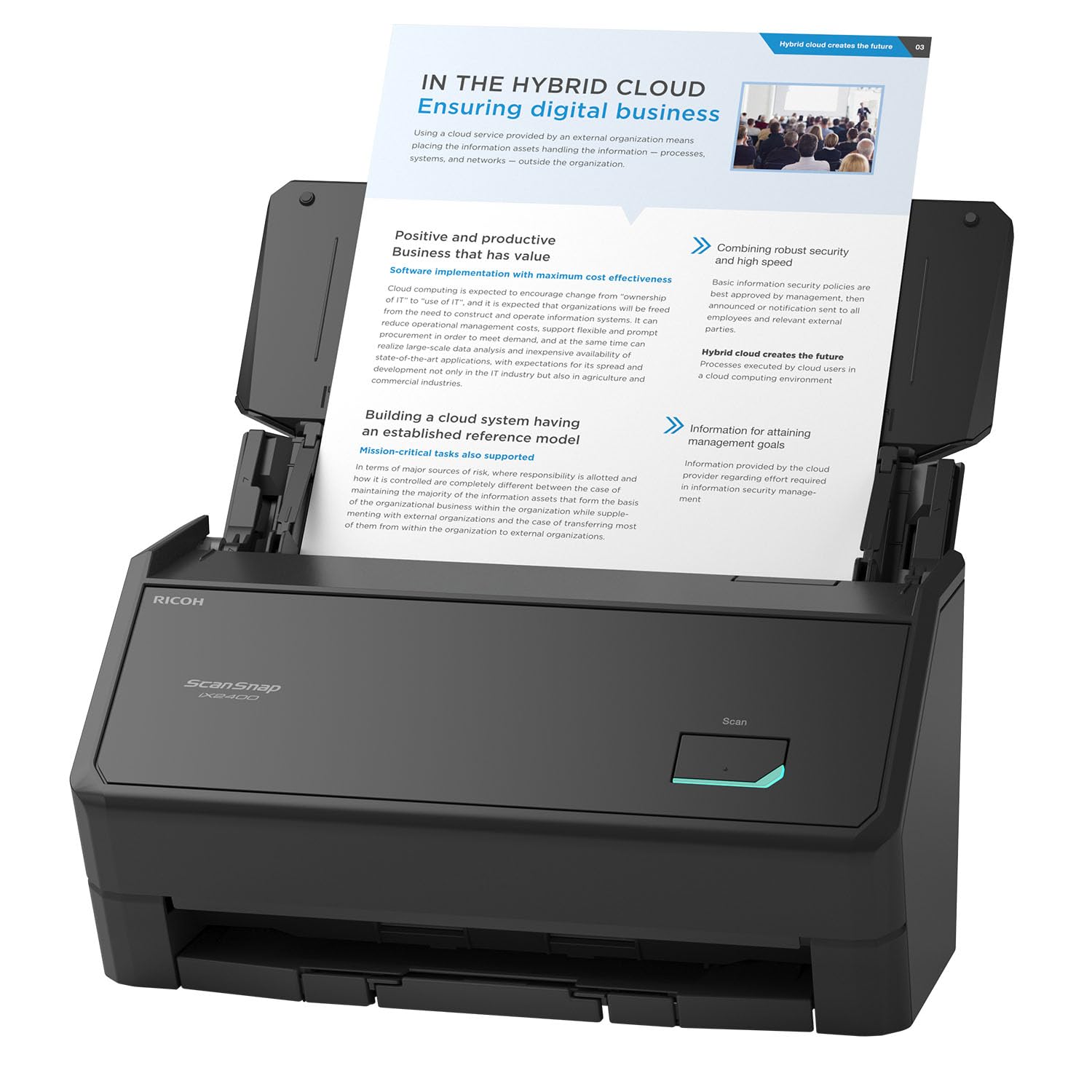
The ScanSnap iX2400 strikes the hardest balance of speed and simplicity in this lineup. Its 45 ppm duplex capture and 100-sheet ADF mean you can load a full folder of mixed-size documents, press one button, and walk away. Users report scanning over 500 pages in under an hour with zero jams — a pace that transforms a paper-heavy task into a background process. The one-touch Quick Menu eliminates driver configuration, routing scans directly to folders, email, or cloud services.
ScanSnap’s proprietary software handles automatic de-skew, blank page removal, and orientation correction without any manual intervention. The iX2400 is noticeably larger than the iX1300 at 7.1 pounds, but the extra weight comes from a sturdier chassis and a 100-sheet feeder track that rarely misfeeds. USB-only connectivity ensures consistent performance, though some users note the lack of TWAIN support limits integration with third-party document management systems.
For anyone who wants maximum throughput with minimal decision-making, the iX2400 is the clear leader. It is not for users who need to scan directly into QuickBooks or rely on TWAIN drivers for custom workflows, but as a standalone batch-scanning appliance, it outperforms everything in its price tier. The speed means you stop thinking about the scanner and start thinking about what you’ll do with the PDFs.
Why it’s great
- Duplex speed of 45 ppm translates to 90 images per minute — fastest in this roundup
- 100-sheet ADF allows unattended scanning of thick stacks
- One-touch button and automatic image cleanup remove all friction from the workflow
Good to know
- No TWAIN or WIA driver support restricts software integration options
- USB-only connection — no wireless or Ethernet option
- Heavier than competitors at 7.1 pounds, less portable
2. Epson WorkForce ES-580W Scanner
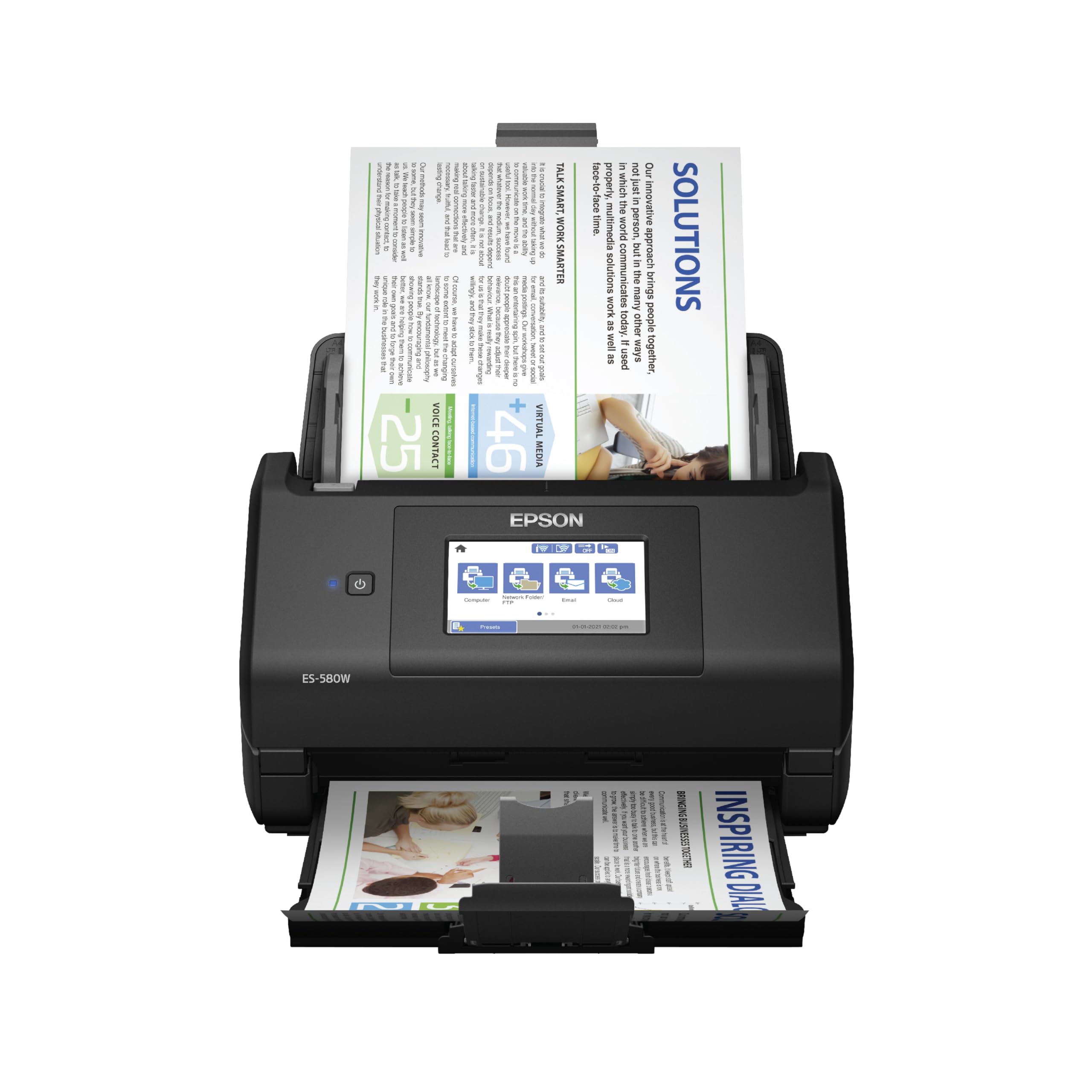
The Epson WorkForce ES-580W differentiates itself with a 4.3-inch color touchscreen that lets you initiate scans without a computer. You can save directly to USB, email, or cloud storage services like Dropbox and Google Drive from the scanner itself. This computer-free workflow is a genuine time-saver in shared office environments or for anyone who wants to scan from a desk without a dedicated PC nearby. The 100-sheet ADF handles mixed document sizes reliably, and duplex scanning at 35 ppm keeps backlogs manageable.
Epson’s ScanSmart software provides OCR to create searchable PDFs and converts scans to editable Word or Excel files. The ES-580W uses a CCD sensor, offering better depth of field for stapled pages and folded receipts compared to CIS-based alternatives. Users praise its reliability for high-volume scanning in notary and small-business settings, noting that the touchscreen configuration presets make recurring scan jobs effortless. Wireless setup is straightforward, and the scanner supports both 2.4 GHz and 5 GHz networks.
The absence of an Ethernet port is a notable omission for businesses that prefer wired network connections. Some users also report that the initial Wi-Fi setup can be finicky on older routers. However, for a wireless-centric document scanner that can operate independently of a host PC, the ES-580W delivers a level of autonomy that few competitors match.
Why it’s great
- Standalone scanning via 4.3-inch touchscreen — no computer needed for basic workflows
- CCD sensor provides superior image quality on stapled or curved documents
- 100-sheet ADF paired with 35 ppm duplex speed handles high volumes efficiently
Good to know
- No Ethernet port — relies on USB or Wi-Fi only
- Initial Wi-Fi configuration can be inconsistent on older network environments
- Heavier design at 8.1 pounds reduces mobility
3. Epson RapidReceipt RR-620W Scanner
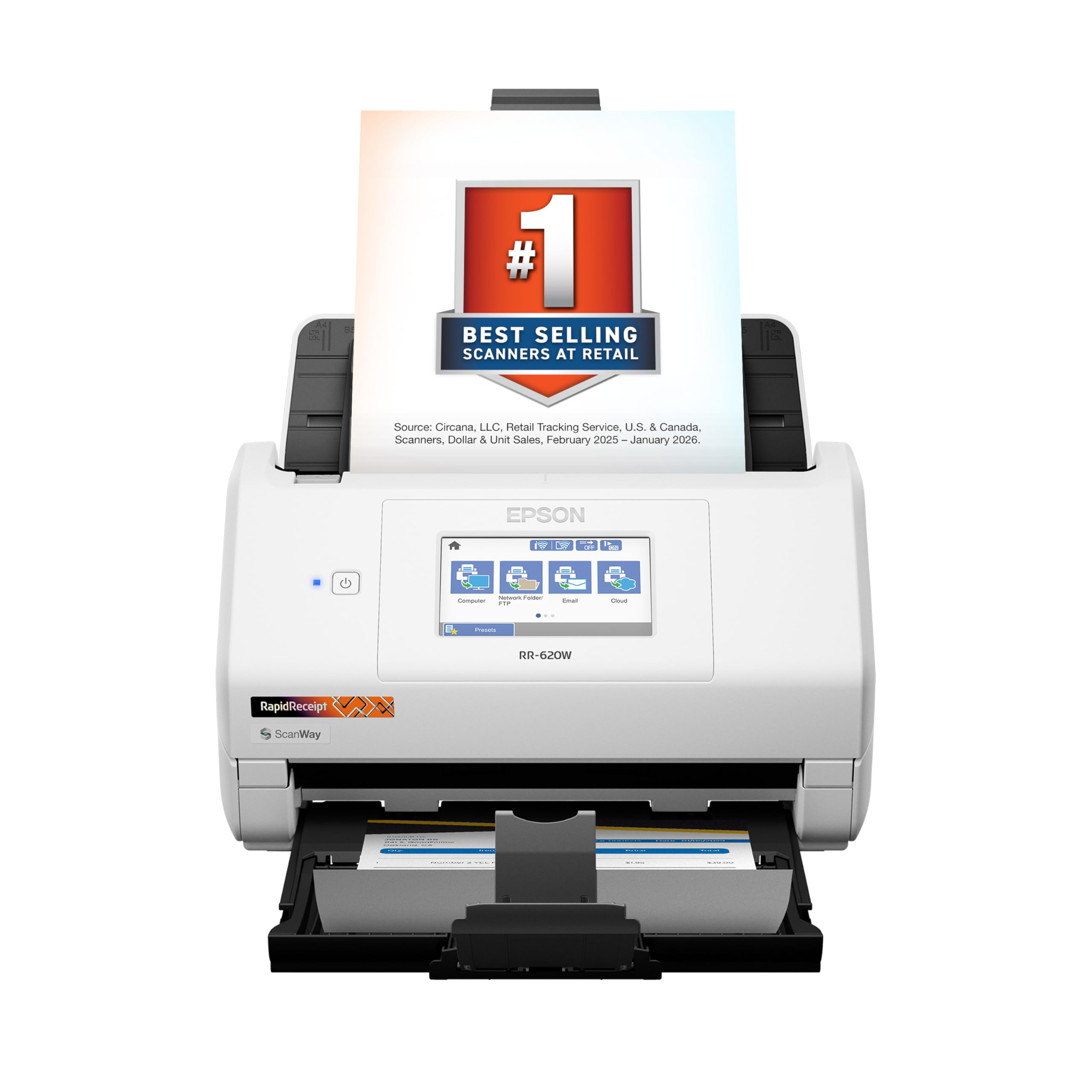
The Epson RapidReceipt RR-620W is purpose-built for receipt and expense management, combining a 45 ppm duplex scan speed with Epson’s ScanSmart AI PRO technology that extracts and categorizes data from receipts and invoices. The AI layer identifies vendor names, amounts, dates, and line items, then exports the structured data directly to QuickBooks, TurboTax, and Excel. For freelancers, accountants, or anyone drowning in paper receipts, this automation cuts data entry time by roughly 80 percent compared to manual keying.
The 4.3-inch color touchscreen enables computer-free scanning, routing documents to email, cloud storage, or a connected USB drive. The 100-sheet ADF handles stacks of receipts, letter-size documents, and business cards interchangeably. Users report that the scanner processes entire months of receipts in under 10 minutes and that the AI categorization is surprisingly accurate with common retail formats, though it occasionally misreads unusual handwritten receipts.
The bundled software includes a partnership with Power PDF that some users found frustrating due to broken download links. The workaround is to use Epson’s own ScanSmart software exclusively, which works flawlessly. If receipt digitization and expense categorization are your primary use cases, the RR-620W is the most specialized and effective tool available at this price tier.
Why it’s great
- AI-powered data extraction auto-categorizes receipts for QuickBooks and TurboTax
- 45 ppm duplex speed and 100-sheet ADF handle high receipt volumes easily
- Computer-free scanning via 4.3-inch touchscreen saves time
Good to know
- Bundled Power PDF software has reported installation issues — use ScanSmart instead
- AI may not parse handwritten or damaged receipts accurately
- Higher weight (8.2 pounds) makes it less portable than compact alternatives
4. Epson DS-770 II Document Scanner

The Epson DS-770 II is built for offices that scan all day, every day. Its CCD sensor captures sharp images with better depth of field than CIS alternatives, making it ideal for batches that include stapled documents, thick cardstock, or pages with folded corners. TWAIN and ISIS driver support ensures compatibility with enterprise document management systems, accounting platforms, and medical records software — a requirement that eliminates most consumer-grade scanners from consideration.
The 100-sheet ADF and USB 3.0 interface keep pace with high-volume workflows, though the DS-770 II lacks a color touchscreen or wireless connectivity found on the ES-580W. This is a deliberate trade-off: the DS-770 II prioritizes durability and driver integration over consumer-friendly bells. Multiple verified reviews confirm that offices with five or more units running daily have encountered zero issues, and the build quality justifies the higher upfront investment.
The DS-770 II does not include receipt-specific AI or direct cloud uploads beyond what the bundled Epson ScanSmart software provides. Its value proposition is reliability in a shared, high-volume environment where downtime is expensive. If you need a scanner that interfaces directly with Line-of-Business applications and can survive years of daily use, the DS-770 II is the most proven workhorse here.
Why it’s great
- CCD sensor delivers superior image quality on stapled, thick, or curved documents
- Full TWAIN and ISIS driver support for enterprise software integration
- 100-sheet ADF and durable build rated for continuous daily use
Good to know
- No wireless connectivity or touchscreen — USB-only connection
- Higher price point reflects enterprise-grade build, not consumer features
- Heavier and larger footprint compared to compact models
5. ScanSnap iX1300 Document Scanner

The ScanSnap iX1300 packs duplex scanning, Wi-Fi, and an innovative space-saving design into a chassis that folds small enough to slide into a drawer. At 4.4 pounds and with a footprint smaller than a laptop, it is the most portable ADF scanner that still delivers 30 ppm duplex speeds. The auto-feed arm and return tray collapse when not in use, making it ideal for cramped home offices or co-working spaces where desk real estate is at a premium.
Wireless connectivity means you can scan directly to a Mac, PC, mobile device, or cloud service without being tethered. Users report that scanning thousands of photos and documents with minimal jams, and that the automatic de-skew and color optimization produce high-quality outputs without manual tweaking. The ScanSnap Home software provides comprehensive organization tools, though it remains a proprietary ecosystem without TWAIN driver support, limiting integration with third-party software.
The iX1300’s 30-sheet ADF is smaller than the 100-sheet feeders on premium models, meaning you cannot load a full folder and walk away. For moderate daily scanning volumes (under 100 pages per day), this is rarely a problem. If you need to batch-scan entire filing cabinets in one sitting, the iX2400’s 100-sheet feeder is worth the step up. For everyone else, the iX1300 offers an unmatched blend of portability and capability.
Why it’s great
- Ultra-compact design with folding ADF arm — fits in a drawer when not in use
- Wi-Fi and USB connectivity for flexible placement and device pairing
- Reliable 30 ppm duplex scanning with automatic image cleanup
Good to know
- 30-sheet ADF is smaller than premium alternatives, limiting unattended batch capacity
- No TWAIN driver support — tied to ScanSnap proprietary software
- Some users report occasional paper jams with very small or lightweight documents
6. Canon imageFORMULA DR-C225 II Scanner

The Canon imageFORMULA DR-C225 II is the most balanced mid-range scanner for anyone who needs TWAIN driver support without paying enterprise prices. Its upright, space-saving design with top feed and top eject takes up minimal desk space, and the 30-sheet ADF handles mixed media including receipts, business cards, plastic cards, and embossed cards. Duplex scanning at 25 ppm is slower than premium options, but the scan quality is consistent thanks to Canon’s reliable CIS sensor with 600 dpi resolution.
What sets the DR-C225 II apart is its robust TWAIN driver and three-year warranty with US-based support. Users report that it handles Post-It notes, staple holes, and mixed paper weights without jamming when double-feed detection is disabled. The bundled software includes Canon CaptureOnTouch for one-touch scanning to cloud services like Dropbox, Google Drive, and OneDrive, as well as business card organization and PDF collaboration tools.
The 30-sheet ADF is the primary limiting factor — you cannot load a large batch and walk away. Some users also noted that the double-feed detection can be overly sensitive with certain paper types, requiring manual disabling in the driver settings. For small offices and home businesses that scan in bursts rather than continuous high volume, the DR-C225 II delivers TWAIN compatibility and Canon’s build quality at a fair price.
Why it’s great
- Full TWAIN driver support for integration with document management systems
- Upright design with small footprint saves desktop space
- Reliable mixed-media handling with 600 dpi resolution and three-year warranty
Good to know
- 25 ppm duplex speed is slower than premium competitors
- 30-sheet ADF requires frequent reloading for large batches
- Double-feed detection may need manual adjustment for certain paper types
7. RICOH SP-1130Ne Document Scanner

The RICOH SP-1130Ne fills a specific niche: a budget-friendly scanner with Ethernet connectivity and TWAIN driver support. Most scanners in this price range are USB-only, making the SP-1130Ne a unique option for offices that want to share a scanner across a network without relying on a dedicated PC. Its compact design (11.2 x 5.3 x 5.2 inches) fits on a shared side table, and the included PaperStream ClickScan software allows one-push scanning to email, local folders, or cloud storage.
The SP-1130Ne supports both Ethernet and USB 3.0, giving you flexibility in placement. Users report that setup is straightforward and that the scanner is quiet during operation. The TWAIN driver enables direct scanning into document management systems, though the network functionality restricts connections to one user at a time. This is a limitation for environments where multiple users need simultaneous access, but for a shared office with sequential scanning needs, it works well.
The scanner handles receipts, business cards, ID cards, and letter-size paper, but its 600 dpi resolution is the only standout spec. Scan speed is not explicitly advertised as high, and some users noted that it is slower than dedicated high-speed models. The SP-1130Ne is best understood as a network-ready entry-level scanner for offices that prioritize connectivity and TWAIN over pure speed.
Why it’s great
- Ethernet and USB 3.0 connectivity for flexible network placement
- TWAIN driver support for integration with document management systems
- Compact footprint fits in shared office spaces
Good to know
- Network mode supports only one user at a time
- Scan speed is not competitive with dedicated high-speed models
- Limited to 600 dpi resolution — no higher optical resolution options
8. Epson WorkForce ES-C220 Scanner

The Epson WorkForce ES-C220 is the smallest ADF duplex scanner in this roundup, measuring just 11.7 x 4.9 x 4.1 inches and weighing under 4 pounds. It claims to save 60 percent more desk space than traditional document scanners, and the claim holds up — the ES-C220 can sit on a crowded desk corner or be tucked away in a drawer. Despite its size, it delivers 30 ppm duplex scanning with a 20-sheet ADF, which is fast enough for occasional batch scanning.
The ES-C220 handles standard documents, cards, and even passports via a flexible scan path. Epson’s ScanSmart software provides automatic cropping, blank page deletion, skew correction, and dirt detection. Users report that setup is straightforward and that the duplex scanning is reliable for most document types. The 20-sheet ADF is the main trade-off: you cannot load a large stack, but the scanner’s speed means you process those 20 sheets in under 40 seconds.
Some users reported compatibility issues with Surface Pro devices and noted that phone support can be inconsistent. The ES-C220 is not designed for high-volume daily use — it is best suited for mobile professionals, loan signing agents, or home users who scan occasionally but want duplex capability. If your primary constraint is desk space and you scan fewer than 100 pages per week, the ES-C220 is a smart compromise.
Why it’s great
- Extremely compact design — saves significant desk space
- 30 ppm duplex scanning is fast for its size category
- Lightweight at 3.85 pounds, easily portable
Good to know
- 20-sheet ADF limits unattended batch scanning capacity
- Some compatibility issues reported with Surface Pro and Windows 11
- Customer support may be inconsistent
9. Canon imageFORMULA R30 Scanner

The Canon imageFORMULA R20 offers a genuinely different approach: no software installation required. Plug the USB cable into a computer, and the scanner appears as an external drive. The built-in scanning software updates automatically and launches without any setup. For users who are not technically inclined or who frequently move between computers, this plug-and-scan simplicity is a game-changer. The scanner supports duplex scanning at 25 ppm with a 60-sheet ADF, which is generous for an entry-level model.
Users report that the R20 handles mixed batches of documents, invoices, contracts, and business cards reliably. The 60-sheet feeder is larger than many mid-range alternatives, allowing you to scan a substantial stack in one go. The scanner produced clean, searchable PDFs in testing, and the automatic blank page removal and de-skew work well. Some users noted that OCR is not built into the device — you need an external program to convert scanned PDFs into editable text.
The trade-off for the no-driver convenience is that the R20 lacks TWAIN or WIA driver support, meaning you cannot use it with third-party scanning applications. The driver software has also been reported as unreliable for some users, requiring reinstallation after every restart. For users who want the simplest possible scanning experience and do not need enterprise software integration, the R20 delivers exceptional ease of use with a generous feeder capacity.
Why it’s great
- No driver installation required — works as a plug-and-play device
- 60-sheet ADF is generous for an entry-level scanner
- Built-in software updates automatically for hassle-free maintenance
Good to know
- No TWAIN or WIA driver support limits third-party software integration
- OCR requires an external program — not built into the scanner
- Some users report driver reliability issues requiring reinstallation
FAQ
Can an auto document scanner scan both sides of a page automatically?
What is the difference between a document scanner and a multifunction printer scanner?
Does every auto document scanner require software installation?
Can a document scanner scan receipts and business cards?
Final Thoughts: The Verdict
For most users, the best auto document scanner winner is the ScanSnap iX2400 because its 45 ppm duplex speed and 100-sheet ADF eliminate the need to babysit the scanner, and the one-touch simplicity means you never have to tweak settings. If you want wireless scanning with computer-free operation via a touchscreen, grab the Epson WorkForce ES-580W. And for receipt-heavy workflows that benefit from AI data extraction and expense categorization, nothing beats the Epson RapidReceipt RR-620W.