
Our readers keep the lights on and my morning glass full of iced black tea. As an Amazon Associate, I earn from qualifying purchases.
Specs are compiled from manufacturer listings and verified buyer reviews and can change over time — please confirm the key details on the product page before buying.
Rewiring a classic car, hot rod, or project truck is the job that separates a weekend from a whole season. The right kit delivers a clean, reliable electrical system instead of a tangle of guesswork that leaves you chasing shorts. This guide ranks the 9 best auto electrical wiring kits by circuit count, wire quality, and real-world install experience to match your build’s needs.
I’m Min — the founder and writer behind Gadgets Feed. This guide is built by comparing the manufacturers’ published specifications and the patterns across verified customer reviews, so you get each pick’s real strengths and trade-offs instead of marketing spin.
From a 8-circuit budget harness for a simple rewiring job to a 22-circuit professional setup, here are the best auto electrical wiring kits for your project car.
Our Picks at a Glance

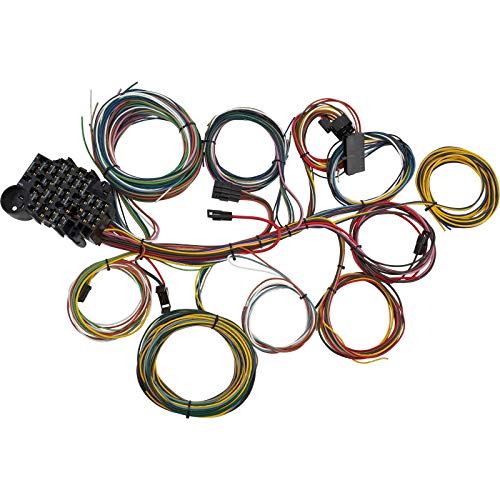

How To Choose The Best Auto Electrical Wiring Kits
Before you buy, match the kit’s circuit count to what your vehicle actually needs. A bare-bones rat rod with lights and a starter needs far fewer circuits than a daily driver with power windows, A/C, and a stereo. Count your must-have electrical features first, then add a couple of spare circuits for future upgrades.
Circuit Count: The Starting Point
Circuit count tells you how many separate fused electrical functions the harness supports. A 12-circuit kit covers the basics: headlights, taillights, brake lights, turn signals, wipers, ignition, and a few accessories. Jump to 21 or 22 circuits and you gain room for power windows, door locks, electric fuel pumps, and A/C. If you’re building a simple street rod, a smaller count saves money and reduces clutter.
Wire Labeling and Color Coding
Look for wires printed with readable identifiers every 6 inches (some kits do 12 inches). Combined with GM color codes, this makes matching each wire to its circuit straightforward instead of tracing continuity with a multimeter. The best kits split the harness into under-hood, interior, and rear groups, which keeps the installation organized.
Quick Comparison
| Model | Best For | Circuits | Wire Labeling | Fuse Type | Amazon |
|---|---|---|---|---|---|
| Painless 10102★ Best Overall | First-time installers | 21 | Every 6 inches | ATO blade | Amazon |
| Speedway 22-CircuitPro Choice | Full custom builds | 22 | Every 6 inches | OEM style | Amazon |
| Speedway 12-Circuit Mini-FuseSmart Pick | GM tilt column swaps | 12 | Every 6 inches | Mini blade | Amazon |
| A-Team 12-Circuit | Street rods | 12 | Every 12 inches | Blade | Amazon |
| VOWAGH 21-Circuit | Budget LS swaps | 21 | Inconsistent | Blade | Amazon |
| Auto Parts Prodigy 21-Circuit | Classic rewires | 21 | Smudged | Blade | Amazon |
| Cheriezing 14-Circuit | Compact builds | 14 | GM color coded | Blade | Amazon |
| WMPHE 12-Circuit | Hot rods on a budget | 12 | Every 6 inches | 12 fuses | Amazon |
| WMPHE 8-Circuit | Minimal rewires | 8 | Every 6 inches | Standard | Amazon |
In‑Depth Reviews
1. Painless Performance 10102 Classic Customizable Chassis Harness
Our pick — over 4.5★ from 200+ verified ratings; the strongest balance of quality and price.
The gold standard that turns a dreaded wiring weekend into a follow-the-dots project.
If you have never wired a car before, this is the kit that saves you. Every wire is printed with its circuit identification and uses GM color codes, so you are matching colors and labels instead of decoding mystery wires. The full-color installation manual is the most praised part of the package — owners call it detailed enough that the job becomes methodical rather than stressful.
The fuse block arrives machine-crimped and pre-terminated, meaning you only terminate one end of each wire. Upgraded ATO bladed fuses replace the old glass style, so you get modern, easy-to-source protection. Built in Fort Worth, TX, since 1990, the brand backs it with a real technical support line — a lifeline if you get stuck mid-install.
With 21 circuits, this covers everything from a full classic rebuild to a modern engine swap. Buyers report the harness is “Well-designed: labeled every 6″, color-coded, pre-wired to fuse block, split into under hood/interior/rear groups.” The only upfront cost beyond the box: the headlight and ignition switches are sold separately.
Why it wins: The clearest instructions and best labeling in this list — the things that determine whether you finish the job.
What it costs you: More than the budget kits, for good reason: US production, a support line, and a manual worth reading cover to cover.
Reach for this if: You want a first-time-friendly install with a support team behind you.
Look elsewhere if: You are on a tight budget and already know how to trace a circuit blindfolded — you can save money with a less polished kit.
2. Speedway Motors 22-Circuit Universal Harness
A 22-circuit powerhouse with 17-foot tail leads that reach the back of any full-size truck.
For a full custom build with power locks, power windows, and a modern charging system, this kit has the circuits you need. The automotive-grade GXL wires are color-coded and labeled every 6 inches, and the OEM-style fuse block includes an integrated flasher unit mount for a clean, factory look. It even had a television debut on Season 4 of “Car Masters: Rust to Riches,” so professionals have put it to work on camera.
The pre-wired GM column ribbon plug makes it plug-and-play with 1968-96 GM tilt columns. Owners consistently praise the instruction quality and the complete factory-style coverage — one noted it includes power locks and windows, starting and charging, HEI/points, and headlight grounds. The generous 17-foot tail light leads mean you are not splicing extensions onto a full-size car, truck, or van.
This one is comparable to the Painless above at roughly a third of the price, per buyer reports, though the crimps are not heat-shrink or waterproof — a detail to address if your build sees weather. It weighs in at 10 pounds, reflecting the sheer amount of wire included.
The pro choice: Near-OEM coverage and a reputation that landed it on a TV build, at a price well below the big names.
The honest limit: The included components draw mixed feedback — a handful of owners note not every necessary wire is in the box, so plan your accessory list first.
Choose this if: You are doing a full-frame build with power accessories and want a professional finish.
Think twice if: Your project is a bare-bones street rod — 22 circuits is more than you need and the extra wire becomes clutter.
3. Speedway Motors 12-Circuit Mini-Fuse Harness
The 12-circuit kit that thinks it is a pro unit, with mini blade fuses and a two-piece modular fuse block.
Built with GXL automotive wiring and modern blade-style mini fuses, this kit dumps the antique glass fuses for protection that is easy to source and replace. Each wire gets the appropriate diameter for its fused circuit, ranging from 8 to 16 gauge, and is labeled every 6 inches. The two-piece fuse block design makes servicing a fuse a quick job instead of a contortion act.
For 1968-96 GM tilt steering columns, it plugs straight in with no splicing. It also connects to aftermarket tilt columns from ididit, Flaming River, or Speedway Motors, and includes an adapter-style pin-out diagram for anything else. The harness splits into four bundled branches — front of vehicle, dash panel, ignition and lighting, and rear — and the tail light leads run 12 feet, so mounting in most vehicles is easy.
Buyers who went cheap first and then moved to this kit describe the difference as night and day. As owners put it plainly: “Don’t waste your time on going with the cheaper harness.” The 5-page instruction booklet walks you through each circuit, though a little more detail on the alternator bypass wire would help.
What wins people over: The ease of use and time saved versus the off-brand kits — twice the cost, but owners call it well worth it.
One thing to know: There is no reverse light circuit in the box, so plan that separately.
Reach for this if: You are wiring a hot rod or engine swap around a GM tilt column.
Look elsewhere if: You need power windows and door locks — step up to the 22-circuit kit instead.
4. A-Team Performance 12-Circuit Universal Harness
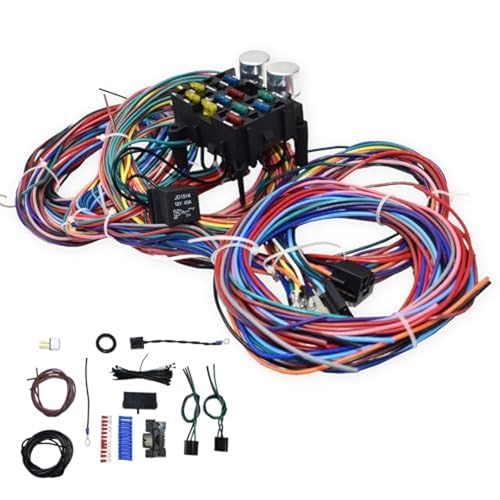
A 12-circuit kit that throws in horn and headlight relays so you are not buying extras later.
This kit is built for street rods and custom cars, with long labeled wires every 12 inches. The pre-wired fuse block covers headlights, turn signals, and radios, plus a circuit breaker and additional connectors. The standout here is the included horn relay, dimmer switch connector, and two flashers — small parts that quietly cost you extra trips to the parts store with other kits.
Compatibility runs across GM, Ford, and Mopar, and it suits 1973-87 models especially well. Owners on a 1982 Chevy C20 called it a really good harness for the money, and a 1931 Ford build went together great. The value pitch lands consistently: everything advertised is in the box and it fits the project as expected.
The catch is the wire printing — owners note the writing on the wires is hard to read, and the instructions lean vague. If you have sorted a harness before, you will be fine; if this is your first rodeo, pair it with patience and a multimeter. It weighs 3.35 kg, so you are getting a substantial bundle of copper.
The value angle: Relays and flashers included at a mid-range price makes the real cost lower than it looks.
The fit note: This kit assumes some electrical knowledge — the instructions are not the place a beginner wants to learn.
Best for: Hobbyists and pros who want a complete 12-circuit solution without paying for a brand name.
Not for: Someone hoping the manual will teach them wiring from scratch — the print readability and vague guide will frustrate.
5. VOWAGH 21-Circuit Hotrod Harness
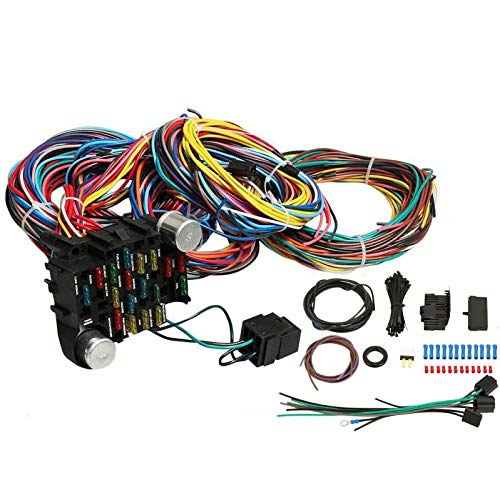
A 21-circuit kit with 5mm wire that gives budget LS swaps a serious shot.
Priced well below the premium 21-circuit kits, this harness bundles 17 fuses and 21 circuits, and includes GM column connectors. Owners praise the wire length — “more than long enough” is the recurring line — and the thick, long wires suit an LS swap into an 80s car. One 1976 C10 owner called it great value, with clearly labeled wires and a fuse box that needed no troubleshooting.
The trade-off is consistency. Some owners mention heavily labeled wires while others received unlabeled ones, and the instructions have typos. The flashers in the box are described as junk — plan to upgrade them. This is a kit for someone with electrical knowledge who can verify each circuit with a meter before trusting it.
At 21 circuits, it covers wiper and radio ACC, cruise and backup, heater and air, clock, dome, cigarette lighter, courtesy power, power door, power seat, fan power, coil, choke, instrument power, flasher, fuel pump power, brake, power window, headlight, radio battery, and horn. The included instructions are more of a starting point than a complete guide.
Where it shines: The biggest bang for your buck in circuit count — 21 circuits for a fraction of the premium price.
Where it wobbles: Labeling and instructions are a gamble; buy it only if you can confidently trace and verify wires yourself.
Reach for this if: You are an experienced builder on a budget doing an LS swap or full rewiring.
Look elsewhere if: You want a kit that just works from the start with reliable labeling — spend more on the Speedway or Painless options.
6. Auto Parts Prodigy 21-Circuit Harness

21 circuits of GXL 125 wire that resists grease, oil, gas, and acid — built for the long haul.
This kit uses GXL 125 high-temp cross-linked polyethylene jacketed wire, which shrugs off grease, oil, gas, and acid — the stuff that eats cheaper harnesses alive in an engine bay. The 21 circuits cover horn, fan, dome light, hazard, radio, cigarette lighter, door locks, brake, headlights, trunk light, gauges, backup and cruise, wipers, choke, coil, A/C, electric fuel pump, power windows, and turn signals. The wires are extra long for whatever build you are tackling.
GM color coding makes routing intuitive for anyone familiar with factory schematics. Specific instruction pages exist for GM, Ford, and Mopar, though owners describe them as vague. One 1955 Belair owner found it adequate, noting the fuse panel connections are cheap and need a little massaging, and two fuse positions plus two wires arrived mislabeled.
The honest read: you get substantial raw wire for the price, with 12awg supply, 14awg circuits, and 16awg sensors and headlights. The recurring theme from owners is that this is a great value in raw material, not the best quality kit. Headlight circuits may need a relay if you run high-wattage bulbs.
The strong suit: Chemical-resistant GXL 125 jacketing at a price that undercuts the premium brands.
The honest limit: Smudged labels and bare-bones instructions mean you will spend time verifying circuits — and the messy fuse block may need 2-3 hours of rework.
Best for: Classic car owners who want lots of wire and don’t mind doing some legwork to sort it.
Not for: First-timers who need clear labeling and a manual they can follow end to end.
7. Cheriezing 14-Circuit Universal Harness
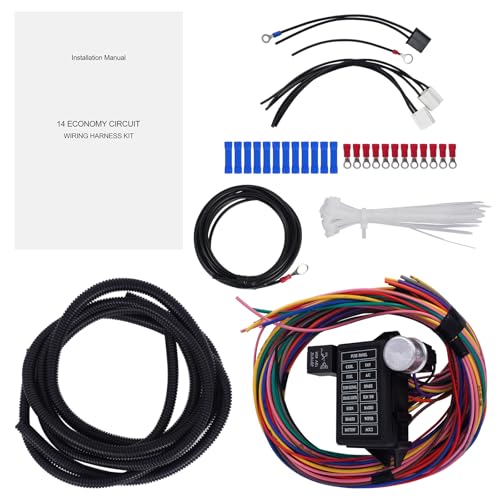
14 circuits with GM color codes and extra long wires, ready for a dune buggy or hot rod.
This mid-range kit hits a smart middle ground: more circuits than the budget 8 and 12, but still approachable for a hobbyist. All wires are coded by GM color and come with detailed instructions, including specific pages for GM builds with Ford and Mopar compatibility. The included circuits span coil, fan, fuel, ACC, relay, spare, lights, turn, horn, radio, brakes, wiper, spare, and dash — a solid spread for a classic build.
The wires are explicitly extra long, which owners confirmed on a dune buggy build where the compact design made routing easy. A hot rod owner called it a great fuse box and wiring setup to get started, with the caveat that you should only expect enough wiring to reach the switchgear — plan to buy more wire to reach the actual components like lights and the horn.
At 1.42 kg, it is a manageable bundle that ships neatly packaged. The main gripe across the reviews is the directions, which could use more detail. Professional installation is recommended, so treat this as a kit for someone with a baseline of electrical confidence.
Why it works: GM color coding plus a fuse box that owners describe as great for the price, in a compact package.
The honest caveat: “Extra long” applies to the included circuits, not the reach to your components — budget for additional wiring and better instructions.
Reach for this if: You are building a dune buggy or simple hot rod and want 14 circuits without paying premium money.
Look elsewhere if: You need a complete, component-to-switch solution from the start — this kit gets you started, not finished.
8. WMPHE 12-Circuit Universal Harness

A 12-circuit hot rod favorite with a basic design that keeps builds rolling on a budget.
This kit covers A/C, ignition, battery and hazard, ignition switch, meter, brake switch, flash, headlight, wiper, ACC1, ACC2, and heater circuits — a practical spread for a classic truck or street rod. The 12 fuses and standard copper wire follow the standards used in production cars, and the high-temperature wire is printed with easy-to-read characters every 6 inches. A picture-based manual is included.
Owners are clear that this is a “nice basic design” that offers good value for a hot rod build. One pulled it into a 1968 Chevy with an LS swap and reported it working fine, with the only real complaint being the instructions and a misspelled wire label. The 1.47 kg weight reflects more wire than the 8-circuit sibling.
The honest split: quality gets positive marks, but labeling is mixed — some wires are labeled, others aren’t, and the instruction sheet draws consistent negative feedback. If you know what you are doing, this is a great deal; if you are learning as you go, the diagram is clearer than the manual for sorting left and right banks.
The draw: Good quality and genuine value for money, with the circuit spread most hot rods actually need.
The catch: Instructions that owners describe as not really useful — budget time to figure out the wiring yourself.
Best for: Budget-minded builders who understand wiring and want a reliable 12-circuit base.
Not for: Beginners hoping the manual will guide them — the labeling inconsistency will cost you time.
9. WMPHE 8-Circuit Universal Harness

The smallest, lightest kit here — 8 circuits of pure simplicity for a minimal rewiring job.
If your project needs just the essentials — brake switch, battery, wipers, hazard lights, signal switch, relay out, gauge, and cluster — this 8-circuit kit is the most budget-friendly way to get there. It runs on 12 volts and is built from standard copper wire with plastic parts manufactured to automotive standards. The high-temperature wire has readable characters printed every 6 inches, and a picture-based manual comes in the box.
At 1.06 kg, it is the lightest harness in this lineup, and owners describe the wire length as perfect with a compact design and great quality. The compact footprint means it can be installed under the dashboard or even under a seat, making it a flexible choice for car modifications. It is a standalone system that can be expanded later.
The flip side is the instructions, which one owner called horrible. There is no universal help available online for this specific kit, so the recommendation for professional installation is worth taking seriously. This is the right pick when you know exactly what 8 circuits you need and don’t want to pay for circuits you will never use.
The appeal: Compact, expandable, and genuinely simple — perfect wire length for a minimal build at the lowest entry price.
The honest note: The manual is the weak link; if you cannot read automotive schematics, factor in the cost of professional installation.
Reach for this if: You are rewiring a bare-bones rat rod or a simple project that needs only 8 circuits.
Look elsewhere if: Your build needs more than the basics — stepping up to the 12-circuit version adds A/C and heater circuits for a small price jump.
Understanding the Specs
Circuit Count
This is the number of separate fused functions your harness supports. Each circuit protects one electrical job — headlights, brake lights, wipers, radio, and so on. Count your vehicle’s needs and add 2-3 spare circuits for future accessories. A 12-circuit kit suits most street rods; a 21 or 22-circuit kit is for full builds with power windows and A/C.
Wire Labeling and Gauge
Quality kits print the circuit name on the wire every 6 inches (some do 12). This saves hours of tracing with a multimeter. Wire gauge matters too — thicker wire like 8 gauge carries more current for high-draw circuits like headlights, while 16 gauge handles sensors. Good kits match the gauge to the circuit; cheap ones run everything at one size.
FAQ
How many circuits do I need for a basic hot rod?
What does GM color coding mean for my install?
Will a universal harness fit my Ford or Mopar?
What is the difference between blade fuses and glass fuses?
How long does it take to install a universal wiring harness?
Are the wires long enough for a full-size truck or van?
Can I install a wiring harness without electrical experience?
What is GXL wire and why does it matter?
Do I need relays for headlights and horns?
Final Thoughts: The Verdict
For the majority of shoppers, the auto electrical wiring kits winner is the Painless Performance 10102 because its labeled-every-6-inches wires and full-color manual make a first-time install genuinely achievable. If you want the most professional coverage for a full custom build, grab the Speedway 22-Circuit — 17-foot tail leads and a TV-build pedigree at a third of the price. And for a budget LS swap where you know your way around a multimeter, the VOWAGH 21-Circuit delivers the most circuits per dollar, provided you verify the labels before you trust them.
How We Picked
We do not accept paid placement. Every pick is matched to a real buyer and a real use-case; we do not hands-on test units.
Sources & Methodology
Specifications: manufacturer listings and product documentation. Review insights: verified customer reviews, as of August 2026. Pricing: not shown on this page (it changes often); check the current price via the retailer link.
As an Amazon Associate, Gadgets Feed earns from qualifying purchases. This does not affect which products we feature.