
Our readers keep the lights on and my morning glass full of iced black tea. As an Amazon Associate, I earn from qualifying purchases.
Specs are compiled from manufacturer listings and verified buyer reviews and can change over time — please confirm the key details on the product page before buying.
An auto feed shredder takes a whole stack of paper off your hands — you load the tray, walk away, and the machine pulls sheets through on its own. That hands-free tray is the whole point of the category. The detail that matters most is cut security, because micro-cut turns a page into confetti you cannot reassemble, while a plain cross-cut leaves larger pieces. The second detail is run time, since most home units shut down to cool after a stretch of work, and filler trays that grab pages at an angle are the most common owner frustration.
I’m Min — the founder and writer behind Gadgets Feed. This guide is built by comparing the manufacturers’ published specifications and the patterns across verified customer reviews, so you get each pick’s real strengths and trade-offs instead of marketing spin.
The right auto feed shredder should run a full tray unattended and stay quiet enough to ignore. The picks below sort the serious micro-cut workhorses from the tray-feed machines that balk at mixed paper, and each one earns its slot for a different kind of desk. This breakdown of the auto feed paper shredder crowd covers tray capacity, run time, and cut security in plain terms.
Our Picks at a Glance
How To Choose The Best Auto Feed Paper Shredder
Start with the job you actually have, not the spec sheet. A household clearing a shoebox of old statements needs something completely different from a small office pushing a hundred pages a day through a tray. Auto feed capacity is the first number to fix: it tells you the biggest stack the machine will pull through unattended.
Tray capacity versus manual slot
The auto feed tray is the whole point of this category. Capacities across these machines run from 60 sheets up into the hundreds, and that number sets how big a job you can hand off. The manual slot is your backup for the odd envelope or receipt — typically a much thinner stack than the tray, often in the single or low double digits. Pick by tray capacity, not by the manual slot’s sheet count.
Cut type and security level
Micro-cut blades slice a page into confetti-sized particles. Cross-cut leaves noticeably larger pieces. Both are far safer than an old strip-cut machine that leaves readable ribbons. The particles matter in a second way too: the finer the cut, the bulkier the waste, so a micro-cut bin fills faster than a cross-cut bin of the same size.
Run time and cool-down
Every shredder is rated for a continuous run — the minutes it can work before the motor needs a rest. Cheaper units tend to run short and cool long. Machines built for volume stretch the run window and shorten the wait. If you shred in bursts on a Sunday evening, a shorter run time is fine. If you feed a business’s worth of paper, the run-and-cool cycle is the spec that decides your afternoon.
What the tray will and will not take
Auto feed trays work best with a clean stack of same-size pages. Mix in a receipt or a folded envelope and many units stall or stop. Staples, paper clips, and cards usually go through the manual slot only. Check the maker’s guidance on each before you feed anything unusual.
Quick Comparison
| Model | Best For | Auto Feed Capacity | Cut Type / Security | Bin Capacity | Amazon |
|---|---|---|---|---|---|
| Aurora AU110MB★ Best Overall | All-round home office pick | 110 sheets | Micro-cut, P-4 | 4 gallons | Amazon |
| Wingwise 60-SheetQuietest Pick | Quiet, compact home use | 60 sheets | Cross-cut, P-4 | 5.8 gallons | Amazon |
| QUIETLEMON OL100Space Saver | Tight-space desks with wheels | 100 sheets | Cross-cut, P-4 | 4.5 gallons | Amazon |
| Locksworth AZ1689VC | Big-bin value pick | 110 sheets | Micro-cut, P-4 | 6.9 gallons | Amazon |
| Aurora AU120MA | High-volume document purge | 120 sheets | Micro-cut, P-4 | 5 gallons | Amazon |
| Fellowes AutoMax 100MA | Fast tray turnover | 100 sheets | Micro-cut, P-4 | 4.5 gallons | Amazon |
| Amazon Basics 200-Sheet | Whole-household paper pile | 200 sheets | Cross-cut, P-4 | 8.5 gallons | Amazon |
| Staples 150-Sheet | Fast, quiet office tray | 150 sheets | Micro-cut, P-4 | 7.4 gallons | Amazon |
| BONSEN S3113 | Heavy daily office volume | 300 sheets | Micro-cut, P-4 | 8.1 gallons | Amazon |
In‑Depth Reviews
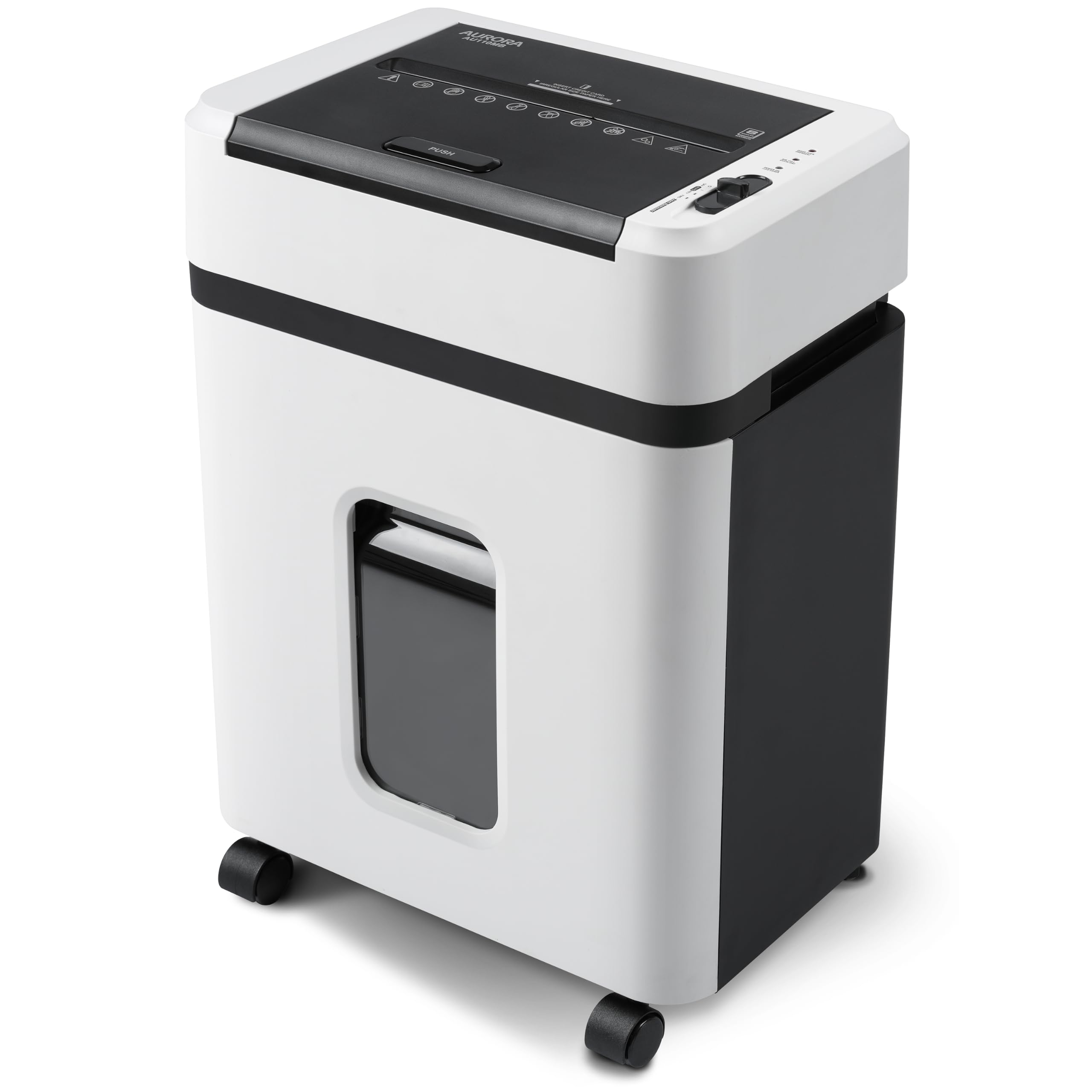
1. Aurora High Security AU110MB 110-Sheet Auto Feed Micro-Cut Paper and Credit Card Shredder
Our pick — over 4.5★ from 250+ verified ratings; the strongest balance of quality and price.
The tray swallows 110 sheets and the blade turns them into confetti without a fuss.
For a home office that accumulates paper faster than it clears it, this is the machine that makes the job feel finished. The auto tray eats up to 110 sheets unattended, and the manual slot takes a thinner stack for envelopes and cards. Because the blades cut micro-cut rather than cross-cut, each page comes out as tiny 5/32 by 9/16 inch particles that are effectively unreconstructable. That is the security level P-4 promise — a standard for how small and unreadable the output is. Pullout bin is 4 gallons with a set of rolling casters underneath, so moving it between rooms is easy instead of a lift.
Run time is a full 30 minutes continuous, and it cools itself down and restarts without drama. It also carries the sensor load you want: feed error, bin full, door open, overload, overheat, and power indicators all show at a glance. So a jam or a full basket tells you before it becomes a mess. In daily use the machine stays quiet enough to sit on an office floor while you take calls, which is why noise keeps coming up as a reason buyers are happy with it.
The recurring gripe is not the motor, it is the tray discipline: mixed paper sizes can stall the auto feed, and the bin sits at the back, so you sometimes push the waste forward before it drops. Both are habits you pick up in the first week. Leave clearance behind the unit so you can push the waste forward without moving it.
Where it earns its keep
- 110-sheet auto tray clears a stack unattended
- Micro-cut 5/32 x 9/16 inch particles, security level P-4
- 30-minute continuous run with auto reverse jam prevention
- Six indicator lights cover feed, bin, door, overload, overheat
- 4-gallon pullout bin on included casters
What to expect on day one
- Auto feed prefers same-size pages — mixing sizes can stall it
- Waste collects at the back of the bin and needs nudging forward
- No keyed lockout, so the on/off button is the only control
Best match for: a home office or small business clearing whole folders of statements in one sitting.
Look elsewhere if: you need a keyed lockout to stop other people operating the machine.
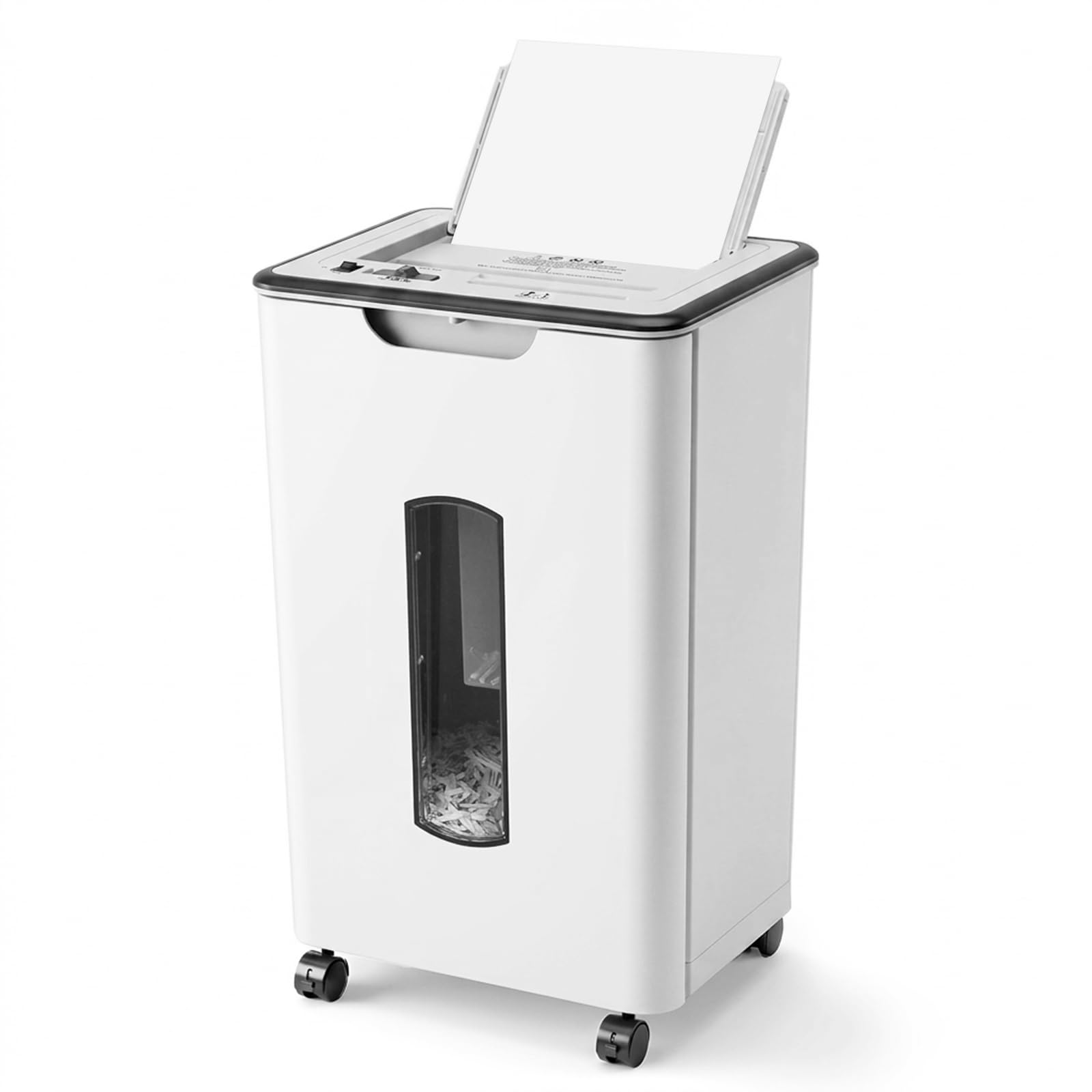
2. Wingwise 60 Sheets Auto Feed Paper Shredder for Home Office
Whisper-quiet at 52dB, with a bin that holds an absurd amount of waste.
If you share a room with the shredder, this is the one that will not draw attention. The Wingwise runs at just 52dB, which is the kind of number you notice when two people are on calls in the same room and nobody has to raise their voice. Compare that with the QUIETLEMON at 63db — a real 21% gap — and the difference in a small office is the difference between background and interruption.
For storage it leans hard on sheer volume. The bin holds 5.8 gallons, which is roughly 386 sheets of A4 before it needs emptying, and the paper tray handles up to 60 sheets unattended, or 380 standard sheets across a session. Shreds go into 4 x 36mm cross-cut particles, and a dedicated side slot takes cards and optical discs separately, so you are not opening the lid to feed them. Speed sits at 2.5 metres per minute. It also carries a 40-minute auto run window.
What owners are most impressed with is the footprint — it is a small unit with a big appetite, and setup is a few minutes of clicking parts together. Where the picture gets murkier is durability, and the honest read is that a batch of buyers report failures around the two-month mark, with speed drawing split opinions. Buy from a seller with a generous return window, and lubricate the blades on the schedule the manual gives.
The niche it owns: quiet, high-capacity shredding for a shared home office where noise is the deciding factor.
Before you commit: check the return window carefully — this is the pick in the list where quality reads most mixed.
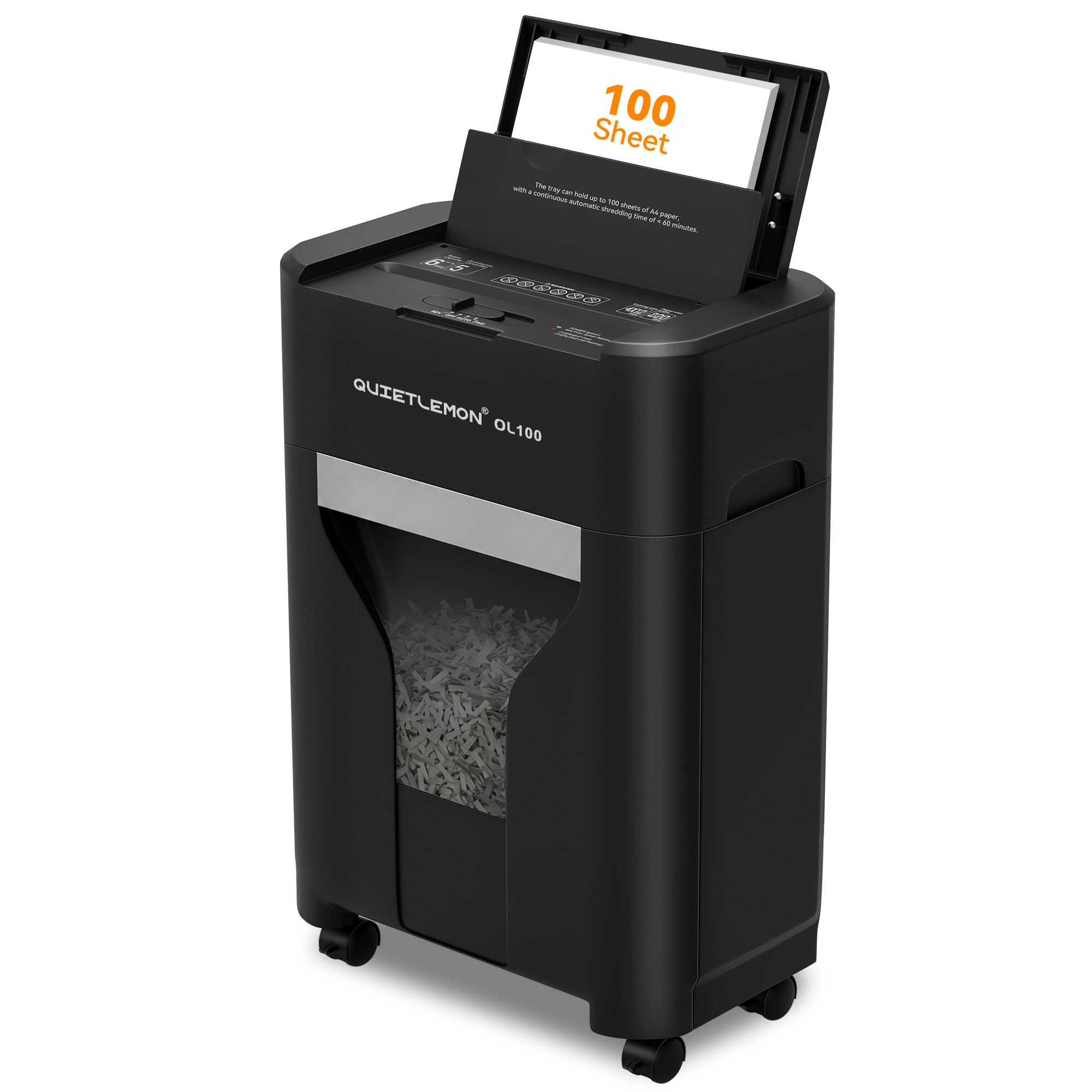
3. QUIETLEMON 100-Sheet Auto Feed Paper Shredder, 40 Min Non-Stop (OL100)
Four casters and a 15-pound frame — the shredder that moves when you do.
The pitch here is manoeuvrability. Four wheels turn a full 360 degrees, so this QUIETLEMON rolls out of a cupboard, does its job, and rolls back without you lifting anything. Weight is 12 pounds, which makes it the lightest machine on this list by a wide margin — compare that with the 17.4-pound Aurora AU110MB, and you have a shredder you can carry upstairs without a plan. The auto tray handles 100 sheets and the manual slot takes 10 at a time.
The bin carries 4.5 gallons, or 17 litres, holding up to about 300 sheets before it needs emptying. When you pull the bin out, the machine shuts itself off — a genuine safety feature that stops the blades mid-run. Cutting goes down to 4 x 12mm cross-cut particles, around 1,300 pieces from a single letter page, and there is an automatic paper retraction function to clear partial feeds. Noise sits under 63dB.
Buyers enjoy the quiet operation and the space-friendly size, but the auto feeder itself divides opinion — some love the convenience, others find it fusses about alignment, and a handful run into jams. The 60-sheet and 100-sheet claims for the tray are a marketing ceiling, not a daily norm; feed closer to two-thirds and the reliability reads much higher. One specific note from the review pages: the exact review copy made a 20-minute cooldown observation after a heavy manual session, worth knowing if you plan to shred all afternoon.
What buyers love: the wheels and quiet 63dB rating turn this into the low-fuss option for people who shred in bursts and store the machine away in between.
The trade to weigh: the auto feeder wants well-aligned, uniform pages — this is a finesse machine, not a shove-it-in machine.
Worth picking up: if storage is your constraint and you value a shredder that disappears under a desk between jobs.
Not the right one for: a clean-out job where half the stack is folded junk mail and envelope edges.
4. Locksworth 110-Sheet Micro Cut Shredder for Home Office, 6.9 Gallons Bin
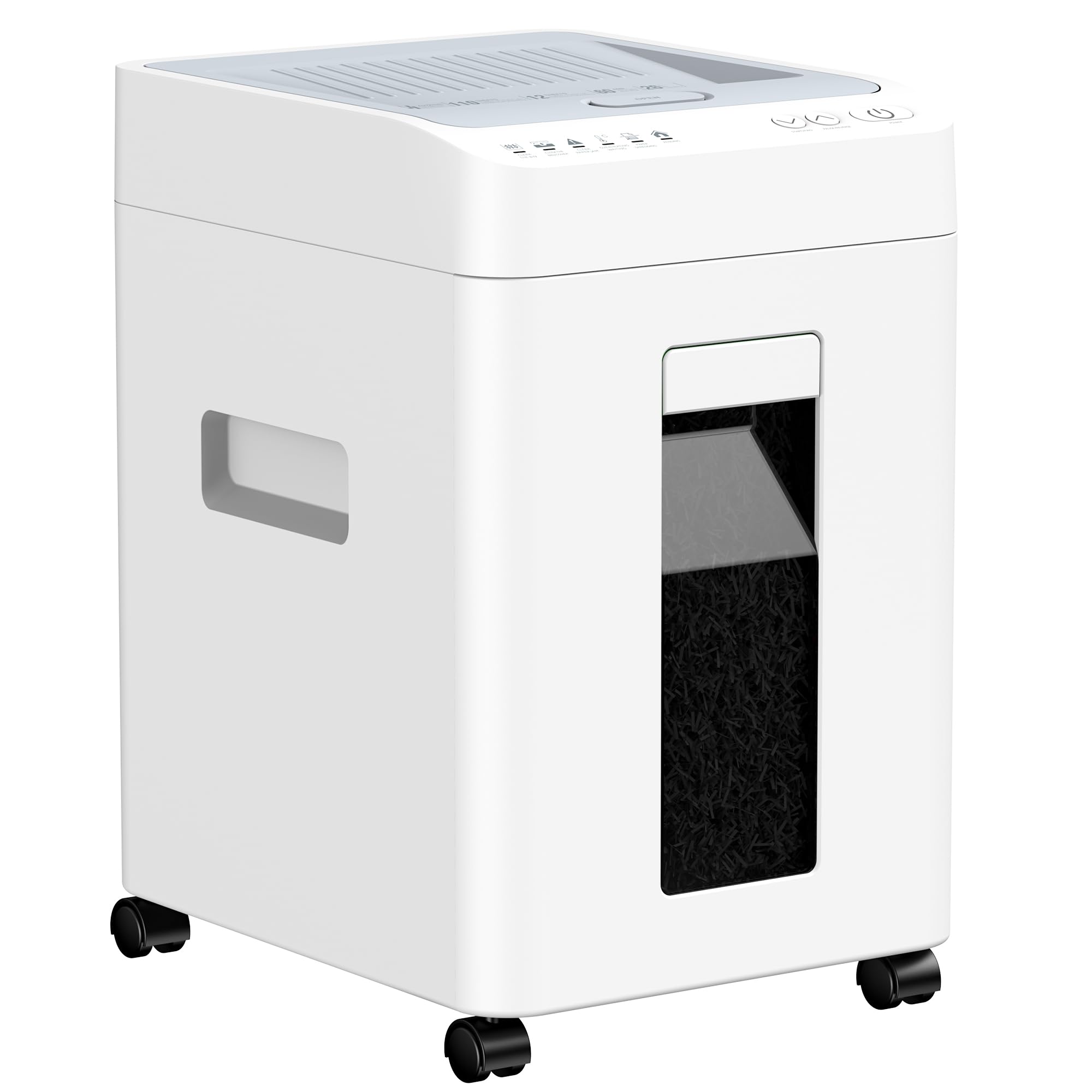
A 6.9-gallon bin with a transparent window, so you never guess when it needs emptying.
Emptying the waste is the chore that kills shredder ownership, and Locksworth attacks it two ways. The bin is 6.9 gallons — the largest of any bin under 8 gallons in this list except the Amazon Basics — and it has a clear window so you can see the waste level at a glance. Four smooth-rolling casters sit underneath. The auto tray runs 110 sheets, then cuts paper into 5/32 inch by 15/32 inch micro-cut particles at security level P-4, so a confidential page is gone the moment it goes in.
You get a full 60 minutes of run time in auto mode, so you can clear a big stack without stopping. The manual slot takes 12 sheets at a time and runs for 30 minutes continuously. After a long session, the maker asks for a 60-minute cool-down before the next run — that is a big number, but it only matters if you shred all day. If a jam happens, an automatic reverse backs the paper out. And the machine shuts itself off the moment the lid comes off or the bin is not properly seated — a real safety feature that stops the blades when a hand could reach them.
Owners are fond of the build and the small cut size. The one honest caveat is speed: it does not rush. On the manual slot the practical ceiling is around 8 sheets before feed speed drops off noticeably, and the tray is best limited to a mid-size stack rather than its 110-sheet header. Feed closer to two-thirds of the 110-sheet rating and the tray keeps its pace.
What you get
- 6.9-gallon bin with transparent window
- 110-sheet auto tray with 60-minute continuous run
- Micro-cut 5/32 x 15/32 inch P-4 particles
- Auto-shutoff when lid or bin is disturbed
- Four casters for easy repositioning
What owners flag
- Manual slot slows noticeably past 8 sheets
- 60-minute cool-down after a long auto session
- Best treated as a mid-size stack machine, not a 110-sheet every time
Best fit for: the household that wants a big bin so emptying stays a weekly task, not a daily one.
Hold off if: you need the fastest possible feed — this one prioritises calm, quiet cutting over speed.
5. Aurora AU120MA 120-Sheet Auto Feed High Security Micro-Cut Paper Shredder

Built for the moment you open a box of documents and want the whole thing gone.
When the job is not a folder but an entire filing cabinet, this is the Aurora to reach for. The auto tray runs 120 sheets, and the manual slot adds another 10 for credit cards or a stray envelope. The blades cut at 5/32 by 15/32 inches, security level P-4 micro-cut — the same fine particle size as the AU110MB above, but at a slightly higher sheet ceiling. The 5-gallon pullout bin sits below with LED lights for standby, overheat, bin-full, overload, feed error, and door-open states, so nothing surprises you mid-session.
You can run it for 30 minutes straight, and it starts and stops on its own. It also has auto reverse to prevent jams and overload protection built in. In real use, this machine eats a box of old statements without complaint — one owner reported clearing roughly 10,000 pages across around four hours of work. The practical feed balance came out around 6 to 7 sheets at a time, with 9 as the ceiling before jams start.
Two quirks worth knowing before you buy. First, the wheels are genuinely fiddly to fit — allow a few minutes with the instructions. Second, the power button has to be switched on at both the front and the rear, and paper needs to feed down the back chute or it will not grip. Neither is a defect, just an assembly step you do once. Buyers are consistently happy with the performance and the quiet operation once the setup is out of the way.
Where it shines: the sheer throughput. A whole cabinet of paperwork disappears in an afternoon on a 30-minute continuous run.
What to budget for: patience at setup — those casters and the dual power buttons are the two steps that trip people up.
Choose this if: you have years of paperwork to clear in one go and want it done today.
Choose something smaller if: this is an occasional-envelope shredder — you will pay for capacity you never use.
6. Fellowes AutoMax 100MA 100-Sheet Micro-Cut Autofeed 2-in-1 Paper Shredder

Clears a 100-sheet batch in about five minutes — the quickest tray cycle here.
Speed is this machine’s whole personality. Fellowes rates the auto tray at up to 100 sheets in roughly five minutes, which is meaningfully quicker per stack than the average unit in this list. Security is P-4 micro-cut, and the manual slot takes credit cards, paper clips, and staples in addition to paper, so the trickier items go through separately while the tray handles the bulk. The two feed paths can work at the same time — you keep loading the manual slot while the tray empties itself.
The bin is a 4.5-gallon pull-out, which conveniently fits a standard wastebasket for emptying. Run time is 10 minutes on auto and 7 on manual — shorter than the Aurora machines, but this machine shreds faster, so the practical throughput over a session is closer than the raw minutes suggest. Auto reverse clears misfeeds before they become jams.
Owners are split on build quality: the unit feels lighter than its size suggests, the three-piece assembly uses thinner plastics than you might expect for the money, and the bin has been known to pop open under load. On the other side, buyers love how quiet and quick it is in normal use and how large the bin feels in practical terms. Set your expectations that this is a nimble home-office machine, not a bank vault’s workhorse, and it performs exactly as advertised.
The right pick for: a home office that shreds in short, frequent bursts and values speed over build heft.
skip it if: you want the tank-built feel of a heavier machine — this is the lighter, faster option.
7. Amazon Basics 200-Sheet Auto Feed Cross-Cut Paper Shredder

Two hundred sheets in the tray and an 8.5-gallon bin — the household-spring-cleaning pick.
When the pile of paper has been growing for years, this is the machine that shrugs it off. The auto tray runs 200 sheets in a single load, the bin holds 8.5 gallons, and staples do not need to be pulled first. Run time is 60 minutes in auto mode before a 45-minute cool-down. Cut output is cross-cut into 5/32 by 25/32 inch confetti-style pieces, meeting security level P-4. There are four control modes — Auto/On, Off, Forward, and Reverse — plus anti-jam auto reverse and an energy-saving sleep mode.
Light indicators cover feed error, bin full, door open, overload, and overheat, and the pull-out bin makes emptying straightforward. In this list it sits as the largest bin short of nothing, with roughly twice the capacity of the Aurora AU110MB.
Here is what owners keep saying, so you can size it honestly. Some heavy paper-only jobs work flawlessly — a decade’s worth of files and credit cards shredded with no issues — but a subset of owners mention the machine will not take a fast pile of 6 sheets at once and prefers feeding 3 to 4 sheets at a time. Noise gets the usual split verdict: quiet enough for most, noticeable when working next to it. And the maker gives one consistent reminder: no aerosol sprays near the unit, and skip metal credit cards because the shredded particles cannot be recycled.
Why it wins hearts: the tray and bin sizes are simply enormous for a home machine, so a job that would take three sessions on a smaller unit takes one.
The honest trade: cross-cut output is bulkier than micro-cut, so the 8.5-gallon bin fills faster than the gallon figure suggests, and a handful of buyers find the machine prefers thinner manual feeds.
Reach for this if: you want one serious purge of household paperwork without babysitting the machine.
Think twice if: you specifically want the smallest possible cut size — micro-cut machines give you finer particles than this cross-cut unit.
8. Staples 150-Sheet Micro-Cut Paper Shredder, Autofeed, Anti-Jam
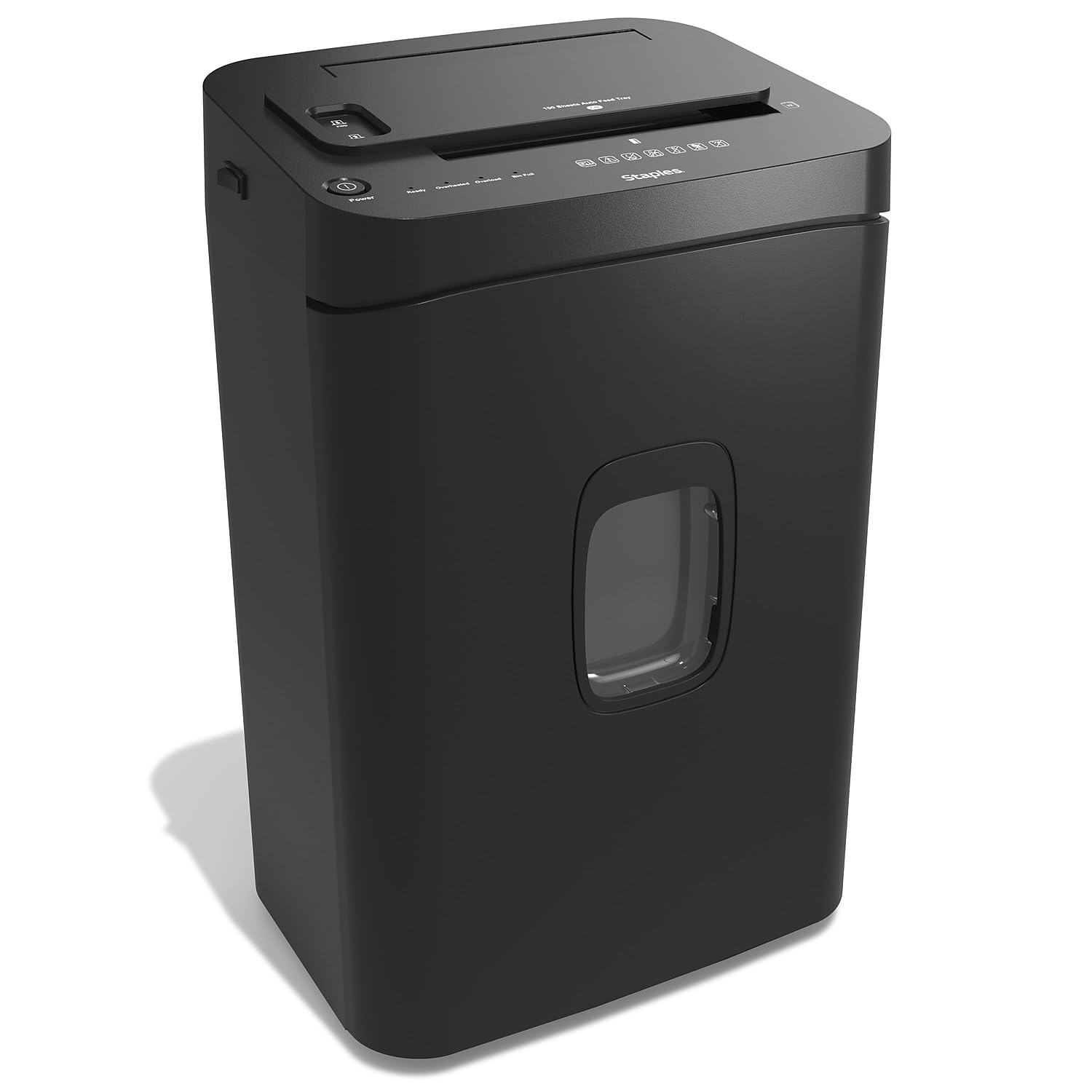
A big tray, a bright clear window, and the quietest lift of the bunch.
This Staples machine pairs the largest tray in the middle of the list — 150 sheets — with a bin of 7.4 gallons, so you thread the needle between speed and clean-up. Micro-cut blades shred to 4.3mm by 12mm particles, security level P-4, from paper and also from credit cards, staples, and small paper clips. Speed is quoted at roughly 7 feet of paper per minute, which is fast enough to keep a busy schedule clear.
Owners describe the operation as quiet — 65 decibels — and the bin as one of the easiest to empty, thanks to the pull-out design and clear window. Auto start and stop kick in only when paper is detected; auto reverse backs out partial misfeeds, and overload protection keeps the motor safe. LED indicators keep you posted on readiness and bin status. The build feels sturdy enough that several owners describe reaching for it as their default office tool.
Two honest quirks from the review pages: there is no on/off switch, just a sliding cover, so the machine enters standby when covered rather than truly powered down. And if it jams or overheats, removing and reinserting the bin resets it. Both are minor habits to learn — worth knowing before your first heavy session rather than mid-way through it.
What you are paying for
- 150-sheet top-load tray with approximately 7 feet per minute feed speed
- P-4 micro-cut 4.3mm x 12mm particles
- 65dB operation, noticeably quieter than the average office unit
- 7.4-gallon pull-out bin with a clear window
- Auto start/stop, auto reverse, overload protection
What to know
- No on/off switch — the sliding cover is the control
- Jams and overheats may need a bin removal to reset
- Manual feed bogs down if you push past a thin stack
Ideal for: a home office that wants the tray-and-bin balance tilted toward capacity without sacrificing quiet operation.
Better suited elsewhere if: you want a hard power switch to kill the motor between uses.
9. BONSEN 300-Sheet Auto Feed Micro Cut Heavy Duty Paper Shredder for Office

Three hundred sheets in the tray and a 60-minute continuous run — a small office workhorse.
This is the machine you buy when the volume is real. The auto tray holds 300 sheets of letter paper, the manual slot takes 12 sheets plus credit cards, staples, and clips, and the micro-cut blades output 5/32 by 15/32 inch particles at security level P-4. Run time is 60 minutes in auto mode and 30 minutes manual, with an advanced cooling system that stretches the auto session without the frequent breaks that smaller machines demand. Noise sits at just 58dB — the quietest of the auto-feed machines on this list.
The bin is 8.1 gallons, roughly 300 sheets of output, and the machine rolls on casters. LED indicators cover feed error, bin full, door open, overload, and overheat, and an auto-sleep after 10 minutes saves power when you are away from the desk.
Customers note real-world reliability on a heavy schedule — one buyer ran 100 to 200 sheets of financial documents daily without issues, and another cleared 75 years of tax returns in one sitting. The genuine trade-off is speed: some owners find it slower than they hoped, and the manual slot offers no rush mode. Dust accumulation around the tray also gets mentioned, so keep a canister of compressed air nearby during long sits. Customer support is a bright spot, with one stuck-button unit replaced free within two days.
The case for the BONSEN
- 300-sheet auto tray, the largest in this list
- 60-minute auto run time, 30-minute manual
- 58dB operation — quietest machine here
- 8.1-gallon bin with LED status indicators
- Auto-sleep after 10 minutes to save power
The trade-offs
- Feed speed draws mixed reviews — expect a steady pace, not a sprint
- Dust accumulates around the tray over long sessions
- 1-year customer support window is shorter than some competitors
Pick this one if: your shredder needs to keep up with a working office, not a filing cabinet.
A smaller machine will suit better if: you only shred a few envelopes a week and want to save the desk space.
Understanding the Specs
Auto Feed Sheet Capacity
This is the number of sheets the top tray can swallow in a single unattended load. It is the spec that decides how big a job you can hand off and walk away from. Numbers across these machines run from 60 sheets up to 300. It is a maximum, not a target — most units perform best at two-thirds of their rated tray load. Feed a clean, uniform stack and you get the capacity the maker promises. Mix in folded envelopes or receipts of different sizes and many trays will simply stop.
Cut Type and Security Level
Security level P-4 means the output particles meet a recognised fine-destruction standard — generally cross-cut or micro-cut rather than the wider strips of an old strip-cut unit. Micro-cut takes the paper down to small non-reconstructable particles, typically around 4 x 12mm or 5/32 x 15/32 inch pieces. Cross-cut is slightly wider — around 4 x 20mm — but still far safer than strip-cut. Finer cuts are more secure but create bulkier waste, so a micro-cut bin fills faster than a cross-cut bin of the same gallon size.
FAQ
What does auto feed actually mean on a paper shredder?
How many sheets can I load into the auto feed tray at once?
What is the difference between micro-cut and cross-cut for security?
Why does my auto feed shredder stop in the middle of a stack?
How long can an auto feed shredder run before it needs to cool down?
Can I shred staples credit cards and paper clips in the auto feed tray?
How do I keep an auto feed shredder from jamming?
How often will I need to empty the bin?
Are these machines quiet enough for an open-plan home office?
What maintenance does an auto feed shredder need?
Final Thoughts: The Verdict
For most buyers, the auto feed paper shredder winner is the Aurora AU110MB because it hits a rare balance — a 110-sheet auto tray, a 30-minute continuous run, and security level P-4 micro-cut output (tiny particles that are hard to read) — with the kind of owner track record that makes buying it feel like the obvious move. If you want the biggest tray and bin on the list, grab the BONSEN S3113, which handles a genuine 300-sheet load and stays quiet at 58dB (about as loud as a normal conversation). And for the household with years of accumulated paper and a limited appetite for bin emptying, the Amazon Basics 200-Sheet and its 8.5-gallon bin makes one long afternoon of shredding feel manageable.
One more thought as you decide— the common thread across every pick here is that the tray does the work, so buy for the stack you actually have rather than the maximum the maker prints on the box. A mid-size 100 to 120-sheet tray will clear a home office faster than a bigger model you never fully load, and every one of these machines rewards a clean, uniform stack over a shoved-in pile.
How We Picked
We do not accept paid placement. Every pick is matched to a real buyer and a real use-case; we do not hands-on test units.
Sources & Methodology
Specifications: manufacturer listings and product documentation. Review insights: verified customer reviews, as of September 2026. Pricing: not shown on this page (it changes often); check the current price via the retailer link.
As an Amazon Associate, Gadgets Feed earns from qualifying purchases. This does not affect which products we feature.