
Changing your car’s oil normally means wrestling with a drain plug under a jacked-up vehicle, catching hot oil in a shallow pan, and praying the wind doesn’t shift the stream. A manual fluid extractor eliminates every part of that ritual by pulling oil straight through the dipstick tube from above, leaving the drain plug untouched and the driveway spotless.
I’m Min — the co-founder and writer behind Gadgets Feed. After cross-referencing specifications like working pressure ratings, hose lengths, and tank capacities across seven models, and analyzing hundreds of verified buyer experiences for failure patterns and real-world extraction speeds, this guide isolates the units that actually hold vacuum and survive repeated use.
Whether you maintain a single sedan or a fleet of small engines, choosing the right best auto fluid extractor means understanding which build qualities prevent cracking and which tube sets reach your specific sump depths.
How To Choose The Best Auto Fluid Extractor
A fluid extractor sounds simple — pump, suck, dump — but the difference between a tool that lasts a decade and one that cracks during its second use comes down to four specific design zones. Beginners often focus on capacity alone, missing the factors that actually govern whether the unit holds vacuum or dumps oil across the engine bay.
Tank Capacity vs. Real-World Engine Sump Volumes
Most passenger cars hold between 4 and 6 quarts of engine oil. A 6.5-liter (roughly 6.9-quart) tank covers a single change without needing to stop and empty mid-job. Trucks and large SUVs with 7- or 8-quart sumps require a mid-process pause or a larger-capacity unit, so matching tank size to your vehicle’s total oil volume is the first spec to lock in.
Working Pressure Range and Seal Integrity
The vacuum inside the tank is generated by pumping the handle — typically building 70 to 170 PSI depending on the unit. A narrow pressure range means you pump more often to maintain suction. More important is how well the seals hold that pressure: buyer reports frequently cite vacuum leaks around the lid gasket or the pump shaft, which turn a 10-minute job into a 40-minute pumping session.
Hose Length and Diameter for Dipstick Access
The main suction hose must be long enough to route from the dipstick tube up to the extractor sitting on the ground or a workbench. A 59-inch main hose with multiple extension tubes (typically three 41-inch pieces) covers most passenger cars and small trucks. The diameter also matters — a hose that is too wide won’t slide into tight dipstick tubes on European or Asian engines, while one that is too narrow slows flow on thicker gear oils.
Build Materials and Base Stability
Polyethylene tanks resist heat and common automotive fluids, but the thickness of the wall and the width of the base determine whether the unit tips over mid-pump or develops stress cracks over time. An extra-wide base with a foot stabilization pedal dramatically reduces wobble. Metal reinforcement around the pump handle mount and lid latch separates the units that survive years of garage use from those that fail after a handful of cycles.
Quick Comparison
On smaller screens, swipe sideways to see the full table.
| Model | Category | Best For | Key Spec | Amazon |
|---|---|---|---|---|
| EWK 6.5L | Premium Manual | Topside car oil changes | 102-inch suction tube with multiple hose sizes | Amazon |
| Mityvac MVA6852 | Premium Syringe | Transaxle & differential fluid | Twist-valve precision control; 1.5-liter capacity | Amazon |
| Wzyblixo 6.5L | Premium Dual-Mode | Shop with air compressor | Pneumatic + manual operation | Amazon |
| Superfastracing 6.5L | Mid-Range Manual | General fluid extraction | Working pressure 70-170 PSI | Amazon |
| Powerbuilt 6.3 Quart | Mid-Range Manual | Personal watercraft & ATVs | Metal suction probe; extra-wide base | Amazon |
| FOUR UNCLES 6L | Value Manual | European cars with deep sumps | 59-inch hose; three 41-inch extensions | Amazon |
| VEVOR 6.5L | Budget Manual | Cost-conscious DIYers | Four suction tube sizes included | Amazon |
In‑Depth Reviews
1. EWK 6.5L Manual Oil Extractor Pump
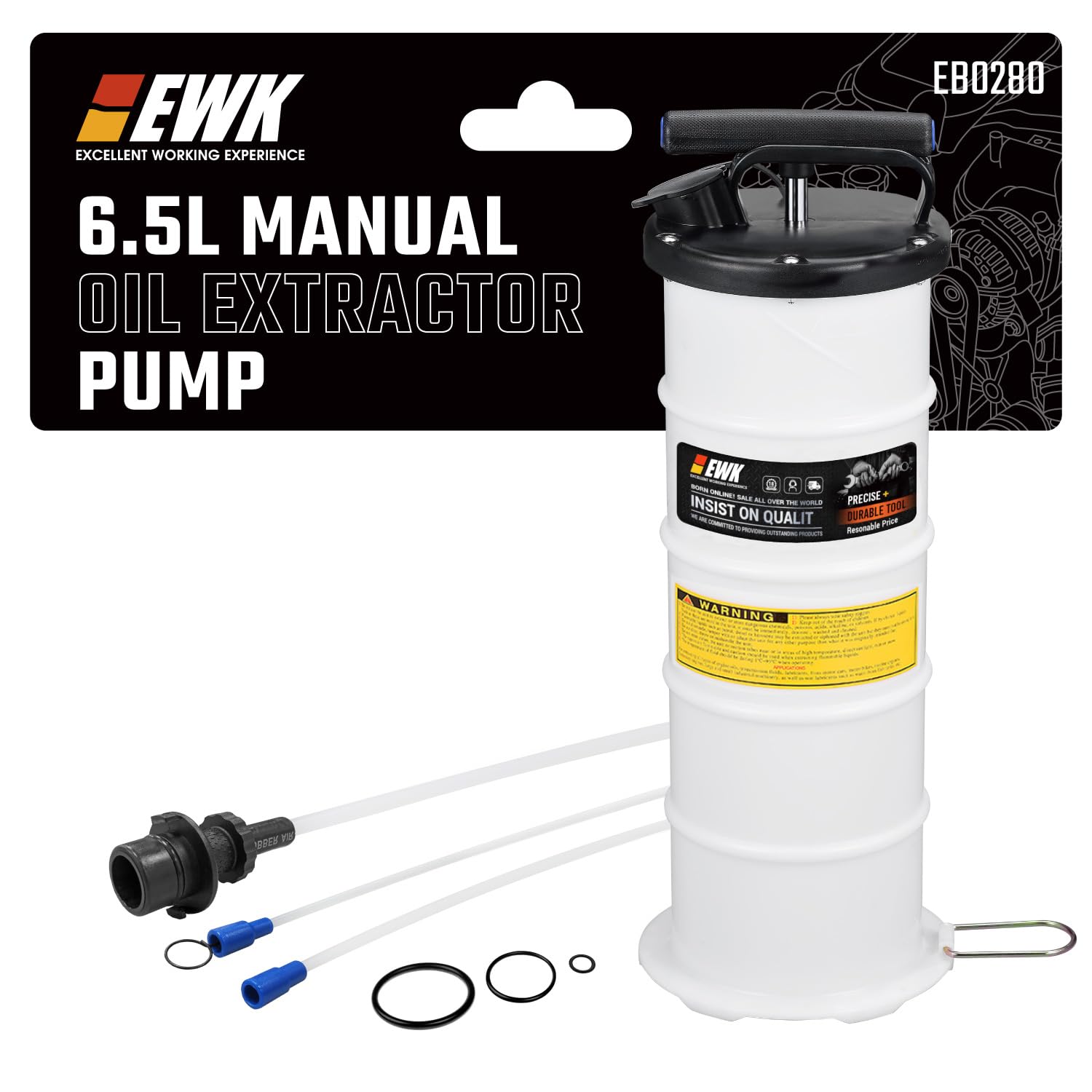
The EWK 6.5L earns the top spot because it pairs a dual-function design — you can pump manually or hook it to a shop compressor — with the longest suction tube in this roundup at 102 inches. That extra length means it reaches dipstick tubes on low-clearance cars, inboard marine engines, and generator sumps without needing to elevate the tank. Users report pulling 5.4 quarts from Audis and Subarus in roughly 15 minutes with only a few firm pump strokes to start flow.
The high-density polyethylene tank resists heat up to 140°F and stands on a stable base with a short, wide profile that resists tipping. Multiple hose diameters (including a rigid probe and flexible hoses) fit both tight dipstick bores on Asian engines and larger reservoir openings on trucks. The sealed cap and pour spout make disposal straightforward, and the included compressor port means you can walk away while it pulls rather than standing over it pumping.
One limitation: the 6.5-liter capacity falls short for 8-quart American truck engines, requiring a mid-job pause to empty. The large suction tube is also notably stiff, which some users found stresses the connection point unless the tank is elevated. Storing the tubes in a PVC pipe keeps them straight between uses. For the majority of passenger cars and marine engines, this extractor’s speed and versatility justify its place as the top pick.
Why it’s great
- Dual manual and pneumatic operation for flexibility
- 102-inch suction tube reaches deep sumps without positioning hassle
- Quick flow with minimal pumping — 2 to 3 strokes start siphon
Good to know
- 6.5L capacity insufficient for large truck engines (8+ quarts)
- Stiff large tube can stress connection; best stored in PVC pipe
- Pour spout design awkward due to handle position
2. Mityvac MVA6852 1.5 Liter Fluid Evacuator
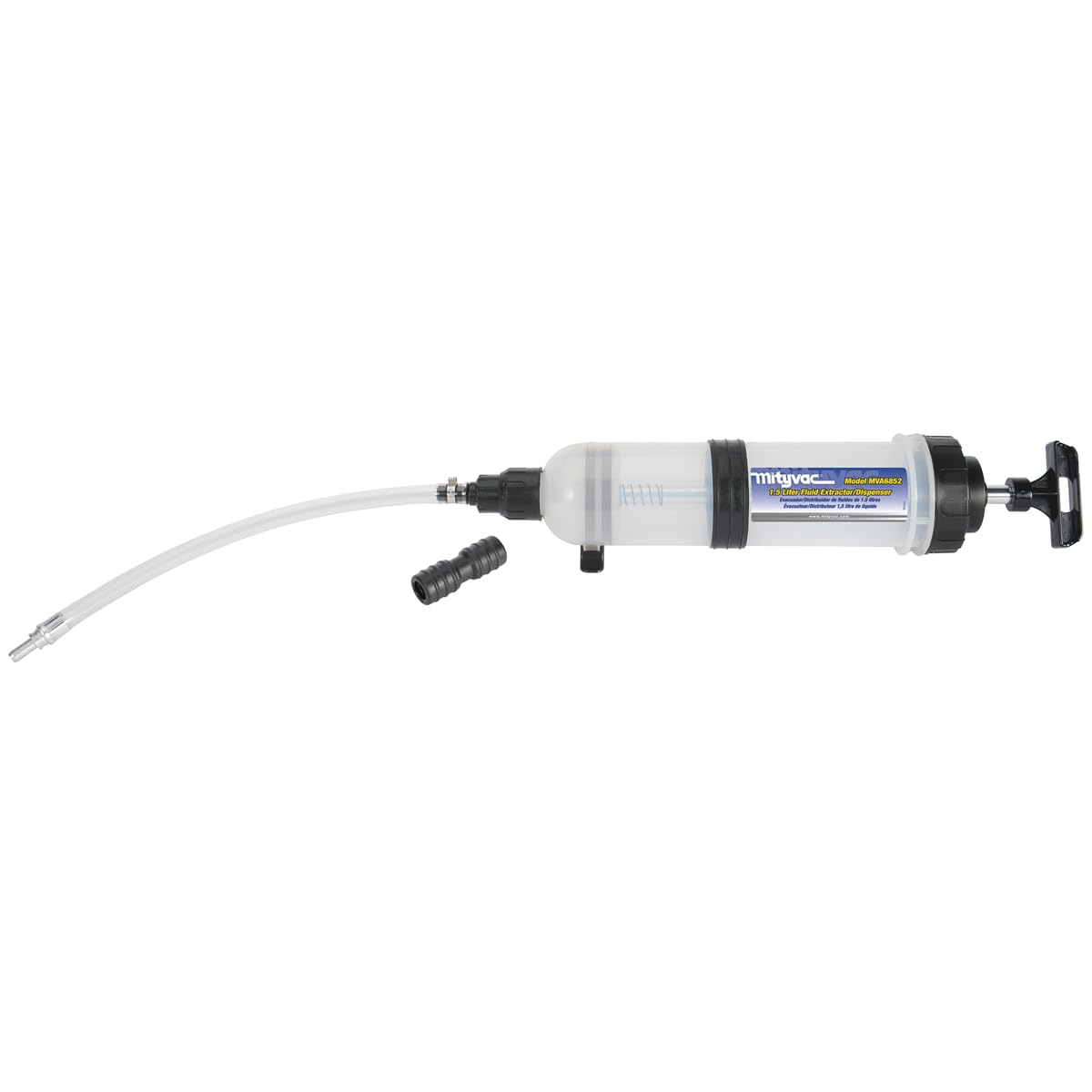
The Mityvac MVA6852 is a fundamentally different tool from the tank-style extractors above. It is a hand-operated syringe with a 1.5-liter capacity designed specifically for precision fluid handling — filling sealed transmissions, evacuating differentials, and bleeding brake systems. The twist-valve mechanism lets you start and stop flow instantly without losing prime, and the dual-seal piston maintains vacuum even when the cylinder is partially full.
Included with the unit is the MVA7218 rubber ATF adapter, which fits over transmission fill ports and creates a leak-free seal for pump-in refills. Users who have owned this tool for over three years report it holds up for repeated sealed-transmission services on Lexus and Honda vehicles, with the twist-valve eliminating the dribbles that plague cheaper syringe-style pumps. The clear cylinder body shows exactly how much fluid you have extracted or dispensed at a glance.
The trade-off is capacity: at 1.5 liters, it cannot handle a full engine oil extraction in one pull. It also costs more per ounce of capacity than any tank-style extractor, so it is best treated as a dedicated tool for differential, transmission, and brake fluid work rather than routine oil changes. The rubber ATF adapter can detach inside a fill hole if not fully seated, so secure it firmly before pumping. For mechanics who need controlled fluid transfer rather than bulk evacuation, this syringe is the category leader.
Why it’s great
- Twist-valve enables precise fluid start/stop control
- Dual-seal piston maintains vacuum for smooth operation
- Includes rubber ATF adapter for sealed transmission fills
Good to know
- 1.5L capacity is too small for full engine oil changes
- Rubber adapter can detach into fill hole if not seated fully
- Higher cost per ounce than tank-style extractors
3. Wzyblixo 6.5L Pneumatic/Manual Fluid Extractor
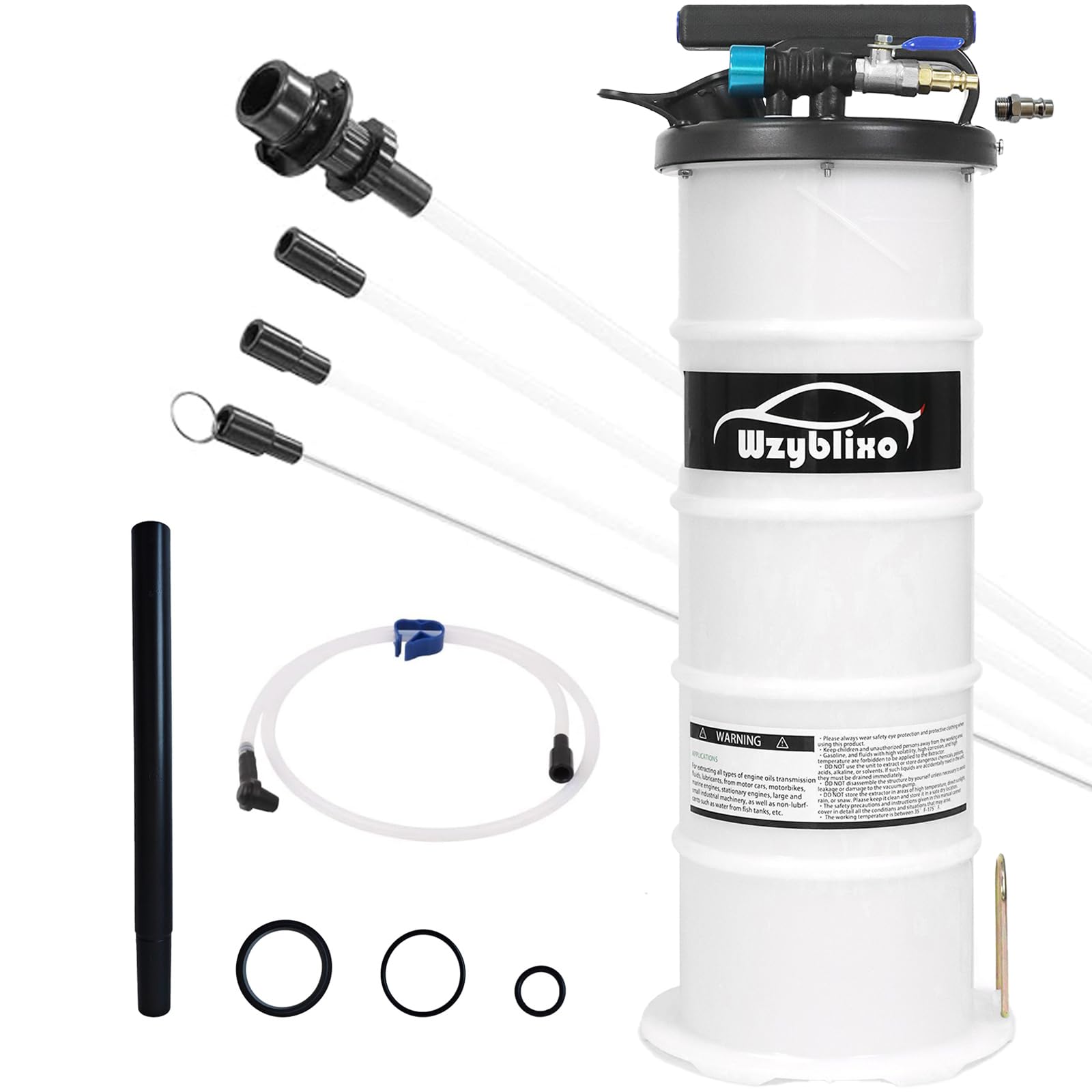
The Wzyblixo 6.5L distinguishes itself with a true pneumatic mode that lets you plug into a shop air line and let vacuum do the work hands-free. Hook it to a compressor, turn the valve, and oil flows without any manual pumping — ideal for shops where you are working on multiple vehicles in sequence. The manual mode works identically to standard extractors, giving you a fallback when a compressor is not available.
The unit ships with two upgraded extra-long tubes of different diameters, allowing access to both tight dipstick bores and larger reservoir openings. Users pulling oil from Ford F-150s and Audi A5s reported extraction times of 5 to 10 minutes with no leaks. The compact tank stands roughly 1.5 to 2 feet tall and the pour spout makes emptying straightforward. The plastic build feels lighter than the EWK or Powerbuilt units, but early reports suggest it holds vacuum reliably if you avoid over-pressurization.
On the downside, the included instructions are essentially useless — multiple users noted the drawings are vague and fail to explain which hose connects where during pneumatic operation. The plastic construction, while functional, does not inspire the same long-term confidence as thicker-walled competitors. For anyone running a home shop with an existing air compressor who wants to speed up fluid changes without buying a dedicated powered evacuator, this dual-mode extractor delivers real time savings.
Why it’s great
- Pneumatic mode pulls oil hands-free with air compressor
- Two long tubes of different diameters fit varied ports
- Fast extraction — most jobs finish in under 10 minutes
Good to know
- Instructions are vague and nearly useless
- Plastic build quality lighter than premium competitors
- Long-term durability still unproven by extended user reports
4. SUPERFASTRACING 6.5L Fluid Extractor

The SUPERFASTRACING 6.5L has been on the market since 2019, giving it a longer track record than most extractors in this range. It uses a manual pump to generate vacuum between 70 and 170 PSI, and the transparent hose lets you watch the fluid flow real-time. A durable metal foot pedal locks the tank in place during operation, which is a welcome stability feature that many cheaper units omit entirely.
Users report successful fluid changes on cars, mowers, and power steering systems. The included multiple tube diameters handle return-line extraction on power steering reservoirs as well as dipstick-tube oil changes. The tank empties via a pour spout, though several reviewers note that careful angling is required to avoid damaging the pump mechanism. Overall, the unit provides reliable performance for a variety of extraction tasks.
The standout complaint involves the tube couplers — they are short and cheap, and the hoses can pop off the suction container under vacuum, spilling oil. A few units arrived with the wrong-size O-ring for the suction connection, requiring the buyer to source replacement seals before first use. The unit is a solid performer if you verify seal fit before starting, but the inconsistency in quality control makes it a step behind the top picks.
Why it’s great
- Proven track record since 2019 with thousands of units sold
- Wide working pressure range of 70-170 PSI
- Metal foot pedal adds stability during pumping
Good to know
- Short tube couplers can pop off, causing oil spills
- Some units arrive with wrong-size O-rings
- Angling required during emptying to avoid pump damage
5. Powerbuilt 6.3 Quart Oil and Fluid Extractor

The Powerbuilt 647570 has been a staple in garages since its introduction, with some users reporting twelve-plus years of reliable service before tube deterioration required replacement. The 6.3-quart (roughly 6-liter) tank holds enough for most passenger car changes, and the included 59-inch transparent main tube makes fluid monitoring easy. The standout feature is the flexible 42-inch metal suction probe that reaches the bottom of oil pans without kinking — ideal for deep sumps on personal watercraft and larger engines.
The extra-wide base allows foot stabilization during pumping, and the sealing cap keeps the tank airtight. The pour spout and handle make emptying simple with minimal drips. Owners of Yamaha Waverunners and jet skis repeatedly cite this extractor as the perfect tool for those tight, recessed oil tanks where a standard drain plug is inaccessible. On cars, the 59-inch tube reaches ground level for sedans, though larger trucks may need to set the tank on a raised surface.
The main weakness reported is slow extraction speed — some users found that pulling 4.5 quarts of warm oil took 30 minutes with periodic pumping. A few units also lose vacuum over time due to a leaky seal, requiring pumping every 1 to 2 minutes to maintain suction. The unit is durable but not fast, making it a better fit for occasional DIYers than high-volume shops.
Why it’s great
- Proven durability — some units last over a decade
- Flexible metal probe reaches deep, recessed oil pans
- Extra-wide base provides excellent stability
Good to know
- Slow extraction — 30 minutes for 4.5 quarts
- Some units develop vacuum leaks requiring frequent pumping
- Tube length may require elevated tank position for trucks
6. FOUR UNCLES 6L Oil Extractor Pump

The FOUR UNCLES 6L extractor bundles a 59-inch transparent main hose with three 41-inch extension tubes, giving you a combined reach that suits deep European dipstick tubes and awkwardly positioned reservoirs. The upgraded aluminum pressure release plug resists corrosion better than plastic alternatives, and the spare rubber plug in the package extends the service life. Side markings on the translucent tank let you track how much fluid you have extracted at a glance.
Users with Challengers, Pacifica minivans, and various European cars report the tube length and diameter work well for reaching sumps without lifting the vehicle. The pump builds vacuum quickly — typically 5 to 10 strokes to start flow on a warm engine — and the wide base keeps the tank planted. The included brake bleeding hose (19 inches) adds transmission and brake fluid capability without a separate purchase.
The most serious failure report involves the plastic tank imploding after roughly 20 pumps, cracking and dumping oil mid-job. This appears to be a defect rather than a design pattern, but it signals that the plastic wall thickness is thinner than premium competitors. A few users also noted the supplied parts bundle includes extra pieces with no instructions for use. For basic oil changes where saving money is the priority, this extractor performs well — just inspect the tank for stress marks before each use.
Why it’s great
- 59-inch hose plus three extensions reach deep sumps
- Upgraded aluminum pressure plug and spare rubber seal
- Includes brake bleeding hose for multi-fluid use
Good to know
- Reported tank implosion after ~20 pumps (possible defect)
- Some extra parts lack instructions for assembly
- Thinner plastic wall than premium-tier extractors
7. VEVOR 6.5L Manual Fluid Extractor

The VEVOR 6.5L is the most wallet-friendly entry in this roundup, but it is not a stripped-down compromise. The package includes four different suction tube sizes — a 9.8-inch main tube, two 47.24-inch extension tubes in different diameters, and a 58.27-inch suction hose — giving you more tube variety than many mid-range competitors. The manual pump builds vacuum quickly, and users report extracting 2 quarts of cold oil from lawnmower engines in roughly 3 minutes.
The 6.5-liter tank holds enough for most passenger car changes, and the four-step operation (grab tube, replace dipstick, pump, pour) is genuinely intuitive. Owners of Mazda MPVs and Kohler lawnmower engines note the thick, sturdy materials feel good in hand, and the unit showed no leaks during use or transport in multiple reviews. For the price, the included accessory count is generous, with spare sealing rings and a user manual that actually explains the process.
Quality control is the catch: a number of units arrived with broken handles caused by inadequate packaging during shipping. One reviewer noted the handle was snapped on arrival, though the pump mechanism itself still functioned. The maximum operating temperature is 60°C (140°F), so use with hot oil requires caution. For the DIYer on a tight budget who can inspect the handle upon delivery and accept the temperature limit, the VEVOR delivers solid extraction performance at the lowest cost.
Why it’s great
- Four tube sizes included — wider selection than most competitors
- Thick, sturdy materials with good build quality for the tier
- Quick extraction on small engines (3 minutes for 2 quarts cold)
Good to know
- Broken handles reported due to poor shipping packaging
- Max operating temperature of 60°C limits hot oil use
- Spare parts lack instructions for correct installation
FAQ
Can I use a manual fluid extractor on a hot engine?
Why does my extractor lose vacuum during use?
Can a fluid extractor pull transmission fluid through the dipstick tube?
Final Thoughts: The Verdict
For most users, the best auto fluid extractor winner is the EWK 6.5L Manual Oil Extractor Pump because its 102-inch tube and dual manual/compressor operation cover the widest range of vehicles while extracting oil faster than competitors. If you need precision for sealed transmissions and differentials, grab the Mityvac MVA6852. And for shop environments with an air compressor, nothing beats the hands-free pneumatic speed of the Wzyblixo 6.5L.