
Our readers keep the lights on and my morning glass full of iced black tea. As an Amazon Associate, I earn from qualifying purchases.
Specs are compiled from manufacturer listings and verified buyer reviews and can change over time — please confirm the key details on the product page before buying.
If your windshield still looks hazy after you wipe it, the problem is usually the cleaner, not your technique. The wrong formula smears oil around instead of lifting it, and anything with ammonia can cloud the tint film you paid to have installed.
I’m Min — the founder and writer behind Gadgets Feed. This guide is built by comparing the manufacturers’ published specifications and the patterns across verified customer reviews, so you get each pick’s real strengths and trade-offs instead of marketing spin.
You will see which formulas cut road film on the first pass and which ones need a second wipe. Pick an ammonia-free, tint-safe formula if your windows carry film; otherwise any of these nine will clear daily road haze.
Our Picks at a Glance


How To Choose The Best Auto Glass Cleaner
Windshield grime is not one substance. It is a mix of exhaust film, insect residue, plasticizer haze from your dashboard, and whatever the car wash left behind. A cleaner that handles one of those often smears the rest. The four checks below separate a bottle that works from one that just makes the glass wet.
Ammonia content and tint safety
Ammonia is a strong degreaser, and it is also why some cleaners fog a tinted window over time. If your side windows or rear glass carry aftermarket tint film, look for a bottle that states ammonia-free and tint-safe on the label. Several of the formulas here make that promise plainly, including HOPE’S, Invisible Glass, Gyeon, Blackline, and SONAX. If your car is untinted, this is one less thing to worry about.
Foam versus liquid spray
A foaming aerosol clings to vertical glass instead of running down the pane. That means less product ends up on the door panel and more stays where you need it. A pump or trigger spray gives you finer control and no propellant, which is why detailers tend to favor it. Both work — the choice depends on how messy your technique is and whether you buy in bulk.
Bottle size and how many you get
Glass cleaner disappears fast when you keep a bottle in the trunk and another under the sink. A multi-pack spreads the same spend across months of refills, while a single large jug suits someone with one garage shelf and no spare space. Match the quantity to where you plan to store it, not just to the per-bottle look.
Plain cleaner versus a protective layer
Some formulas just clean. Others leave a hydrophobic layer behind, which is a thin coating that makes water bead and roll off instead of clinging as a sheet. That coating helps in rain and cuts how often you have to rewash, but it also asks more of your technique on the first pass. Decide if you want a cleaner or a cleaner plus a light protectant.
Quick Comparison
| Model | Best For | Format | Ammonia-Free | Size | Amazon |
|---|---|---|---|---|---|
| Sprayway Glass Cleaner Lavender Foaming Aerosol, 19oz, Pack of 6★ Best Overall | Keeping every car and window in the house spotless | Foaming aerosol | Yes | 19 oz each | Amazon |
| SONAX Glass Cleaner 338400Top Performer | Heavy road film and stubborn smoke haze | Spray and wipe | Yes | 750ml | Amazon |
| Gyeon Glass Cleaner 500mlBest for Screens | Windshields plus infotainment screens and trim | Liquid spray | Yes | 500 ml | Amazon |
| Koch-Chemie Glass Cleaner 500ml | Detailing routines where wiping feel matters | Ready-to-use liquid | Not stated | 500 ml | Amazon |
| CARPRO Clarify 500mL | Ceramic-coated paint and windshield sealant owners | Liquid spray | Not stated | 500mL (17oz) | Amazon |
| Griot’s Garage Ceramic Glass Cleaner 11009 | Rainy-climate drivers who want water to bead | Liquid spray | Not stated | 1 gallon | Amazon |
| HOPE’S Perfect Glass Automotive Glass Cleaner 23oz | Interior windshield film that other brands smear | Liquid spray | Yes | 23 oz | Amazon |
| Invisible Glass Auto Glass Cleaner 92163, Pack of 3 | All-purpose glass duty on cars and in the house | Liquid spray | Yes | 16 fl oz each | Amazon |
| Blackline Car Glass Cleaner 16oz | Tinted windows and navigation screens | Spray and wipe | Yes | 16 oz | Amazon |
In‑Depth Reviews
1. Sprayway Glass Cleaner Lavender Scent Foaming Aerosol Spray, 19oz, Pack of 6
Our pick — over 4.5★ from 650+ verified ratings; the strongest balance of quality and price.
The foam that clings to vertical glass and refuses to streak, six cans deep.
Sprayway’s own edge is the foaming action. Instead of running down a windshield like a thin liquid, the aerosol sits on the pane and gives the cleaner time to lift fingerprints, dust, dirt, and smoke film before you touch it. That clinging foam is also why it holds 4.8 stars across 600+ ratings.
The count tells you how it’s meant to be bought. It’s a six-pack of 19oz cans, so one lives in the trunk, one under the sink, and the rest sit in reserve. Buyers report it “Works better than a concentrate that I ordered. Great smell!” and the lavender scent is a real part of that — enough people bring it up as a positive that it is not a throwaway detail. Just as many note they use it on stainless and granite counters, not only glass.
Buyers also use it on stainless and granite counters, not just car glass. Grease is the honest limit; heavier kitchen grime takes a scrub rather than a wipe. But for daily windshield haze and quick touch-ups on mirrors and windows, the effort is about as low as it gets.
The case for the six-pack
- Foaming aerosol clings to vertical glass instead of running off
- Ammonia-free, so it will not damage tint film
- Removes fingerprints, dust, dirt and smoke film in one pass
- Six 19oz cans at a per-can cost that’s tough to top
Where it stops
- Heavy grease needs extra scrubbing
- You are committing to six cans worth of storage space
Reach for this if: you want a do-everything glass spray that handles the car, the mirrors, and the kitchen window without thinking about it.
Look elsewhere if: you only clean one windshield and six cans is more inventory than you have shelf for — a single jug will serve you better.
2. SONAX Glass Cleaner 338400 | Powerful Streak Free Formula | 750ml
Built for the grime that nothing else in your cabinet touches — tar, nicotine film, exhaust buildup.
SONAX built this one around stubborn contamination. The label names insect residue, nicotine film, and exhaust buildup specifically, and it keeps the formula phosphate-free — meaning no phosphates in the mix — while staying ammonia-free and tint-safe. That combination is what makes it a fit for a car that has sat outdoors with a film on the inside of the windshield for years.
What buyers keep reporting is that it works after the usual suspects fail. One Sonax owner puts it plainly: “I have two custom hot rods. This is perfect for cleaning all the windows. No streaks. Gives my cars a professional look.” The other common thread is patience — long-neglected tar needs some back-and-forth wiping before it lifts. The 750ml bottle spreads further than the spray count suggests, because the instructions say to spray dry glass, let it sit briefly, and wipe with a lint-free microfiber, which means you’re not drowning the pane in product.
The manufacturer’s own caveat: avoid direct sunlight and hot surfaces. Clean in the shade, when the glass is cool, and this behaves. Do it in the sun and you get the haze everybody complains about.
The formula edge: phosphate-free, ammonia-free, and tint-safe, in a 750ml spray-and-wipe bottle that suits interior glass and exterior alike.
Worth buying if: your car has accumulated hard road film or interior haze that lighter sprays just push around.
Know before you buy: it wants cool glass and a microfiber cloth — skipping either step brings streaks.
3. Gyeon Glass Cleaner Streak Free Tint Safe Premium Window Cleaner 500ml
One bottle that treats a windshield and a touchscreen with the same ammonia-free care.
Gyeon is the pick for anyone whose car has more screens and trim than bare glass. The formula is ammonia-free and tint-safe, and the label says it’s fine on interior screens, plastics, and trim as well as windshields, side and rear windows, and mirrors. Most glass cleaners stop at glass — this one keeps going across the cabin without attacking the surface.
The defining feature, though, is the hydrophobic layer. Hydrophobic is a tech word for water-repelling, and here it means the formula leaves a coating that beads water and dirt so you clean less often. That’s a different job from spraying and wiping — you’re building up resistance. The 500ml bottle is unscented, which is a fit for anyone who finds fragranced cleaners distracting.
Patience matters at the price. One owner notes on the review page that dried-on stains take “extra effort” — this is a cleaner that rewards a second pass. But most Gyeon buyers describe it as their go-to, with one saying: “Best I’ve ever used. Threw out all my other glass cleaners and will only use this going forward.”
Why owners choose it
- Ammonia-free and safe on tint, screens, plastics, and trim
- Hydrophobic layer repels water and dirt between cleans
- Unscented formula — nothing competing with the car’s own smell
- 500ml bottle that works across car and household surfaces
The trade-off
- Dried-on stains need a second pass, not just one wipe
- Editorial price expectation runs premium for a 500ml bottle
Take this one: if your dash has a touchscreen and your windows carry tint, and you want one bottle for both.
Skip if: you only need the exterior windshield cleaned and want the lowest effort per pass — a plain spray will do.
4. Koch-Chemie Glass Cleaner 500ml

The detailing-world classic that makes the wiping feel slick rather than draggy.
Koch-Chemie’s angle is the smoothness additive. Glass cleaner normally fights your cloth; this one adds gloss and smoothness to improve how the cloth glides across the pane. If you’ve ever felt a microfiber drag and skip on a dry windshield, that’s the problem this solves. It handles oil, grease, insects, and residues without a pre-soak, and it’s ready to use at full strength out of the 500ml bottle.
The brand has been making cleaning chemistry since 1968, and buyers treat this as a working detailer’s product rather than a grocery-store spray. One verified owner breaks down the technique: “This is the best window cleaner hands down I’ve ever used. No streaks, wipes off clean and there is no hazing. Use a good microfiber cloth with at least 350 gsm rating and you’ll be very pleased.” That 350 gsm rating is the cloth’s weight per square meter — heavier cloths hold more liquid and lift residue instead of smearing it.
Fresh-fragranced but not overpowering, this sits in the middle of the pack on price. It’s an easy recommendation for someone who already has good cloths and wants a cleaner that pulls its weight.
What the additive delivers: reduced drag means more of the product ends up wiping with you and less streaks behind you.
Match for: detailers and daily drivers who already own quality microfiber and want glass cleaner that keeps pace.
Not for: someone looking for a scrubbing shortcut on caked-on grime — this is a wipe-off formula.
5. CARPRO Clarify Streak Free Car Window Cleaner 500mL

The one to choose when your paint already carries a ceramic coating you don’t want to strip.
CARPRO Clarify is formulated to be safe on ceramic coatings and windshield sealant — that’s the whole pitch, and it’s the reason this bottle exists. If you paid for coating work, you don’t want a random glass cleaner eating into it. Clarify cuts traffic film, oils, fingerprints, and contamination while staying gentle on that coating and on interior surfaces alike.
The one consistent gripe is mechanical, not chemical: several owners mention broken sprayers on arrival. That’s a packaging quality issue rather than a formula problem, and it’s worth knowing before you buy — if yours arrives with a cracked nozzle, return it rather than fighting it. On the formula itself, the consensus is strongly positive, with the clarifying power being the headline. One Tesla owner reported it removed oils, fingerprints, and dirt from the Model 3 windows and left a sparkling, streak-free finish.
The bottle is 500mL, which is 17oz — a useful size for a home garage shelf. The pleasant smell is a small bonus; it’s a product people actually enjoy spraying, which matters when you clean windows more often than you’d like to admit.
What wins people over
- Safe on ceramic coatings and windshield sealants
- Cuts oils, fingerprints, traffic film, and contamination
- Works on interior and exterior glass
- Pleasant but not overwhelming scent
The catch
- Sprayers have been known to arrive broken — inspect on delivery
- Editorial price expectation runs high for a 500mL bottle
- Not for sale or use in the state of California
Built for: coated cars and windshield-treated vehicles where the cleaner must respect what’s underneath.
Think twice if: you’re in California or you’d rather not risk a broken sprayer in transit.
6. Griot’s Garage Ceramic Glass Cleaner Spray 11009, One Gallon

A gallon of cleaner that leaves a ceramic layer behind, so rain beads off instead of smearing.
Griot’s built this around silane polymer technology with SiO₂, which is a silicon-based compound that leaves a water-resistant ceramic layer on your exterior glass. In practice, that means rain beads and streams off the windshield instead of sheeting and blurring. It cleans and protects in one step, and it also reduces how often you need the wipers, which is easier on the blades over time.
One gallon is the real headline. At 8.3 pounds on the shelf, this is a station bottle — you decant it into a sprayer rather than carrying it to the car. That’s a commitment, so it suits someone who cleans multiple vehicles or splits refills across a household. It also resists water spots, ice, and dirt buildup so the glass stays clearer between washes.
The honest part is the technique demand. Buyer accounts split on streak-free results, and the split tracks with technique, not the product. The reviewers who love it followed the directions; the ones who saw streaks admit they sprayed onto a warm windshield, used paper towels, or over-applied. One reviewer noted it straight: “It’s a good product that I have been using wrong this whole time. I kept getting streaks but that is due to user error on my part.” Cool glass, a microfiber wipe-down first, and modest application is the formula the makers intend.
The technique tax: this is not a simple spray-and-wipe. It’s a clean-and-coat, and the application discipline matters as much as the liquid in the bottle.
For you if: you want water beading off the windshield and a gallon that keeps multiple cars in the family covered.
Choose a simpler bottle if: your cleaning window is tight and you want something that just sprays and wipes — this one asks for more.
7. HOPE’S Perfect Glass Automotive Glass Cleaner 23oz

The interior-windshield specialist — the one that finally removes the film others only move around.
HOPE’S came at this from the household side and tuned the formula for cars. It’s higher-concentration than typical glass cleaners, with a no-residue formula that eliminates haze instead of leaving it. Ammonia-free and tint-safe, it works inside and outside the car, and it’s specifically aimed at the smudges, road grime, and smoke film that build up over time.
The capability most owners celebrate is the interior windshield film — that greasy dashboard-generated haze that every other product just smears across the pane. Customers note: “Buy it. Used it three times and it worked great.” The 23oz bottle carries a moderate per-ounce value for what you get. There’s a real technique note here too — plenty of reviewers point out cool glass only. One owner put it bluntly: “As long as the glass is cool, not hot, this works as advertised.”
Compared to the SONAX above, this trades off a bit of extra size for capability on the interior side, which is where most commuters actually have a problem. Anyone who has been disappointed by generic spray-and-wipe cleaners on interior windows should see this first.
Why it earns a slot here
- High-concentration formula designed around interior windshield film
- Ammonia-free and safe on tint film
- No-residue finish that eliminates haze
- 23oz bottle covers both sides of the glass
Where it asks more
- Editorial price-per-ounce expectation runs above big-box cleaners
- Hot glass brings out streaks — cool windows only
Pick it when: the inside of your windshield has that recurring greasy film that no grocery-store bottle will touch.
Not needed if: your only problem is exterior bug splatter and you want a lower cost per ounce.
8. Invisible Glass Auto Glass Cleaner Spray, 16 fl oz, Pack of 3
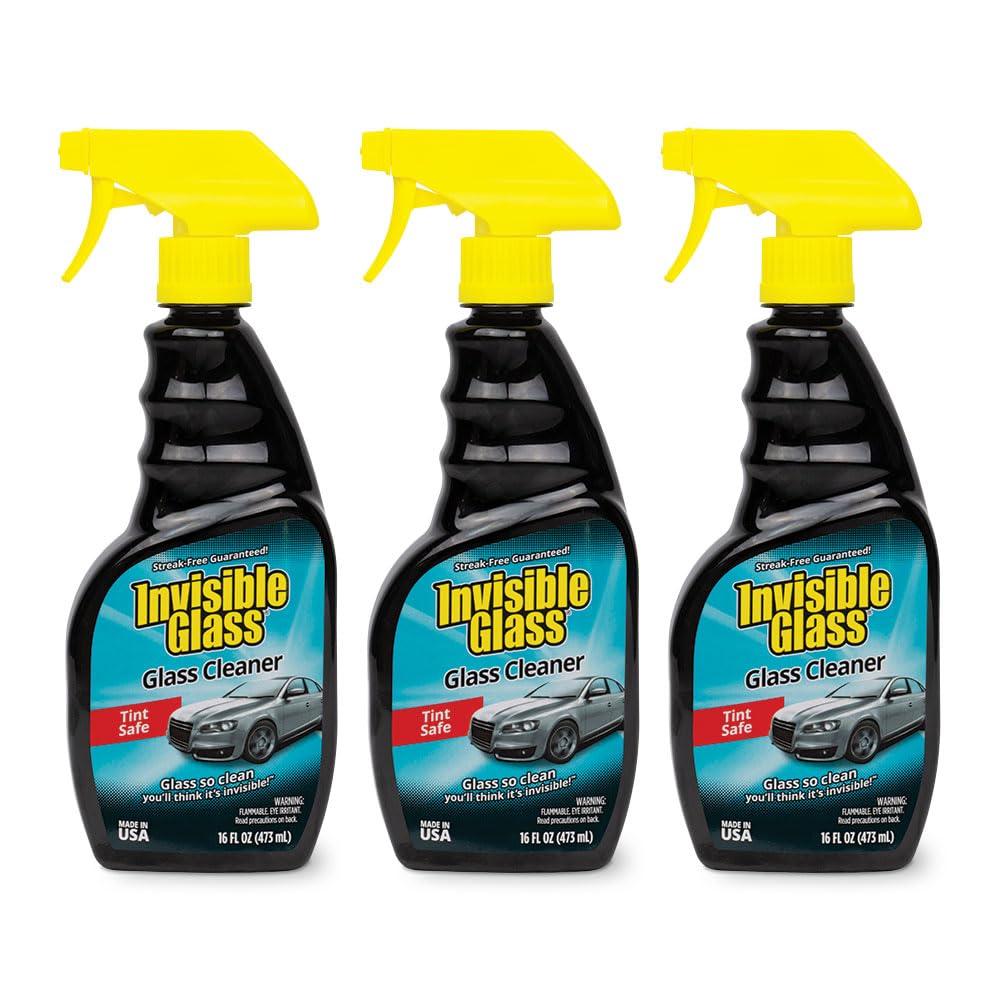
Three bottles of the household name that removes fingerprint grease and road film without residue.
Invisible Glass is the formula car washes and home detailers reach for first, and the reasons are simple. It’s ammonia-free and tint-safe, so factory and aftermarket film both survive. The spray is designed for controlled application, which is the difference between a fine mist that clings and a liquid that pools and runs. And there’s no residue left when you wipe — that’s the meaning of “invisible.”
This is a three-pack of 16 fl oz bottles, and the count is deliberate. One in the car, one in the garage, one as backup. That covers a year of routine window cleaning without needing to restock. It’s made in the USA by Stoner Inc, and the formula is designed to cut haze and buildup without the residue that makes a window look clean until the sun hits it.
The honest caveat is that the multi-pack is a bigger upfront buy than a single bottle, and the spray pattern isn’t everyone’s favorite — a few folks find the mist a touch odd-feeling on the wipe. Neither of these is a reason to skip the formula. This is a straight-down-the-middle choice for someone who wants a known quantity and doesn’t want to experiment.
Why it sticks: three bottles, made in the USA, ammonia-free, and a formula that has spent decades earning trust from detailers and drivers alike.
Ideal for: a multi-car household or a carwash regular who wants a known performer stocked up.
Look at a single bottle instead if: you’d rather not commit to three at once.
9. Blackline Car Glass Cleaner 16oz — Tint Safe, Ammonia-Free, Streak-Free
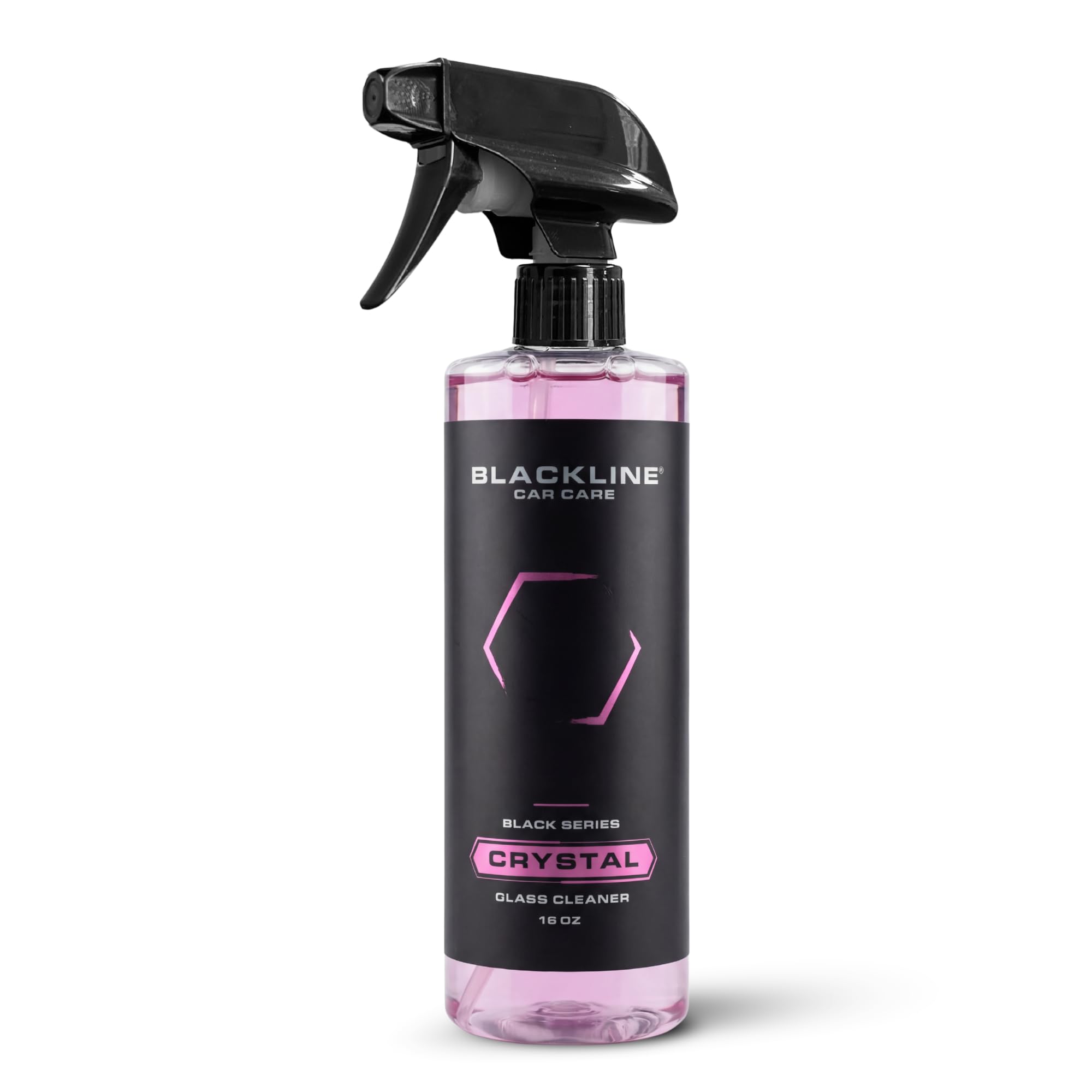
A tint-first formula that handles navigation screens and interior trim without fading them.
Blackline approaches this from the interior side. The formula is tint-safe and ammonia-free, which matters if your car has film on the side windows — that’s the reason you can’t reach for the cheap blue bottle. And it doesn’t stop at glass: the label names navigation screens, mirrors, and trim, so it covers the surfaces you actually touch every day. The spray-and-wipe design is what the product wants from you: no scrubbing, no pre-soak.
The 16oz bottle is a healthy single-car size. At this tier, though, value expectations are higher — a couple of buyers describe it as pricey for what’s in the bottle. Some dilute it 1:1 with distilled water to stretch it further, and reports say the diluted mix still wipes streak-free. The catch on that method is the bottle cap: at least one buyer mentioned the cap loosens in transit and leaks, so keep it upright during shipping.
It’s the right pick if you prioritize a formula that won’t touch the tint or damage the display surfaces inside your cabin. If you want the cheapest fix for exterior bug splatter, there are better-value choices above.
What sets it up
- Tint-safe and ammonia-free for film-protected glass
- Safe on navigation screens, mirrors, and dashboard trim
- Spray-and-wipe — no scrubbing required
- Made in the USA by Blackline Car Care
Weigh before you buy
- Price-to-volume runs high for a 16oz bottle
- Caps have been known to loosen and leak in transit
Best matched to: tinted windows and cars with dash screens where surface safety is the priority.
Pass if: you’re after the cheapest way to clear a windshield and don’t have tint or displays to protect.
Understanding the Specs
Ammonia-Free vs Ammonia-Based
Ammonia is a strong degreaser, but it’s also what fogs tinted film over time. An ammonia-free formula uses other cleaning agents that lift grease and film without attacking the adhesive layer under your tint. If your car carries aftermarket film on the sides or rear, look for ammonia-free and tint-safe on the label before you buy. If your car has no tint, this distinction matters less — but it’s a safety margin that costs nothing to take.
Foaming Aerosol vs Liquid Spray
A foaming aerosol expands on contact, so it sits on vertical glass instead of running straight down the pane. That puts more cleaner where the dirt is and less on your door panel. A liquid spray gives you finer control over how much product you use and no propellant to worry about, which is why detailers favor it. Neither is better — one suits messy technique, the other suits precise technique.
SIze and Concentration
A concentrated formula means you use less per window, so a small bottle lasts longer than its volume suggests. Diluting some formulas with distilled water extends them further, though you should only do that if the maker permits it and you use distilled water, not tap. When comparing two bottles, look at the label’s recommended spray-and-wipe density, not just the raw volume.
Water-Repellent Coatings
Some formulas leave behind a hydrophobic layer — hydrophobic meaning water-repellent. That layer makes water bead and roll off instead of sheeting and blurring. The upside is clearer driving in rain and cleaner glass between washes. The trade-off is a stricter application: warm glass, paper towels, or over-application can leave streaks that a plain cleaner would never produce. Hydrophobic formulas reward careful technique.
FAQ
Is auto glass cleaner safe on tinted windows?
Why does my windshield still look hazy after I clean it?
Should I use a microfiber cloth or paper towels?
What is the difference between glass cleaner and windshield cleaner?
Can I dilute car glass cleaner to make it last longer?
How often should I clean my car windows?
Does glass cleaner work on mirrors and household windows?
Will a water-repellent glass cleaner damage my wiper blades?
How do I stop streaks on the inside of my windshield?
Can I use the same cleaner on exterior and interior glass?
Final Thoughts: The Verdict
For most people, the auto glass cleaner to grab is the Sprayway Lavender Foaming Aerosol six-pack — the foaming action clings to vertical glass, it’s ammonia-free, and the multi-pack means you never run out mid-detail. If your interior windshield carries that recurring greasy film, the HOPE’S Perfect Glass 23oz is the one that lifts it. And if you drive in rain and want water to bead off the glass instead of blurring it, the Griot’s Garage Ceramic Glass Cleaner gallon earns its place with silane polymer technology and SiO₂ protection. Whichever one you choose, pair it with a 350 gsm microfiber cloth — the formula is only half the job.
How We Picked
We do not accept paid placement. Every pick is matched to a real buyer and a real use-case; we do not hands-on test units.
Sources & Methodology
Specifications: manufacturer listings and product documentation. Review insights: verified customer reviews, as of September 2026. Pricing: not shown on this page (it changes often); check the current price via the retailer link.
As an Amazon Associate, Gadgets Feed earns from qualifying purchases. This does not affect which products we feature.