
Our readers keep the lights on and my morning glass full of iced black tea. As an Amazon Associate, I earn from qualifying purchases.
Specs are compiled from manufacturer listings and verified buyer reviews and can change over time — please confirm the key details on the product page before buying.
Your car’s factory stereo hides most of your music. The speakers work, but vocals sit behind the road noise, bass turns to mud, and no amount of twisting the head-unit knobs fixes it. An auto graphic equalizer is the add-on that gives you actual control — letting you reshape every frequency band and, in the best units, calibrate itself to your car’s acoustics with a built-in microphone or smart preset system instead of relying on guesswork.
I’m Min — the founder and writer behind Gadgets Feed. This guide is built by comparing the manufacturers’ published specifications and the patterns across verified customer reviews, so you get each pick’s real strengths and trade-offs instead of marketing spin.
Here are three very different ways to go, from a compact budget processing brain to a studio-grade 8×10 matrix, all ranked in one focused look at the auto graphic equalizer category.
Our Picks at a Glance

How To Choose The Best Auto Graphic Equalizer
The real question isn’t which one has the most dials — it’s which one matches the number of speakers you’re running and the radio you already own. A processor with more outputs than you have amplifier channels is wasted potential, and one that can’t accept your factory radio’s signal is a paperweight.
Count Your Channels Before You Count the Bands
Every output channel on a DSP (a Digital Signal Processor, the computer chip that does the audio shaping) feeds one speaker or one amplifier input. If you have a front pair, a rear pair, and a subwoofer, that’s a 4-channel need at minimum. A unit like the AudioControl DM-810 offers 8 channels of output, which is serious headroom for anyone planning a full system with tweeters, mids, and subs on separate amp channels.
Match the Input to Your Radio
Factory stereos don’t always have RCA jacks (the red-and-white round connectors used for audio signals). If your car has a stock head unit, you need speaker-level inputs — the type that accepts the amplified signal already going to your speakers. The Stetsom and Taramps both accept RCA and high-level speaker inputs, which makes them much friendlier for a factory-radio install than a unit that only takes RCA preamp signals.
Decide How Much Auto You Want
True “auto EQ” means the unit measures your car’s sound with a microphone and adjusts itself. Some processors instead offer one-touch preset curves (FLAT, ROCK, VOCAL) that are effectively automatic tuning for your music style. If you want hands-off setup, look for either a real calibration mic or a deep library of presets you can scroll through and apply with one button press.
Quick Comparison
| Model | Best For | EQ Bands | Output Channels | Weight | Amazon |
|---|---|---|---|---|---|
| Stetsom STX2448 FLOATING PRO★ Best Overall | Budget full-system tuning | 15 bands | — | 14.9 oz | Amazon |
| Taramps Pro 2.8S DSP | 8-way project flexibility | 15 bands + 12 presets | 8 channels out | 15.8 oz | Amazon |
| AudioControl DM-810 | Serious multi-channel installs | 30 bands (auto EQ) | 8 channels out | 3 lb | Amazon |
In‑Depth Reviews
1. Stetsom STX2448 FLOATING PRO
Our pick — 4.5★ from 90+ verified ratings; the strongest balance of quality and price.
A featherweight 14.9 oz tuning brain that opens up your speakers’ potential without emptying your wallet.
The STX2448 FLOATING PRO packs a 15-band graphic equalizer (a set of 15 separate frequency controls) into a plastic-bodied unit that tips the scales at just 14.9 ounces — noticeably lighter than the 15.8-ounce Taramps sitting next to it on this list. That lightness eases under-seat or behind-panel mounting where bracket strain matters.
Setup flexibility is the headline here. It accepts both RCA and high-signal speaker-level inputs (meaning you can feed it a clean preamp signal or tap directly into your factory stereo’s speaker wires), and the encoder button — a single dial that rotates and clicks — walks you through every configuration option. Two CLIP LEDs on input channels A and B light up when your signal is saturated, so you know exactly when you’re overdriving the input instead of guessing.
Owners confirm the payoff: “You can get more rich sound from your speakers with less tuning if u have an equalizer.” It’s fully manual — no auto-calibration mic — but owners say setup tutorials make tuning manageable. Its modest 9-volt draw and black plastic shell keep it discreet in any install.
Where It Wins
- Dual input types (RCA plus speaker-level) ease factory-radio hookups
- 15 bands give real frequency control, not just bass and treble knobs
- Clip indicator LEDs prevent distortion before you hear it
The Real Trade-Off
- No auto-calibration — tuning is on you, not a microphone
- Sound quality is mixed, with occasional loud-noise reports.
Reach for this if: you want a budget-friendly first processor that works with a stock radio and gives you genuine 15-band shaping power.
Look elsewhere if: you expect the unit to tune itself — this one rewards hands-on effort.
2. Taramps Pro 2.8S Black DSP

A 15.8-oz DSP that squeezes pro-grade tuning tools into a package nearly 2x more compact than the big-name options.
The Taramps Pro 2.8S is a Digital Signal Processor (a dedicated computer chip that reshapes your audio) built for what the brand calls 8-way projects — setups with up to 8 separate channels, each tunable on its own. At 7.8 x 4.45 x 1.46 inches, it’s dramatically more compact than the AudioControl DM-810’s 15-inch-long chassis, so it disappears into tight installs where a full-size processor won’t fit.
What makes it feel like a bigger system on a budget is the preset library. It ships with 12 preset equalizer curves — FLAT, LOUDNESS, BASS BOOST, ROCK STYLE, HIP HOP STYLE, VOCAL, and more — so you can pick a music style and apply the matching EQ curve with a press of the encoder center button. That’s the closest thing to hands-off auto tuning you’ll find at this level, and it pairs with a 15-band graphic equalizer that boosts or cuts up to 12dB at ISO-standard center frequencies from 25 Hz to 16kHz.
Under the hood there’s a full parametric EQ (a flexible filter you can tune to any frequency, not just fixed bands), high-pass and low-pass crossover filters that adjust from 10 Hz up to 22 kHz, and real-time audio generation for calibrations — including frequency sweeps (tones that slide across the range so you can hear problem spots). Buyers report it’s a “little DSP” that’s “an absolute monster,” and the assessment is blunt: “This DSP is perfect if you want to have a big system but are running on a budget.” The 8-channel output pairs with the 2-channel input to give you serious routing flexibility, and the dynamic mode adds peak and RMS limiters (safety guards that stop your amp from clipping or overheating).
What Owners Love
- 12 one-touch EQ presets make fast tuning easy
- 8 output channels support complex multi-speaker builds
- High-precision crossovers from 10 Hz to 22 kHz with multiple slopes
Known Hiccups
- Sound quality is mixed — crisp for some, underwhelming for others.
- Wish the programming process came with clearer guidance
The short version: if you’re plotting a big multi-speaker system on a controlled spend, this 2x-more-compact processor gives you the same routing ideas as far pricier gear.
The one thing to know: plan to watch setup videos — the programming isn’t self-explanatory.
3. AudioControl DM-810 8×10 Channel Matrix DSP
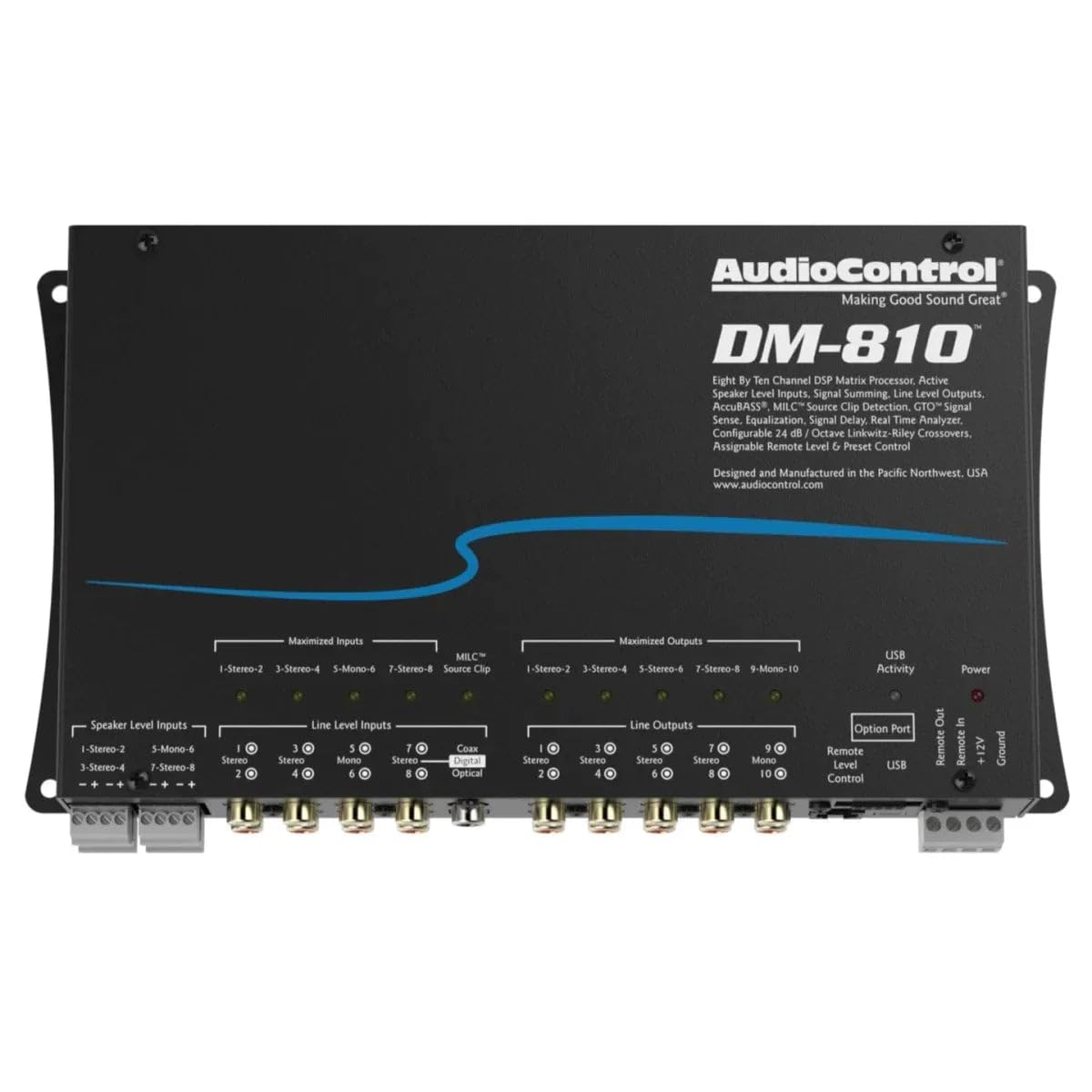
A 3-pound studio-grade brain with a 30-band auto EQ — the pick for audiophiles building a serious, fully calibrated system.
The DM-810 is the heavyweight here, and not just because it weighs a full 3 pounds against the 15.8-ounce Taramps. This is an 8×10 channel matrix processor — 8 inputs and 10 outputs — giving you more routing options than any other unit in this comparison. At 15 x 12.01 x 4.02 inches, it’s nearly 2x the footprint of the Taramps, so plan your mounting space before you buy.
The defining feature is the 30-band equalizer with auto EQ — literally twice the bands of the Stetsom and Taramps, letting you carve out problem frequencies with surgical precision. Even better, the auto EQ function means the unit can calibrate itself to your car’s acoustics rather than making you guess. It’s controlled through the DM Smart DSP app on a laptop or PC, which gives you complete access to every tuning feature on a screen you can actually read.
On the input side, it accepts four sets of speaker-level inputs and four sets of RCA line-level preamp inputs, plus one S/PDIF and one TOSLINK digital input — so whether you’re running a factory radio or a high-end aftermarket head unit, there’s a connection for it. Real-time analyzers (RTAs) let you identify and sum speaker signals from your factory radio, and the AccuBASS processing recovers bass frequencies that get lost at higher volumes. Signal delay mode handles acoustical alignment between left and right channels, and between front and subwoofer channels — the kind of precision tuning that separates a good system from a great one.
The Big Leagues
- 30-band auto EQ calibrates itself to your car — no guesswork
- 8×10 matrix routing supports the most complex systems here
- Multiple digital and analog inputs (S/PDIF, TOSLINK, RCA, speaker-level)
Fair Warnings
- Micro USB cable is rigid and poorly placed — owners mention it failed after one use
- Persistent hissing noise reported even with the engine off.
- No EQ presets for music styles; minor software glitches noted
Choose this if: you’re building a reference-grade system and want auto-calibration plus 30-band precision.
Think twice if: you want quick presets or a simple plug-and-play — this is a laptop-driven tool for serious tuners, and the hissing reports give smart shoppers pause..
Understanding the Specs
What a Graphic Equalizer Really Does
A graphic equalizer splits your music into fixed frequency bands (like 60 Hz for deep bass, 1 kHz for vocals, 10 kHz for cymbals) and lets you raise or lower each one independently. A 15-band unit gives you 15 separate sliders; a 30-band unit doubles that to 30. More bands means you can fix a narrow problem — like a honky resonance around 400 Hz — without dragging the whole midrange down with it.
RCA vs Speaker-Level Inputs
RCA inputs take a low-voltage preamp signal from an aftermarket head unit — the cleanest signal path available. Speaker-level inputs accept the already-amplified signal going to your factory speakers, which is essential if your stock radio has no RCA jacks at all. Processors that accept both (like the Stetsom and Taramps here) are far more flexible for factory-radio installs than those that demand RCA only.
FAQ
Will a 15-band equalizer fit my factory car stereo setup?
What is the difference between a graphic EQ and a parametric EQ?
How many output channels do I need for my car audio system?
What is a DL the DSP’s automatic EQ actually do?
Are preset EQ curves the same as auto EQ?
How do crossovers on a DSP improve my system?
Why does the AudioControl DM-810 have both speaker-level and RCA inputs?
Is a heavier processor better for a car audio build?
Final Thoughts: The Verdict
For the majority of shoppers, the auto graphic equalizer winner is the Taramps Pro 2.8S because it packs 12 one-touch preset EQs and 8 routing channels into a compact, budget-friendly package that owners describe as a “monster.” If you want the most hands-off tuning with a 30-band auto EQ that calibrates to your car, the AudioControl DM-810 is the premium route — just budget for proper mounting and consider the hissing reports. And for a true entry-level first processor that accepts both RCA and speaker-level inputs, the Stetsom STX2448 FLOATING PRO is the one to reach for.
How We Picked
We do not accept paid placement. Every pick is matched to a real buyer and a real use-case; we do not hands-on test units.
Sources & Methodology
Specifications: manufacturer listings and product documentation. Review insights: verified customer reviews, as of August 2026. Pricing: not shown on this page (it changes often); check the current price via the retailer link.
As an Amazon Associate, Gadgets Feed earns from qualifying purchases. This does not affect which products we feature.