
A sagging headliner turns your car’s cabin into a claustrophobic mess, with fabric drooping in your peripheral vision and brushing against your hair every time you drive over a bump. There is no temporary fix — the foam backing has disintegrated, and the only permanent cure is the correct spray glue that can withstand 170°F interior heat without releasing its grip.
I’m Min — the co-founder and writer behind Gadgets Feed. I’ve spent months analyzing technical data sheets and combing through thousands of real-world user reports to identify which formulations actually defeat the heat-cycling and humidity that kill generic adhesives in automotive headliner repairs.
Choosing the wrong product means doing the job twice, so I’ve narrowed down the market to the seven formulas that professional body shops and dedicated DIYers trust for a lasting bond. This guide delivers the definitive shortlist for the best auto headliner glue based on heat resistance, open time, and real-world adhesion testing.
How To Choose The Best Auto Headliner Glue
The single most common mistake in headliner repair is grabbing a general-purpose spray adhesive that cannot survive the thermal cycling inside a parked car. Automotive headliner glue must maintain structural integrity at sustained temperatures above 150°F while resisting humidity that accelerates foam breakdown. Three technical parameters separate the products that work from those that fail.
Heat Resistance Threshold
Interior cabin temperatures in a parked car can exceed 170°F on a summer afternoon. Adhesives rated below 160°F will soften, allowing the fabric to detach and sag again within weeks. Products with a published maximum service temperature of 170°F or higher provide the margin required for year-round durability. This single spec eliminates most craft-grade sprays from consideration.
Open Time vs. Tack Time
Open time is the window during which you can reposition the fabric after the adhesive becomes tacky. A short open time (under 2 minutes) requires surgical precision and often results in wrinkles that cannot be undone. Professional-grade headliner glues offer open times between 5 and 60 minutes, giving you room to align large panels without panic. Longer open times reduce waste and rework.
Application Method and Overspray Control
Aerosol cans with adjustable fan nozzles deliver controlled coverage without pooling, while brush-grade contact cement requires a spray gun for even application. The aerosol format suits single-panel repairs because it eliminates cleanup and thinning. Products that dispense a fine mist rather than a stringy web pattern produce a more uniform bond line and reduce the risk of visible glue marks through thin fabric.
Quick Comparison
On smaller screens, swipe sideways to see the full table.
| Model | Category | Best For | Key Spec | Amazon |
|---|---|---|---|---|
| Permatex 27828 | Aerosol Spray | Heat resistance up to 170°F | 170°F temp rating | Amazon |
| 3M Headliner & Fabric 2-Pack | Aerosol Spray | Large projects needing two cans | 18.1 oz per can (2-pack) | Amazon |
| Polymat 797 Hi-Temp | Aerosol Spray | Marine and high-humidity use | 160°F heat resistance | Amazon |
| 3M Hi-Strength 94 ET | Aerosol Spray | Long open time (60 min) | 60-minute bonding range | Amazon |
| Camie Fast TACK 313 | Aerosol Spray | Foam-to-foam and foam-to-fabric | 2-hour full cure time | Amazon |
| Gorilla Heavy Duty 2-Pack | Aerosol Spray | Multi-surface household repairs | 14 oz can (2-pack) | Amazon |
| DAP Weldwood Landau Top & Trim | Brush/Gun Grade | Professional spray-gun application | 1 gallon liquid contact cement | Amazon |
In‑Depth Reviews
1. Permatex 27828 Body Shop Heavy Duty Headliner and Carpet Adhesive

The Permatex 27828 is explicitly formulated for automotive headliner repair with a published heat resistance of 170°F, making it the benchmark product in this category. Its high-temperature formula maintains strength well above the 150°F threshold where interior adhesives typically fail, and users confirm it holds fabric securely through Texas summer heat without sagging after multiple weeks of daily exposure.
The aerosol dispenses a uniform web pattern that covers fabric and substrate efficiently, and the recommended application method of three light coats on both surfaces with a 5-minute dry time between coats produces a bond that feels permanent. Multiple real-world reviews note that once the adhesive grabs, material folds and touches instantly stick with no repositioning possible — which is precisely the behavior you want after alignment.
The primary caution involves wind and overspray control. Several users warn that attempting application outdoors on a breezy day causes the adhesive to dry before the fabric is positioned, leading to irreversible sticking. Inside a garage with minimal air movement, the product works predictably and delivers results that look professionally installed. The 16.75 oz can size is appropriate for a single sedan headliner.
Why it’s great
- Highest heat resistance in its class at 170°F
- Extremely tacky formula bonds aggressively to fabric and foam
- Dries clear and maintains hold at temperature extremes
Good to know
- Must be applied indoors to avoid wind-related curing issues
- Instant tack leaves zero room for fabric repositioning
2. 3M Headliner & Fabric Adhesive 18.1 oz Aerosol Can (Pack of 2)

The 3M 38808 is specifically engineered for heavyweight automotive headliners and arrives as a two-pack, giving you enough adhesive for a full SUV headliner or a convertible top installation without needing a second purchase mid-project. Users successfully bonded fabric to metal and plastic with consistent spray patterns that avoid the pooling issues common with cheaper aerosol designs, and the formula resists humidity, heat, and cold cycling.
Real-world feedback from Jeep hardtop owners and convertible Beetle restorers confirms that this adhesive withstands extreme temperature swings without the fabric delaminating. The adjustable nozzle allows you to dial in a fan pattern that matches the panel width, reducing waste and overspray. Several reviewers noted that the 30- to 60-minute dry time provides a reasonable window for alignment before the bond becomes permanent.
The product’s main drawback is its strength — multiple non-professional users reported that the adhesive is almost too effective. One reviewer explicitly stated that if you are not experienced with headliner work, the instant grab can cause wrinkles and fabric bunching that are impossible to undo. For a first-time DIYer, practice on a scrap piece of fabric is strongly recommended before tackling the actual headliner.
Why it’s great
- Two-pack provides ample coverage for large projects
- Adjustable nozzle for controlled fan pattern application
- Resists moisture, heat, and cold cycling effectively
Good to know
- Very aggressive tack requires careful handling to avoid wrinkles
- Not ideal for beginners without prior adhesive experience
3. Polymat 797 Hi-Temp Spray Adhesive

The Polymat 797 is an industrial-grade spray adhesive rated for 160°F heat resistance with a water-resistant formulation that makes it suitable for marine upholstery and vinyl top bonding. Its primary application targets heavyweight headliners, hood silencer pads, and vinyl tops where both heat and moisture resistance are required. Users report that it bonds heavier-weight materials to metals, woods, and plastics without delamination.
Real-world testing by a user who wrapped door jambs with this adhesive reported that the bond held for four years without any visible failure. Another reviewer who switched from a competing brand stated that the Polymat formula laid material down more easily without creases, which suggests a favorable balance between tack and workability. The 13 oz can size is slightly smaller than competing products, so panel coverage should be calculated in advance.
The adhesive dispenses as a white spray rather than clear, which can be a visual concern on thin or light-colored fabrics. While the bond itself dries clear over time, the initial white appearance makes it harder to judge coverage uniformity. The 160°F heat rating is adequate for most climates, though vehicles in extreme desert conditions may benefit from the higher 170°F threshold offered by the Permatex option.
Why it’s great
- Water-resistant formula for marine and humid environments
- Strong bond on heavyweight materials with long-term durability
- Good workability reduces creasing during fabric installation
Good to know
- Sprays white initially before drying clear
- 13 oz can is smaller than category average
4. 3M Hi-Strength 94 ET Spray Adhesive
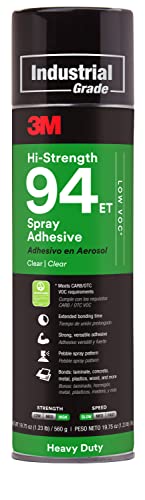
The 3M Hi-Strength 94 ET stands apart from every other product in this guide due to its 60-minute bonding range, which gives you an unprecedented window for aligning large fabric panels before the adhesive locks down. This open time transforms headliner installation from a high-pressure rush into a methodical process where you can walk around the vehicle, check alignment, and make micro-adjustments without risking a permanent wrinkle.
The 19.75 oz can is the largest aerosol in this comparison, and its Low VOC formulation with GREENGUARD certification makes it a responsible choice for indoor application without overwhelming solvent fumes. Users report aggressive tack and strong bonds on metals, wood, rubber, and carpet, though the primary use case reported in real reviews was foam soundproofing panels and upholstery rather than direct headliner repair. The adhesive works, but it is not explicitly marketed as headliner glue.
The trade-off for the extended open time is that the adhesive requires a 30-minute drying period before the surfaces are mated, which adds to the total project time. Some users found the smell, described as similar to airplane glue, to be intense despite the Low VOC rating, so a respirator and cross-ventilation are still recommended. This product is best suited for DIYers who prioritize positioning accuracy over speed.
Why it’s great
- 60-minute open time allows careful fabric alignment
- 19.75 oz can provides generous coverage per can
- Low VOC and GREENGUARD certified for indoor use
Good to know
- Requires 30-minute drying before mating surfaces
- Strong solvent odor despite Low VOC rating
5. Camie Fast TACK Upholstery Adhesive 12 oz (313)
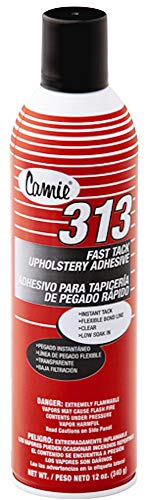
The Camie 313 Fast TACK is formulated specifically for foam-to-foam and foam-to-fabric adhesion, making it an excellent choice when the foam backing on your original headliner is still intact but the fabric has separated. Its web spray pattern delivers a clear application with low soak-in, meaning the adhesive stays on the surface rather than saturating and stiffening the foam layer. Users report instant tack followed by a strong, permanent grip after full cure.
Real-world feedback from upholstery repair applications confirms that Camie bonds foam sections together effectively for shaping and rebuilding headliner boards before fabric wrapping. One user specifically used it to adhere sections of upholstery foam and noted that the adhesive becomes tacky quickly and then grips hard after drying, which is exactly the behavior needed for multi-layer headliner construction. The 12 oz can is compact and suitable for smaller repair jobs.
The main limitation is the 12 oz size, which may not be sufficient for a full sedan headliner replacement, especially if both the foam and fabric layers require separate bonding steps. The nozzle spray pattern on some cans experienced intermittent glitching during use, though coverage per can was reported to be good relative to competitors. This is a niche specialty product rather than a general-purpose headliner adhesive.
Why it’s great
- Specifically formulated for foam-to-fabric and foam-to-foam bonding
- Clear web spray pattern with low soak-in through foam
- Fast tack develops into permanent bond after 2-hour cure
Good to know
- 12 oz can may be too small for full headliner projects
- Inconsistent nozzle spray on some cans
6. Gorilla Heavy Duty Spray Adhesive 14 oz (Pack of 2)
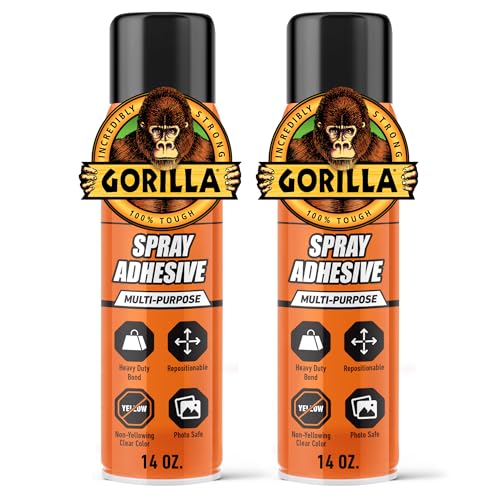
The Gorilla Heavy Duty Spray Adhesive arrives as a two-pack of 14 oz cans and positions itself as a multi-purpose heavy-duty bonding solution for paper, cardboard, foam, fabric, wood, metal, leather, glass, and plastic. Its repositionable window of up to 10 minutes before forming a permanent bond is a useful feature for DIYers who need to adjust fabric alignment, and the wide pad nozzle produces a controlled fine mist that reduces overspray.
User reviews highlight the product’s versatility, with applications ranging from adhering non-faced insulation to boosting peel-and-stick flooring adhesion. However, the product is not explicitly designed or marketed for automotive headliner repair, and one reviewer reported that the initial hold was insufficient and required reapplication of additional glue to achieve a secure bond on fabric. This suggests the formula may lack the aggressive tack needed for headliner foam backing.
The non-yellowing formula and photo-safe rating indicate this is more of a craft-grade adhesive than an industrial headliner solution. While the two-pack represents good value for general shop use, the absence of a published heat resistance temperature makes it a gamble for interior applications where thermal stability is critical. This product works best for light-duty repairs or as a backup for non-headliner projects.
Why it’s great
- Repositionable up to 10 minutes before permanent bond
- Two-pack provides good value for general repairs
- Non-yellowing formula with wide pad nozzle
Good to know
- No published heat resistance rating for automotive use
- Some users report insufficient initial hold on fabric
7. DAP Products Weldwood Landau Top & Trim Contact Adhesive 1 Gal
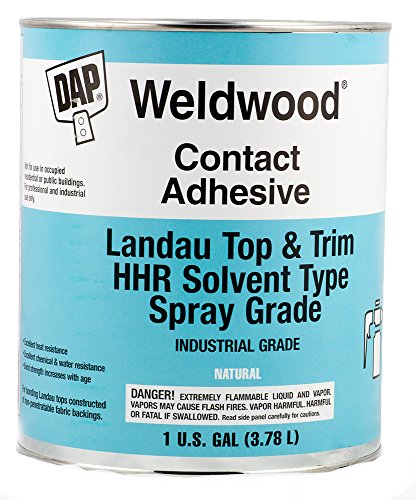
The DAP Weldwood Landau Top & Trim is a solvent-type contact cement sold by the gallon, intended for professional body shop use where application is performed with a spray gun or brush rather than an aerosol can. It is formulated for automotive upholstery, foam, and vinyl material with a permanent, high-heat-resistant, water-resistant bond suitable for both interior and exterior applications. This is the product you buy when you have a compressor and a paint gun and need to do multiple vehicles.
Professional users confirm that this adhesive, when applied through a siphoning paint gun at approximately 45 psi, produces a consistent, strong bond on interior fabrics. One long-term user reported using it exclusively for years without issues, noting that it is not too thick for thin fabrics and that the bond holds well when dry. The gallon quantity makes sense for a shop that does several headliner jobs per month, but the can size is excessive for a single DIY repair.
The strongest caution involves the solvent fumes. Multiple reviews emphasize that the odor is very strong and that a respirator and ventilation are mandatory — the product is highly flammable and should never be used near ignition sources. The adhesive also requires spraying both surfaces and allowing them to dry before mating, which is the standard contact cement process. For a one-time headliner repair, the aerosol cans listed above are far more practical than this industrial gallon.
Why it’s great
- Professional-grade contact cement for high-volume use
- High heat and water resistant for demanding environments
- Thin consistency works well with thin fabrics
Good to know
- Requires spray gun and compressor for application
- Extremely strong solvent fumes; respirator mandatory
FAQ
Can I use 3M Super 77 for auto headliner repair?
How many cans of adhesive do I need for a full headliner replacement?
Final Thoughts: The Verdict
For most users, the best auto headliner glue winner is the Permatex 27828 because it offers the highest heat resistance at 170°F and a predictable application process that works reliably when performed indoors. If you want maximum coverage and value for a large SUV headliner, grab the 3M Headliner & Fabric 2-Pack. And for a professional shop performing multiple repairs per week, nothing beats the DAP Weldwood Landau Top & Trim gallon for consistency and cost per application.