
Our readers keep the lights on and my morning glass full of iced black tea. As an Amazon Associate, I earn from qualifying purchases.
Specs are compiled from manufacturer listings and verified buyer reviews and can change over time — please confirm the key details on the product page before buying.
Your car’s factory heater gave out, the defroster barely touches the windshield, or you need to stay warm in a side-by-side, truck, or tractor cab while the engine idles. An auto heater steps in with direct electric heat that runs off your 12V battery, but picking the wrong one means weak airflow, a dead battery, or worse—melted wiring. The decision depends on one question: do you need electric heat from the battery, or a coolant-fed unit that taps the engine’s existing hot water?
I’m Min — the founder and writer behind Gadgets Feed. This guide is built by comparing the manufacturers’ published specifications and the patterns across verified customer reviews, so you get each pick’s real strengths and trade-offs instead of marketing spin.
This roundup breaks down seven very different auto heater designs, from low-cost electric blowers to heavy-duty coolant-powered units, using real wattage, BTU, weight, and review data so you know which one fits your vehicle, your budget, and the winter temperatures you actually face.
Our Picks at a Glance


How To Choose The Best Auto Heater
Not all 12-volt heaters work the same way. You need to match the type, power draw, and installation to your specific vehicle and climate. Start with the two main categories: electric heaters that pull power directly from your battery, and coolant heaters that route hot engine water through a separate core. Each has a real trade-off you can’t ignore.
Electric vs. Coolant Type: The Real Difference
An electric heater like the CYDZSW 800W unit uses a PTC ceramic element to create heat from your battery’s current. It’s simple to wire (red to positive, black to negative) but it draws heavy amps—enough to kill a small alternator or drain a battery within minutes at idle. A coolant heater like the XuSha 8000 BTU or the Sallurmose unit connects to your engine’s heater hose and uses the radiator’s hot coolant to generate heat. It puts out serious warmth without stressing your electrical system, but you need a functioning water pump and engine at operating temperature to make it work.
Power Draw: The Amp Math You Must Check
Every electric heater in this list runs on 12 volts. Wattage divided by voltage gives you the amp draw. A 600W heater pulls about 50 amps—and some vehicles only have a 60-amp alternator to run the whole car plus the heater. If you push past that limit, you risk a dead battery or a melted fuse. The Roadpro unit’s instructions are honest: it requires a 30A inline fuse and a direct battery connection because its 300W load still draws roughly 25 amps continuous.
Airflow vs. Heat Output
Some units get hot but barely move air. Reviewers of the EVGATSAUTO heater say it blows “HOT Air” but “air volume low.” The Roadpro got a one-star review for only blowing heat six inches. Meanwhile, the Saihisday 4-port unit and the XuSha coolant heater have fans and ducting to push warm air across a larger area. If you are heating a whole cab rather than just your hands or the windshield, prioritize models with visible air outlets and positive fan reviews over pure wattage numbers.
Quick Comparison
| Model | Best For | Type | Wattage / BTU | Weight | Amazon |
|---|---|---|---|---|---|
| EVGATSAUTO 400-600W★ Best Overall | Compact electric for a single spot | Electric (PTC) | 400-600W | 2.11 lbs | $25.31Amazon |
| XuSha 8000 BTUAlso Great | Real cab heat from coolant | Coolant | 8000 BTU | 7.0 lbs | $45.99Amazon |
| Sallurmose Upgraded 12V Heater | Durable coolant-fed heat | Coolant | Coolant-fed | 6.93 lbs | $66.00Amazon |
| Saihisday 4 Ports Aux | Budget coolant/heater blend | Coolant | Coolant-fed | 7.04 lbs | $59.29Amazon |
| CYDZSW 800W | Quick electric heat for small cabs | Electric (PTC) | 800W | 2.12 lbs | $32.99Amazon |
| CYDZSW 500W 4 Holes | Electric with ducting | Electric (PTC) | 500W | 3.1 lbs | $36.99Amazon |
| Roadpro RPSL-681 | Minimal supplemental heat | Electric (Ceramic) | 300W | 3.14 lbs | $49.95Amazon |
In‑Depth Reviews
1. EVGATSAUTO Car Heater, 12V 400W to 600W 3 Air Outlet
The 2.11-pound electric heater that gets hot but gives you three choices for how much amp draw you risk.
This unit offers a dual-gear switch for 400W or 600W output—so you can trade lower heat for less strain on your system. It has three air outlets for wider distribution. At 2.11 pounds, it is the lightest electric unit in the list, edging out the CYDZSW 800W by 0.01 pounds. The manufacturer says it connects directly to the battery (red to positive, black to negative) and does not support a cigarette lighter plug.
The mixed reviews tell a split story. One buyer mentioned it “pulls 66 amps so needs a relay for auto use” and that air volume is low but the air is “HOT Air.” Another gave it 1/5, writing “it’s kind of a waste of money,” and discovered his Can-Am side-by-side didn’t make enough power to run it. A third reviewer said it “barley puts out any heat” and killed an alternator in a Camaro. The variance suggests this unit works only in vehicles with a sturdy charging system—and even then, you need a relay and likely 4-gauge wire.
Budget-friendly option: The dual-gear switch (400W/600W) is a real feature for managing draw, but the amp pull still demands a relay and heavy wiring that most buyers don’t expect.
Safety tradeoffs: The heater body gets very hot to the touch—mount it on a non-flammable surface and keep it away from anything plastic.
Best for tight budgets: You need an inexpensive electric heater for a full-size car with a strong alternator and you are willing to add a relay and 4-gauge wire.
Skip for long-term use: You drive a side-by-side, ATV, or any vehicle with a stock alternator under 100 amps—this heater will leave you cold and possibly with a dead battery.
2. XuSha 8000 BTU 4 Ports 12 Volt Universal Car Truck Fan Heater
The coolant-powered heavy lifter that actually heats a whole cab without draining your battery.
This heater skips the battery-killer approach. It uses the engine’s own hot coolant, so you get 8000 BTU of real heat without pulling 50 amps from your alternator. That makes it a fundamentally different option from every electric unit on this list. It connects via a 5/8” (16mm) inner diameter water hose (not included) and uses your vehicle’s water temperature to deliver warmth—so you must have a running engine with proper coolant flow.
The trade-off is weight and complexity. At 7 pounds, the XuSha is a full 4.9 pounds heavier than the tiny 800W electric heater from CYDZSW (2.12 lbs vs 7.0 lbs). It also needs real installation: hooking into your heater hoses, mounting it under the dash, and routing the 4-port ducting to where you need heat. Buyers report it “kept user warm at 16°F in a RZR with soft doors” and that it is an “excellent low-cost solution for a failed heater core,” with one owner saying they wish they had found it “4 years earlier instead of freezing through multiple winters.” The catch is some units arrived missing mounting screws and one reviewer had a switch burn out after the second use, so expect to work through minor hardware issues.
Universal coolant heater: If you have a running engine and need real heat for an enclosed cab, this is the most effective solution here—no electric heater at this price puts out the same warmth.
Installation complexity: It requires your own 5/8″ heater hose, and the included mounting hardware may be incomplete. Check the bag before you start the install.
Best for engine preheat: You have a side-by-side, classic truck, or any vehicle with a working coolant system and want actual cab heat without draining your battery.
Skip for cabin heat: You need quick, no-install plug-and-play heat for a short commute or a cab that isn’t warmed up yet—the XuSha only works once the engine is at operating temperature.
3. Upgraded 12V Universal Auxiliary Heater (Sallurmose)
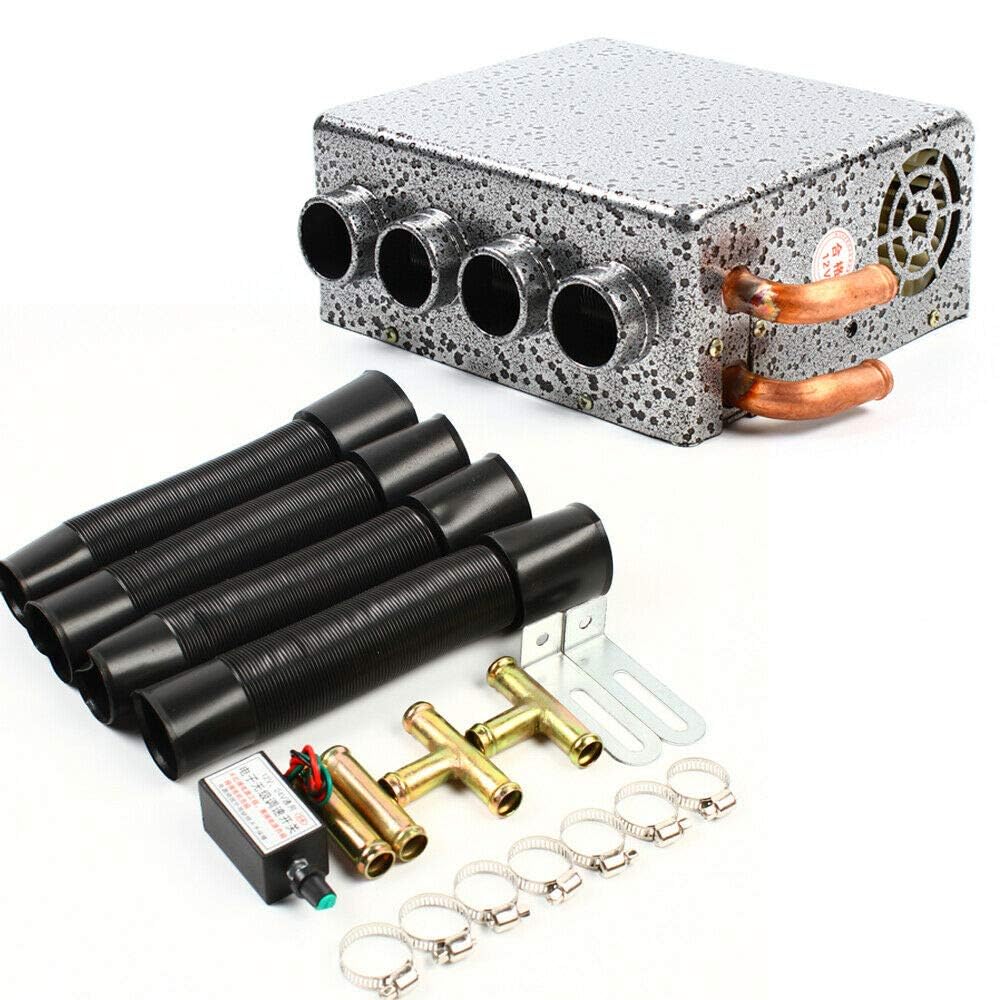
The coolant heater that trades heavy metal for smart design and a stepless fan control.
Like the XuSha, this is a coolant-fed unit that uses the engine’s hot water. The big difference is a stepless adjustment knob that lets you dial the fan speed anywhere between low and high, not just fixed positions. The unit weighs 6.93 pounds and is built with copper and thickened iron. Owners mention it works as a “great alternative for broken core heater” and requires only minimal electrical draw (a 10A fuse is recommended).
Installation is similar to the XuSha: you need a 5/8″ heater hose and a coolant loop. The manufacturer says it fits trucks, minivans, excavators, and harvesters. One reviewer installed it in a side-by-side and called it “very durable, easy to install.” The main downside reported is the included hose clamps—several owners say they strip out immediately, so plan to replace those with standard automotive clamps. Another buyer noted it is “good for aux heat not main heat,” so this works best as a supplement to a weak factory heater rather than a total replacement.
Stepless temperature control
- Variable fan speed gives precise airflow control
- Copper and iron construction feels solid for the price
- Very low electrical draw (recommended 10A fuse)
Build quality concerns
- Included hose clamps strip easily—plan to buy better ones
- Not a primary heat source for very large cabs
Best for precise regulation: You want the battery-friendly heat of a coolant heater with the ability to fine-tune the fan speed to just a whisper or a roar.
Skip if durability matters: You are not comfortable swapping out cheap hardware or adding your own hose clamps—the XuSha is simpler in that department despite also needing hose.
4. Saihisday 12V Car Auxiliary Heater, 4 Ports Underdash

The powerful blower with four duct outlets that redirects heat exactly where you want it.
This coolant unit from Saihisday uses a sturdy fan motor and four vent holes to push hot air to multiple points in your cab. It weighs 7.04 pounds and is designed for under-dash mounting. The wiring is straightforward: red wire to positive, blue to the motor negative, black to power negative. Reviewers who installed it in older trucks were pleased—one put it in a 1998 Chevy S10 single cab and said “works well, provides heat where there was none.” Another bolted it into a Polaris Ranger 900XP under the dash and called it “good built unit.”
The four included plastic hoses let you aim heat at the windshield, your feet, and the passenger side independently. The catch is quality control. At least one reviewer received a unit with a defective switch that only works when wiggling wires, and several note the hose clamps strip out easily. The fan is “a little weak” according to one Ranger owner, though others found it adequate. For the price, it sits in a mid-range balance between the cheap electric units and the premium Sallurmose.
Multi-zone output: Four ducted outlets mean you can defrost your windshield and warm your feet at the same time—a feature no single-outlet electric heater offers.
Limited airflow: The wiring diagram is unusual (three wires for speed control), and you may need to replace the switch or clamps if you get a Friday-afternoon unit.
Best for directed heat: You want a ducted coolant heater for an older truck or UTV and need heat directed to multiple spots.
Skip for whole cabin: You aren’t comfortable troubleshooting a potentially defective switch or replacing cheap hardware right from the start.
5. CYDZSW 12V 800W Car Heater Battery Powered

The lightweight electric heater that pulls 66 amps but delivers serious temp rise in small spaces.
At just 2.12 pounds, this PTC ceramic heater is the highest-wattage electric unit here at 800W. It is designed for windshield defrosting, defogging, and deicing in golf carts, trucks, and UTVs. One reviewer noted the “800W 12V heater raised forklift temp 25-35°F above ambient,” which is a real number that shows it can work in an enclosed, small-volume cab. The heater has switch overload and insulation protection to prevent overtemperature.
The problem is the amp draw. At 800W on a 12V system, you are pulling roughly 67 amps—that is more than many stock alternators can spare while running lights and a radio. Multiple reviewers warn that the quick-connect plug can melt after a few hours and recommend direct wiring instead. Another buyer says it “could burn up the car wiring” and calls it too much for a standard 12V system without a dedicated relay and heavy-gauge wire. This is not a plug-and-play unit; it demands careful electrical planning.
Wired for real heat
- Can raise interior temps by 25-35°F in a small cab
- PTC ceramic element is efficient and safe
- Easy to mount and wire if you know electrical basics
Connector reliability
- Stock quick-connect plug melts under load—direct wiring is essential
- 67-amp draw will kill an alternator or battery at idle
Best for hardwired setups: You have a high-output alternator, a dedicated relay, and you need maximum electric heat for a forklift, golf cart, or small UTV cab.
Skip for plug-and-play: You want to plug it into a cigarette lighter or 12V accessory port—this heater needs a proper battery direct-wire setup with a fuse.
6. CYDZSW Car Battery Powered Heater, 12V 500W 4 Holes

The electric heater with four telescopic tubes that lets you direct heat, but the fan volume falls short.
This 500W unit is the middle sibling between the 800W CYDZSW and the 300W Roadpro. It has four aluminum foil telescopic tubes, two clamps, fasteners, and brackets in the box. The package includes everything you need to mount it and route the air to four spots—a real advantage over most single-outlet electric heaters. It weighs 3.1 pounds, making it a full pound heavier than the 800W CYDZSW (3.1 lbs vs 2.12 lbs), likely due to the metal housing and included ducting.
Customers note the unit blows hot air but the volume is limited. One review on a Kubota 4-person cab noted “the unit blows hot air but limited volume so the area better be sealed up or it won’t work well.” The same buyer reported that running it for over 5 minutes at idle killed the battery. This reflects the fundamental problem with 500W electric heat: it draws roughly 42 amps continuous, and an idling alternator may not replenish that. The temperature of the air is high (it can reach 86-100 degrees Celsius), but without strong fan pressure, that heat doesn’t fill the space.
Flexible ducting
- Four telescopic tubes let you direct warm air to specific spots
- Painted metal housing is more durable than plastic
- High heat conversion rate for the wattage
Fan performance
- Airflow volume is low—heat stays near the unit
- 42-amp draw will drain a battery at idle within minutes
Best for targeted heating: You need an electric heater with ducting for a small, well-sealed cab and don’t mind wiring it directly to the battery with a relay.
Skip for high airflow: You expect this unit to warm a full-size truck cab or any vehicle that idles for long periods without a high-output alternator.
7. Roadpro 12v RPSL-681 12-volt Ceramic Heater/fan

The classic ceramic heater that comes with a long 15-foot wire but barely pushes heat past six inches.
Roadpro has been making this unit since 2011, and it shows in the 253 ratings—more than any other product here. It draws 300 watts, uses a ceramic heating element with a burn-guard cover, and includes a 15-foot 12-gauge wire with ring terminals for direct battery hook-up. You get both low and high fan speed, plus a heat-only or fan-only switch. At 3.14 pounds, it is the second-heaviest electric unit, likely due to the long cord and metal construction.
The reviews are brutally honest. One 5-star buyer said it has “weak heat output but adequate for bad heater core” and noted “wires get warm even with 12 gauge.” Another said “heat only blows 6 inches even on high” and that the manufacturer confirmed that is normal. A third reviewer called it “VERY weak airflow, barely heats a space at all” and added a computer fan to make it work. This is a true supplemental heater for a very small area—warming your hands or clearing a tiny patch of windshield—but it will not heat a cab.
Classic ceramic design: The 15-foot wire is genuinely useful for reaching a battery in a large truck, but 300W and a weak fan mean you get warmth only if you are sitting directly in front of it.
Low output: Requires a 30A inline fuse and direct battery connection. Even then, wires get warm. Do not expect cabin-wide heat.
Best for small spaces: You need a very small, focused heat source for a single spot—warming your right hand on a long drive with a failed heater core, for example.
Skip for larger cabins: You need to defrost a windshield, heat a cab, or keep more than one person warm—this unit’s airflow is too weak for those jobs.
Understanding the Specs
Wattage and Amp Draw
The wattage (300W, 500W, 600W, 800W) on an electric auto heater tells you how much heat it can produce, but the number that actually matters for your vehicle is the amp draw. Divide the wattage by 12 volts to get the approximate amps: a 600W unit pulls about 50 amps. Most car alternators produce 60-140 amps, but that power also runs the engine computer, lights, radio, and cooling fan. A 50-amp heater leaves very little headroom. If your alternator cannot keep up, the battery drains within minutes—one owner reported their Kubota’s battery died after 5 minutes of idling with a 500W unit.
Coolant vs. Electric
Coolant heaters (like the XuSha 8000 BTU and the Sallurmose unit) do not generate heat electrically. They are small radiators that use the engine’s hot coolant to warm air that a fan blows into the cab. The electrical draw is limited to the fan motor—typically 3 to 10 amps. The trade-off is they only work when the engine is running and at operating temperature. Electric heaters (like the CYDZSW and Roadpro) work any time the battery has power, even with the engine off, but they pull massive current and can drain a battery quickly if the engine is not running.
FAQ
Will an auto heater drain my car battery?
Can I plug a 12V car heater into my cigarette lighter?
What size wire do I need for a 12V car heater?
How does a coolant-fed auto heater work?
Can I install an auto heater in a side-by-side or UTV?
Which is better for an auto heater: PTC ceramic or standard heating elements?
What does BTU mean for an auto heater?
How long do 12V car heaters last?
Final Thoughts: The Verdict
If you want one dependable pick, the auto heater winner is the XuSha 8000 BTU because it delivers actual cab-warming heat without pulling 50+ amps from your alternator—the real-world reviews confirm it keeps people warm at 16°F. If you want a coolant heater with adjustable fan speed and a more modern design, grab the Sallurmose Upgraded 12V Heater. And for the most pure electric power in a compact, lightweight package when you have a high-output alternator and a small cab, the standout is the CYDZSW 800W despite its wiring demands.
How We Picked
We do not accept paid placement. Every pick is matched to a real buyer and a real use-case; we do not hands-on test units.
Sources & Methodology
Specifications: manufacturer listings and product documentation. Review insights: verified customer reviews, as of July 2026. Pricing: not shown on this page (it changes often); check the current price via the retailer link.
As an Amazon Associate, Gadgets Feed earns from qualifying purchases. This does not affect which products we feature.
Related Guides
Product prices and availability are accurate as of the date/time indicated and are subject to change. Any price and availability information displayed on Amazon at the time of purchase will apply to the purchase of this product. As an Amazon Associate I earn from qualifying purchases.
CERTAIN CONTENT THAT APPEARS ON THIS SITE COMES FROM AMAZON. THIS CONTENT IS PROVIDED "AS IS" AND IS SUBJECT TO CHANGE OR REMOVAL AT ANY TIME.
Amazon and the Amazon logo are trademarks of Amazon.com, Inc. or its affiliates.