
Our readers keep the lights on and my morning glass full of iced black tea. As an Amazon Associate, I earn from qualifying purchases.
Specs are compiled from manufacturer listings and verified buyer reviews and can change over time — please confirm the key details on the product page before buying.
Winter mornings can mean scraping frost off your windshield or shivering through the first five miles. A plug-in car heater promises to fix that — blowing warm air straight from your 12V outlet to clear fog and melt ice before you pull away. But the cheap options have a dark side: buyers report units failing within days, blowing fuses, or even heating up dangerously. This guide sorts the usable from the genuinely unsafe so you know which one is worth the plug.
I’m Min — the founder and writer behind Gadgets Feed. This guide is built by comparing the manufacturers’ published specifications and the patterns across verified customer reviews, so you get each pick’s real strengths and trade-offs instead of marketing spin.
You will find honest assessments of five different auto heaters plug in, covering everything from build quality and real-world heat output to the safety flaws that can make a cheap heater a bad bet for your vehicle.
Quick Picks
- LLWAN Car Heater — Top Defroster
- Nedittpy Portable Car Heater — Safety-First Budget
- KINOWJI Portable Car Heater — Airflow Champ
- Ouffun 200W Car Heater — Budget Entry
- Therwen 3 Pcs Portable Car Heater — Compact Multi-Pack
How To Choose The Best Auto Heaters Plug In
Picking the right plug-in car heater is less about brand names and more about three things: how much heat it actually makes, whether it has safety cutoffs, and how well it fits your car’s electrical system. Here is what to check before you click buy.
Power Output — 150W vs 200W
Nearly all 12V cigarette-lighter heaters run at either 150 or 200 watts. The difference matters: a 200-watt heater pushes noticeably warmer air faster, which means less time waiting for fog to clear. But your car’s fuse matters too — some older vehicles have 10-amp circuits that struggle with a full 200W draw. Check your owner’s manual for the amp rating of your accessory port before choosing.
Safety Features (The Non-Negotiable)
Many budget heaters skip basic safety parts like an inline fuse or automatic overheat shutoff. Customer reviews on several models report wire melting and blown vehicle fuses. Look for a unit that explicitly lists a built-in fuse and overheat protection — these two features can prevent a small heater from becoming a fire risk in your cabin.
Build Materials and Mounting
Heat-resistant ABS and polymer plastic hold up better to prolonged use than cheaper grades. A 360-degree rotating bracket or a suction-cup mount lets you aim the airflow at the windshield directly rather than just the general cabin, which speeds up defogging significantly. Compact units that weigh under a pound are easier to position on the dashboard without slipping.
Quick Comparison
On smaller screens, swipe sideways to see the full table.
| Model | Best For | Watts | Weight | Safety Features | Amazon |
|---|---|---|---|---|---|
| LLWAN Car Heater | Reliable Defrosting | 200W | 13.1 oz | Overheat Protection | $34.99Amazon |
| Nedittpy Portable Car Heater | Budget Safety Pick | 200W | 11.3 oz | Fuse + Auto Shutoff | $16.98Amazon |
| KINOWJI Portable Car Heater | Airflow Volume | 200W | 12.6 oz | Heat-resistant ABS | from $18.99Amazon |
| Ouffun 200W Car Heater | Budget Entry | 200W | 0.34 kg | Thermostat | $22.95Amazon |
| Therwen 3 Pcs Portable Heater | Compact Multi-pack | 150W | 2 lbs | None Listed | $22.99Amazon |
In‑Depth Reviews
1. LLWAN Car Heater
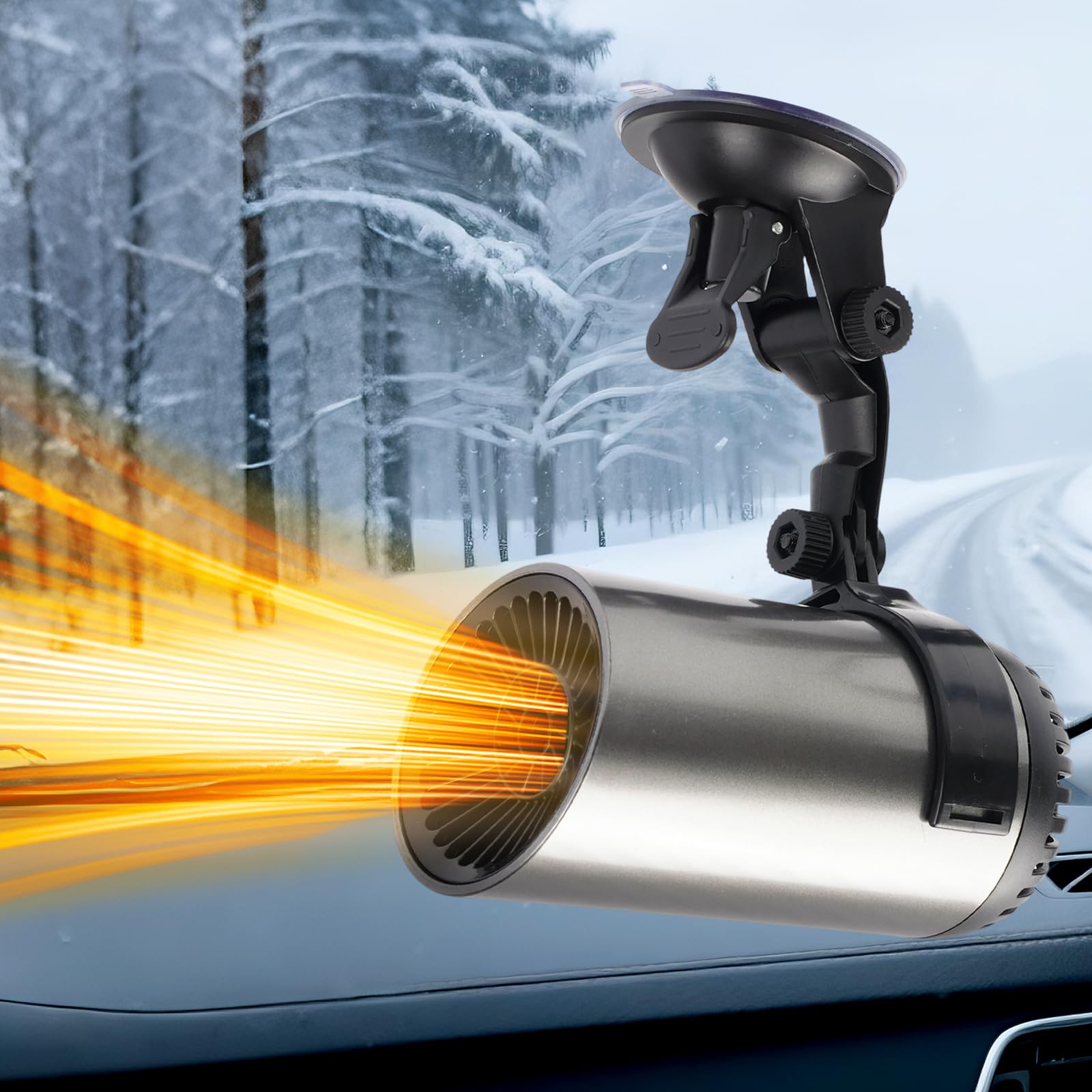
The one that actually beat a broken car heater on a freezing morning.
This LLWAN unit delivers 200W of heating power through a 12V cigarette lighter plug, and it is the only pick here that multiple verified buyers said warmed their interior faster than their vehicle’s own heater. One reviewer whose heater core failed reported a measured draw of 166W on a portable power station, confirming it runs well within the typical 15-amp circuit found in most cars. The overheat protection means it shuts down before the housing gets dangerously hot — a feature several competing units simply omit.
You can aim the airflow directly at frost instead of just filling the cabin with lukewarm air, thanks to the 180-degree rotatable suction mount that sticks high on the windshield. At 13.1 ounces, it is light enough to stay attached without sliding, and the ABS and polymer plastic body resists heat deformation. Owners mention that it works “like a champ” for defrosting a side-by-side windshield, though one noted the airflow volume is modest — about the same as a gentle exhale — so clearing a full windshield takes around 10 minutes for a pizza-sized patch.
Compared to the 150W Therwen below, the LLWAN is rated at 200W and has overheat protection, while the Therwen is rated at 150W with no listed safety cutoff. The trade-off is that the cord itself gets warm during use, which is normal for a 200W draw but note if you route it near anything sensitive.
What it does well
- 200W output provides meaningful warmth — one reviewer noted it warmed the interior faster than their car’s own heater
- Overheat protection adds a real safety layer that cheaper units skip
- Suction-cup mount lets you aim directly at the windshield for targeted defrosting
Where it falls short
- Airflow volume is gentle rather than forceful — not great for quickly heating a large cabin
- A few units arrived with no internal fan, meaning zero heat output (check yours immediately on arrival)
- Power cord gets warm during extended use, which may be a concern in tight routing
Reach for this if: you need a dedicated windshield defroster with a safety shutoff that can outperform your car’s own heater in a pinch.
Look elsewhere if: you expect hurricane-force airflow — this heater prioritizes warmth over blast power.
2. Nedittpy Portable Car Heater
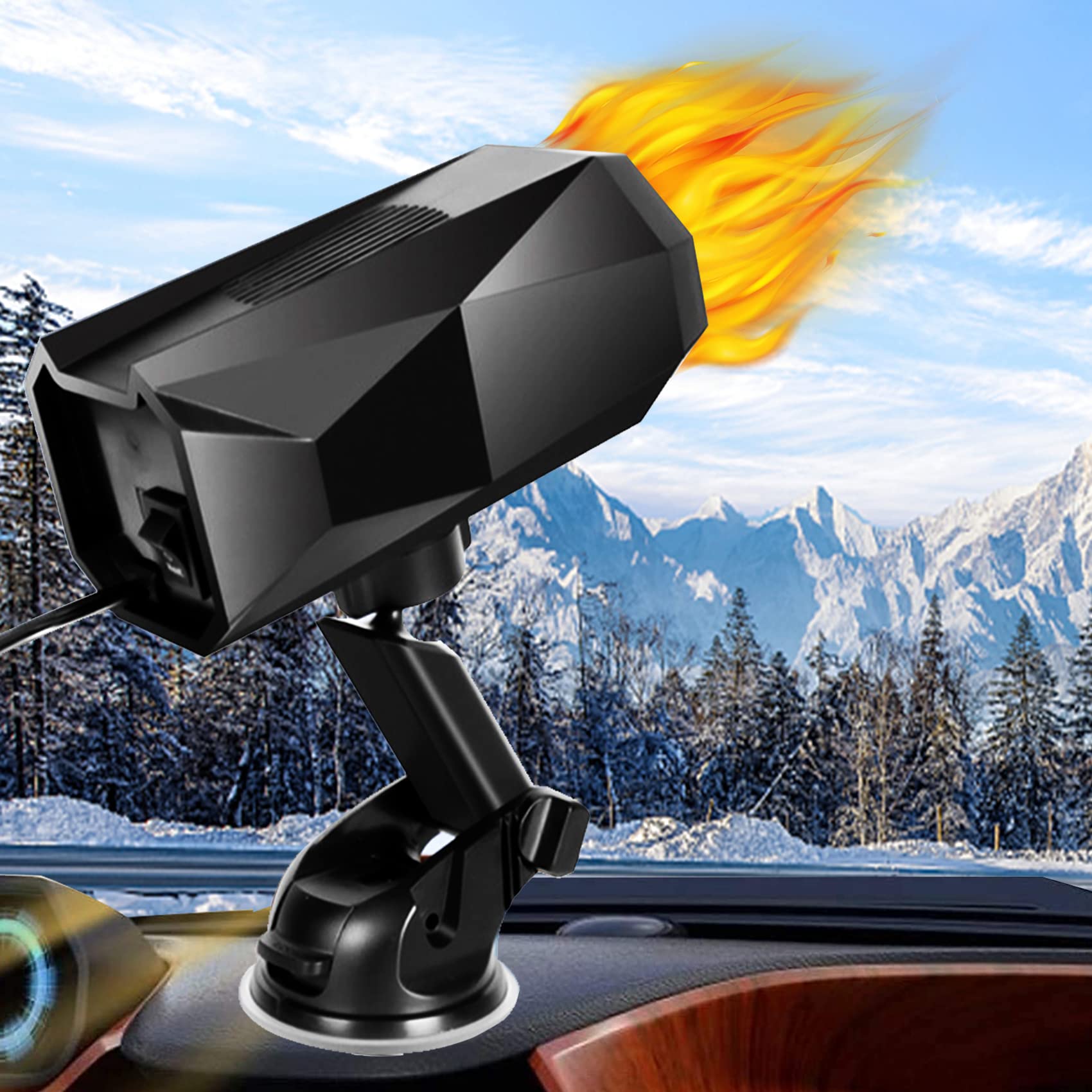
A small heater with a built-in fuse — rare at this price point.
At 11.3 ounces and with a 200W output, the Nedittpy is the lightest full-power option in this lineup. Its standout spec is the combination of a built-in fuse and automatic power-off protection — two safety features that are absent from similarly priced competitors. Heat-resistant ABS and polymer plastic make up the housing, which should hold up better to prolonged use than cheaper grades. The 180-degree rotary holder lets you point airflow at the windshield or toward the cabin.
The reality check comes from buyer reports. One verified reviewer said the unit blew their 12V outlet within two minutes during a cold snap. Another said it worked only 10-20 seconds before shutting off repeatedly, which points to possible overheating protection kicking in prematurely or a wiring defect. On the positive side, a non-verified buyer said it heats in under one minute and clears frost and fog “instantly” with dual heating and fan modes. The inconsistency is a pattern across most plug-in heaters at this tier.
Compared to the Ouffun (Product 4), which lacks a fuse entirely, the Nedittpy at least attempts some electrical protection. But the reliability gap with the LLWAN above is clear: the LLWAN’s overheat protection appears to work consistently, while the Nedittpy’s safety systems seem to trigger too aggressively for some buyers.
Built-in safety
- Built-in fuse and automatic power-off protection — rare for a sub- heater
- Fast heating claim of under one minute is backed by some positive reviews
- Compact size at 11.3 ounces makes it easy to store or reposition
Reliability worry
- Multiple customers note the unit failing after seconds or minutes of use
- Blew a 12V outlet in one verified instance — possible circuit compatibility issue
- Inconsistent performance makes it a gamble for daily winter use
Best fit for: cautious buyers on a tight budget who want a fuse in the circuit and are willing to test the unit immediately to catch a dud.
skip it if: you need guaranteed daily reliability — the failure rate in reviews is too high for that.
3. KINOWJI Portable Car Heater
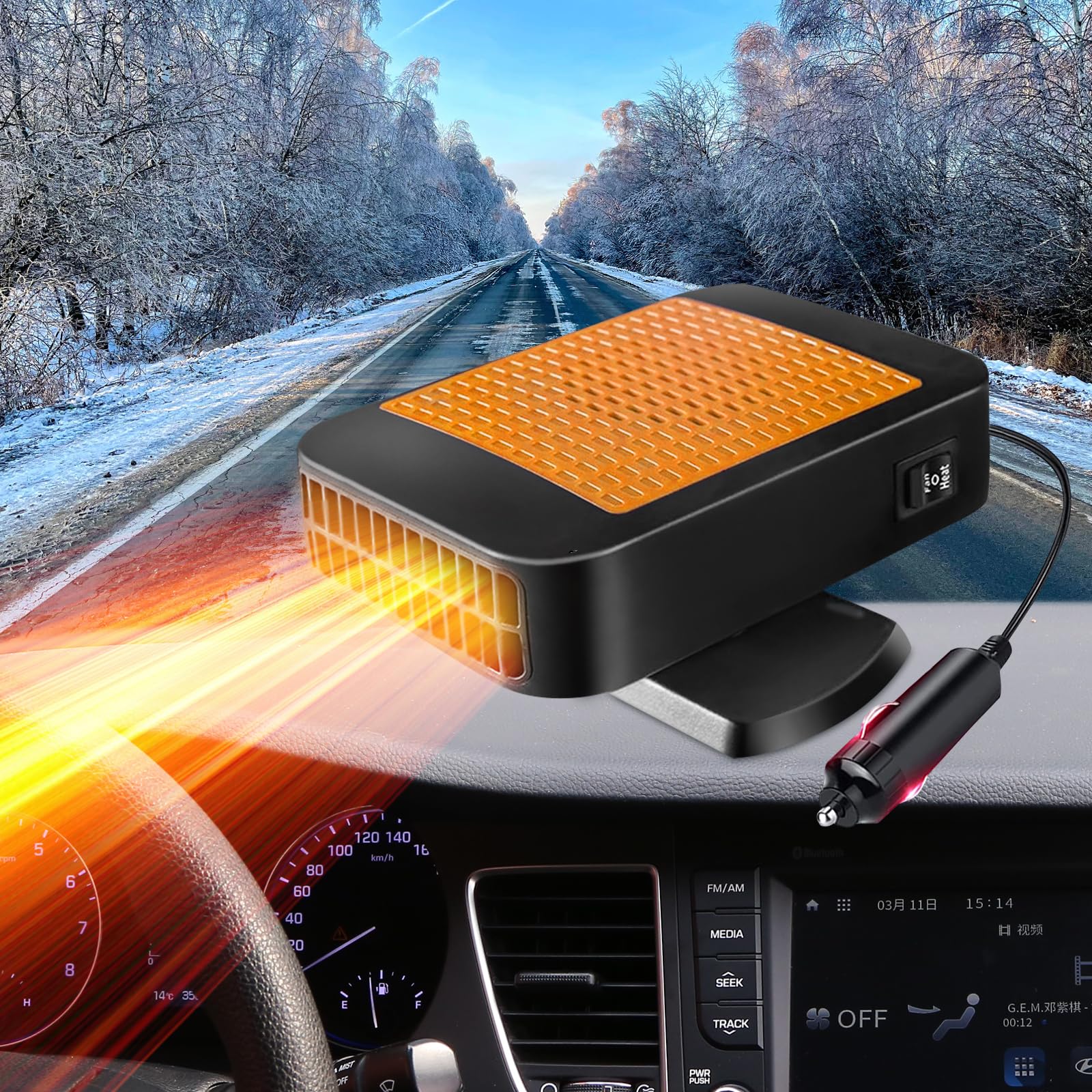
Three fan speeds and genuine airflow — until the gremlins show up.
The KINOWJI stands apart from the others because buyers consistently praise its airflow. One verified owner of a large SUV said it is “compact but powerful,” with three speed settings and very quiet operation that effectively cooled the back seats. At 200W through a 12V plug, it has the same power rating as the LLWAN and Nedittpy, but the multi-speed fan gives you more control over how the air moves. The 360-degree rotatable base means you can aim it at the windshield, side windows, or rear passengers without repositioning the whole unit.
However, a pattern emerges that matches many 12V heaters: “The fan was amazing, until it wasn’t.” One buyer mentioned the unit started working only intermittently after the return window closed, as if a short was developing inside. Another simply called it “garbage” and “Chinese-made junk.” At 12.6 ounces, it is heavier than the Nedittpy but still dashboard-friendly. The dual-function design claims both heating and cooling (fan-only mode), which is useful for year-round use.
Compared to the Therwen (Product 5), which has zero documented safety features and a 150W output, the KINOWJI has a 360-degree mount. But the intermittent-failure issue is a real drawback that puts it behind the LLWAN in overall reliability.
Strong points
- Three fan speeds give you real control over airflow — rare in this category
- Quiet operation even at higher speeds, per buyer reports
- 360-degree rotatable base for flexible windshield or cabin targeting
Weak points
- Intermittent failure reported — unit works fine then stops, often after the return period
- Build quality concerns: multiple buyers describe it as cheaply made
- No mention of a fuse or overheat protection in the specs
Ideal for: someone who prioritizes airflow volume and speed options over long-term durability, and is okay replacing it if it fails.
Not for: anyone who needs a heater that will work reliably all winter without surprises.
4. Ouffun 200W Car Heater
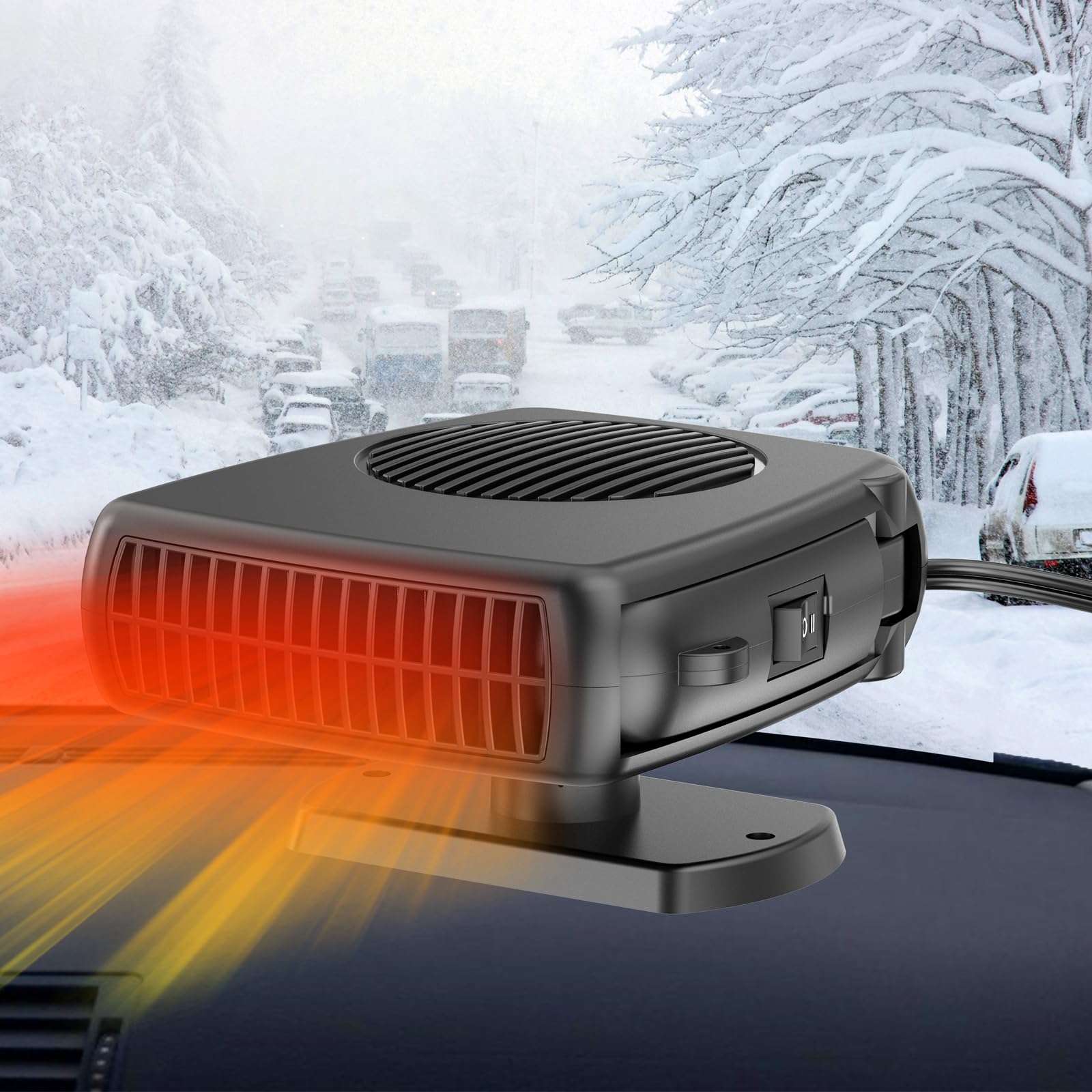
A 200W heater that sounds good on paper but reviewers point out dies fast.
The Ouffun has the specs of a decent heater: 200 watts of forced-air heat, a pure copper cable, and a self-adjusting thermostat that adds a layer of temperature control. At 0.34 kilograms (about 12 ounces) and with a 360-degree rotating stand that tilts up to 60 degrees, it is flexible enough to aim at the windshield or the cabin. The 2-in-1 heating and cooling design means you can flip to fan mode in summer, which extends its usefulness beyond winter months.
The reviews paint a much darker picture. “It is likely to fail within the first 30 days” wrote one verified buyer, reporting the rocker switch failed after 1-2 weeks on two separate units and a third had loud fan noise on startup. Another said the output was “very weak” and stopped working after a few uses, taking forever to defrost a windshield. There is a single 5-star review saying it works “as described,” but the overwhelming pattern is that this heater does not last. Compared to the Nedittpy, which at least has a fuse, the Ouffun relies on its built-in thermostat for safety — but without a fuse, a short could still blow your car’s circuit.
The pure copper cable is a genuine quality detail that many cheaper heaters skip, but it cannot compensate for a rocker switch that fails in the first week.
Specs that stand out
- 200W output matches the top performers in this list
- Pure copper cable should last longer than standard wiring
- Self-adjusting thermostat adds some safety and temperature consistency
Where it falls apart
- High early-failure rate — rocker switch and fan problems show up within 1-2 weeks
- Weak heat output according to multiple buyers, not enough for effective defrosting
- No fuse or overheat protection listed explicitly
One-line verdict: The specs say 200W, but the real-world results say “buy something else” — the failure rate is too high to recommend as a primary defroster.
5. Therwen 3 Pcs Portable Car Heater

Three units for the price of one — but the safety report is alarming.
The Therwen is the only multi-pack in this list: you get three 150W heaters for roughly the same cost as a single 200W unit from other brands. That seems like a good deal if you want to put one in each family vehicle. It measures 5.12 x 4.33 x 2.76 inches and weighs 2 pounds for the set, with a 360-degree rotating bracket and dual heating/cooling functionality. The ABS and heat-resistant polymer plastic build is standard for this tier.
The safety red flag is impossible to ignore. One verified buyer opened the unit and found “no safety features, no fuses.” They reported that the first unit popped their truck fuse in four seconds, and the second had a wire that got hot enough to burn. “Internal inspection found no safety switches” they wrote, calling it dangerous. Another buyer said the plastic melted in their cup holder after 15-25 minutes of use in a 55°F vehicle, and the unit only raised the cabin temperature by about 5°F. Some buyers do report satisfactory results — one said it works great for a small space and keeps the cabin “warm and toasty” — but the risk profile is higher than any other pick here.
Compared to the LLWAN, which has overheat protection, or even the Ouffun, which has a thermostat, the Therwen has zero documented electrical safety features. It is rated at 150W, while the other units discussed here are rated at 200W, which means it takes longer to produce noticeable warmth.
The value angle
- Three heaters in one box — good for equipping multiple vehicles
- Dual heating/cooling function adds year-round usefulness
- 360-degree rotating bracket for flexible positioning
The risk
- No fuse, no safety switches — shoppers say wires getting hot enough to burn
- Plastic housing melted during normal use in one verified review
- 150W output is the weakest in this lineup, with slow heating reported
Only consider if: you are fully aware of the safety gaps and plan to use it strictly in a 12V circuit with a strong fuse, never unattended, and only on short trips.
Better to skip if: you want a heater you can plug in and forget about — the lack of safety features makes this a watch-it-constantly device.
Understanding the Specs
Wattage (150W vs 200W)
This is the most important number. A 200W heater uses more power from your car’s 12V outlet and produces noticeably warmer air faster than a 150W model. But it also pulls about 16.6 amps, which some older cars with 10-amp fuses cannot handle. A 150W unit draws roughly 12.5 amps, making it safer for marginal circuits but slower to defrost. Check your vehicle’s fuse rating for the cigarette lighter port before picking.
Safety — Fuse and Overheat Protection
A built-in fuse stops a short circuit from damaging your car’s electrical system. Overheat protection automatically powers the heater down if the internal temperature gets too high, preventing melted plastic or fire. Many budget models skip both. If you see no mention of these in the specs, assume they are absent — and factor that into whether you are comfortable leaving the heater plugged in for extended periods.
FAQ
Will a 200W heater drain my car battery?
Can I use a plug-in car heater in a truck with a 24V system?
How long does it take to defrost a windshield?
Are plug-in car heaters safe to leave unattended?
What does “2 in 1” mean on these heaters?
Why do some buyers report the heater blew their car’s fuse?
Can I use a plug-in car heater to heat the entire cabin?
What is the difference between a ceramic heater and a resistance-wire heater?
How do I know if a 150W or 200W heater will work in my specific car?
Do these heaters work with portable power stations like Jackery or EcoFlow?
Final Thoughts: The Verdict
For most drivers, the auto heaters plug in that balances real-world performance with safety is the LLWAN Car Heater because it delivers 200W of actual warmth with overheat protection and a useful suction mount that buyers confirm works in freezing conditions. If you want the safety of a fuse and automatic shutoff at a lower price, grab the Nedittpy Portable Car Heater. And for maximum airflow with three fan speeds — understanding it may not last forever — the KINOWJI Portable Car Heater is your pick. Skip the budget options unless you are prepared to treat them as disposable and never leave them unattended.
How We Picked
We do not accept paid placement, and we did not hands-on test every unit. Instead, we match each pick to a real buyer and use-case by comparing the manufacturers’ published specifications against the patterns in verified customer reviews — so you get each pick’s real strengths and trade-offs instead of marketing copy.
Sources & Methodology
Specifications: manufacturer listings and product documentation. Review insights: verified customer reviews, as of July 2026. Pricing: not shown on this page (it changes often); check the current price via the retailer link.
As an Amazon Associate, Gadgets Feed earns from qualifying purchases. This does not affect which products we feature.
Product prices and availability are accurate as of the date/time indicated and are subject to change. Any price and availability information displayed on Amazon at the time of purchase will apply to the purchase of this product. As an Amazon Associate I earn from qualifying purchases.
CERTAIN CONTENT THAT APPEARS ON THIS SITE COMES FROM AMAZON. THIS CONTENT IS PROVIDED "AS IS" AND IS SUBJECT TO CHANGE OR REMOVAL AT ANY TIME.
Amazon and the Amazon logo are trademarks of Amazon.com, Inc. or its affiliates.