
Our readers keep the lights on and my morning glass full of iced black tea. As an Amazon Associate, I earn from qualifying purchases.
Specs are compiled from manufacturer listings and verified buyer reviews and can change over time — please confirm the key details on the product page before buying.
An auto interior heater isn’t about replacing your car’s built-in climate system — it’s about surviving the first brutal minutes of a winter drive, when the windshield is fogged and the seats feel like ice. The right one clears frost and fog quickly without draining your battery.
I’m Min — the founder and writer behind Gadgets Feed. This guide is built by comparing the manufacturers’ published specifications and the patterns across verified customer reviews, so you get each pick’s real strengths and trade-offs instead of marketing spin.
After checking the specs and owner experiences, the best auto interior heater is the auto interior heater that delivers real warmth quickly without draining your battery — and this list separates the instant-warmth winners from the underpowered letdowns.
Our Picks at a Glance
How To Choose The Best Auto Interior Heater
Most 12V heaters look alike, but the ones that help your commute share specific traits. Here’s what separates a useful defogger from a gadget that just blows cold air.
Match the wattage to the job you need done
A 150W unit is perfect for clearing fog and warming your hands during a short drive. A 600W or 800W unit can move more air and feel warmer, but it also pulls far more current from your battery. Higher wattage usually means a hardwired battery connection, not a simple plug-in.
Check how it connects before you buy
Some heaters plug straight into the 12V outlet and run instantly. Others expect you to wire the red and black lines directly to the battery terminals, which is a bigger job than most first-time buyers expect. For zero hassle, choose the plug-in style.
Quick Comparison
| Model | Best For | Power | Connection | Features | Amazon |
|---|---|---|---|---|---|
| Blytra 200W★ Best Overall | Fast plug-in defogging | 200W | Cigarette lighter | 360° rotatable head | Amazon |
| Blytra 150WQuiet Warmth | Quiet morning warm-ups | 150W | Cigarette lighter | 360° rotatable head | Amazon |
| Ejoyous 600W | Footwell floor heating | 600W | Cigarette lighter | 3 air outlets | Amazon |
| Rossesay 800W | Localized heat on a budget | 800W | Cigarette lighter | 2-hole defroster | Amazon |
| CYDZSW 500W | UTV and truck cabs | 500W | Battery hardwire | 4 hose outlets | Amazon |
| Akozon 600-800W | Hardwired supplemental heat | 600-800W | Battery hardwire | Dual gear switch | Amazon |
| Roadpro 300W | Heater-core failures | 300W | Battery hardwire | Dual fan speeds | Amazon |
In‑Depth Reviews
1. Blytra Portable Car Heater 200W
Our pick — over 4.5★ from 80+ verified ratings; the strongest balance of quality and price.
The plug-in pick that clears a fogged windshield in seconds, not minutes.
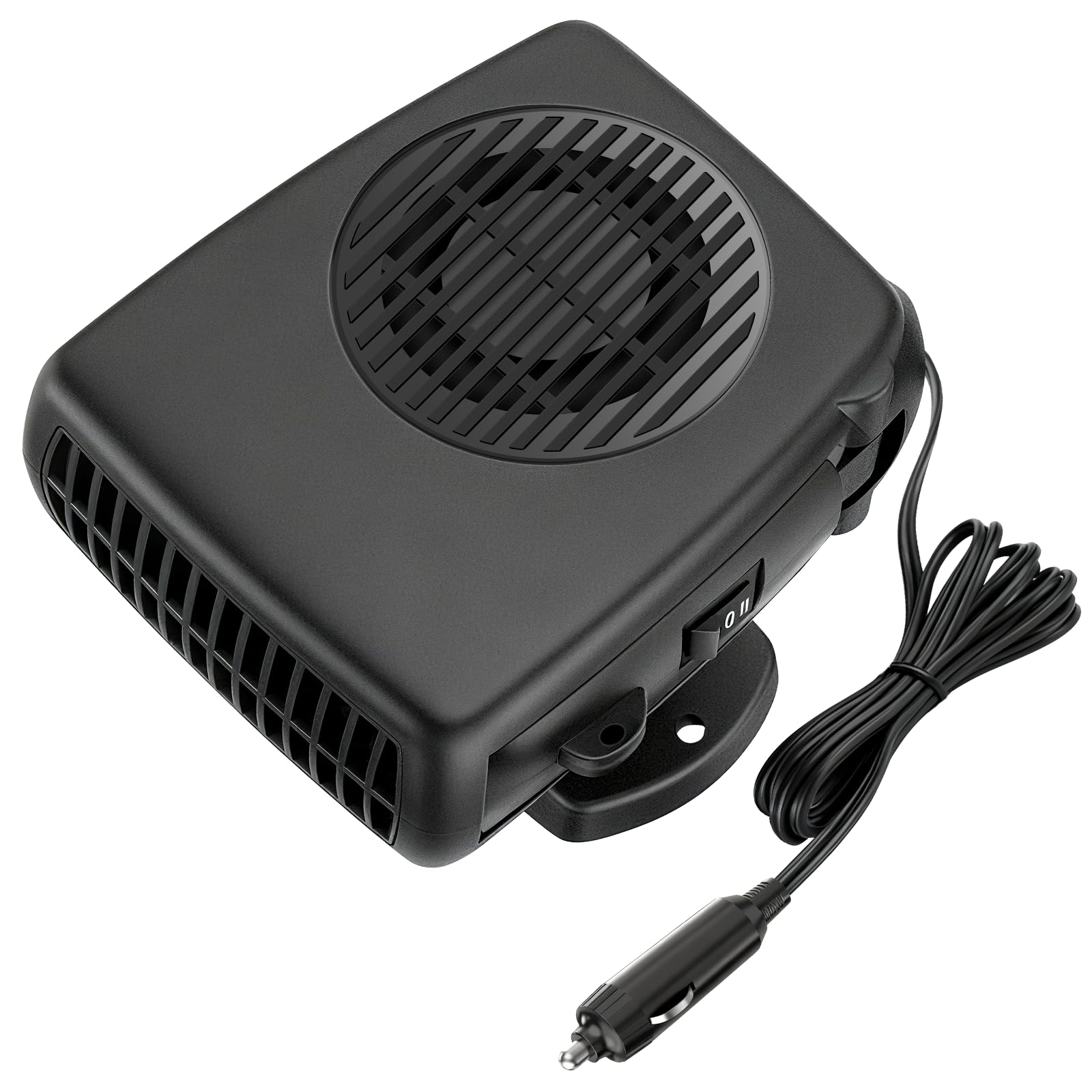
This is the crowd favorite — 4.7 stars across 80+ owners — and the consensus is simple: it delivers warm air in about 2 minutes and clears condensation almost instantly. The secret is the high-efficiency PTC heating element (a ceramic heater that self-regulates its temperature), which gets hot fast without the burnt-smell risk some cheaper coils produce.
You get 200W of heat output through a 360° rotatable outlet, so you can point warm air exactly where frost or fog is forming. The build uses ABS plastic and pure copper cables, and it mounts with a self-adhesive base — peel, stick on a clean surface, plug into the 12V cigarette lighter, and you’re done. The heat/fan switch is one simple toggle, and it’s compact enough to tuck beside the console.
A few owners use it as a supplemental boost alongside their car’s own heater, which is the honest way to think about any of these units. It won’t warm a whole SUV cabin by itself, but as a fast defogger and near-hands warmer for cold starts and short drives, it’s exactly the tool described.
Why owners pick it
- Warm air in roughly 2 minutes from a cold start
- 360° head aims heat at fog or frost directly
- Tool-free plug-in with adhesive base mounting
Reality check
- Designed as a defogger and booster, not a full-cabin replacement
- Best on short drives and morning warm-ups
Reach for it if: you want the simplest, fastest way to clear fog and frost at a 7 a.m. cold start with zero wiring.
Keep expectations set: it’s a supplemental heater — your main climate system still does the heavy lifting once the engine warms.
2. Blytra Portable Car Heater 150W
The same clever 360° design, tuned for gentle, low-noise warmth.
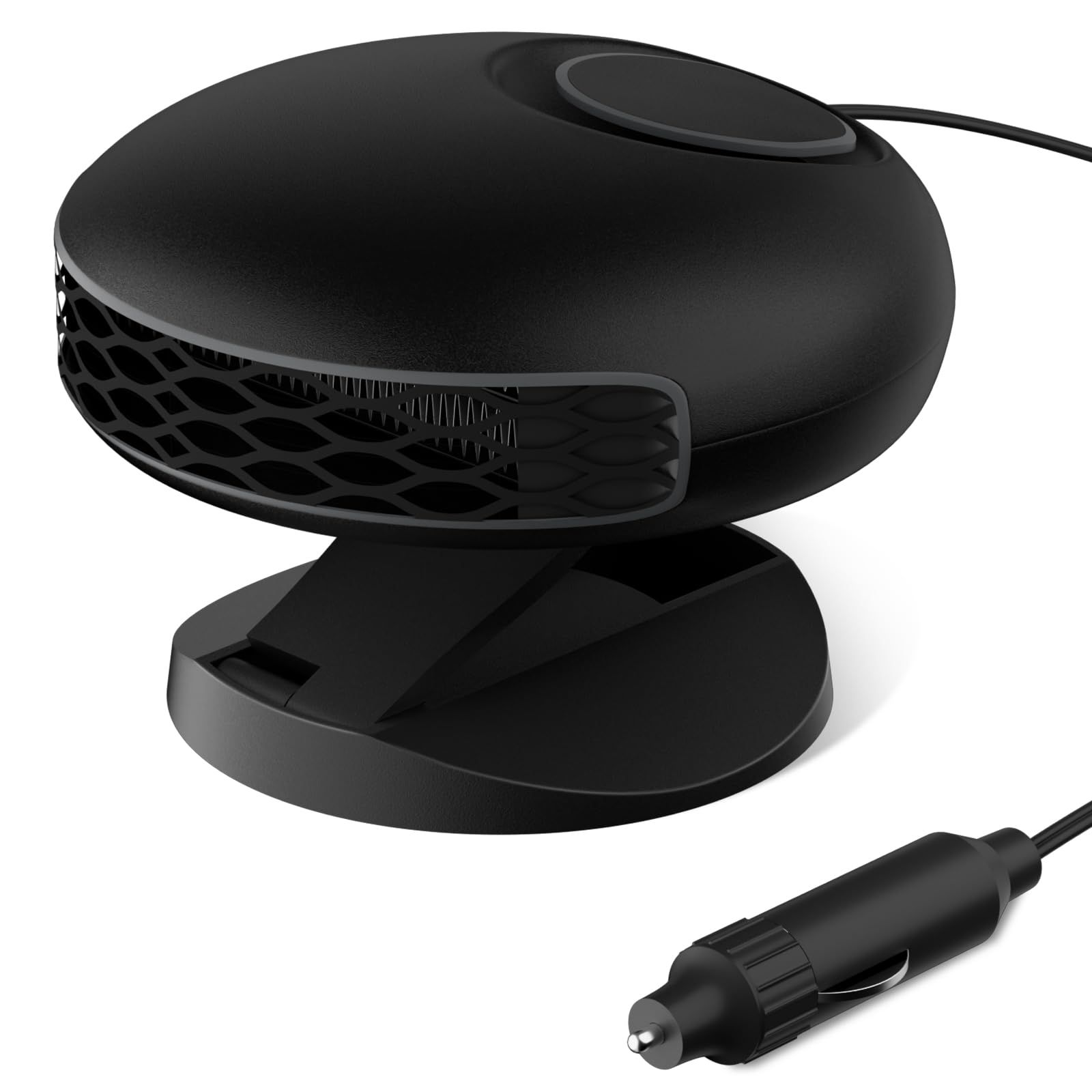
This sibling to the 200W pick runs the same PTC heating element and rotatable head but steps down to 150W output, which makes it a touch easier on your battery and notably quiet in the cabin. Owners describe it as the ideal companion for SUVs that take forever to warm up — it fills that awkward first ten minutes with heat aimed right at the windshield or your hands.
Buyers report it delivers instant heat, clears window fog in seconds, and mounts with the same self-adhesive pad on a clean, dry surface. The ABS plastic shell and pure copper cables hold up to daily use, and the built-in overheating protection means you’re not babysitting a hot element while you drive. Being lighter, it’s easy to pull out and move between a car, SUV, or van.
Compared with the 200W model above, you trade a little raw output for a quieter, slightly more battery-friendly run — a fair swap if your drives are short and your priority is a calm cabin over maximum airflow.
Who it suits best: drivers of slow-warming SUVs who want quick defogging without a noisy fan humming through the whole commute.
The honest limit: 150W is plenty for fog and localized warmth, but it’s a booster, not a cabin heater.
3. Ejoyous 600W Car Heater

A compact floor unit with 75°C air aimed at cold feet and foggy glass.
This one takes a different approach: instead of a single rotatable head, it pushes 600W of heat through 3 separate air outlets at a rated air outlet temperature of 75°C (167°F). The PTC ceramic elements — the same self-regulating heating tech as the Blytra picks — keep the output safe and steady, with a double gear switch to adjust the fan between two speeds.
It’s built for placement flexibility: self-tapping screws let you mount it under a seat, against a footwell, or on a workbench, and the high-quality PVC and aluminum alloy body keeps it light at 1.34 pounds. Owners have installed it in cargo trailers and use it to keep feet warm in vehicles where the factory heat is slow. The honest read from owners: it works better as a fan than a true heater, so treat it as a warm-air circulator for a small space rather than a cabin warmer.
The bigger caveat from the review pages is battery drain — a couple of owners mention it killing the battery when left running with the engine off. Use this one while driving, not parked, and it earns its place as a foot-warmer.
Best placed: at floor level in a car, truck, or camper where targeted warmth at the feet matters more than cabin-wide heat.
Watch out: it’s known to draw the battery down if the engine isn’t running.
4. Rossesay 800W Car Heater
A budget 800W option that works best when you keep expectations low.
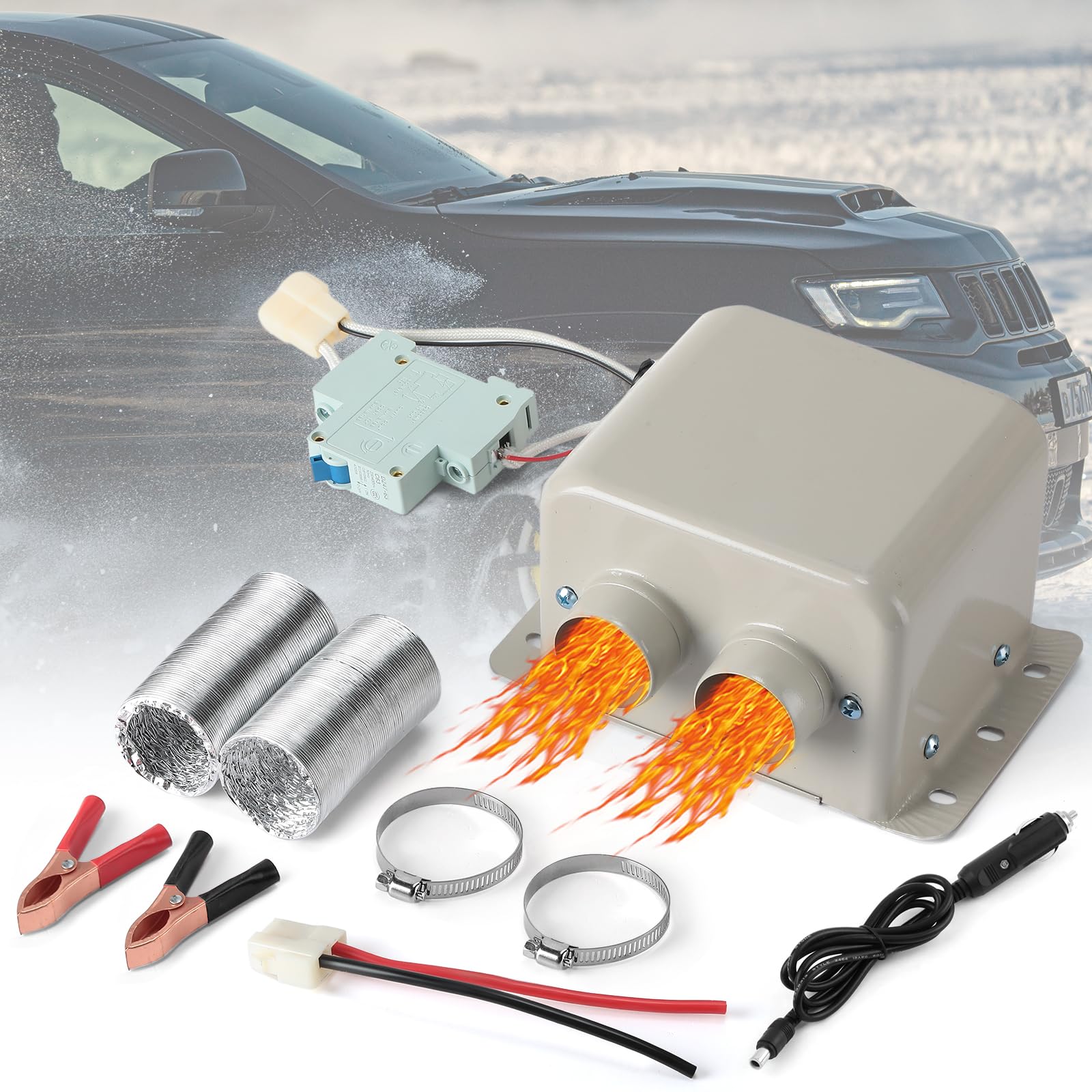
At first glance the 800W rating sounds like the most powerful plug-in here, but the owner feedback tells a more careful story. The manufacturer is upfront in the listing: this is for “defrosting, defogging, and localized heating” and is not intended to heat the entire cabin. The PTC heating plate directs warm air at the windshield, and the aluminum air outlets hold up better than plastic rivals — at 2.23 pounds, it’s still easy to move between vehicles.
Buyer feedback is split on this one. A few owners say it works “better than I expected” and will eventually defrost a windshield if you give it time. But the louder voice in the reviews says the heat output is disappointing, that the fan blows fast enough to cool the heat back down, and that the included 12V adapter (the plug that fits your car’s cigarette lighter) caused setup headaches — one owner had to splice wires to make it work.
This is the pick to consider only if you’re on a tight budget and understand it’s a mild helper, not a serious heater. If you want reliable warm air without fuss, the Blytra picks above justify their slightly higher cost.
Consider it if: you need a cheap, lightweight defogging aid for occasional use and can accept modest heat.
Look elsewhere if: you want dependable, consistent warmth — the build and output reviews are too mixed to rely on.
5. CYDZSW 500W Car Heater

A 4-hole hardwired blower built for truck cabs and UTVs.
This 500W unit abandons the cigarette lighter entirely — you connect the red line to the battery positive and the black line to negative, making it a more permanent install for a truck cab, UTV, or RV. Its defining feature is the 4 air outlets fed by aluminum foil telescopic tubes, letting you route warm air where you need it. The listed output temperature runs as high as 86–100°C, and the metal body resists the high-temperature deformation plastic units suffer.
The package includes the heater, 4 telescopic tubes, 2 clamps, 4 fasteners, and 2 brackets, so it’s a complete kit. Owners confirm it blows legitimately hot air — one notes the cable “never go hot” even under load. The honest trade-off is power draw: this unit pulls enough current that an idle vehicle with a small battery can be drained in a matter of minutes. Sealed cabs work far better than open spaces, and reviewers stress using heavy-gauge wire for the connection.
If you’re mounting it in a Kubota cab or a UTV as auxiliary heat while the engine runs, it’s a solid fit. If you expected a plug-and-go gadget, the hardwiring requirement will surprise you.
Built for: off-road and work vehicles where a permanent, hose-routed heat source beats a handheld plug-in.
Respect the power draw: keep the engine running or the battery dies surprisingly fast.
6. Akozon 600W-800W Car Heater

A high-power hardwired heater that rewards careful installation.
This one brings a dual gear switch that toggles between 600W and 800W output through 3 air outlets, giving you some control over how much warmth — and how much battery drain — you’re asking for. The listed temperature range of 80–100°C puts it among the hotter-running options here, and the iron body is built to shrug off tough conditions. Installation means connecting the positive and negative leads to your battery, so it’s not a quick plug-in like the Blytra units.
Owners who installed it properly report real success — one runs it off a 110 amp-hour deep cycle battery bank with a thermostat and keeps a solarium at 50°F all night. The recurring warning in the feedback is about wiring: one owner stresses the need for 6-gauge wire and a breaker to avoid melting wires or fuses. Another reported the box arrived falling apart with cords missing, so delivery quality varies.
This is the pick for someone comfortable with a modest DIY install who needs serious supplemental heat output — not a first-time buyer looking for tool-free warmth.
The payoff
- 600W to 800W output via a simple dual gear switch
- Rugged iron build rated for tough conditions
- Real success stories as supplemental auxiliary heat
The cost of entry
- Requires hardwiring to the battery with proper heavy-gauge wire
- Box and parts quality have varied in delivery
Choose this for: a workshop, camper, or project vehicle where you’ll wire it once and run it hard.
skip it if: you want a grab-and-go plug-in — this one demands wiring care.
7. Roadpro RPSL-681 Ceramic Heater

A veteran 12V ceramic fan that still saves drivers with broken factory heat.
This Roadpro has been around since 2011, and its longevity speaks to a specific niche: drivers whose cars have a failing heater core. It hooks directly to your vehicle battery with an included 15-foot 12-gauge terminal wire — no cigarette lighter involved — and delivers 300W of supplemental heat. A simple flip of the switch toggles between heat and fan-only, and you get two fan speeds to adjust airflow low or high.
The build includes burn-guard material covering the ceramic heating element, a thoughtful safety touch. Owners describe it as the exact solution for an old Corolla with a bad heater core — it takes the edge off and keeps a commute tolerable. The recurring honest note is weak airflow; several owners say the warm air is there but the volume is low, with one modifying the unit with a larger computer fan to push air through the cab.
The battery draw is real too — drain in under an hour is reported when running off a large battery bank with the engine off. Keep it connected while driving and it’s a decent emergency heater; expect durability to be modest at this spec.
Best rescue tool: for a car with a failed heater core, as a warm-air bridge during winter commutes.
Set expectations: airflow is weak and battery drain is heavy — this is a stopgap, not a daily comfort upgrade.
Understanding the Specs
Wattage (W) and What It Really Feels Like
Wattage tells you how much electrical power the element converts into heat, but it doesn’t tell you how warm you’ll feel. A 150W unit can feel perfectly comfortable for defogging because its airflow is directed and steady, while a higher-wattage unit with poor airflow can still leave you cold. Wattage plus airflow matters more than any single spec.
Cigarette Lighter vs. Hardwired Battery Connection
Plug-in heaters run off your 12V outlet and install in seconds, but their wattage is capped by what the socket can safely deliver. Hardwired units connect red and black leads directly to the battery, which allows higher wattage and more output — but they demand basic wiring skill and heavier-gauge wire to avoid melting fuses. If you’re not comfortable with wiring, a plug-in model is safer.
FAQ
Will a 12V car heater drain my battery if I use it while parked?
Can a plug-in 12V heater warm my whole car cabin?
What’s the difference between a PTC heater and a regular coil heater?
Is the 360° rotatable head really useful on a car heater?
How long does it take for a 12V heater to actually produce warm air?
Can I use a 12V car heater in a truck, UTV, or RV?
Is it safe to leave a car heater running while I drive?
What’s the difference between a defroster and a heater in these 12V devices?
Why do some of these heaters not include a cigarette lighter plug?
How much do I need to spend to get a reliable 12V car heater?
Final Thoughts: The Verdict
Across the board, the auto interior heater winner is the Blytra 200W because it clears fog in about 2 minutes, swivels 360° to aim heat where you need it, and plugs straight into the cigarette lighter with zero wiring. If you want a quieter, slightly gentler version of the same idea, grab the Blytra 150W. And for truck or UTV owners who need hose-routed heat hardwired to the battery, the CYDZSW 500W is the one to reach for.
How We Picked
We do not accept paid placement. Every pick is matched to a real buyer and a real use-case; we do not hands-on test units.
Sources & Methodology
Specifications: manufacturer listings and product documentation. Review insights: verified customer reviews, as of August 2026. Pricing: not shown on this page (it changes often); check the current price via the retailer link.
As an Amazon Associate, Gadgets Feed earns from qualifying purchases. This does not affect which products we feature.