
Sun-bleached dashboards, scuffed door panels, and faded center consoles turn a well-maintained car’s interior into an eyesore. The specialized aerosol formulations designed for this task must bond to flexible plastics, resist oils and UV, and match factory texture without cracking or peeling during temperature swings.
I’m Min — the co-founder and writer behind Gadgets Feed. My analysis for this guide focuses on cross-referencing actual customer durability reports against manufacturers’ claimed adhesion performance across different substrate types to separate lasting restorations from temporary fixes.
Whether you’re refreshing a daily driver or restoring a classic cabin, selecting the right aerosol is critical. This guide breaks down the top aftermarket aerosol coatings to help you find the best auto interior paint for your specific trim, plastic, and vinyl needs.
How To Choose The Best Auto Interior Paint
Interior trim paint must do more than look good—it has to flex when the plastic flexes, resist the chemical off-gassing from vinyl cleaners, and survive the intense infrared heat of a parked car in summer. Choosing the wrong formula leads to flaking within weeks.
Adhesion Chemistry and Surface Prep
Most automotive interior plastics are molded from TPO (thermoplastic polyolefin) or polypropylene—materials that repel paint due to their low surface energy. Effective adhesion requires either a dedicated plastic adhesion promoter or a paint formulated with aggressive solvents that etch the surface. Skipping the cleaning step with isopropyl alcohol or SEM Prep Spray guarantees failure, regardless of brand.
Flexibility and Heat Resistance
Interior surfaces expand and contract with temperature changes. A rigid paint will crack on flexible bumper covers or soft-touch dash panels. Products like Seymour’s Flexible Trim Spray and VHT’s High Temp formula are engineered for this movement, with heat ratings between 200–250°F to handle the greenhouse effect of a closed vehicle on a hot day.
Gloss Level Match
OEM interior trims almost never use high-gloss. Factory finishes are typically matte (flat) or satin for a reason—shiny surfaces produce glare on windshields and look aftermarket. The SEM Trim Black Ultra (satin) and SEM Landau Black (slightly glossier) are the industry standards because they replicate the original sheen of most domestic and Japanese interior plastic.
Quick Comparison
On smaller screens, swipe sideways to see the full table.
| Model | Category | Best For | Key Spec | Amazon |
|---|---|---|---|---|
| SEM Trim Black Ultra | Premium Spray | Plastic, TPO, & aluminum trim | Satin finish, OEM-recommended adhesion | Amazon |
| SEM Landau Black Color Coat | Premium Vinyl Dye | Seats, carpets, & vinyl door cards | Flexible gloss, covers light colors | Amazon |
| VHT High Temp Plastic Paint | Mid-Range Spray | High-heat plastic engine-adjacent interior parts | 200°F heat rating, no sanding needed | Amazon |
| Seymour Flexible Trim Paint | Mid-Range Spray | Flexible bumpers & soft trim | 250°F heat resistance, flexible coating | Amazon |
| HI-TECH Big Can Spray Dye | Budget Pick | Carpets, fabric, & large vinyl areas | 15 oz, adjustable fan nozzle | Amazon |
| SprayMax 2K Matte Clear Coat | Premium Clear Coat | Top-coating base paint for chemical/UV protection | 2-component polyurethane, 12 ± 3 gloss units | Amazon |
| Eastwood 2K Clear Coat | Premium Clear Coat | High-gloss restoration & scratch repair | 2K aerosol, high-gloss, 12-hour cure | Amazon |
In‑Depth Reviews
1. SEM 49143 Trim Black Ultra

SEM’s Trim Black Ultra delivers a true jet-black satin finish that closely matches the sheen of factory plastic trim on most modern vehicles. The formula sprays smooth without orange peel, and its ultra-transfer-efficiency nozzle reduces overspray—critical for tight areas like pillar trim and center consoles.
Adhesion is the standout feature here: the paint is explicitly designed to grip TPO and polypropylene without an external adhesion promoter. Multiple verified buyers report it holds up through pressure washes, 100°F-plus summer heat, and repeated contact without peeling. The 14.5 oz can covers roughly 4–5 square meters, making it economical for full interior jobs.
The single-layer coverage is impressive, but full professional results still require cleaning with SEM Prep Spray first. It’s the go-to choice for collision shops and restorers who need predictable, repeatable results on painted plastic versus dyed vinyl areas.
Why it’s great
- Plugs directly into TPO and PP without adhesion promoter
- Factory-correct satin sheen eliminates windshield glare
- Durability withstands regular contact and weather cycling
Good to know
- Full 24-hour dry time before handling is mandatory
- Not flexible enough for soft vinyl seats or bumper covers
2. SEM 15013 Landau Black Color Coat

SEM’s Landau Black Color Coat is a specialized dye formulated for vinyl, fabric, and carpet rather than hard plastic. It’s the gold standard among Ford and GM enthusiasts because Landau Black matches the deep, slightly glossy black used on premium interior panels, seats, and headliners from the late 90s through the 2010s.
The 12 oz aerosol dries to the touch in one hour and bonds chemically to porous surfaces instead of just sitting on top. Users report that color changes from lighter interiors to black are achievable without bleed-through, though carpet and headliner material require extra coats. For best results, SEM recommends their Prep Spray for degreasing and an adhesion promoter for bare plastic edges.
One caveat: the gloss level is higher than standard satin trim paint. If your vehicle has a strictly matte interior, the slight gloss may clash. But for matching door panel inserts, side bolsters, and convertible top boots, this is the industry benchmark for a permanent, flexible color restoration.
Why it’s great
- Perfect match for Ford/GM interior Landau Black trim
- Penetrates and bonds to vinyl and fabric fibers
- Dries quickly—handling in one hour
Good to know
- Glossier than most hard plastic OEM finishes
- Light colors may show through carpet without multiple coats
3. VHT High Temperature Plastic Paint

VHT designed this spray for surfaces that experience both cosmetic wear and moderate thermal load—engine covers, side panels near heat vents, and interior plastic close to the transmission tunnel. The 200°F (93°C) heat rating means it won’t soften or tackify when parked in direct sun with the windows rolled up.
The 11 oz aerosol covers 12-15 square feet and dries to the touch in 30 minutes, with full handling possible after one hour. Crucially, the formula claims adhesion to plastic without sanding or adhesion promoter, which a number of reviewers confirm on prepped but unscuffed surfaces. The finish is brushed/matte, good for low-glare applications.
However, several long-term reviews noted chipping after two months on high-contact items like truck door handles. This is a solid mid-range option for decorative or low-touch interior plastic, but for daily handled surfaces (steering column shrouds, grab handles), a dedicated trim paint with more flex is advisable.
Why it’s great
- Rated for 200°F—won’t degrade near heat sources
- Fast dry times speed up interior reassembly
- Adheres to plastic without sanding or promoter
Good to know
- Chipping reported on frequently touched surfaces
- Not suitable for flexible or soft-touch plastics
4. Seymour 20-1678 PBE Flexible Trim Paint

Seymour’s PBE (Paint & Body Equipment) line targets flexible body parts: bumpers, trim strips, and the soft plastic rub rails common on trucks and SUVs. The 15 oz can delivers a flat black matte finish that stays flexible after curing, preventing the cracking that plagues rigid paints on curved or pliable panels.
The sprayhead is designed to mimic a professional spray gun’s pattern, providing a wide, even coat that reduces tiger-striping on large surfaces. At 250°F heat resistance, it’s also one of the higher-temperature-rated options in this tier, good for both interior and exterior flexible trim applications. The paint bonds to plastic and properly prepared metal without lifting.
Some users report that the finish leans semi-gloss rather than true flat, and the nozzle can sputter on angled or complex surfaces like headlight bezels. That said, for its price point, it holds up exceptionally well on daily-driven vehicles and is a frequent alternative to the more expensive SEM line for basic trim blackening.
Why it’s great
- Flexible formula prevents cracking on curved trim
- Wide spray pattern for large bumpers and panels
- 250°F heat rating handles extreme interior conditions
Good to know
- Finish can be glossier than expected for “flat black”
- Nozzle may sputter on steeply angled spots
5. HI-TECH Big Can Black Spray Dye

HI-TECH packs 15 ounces of dye into its Big Can, giving it a clear volume advantage over standard 11-12 oz competitors. The formula is a dye rather than a paint, meaning it penetrates carpet fibers, fabric upholstery, and vinyl rather than coating them in a layer that could peel. The adjustable fan spray tip helps cover large carpeted areas evenly without pooling.
For DIY restorers, this is the budget-friendly workhorse for carpets, headliners, and fabric door cards that are faded or stained but structurally intact. The black dye restores rich depth to sun-blanched beige or gray carpets and covers set-in stains that carpet cleaners can’t remove. The flexible coating resists cracking on vinyl, but the manufacturer notes it is not compatible with all plastic formulations, so test on a hidden area first.
The main trade-off is adhesion to hard plastics. Multiple users report that it wiped off smooth hard plastic surfaces even after drying. It’s best deployed on porous textile surfaces and vinyl, where bonding is strong and permanent.
Why it’s great
- 33% more product per can than standard 11 oz paints
- Dye formula penetrates fabric fibers for permanent color
- Adjustable fan nozzle prevents blotching on carpet
Good to know
- Does not bond well to smooth hard plastics
- Requires multiple cans for larger SUV interiors
6. SprayMax 2K Matte Clear Coat
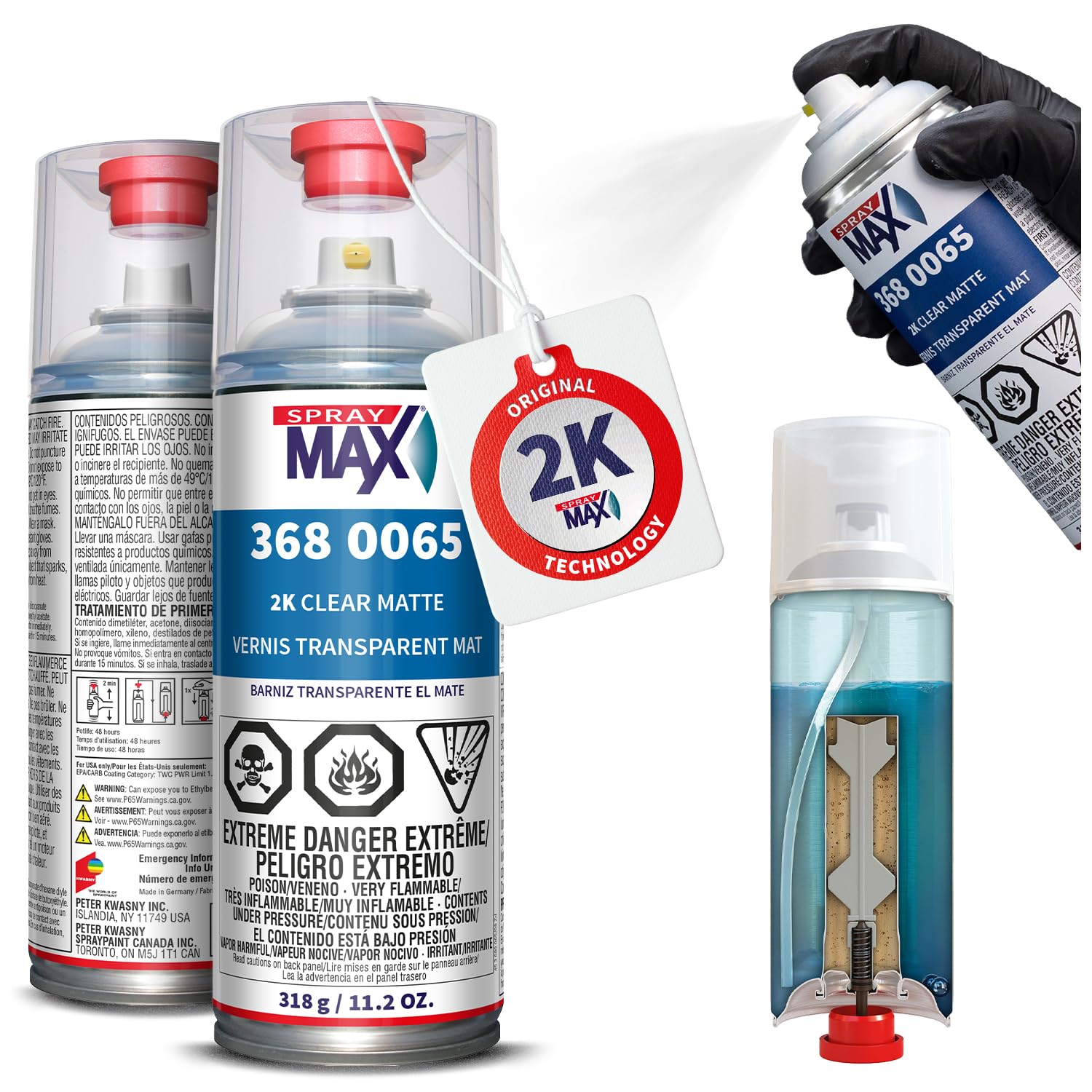
SprayMax’s 2K (two-component) aerosol contains isocyanate hardener, activated by pushing the can’s internal button, delivering true catalyzed polyurethane chemistry from a spray can. The result is a matte clear coat that chemically cures into a tough, solvent-resistant shell—far superior to rattle-can lacquers that remain thermoplastic and soft.
The matte gloss registers at 12 ± 3 units, ideal for modern flat OEM-style interiors where the top coat must be invisible. It’s dust-dry in 12 minutes and can be handled after 80 minutes. The fan nozzle lays down an even layer that self-levels, and the cured film resists gasoline, sunscreen, and interior cleaners without clouding.
The major caution is the 48-hour pot life after activation. This product is best for planned, focused projects where you can use the entire can in one session. However, storing the can in a refrigerator dramatically extends the pot life, as some experienced users have confirmed through testing. A quality respirator is mandatory for spraying isocyanate-containing products.
Why it’s great
- True 2K polyurethane for maximum chemical and UV resistance
- Consistent matte finish at 12 ± 3 gloss units
- Self-leveling formula reduces orange peel on flat surfaces
Good to know
- 48-hour pot life requires completing the job quickly
- Requires full respiratory protection—isocyanate is hazardous
7. Eastwood 2K Aerosol Clear Coat

Eastwood’s 2K clear coat is the high-gloss counterpart to SprayMax’s matte option, designed for users who want a deep, wet-look protective finish over painted interior parts or repaired exterior panels. The catalyzed 2K resin hardens via chemical reaction, not simple solvent evaporation, giving a finish that resists yellowing—a common failure of cheaper 1K clears.
The application requires 1-2 passes at 50% overlap, depositing about 1.2 mils per coat. Full cure at 68°F takes 12 hours, but IR drying at 140°F can accelerate it to 35-40 minutes, useful for workshops with proper equipment. The gloss level is high; appropriate for center console accents, painted dashboard trim, or glossy pillar covers, but likely too shiny for factory matte interior restorations.
One user verified that a single 11.8 oz can repaired a deep scratch on a door panel for roughly , versus a dealer panel replacement quote. After 1.5 years in Texas sun, the repair remained intact without yellowing. The main limitation is coverage—at 5.4-8.1 square feet per can, it’s not cost-effective for full interiors unless sprayed in thin, controlled coats.
Why it’s great
- Catalyzed 2K chemistry resists yellowing indefinitely
- High-gloss finish suitable for accent or painted trim
- IR flash cure capability for shop environments
Good to know
- Limited coverage area per can for the price
- Overly glossy for standard OEM matte interior plastics
FAQ
Can I use auto interior paint on exterior plastic trim?
How do I prep plastic surfaces for painting?
Why does my interior paint peel off after a few weeks?
Final Thoughts: The Verdict
For most users, the best auto interior paint winner is the SEM Trim Black Ultra because its true satin finish and direct-to-TPO adhesion deliver professional, long-lasting results without extra steps. If you need to restore vinyl seats or fabric carpets, grab the SEM Landau Black Color Coat. And for clear-coating a painted interior panel with maximum chemical and UV resistance, nothing beats the SprayMax 2K Matte Clear Coat.