
Our readers keep the lights on and my morning glass full of iced black tea. As an Amazon Associate, I earn from qualifying purchases.
Specs are compiled from manufacturer listings and verified buyer reviews and can change over time — please confirm the key details on the product page before buying.
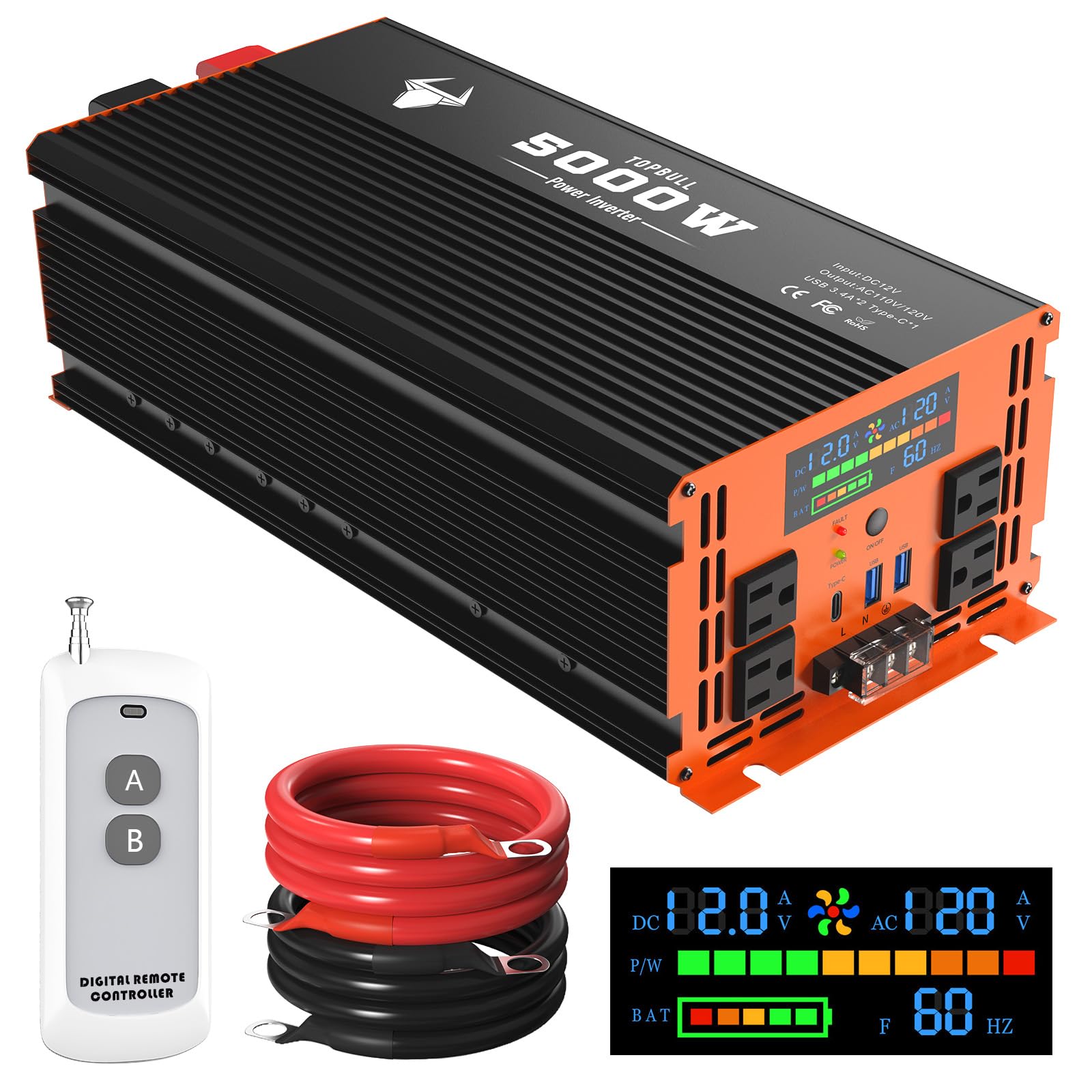
You want a power inverter that turns your car’s 12V battery into usable power for a laptop or a coffee machine. For most people the safest buy is the TOPBULL 5000W: it runs 5000W continuously and handles a 10000W peak surge (a short burst when a motor first kicks on). It also gives you four 20A AC sockets (standard household-style outlets) and holds a 4.5+ star record from a large pool of owners. The catch every buyer hits early is the waveform (the shape of the AC power it makes). A modified sine wave unit is cheaper and fine for chargers and tools. Anything with a motor or a sensitive chip inside usually wants pure sine wave (a smoother, cleaner AC signal). That one distinction decides more purchases than wattage does, so it runs through every pick below.
I’m Min — the founder and writer behind Gadgets Feed. This guide is built by comparing the manufacturers’ published specifications and the patterns across verified customer reviews, so you get each pick’s real strengths and trade-offs instead of marketing spin.
Wattage tells you what will start, the waveform tells you what will run cleanly, and the fuse tells you what your cigarette socket will tolerate. Here is how the leading contenders stack up when you shop for the best auto inverter for your vehicle, camper, or home backup setup.
Our Picks at a Glance
How To Choose The Best Auto Inverter
Pick the waveform first, the wattage second, and the connector third. Reverse that order and you end up with a 3000W unit that makes your coffee machine hum and your CPAP (a breathing machine used at night) whine. Or you get a 150W plug-in adapter trying to run a fridge. The inverter is not the machine that does the work. It is the translator between your car battery’s 12V DC (direct current, the steady kind a battery gives) and the 110V AC (alternating current, what wall outlets and appliances expect). Matching that translator to your load is the entire job.
Pure sine wave versus modified sine wave
A pure sine wave output is grid-quality AC — the same smooth curve your wall outlet delivers. Modified sine wave output is a stepped approximation of that curve. Chargers, laptops, and simple resistive loads tolerate the stepped version fine. Motors, compressors, and audio gear often buzz, run hot, or refuse to start on it. If you plan to run a coffee machine, a window AC, or anything with a heating element or a compressor, pay the premium for pure sine wave.
Continuous watts versus peak surge watts
Continuous rating is what the inverter sustains hour after hour. Peak rating is the short burst it can supply the instant a motor or compressor kicks on. A fridge that draws modest power while running can pull several times that in the first second. Every unit here lists both numbers, and as a rule you want a continuous rating comfortably above your appliance’s steady draw, not just above its label number.
Cigarette socket current limits
Anything plugged into a 12V cigarette lighter socket is capped by that socket’s fuse — often a 20-amp circuit, which limits what you can realistically pull. That is why compact plug-in units top out in the low hundreds of watts and why step-up models ship with alligator clips or pure copper battery cables instead. If a listing mentions high continuous wattage but only offers a cigarette plug, treat the high number as surge, not sustained output.
Efficiency and idle losses
Conversion efficiency tells you how much of the battery’s DC energy actually reaches your device as AC. Units in the mid-nineties percentage range waste less, and low no-load draw keeps the battery from bleeding when nothing is plugged in. If the inverter sits connected overnight, low idle loss matters as much as peak output.
Quick Comparison
| Model | Best For | Output Power | Waveform | Ports | Amazon |
|---|---|---|---|---|---|
| TOPBULL 5000W★ Best Overall | Whole-rig power | 5000 watts | Modified Sine Wave | 4 AC, 2 USB-A, 30W USB-C, 3 AC terminals | Amazon |
| TOPBULL 3000WHeaviest Lifter | RV and job-site power | 3000 watts | Modified Sine Wave | 2 AC, 3.4A USB-A, 30W USB-C, grounding terminal | Amazon |
| LANDERPOW 3000WCleanest Sine | Clean power for sensitive gear | 3000 watts | Pure Sine Wave | 3 AC, 5V/3.1A USB-A, 30W PD, hardwire terminal | Amazon |
| BESTEK 400W | CPAP and small appliances | 400W (800W peak) | Pure Sine Wave | 2 AC, 30W USB-C, 18W USB-A | Amazon |
| OLTEANP 500W | LCD-monitored travel power | 500W (1000W peak) | Modified Sine Wave | 2 AC, 36W USB-C, 5V/3A USB-A | Amazon |
| BESTEK 300W | Laptop and gadget charging | 300W (700W peak) | Pure Sine Wave | 2 AC, 30W PD, 18W QC | Amazon |
| ZEEHOO 150W | Cup-holder charging hub | 150W | Pure Sine Wave | 2 AC, 18W USB-A, dual 30W PD | Amazon |
| Pro Chaser 400W | Road-trip gadget charging | 400W (800W peak) | Modified Sine Wave | 2 AC, two USB (6.2A total) | Amazon |
In‑Depth Reviews
1. TOPBULL 5000W Power Inverter 12V DC to 120V/110V AC
Our pick — 4.5+★ from 450+ verified ratings; the strongest balance of quality and price.
Five thousand watts of continuous output with a ten-thousand-watt kick when a compressor fires up.
The headline figure is the surge: this TOPBULL delivers 5000W continuous with a 10000W peak, which is a far bigger reserve than the 700W peak on the BESTEK 300W down the list. That reserve is what lets it start something with a motor inside rather than just run a laptop. Buyers report it running up to five industrial fans at once, a load that would stall most plug-in units. For a van build, a working truck, or a home solar backup bank, that headroom is the reason to buy it.
Where it wins people over is build quality, which is the most-praised trait across its feedback by a wide margin. The metal shell has real impact resistance, the pure copper cables are thick enough to stay cool under load, and the temperature-controlled dual fan system keeps it running quietly rather than buzzing through a job. Value for money is the second thing owners keep returning to. The port set is genuinely generous: four 20A AC sockets, two 3.4A USB-A ports, a 30W USB-C port, and three AC terminal blocks for hardwiring.
The trade-off is the waveform. This is a modified sine wave unit, so it should not be your first choice for a CPAP, a variable-speed compressor, or high-end audio gear that expects a clean curve. There is also the obvious size question — at 15.94 by 7.09 by 4.72 inches it is a permanent mount, not something you toss in a glovebox. The 200-foot remote helps here: you can mount the box near the battery bank and switch it from inside the cab.
What earns its place
- 5000W continuous with a 10000W peak surge for heavy startups
- Four 20A AC sockets plus USB-A, USB-C, and three hardwire terminals
- Runs up to five industrial fans at once
- Dual smart fans stay quiet; 200ft remote lets you switch from a distance
What to weigh first
- Modified sine wave — not the pick for sensitive medical or audio gear
- Large footprint demands a permanent mount rather than a glovebox stash
Buy it for: a van, truck, RV, or solar setup where you need serious sustained wattage and don’t mind a modified waveform.
Pass if: your load list includes a CPAP, a refrigerator compressor, or anything with a motor that objects to a stepped wave.
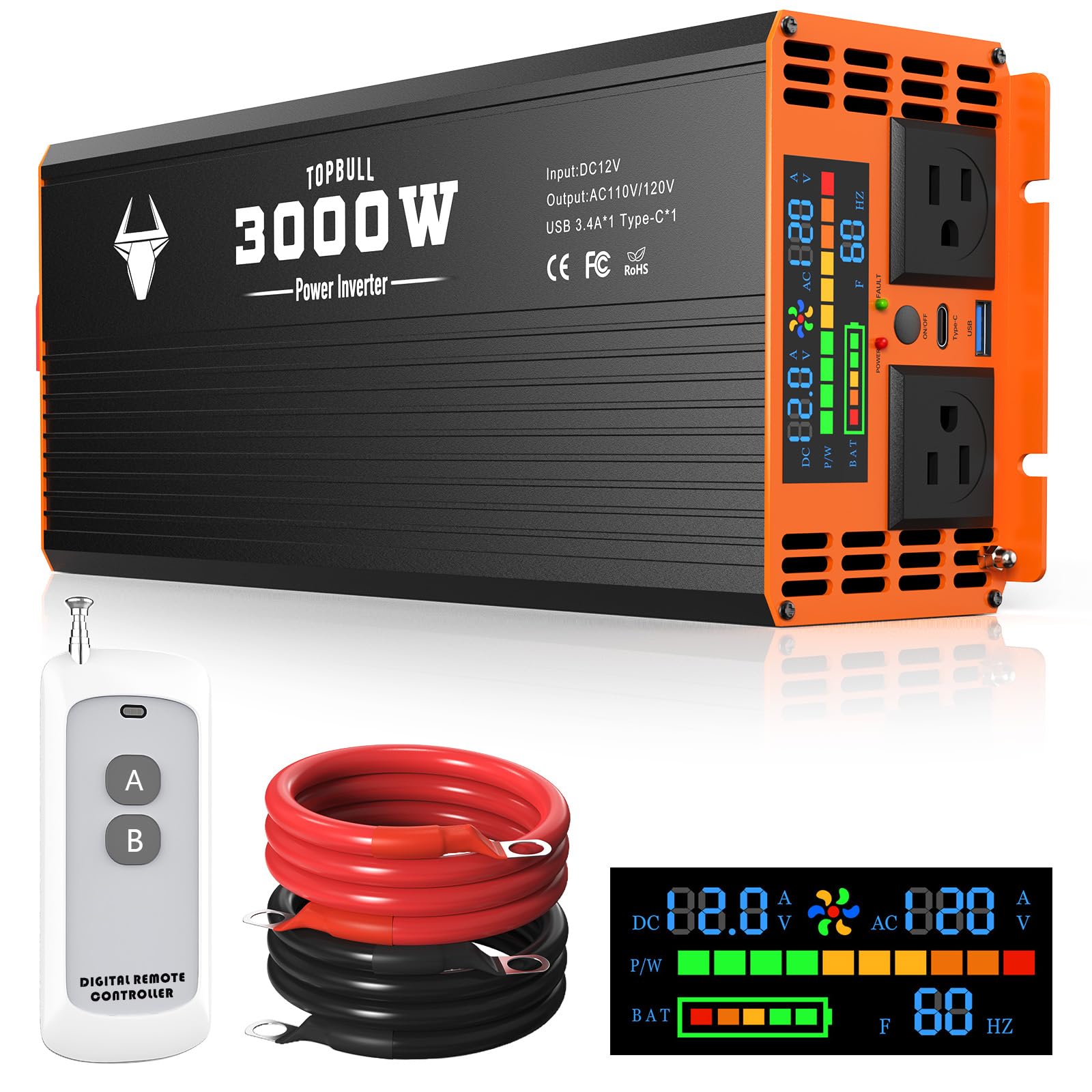
2. TOPBULL 3000W Power Inverter Car/Home 12V DC to 110V/120V AC
A camper and job-site workhorse that pulls 3000W continuously without needing a dedicated power room.
If you want heavy output without stepping up to the biggest box in the lineup, this TOPBULL 3000W is the middle child with the loudest voice. It delivers 3000W continuous and a 6000W peak, and the IPM power management system pushes conversion efficiency past 93% so more of your battery’s charge reaches the appliance instead of the heatsink. The port arrangement is work-ready: two 20A/120V AC outlets for high-current tools, a 3.4A USB-A fast-charge port, a 30W USB-C port, and a grounding terminal.
What owners keep coming back to is the value — getting a 3000W pure copper unit at this tier is the whole pitch. It powers a fridge, freezer, furnace blower, and device charging at the same time. The dual silent fans only come on briefly under load, so sleeping next to it in an RV is realistic. Reinforced aluminum housing resists corrosion, and the ten-layer protection stack (low-voltage, high-voltage, overload, short circuit, overheat, reverse, ground fault, overcurrent, earth leakage, and battery protection) cuts output the instant something goes wrong.
The honesty note: this is a modified sine wave unit despite the “professional-grade” framing, so sensitive electronics still prefer the LANDERPOW below. And the 200-foot wireless remote and color display are nice-to-haves, not necessities — they shouldn’t be the reason you choose it. Compatibility is broad, though: it works with any 12V or 12.8V battery on the market, and the thickened pure copper battery cables resist overheating during install.
Where the money goes: 3000W continuous, 6000W peak, >93% efficiency, and a full protection suite in a rugged aluminum case — this is the work-truck pick.
The waveform caveat: modified sine wave means CPAP machines, audio components, and variable-speed compressors are better served by a pure sine unit.
Right for: RV livers, contractors, and emergency-backup buyers who need sustained 3000W from a pure copper unit.
Not for: the buyer whose main load is a sensitive electronics rack that wants a clean sine curve.
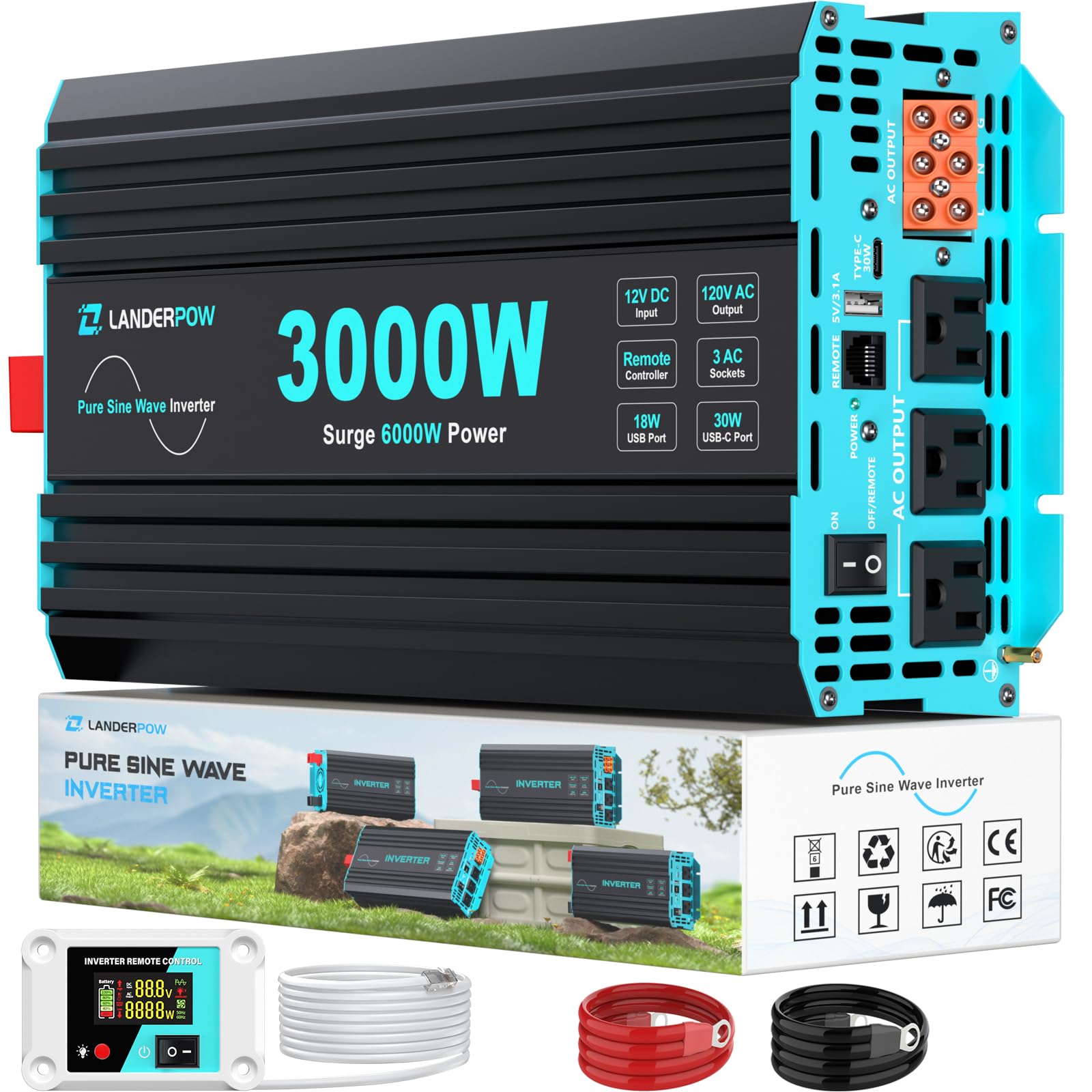
3. LANDERPOW 3000W Pure Sine Wave Inverter 12V DC to 120V AC
Grid-quality power for the gear that refuses to run on anything less than a clean curve.
Here is the direct trade against the TOPBULL 3000W above: both are rated 3000W continuous, but only this LANDERPOW sends out a pure sine wave. That means the same wattage arrives as a smooth grid-style curve instead of a stepped approximation, so window ACs, coffee machines, refrigerators, home theater gear, and car audio run with zero hum and no flicker. It runs a 10,000 BTU AC unit. If your load list includes anything with a motor or a sensitive chip, this is the version of the 3000W class you want.
The delivery side is well thought out. You get three AC outlets plus a hardwired AC terminal for high-current tools, a 5V/3.1A USB-A port, and a 30W PD port. Two 1AWG pure copper battery cables at 2 feet each come in the box and stay cool under load — a real difference from thin mystery-metal leads. Efficiency is listed above 91%, which means less battery drain per converted watt. And the 15ft wired remote controller carries a smart LED screen that tracks battery level, output, and error codes in real time from your cab.
The recurring gripe is the remote cable: 15 feet can feel short in a long trailer, so plan your mounting point before it arrives. Reliability and noise both draw mixed feedback, which is normal for a unit this size handling heavy inductive loads (devices with motors that pull a big startup jolt). Owners praise the simple installation and the confidence from the watt meter (a live readout of how much power you are drawing) sitting right there on the remote. At 7.5 pounds it is heavy enough to want a solid mount.
Why it stands apart
- Pure sine wave at 3000W — clean power for motors, medical, and audio
- Runs a 10,000 BTU AC unit
- Ships with two 1AWG pure copper cables that stay cool
- Smart LED remote tracks battery, output, and faults from the cab
Fit notes
- The 15ft wired remote can run short in a long trailer
- Noise and reliability draw mixed feedback under heavy inductive loads
Choosing this means: you need the cleanest waveform at 3000W and want real-time monitoring from inside the cab.
Think twice if: your rig is long and you need the remote to reach far from the battery bay.
4. BESTEK Pure Sine Wave Power Inverter, 400W DC 12V to 110V AC
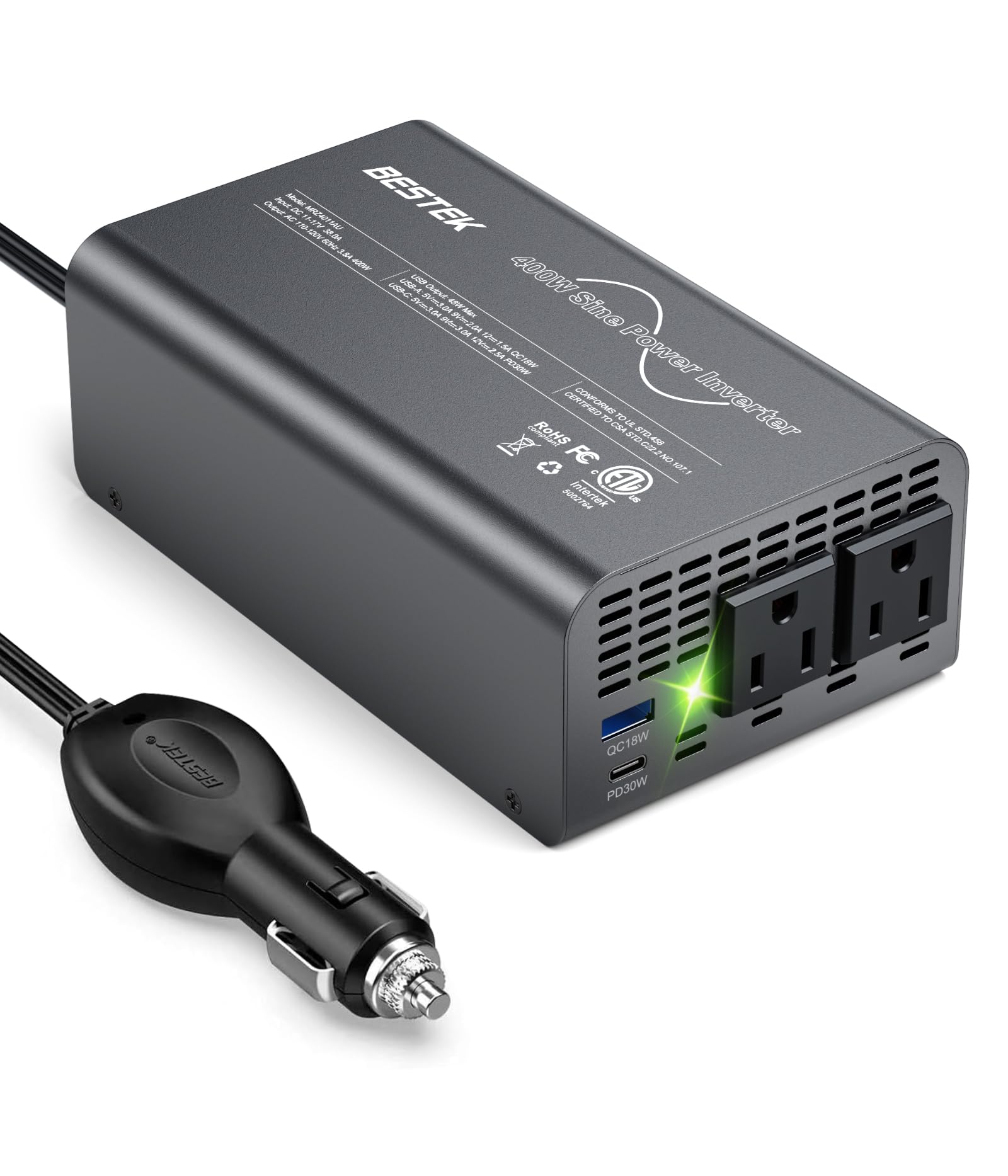
Four hundred clean watts that a CPAP, nebulizer, or breast pump will happily accept.
The number that matters here is the waveform, not the wattage. This BESTEK sends out a pure sine wave equivalent to grid power, which is why it is the pick for CPAP machines, nebulizers, air pumps, and breast pumps — the exact devices that misbehave on a stepped output. It delivers 400W continuous with an 800W peak surge at load start-up. Compare that to the ZEEHOO 150W further down and you can see the tier jump: this one can start a load the plug-in adapter simply cannot carry.
Charging is handled by a PD30W USB-C port and a QC18W USB-A port, and the 18W Quick Charge 3.0 port charges most Android phones from 0% to 80% in 30 minutes. You can run up to four devices at once across the two AC outlets and two USB ports. Owners consistently point to performance as the star — clean, steady output that doesn’t sag under load. The smart temperature-controlled fan throttles with the load, so it stays quiet in a cab. ETL certification covers the electrical side.
The honest note: noise divides opinion. Some owners find it relatively quiet, while others notice the fan clearly under heavier draw. That is the constant with compact pure sine units at this power level — the clean waveform costs you some cooling effort. It is also a cigarette-lighter or small-battery unit, not a hardwired 3000W-class machine, so keep your expectations on sustained draw realistic.
The defining spec: a pure sine wave at 400W continuous and 800W peak — grid-quality output that sensitive medical devices accept.
Fair warning: the fan draws mixed reviews on noise, so if the inverter will sleep next to you, factor that in.
Made for: CPAP users, road-trippers with medical or infant-care gear, and anyone whose devices demand a clean wave.
Wrong pick if: you expect to hardwire a 3000W load or run a full-size appliance.
5. OLTEANP 500W Power Inverter 12V DC to 110V/120V AC

A readout-first inverter that tells you exactly what your battery and output are doing.
For the buyer who wants to see the numbers instead of guessing, this OLTEANP puts an LCD screen front and center. It shows input voltage, output voltage, and battery status in real time. When something goes wrong, the display throws a fault code — OL for overload, HI for high voltage, LO for low voltage, OH for overheating — so you can diagnose the problem without a multimeter. The display is the star here, and it’s the second most-praised feature across owner feedback.
Power-wise it delivers 500W continuous and 1000W peak surge from a 12V source, feeding 110V/120V AC out through two outlets. A 36W USB-C PD port and a 5V/3A USB-A port round out the connections, so a phone and a laptop can charge while an AC device runs. It comes with alligator battery clips, a cigarette lighter plug, and a manual, and it’s backed by a 2-year warranty. Quality is the trait owners praise most by a clear margin — the build feels solid, and the digital display is a genuine convenience.
The catch is power honesty. This is a modified sine wave unit, and the power output draws mixed feedback — some owners find it impressive, others note it doesn’t reach the advertised wattage under real loads. There’s also a multimeter quirk worth knowing: modified sine wave output can read inaccurately on a standard multimeter, so the maker recommends a True RMS meter for accurate readings. That’s a measurement issue, not necessarily a fault.
The standout feature: an LCD that shows input, output, and fault codes live — diagnostic clarity most inverters in this class lack.
Honest limit: modified sine wave plus mixed reports on reaching full wattage mean it suits small electronics, not heavy motor loads.
Best for: tinkerers and travelers who want to watch the numbers and troubleshoot without a meter.
Skip if: you’re running a compressor or a device that needs a pure sine wave.
6. BESTEK 300W Pure Sine Wave Power Inverter
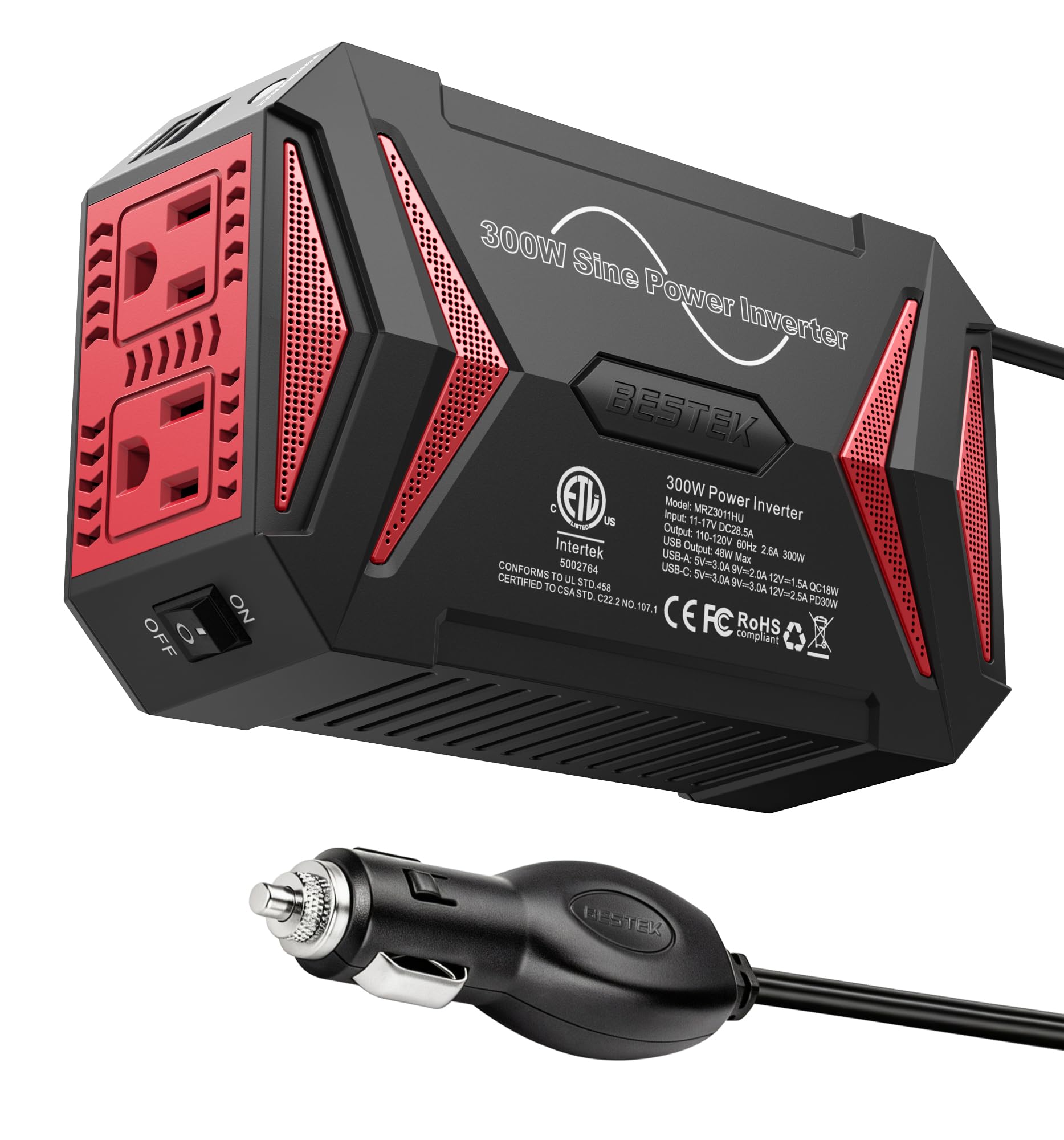
Three hundred clean watts and a fuse that respects your cigarette socket.
Set this BESTEK 300W beside the TOPBULL 5000W at the top and you see the two ends of the spectrum: 700W peak here versus 10000W peak there. The BESTEK is built for laptops, speakers, cameras, nebulizers, game consoles, iPads, and string lights — the everyday gear that needs a clean wave, not a huge one. Owners note it can deliver up to 300W without blowing the 20-amp fuse, which is exactly the point of this class. It’s a pure sine wave unit delivering 300W continuous and 700W peak.
The charging side gives you a PD30W USB-C port and a QC18W USB-A port plus two AC outlets, all fed through a 24-inch cable with a cigarette lighter plug. A built-in 40-amp fuse plus LED indicators for short-circuit, temperature, under-voltage, and over-voltage protection guard the electronics on both ends. Owners describe the fan as quiet enough to forget it’s running. Quality is what owners praise most by far.
The practical ceiling is the cigarette socket itself. This is a plug-in unit, so sustained high draw is limited by that socket’s fuse, not by the inverter. That’s why it shines with laptops and gadgets but won’t run a fridge or a high-current tool. The 7 by 5 by 2-inch footprint and 24-inch cord also keep it tethered near the socket rather than giving you freedom to place it anywhere.
Why owners keep it: pure sine wave output, PD30W and QC18W fast charging, and a fan quiet enough to disappear — all in a compact plug-in body.
Real ceiling: the cigarette socket’s fuse caps sustained draw, so this is a gadget charger, not an appliance power plant.
Ideal for: commuters and road-trippers charging laptops, consoles, and small medical devices on a clean wave.
Look elsewhere if: you need to power a fridge, a compressor, or anything drawing serious sustained watts.
7. ZEEHOO 150W Car Power Inverter with Dual 30W PD
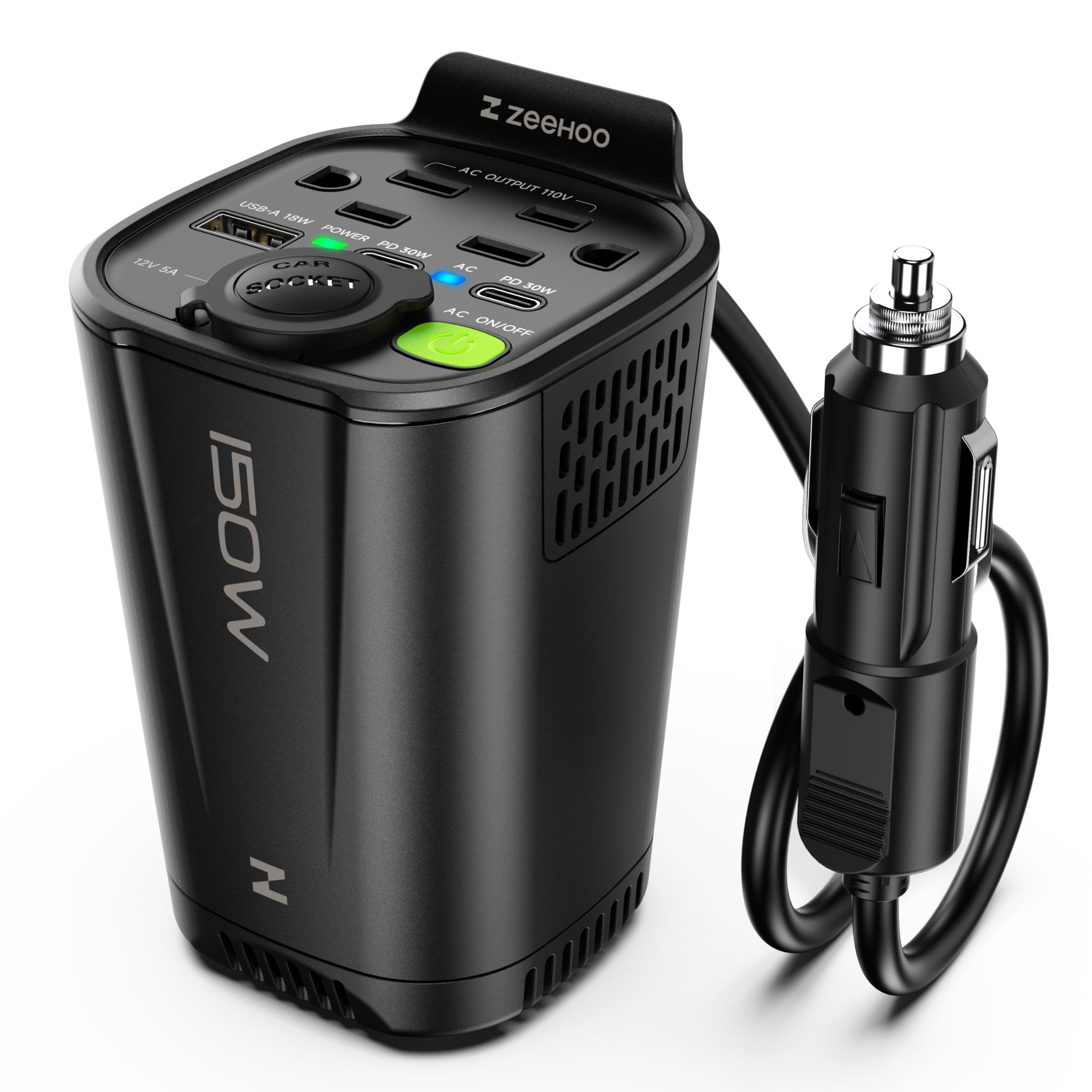
A tidy charging hub that drops straight into your cup holder and stays out of the way.
The size is the whole story. At 2.75 by 2.75 by 4.13 inches, this ZEEHOO nestles into a cup holder, which is smart packaging for a device that lives in your car full-time. It converts 12V DC to 110V AC and delivers 150W through two AC outlets, an 18W USB-A port, and dual 30W PD car chargers (PD means Power Delivery, a fast-charging standard). So two fast-charging USB-C devices plus a laptop can all draw power at once. For comparison, that is 150W against the 300W of the BESTEK 300W, but it is the right amount for phones, tablets, and small laptops.
The fit is what owners come back to. The device settles into the cup holder exactly as intended, which means it doesn’t rattle around under the console. Owners mention fast charging across several devices at once and quiet operation. Function is the most-praised trait across its feedback by a wide margin, with charging capability following close behind. A sleek black housing blends with most interiors, which sounds unremarkable until you’ve lived with a chunk of plastic that doesn’t.
Be realistic on the wattage ceiling. One hundred fifty watts runs a laptop, a phone, and a tablet comfortably, but it will not start a coffee machine or a small fridge. If those loads are on your list, jump up to the 500W or 3000W class. It also runs off the cigarette socket, so it’s tethered to that circuit — no alligator clips here.
What it nails: cup-holder fit, dual 30W PD charging, and quiet operation in a body that doesn’t clutter the cabin.
Wattage limit: 150W covers phones, tablets, and small laptops — not appliances or motor loads.
A natural fit for: daily drivers and campers who want tidy multi-device charging that disappears into the console.
Not the one if: your plan is to run anything bigger than a laptop off the vehicle.
8. Pro Chaser 400W Car Power Inverter 12V DC to 110V AC

A featherweight road-trip charger that punches in at 0.46 kg and never takes up space.
Portability is the Pro Chaser’s calling card. At 0.46 kg and 4.85 by 3.1 by 1.81 inches it slides into any door pocket, and the 30-inch cord extends reach from the socket without a tangle. It delivers 400W continuous with an 800W peak — against 150W for the ZEEHOO 150W at the low end — and drives two 110V AC outlets plus two USB ports totaling 6.2A. USB to USB-C adaptors are included, so a phone with no USB-A lead still gets charged.
The load list it’s designed for is explicit: laptops, DVD players, breast pumps, bottle warmers, PS4, Xbox, TV, power tool battery chargers, and air compressors in the 300W to 400W range. A built-in automatic cooling fan kicks on at 113F to keep the internals safe, and short-circuit, overload, and temperature protection are standard. The design is compact and travel-friendly, and it fits the glovebox after a road trip ends. Backed by a 12-month warranty.
The honest note here is reliability. This is the one pick where the feedback gets divided — some units die after a half night of use, others break within minutes. That’s a real-world pattern for budget-class plug-in inverters pushed near their ceiling. Treat it as a road-trip accessory for light loads, not a hardwired power station, and keep its 400W limit in mind. Versatility and compact size are what owners praise most.
Where it shines
- 0.46 kg and under 5 inches long — slides into any pocket
- 400W continuous with an 800W peak and a 6.2A dual-USB setup
- USB-to-USB-C adaptors included for modern devices
- Auto fan at 113F plus overload and temperature protection
The real question mark
- Reliability splits feedback, with some units failing early under load
- 400W ceiling rules out appliances and anything with a motor
A sensible buy for: casual road-trippers who want a light, adaptable charger for laptops and gadgets.
Not the pick for: anyone planning to lean on it hard or power appliances from a vehicle.
Understanding the Specs
Continuous Watts vs Peak Surge
Continuous watts is the output the inverter can sustain for hours; peak watts is the brief burst it can deliver at a motor’s first instant. A fridge or coffee machine can pull several times its running current at startup, so check the peak figure against that surge. Buying on peak alone means a unit that starts the load then trips on the second minute — always match the continuous rating to your steady draw, and let the peak handle the startup spike. When both numbers are listed, treat continuous as the honest number.
Pure Sine Wave vs Modified Sine Wave
Pure sine wave output matches the smooth curve of a wall outlet; modified sine wave steps through an approximation. Chargers, laptops, and simple heaters usually don’t care. Motors, compressors, audio equipment, and medical devices often do — they hum, run hot, or fail to start on a modified waveform. If the load has a heating element, a compressor, or a sensitive chip, buy pure sine wave. If the load is phones and laptops, the cheaper modified waveform is usually fine.
Cigarette Socket vs Battery Cables
A 12V cigarette lighter socket is protected by a fuse that caps how much current you can draw — often in the low-twenties in amps, which limits practical output to the low-hundreds of watts. Units that claim big wattage while only offering a cigarette plug are relying on surge, not sustained output. Step-up models ship with alligator clips or thick pure copper battery cables so they can pull from the battery directly. Match the connection type to your real wattage plan.
Efficiency and Idle Draw
Efficiency tells you what percentage of the DC energy drawn from the battery makes it out as AC — units in the nineties waste less and run cooler. Idle or no-load draw is what the inverter sips while connected but doing nothing; lower is better if it stays wired up overnight. Together these two numbers decide how fast your battery drains when nothing is plugged in and how much runtime your appliance actually gets.
FAQ
Will a pure sine wave inverter run my CPAP machine?
Can I run a fridge from a car inverter?
What is the difference between modified sine wave and pure sine wave?
Can I plug a 5000W inverter into my cigarette lighter socket?
How much power can my car’s 12V battery actually supply?
Will a modified sine wave inverter damage my laptop?
What size inverter do I need for a laptop and phone charging?
Why does my inverter fan run loudly sometimes?
Can I leave my inverter connected to the battery all the time?
Final Thoughts: The Verdict
For most buyers, the best auto inverter is the TOPBULL 5000W. It pairs 5000W continuous with a 10000W peak surge, four 20A sockets, two USB-A ports, a 30W USB-C port, and three AC terminal blocks (screw-down connection points for bare wiring). That lets you power a serious load list from one box. If your gear includes a CPAP, a compressor, or sensitive audio and needs a clean sine wave, grab the LANDERPOW 3000W, which is pure sine wave. And if you just want tidy, quiet multi-device charging that lives in the cup holder, the ZEEHOO 150W fits the bill without cluttering the cabin.
How We Picked
We do not accept paid placement. Every pick is matched to a real buyer and a real use-case; we do not hands-on test units.
Sources & Methodology
Specifications: manufacturer listings and product documentation. Review insights: verified customer reviews, as of July 2026. Pricing: not shown on this page (it changes often); check the current price via the retailer link.
As an Amazon Associate, Gadgets Feed earns from qualifying purchases. This does not affect which products we feature.