
Our readers keep the lights on and my morning glass full of iced black tea. As an Amazon Associate, I earn from qualifying purchases.
Specs are compiled from manufacturer listings and verified buyer reviews and can change over time — please confirm the key details on the product page before buying.
Your engine’s health starts with one honest question: does the oil you pour in match the driving you actually do? A short stop-and-go commute is far harder on oil than a long highway cruise, and the wrong grade can leave your engine louder, thirstier, and dirtier inside. Below you’ll find nine real options, sorted by what they genuinely do well, so you can match one to your mileage, your climate, and your owner’s manual.
I’m Min — the founder and writer behind Gadgets Feed. This guide is built by comparing the manufacturers’ published specifications and the patterns across verified customer reviews, so you get each pick’s real strengths and trade-offs instead of marketing spin.
Most buyers only want to know which jug protects their engine without overpaying. The short answer: match the viscosity grade in your owner’s manual first, then choose a full synthetic if you want longer change intervals — the details below cover every option for auto motor oil.
Our Picks at a Glance

How To Choose The Best Auto Motor Oil
The single biggest mistake buyers make is grabbing a familiar brand in the wrong grade. Oil weight is not a preference — your engine’s bearing clearances and oil pump were designed around one specific grade, and going thicker or thinner changes how the oil behaves on a cold start and at full temperature. Get the grade right first. Then decide between a blend and a full synthetic based on how long you want to go between changes.
Read the grade cold-first
The first number with the W tells you how the oil behaves in the cold — a 0W flows more freely on a freezing morning than a 10W, which means the pump pushes oil to the top of the engine faster. The number after the W is the hot thickness. A 5W-30 is a common middle ground, while 10W-30 suits older engines and warmer climates where a slightly thicker film is welcome.
Decide blend versus full synthetic
A synthetic blend mixes synthetic base oil with conventional oil, which keeps the jug budget-friendly while improving on plain conventional protection. A full synthetic resists breakdown at high heat for longer, so it usually supports longer drain intervals. If you change your own oil every few thousand miles on a simple commuter, a blend is plenty. If you stretch intervals or tow and haul, the full synthetic earns its keep.
Check the back-label approvals
The API and ILSAC lines on the back of the jug tell you which industry standards the oil actually meets. Turbocharged or direct-injection engines often call for a specific OEM approval such as dexos1, and running an oil without it can void coverage. Always cross-check the numbers printed on the label against your owner’s manual before you buy.
Quick Comparison
| Model | Best For | Viscosity Grade | Volume | Type | Amazon |
|---|---|---|---|---|---|
| Mobil 1 Extended Performance 10W-30★ Best Overall | Long-interval daily drivers | 10W-30 | 160 fl oz | Full Synthetic | Amazon |
| Valvoline MaxLife High Mileage 5W-30High-Mileage Hero | Engines past 75,000 miles | 5W-30 | 160 fl oz | Synthetic Blend | Amazon |
| Castrol EDGE 5W-30Long-Interval Pick | Extended drain intervals | 5W-30 | 5 quarts | Full Synthetic | Amazon |
| Mobil 1 Extended Performance 5W-30 | Year-round all-climate use | 5W-30 | 160 fl oz | Full Synthetic | Amazon |
| Castrol EDGE Extended Performance 0W-20 | Modern turbos and hybrids | 0W-20 | 160 fl oz | Full Synthetic | Amazon |
| Royal Purple HMX 10W-30 | Reviving tired high-mileage engines | 10W-30 | 160 fl oz | High-Mileage Synthetic | Amazon |
| K&N 5W-30 Synthetic | Mixed hot and cold climates | 5W-30 | 4.73 liters | Full Synthetic | Amazon |
| Quaker State 5W-20 Full Synthetic | Budget-minded turbo owners | 5W-20 | 160 fl oz | Full Synthetic | Amazon |
| Quaker State 10W-30 | Older cars and lawn equipment | 10W-30 | 160 fl oz | Conventional | Amazon |
In‑Depth Reviews
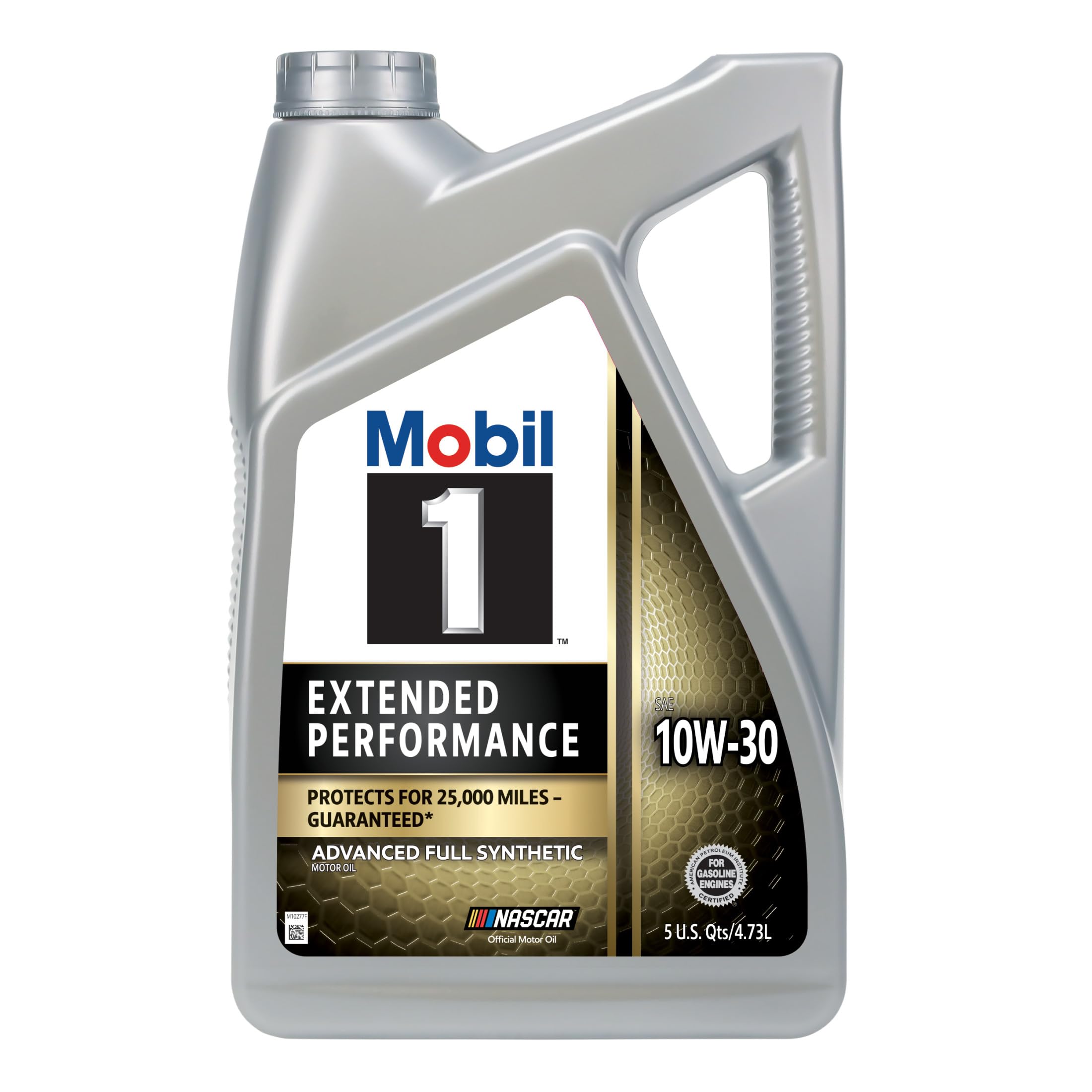
1. Mobil 1 Extended Performance Full Synthetic Motor Oil 10W-30, 5 Quart
Our pick — 4.5+★ from 950+ verified ratings; the strongest balance of quality and price.
The jug that keeps a high-mileage engine composed through long intervals and hard heat.
If your owner’s manual specifies 10W-30 and you’d rather change oil twice a year than four times, this is the pick. It’s a full synthetic — a man-made base oil rather than a refined crude base — and that’s why it resists thinning out under sustained highway heat. You get 160 fluid ounces, which is 5 quarts, enough for a standard fill on most six-cylinder engines with a little left for top-offs.
What wins people over is the consistency. Its full synthetic base stock holds viscosity through the whole drain interval instead of thinning out in the last stretch. That matters most in the real-world case this oil is built for: a car that sees repeated short trips where the engine never fully warms, then the occasional long haul. It keeps the inside clean enough that a single change does visible work on deposits.
The honest catch is the grade itself. A 10W-30 is thicker when cold than a 5W-30 or 0W-20, so it’s the wrong choice for a modern engine whose manual calls for a thinner oil — and it moves the oil a touch more slowly to the top end on a freezing start. Stick to it only if 10W-30 is what your engine was designed around.
What earns it the top slot
- Full synthetic base holds its film under sustained heat
- 5-quart jug (160 fluid ounces) covers a standard fill
- Consistent quality rating — the crowd favorite at 4.5+ stars across 900+ ratings
- Cleans deposits over the course of one change
Where it stops being the right buy
- 10W-30 is too thick for engines spec’d on 0W-20 or 5W-20
- Not the budget-friendly option in the lineup
- Universal fit label still means you must match your manual’s grade
Made for: the owner running a 10W-30 engine who wants one jug to cover long intervals without babysitting the dipstick.
Walk on by if: your manual says 0W-20 or 5W-20 — a thicker oil here works against the engine, not for it.
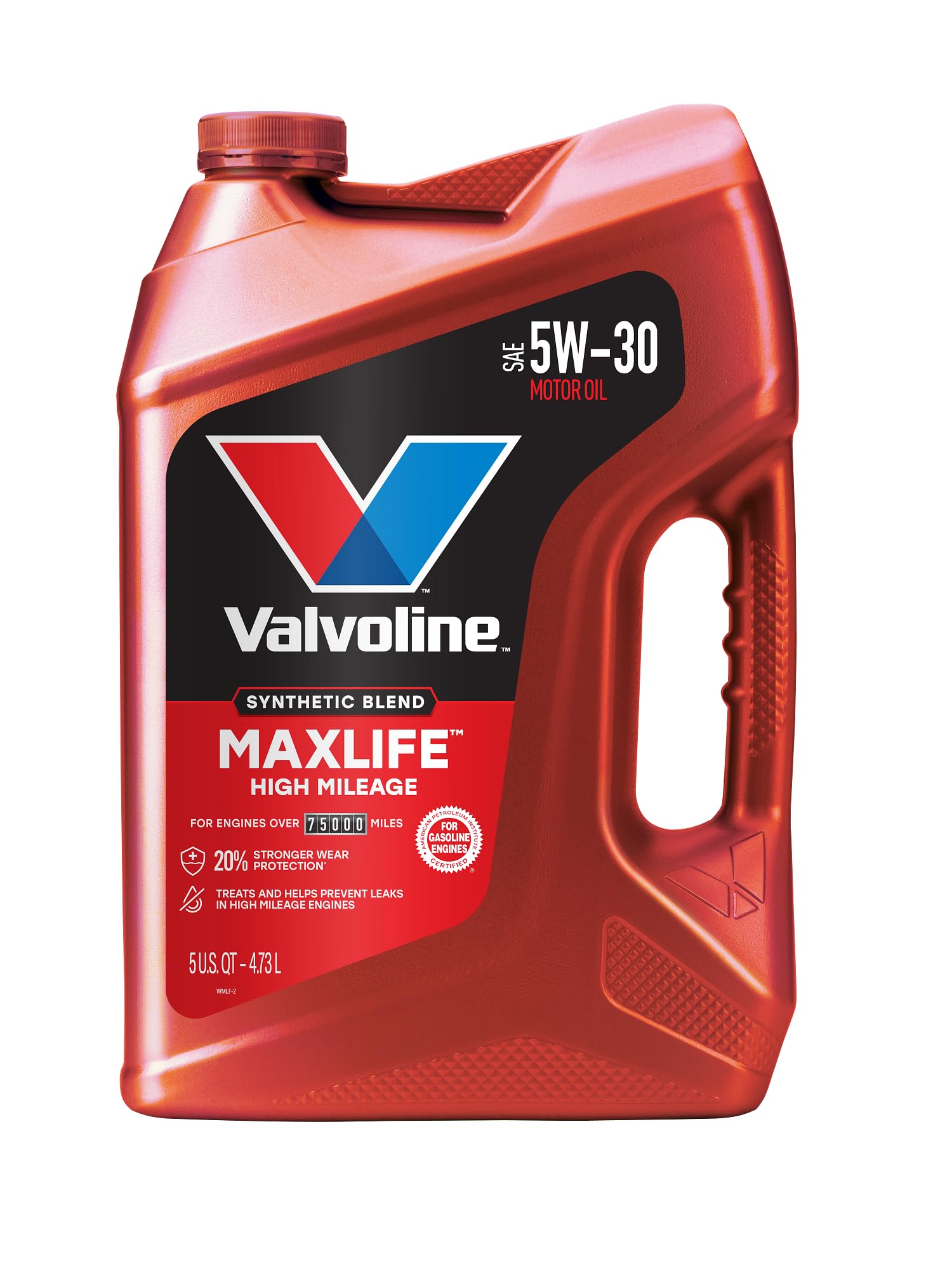
2. Valvoline MaxLife High Mileage 5W-30 Synthetic Blend Motor Oil 5 Quart
For the car that’s crossed 75,000 miles and started leaving a spot on the driveway.
This is the one to reach for when your engine is old enough to matter. Valvoline formulates it specifically for engines with 75,000 miles or more, and the seal conditioners in the blend are there to soften hardened gaskets and slow the drips and oil burn that come with age. It meets or exceeds ILSAC GF-7A and API SQ, and the back label also carries Ford WSS-M2C971-A-1 and Chrysler MS-13340 approvals.
Buyers report a smoother-running engine and a steadier dipstick level between changes, which is exactly what the 75,000-mile seal-conditioner formula is built to deliver. It’s a synthetic blend rather than a full synthetic, which keeps it budget-friendly while delivering more sludge defense and wear protection than the base industry standards require. The flash point sits at 394 °F, a sign of how it resists burning off under heat.
Here’s the part worth knowing before you commit: results on leaks run mixed. Some engines quiet down and stop weeping; others keep seeping, and a badly worn seal won’t be rescued by any additive. If your leak is a torn gasket rather than a dried-out one, this is a stopgap, not a repair. It also weighs 9.5 pounds per jug versus 3.7 pounds for the Castrol EDGE above — a real difference if you’re lifting it onto a shelf.
Where it shines: an aging engine that burns a little oil between changes often settles down — the seal conditioners do the work the high-mileage label promises.
Set expectations: treat it as maintenance for tired seals, not a fix for a physical leak, and confirm your manual actually specs 5W-30 first.
Right for: anyone nursing a higher-mileage car through daily driving who wants less top-off between changes.
Wrong for: a fresh engine under warranty that calls for a thinner full synthetic grade.
3. Castrol EDGE 5W-30 Advanced Full Synthetic Motor Oil, 5 Quarts
Built for the driver who wants to stretch a change out as far as the label allows.
Castrol rates this one for 20,000 miles between oil changes, or one year, whichever comes first. That’s the headline number, and it’s the reason this jug lands in the premium tier. The company also claims it’s 3X stronger than the leading full synthetic in a viscosity-breakdown test and delivers 10X better high-stress performance under high load — both manufacturer claims measured against API SQ test limits, not independent lab results.
It’s approved to a long list of standards including API SQ, ILSAC GF-7, and GM dexos1 Gen 3, which is the approval many modern turbocharged and direct-injection engines require. The back label also lists Chrysler MS 6395 and two Ford specifications. Owners mention it holding up in everything from a GMC Acadia to an F150, and the qualities that keep them coming back are quality and value — it’s the most-cited full synthetic in this whole roundup.
Weigh the trade-off honestly: a 20,000-mile interval is a manufacturer recommendation, not a guarantee for every engine. If you do a lot of short, cold, stop-and-go trips — the hardest kind of driving on oil — you should still follow the severe-service interval in your manual rather than the label maximum. And it’s a premium-tier jug, so budget-minded buyers may not want to pay for interval length they won’t use.
Standout strengths
- 20,000-mile or one-year drain interval claim
- Meets GM dexos1 Gen 3 and ILSAC GF-7
- Full synthetic base for high-heat turbo engines
- Long track record across high-stress, high-load conditions
What to weigh
- Premium-tier cost for interval length some drivers won’t use
- Severe-service driving should still shorten the interval
- Requires you confirm the 5W-30 grade matches your manual
A solid match for: long-haul commuters and turbocharged cars where a longer interval genuinely saves you shop visits and time.
Think twice if: most of your driving is short city hops — you’ll never reach the interval this oil is priced for.
4. Mobil 1 Extended Performance Full Synthetic Motor Oil 5W-30, 5 Quart
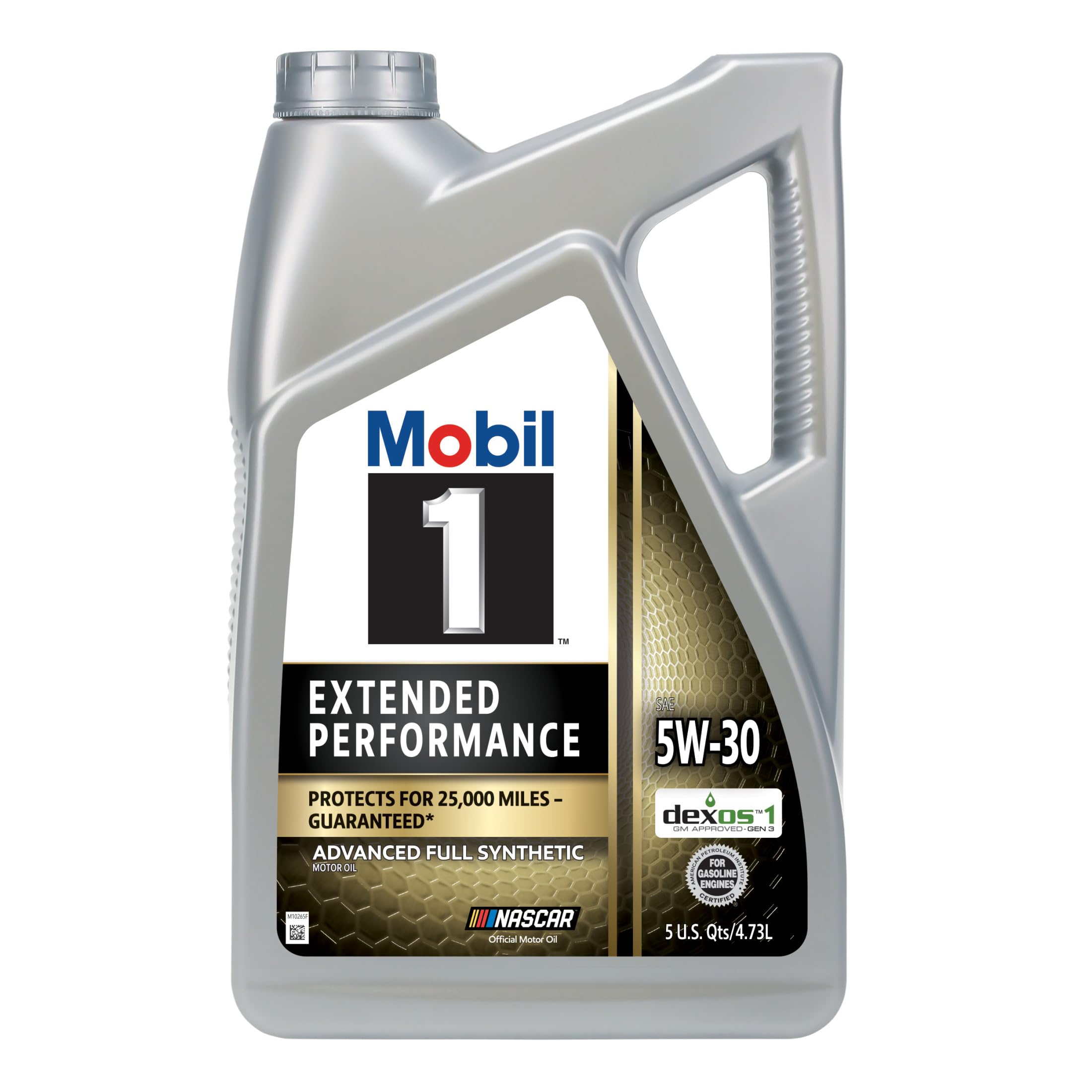
The 5W-30 version of the top pick, tuned for colder starts and year-round driving.
Where the 10W-30 above is for warmer climates and older engines, this 5W-30 pours more freely on a cold morning, so the oil pump moves it to the valvetrain faster on the first start of a freezing day. It carries the same Extended Performance line, with a 20,000-mile protection claim and extreme temperature control in the formulation. You still get 160 fluid ounces, the standard 5-quart fill.
Owners running it in daily drivers report the engine staying smooth and protected across years of 20,000-mile intervals. It’s rated universal fit across cars, and the triple-action formula is aimed at cleaning, protecting, and controlling heat in one interval. If you want the Mobil 1 approach but live somewhere the mercury drops hard, this is the grade to pick.
One practical note: at 10.1 pounds per jug, it’s heavier than the Castrol EDGE 5W-30 above at 3.7 pounds, so lifting it overhead into a truck fill tube takes a little more arm. And the same caveat applies — the 20,000-mile claim is the maker’s recommendation, and short cold trips still call for a shorter interval by your manual.
What it gets right: a full synthetic that flows in the cold and holds its film in the heat, with a five-quart jug ready for a standard drain.
Keep in mind: confirm your manual specs 5W-30, and don’t stretch the interval if your driving is mostly short trips.
Best for you if: you want the top-performing Mobil 1 formula but need cold-start flow for winter driving.
Pass if: your engine specifies 0W-20 or a 10W grade — match the manual, not the brand.
5. Castrol EDGE Extended Performance 0W-20 Advanced Full Syn Motor Oil 5 Qt

A thin, fast-flowing 0W-20 for the tight-clearance turbos and hybrids rolling off modern lines.
Newer engines run thinner oil on purpose, and a 0W-20 is the grade many turbocharged four-cylinders and hybrids are built around. This Castrol formula is rated for 25,000 miles between changes, or one year, whichever comes first — the longest interval claim in this roundup — and the company claims 50X better high-temperature performance measured against API SQ limits in a sequence test.
It also carries a long list of approvals that matter for modern drivetrains: API SQ, ILSAC GF-7, ACEA C5, GM dexos1 Gen 3, MB-Approval 229.71, and Ford WSS-M2C947-B1. It’s listed as compatible with gasoline and light-duty diesel, hybrids, and trucks. Repeated reviews praise its consistency — no oil-burn surprises and no viscosity breakdown between 25,000-mile changes.
The catch is simple: a 0W-20 is too thin for older engines designed around 5W-30 or 10W-30, and pouring it into one can accelerate wear rather than prevent it. Match the grade to your manual before anything else. It’s also a premium-tier jug — you’re paying for interval length and modern approvals you should only choose if your engine actually needs them.
Built for: late-model turbo and hybrid owners whose manual clearly calls for 0W-20 and who want the longest interval available.
Not for: high-mileage engines or older cars spec’d on a thicker grade — this goes the wrong direction for them.
6. Royal Purple 11750 HMX SAE 10W-30 High-Mileage Synthetic Motor Oil – 5 qt

The specialist’s jug for a tired engine that’s lost compression and started drinking oil.
Royal Purple builds HMX around engines with more than 75,000 miles, and the formula leans on zinc and phosphorus anti-wear compounds paired with the company’s own additive technology. The aim is to reduce friction and metal-to-metal contact, and to chemically revitalize hardened seals so the engine burns less oil. It also carries oxidation resistance to support longer drain intervals, plus an ionic attraction to metal that keeps a protective layer on surfaces between starts.
Customers note the engine running quieter and smoother on the zinc/phosphorus HMX formula, with some noting better fuel mileage. It’s rated vehicle-specific fit, which is Royal Purple’s way of saying you must confirm the grade against your own manual. At 160 fluid ounces it’s a standard five-quart fill.
Consider the cost honestly: this sits in the premium tier, and the seal-revitalizing chemistry is aimed at tired engines. If your car is newer and tight, you’re paying a premium for a high-mileage formula you don’t need. It’s also a 10W-30, so the cold-flow point from the top pick applies here too — expect it to move a bit slower to the top end on a freezing morning.
The reason to buy: a high-mileage engine that runs rough and burns oil can gain smoothness and a steadier level, thanks to the zinc/phosphorus anti-wear package.
The real catch: it’s premium-tier and aimed at older engines, so a healthy low-mileage car gets little from the extra chemistry.
Choose it for: a worn engine you’re trying to restore smoothness and control oil burn on, not replace.
Leave it if: your car is low-mileage or spec’d for 5W-30 or 0W-20 — the high-mileage chemistry isn’t what you need.
7. K&N Motor Oil: 5W-30 Synthetic Engine Oil, 5 qt, 104102

A full synthetic tuned for temperature swing — the same jug in January and in July.
K&N’s pitch here is all-weather behavior, and the formulation backs it with an additive package the company calls SynthAMAX. The idea is to hold engine protection whether the morning is freezing or the highway is baking, so you don’t switch grades with the seasons. The 5W-30 grade is a common middle ground that works in both cold-start and hot-running conditions, and the jug holds 4.73 liters, roughly a five-quart fill.
Owners mostly cite how the engine runs — smoother cold starts and steady behavior across temperature swings — as the reason they re-buy. The advanced synthetic base is blended to cut sludge and contaminants, keeping critical components protected between changes. If you drive the same car year-round through real seasons, that’s the combination you want.
Worth flagging: this is a premium-tier jug, so you’re paying for a brand with a long history in performance filtration rather than the longest interval claims. The warranty description also runs just 3 months, which is shorter than the extended-interval oils above — read the back label rather than depending on warranty length as a proxy for protection.
Why it earns a spot
- All-weather formulation for year-round 5W-30 use
- SynthAMAX additive package fights sludge and contaminants
- Full synthetic protection in hot and cold conditions
- 5-quart capacity (4.73 liters) for a standard fill
The trade-offs
- Premium-tier cost without the longest interval claims
- 3-month warranty description is shorter than rivals
- Still requires confirming 5W-30 is the grade your manual calls for
Suits you if: you want one full synthetic that behaves the same through a real four-season climate.
Better elsewhere if: you’re chasing the longest possible drain interval — the extended-interval Castrols go further.
8. Quaker State Full Synthetic 5W-20 Motor Oil, 5-Quart
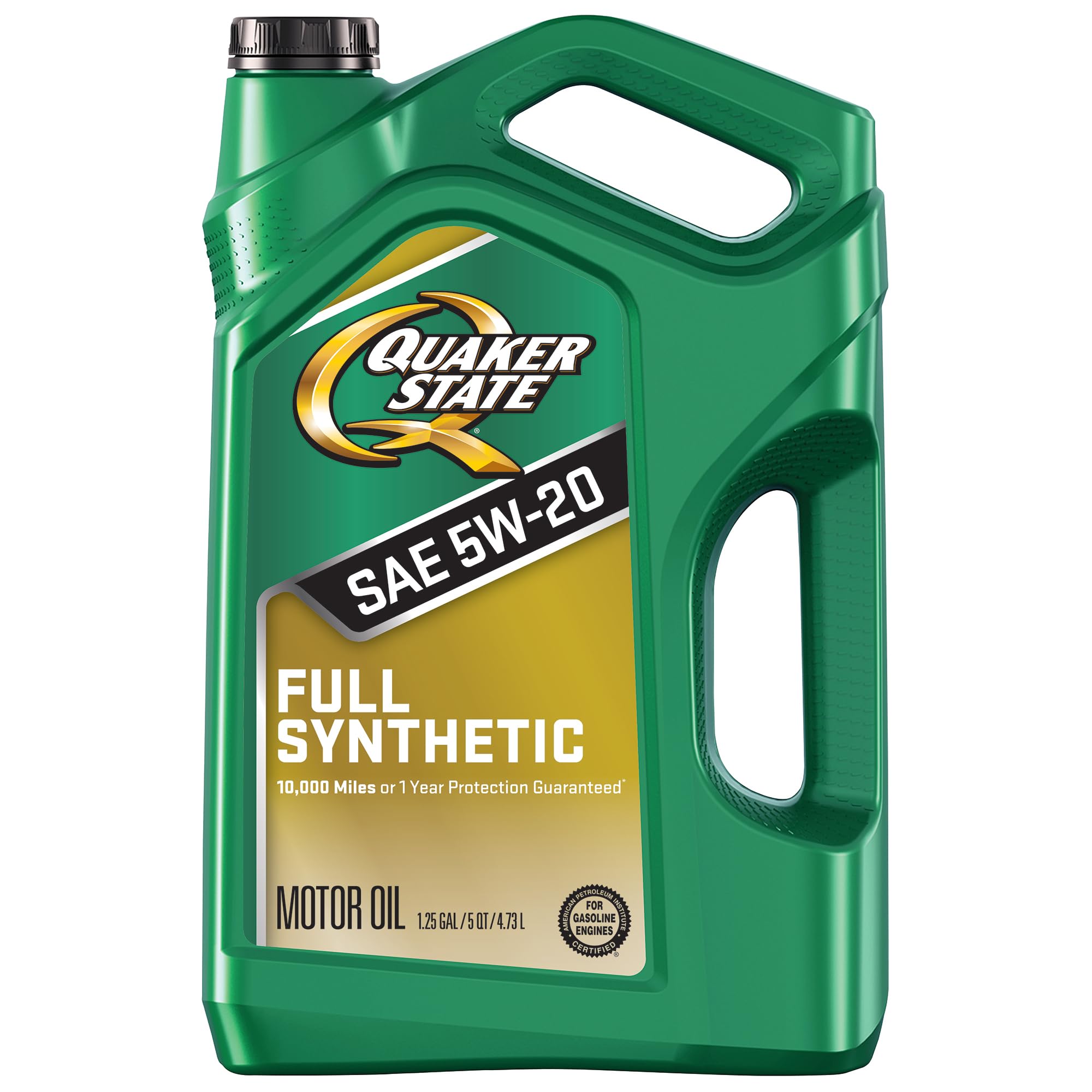
A budget-friendly full synthetic for modern turbo engines — the value play in a 5W-20.
If your manual calls for 5W-20 and you want a full synthetic without premium-tier cost, this is the one to shortlist. It’s built for modern turbocharged engines and high-performance vehicles including sports cars, SUVs, trucks, and minivans, and it’s designed to reduce friction and free up horsepower compared to Quaker State’s conventional motor oil. You get 160 fluid ounces, the standard five-quart jug.
Buyers cite the price against its dexos1 Gen 3 and API SP approvals — full synthetic protection for turbo engines at a budget-tier cost. It’s approved to API SP-Resource Conserving and ILSAC GF-6A, and it meets OEM specs including Chrysler MS-6395, GM dexos1 Gen 3, and Ford WSS-M2C960-A1. There’s also a warranty of up to 10 years or 300,000 miles when you exclusively use Quaker State oil.
The honest limit: the 5W-20 grade only fits engines designed for it, so this is not a universal jug — check your manual’s grade first. And while it resists oxidation to keep the oil fresher longer, it’s aimed at buyers who want solid protection at a friendlier price rather than the longest interval on the shelf.
The value case: a full synthetic meeting dexos1 Gen 3 for turbo engines, at a budget-friendly price that doesn’t skimp on approvals.
The honest limit: it’s a 5W-20 only — great if that’s your grade, wrong for anyone spec’d on 5W-30 or 0W-20.
Pick it when: your turbo four or modern engine calls for 5W-20 and you want full synthetic protection on a budget.
Skip it when: your manual specifies any other grade — the approvals are excellent but only for the right engine.
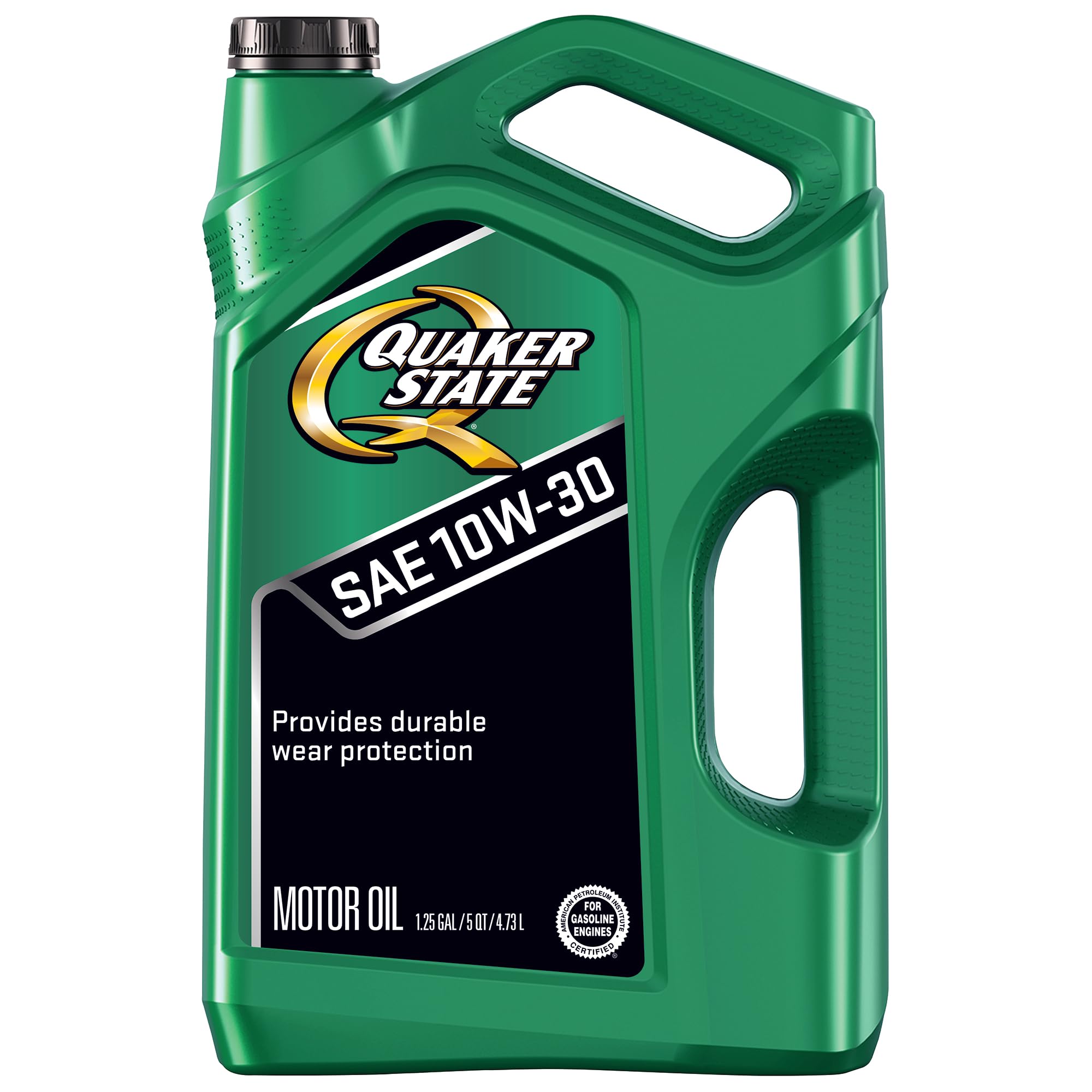
9. Quaker State Motor Oil, 10W-30, 5 Quart
The no-frills conventional jug for older cars, mowers, and simple maintenance.
Not every engine needs a full synthetic, and this is the budget-friendly option for the ones that don’t. It’s a 10W-30 conventional oil rated to SN/GF-5, built to protect against wear on daily commutes that swing from highway speed to stop-and-go. The formulation also fights corrosion from acids and holds its viscosity from start to finish, keeping an oil film on the metal between changes.
Owners use it in older cars and lawn mowers alike and rate it a solid value for a conventional 10W-30 at short change intervals. It combats sludge and deposits too, so a basic engine stays cleaner than it would on a cut-rate oil. At 160 fluid ounces, it’s a standard five-quart fill.
The trade-off is clear: a conventional oil won’t hold up to heat and long intervals the way a full synthetic does, so it’s best for shorter change intervals and simpler engines. It’s also a 10W-30, so it’s the wrong grade for modern engines spec’d on a thinner oil. Reach for it when simple, honest protection on a budget is exactly what you need.
What it does well
- Budget-friendly conventional oil for older cars and mowers
- Fights corrosion from engine acids and holds viscosity
- Combats sludge and deposits in simple engines
- Standard five-quart jug (160 fluid ounces)
Where it’s limited
- Conventional base won’t hold up to long intervals like a full synthetic
- 10W-30 is the wrong grade for modern thin-oil engines
- Not turbo or high-performance oriented
Made for: the older car, the lawn tractor, the simple engine that just needs clean, affordable protection at short intervals.
Not the one for: a modern turbocharged engine or anyone stretching changes — go full synthetic there.
Understanding the Specs
Viscosity grade (the 5W-30 number)
The first number before the W tells you how the oil flows when cold — a 0W pours more freely on a freezing morning than a 10W, moving faster to the top of the engine. The number after the W is the oil’s thickness at running temperature. Match the grade to what your owner’s manual specifies; a thicker or thinner oil than the engine was built for changes how it protects. A 5W-30 is a common middle ground, while 5W-20 and 0W-20 are thinner grades for modern engines, and 10W-30 is thicker for older ones.
Synthetic versus blend versus conventional
A conventional oil is refined from crude base stock and suits simple engines on shorter change intervals. A synthetic blend mixes in synthetic base oil to improve heat resistance while keeping the jug budget-friendly. A full synthetic is built from man-made base stock, holds its film under higher heat, and usually supports longer drain intervals. If you do a lot of towing, turbo driving, or long highway stretches, the full synthetic earns its keep; for a basic commuter changed often, a blend or conventional is plenty.
API and OEM approvals
The API and ILSAC lines on the back label tell you which industry standards the oil actually meets. Many modern turbocharged and direct-injection engines call for a specific OEM approval such as dexos1, and running an oil without it can affect coverage. Always cross-check the printed approvals on the jug against your owner’s manual — the grade and the approval both have to line up.
High-mileage formulas
Oils labeled for high mileage are typically aimed at engines past 75,000 miles, and they often include seal conditioners meant to soften hardened gaskets and reduce oil burn. They can genuinely quiet a tired engine and steady the oil level, but they are maintenance for worn seals, not a repair for a physical leak. If your engine is newer and tight, a standard full synthetic is the better match.
FAQ
Can I switch from conventional oil to full synthetic in an older engine?
What does the 5W in 5W-30 actually mean for my engine?
How often should I change full synthetic oil?
Is a synthetic blend good enough or do I need full synthetic?
What does the API SQ or dexos1 approval on the label mean?
Will high-mileage oil really stop my engine from leaking?
Can I use 10W-30 oil in a car that recommends 0W-20 or 5W-20?
Does the weight of the jug matter if the volume is the same?
Is 5W-30 better than 10W-30 for winter driving?
What happens if I mix two different brands of oil?
Final Thoughts: The Verdict
The winner for most drivers is the Mobil 1 Extended Performance 10W-30, because it pairs a full synthetic base that holds its film through long intervals with a spotless consistency record across a huge pool of owners. If your engine runs on thinner oil, reach for the Mobil 1 Extended Performance 5W-30 for the same protection with better cold-start flow. And if you’re nursing an engine past 75,000 miles with a little oil burn, the Valvoline MaxLife High Mileage 5W-30 is the one built for that job — the seals get the attention they need and the price stays friendly. Match your grade to the manual first, choose the type by how hard you drive, and any of these nine will serve you well.
How We Picked
We do not accept paid placement. Every pick is matched to a real buyer and a real use-case; we do not hands-on test units.
Sources & Methodology
Specifications: manufacturer listings and product documentation. Review insights: verified customer reviews, as of November 2026. Pricing: not shown on this page (it changes often); check the current price via the retailer link.
As an Amazon Associate, Gadgets Feed earns from qualifying purchases. This does not affect which products we feature.