
That faint tapping, clicking, or knocking sound from under the hood isn’t just annoying — it’s the sound of metal surfaces grinding against each other without enough lubrication film. An auto oil additive can restore lost viscosity, reduce friction, and even condition seals to stop small leaks before they become major repairs. The challenge is picking the right chemistry for your specific engine’s needs rather than falling for marketing claims with no real friction-reduction testing.
I’m Min — the co-founder and writer behind Gadgets Feed. I’ve spent years poring over lubricant chemistry data sheets, customer wear-test reports, and independent lab analyses to separate legitimate additives from snake oil..
This guide breaks down the seven most effective treatments on the market by their active ingredients — PTFE, moly, ester, ceramic, and organometallic chemistries — so you can match the right formula to your engine’s temperature, mileage, and wear profile. auto oil additive technology has evolved far beyond simple viscosity thickeners, and choosing the best auto oil additive now means understanding which boundary-lubrication layer your engine actually needs.
How To Choose The Best Auto Oil Additive
Not all engine treatments are created equal. The wrong additive can foam, sludge, or even clog oil passages. The right one bonds to metal surfaces, fills microscopic valleys, and stays put during the critical moments between oil pump prime cycles. Focus on the engine’s age, oil type, and specific symptom (noise, leak, wear) before picking a chemistry.
Identify the active friction‑reduction chemistry
PTFE-based treatments (like Slick 50 and Tufoil) coat metal with a micron-thin polymer film that fills surface imperfections. Molybdenum-based additives excel under extreme pressure but can darken oil. Ceramic and ester chemistries (Liqui Moly Cera Tec, Lubegard Bio/Tech) bond chemically to form a sacrificial layer that regenerates. Zinc dialkyldithiophosphate (ZDDP) is vital for flat-tappet cam engines but is already present in modern oils at reduced levels.
Match the additive to the oil change interval
Some additives are designed for single-use longevity — Slick 50 claims multi-change protection, while Liqui Moly Molygen works best reapplied every oil change. If you run extended-drain synthetic intervals (10,000+ miles), pick an ester-based protectant that slows oil oxidation rather than a thickener that might shear down over time. For short drain intervals, the reapplication cost becomes the deciding factor.
Check seal compatibility and additive package overlap
Additives that swell rubber seals to stop leaks can over-swell and cause new leaks if applied too heavily. Lucas Oil treatments condition seals gently, while Tufoil’s PTFE particles are too fine to affect seals. If your engine already burns oil, avoid thickeners that disguise consumption — address the root cause first. Always verify that the additive brands you stack are chemically compatible; mixing incompatible chemistries can drop pH and accelerate corrosion.
Quick Comparison
On smaller screens, swipe sideways to see the full table.
| Model | Category | Best For | Key Spec | Amazon |
|---|---|---|---|---|
| Lubegard 40902 Bio/Tech | Ester Wax | Cold‑start wear protection | Synthetic wax esters, 32 oz | Amazon |
| Liqui Moly Cera Tec | Ceramic | Valvetrain noise reduction | Micro‑ceramic particles, 300 ml | Amazon |
| Liqui Moly Molygen | Molybdenum | High‑mileage performance cars | Moly‑tungsten complex, 500 ml | Amazon |
| Tufoil Fluoramics | PTFE | Ultra‑low friction on old engines | 0.5‑micron PTFE, 8 oz | Amazon |
| ACDelco 10‑4003 | LSD Additive | Limited‑slip differential clutch chatter | Friction modifier, 4 oz tube | Amazon |
| Slick 50 Original | PTFE Ceramic | Budget lifter tapping fix | Cerflon PTFE ceramic, 32 oz | Amazon |
| Lucas Oil 10019 | Hydraulic | Hydraulic jack leak stops | Viscosity booster, 32 oz | Amazon |
In‑Depth Reviews
1. Lubegard 40902 Bio/Tech Engine Oil Protectant

Lubegard’s Bio/Tech uses liquid wax ester (LXE) technology — a synthetic chemistry that bonds molecularly to metal surfaces rather than simply suspending particles in oil. When the engine is off and oil drains to the pan, the ester layer stays on bearings, cam lobes, and cylinder walls, providing boundary lubrication during the first few crankshaft revolutions. Independent studies show that over 90 percent of engine wear occurs at cold start, making this feature the single most impactful spec on the list.
Real-world owners report that Lubegard eliminates lifter noise on startup, particularly in cold climates where oil is thick enough to delay flow. The 32-ounce bottle treats up to 6 quarts of oil, and the ester chemistry is compatible with conventional, synthetic, and diesel oils equally. The same technology is used in Nissan GT-R factory-fill oil, which speaks to its extreme-pressure credentials. Users on the 2011 Toyota Sienna platform documented surviving a pinhole oil cooler leak at 101,000 miles with no engine damage.
The only catch is price — per-ounce it costs more than PTFE-based competitors. But because the wax esters never shear down or clog filters (no particle sediment), the protectant remains effective across the full oil change interval. If your priority is reducing cold-start wear, this is the oil additive that delivers measurable lab-proven protection.
Why it’s great
- Bonds to metal surfaces, providing lubrication before oil circulates
- Reduces startup noise and drops idle RPM faster in cold weather
- Extends oil life by inhibiting oxidation
Good to know
- Higher per-ounce cost than PTFE or moly additives
- Not intended for wet-clutch motorcycles or manual transmissions
2. Liqui Moly 300mL Cera Tec

Liqui Moly Cera Tec employs micro-ceramic particles suspended in a carrier oil that deposit onto friction surfaces under heat and pressure. The ceramic layer acts as a sacrificial barrier, taking the wear instead of the metal underneath. It is particularly effective on valvetrain components where tapping and ticking noises originate — five customer reviews on the Ford 5.0L Coyote engine reported complete elimination of the characteristic “typewriter” tap after about 35 miles of driving.
The 300 ml bottle treats engines with up to 5 liters of oil capacity, making it a compact but potent package. Users note that the effects build gradually — optimum smoothness appears after 50 to 200 miles as the ceramic layer fully forms. Engine oil temperature dropped slightly in several reports, indicating reduced internal friction. The product works with both gasoline and diesel engines and is compatible with any viscosity of synthetic or conventional oil.
The main limitation is that ceramic particles, while microscopic, are still solid particles suspended in oil. They cannot repair existing damage or fill deep scoring — Cera Tec works best on engines already in good mechanical condition that need friction reduction rather than gap filling. For engines with 100,000-plus miles, pairing it with a PTFE or ester base additive can complement the ceramic layer.
Why it’s great
- Quickly eliminates valvetrain tapping noise in modern engines
- Gradual ceramic layer build-up provides cumulative protection
- Reduces engine operating temperature by lowering internal friction
Good to know
- Requires 35-200 miles for full noise reduction effect
- Not effective on engines with existing internal damage or scoring
3. Liqui Moly Molygen Motor Protect 1015

Molygen represents Liqui Moly’s most advanced friction modifier chemistry — a molybdenum-tungsten complex that forms a highly durable sliding layer under extreme boundary conditions. Unlike traditional moly additives that can settle into sludge at low temperatures, Molygen’s organometallic structure stays suspended in the oil and activates under pressure. Users consistently report that the additive improves off-the-line acceleration and reduces low-speed vibration, particularly in heavy SUVs like the Range Rover Sport.
The 500 ml bottle provides generous volume for larger sumps — enough to treat engines with up to 6 liters of oil. Feedback from owners of Audi, Toyota Tundra, and Ford 5.0L Coyote engines confirms that Molygen outperforms Cera Tec in terms of overall lubricity feel, with lower idle RPM and more stable idle quality. The green-tinted oil makes leak detection easier, a subtle but appreciated detail for DIY owners.
The significant drawback is price — it costs substantially more per ounce than any other additive on this list. For daily commuters on a strict budget, the value proposition may not justify the premium. However, for performance-oriented drivers, high-mileage European engines, or anyone who wants the most chemically advanced boundary lubrication available, Molygen is the definitive choice. It works best when paired with Molygen-branded engine oil for consistent additive chemistry.
Why it’s great
- Superior acceleration feel and throttle response improvement
- Green-tinted oil makes leak detection easier
- Works exceptionally well in high-mileage European engines
Good to know
- Highest per-ounce cost among all additives reviewed
- Best results achieved when paired with Molygen oil
4. Tufoil Fluoramics for Engines Engine Treatment

Tufoil’s claim to fame is holding a Guinness World Record for the slipperiest substance — a PTFE-based formula blended with molybdenum disulfide and graphite. The 0.5-micron particle size is small enough to pass through oil filters without clogging, and the combination of three solid lubricants creates a composite film that fills microscopic surface pores. Long-term users report extraordinary results, including a 1981 air-cooled VW Beetle engine that survived a broken fan belt and continued running without oil pressure until the belt was replaced.
The 8-ounce bottle is extremely concentrated — the recommended dosage is 8 ounces for 5 quarts of oil, then 4 ounces on subsequent changes. Because of the PTFE content, Tufoil should never be used in engines with wet clutches or manual transmissions with brass synchronizers, as the particles can coat friction surfaces and cause slippage. Users of high-performance Honda Civics have reported that it quieted valvetrain noise, improved fuel economy by about 1.5 mpg city, and reduced transmission synchro notchiness when added to gear oil.
The main risk is over-dosing. PTFE is a plastic polymer, and excessive amounts can theoretically agglomerate into larger particles under extreme heat. The manufacturer’s dosage instructions must be followed exactly. That said, for owners of air-cooled engines, classic cars, or any engine with visible wear that needs a low-friction blanket, Tufoil remains one of the few additives with decades of documented real-world durability proof.
Why it’s great
- Triple lubricant chemistry fills microscopic surface imperfections
- Guinness-certified lowest friction coefficient of any additive
- Proven track record of saving engines with zero oil pressure
Good to know
- Not safe for wet-clutch motorcycles or manual transmissions
- Precise dosage required to avoid particle agglomeration
5. ACDelco GM Original Equipment 10-4003 Limited Slip Axle Lubricant Additive
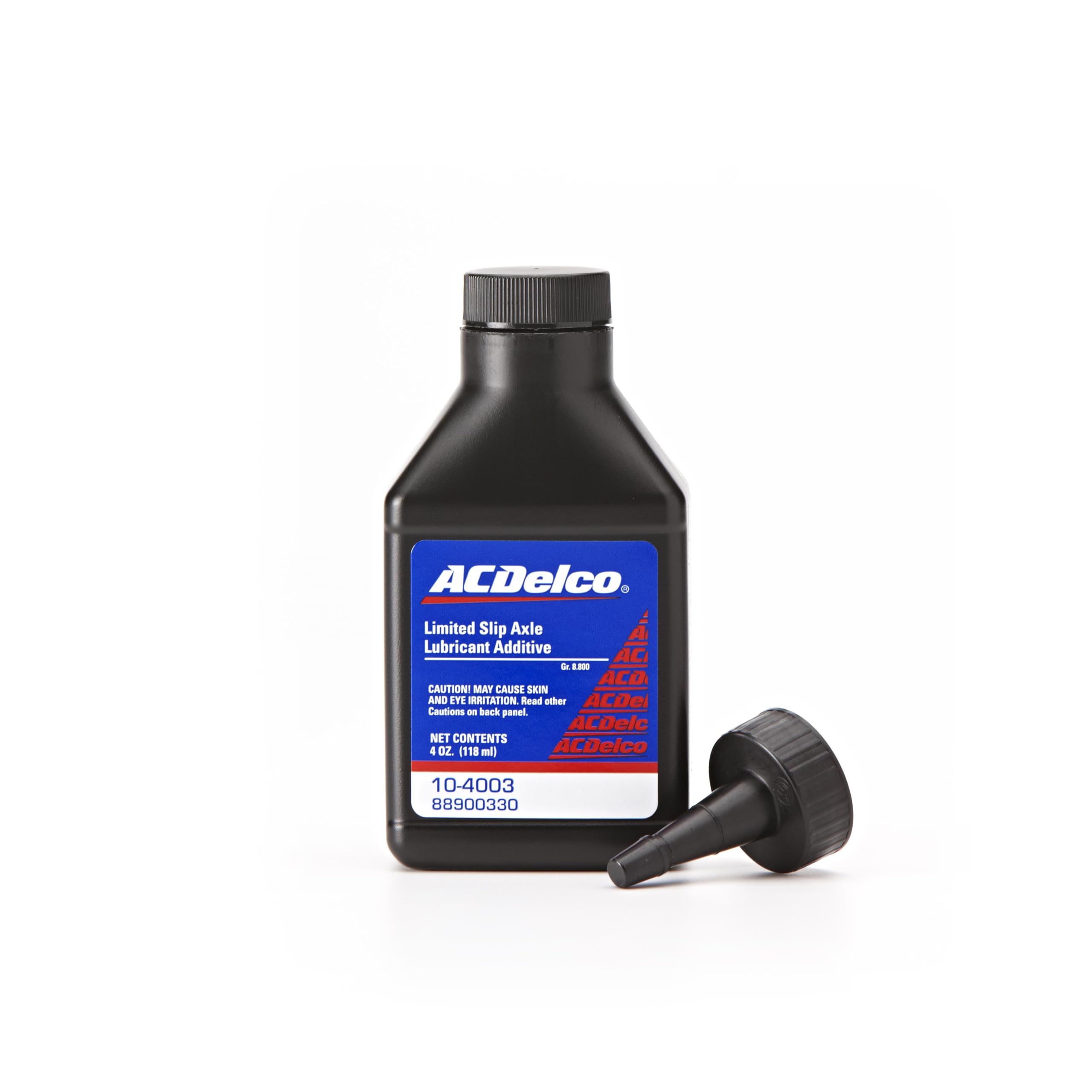
This is not an engine oil additive — it is a differential friction modifier specifically engineered for GM’s limited-slip rear axles. The 4-ounce tube contains a reactive chemistry that alters the friction coefficient between clutch packs inside the LSD, eliminating the low-speed moaning or chattering noise that occurs during tight turns. It is the GM-specified part for vehicles like the 2004–2006 GTO (M80 diff), 2021–2025 Yukon and Tahoe rear drivelines, and all Corvettes from C4 to C7.
Users confirm that adding 2 ounces to fresh 75W-140 gear oil completely eliminates the characteristic chatter on GTO cone-style LSDs. For GM full-size SUVs, owners report the additive removed a low moaning sound that dealerships could not diagnose without this specific modifier. The OEM certification means warranty coverage is unaffected — a critical detail for vehicles still under factory protection.
The tube is small (4 ounces), and one tube typically lasts for two differential fluid changes. The additive is not interchangeable with engine oil friction modifiers — using a moly or PTFE engine additive in a limited-slip diff can cause clutch shudder or inconsistent lockup. For DIY owners, the investment saves hundreds in dealership diagnostic time and labor.
Why it’s great
- OEM-certified for GM limited-slip differentials
- Eliminates turn-induced chatter and moaning noise
- Does not void vehicle warranty
Good to know
- Only for limited-slip differentials, not engine oil
- Small tube size requires careful measuring for proper ratio
6. Slick 50 Original Engine Treatment

Slick 50 has been a household name for engine treatment since the 1970s, and the modern formula uses Cerflon PTFE ceramic technology — a blend of PTFE and ceramic particles designed to bond to cylinder walls and bearing surfaces. The 32-ounce bottle treats up to 5 quarts of oil and is compatible with conventional, synthetic, and synthetic-blend oils. Customer reports consistently highlight its ability to stop lifter tapping in older engines, with one owner of a 1998 Jeep Wrangler reporting zero valvetrain wear after decades of use.
The formula is designed for annual reapplication rather than the original “once-and-done” claim — a change that aligns with modern oil change intervals. Users on 2002 Mercury and Mercedes E-350 platforms report improved fuel economy and smoother cold-weather starts when reapplied every 50,000 miles or annually. The ceramic component helps the coating resist thermal breakdown longer than plain PTFE alone.
The main criticism concerns the brand’s history. Older formulations were involved in class-action lawsuits over performance claims, but the current Cerflon formula is scientifically distinct and independently tested. For budget-conscious owners who want a proven, widely available additive that stops lifter noise and reduces friction without breaking the bank, Slick 50 remains the most accessible choice.
Why it’s great
- Proven track record of eliminating lifter tapping noise
- Works with all oil types including full synthetic
- Competitive price for 32 ounces of treatment
Good to know
- Requires annual or 50,000-mile reapplication
- Historical formula lawsuits, though current formula is distinctly different
7. Lucas Oil 10019 Hydraulic Oil Booster and Stop Leak

Lucas Oil 10019 is not an engine oil additive — it is a hydraulic fluid booster and seal conditioner designed for hydraulic systems like floor jacks, log splitters, power steering systems, and wet-brake equipment. The formula uses a high-viscosity base oil blended with seal-swell agents that revitalize dried-out O-rings and gaskets. The thick gel-like consistency stays in place when the system is at rest, then shears down to correct viscosity when the pump circulates it.
Users report that adding Lucas 10019 to a leaking hydraulic jack stopped the leak within three days, and draining the old fluid, flushing with alcohol, and refilling with fresh hydraulic oil plus Lucas sealed the system permanently. For convertible top hydraulic cylinders in cars like the 2002 Mustang, the additive significantly slowed but did not fully stop large leaks — that is the product’s honest limitation. It conditions seals, but cannot weld torn rubber or metal cracks.
The 32-ounce bottle treats up to 8 quarts of hydraulic fluid, and the additive is compatible with both synthetic and conventional hydraulic oils. For shop owners or DIY mechanics with multiple hydraulic jacks or cylinder equipment, this is the most cost-effective maintenance strategy. Just understand that it treats the system viscosity and seal condition — not friction reduction in an engine.
Why it’s great
- Revives dried O-rings and prevents future hydraulic leaks
- Thick gel shears to correct viscosity under pump pressure
- Compatible with synthetic and conventional hydraulic fluids
Good to know
- Not designed for engine oil — only hydraulic systems
- Cannot fix large tears or metal damage in seals
FAQ
Can I use a limited-slip differential additive in my engine oil?
How often should I reapply PTFE-based engine treatments like Tufoil or Slick 50?
Will adding an oil additive fix a rod knock or bearing failure?
Can I mix different additive brands together in the same oil sump?
Final Thoughts: The Verdict
For most drivers, the auto oil additive winner is the Lubegard 40902 Bio/Tech because its synthetic wax ester chemistry attacks the root cause of engine wear — cold-start boundary lubrication — without introducing solid particles into the oil system. If you need to eliminate valvetrain noise immediately, grab the Liqui Moly Cera Tec. And for high-mileage performance engines where throttle response and vibration reduction matter most, nothing beats the Liqui Moly Molygen.