
An amateur paint job on a treasured project car is a heartbreak almost every DIY restorer knows too well — dust nibs buried in the clear coat, a runnel forming at the edge of a panel, or the dreaded orange-peel texture that mocks hours of prep work. The single biggest variable between a “good enough” finish and a professional-grade gloss is the paint application system you choose, and hunting down the right gear can feel like deciphering a chemical engineering manual.
I’m Min — the co-founder and writer behind Gadgets Feed. I sort through thousands of customer reports and technical data sheets to identify which paint delivery systems actually deliver consistent atomization and durable film builds for the home garage specialist.
After combing through mix ratios, tip sizes, and real-world user results, this guide will help you find the right best auto paint kit for your restoration budget and skill level.
How To Choose The Best Auto Paint Kit
Selecting the right kit is a balance of paint chemistry, application hardware, and your specific project (full respray vs. a single panel vs. custom graphics). The wrong choice leads to adhesion failure, runs, or a finish that clouds after a season.
Paint Type: Single-Stage vs. Basecoat/Clearcoat
A single-stage kit (like acrylic enamel) combines color and gloss in one layer — quicker to spray but harder to buff out imperfections. A basecoat/clearcoat system (typically urethane) requires two distinct product types: a color layer that dries flat and a clear top layer that provides depth and UV protection. The latter is more forgiving of beginner mistakes because you can wet-sand and polish the clear without disturbing the color underneath.
Delivery System: HVLP Spray Gun vs. Airbrush
For a full body panel or entire vehicle, an HVLP (High Volume, Low Pressure) gravity-feed gun is the standard — it transfers roughly 65% or more of the paint onto the surface rather than into the air, saving material and reducing overspray. For touch-ups, custom graphics, or small parts like mirrors and emblems, an airbrush with a 0.24 oz cup offers fine-line control but cannot lay down enough volume for large areas. Many buyers start with a complete HVLP kit and later add a dedicated airbrush for detail work.
Tip Size Matters More Than You Think
Tip diameter controls how much paint hits the panel per second. A 1.3mm nozzle is ideal for thin basecoats and metallic urethanes — too much material with a larger tip on a low-viscosity paint will cause runs instantly. A 1.8mm or larger nozzle is for thick coatings like high-build 2K primers. Kits that include multiple tip sets (1.3mm, 1.4mm, and 1.8mm) allow the same gun body to handle primers, color, and clear without buying separate guns.
Quick Comparison
On smaller screens, swipe sideways to see the full table.
| Model | Category | Best For | Key Spec | Amazon |
|---|---|---|---|---|
| Master PRO-88 | Spray Gun Kit | Versatile DIY respray | Three tip sets: 1.3, 1.4, 1.8mm | Amazon |
| Restoration Shop Black | Paint Kit | Complete single-stage paint | 8:1 mix ratio, 2.8 VOC, 12 sq ft/qt | Amazon |
| LiME LiNE Clearcoat | Clearcoat Kit | Budget-conscious clear topcoat | 1.25 gallon, 4:1 mix, 12-hr cure | Amazon |
| DeVilbiss 802342 | Spray Gun Kit | Entry-level HVLP set | 1.0, 1.3, 1.8mm tip set | Amazon |
| DeVilbiss 802343 | Complete HVLP Kit | Full primer/paint/clear set | Gravity feed, multi-gun set | Amazon |
| Iwata Eclipse HP-CS | Airbrush | Detail work & touch-ups | 0.35mm nozzle, 0.24 oz cup | Amazon |
| 3M Performance 26778 | Professional HVLP Kit | Pro-level speed & cleanup | 15 quick-change nozzles (1.2-1.4mm) | Amazon |
In‑Depth Reviews
1. Master Elite Performance PRO-88 Ultimate Kit

The PRO-88 is the sweet-spot HVLP system for the DIY restorer who needs a single gun body to handle everything from a high-build 2K primer (using the 1.8mm tip set) to a metallic single-stage topcoat (using the 1.3mm or 1.4mm tip set). The three complete atomizing sets — each with a matched needle, nozzle, and air cap — eliminate the guesswork of swapping parts. Users report that the 1.3mm tip lays down basecoat with zero spitting and the trigger modulation feels linear within the typical 25-35 PSI range for a hobby compressor.
The included high-flow air pressure regulator with gauge and the MPS adapter for disposable cup liners are thoughtful touches that save you another in separate purchases. The 1-liter aluminum cup is plenty for single-panel work, and the stainless-steel fluid path resists corrosion from waterborne paints better than nickel-plated brass alternatives. Multiple reviewers who stepped up from budget “Black Widow” guns noted an immediate improvement in atomization consistency, especially with pearl and metallic particles that tend to clump in poorly designed nozzles.
One informed caution: the main paint channel uses galvanized steel rather than a fully stainless interior, meaning this gun is not ideal for long-term storage with waterborne paints unless meticulously dried after every use. For solvent-based urethanes and acrylics — which dominate the home-garage market — this is a non-issue, and the PRO-88 delivers a finish quality that rivals guns costing twice as much.
Why it’s great
- Three complete tip sets (1.3, 1.4, 1.8mm) cover primer, color, and clear with one gun
- Included pressure regulator and MPS adapter save significant separate cost
- Excellent atomization with metallics and pearls for a mid-range HVLP
Good to know
- Internal paint channel is galvanized steel — requires thorough drying after waterborne use
- Heavier than composite alternatives; noticeable during extended overhead spraying
2. 3M Performance Spray Gun Starter Kit 26778

The 3M 26778 redefines the workflow for an automotive painter by eliminating the single most tedious task: gun disassembly for cleaning. Instead of pulling the needle and nozzle after every color change, you simply snap off the quick-change atomizing head (available in 1.2mm, 1.3mm, and 1.4mm — five of each are included) and attach a fresh one. The PPS 2.0 spray cup system uses disposable liner cups with pre-attached lids, meaning you mix paint in the liner, snap it to the gun, and throw the liner away when done. Cleanup drops from 20 minutes to under 2.
The air control valve is built into the base of the handle, giving you quick thumb access to fine-tune fan width without reaching for a separate regulator on the hose. Transfer efficiency is excellent; users report noticeably less material consumption compared to entry-level metal guns, which offsets the higher upfront cost over a few projects.
The trade-off is that the 1.4mm nozzle is the largest included cap, so heavy-build 2K primers or gel coats that require a 1.8mm or 2.0mm tip are outside this kit’s sweet spot. For pure automotive topcoat work — solid colors, pearls, metallics, and clearcoats — the 26778 delivers a finish that competes with + SATA guns. The disposable cup system also has a small per-job cost, typically to per liner lid, which accumulates over many small touch-ups.
Why it’s great
- Revolutionary quick-change nozzle system cuts color-change downtime to seconds
- PPS 2.0 disposable cups eliminate traditional gun cleaning entirely
- Ultra-lightweight composite body reduces fatigue during long spraying sessions
Good to know
- No nozzle above 1.4mm included — not suitable for heavy primers or gel coats
- Recurring cost for disposable PPS liners and lids adds up over high-volume work
3. Restoration Shop Jet Black Acrylic Enamel Complete Quart Paint Kit

Restoration Shop’s AE acrylic enamel is a single-stage system — meaning the color and gloss are delivered in one application, eliminating the need for a separate clearcoat layering step. The 8:1 mix ratio (8 parts paint to 1 part AE3001 hardener) yields roughly 1.2 quarts of sprayable material, and the 2.8 VOC formulation complies with most state air quality regulations without requiring a reducer for thinning. Experienced DIY users confirm that this paint lays down like a factory finish when applied through a quality HVLP gun with a 1.4mm tip and steady 25 PSI at the gun inlet.
The formula is forgiving of overspray and resists runs better than many urethane-based systems, which makes it a strong choice for someone tackling their first full panel respray. Users report that the paint “sprays like plastic” — it flows out smoothly and self-levels before setting, reducing the need for extensive wet-sanding to correct orange peel. The kit includes three 190-micron nylon strainers, which are essential for filtering out any dried paint skin or debris that could cause tip spit or fisheyes in the finish.
The limitation is durability: acrylic enamel is softer than a modern 2K urethane clearcoat and can chip more easily on horizontal surfaces like hoods and trunk lids if gravel hits the paint. It also requires at least 24 hours of dust-free curing time in a clean garage environment, as contaminants landing in the still-soft film will be permanent. For a budget-friendly restoration that prioritizes gloss over stone-chip resistance, this kit punches far above its price class.
Why it’s great
- Complete all-in-one kit: paint, hardener, and strainers ready to mix and spray
- Forgiving of amateur technique — self-levels well and resists runs
- 2.8 VOC formulation requires no reducer for legal compliance in most states
Good to know
- Single-stage acrylic enamel is softer than urethane clear — more prone to chips
- 8-hour pot life means mix must be used in one session; no saving leftovers for tomorrow
4. LiME LiNE 2K Clearcoat with Mixing Kit
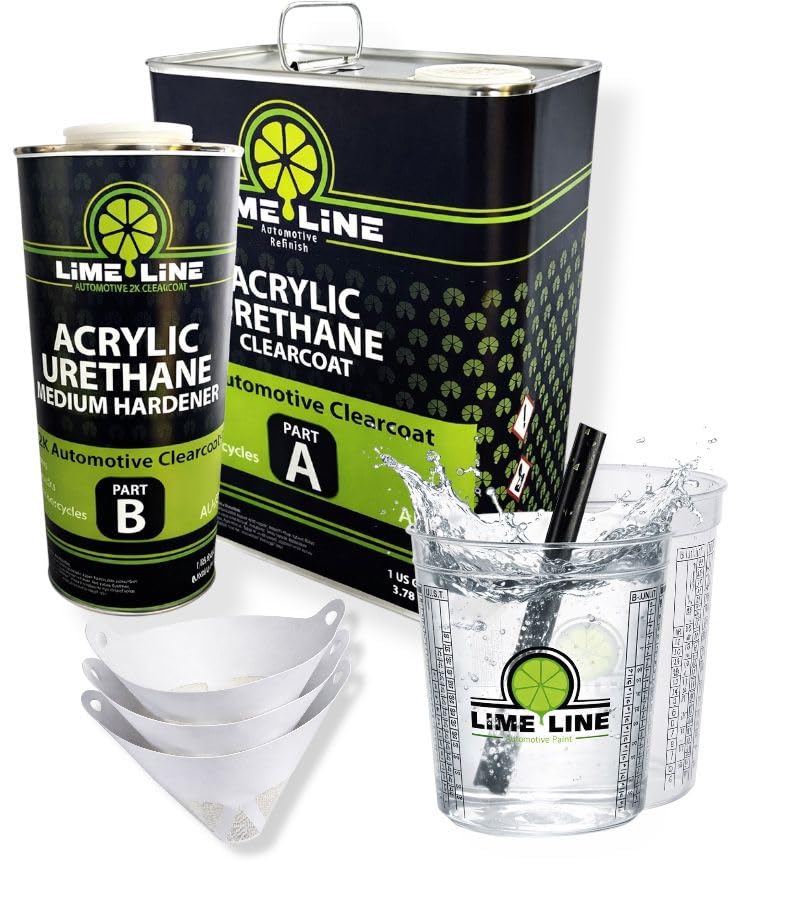
The LiME LiNE 2K clearcoat kit is a true urethane clear designed to be mixed at a straightforward 4:1 ratio with the included hardener. At 1.25 gallons total volume (1 gallon of clear + 0.25 gallon of activator), this is enough material to apply three full coats on a standard sedan, making it one of the most cost-effective per-quart clearcoat options on the market. The pot life after mixing is 1.5 hours, which is short but reasonable for a two-stage urethane — you must mix only what you can spray in that window.
Users who have cross-shopped this against established brands like House of Kolor report that LiME LiNE flows out very well and, after a proper wet-sanding and buffing sequence, produces a mirror finish comparable to products costing substantially more. The clear goes on tack-free in 20 to 40 minutes depending on ambient temperature, and it sands easily after a 12-hour cure at 70°F without gumming up the sandpaper — a common frustration with cheaper urethanes that never fully harden. The included mixing cups, reusable stir stick, and three disposable strainers give you everything except the spray gun.
The main drawback is that the pearl particles in certain colors can be slightly large, though users report no clogging issues with a 1.5mm tip. The short pot life means you cannot afford to dawdle during application, and the isocyanate content requires a proper supplied-air respirator for safe use. For the budget-minded restorer who wants a glossy, sandable clearcoat without paying brand-name markup, this kit delivers remarkable depth and durability.
Why it’s great
- High-gloss urethane clear with excellent flow-out and easy sandability after 12 hours
- Generous 1.25-gallon volume covers an entire car for less than many 1-quart competitors
- Complete mixing kit (cups, stir stick, strainers) included — no extra purchases needed
Good to know
- 1.5-hour pot life is short; you must work in disciplined sessions
- Requires isocyanate-rated respiratory protection — not ideal for casual users without proper gear
5. DeVilbiss StartingLine HVLP 802342 Detail Spraying Kit

The DeVilbiss StartingLine 802342 is the most affordable true-HVLP gravity-feed system on our list, and it earns its spot by delivering a legitimate spray pattern at a price point that lets beginners invest in paint instead of hardware. The kit includes a main spray gun and a detail gun with a smaller cup, plus three fluid tip sets (1.0mm, 1.3mm, and 1.8mm) that cover thin basecoats through heavy primers. Numerous first-time users report that this gun outperformed their expectations on metallic paints and pearls — the atomization is surprisingly even for a sub- entry-level system.
The detail gun is the hidden value here: with its 1.0mm tip and reduced fan width, you can spot-repair a door handle or mirror housing without masking off the entire vehicle. The trigger action on both guns is predictable, and the chrome-plated exterior cleans up well with standard gun cleaner. Users advise testing the spray pattern with solvent immediately upon arrival — a perfect cigar-shaped pattern with even distribution top-to-bottom indicates a properly machined nozzle, while a “fat” top or bottom signals a defect that should trigger a return.
Some plastic components (such as the air cap retainer ring) feel less robust than the all-metal DeVilbiss Plus+ line, and a handful of users reported the detail gun needle seal needed lubrication straight out of the box to prevent a slow drip. For a hobbyist painting one or two vehicles a year, the 802342 provides a genuine HVLP experience without the commitment of premium equipment, but the build quality will not survive daily professional use.
Why it’s great
- True HVLP transfer efficiency at a beginner-friendly price
- Dual-gun kit includes a dedicated detail gun with 1.0mm tip for precision work
- Three tip sizes allow a single system to handle primer, base, and clear
Good to know
- Some plastic parts and potential needle seal leaks on the detail gun
- Not built for continuous 40-hour-week professional use; treat it as a capable hobbyist tool
6. DeVilbiss StartingLine Complete Auto Painting & Priming Kit 802343

The 802343 expands on the 802342 design by including multiple guns dedicated to separate roles — typically a primer gun, a basecoat gun, and a clearcoat gun — so you never have to stop mid-project to swap tips and flush out a color change. For the DIY restorer painting a complete vehicle over a weekend, this eliminates the single biggest workflow bottleneck. Users who painted a classic ’70 Barracuda with this kit reported professional-level results with high-build 2K primer followed by basecoat and clearcoat, all laid down through the same collection of guns.
The spray pattern on the primer gun is notably forgiving — it accepts a wider viscosity range without spitting, which is valuable when spraying thick high-build primers that other guns struggle to atomize. The basecoat gun produces a fine, even mist that minimizes mottling on metallic paints, and the clearcoat gun lays a wet coat that flows out nicely before solvent pop becomes an issue. The whole package weighs roughly 7 pounds and comes in a sturdy plastic case that keeps the guns organized and protected between projects.
However, the consistency between guns can vary: one reviewer reported that the spray pattern on their clearcoat gun was inconsistent on stops and restarts, requiring a quick test spray onto a practice panel before each coat. The metal cup on the primer gun also has a known weak point at the cup-to-lid fitting — several users broke this on the first tightening. These are quality-control issues that DeVilbiss could address, but at this price point for a complete multi-gun system, many users accept the trade-off for the convenience of dedicated guns per material.
Why it’s great
- Multiple dedicated guns eliminate tip swapping and flushing between primer/color/clear
- Forgiving spray pattern on the primer gun handles high-build 2K materials well
- Comes with a storage case for organized transport and protection
Good to know
- Inconsistent spray pattern on some individual guns (clearcoat gun less reliable)
- Metal cup fitting fragile — overtightening can crack the connection on first use
7. Iwata Eclipse HP-CS Airbrush Value Set
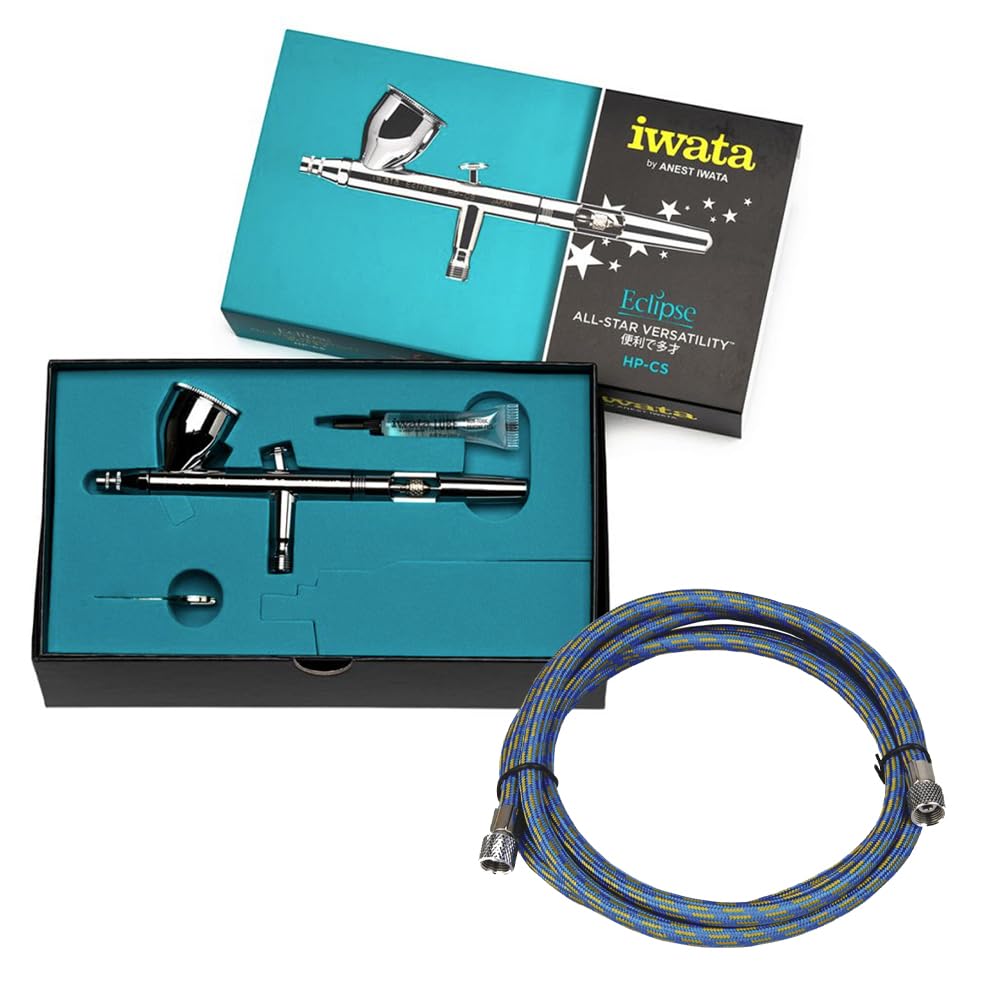
The Iwata Eclipse HP-CS is not a full panel-painting tool — it is a precision airbrush with a 0.35mm nozzle and a 0.24 oz gravity-feed cup designed for custom graphics, pinstriping, touch-up, and model work. What makes it essential on an auto paint kit list is that nearly every vehicle restoration requires some detail work: blending a repaired spot, painting a faded emblem, or applying a custom graphic. The HP-CS delivers an atomization quality that makes fine lines at low PSI (20-25 psi) without the tip clogging that plagues cheap airbrushes, and the break-resistant spring-steel needle holds up to solvent-based paints.
The exclusive compression-fit E3 nozzle eliminates the tiny threading that makes other airbrushes a nightmare to reassemble after cleaning — you simply push the nozzle into place and tighten the head cap. The cutaway handle design gives you quick access to pull the needle for cleaning or replacement without disassembling the entire brush body. The set includes a Createx Cerulean Blue paint sample and a beginner’s guide, but serious auto work will require dedicated solvent-based urethane or urethane-compatible paints. Users consistently describe this as the point where their airbrushing skill jumped two levels after upgrading from budget kits.
The limitation is volume: a 0.24 oz cup evaporates fast and you will be refilling constantly for anything larger than a motorcycle gas tank graphic. For a full-color airbrush project (say, painting a flame job on a custom fender), you will want a larger 0.5 oz or 1.0 oz side-feed cup conversion. The HP-CS also demands a moisture trap on your air line — the fine nozzle tolerances mean a single water droplet in the air supply will cause spitting that ruins delicate work.
Why it’s great
- Threadless E3 compression nozzle makes cleaning and reassembly exceptionally fast
- Precise trigger modulation allows ultra-fine lines and smooth gradients
- Solvent-resistant packings and spring-steel needle last through years of automotive paint abuse
Good to know
- Small 0.24 oz cup requires frequent refills for anything beyond small touch-ups
- Moisture in the air line causes immediate spitting — a quality inline water trap is required
FAQ
Can I spray a single-stage paint without a clearcoat on top?
How much air pressure do I need from my compressor?
What is the difference between a complete paint kit and a spray gun kit?
Is a 4:1 mix ratio better than an 8:1 mix ratio?
Do I need a moisture trap for my air line?
Final Thoughts: The Verdict
For most users, the best auto paint kit winner is the Master Elite Performance PRO-88 Ultimate Kit because its three included tip sets — 1.3mm, 1.4mm, and 1.8mm — let a single gun body handle primer, basecoat, and clearcoat without needing separate purchases. If you want professional-grade cleanup speed and a lightweight composite body, grab the 3M Performance Spray Gun Starter Kit 26778. And for a budget-friendly complete paint-and-hardener set that delivers high gloss for a single-stage restoration, nothing beats the Restoration Shop Jet Black Acrylic Enamel Kit.