
Finding the right auto polishing compound is the difference between a paint correction job that leaves a deep, wet-looking gloss and one that introduces haze, holograms, or micro-marring. The wrong compound fights you at every stage — it dusts prematurely, dries out mid-cycle, or simply lacks the cut to remove P1500 sanding marks from a repainted panel. The best formulas balance abrasive aggressiveness with lubricity, extending work time so you can break down the abrasive evenly before wiping clean.
I’m Min — the co-founder and writer behind Gadgets Feed. I’ve spent countless hours cross-referencing technical data sheets, cross-examining user test results on hard and soft clear coats, and grading each compound’s cut index, dusting behavior, and wipe-off residue to build this analysis.
If you’re restoring oxidized single-stage paint, removing buffer trails, or refining a wet-sanded surface, the best auto polishing compound must match your defect depth, pad material, and machine speed — not just your budget.
How To Choose The Best Auto Polishing Compound
A polishing compound isn’t a universal liquid — it’s defined by its abrasive mineral (aluminum oxide is the industry standard), its particle size (measured in microns, not an arbitrary grit number), and its lubricant carrier. Selecting the wrong tier either wastes time or damages the clear coat.
Match Cut Level to Defect Depth
Heavy-cut compounds (3–6 micron abrasives) remove P800–P1500 sanding marks and deep oxidation. Fine-cut polishes (1–3 micron) remove P2500–P3000 scratches, holograms, and micro-swirls. Using a heavy cut on light swirls introduces unnecessary clear-coat removal; using a fine cut on a wet-sanded panel will leave sanding scratches visible under garage lighting.
Silicone-Free vs. Filler-Heavy Formulas
Silicone-oil-free compounds, such as the Koch-Chemie line, leave no residue that can contaminate a panel before ceramic coating or paint. Filler-heavy compounds mask defects temporarily — they look great for a day but wash off, revealing the original scratches. For permanent correction, choose a true diminishing-abrasive compound.
Dusting and Work Time
Compounds that dry out quickly create airborne dust that lands on adjacent panels and requires re-washing. A high-lubricity formula extends the buffing cycle so the abrasive breaks down gradually, allowing a single pass to accomplish what a dry compound needs two passes to complete.
Quick Comparison
On smaller screens, swipe sideways to see the full table.
| Model | Category | Best For | Key Spec | Amazon |
|---|---|---|---|---|
| Griot’s Garage BOSS Correcting Cream | Mid-Range | Moderate swirl removal on clear coat | Extended buff cycle, low dusting | Amazon |
| Meguiar’s Ultra Pro Speed Compound M11032 | Premium | Heavy cut with fast wipe-off | 32 oz, 125-year formulation expertise | Amazon |
| Koch-Chemie Micro Cut M3.02 | Premium | Hologram-free final finishing | 8.45 oz, silicone-oil-free, gloss 9.0 | Amazon |
| Malco Super Duty Heavy Cut | Premium | Heavy sand scratch removal on gel coat | 32 oz, removes P1500 scratches | Amazon |
| KOCHCHEMIE Fine Cut F3.01 | Mid-Range | Medium defect removal on weathered paint | 8.45 oz, unique oxide grain size | Amazon |
| Wizards Shine Master Polish | Budget | All-in-one polish and sealant | 16 oz, breathable polymer sealant | Amazon |
| Menzerna Heavy Cut Compound 1000 | Budget | Deep scratch removal for beginners | 8 oz, silicone-free, beginner-friendly | Amazon |
In‑Depth Reviews
1. Griot’s Garage BOSS Correcting Cream (120P)

The BOSS Correcting Cream uses a 120-grit aluminum oxide abrasive that strikes an impressive balance between cut and finish. It eliminates moderate swirls and light scratches on clear-coat paint systems without leaving the haze that aggressive compounds often create. Users report removing 12 years of surface defects from dark-colored vehicles in four to five panel passes, restoring a mirror-like finish that rivals professional correction.
What sets this formula apart is its high-lubricity carrier that extends the buffing cycle beyond the typical 30-second window. The cream stays wet longer, allowing the abrasive to break down progressively rather than dusting off prematurely. Applied with a medium orange foam pad on a dual-action polisher, it finishes down with minimal residue — no chalky dust clouding adjacent panels or gumming up pad pores.
On the practical side, the 16-ounce bottle covers roughly a full sedan with room to spare for spot corrections. The cream works effectively on both factory clear coats and repainted panels, though deep P800 scratches require a heavier compound first. For anyone doing paint correction two or three times a year, this sits in the sweet spot of cutting power and user forgiveness.
Why it’s great
- Extended work time prevents drying and dusting
- Finishes with high gloss and no micro-marring on clear coat
- Compatible with both foam and microfiber pads
Good to know
- Not aggressive enough for wet-sanded P800 marks
- Requires at least 3 passes for deep swirls
2. Meguiar’s Professional Ultra Pro Speed Compound M11032
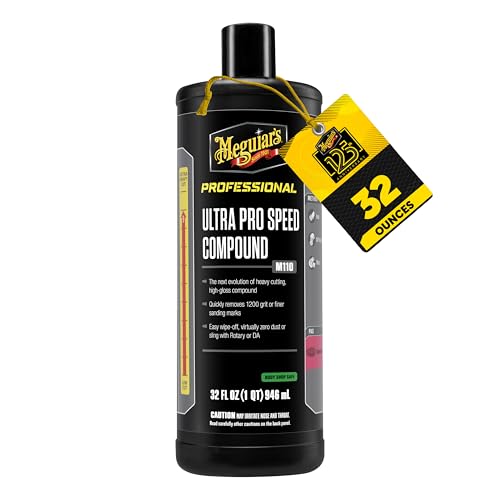
Meguiar’s M110 is a modern heavy-duty compound engineered specifically for dual-action polishers — a combination that historically struggled to match rotary cutting power. The 200-grit aluminum oxide abrasive removes P1200 wet-sanding marks and heavy oxidation effectively, yet the formulation is forgiving enough that a novice can achieve streak-free results on their first attempt. Reviewers note that it cuts faster than the previous M105 formula while producing significantly less dust.
The standout trait is the wipe-off behavior: the compound breaks down into a nearly transparent film that wipes clean with a single microfiber pass. This dramatically reduces the risk of leaving residue in crevices or on emblems, saving prep time before the finishing polish stage. In controlled tests on a repainted hood that had been wet-sanded from P1500 to P3000, the M110 cut through the remaining texture in two fast passes, leaving a deep, wet shine ready for a fine polish like M210.
At 32 ounces, this bottle delivers excellent coverage for multiple full-car corrections. The compound is VOC-compliant and body-shop safe, meaning it won’t soften adjacent panel edges or cause clearing issues on fresh paint. If you need one heavy-cutting compound that works across DA and rotary machines without demanding a steep learning curve, the M110 is the strongest universal contender in this roundup.
Why it’s great
- Low-dust, easy wipe-off even after extended buffing
- Exceptional cut with DA polisher on hard clears
- Large 32-ounce bottle offers strong per-ounce value
Good to know
- Advertises P1200 removal but requires significant machine time
- Not ideal for soft clear coats without reducing pad pressure
3. Koch-Chemie Micro Cut M3.02 Polishing Compound
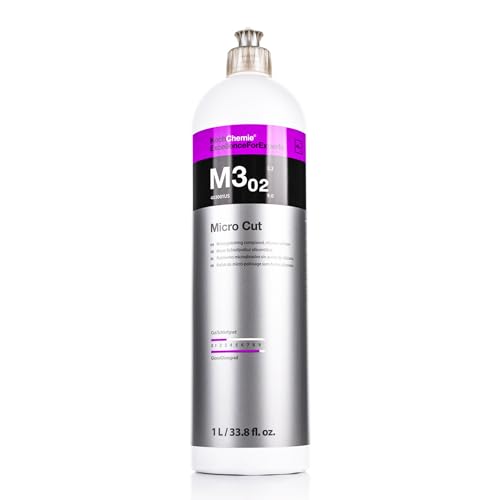
The Micro Cut M3.02 is a finishing polish that operates in the 1–3 micron abrasive range, targeting the fine defects left behind after compounding — holograms from rotary buffers, fine scratches from P3000 sanding, and wash-system swirls. Its abrasive bodies are extremely homogeneous, meaning they break down at a consistent rate and produce a brilliant deep gloss (rated 9.0 on a 10-point finish scale) without requiring a second refining step.
Silicone-oil-free construction is the critical advantage here. Many finishing polishes leave behind oils that fill scratches temporarily but wash out after two or three car washes, revealing the original damage. The M3.02 leaves zero residue, making it a perfect last step before applying a ceramic coating or a high-end paint sealant. Users working on Volvo single-stage paint report that it removes decades of oxidation in one session, transforming a dull surface into a clean, wet-looking finish with no white residue in seams.
The 250-milliliter (8.45 oz) bottle is compact but economical — a little goes a long way due to the low-viscosity formula. Work time is generous: the polish remains lubricated for up to 60 seconds per section on a DA polisher, reducing the risk of burning the paint. For detailers who want a dedicated finishing compound that leaves no oily film and no micro-scratches, this is the reference standard.
Why it’s great
- Excellent gloss level with zero holograms
- No fillers — optically clear finish ready for coating
- Long working time and no dusting
Good to know
- Bottle size is small relative to competitors
- Not a single-step compound — requires a prior cut stage for deep defects
4. Malco Super Duty Heavy Cut Compound (127632)
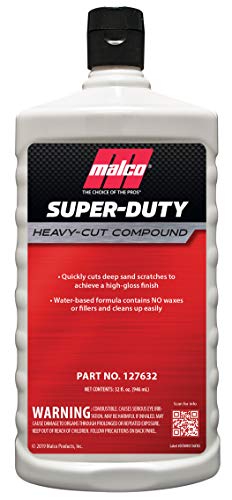
Malco’s Super Duty is a true heavy-cut compound built for automotive, marine, and industrial painted surfaces, including gel coats. Its abrasive system handles P1500 grit and finer sand scratches efficiently, making it a go-to option for body shops and detailers performing cut-and-buff on fresh paint. Users tackling severely oxidized single-stage urethane on older Honda Accords report that the compound restored gloss in one pass with a wool pad and rotary buffer, exceeding expectations for a product in this bottle size at 32 ounces.
The formula is clear-coat safe, meaning it operates aggressively without burning through thin clear layers when used correctly. This is partly achieved by pairing it with a white wool cutting pad, which keeps the working temperature lower than foam on high-speed rotary applications. The trade-off is that the residue can become sticky if overworked; professional detailers recommend working in smaller sections and wiping with a damp microfiber cloth before the compound fully dries.
Compared to other heavy compounds in its class, the Malco creates noticeably less airborne dust than the Meguiar’s M105, which makes in-booth correction sessions cleaner. It also finishes with a high-gloss shine that reduces the number of refining passes needed — a practical advantage for production detailing where every minute counts. For boat repairs, oxidized gel coats, or heavy industrial paint correction, this is a volume-efficient workhorse.
Why it’s great
- Fast cut on sand scratches up to P1500 grit
- Low dust generation compared to similar heavy compounds
- Large 32-ounce bottle delivers extensive coverage
Good to know
- Can become tacky if overworked on a panel
- Best results require a wool pad, not foam
5. KOCHCHEMIE Fine Cut F3.01 Polishing Compound

The Koch-Chemie Fine Cut F3.01 occupies the middle ground between a heavy compound and a finishing polish, targeting medium to heavy defects on weathered paint systems. Its intelligent grain-size distribution — using uniquely refined aluminum oxide particles — allows it to remove wash-system scratches, transportation marks, and sanding remnants up to P2500 grade while refining the surface to a deep, long-lasting sheen. Users report successfully cutting through transport marks on a 2020 BMW hood using a fine foam pad, leaving excellent clarity with minimal haze.
Silicone-oil-free, the F3.01 will not contaminate the panel surface, making it suitable for body shops that follow up with a ceramic coating or a high-solids clear coat. The compound works on both soft and hard clear coats, though users note that it runs best on a dual-action polisher at medium speed (around 3000–4500 orbits per minute). It produces very little dust — significantly less than many mid-range compounds — and wipes off with a single microfiber without streaking.
At 250 milliliters, the bottle is compact but the formula is economical; a single session on a full sedan uses roughly a third of the bottle. The main limitation is that it falls short of the cut needed for heavy wet-sanding jobs below P1500 — those still require a dedicated heavy-cut step. For the vast majority of paint correction on daily-driven vehicles, the F3.01 offers the right amount of cut with a finish that often eliminates the need for a separate polishing step.
Why it’s great
- Excellent balance of cut and final gloss
- Works well on medium to heavily weathered paint
- Very low dusting during extended buff cycles
Good to know
- Not designed for P1000-level sand scratch removal
- Small bottle size may require repeated purchases for volume users
6. Wizards Shine Master Polish and Sealant (11033)
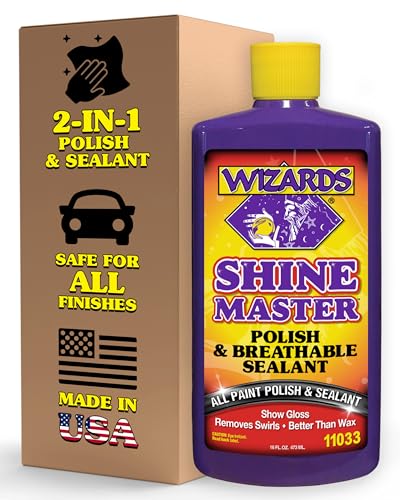
Wizards Shine Master is an all-in-one cleaner, polish, and breathable paint sealant that simplifies the detailing process for users who want a single-step solution. Rather than compounding, refining, and waxing separately, this product uses a polymer blend that abrades dead paint and fine scratches while simultaneously depositing a protective sealant. Applied with a foam pad on a DA polisher, it removes light oxidation and swirls in one pass, leaving a smooth, streak-free finish with noticeable depth.
Unlike traditional waxes, the sealant does not contain silicone oils, so it won’t cause fisheyes during later paint work or transfer onto clothing after curing. Users report that applying a second coat the following day deepens the mirror-like reflection — a trick that works because the polymer layer builds without the greasy residue of carnauba-based products. The formula also performs on marine gel coats and motorcycle tank paint, making it a versatile option for multi-vehicle households with different surface types.
The 16-ounce bottle provides good value for the price tier, and the spray-trigger applicator allows easy dispensing directly onto pads without over-pouring. The trade-off is that the cleaning cut is relatively mild — deeper scratches and oxidation from neglected paint still require a dedicated compound first. As a maintain-and-protect product for vehicles in decent condition, the Shine Master performs better than most all-in-ones in its class while being remarkably easy to apply and remove.
Why it’s great
- Combines polish and sealant in a single application
- Breathable polymer finish doesn’t trap moisture
- Safe for paint, gel coat, and vinyl surfaces
Good to know
- Limited cutting power — not for scratch repair
- Sealant durability is shorter than dedicated ceramic coatings
7. Menzerna Heavy Cut Compound 1000 (8 oz)
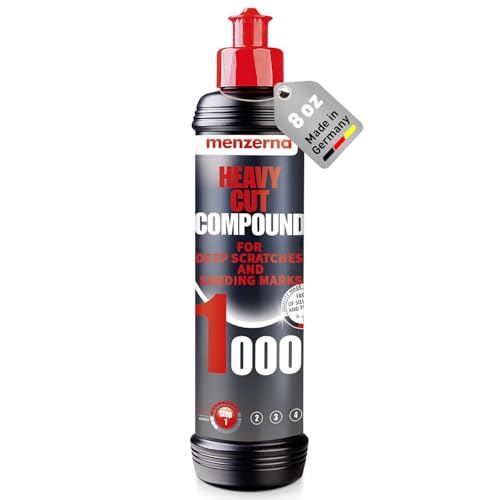
Menzerna’s 1000-grit heavy cut compound is one of the most accessible products for first-time paint correctors. It uses medium-grit aluminum oxide abrasives suspended in a silicone-free carrier that works both with a DA or rotary polisher and — crucially — by hand. The formula is designed to remove deep scratches, sanding marks, swirls, and holograms from clear coat without requiring expensive pad sets or high machine speeds. Users report removing parking-lot scrapes in under 10 minutes of hand application, with results that avoid a body-shop visit.
The silicone-free construction prevents contamination issues if you plan to seal or wax afterward, and the 8-ounce bottle is an approachable entry point for users who aren’t sure how much compound they’ll need. The product works within a specific temperature window: apply a pea-sized amount to a green Soft Cut Foam Pad, work in a criss-cross pattern at moderate speed until the milky film runs translucent, then wipe with a microfiber before the residue hardens. Following with a Menzerna top coat seals the correction.
Where the Menzerna falls short is work time — the compound dries faster than premium options, requiring smaller section passes (roughly 18-inch panels) to prevent the abrasive from caking. Users have also noted that the bottle size (8 oz) runs out quickly on larger vehicles like SUVs or trucks. Still, for spot repairs on daily drivers or for anyone entering the world of paint correction, this is a low-risk, high-reward starting point with a 130-year German formulation pedigree behind it.
Why it’s great
- Outstanding deep scratch removal by hand or machine
- Silicone-free formula won’t interfere with sealants
- Low entry price for high-quality German chemistry
Good to know
- Small 8 oz bottle covers only a few panels
- Dries faster than premium heavy-cut compounds
FAQ
Can I use an auto polishing compound by hand without a machine?
Will a heavy-cut compound remove clear coat completely?
What pad material should I use with each compound type?
Final Thoughts: The Verdict
For most users, the best auto polishing compound winner is the Griot’s Garage BOSS Correcting Cream because it offers the ideal cut-to-finish ratio with a forgiving work time that suits both beginners and experienced detailers. If you need maximum material removal with a DA polisher, grab the Meguiar’s Ultra Pro Speed Compound M11032. And for a flawless, silicone-free finish stage that leaves zero holograms, nothing beats the Koch-Chemie Micro Cut M3.02.