
Our readers keep the lights on and my morning glass full of iced black tea. As an Amazon Associate, I earn from qualifying purchases.
Specs are compiled from manufacturer listings and verified buyer reviews and can change over time — please confirm the key details on the product page before buying.
I’m Min — the founder and writer behind Gadgets Feed. This guide is built by comparing the manufacturers’ published specifications and the patterns across verified customer reviews, so you get each pick’s real strengths and trade-offs instead of marketing spin.
After digging through the specs and real owner experiences, these four models stand out as the best auto pool tester options for keeping your water balanced without the daily hassle.
Quick Picks
- AIPER HydroComm Smart Pool Monitor — Best Overall
- Crystal Smart Water Monitor for Salt Water Pools — Top Performer
- kactoily Solar Powered Smart Pool Water Monitor — Solar Champion
- YINMIK 5-in-1 Pool Monitor (Smart Pool Monitor, Pool Salt Reader) — Budget-Friendly
How To Choose The Best Auto Pool Tester
The right automatic tester saves you time, but the wrong one can mean useless readings or constant connectivity headaches.
What It Actually Measures
Not every “6-in-1” tester checks six things. Some count basic conductivity as a separate parameter to inflate the number. Look for a model that covers the essentials you personally need: pH, ORP (oxidation-reduction potential — a more stable way to measure sanitizer effectiveness than a direct chlorine sensor), salinity for saltwater pools, and temperature. If you do not need salinity, you can skip paying for it.
Connectivity and App Reliability
An auto pool tester is only useful if the data reaches your phone. Every model here uses a WiFi gateway that plugs into your router. The critical question is whether the app pairs cleanly the first time. Several verified reviews report “Setup failed; device won’t connect to internet” or a gateway that “blinks red, fails to connect.” A sensor that can not talk to your phone is just an expensive float.
Power and Maintenance
Solar charging sounds great — and it works — but some units still need occasional cable charging. The AIPER HydroComm, for example, offers up to 15 days of battery life per full charge plus a solar panel to extend it, while buyers report they still need to plug it in weekly. Compare that to fully solar-driven models that depend on consistent sunlight. Also check whether replacement probes are easy to buy. One reviewer warned “the test probes that must be replaced periodically are not available,” which makes the whole unit useless after the first sensor wears out.
Quick Comparison
On smaller screens, swipe sideways to see the full table.
| Model | Best For | Parameters Measured | Connectivity | Charging | Amazon |
|---|---|---|---|---|---|
| AIPER HydroComm | Total hands-off monitoring | pH, ORP, TDS, EC, Temperature | WiFi + Bluetooth | Solar + AC (15-day battery) | Amazon |
| Crystal Smart Water Monitor | High-frequency data + dosing help | pH, ORP, Salinity, Temp, plus weekly alkalinity strip | WiFi App | AC power | Amazon |
| kactoily Solar Powered | Continuous solar operation | pH, ORP, Salinity, TDS, EC, Temperature | WiFi Gateway + Kactoily App | Solar (2 Lithium Ion batteries included) | Amazon |
| YINMIK 5-in-1 Monitor | Value pick for saltwater pools | pH, Salt, EC, TDS, Temperature | WiFi Tuya gateway (2.4GHz) | Solar + fixed rope | Amazon |
In‑Depth Reviews
1. AIPER HydroComm Smart Pool Monitor
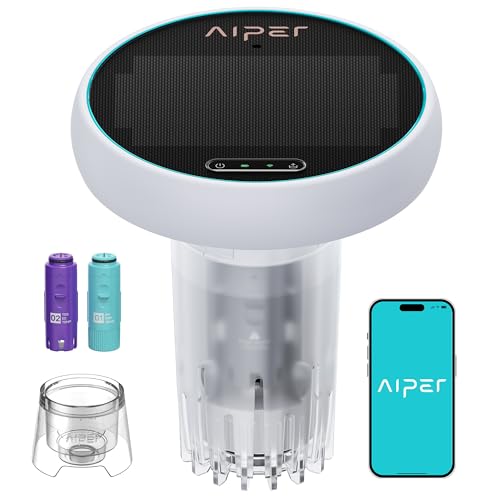
The floating sensor that tests your pool every hour so you barely have to think about it.
This is the auto pool tester that does the work for you — it automates a 5-in-1 water analysis (pH, ORP, TDS, EC, and temperature) every hour, day and night. The payoff is you open the AIPER app on your phone and see a clear summary with data-based adjustment insights, not just raw numbers. Owners mention it “makes maintaining my pool a breeze” and that the actionable recommendations help improve water consistency. Setup requires a few tries according to some owners, but once paired over WiFi you get historical trend charts that show how your water responds to chemical changes.
One real trade-off is the charging. The dual power system includes a solar panel and AC backup, and the spec says it provides up to 15 days of battery life per full charge. But customers note “needs weekly charging; solar charging inconsistent.” The short charging cord and the port being underneath the unit also came up as minor annoyances. Still, the 2-year limited warranty gives you a safety net that cheaper models do not offer, and several owners say it saves them what they used to pay for pool service.
One verified buyer warns the device “gives off radiation and must be kept 8 inches away from your body.” The same review notes that replacement probes are not yet available, so the unit could become useless once the first probe wears out (One buyer estimates “one probe lasts 1 year, price unknown.”). Before you buy, check that AIPER has stocked replacement sensors for your region.
Best for: Pool owners who want automated hourly testing and actionable chemical tips without a subscription fee.
Heads up: Verify replacement probe availability before you buy, and expect to plug it in for a charge every week despite the solar panel.
Reach for this if: You value set-and-forget water analysis and prefer a brand with a 2-year warranty backing it.
Look elsewhere if: You cannot tolerate weekly charging or live in a region where AIPER replacement probes are not sold yet.
2. Crystal Smart Water Monitor for Salt Water Pools
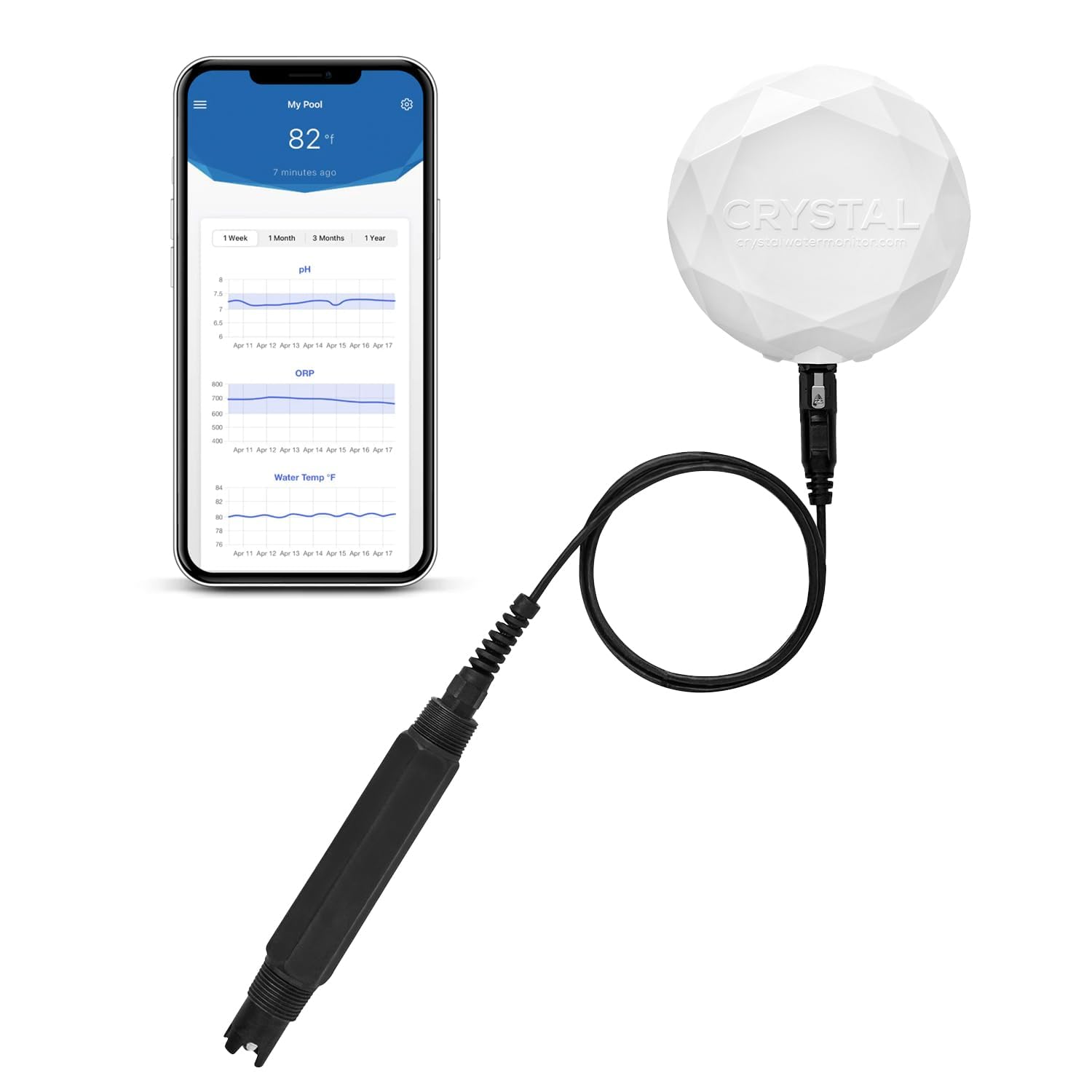
Tests your water 144 times a day and tells you exactly which chemicals to add and how much.
The Crystal takes a different approach from the competition — instead of floating, it actively samples your pool or hot tub water around 1,000 times per week (roughly 144 times a day). The app then sends automatic notifications with precise chemical dosing recommendations customized for your pool’s volume and your preferred chemical brand. You simply scan the barcode on your chemical bottle once, and it remembers. This model supports saltwater pools, hot tubs, and swim spas, and there is a separate chlorine/bromine version too.
A big win here is that Crystal does not lock you into proprietary replacement cartridges. The maker claims “competitive monitors require” expensive monthly cartridges, while Crystal uses a single sensor with a simple weekly dip test for alkalinity — the monitor handles chlorine and the rest. Verified reviews call it “quick, easy and super accurate” and one owner says it “pays for itself in 2-3 months, replacing chemical service.” Compare that to the AIPER HydroComm, which needs its probes replaced yearly at an unknown cost, and the Crystal’s /year service renewal after the first complimentary year starts to look like a predictable expense.
However, the support reputation is mixed. Multiple verified one-star reviews describe “unresponsive customer service” and that “customer service is a joke,” with one buyer saying the company went silent after admitting a replacement was needed. A sensor was also reported as non-functional from the start. The complimentary first-year service and US-based support are a nice start, but you are betting that the company answers the phone when something goes wrong.
Best for: Saltwater pool owners who want the most frequent readings and precise dosing help without being forced into proprietary chemical packs.
Heads up: Customer support has been inconsistent in verified reviews; the real value depends on that service being responsive.
Reach for this if: You want the highest test frequency on the market and prefer paying a predictable annual fee rather than replacing expensive probes.
Look elsewhere if: You cannot afford a non-functional sensor situation with no follow-up support.
3. kactoily Solar Powered Smart Pool Water Monitor
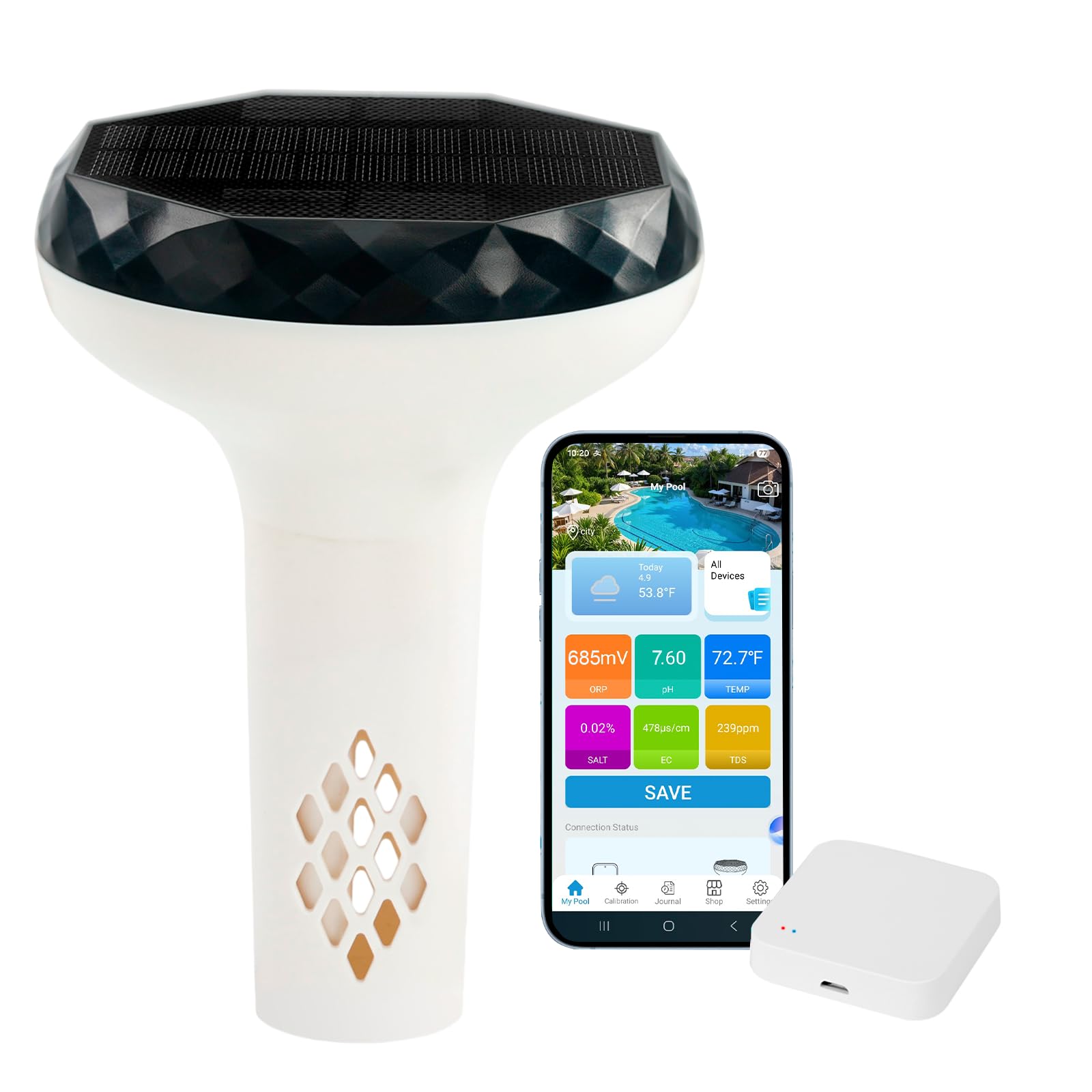
Industrial-grade sensors with solar endurance — if you can get the app to connect.
The kactoily monitor uses ORP (oxidation-reduction potential) as its primary sanitizer measurement instead of a direct chlorine sensor. That matters because the maker argues ORP sensors have “superior long-term stability and zero-drift accuracy” compared to chlorine sensors that drift and fail. The device tracks six parameters: pH, ORP, salinity, TDS, EC, and temperature. It also has a rugged IP68 waterproof housing rated for harsh UV and pool chemicals, plus integrated solar panels for continuous self-charging. At 1.9 pounds, it is noticeably heavier than the YINMIK (10.6 ounces) and feels more substantial in the water.
Here is the honest catch. This product has a serious connectivity problem in verified reviews. Multiple reviewers point out “Setup failed; device won’t connect to internet” and a gateway that “blinks red, fails to connect.” One reviewer tried for three days and could not even register for the app. Another described the customer service as “unhelpful, requiring unwanted network changes.” A few owners did get it working — one 5-star review calls it “convenient continuous pool monitor with app” — but the pattern of failed WiFi pairing is too frequent to ignore. The kactoily app and gateway seem to be the weakest link in an otherwise solid sensor package.
Also worth knowing: this monitor does not measure chlorine levels directly. One buyer pointed that out as a specific shortcoming. If tracking free chlorine is critical for your pool, you would need to pair this with a separate test. But if you trust ORP as a proxy for sanitizer effectiveness — and many commercial pools do — this tester delivers clean data with fewer calibration headaches than a chlorine-specific unit.
What Works
- ORP tracking is more stable long-term than standard chlorine sensors
- Solar charging eliminates battery swaps in good sunlight
- IP68 rating means it survives harsh pool chemicals and UV
The Risk
- WiFi gateway/app pairing fails for many buyers — multiple 1-star reviews
- Customer support reportedly unhelpful with connectivity issues
- Does not measure free chlorine; ORP only gives a sanitizer proxy
Best for: Tech-savvy pool owners who are comfortable troubleshooting WiFi setup and trust ORP as a sanitizer indicator.
Skip if: You need a reliable plug-and-play connection right from the start or must track free chlorine levels directly.
4. YINMIK 5-in-1 Pool Monitor (Smart Pool Monitor, Pool Salt Reader)
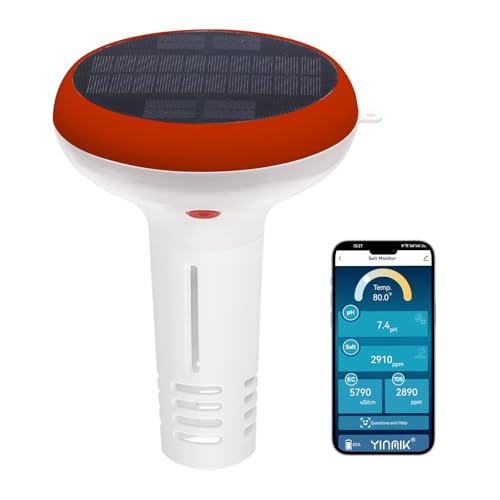
A solid saltwater-focused tracker at a lower cost — just keep the instructions handy.
The YINMIK monitor focuses on the parameters that matter most for saltwater pools: pH, salinity, EC (conductivity), TDS (total dissolved solids), and temperature. It connects to your phone through the Tuya Smart app via a WiFi gateway that requires 2.4GHz wireless network coverage (most smart home devices do, so this is standard). A nice extra is the package includes calibration solutions for pH values 4.00, 7.00, 10.01 and salinity 12.88, so you can check accuracy yourself. The salinity is calibrated at the factory, meaning it is ready to use immediately after unpacking.
Size-wise, this is the lightest of the four at 10.6 ounces, making it less obtrusive floating in a smaller above-ground pool or spa. The package dimensions (9.06 x 6.69 x 5.91 inches) are also slightly more compact than the kactoily (9.45 x 6.69 x 6.69 inches), a 4% size gap. A fixed rope is included so you can tether it to the side. Owners like the clear backlit display and the fact that it can display TDS readings on two scales (500/700 PPM). One verified reviewer specifically called out an “accurate TDS meter (within 2% of lab results),” which is strong for this price tier.
The weak spot according to buyer reports is the setup instructions. One owner said they were “a little confusing” and had to search YouTube for clarity. Another noted the LR44 batteries are difficult to access and replace due to a tight spring assembly. On the upside, YINMIK offers a visual red-flag system: if your pH or salinity goes outside the recommended range (pH 7.2-7.8, salinity 2700-3400 ppm), the measurement value displays in red in the app as a clear reminder to adjust. That is a genuinely helpful feature for beginners learning pool chemistry.
What Stands Out
- Factory-calibrated salinity — use immediately with no setup chemistry
- Red-flag alerts in the app for out-of-range pH and salt levels
- Includes four calibration solutions for long-term accuracy checks
Minor Frustrations
- Setup instructions are confusing per multiple buyers; YouTube needed
- Battery compartment is tight; changing LR44 cells is fiddly
- Only 5 parameters vs the 6-in-1 competitors (no ORP)
Best for: Saltwater pool owners on a budget who want solid accuracy (within 2% of lab TDS) and do not need ORP or chlorine tracking.
Heads up: Expect to spend 15 minutes on YouTube figuring out the WiFi pairing; the instructions alone may not be enough.
Understanding the Specs
ORP vs Direct Chlorine Sensors
ORP stands for oxidation-reduction potential — it measures the water’s ability to break down contaminants rather than the exact level of chlorine. Many pros prefer ORP because it does not drift the way a direct chlorine sensor does. If a tester uses ORP, you get a more stable reading of your water’s sanitizing power, but you will not see “free chlorine” as a number. Choose ORP if you want long-term accuracy without recalibration; choose a direct chlorine sensor if you must track exact ppm for compliance or closely managed pools.
Solar Charging and Battery Life
Not all solar charging is equal. Some auto pool testers can run indefinitely on solar in good sun, while others use the solar panel to simply extend the time between cable charges. Check whether the spec says it can operate “24/7” on solar alone or if it says “up to X days of battery life” with solar as a supplement. The AIPER, for example, gives you up to 15 days per full charge but reviewers still need to plug it in weekly. If your pool is in heavy shade, rely less on solar claims and plan for regular cable charging.
FAQ
Will an auto pool tester work with my above-ground pool?
Do I still need to take water to the pool store?
How long do the sensors or probes last?
Can these testers handle hot tubs and spas?
Do I need a 2.4GHz or 5GHz WiFi network for the gateway?
Is an ORP-based tester better than one with a direct chlorine sensor?
How often does the tester actually sample the water?
What happens if the WiFi gateway loses power or connection?
Can I share the app data with a family member or pool service?
Is there a subscription fee for these testers?
Final Thoughts: The Verdict
For most people, the best auto pool tester winner is the AIPER HydroComm because it delivers reliable hourly testing with actionable insights, a solar backup option, and a strong 2-year warranty. If you want the highest test frequency (144 times a day) and precise chemical dosing recommendations without proprietary cartridges, grab the Crystal Smart Water Monitor. And for the best value on a saltwater-focused tester that includes calibration solutions right in the box, the YINMIK 5-in-1 is a solid entry-level pick that delivers TDS accuracy within 2% of lab results.
How We Picked
We do not accept paid placement, and we did not hands-on test every unit. Instead, we match each pick to a real buyer and use-case by comparing the manufacturers’ published specifications against the patterns in verified customer reviews — so you get each pick’s real strengths and trade-offs instead of marketing copy.
Sources & Methodology
Specifications: manufacturer listings and product documentation. Review insights: verified customer reviews, as of July 2026. Pricing: not shown on this page (it changes often); check the current price via the retailer link.
As an Amazon Associate, Gadgets Feed earns from qualifying purchases. This does not affect which products we feature.
Product prices and availability are accurate as of the date/time indicated and are subject to change. Any price and availability information displayed on Amazon at the time of purchase will apply to the purchase of this product. As an Amazon Associate I earn from qualifying purchases.
CERTAIN CONTENT THAT APPEARS ON THIS SITE COMES FROM AMAZON. THIS CONTENT IS PROVIDED "AS IS" AND IS SUBJECT TO CHANGE OR REMOVAL AT ANY TIME.
Amazon and the Amazon logo are trademarks of Amazon.com, Inc. or its affiliates.