
Our readers keep the lights on and my morning glass full of iced black tea. As an Amazon Associate, I earn from qualifying purchases.
Specs are compiled from manufacturer listings and verified buyer reviews and can change over time — please confirm the key details on the product page before buying.
Your car’s 12V port (the round DC power socket) has probably let you down: your laptop battery blinking red or your cooler just barely keeping things cold. You need an inverter that delivers clean, stable power for your gear without blowing a fuse. This guide picks the best auto power inverter based on manufacturers’ published specs and patterns across verified customer reviews, so you get real strengths and trade-offs, not marketing spin.
I’m Min — the founder and writer behind Gadgets Feed. This guide is built by comparing the manufacturers’ published specifications and the patterns across verified customer reviews, so you get each pick’s real strengths and trade-offs instead of marketing spin.
The key facts you need: continuous wattage (steady power output), waveform type (modified sine wave vs. pure sine wave), and the connection limit (the 12V lighter socket maxes out around 150W). Each pick below covers a different wattage tier and use case.
Quick Picks
- BESTEK 1000W Car Power Inverter — Best Overall
- BELTTT 2000W Pure Sine Wave Inverter — Pure Sine Champ
- TOPBULL 3000W Power Inverter — Heavy Lifter
- OLTEANP 1000W Power Inverter — Compact Display
- FSATBTNE 400W Power Inverter — Budget Speedster
How To Choose The Best Auto Power Inverter
Picking the right inverter depends on three things: how much power your devices actually need to run, what kind of electrical waveform they can tolerate, and whether your car’s electrical system can keep up. Here is what to sort through before you buy.
Continuous Watts vs Peak Watts — The Real Number
The number that matters most is continuous wattage. That is the steady power the inverter can feed your gear for hours. Peak (or surge) wattage covers the brief startup jolt something like a fridge compressor or a power tool takes — typically a second or two. A 1000W inverter that claims 2000W peak can handle that startup spike, but it cannot run a 1200W microwave continuously. Check your device’s running draw (usually on a label near the power cord) and pick an inverter whose continuous rating comfortably exceeds it.
Waveform: Modified Sine vs Pure Sine
Nearly all budget-to-mid-range inverters output modified sine wave — a stepped approximation of household power. It runs basic electronics like phone chargers, laptop bricks, and simple motors just fine. But anything with a digital timing circuit, a variable-speed motor, or sensitive audio equipment may hum, flicker, or even fail over time. Pure sine wave inverters deliver a smooth current identical to wall power, so fans spin quietly, CPAP machines run cleanly, and microwaves heat evenly. If you are powering a modern TV, a printer, or a medical device, pure sine is the safer call.
Connection to Your Vehicle — Lighter Plug vs Battery Clamps
Plugging into the 12V cigarette lighter socket is the easiest route, but most vehicles limit that circuit to roughly 10-15 amps — meaning about 120 to 180 watts. For anything over 150W continuous, you need to connect the inverter directly to the 12V battery with the included alligator clips or ring terminals. Many inverters above 400W come with both options. Ignoring this is the most common reason a new inverter shuts down the moment you plug in a laptop.
Quick Comparison
| Model | Best For | Continuous Watts | Waveform | USB-C Charging | Amazon |
|---|---|---|---|---|---|
| BESTEK 1000W | Mid-range all-rounder, RV/emergency | 1000W | Modified Sine | 30W PD | Amazon |
| BELTTT 2000W Pure Sine | Premium pure sine, sensitive electronics | 2000W | Pure Sine | 5V 2.1A USB | Amazon |
| TOPBULL 3000W | Heavy-duty high power, tools/worksite | 3000W | Modified Sine | 2.1A USB | Amazon |
| OLTEANP 1000W | Mid-range value, camping/road trips | 1000W | Modified Sine | 36W Type-C | Amazon |
| FSATBTNE 400W | Budget-friendly, small electronics | 400W | Modified Sine | 65W PD | Amazon |
In‑Depth Reviews
1. BESTEK 1000W Car Power Inverter

The mid-range workhorse that genuinely runs a fridge without breaking a sweat.
This inverter converts 12V vehicle power to 110V household current. It provides 1000W of continuous DC to AC power (enough to run a fridge or tools) with a 2000W peak surge for startup loads. Buyers report it runs a Haier refrigerator and an 8-amp electric chainsaw at 450 watts without tripping. That puts its real-world performance well above the 400W inverters at a lower price — the BESTEK offers 1000W continuous versus the 400W of smaller inverters, allowing it to handle tools and small appliances that stall a 400W unit.
It has dual 110V AC outlets, a 30W PD USB-C port (PD stands for Power Delivery, a fast-charging standard for laptops and phones), and an 18W QC USB-A port (QC stands for Quick Charge, a fast-charging standard for Android phones). The unit is 9.13 x 4.72 x 2.71 inches. Dual intelligent cooling fans speed up based on temperature to prevent overheating. The catch: to use all 1000W, you must hardwire it directly to the battery via the included battery clamps (the cigarette lighter adapter fuses out around 120W, something owners mention as a common rookie mistake).
High wattage, reliable output
- 1000W continuous output with 2000W peak handles full-size fridges and power tools
- Dual intelligent cooling fans keep it from overheating under sustained load
- ETL certified for safety, plus 180-day refund and 18-month replacement warranty
Bulky, noisy fan
- Modified sine wave — not ideal for sensitive electronics like CPAP or modern TVs
- Cigarette lighter input is limited to ~120W, so battery clamps are required for full power
Heavy-duty use: you need a proven mid-range inverter that powers a fridge, a chainsaw, or a small air compressor on camping trips or during an outage.
Quiet spaces: you plan to run modern televisions, laser printers, or any device with a digital timing circuit — pure sine wave is the safer bet.
2. BELTTT 2000W Pure Sine Wave Inverter

Clean power for the gear that chokes on modified sine wave.
Unlike the modified-sine units, the BELTTT outputs a pure sine wave — the same smooth electrical shape as a wall outlet. That makes it safe for sensitive loads like home theater systems, televisions, and any device with a digital motor controller. It delivers 2000W continuous power (converting 12V DC to 110V/120V AC) and up to 4000W peak surge, with a conversion efficiency the brand claims is above 93%. An intelligent LCD display shows both input and output voltages on one screen, along with battery and load status for easy troubleshooting. Customers note the display makes it easy to spot a draining battery before the inverter shuts off.
It features dual AC sockets, a dedicated 20A outlet for heavy draws, a 5V 2.1A USB port, a hardwire port, and a remote controller with a 23-foot cable — a feature the OLTEANP and BESTEK lack. The housing uses aluminum alloy with sturdy plastic end caps. Compared to the BESTEK 1000W, this inverter delivers 2000W continuous versus 1000W and protects sensitive electronics, but the 5V USB port is much slower for laptop charging.
Pure sine wave, clean power
- Pure sine wave output protects sensitive electronics from buzzing or damage
- Remote controller with a 23-foot cable lets you turn it on/off from inside the vehicle
- UL/ETL certified and includes a hardwire port for permanent installation
Pricey, heavy
- Battery cables are only 3 feet long and undersized for a typical RV install — expect to buy longer 2/0 AWG wire
- No integrated USB-C PD port, so you’ll need a separate adapter for fast laptop charging
Sensitive electronics: any setup where clean waveform matters — powering a TV, CPAP machine, printer, or anything with a variable-speed motor in an RV or off-grid cabin.
Budget builds: you just need to charge a laptop and a phone; a modified sine inverter with USB-C will cost half as much and do the job fine.
3. TOPBULL 3000W Power Inverter
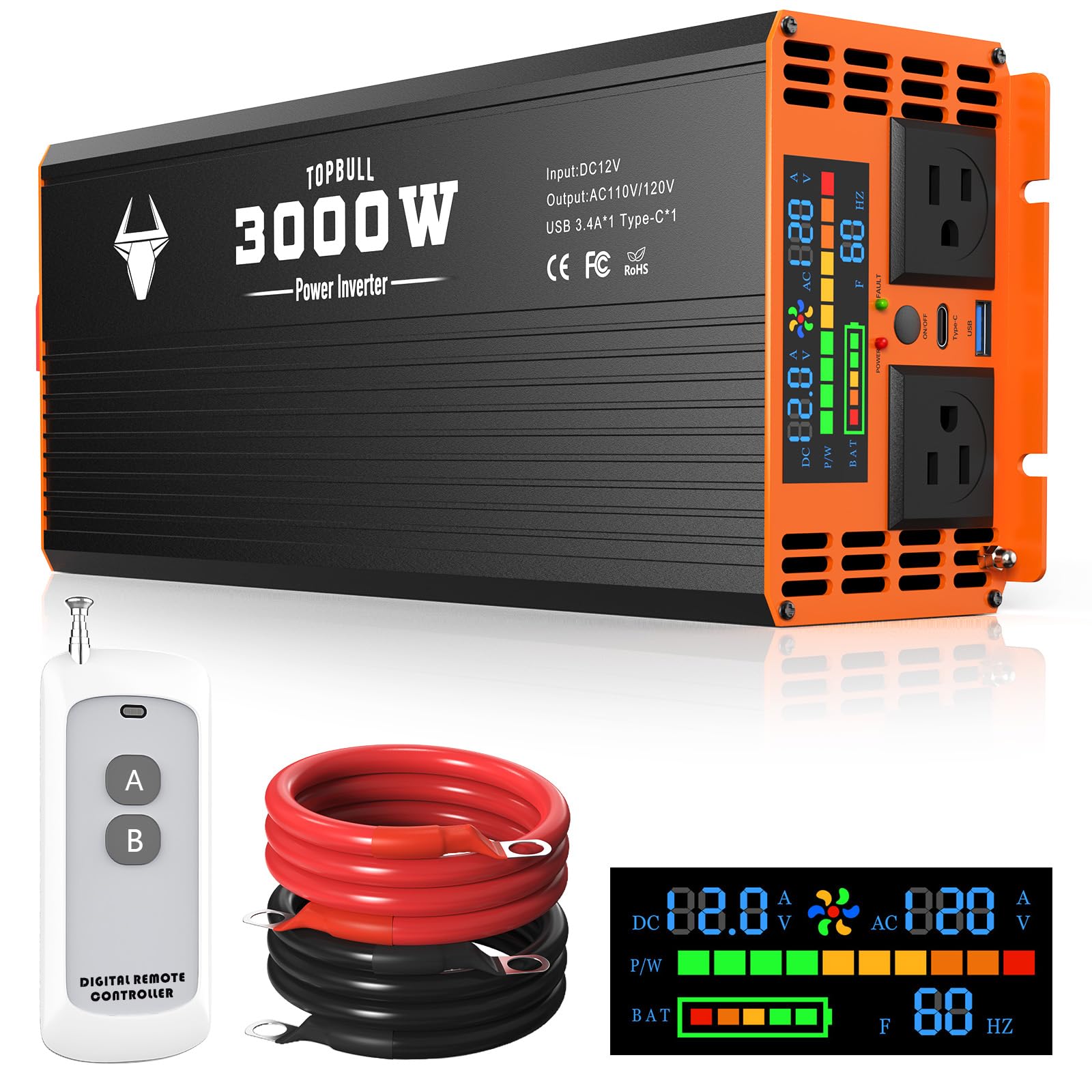
Three thousand continuous watts for the jobs that smaller inverters cannot touch.
If your load regularly exceeds 1500W — say, running a demolition hammer drill, a large microwave, or a well pump — the TOPBULL brings 3000W continuous and 6000W peak surge. That is 3000W continuous versus the BESTEK’s 1000W and enough to power two 1500W space heaters (not simultaneously at full tilt, but within surge range). It uses a high-frequency transformer with 100% pure copper ultra-flexible cables, built into an aviation-grade aluminum alloy shell that handles rough use. A large LED color screen shows voltage and battery status at a glance, while dual intelligent fans adjust speed based on temperature. One reviewer noted it ran a 25-amp 120V charger at full 3000W output with fans ramping normally and the unit staying warm, not hot.
It offers six layers of safety protection: undervoltage, overvoltage, overload, over-temperature, short circuit, and reverse connection — plus IPM (Intelligent Power Module) and AVR (Automatic Voltage Regulation, which keeps output steady when input voltage fluctuates). At 16.14 x 6.14 x 3.45 inches, it is the longest unit here and requires battery-direct connection with included 4 AWG cables (AWG stands for American Wire Gauge; a lower number means thicker wire).
Massive 3000W capacity
- 3000W continuous / 6000W peak — enough for heavy tools and appliances that stall a 1000W unit
- Aviation aluminum shell with dual smart fans for sustained high-load use without overheating
- Clear LED color screen and six protection modes for safe operation
Large footprint
- Modified sine wave limits it to rugged tools and resistive loads — skip if you need to power sensitive home electronics
- Large size (16.14 inches long) demands dedicated installation space in an RV or truck bed
High-power tools: you run power tools, pumps, or high-draw appliances on a job site, in a workshop, or in an RV with battery bank capacity to match.
Compact setups: your gear includes TV, audio equipment, or a laptop that needs clean sine-wave power — pay up for the BELTTT instead.
4. OLTEANP 1000W Power Inverter

A well-priced 1000W inverter with an LCD screen that tells you voltage at a glance.
Like the BESTEK, the OLTEANP provides 1000W continuous and 2000W peak surge in a compact frame (7.87 x 4 x 2.28 inches), but it adds a smart LCD display that shows input voltage, output voltage, and battery status — plus protection codes like OL (overload) and OH (overheat) for easy diagnostics. It also steps up to a 36W Type-C port for faster laptop charging, though the BESTEK’s 30W PD is close. The unit is UL-listed for safety and includes both battery alligator clips and a cigarette lighter plug in the box.
Buyers on road trips report it powers a laptop, coffee maker, and mini fridge simultaneously without issue, and reviewers like the voltage monitor for catching battery drops early. That said, a couple of owners had trouble deciphering the LCD readout and the minimal manual. And like every 1000W inverter here, the lighter socket is only safe up to about 150W — you must connect to the battery with the clips for loads above that. Its modified sine wave output means it is not recommended for refrigerators, microwaves, or sensitive medical devices, according to the manufacturer’s own specs.
Compact, affordable
- Built-in LCD with protection codes for real-time battery voltage and troubleshooting
- 36W USB-C port outpaces the 30W PD on the BESTEK for laptop charging
- UL-certified with both cigarette lighter plug and alligator clips included
Lower surge capacity
- LCD interface and manual can be confusing, according to some buyers
- Modified sine wave — not suitable for fridges, microwaves, or CPAP machines
Basic devices: campers and road-trippers who want a compact 1000W unit with on-screen battery monitoring to avoid draining the car battery.
High-startup loads: you need to run a refrigerator or sensitive medical gear — the modified sine wave and manufacturer warning rule those out.
5. FSATBTNE 400W Power Inverter

The compact entry-level pick that charges a MacBook Pro faster than any other here.
At 400 watts continuous and 800 watts peak, this little unit cannot run a fridge or a saw — but its 65W PD USB-C port is the fastest laptop charger in this entire list. Reviewers point out it charges a MacBook Pro 14-inch to 50% in 37 minutes. It offers 65W PD versus the BESTEK’s 30W PD. It also has an 18W QC USB-A port and two AC outlets for plugging in a phone charger or a small lamp.
The body is 4.6 x 3.1 x 1.8 inches — roughly the size of an iPhone — with an aluminum alloy housing for heat dissipation and a built-in MCU chip (microcontroller unit) that auto-detects the voltage and current needed by each device. An intelligent cooling fan adjusts speed based on ambient temperature to keep it quiet. The 24-inch cigarette lighter cable makes it easy to reach the port from the dash or rear seat. Just keep expectations in check: 400W continuous means it is strictly for small electronics and laptop bricks, not power tools or appliances.
Small, portable
- 65W PD USB-C is the fastest laptop charging port in the entire lineup
- Compact aluminum body (4.6 x 3.1 x 1.8 inches) slips into a glove box or door pocket
- 24-inch cigarette lighter cable is long enough to reach back seats or trunk cubbies
Low wattage
- 400W continuous cannot run a fridge, a coffee maker, or any power tool
- No battery clamps — limited to the lighter socket’s ~120W usable limit for sustained loads
Car charging: daily commuters or road trippers who mostly need super-fast laptop and phone charging without the bulk of a larger inverter.
Full home backup: you plan to power a mini fridge, a CPAP machine, or anything drawing over 150W — step up to the 1000W BESTEK.
Understanding the Specs
Continuous Wattage vs Peak Surge
Continuous wattage is the steady power the inverter can supply hour after hour, which is the number you match to your device’s running draw. Peak surge covers the brief startup spike — typically two to three times the continuous rating — for devices like fridge compressors or induction motors. If your gadget draws 800W running, you need an inverter rated for at least 800W continuous, even if it claims 2000W peak.
Modified Sine Wave vs Pure Sine Wave
Modified sine wave inverters produce a stepped approximation of AC power. They work fine for simple electronics, laptop bricks, and incandescent lights, but motors may run hotter and hum, and some sensitive gear (digital clocks, variable-speed fans, medical devices) may malfunction or fail over time. Pure sine wave inverters deliver a smooth, utility-grade current that matches what comes out of a wall outlet, so any device rated for household power runs exactly as expected.
FAQ
Will a 400W inverter run my laptop and phone at the same time?
Can I use a 1000W inverter with the cigarette lighter socket?
What appliances will a modified sine wave inverter damage?
How long can I run a fridge off a 1000W inverter on a car battery?
Can I leave an inverter plugged in when the car is off?
What is the difference between continuous and peak watts?
Does a pure sine wave inverter use more battery power than modified sine?
What gauge wire do I need to hardwire a 2000W inverter?
Final Thoughts: The Verdict
For most buyers, the best auto power inverter is the BESTEK 1000W because it strikes the best balance of real-world power delivery, safety certification, and price — it runs a fridge and power tools, yet stays compact enough for a car or RV. If you need clean pure sine wave for sensitive electronics like a CPAP or modern TV, grab the BELTTT 2000W. And for heavy-duty workshop or worksite loads where nothing else cuts it, the TOPBULL 3000W brings the raw wattage you need.
How We Picked
We do not accept paid placement. Every pick is matched to a real buyer and a real use-case; we do not hands-on test units.
Sources & Methodology
Specifications: manufacturer listings and product documentation. Review insights: verified customer reviews, as of July 2026. Pricing: not shown on this page (it changes often); check the current price via the retailer link.
As an Amazon Associate, Gadgets Feed earns from qualifying purchases. This does not affect which products we feature.