
Our readers keep the lights on and my morning glass full of iced black tea. As an Amazon Associate, I earn from qualifying purchases.
Specs are compiled from manufacturer listings and verified buyer reviews and can change over time — please confirm the key details on the product page before buying.
If your factory stereo has no USB slot, you already know the daily annoyance: no charging, no flash-drive playlists, and a phone dangling from a cigarette-lighter adapter. A single-DIN head unit with a front USB port fixes all three, and the nine picks below run from basic Bluetooth receivers to a wireless CarPlay screen that stays readable in direct sunlight.
I’m Min — the founder and writer behind Gadgets Feed. This guide is built by comparing the manufacturers’ published specifications and the patterns across verified customer reviews, so you get each pick’s real strengths and trade-offs instead of marketing spin.
You’ll see which units charge your phone fast while playing music, which ones need an external amp to wake up your door speakers, and which screens wash out in the sun. Below is the shortlist of the Best Auto Radio With USB.
Our Picks at a Glance


How To Choose The Best Auto Radio With USB
A single-DIN radio with USB has one job that matters more than any spec sheet bullet: it must physically fit your dash opening, and it must charge and play from the USB port at the same time. Equalizer depth, preamp voltage, and display type matter only after those two. The three checks below cover dash depth, USB charging amperage, and preamp outputs.
Chassis depth decides whether install day is easy or awful
Old dashes were built around a CD mechanism, which is why 1990s and early-2000s vehicles have deep radio wells. A mechless receiver (one with no CD slot) uses a much shorter body, so it slides into tight cavities with room left over for the wiring bundle behind it. The JVC KD-SX27BT, for instance, is built with a short chassis design specifically to simplify installation in cramped openings. In an older car, a full-cab truck, or a golf cart, check chassis depth before wattage.
The USB port is a charger as much as a music player
Your phone can gain battery on a long drive, or barely hold its charge, depending on one number in the listing. Look for an amperage rating (how much electrical current the port sends out). A 1.5A USB port (1.5 amps) is the current standard on better mid-range units, so your phone tops up meaningfully during a commute. A basic data-only port will barely hold its charge. Kenwood’s KMM-BT332U and JVC’s KD-SX27BT and KD-SR87BT all advertise 1.5A USB charging, so on a long drive your phone gains battery instead of draining it while it plays.
Preamp outputs tell you how far the system can grow
Preamp outputs (often called RCA outputs) let you send a clean low-level signal to an external amplifier or a subwoofer later. A receiver with front and rear RCA outputs supports a four-speaker amp upgrade without replacing the head unit. A receiver with a dedicated subwoofer output supports a sub, which is the single biggest improvement most people make. If you plan to add bass, buy a unit with at least a rear/sub output pair now.
Quick Comparison
| Model | Best For | Power | USB Charging | Preamp Outputs | Amazon |
|---|---|---|---|---|---|
| Kenwood KMM-BT332U★ Best Overall | Overall balance of sound and features | 50W x 4 | 1.5A | 6-channel (rear + sub, 2.5V) | Amazon |
| JVC KD-SX27BTBest for Amp Builds | EQ tinkerers on a budget | 100W max (50W x 2 channels) | 1.5A | Preamp-out for additional amp/sub | Amazon |
| Sony DSX-A410BTBest Dual Phone | Two-phone households and farm vehicles | 4-channel output | — | Rear RCA outputs | Amazon |
| JVC KD-SR87BT | CD collections that still matter | 50W x 4 | 1.5A | 2-channel (rear/sub, 2.5V) | Amazon |
| Kenwood KMM-BT270U | Simple controls, no manual needed | 200W max | USB charging (rated rate not published) | — | Amazon |
| Sony XAV-AX6000 | Wireless CarPlay with a big screen | 5V pre-amp outputs | USB-C | 5V front, rear, sub (gold-plated) | Amazon |
| Pioneer MVH-S230BT | Reliable Bluetooth on a tighter budget | 50W x 4 | USB input | Front & SW RCA output | Amazon |
| Pioneer MVH-S110BT | Bare-bones AM/FM upgrade | 50W x 4 | USB input | Front & SW RCA output | Amazon |
| JBL Celebrity150 | Feed-an-amp builds on a tight budget | — | USB input | Front/rear/sub RCA outputs | Amazon |
In‑Depth Reviews
1. Kenwood KMM-BT332U Bluetooth Single DIN Car Stereo
Our pick — 4.5★ from 600+ verified ratings; the strongest balance of quality and price.
The Kenwood that turns a 35-year-old dash into a modern streaming station without a screen in sight
Install this one if your goal is a deep, tunable sound system in a vehicle you plan to keep. Six-channel preamp outputs (2.5-volt rear and sub connections that let you hook up external amplifiers later) mean the little black box can drive a full door-speaker-plus-sub build. The built-in 50-watts-per-channel amplifier handles four speakers on its own. Its front USB port pushes 1.5A, enough to visibly charge a phone during a commute rather than just slow its drain. And it plays MP3, WMA, WAV, and high-res FLAC files — lossless formats that keep every detail of a track instead of compressing it.
You get finer control over your sound than budget decks allow, thanks to a 13-band equalizer (13 separate sliders for shaping frequencies) with digital time alignment. Time alignment delays each speaker’s output so the sound from every door reaches your ears at the same moment. That is why owners in lifted trucks and rock crawlers, where the speakers sit far apart, hear tighter staging. The Music Mix feature lets up to five paired smartphones stream and control playback, so passengers can queue their own songs. This is also the physically smallest unit on the list — measured at 7.19 inches deep by 3.93 inches wide by 2.06 inches high, roughly a 3.6x difference in that footprint versus the JBL Celebrity150 at 1.97 by 7 by 3.43 inches. Old dashes and golf carts swallow it easily.
The sensible warning: the screen is a small monochrome LCD, and owners say it’s genuinely hard to read in bright sunlight. Like every mechless unit here, it plays no CDs. It also carries a detachable faceplate, so you pop the front panel off and pocket it when you park. That detachable face is the reason this unit has held strong on reliability, though it means one more thing to keep track of. Buyers report it capably: “Kenwood deck sounds excellent, replacing 35-year-old Panasonic. Amped to Eclipse 3640 bridged on rears to sub, 90W marine front speakers. Big upgrade in rock crawler Jeep.”
Why owners stay loyal
- Six-channel, 2.5-volt preamp outputs support a real amp-and-sub build later
- 13-band EQ with digital time alignment tunes the whole cabin
- 1.5A front USB charges while it plays, plus a front AUX input back-up
- Only 1.3 pounds of hardware with a slim depth for tight cavities
Where it asks patience
- No CD slot, and no CD changer support either
- Monochrome display is difficult to read in direct sun, per owner reports
- Built-in Alexa needs pairing set up before it is useful
Reach for this if: you want an amp-ready, EQ-tunable deck with a charging USB port for a truck, off-roader, or older car.
Look elsewhere if: you stream Spotify visually all day and want an app-friendly color screen instead of a hard-to-read LCD.
2. JVC KD-SX27BT Car Stereo with Bluetooth
Thirteen bands of EQ and a short chassis built for people who tinker until the sound is exactly theirs
Count the bands before you count the watts. This receiver carries a 13-band equalizer (13 separate sliders for shaping frequencies) with digital time alignment, plus “JVC Remote” app control for iOS and Android, so you can shape the sound from the driver’s seat instead of stabbing at a menu button. If you upgraded from a decade-old deck and want to hear the difference on factory speakers, this is the one that answers. The K2 technology is JVC’s own processing intended to restore detail lost when a music file was compressed — it won’t add back what a low-bitrate MP3 threw away, but on high-res FLAC files (a format that keeps more musical detail) it’s audible to careful ears. The USB port pushes 1.5A for real charging, and the front panel takes a USB drive or AUX cable for older devices.
Two phones can connect at the same time for calls, and the Bluetooth radio holds up to five devices at once, so family members can swap in without re-pairing. That’s a small convenience until you’ve re-paired a phone at a stoplight, which is the moment you notice. Meanwhile, the phone isn’t the only thing that benefits: the unit plays MP3, WMA, WAV, AAC, and high-res FLAC files.
Older dashes are the real test for this one. The receiver is built with a short chassis design and a reduced weight specifically so it drops into cramped spaces, and 1987 Monte Carlo, ’06 Jeep TJ, and small-truck owners confirm the fit works. What owners don’t love: the limited display in bright sun, and pairing that occasionally needs a phone toggled off and back on to reconnect. The 13-band EQ isn’t for the driver who wants a single “bass” button. It rewards people who enjoy tuning, and it’s the JVC to pick over the CD-equipped KD-SR87BT if you never reach for a disc.
Where it earns its keep: a short chassis made to fit cramped dashboards, plus six channels of EQ control for a system that grows over time.
What reviewers warm to: the sound is described by owners as an “amazing replacement for audiophiles on a budget,” with plenty of settings to make your own signature. Call quality through the included mic gets repeated mention as clear and useful, not an afterthought.
Pick this if: you’re an EQ tinkerer who wants deep sound controls and a compact footprint that slides into an old dash without a fight.
skip it if: you want one-touch bass and treble and no menus to learn, or you need the clock display to be legible in bright daylight.
3. Sony DSX-A410BT Single Din Bluetooth Car Stereo
Two phones connected at once, so the passenger can take the call for once
This model’s party piece is Dual Bluetooth: two smartphones stay paired simultaneously, with the second phone taking hands-free calls while the first handles music, navigation, and contacts. In a two-driver household or a works truck with a rotating crew, that’s the feature you notice every single day — no unpairing, no arguing over who connects first. Voice control lets you manage playback, get directions, and reach contacts by talking instead of tapping, though owners describe the interface as hard to select while driving.
Fit is where this Sony overdelivers. Sound quality is the aspect owners bring up most, with 65 positive mentions, and the extra bass button offers three levels for tuning — not a full equalizer, but enough for casual listening. The white LED screen with red backlight is fixed and cannot be re-colored, so if you want a customizable display, the Kenwood KMM-BT332U above gives you two-zone color control instead.
The known weak spots: Bluetooth can be leisurely to connect, and the rear panel has no AUX inputs — you’ll use the front AUX or USB instead. The Sony Music Center app helps with source switching, fader control, and streaming service access, so pairing your phone with the app smooths some of the rough edges. Sony also makes adding a subwoofer easy, with a dedicated subconnection. For a farm vehicle, motorcycle, or a truck with two regular drivers, the reliability is the selling point.
This is your unit if: two phones need to be usable at once and the radio has to survive a tractor, a boat, or a bike.
Think twice if: you demand instant Bluetooth handshake or you want a color-adjustable screen — both are limited here.
4. JVC KD-SR87BT Single DIN Car Stereo with CD Player

The last holdout for disc collectors who still refuse to burn their library to a thumb drive
Your disc collection stays useful here, because this JVC is the exception on a list where almost every receiver is mechless (no CD slot). It keeps a real CD player alongside Bluetooth, a front USB, and a front AUX input, so your phone streams on top of your discs. The USB port charges at 1.5A — the same charging ceiling as the more expensive Kenwood at the top — and plays MP3, WMA, WAV, AAC, and FLAC files (common digital music formats), so a thumb drive sounds as good as a CD when it needs to.
Your old factory speakers can come alive without adding an amp, if you check the power numbers first. The unit is rated up to 50 watts per channel across four channels, with the “200W” total being the sum across all four. In real installs that’s enough to wake up old factory speakers — an ’80s G-body running 3.5-inch fronts and 4-by-10 rears sounded genuinely good with no amp and no sub, and a ’94 Camry owner running the front USB got stable Bluetooth from a Pixel without a single miss. What you won’t get is deep, chest-thumping bass from the deck alone; for that you’ll want the sub output fed to a dedicated amplifier, which the rear/sub pair can do.
The honest limitation is the display. Owners split on it — some call it outstandingly crisp, others find it dim in daylight, and the adjustability gets a similar split verdict. Treat the screen as adequate rather than dazzling. If you spend most of your drive streaming Spotify without looking at the panel, that’s a non-issue, and this is the only JVC on the list that can still play a scratched road-trip disc when the signal drops.
The value case: a CD player, 1.5A USB charging, a 13-band equalizer, and K2 processing in a single-DIN body — a rare combination for anyone who still owns discs.
Where the display stands: a high-contrast LCD (a screen with strong light-versus-dark contrast) that some find crisp and others find dim, so don’t buy it for the screen.
Best matched to: a classic car or daily driver with a CD collection you refuse to abandon, plus a phone you stream from on the side.
Look elsewhere if: you only stream from your phone and never touch a disc — the mechless Kenwood or JVC gives you more tuning for the same money.
5. Kenwood KMM-BT270U Bluetooth Digital Media Car Stereo Receiver

The Kenwood you can learn from the driver’s seat, with no manual on the passenger side
The controls are the story here. Big physical buttons and a straightforward menu mean you can find the right function by feel, which matters when your eyes belong on the road. A golf-cart owner summed up the appeal in three words — easy to install, simple to control — and that describes the whole experience. The unit carries a MOSFET amplifier rated up to 200 watts max, which is the headroom number, and a 13-band EQ for anyone who wants to fine-tune beyond the presets. The detachable faceplate pops off for parking security, and the front USB takes a flash drive directly so you’re not burning CDs to update a playlist.
You can take calls hands-free, and the receiver supports USB, AUX, and iPod or iPhone playback as inputs. With the correct speakers, the deck’s own amplifier wakes up factory drivers more loudly than the stock radio ever managed — one owner put it plainly, calling this “a great product” that “really woke up the speakers” in a budget swap. The trade-off is a volume ceiling of 35 on the dial, so if you run an amp-heavy system and want finer gradations at high output, adjust your expectations.
Where this Kenwood sits versus its near-twin above: the KMM-BT332U at the top of the list gives you 1.5A USB charging and third-party amplifier plug-ins that this unit doesn’t advertise, while this one keeps things simpler and slightly lighter on advanced features. Buyers who value intuitive operation over deep tweaking will prefer it. The known caveat is Bluetooth pairing, which owners describe as occasionally tricky on first setup — worth a patient five minutes before you give up.
What buyers single out
- Big buttons and a simple menu — control by feel without looking down
- Detachable faceplate for parking security
- Front USB input for flash drives, plus AUX and iPod/iPhone support
- MOSFET amplifier rated up to 200 watts max for headroom
What to watch for
- Volume dial tops out at 35 — limited fine-tuning at high output
- Bluetooth pairing can be fiddly on first connect
- No CD slot — mechless design only
Go with this: if you want the Kenwood brand’s reliability and a control layout you barely have to think about.
Pass if: you plan a heavily amped system and need finer control over absolute output levels.
6. Sony XAV-AX6000 7-Inch Multimedia Receiver
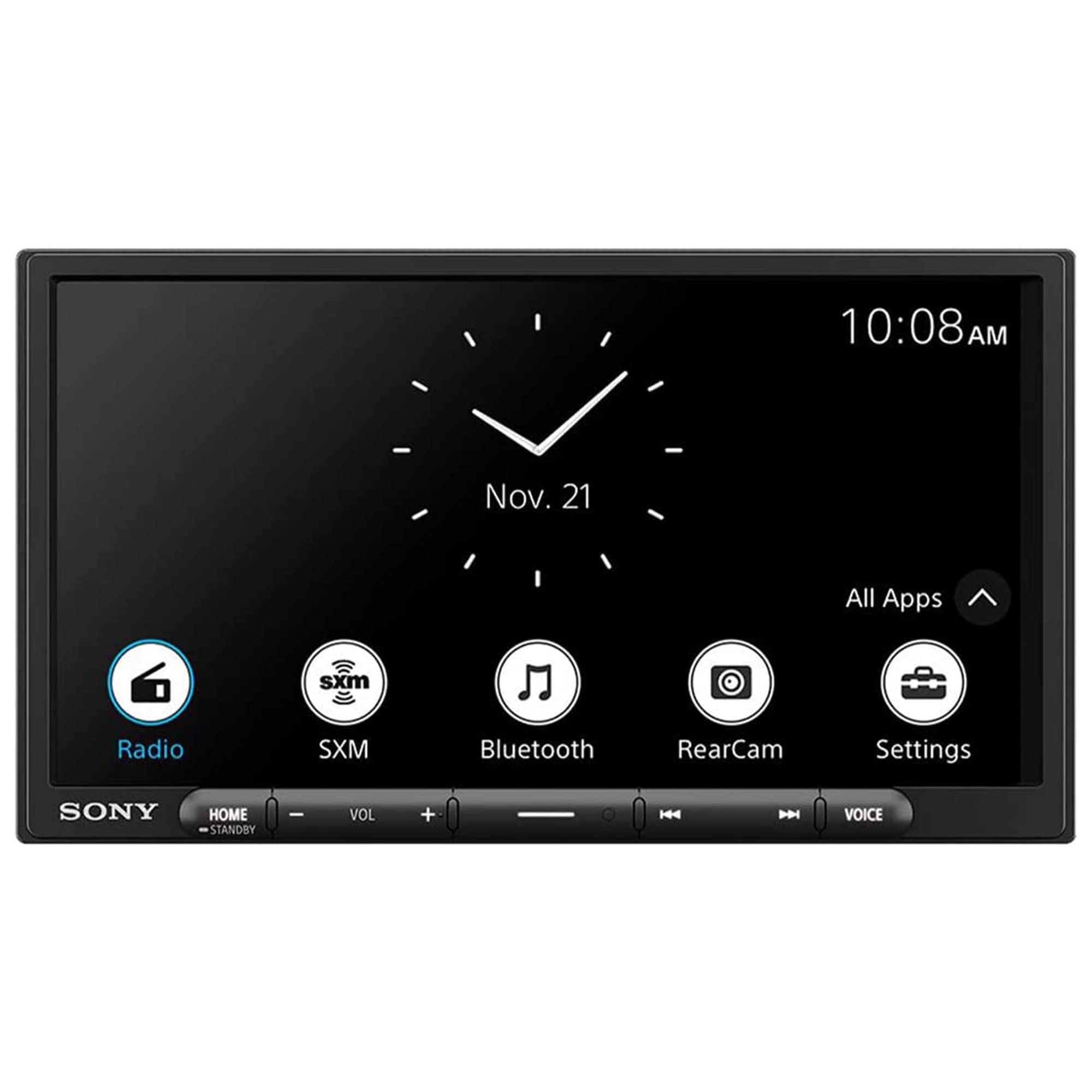
A 7-inch, glare-killing touchscreen that makes your phone disappear from the dashboard entirely
This is the premium pick for one reason: it’s the only unit on the list with a full color touchscreen and wireless Apple CarPlay and Android Auto. Your phone stays in your pocket — the screen handles maps, calls, and music without a cable draped across the console. The display is bezel-less and anti-glare, which matters on sun-facing routes, and owners describe the panel as crisp, bright, and readable in direct sunlight. There is a rear camera input, a 3-year warranty, and input ports for HDMI and USB-C, so a camera and a wired device can both connect at once.
The audio connections are a step up from the single-DIN picks: 5-volt front, rear, and subwoofer gold-plated preamp outputs. Higher preamp voltage sends a stronger, cleaner signal to an external amp, which reduces noise as you turn the amplifier gain up — worthwhile if you’re building a serious system. Owners pair it with Infinity Kappa speakers, an 8-channel amp, and iDatalink Maestro compatibility for steering-wheel controls and vehicle data, and the resulting sound is described as unbelievable-versus-stock. The screen comes off regularly, and the rear chassis is compact enough for vehicles with tight space behind the dash, which is why it works best in cars that have a double-DIN opening.
Two caveats before you commit. First, there’s no physical volume knob, so adjust with buttons or steering controls instead — much easier if your car supports the wheel buttons through an adapter. Second, some owners find off-center viewing angles glare-prone, and steering-wheel controls may need an add-on module to work fully. This is a receiver for the driver who wants modern visuals and wireless convenience over a plain radio look, and the budget buys on this list can’t match it here.
Why it stands apart
- Wireless Apple CarPlay and Android Auto erase cable clutter
- 7-inch bezel-less capacitive touchscreen with anti-glare coating
- 5V gold-plated front, rear, and subwoofer outputs
- HDMI video input, USB-C, rear camera input, and a 3-year warranty
Know before you install
- No physical volume knob — buttons and steering controls only
- Steering-wheel control may need an added Maestro module
- Some find off-center glare, and it wants a double-DIN opening
The obvious match: a modern car owner with a double-DIN opening who wants wireless CarPlay and doesn’t mind a bigger screen.
Best left alone if: you drive an older single-DIN vehicle or you want a physical volume dial to grab without looking.
7. Pioneer MVH-S230BT 1-Din Car Stereo with Bluetooth

Pioneer’s newer budget receiver, with a trick that makes compressed streaming sound less hollow
The differentiator is Advanced Sound Retriever, Pioneer’s processing that attempts to restore detail lost when audio was compressed — useful if you stream from a phone and dislike the thin quality of low-bitrate tracks. It pairs with a USB input that handles charging and playback, a front panel for drag-and-drop file access, and a built-in Bluetooth radio for hands-free calls. Under four inches deep, the mechless chassis slots easily into tight dashes, and the whole unit weighs the same 1.1 pounds as its cheaper sibling below.
Your factory speakers can wake up here, a reputation Pioneer decks carry. One owner who installed it in a Beetle powered four 6.5-inch speakers plus an amp and a 10-inch sub via RCA (a cable that carries audio signals), and reported the Bluetooth connects instantly every time — that pairing consistency is what most people value day to day. The built-in amp, per owners, feels stronger than a stock Colorado radio even on original speakers, with noticeably more bass and volume. What you won’t get is heavy tuning: the equalizer is a 5-band affair with a bass boost, not the 13-band depth of the Kenwoods and JVCs on this list.
Here’s the part to weigh. At 1.1 pounds and around the same physical size, this Pioneer and the MVH-S110BT are near-twins, but the S230BT adds Advanced Sound Retriever (processing that fills in detail lost in compressed audio) and a higher-grade internal amplifier — a small step up for a modest price difference. If you see the two side by side and you stream more than you play files, this is the smarter of the pair. There is a real fail-case worth noting: a small minority of units have been reported to fail to power on after sitting unplugged, so keep your installation tidy and your return window open while you confirm it works through the first few days.
The standout feature: Advanced Sound Retriever, a processing layer built to restore compressed-audio detail, which is worth more than an extra EQ band if you mostly stream.
The honest catch: the equalizer is only 5-band, so diehard tuners will run out of adjustment range — this is a simple, effective deck, not a tuning lab.
Consider this: if you stream from your phone and want Pioneer’s strong factory-speaker wake-up without paying for a full tuning platform.
Skip if: you demand deep EQ control or you want the same brand’s more affordable bare-bones model instead.
8. Pioneer MVH-S110BT 1-Din Digital Media Car Stereo
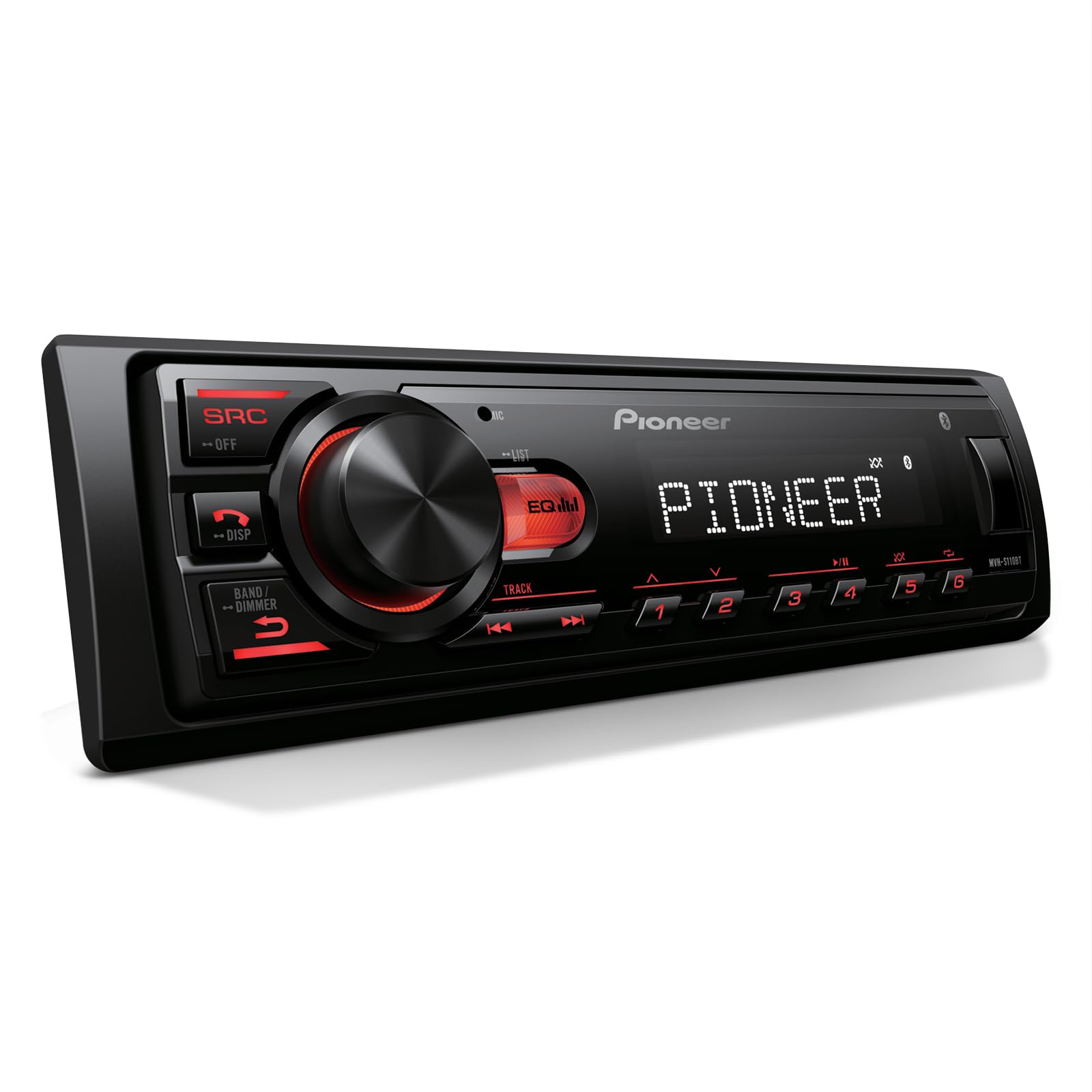
The no-frills Pioneer that just plays your music and gets out of the way
If you want a receiver, not a project, this is the entry level done right. Front USB with FLAC, MP3, and WMA support, a built-in MOSFET amplifier rated up to 50 watts per channel across four speakers, and Direct EQ keys for quick bass, treble, and balance changes on the road. The chassis is deliberately short so it clears space in tight dashes. The whole package weighs 1.1 pounds — lighter by a small margin than the Kenwood KMM-BT332U at 1.3 pounds, which is about an 18% difference if you’re counting every ounce during installation.
Bluetooth handles streaming and hands-free calling, and owners describe the connection as fast and stable once it’s paired. The trick, per multiple reports, is pairing discipline: bring both devices into pairing mode, let the pass key show on the radio face and the phone at the same time, then confirm. Getting impatient with the standard flow is often what makes it feel tricky rather than the radio itself. After that, owners mention it streams without hiccups across the drive.
The bare-bones nature cuts both ways. You get dedicated tone keys instead of a full EQ, so if you want deep, surgical sound shaping you’ll want the Pioneer MVH-S230BT above or a 13-band unit. One owner hit a hang-up where a phone pairing failed until a smartwatch was disconnected — a reminder that busy Bluetooth environments can confuse any single-band receiver. And no CD slot, no camera input, no color screen. What you do get, for a genuinely modest outlay, is a dependable AM/FM and USB deck that beats most factory radios and doesn’t need a second mortgage.
Go for it: if you want a simple, reliable AM/FM plus USB deck and don’t need deep EQ or a color display.
Skip if: you want app control, a large screen, or advanced sound processing — look to the higher Pioneer or the Kenwoods instead.
9. JBL Celebrity150 Single DIN Bluetooth Car Media Receiver

The budget build’s secret weapon: a strong preamp signal that feeds an amp, not a speaker, on purpose
Read the fine print and this JBL makes sense for a specific buyer: someone running an external amplifier and needing a clean, strong low-level output. It has front, rear, and sub RCA outputs and feeds them a high preamp voltage signal, which owners describe as comparable to high-end head units for driving an amp. If you drive door speakers directly from the receiver, you’ll work harder — owners note it needs to be pushed well up the dial to get loud. But if you’re adding a separate amplifier for mids and highs, this is the arithmetic that wins.
Multiple playback sources give it flexibility: Bluetooth, USB, AUX in, SD card, and FM radio. Detachable face, ISO connector and included wiring harness make the swap-in straightforward if you’re replacing a factory unit. It’s also the physically shallowest of the group — measured at 1.97 inches deep, 7 inches wide, 3.43 inches high — and its build means it drops into tight dash cavities without the fights a deeper unit causes. For a work truck or a low-budget first car, that simplicity is the point.
Two owner gripes surface often enough to mention. The volume dial gets called sloppy, and the volume ceiling is limited — it won’t roar from the deck alone even at full tilt. The display dims and can be buggy, so don’t buy this for the screen. Bluetooth stuttering has been reported, occasionally dropping for a half-second before resuming. None of that stops the core job — a reliable preamp for a budget amp build. Owners sum it up generously: “it’s awesome, plus it has all the rca outputs i need for my door speakers plus my sub.”
Who this is built for: the audiophile on a budget who is adding an amp and a sub and wants the strongest RCA signal per dollar.
The fair caveat: on its own, driving door speakers directly, it sounds thin until you crank the dial — plan for an amp if you buy this.
Pick this: if you’re feeding an external amp and sub on a tight budget and want strong preamp signal, not screen time.
Not for you if: you plan to run door speakers straight off the deck and want serious onboard volume.
Understanding the Specs
USB charging rate in amps
The amp rating of the USB port tells you how fast your phone refills while it’s plugged in. A 1.5A port is the faster end of what these head units offer and will visibly add charge on a commute. A lower, unrated port may only slow the drain. If your phone needs a lot of juice for navigation, pick a unit with an explicit 1.5A spec, like the Kenwood KMM-BT332U or the two JVC models here.
Chassis depth (D x W x H)
Depth is the number that decides whether a receiver drops into your dash or fights you. A short, mechless body clears the wiring bundle behind the mounting sleeve, which is why old-truck and golf-cart installers prize shallow units. Standard DIN width is about 7 inches, so a depth under 4 inches tends to fit wherever a factory radio came out. Deeper bodies with a CD mechanism need more rear clearance.
Preamp output voltage and channel count
The preamp outputs send a low-level signal to an external amplifier. Higher voltage — such as the 5-volt outputs on the Sony XAV-AX6000 — delivers a stronger, cleaner signal that resists noise as amp gain rises. Channel count tells you how much the system can grow: front and rear pairs cover a four-speaker amp, and a dedicated sub output covers added bass. Buy for the amp and sub you plan to add, not just the speakers you have now.
Equalizer bands and time alignment
An equalizer lets you shape the tone across frequency ranges; more bands mean finer control. A 13-band EQ, like the one on the Kenwood KMM-BT332U and JVC KD-SX27BT, offers deep adjustment, while a 5-band EQ on the Pioneer MVH-S230BT keeps things simple. Digital time alignment delays individual speakers so their sound reaches your ears together, sharpening the staging in vans and lifted trucks where speakers sit far apart.
FAQ
Will a single-DIN radio with USB fit my car?
Does the USB port charge my phone or only play music?
Do I need an external amplifier for good sound?
What is the difference between a mechless receiver and a CD receiver?
Why does my Bluetooth disconnect or stutter?
Can I connect two phones to the same car stereo at once?
Will a USB flash drive work as well as my streaming phone?
Do I need a special harness to install these radios?
How do I keep my car stereo safe from theft?
Final Thoughts: The Verdict
For most drivers, the auto radio with usb winner is the Kenwood KMM-BT332U because it balances a genuinely tunable 13-band EQ (13 separate sliders for shaping frequencies) and six-channel preamp outputs with a 1.5A charging USB port — and its shallow chassis fits the tight dashes that trip up deeper units. If you want a CD player that still works alongside Bluetooth, the JVC KD-SR87BT keeps a disc slot without giving up the 13-band EQ or 1.5A charging. And for wireless Apple CarPlay and Android Auto on a full-color screen that stays readable in bright sun, the Sony XAV-AX6000 is the one to reach for. If your priority is simply the strongest preamp signal per dollar for an amp-and-sub budget build, the JBL Celebrity150 delivers front, rear, and sub RCA outputs that owners compare to far pricier head units. Pick the one that matches your dash depth and your daily routine, then enjoy charging your phone while the music plays.
How We Picked
We do not accept paid placement. Every pick is matched to a real buyer and a real use-case; we do not hands-on test units.
Sources & Methodology
Specifications: manufacturer listings and product documentation. Review insights: verified customer reviews, as of September 2026. Pricing: not shown on this page (it changes often); check the current price via the retailer link.
As an Amazon Associate, Gadgets Feed earns from qualifying purchases. This does not affect which products we feature.