
Our readers keep the lights on and my morning glass full of iced black tea. As an Amazon Associate, I earn from qualifying purchases.
Specs are compiled from manufacturer listings and verified buyer reviews and can change over time — please confirm the key details on the product page before buying.
Salt on winter roads and humid coastal air can turn your vehicle’s frame into a rust bucket, and the choice of what you spray on the metal often decides whether your car lasts a decade or gets scrapped early. The best auto rust inhibitor penetrates seams, self-heals after scrapes, and blocks moisture from reaching bare steel. Choosing the right formula determines whether you reapply yearly or seal it once.
I’m Min — the founder and writer behind Gadgets Feed. This guide is built by comparing the manufacturers’ published specifications and the patterns across verified customer reviews, so you get each pick’s real strengths and trade-offs instead of marketing spin.
We’ve broken down the top formulas, from cavity-penetrating aerosols to brush-on urethane coatings, so you can match the right protection to your climate and project. auto rust inhibitor choices this clear make protecting your vehicle’s undercarriage straightforward.
Our Picks at a Glance


How To Choose The Best Auto Rust Inhibitor
Rust inhibitors split into two families: thin penetrating oils that creep into seams and stop existing corrosion, and thick coatings that seal the surface from air and moisture. Your choice depends on where you’re applying it and how long you want the job to last.
Match the Format to the Location
Inside frame rails and rocker panels, you need an aerosol with a long extension wand that can reach deep into the cavity. For flat surfaces like floor pans and suspension arms, a brush-on urethane paint gives a much harder, more durable shell that resists rock chips better.
Check the Coverage Math
Every can lists a coverage figure, typically in square feet, and that number tells you how many cans you’ll need for a full vehicle. A 12-ounce aerosol might cover a pickup truck’s frame only if you buy three or four of them, so always estimate high before starting the job.
Quick Comparison
| Model | Best For | Format | Coverage | Dry Time | Amazon |
|---|---|---|---|---|---|
| Eastwood Internal Frame Coating★ Best Overall | Cavity & frame rail interiors | Aerosol | 50 sq ft | 24 hours | Amazon |
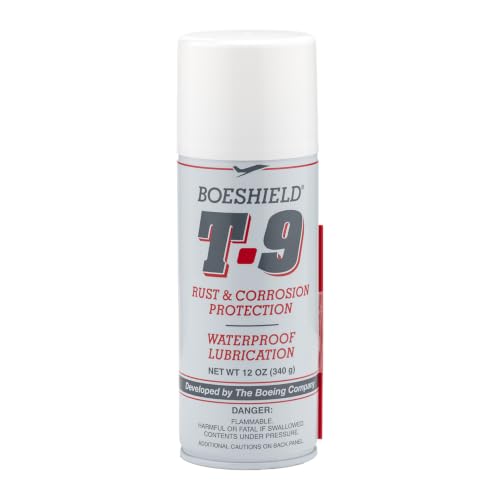
| BOESHIELD T-9Dry Lube | Tools, locks & exposed metal | Spray | — | Minutes | Amazon |
| CorrosionX Heavy DutyMarine Grade | Marine & saltwater exposure | Aerosol | — | — | Amazon |
| CorrosionX 90102 | Electrical connections & electronics | Aerosol | — | — | Amazon |
| CRC 06026 Heavy Duty | Full underbody & winter prep | Spray (4 pack) | — | Hours | Amazon |
| B’laster Surface Shield | Underbody lanolin coating | Spray (6 pack) | — | — | Amazon |
| KBS Coatings RustSeal | Brush-on hard shell finish | Liquid | 50 sq ft | — | Amazon |
| Rust-Oleum Pro Grade Rubberized | Underbody sound deadening & coating | Aerosol | 10-15 sq ft | 1 hour | Amazon |
| POR-15 Rust Preventive Coating | Permanent hard barrier on rusted metal | Liquid | 32 sq ft | 2-5 hours | Amazon |
In‑Depth Reviews
1. Eastwood Internal Frame Coating Aerosol
Our pick — over 4.5★ from 900+ verified ratings; the strongest balance of quality and price.
The cavity-coating specialist that saves a chassis from the inside out.
This black aerosol earns its spot because it handles two jobs at once: it stops rust that has already started and prevents it from forming in the first place. That dual action makes it the pick for serious restoration work on frame rails, where you can’t scrub the metal clean once it’s welded together. Owners who coated the inside of main frame rails on an Austin Healey 3000 reported all three cans worked perfectly and called the whole process easy — high praise for something that usually requires contorting under a car.
The real trick here is the 360-degree spray wand, which rotates to coat every inner surface even in blind cavities. It covers a solid 50 square feet per can, and the gloss black finish cures fully in 24 hours. Buyers report that it “coats very well” thanks to that wand, and that it dries fast, though the warning labels are worth reading seriously — Eastwood specifies a 90-day warranty and notes the product needs eye, skin, and respiratory protection plus a well-ventilated space. The recurring tip from long-time users is practical: order a can more than you think you need, because the tube lacks real support and flails around unless you rig a DIY hanger to control it. The thing everyone raves about is the overall quality — even owners using it in tight spaces and inside frames find it works exceptionally well.
It’s also heavier than a typical aerosol at 13.76 ounces, so you feel the value in hand, and the waterproof formula means the protection doesn’t wash away with the first rain. For a 2013 Chevy 2500 frame, one owner found three cans covered the back half completely, which tells you roughly how to plan your own project.
Why Owners Stick With It
- Rust converter plus preventer in one coating saves a second step
- 360° wand reaches inside closed frame rails and bolt holes
- Waterproof gloss finish resists moisture once cured
Plan Around These
- Flexible tube flails during use without a DIY support rig
- Strong chemical warnings demand a respirator and goggles
- Coverage varies by frame size, so buy extra cans
Reach for this if: you’re doing restoration or rust-prevention work inside frame rails where a standard spray nozzle simply can’t reach.
Look elsewhere if: you want a quick wipe-on coating for visible panels — this is built for internal cavities, not show finishes.
2. BOESHIELD T-9 Rust Remover & Corrosion Inhibitor
A non-oily dry film that lubricates and shields metal without the mess.
What makes T-9 stand out is what happens after you spray it: the liquid dries in minutes into a smooth, non-oily, non-sticky finish that still locks out moisture. That’s a meaningful difference for tools and garage equipment, because unlike a wet oil film that collects dust and grime, this waxy coat stays clean and keeps working. Owners mention using it on locks, hinges, saws, bearings, and even RV slide-room guide blocks, and it holds up well in hot, humid climates where lithium grease and silicone spray tend to congeal and fail.
The 12-ounce can is lighter than the heavier heavy-duty options, and it’s biodegradable and non-toxic, which matters if you’re spraying in a shared workspace. It excels at fixing small problems before they grow: owners describe it smoothing a hitch coupler, removing rust, and preventing further corrosion for months at a time, with the film repelling dirt so it doesn’t turn into an ugly black sludge. It’s also a genuine dry lubricant, so it reduces friction and wear on moving parts rather than just sitting there as a passive barrier.
The trade-off is that value opinions split — some call it pricey for a 12-ounce can, though the same owners tend to add “but worth it” because the protection genuinely lasts. Since it dries to a waxy film rather than a hard shell, it’s best used on exposed surfaces and moving parts, not as a thick underbody coating for a daily driver.
Clean, protective, versatile: the dry film repels dirt and moisture, making it ideal for tools and hardware that you handle regularly.
One honest limit: it’s a thin film, so for a vehicle underbody fighting off salt spray you’ll want a heavier barrier product.
3. CorrosionX Heavy Duty Anti Rust Spray
A self-healing shield that clings through salt spray and pressure washing.
CorrosionX Heavy Duty is the answer for anyone who owns a boat, lives near the coast, or faces relentless saltwater exposure. The defining feature here is the self-healing barrier — it clings to metal through rain, seawater, and pressure washing without dripping or washing away, and it keeps working for up to 5 years indoors and 2 years outside. That’s a genuinely long protection window for an aerosol, which is why saltwater owners keep coming back to it.
The formula is thicker than a standard penetrating oil, which is exactly the point: it won’t run off vertical surfaces, and it stays flexible so it flexes with machinery instead of flaking and cracking like waxy sprays that dry out. Boat customers note that a monthly coating stops and fixes salt corrosion while keeping the equipment looking new, and the Polar Bonding chemistry locks onto surfaces to stop corrosion before it starts, even in places you can’t see like engine bays. It’s also ideal for heavy-duty electrical connections like battery posts and grounding lugs because the thick formula won’t harm sensitive components.
Here’s the honest catch: it’s sticky and it can stain clothes. The same goopy consistency that makes it cling also means it attracts dirt over time and won’t stay clean-looking. Most owners accept this as the trade-off for protection that actually lasts, and they describe it as cost-effective despite the price. One even called it a must-have after five purchases, which is about as strong a vote of confidence as a rust product gets.
Built For The Worst Weather
- Self-healing barrier resists salt spray, rain, and pressure washing
- Protects up to 5 years indoors and 2 years outdoors
- Flexes with machinery instead of flaking off
Know Before You Spray
- Sticky texture attracts dirt and stains clothing
- Thick formula is goopy during application
- Premium price point despite the long-term value
Choose it for: boat trailers, winches, barn doors, and any metal that lives in saltwater or coastal air year-round.
Not for: anyone who wants a clean, dry finish — this one stays tacky and collects grime by design.
4. CorrosionX 90102 Rust Inhibitor

The dielectric favorite that keeps boat electronics corrosion-free for years.
If your rust problem involves electricity — battery terminals, sensors, circuit boards, or the exposed connections under a boat’s dash — this is the inhibitor built for exactly that. The key spec is the dielectric film rated over 39,000 volts, which means it forms a moisture-blocking barrier on electrical components without shorting them out, displacing water and stopping galvanic corrosion between different metals touching each other. It’s the flagship product of a manufacturer that holds a U.S. Navy qualification for advanced marine corrosion protection, which tells you the standard it’s engineered to meet.
Boat owners are the most enthusiastic fans here. The report that comes up again and again is someone spraying every exposed connection on their boat and finding zero corrosion years later. It also works as a penetrating oil, freeing rusted bolts in salty, humid conditions. The 16-ounce aerosol is easy to apply, and owners note that a little goes a long way because it clings to metal like a magnet and resists washout from rain and spray.
The honest downsides: it’s an oil-based lubricant, so it leaves a greasy film that some find messy, and the value debate comes up given the price. But for the specific job of protecting electronics and marine components from saltwater intrusion, owners consistently describe it as class-leading — one called it the best product they’ve used for preventing and treating corrosion, period. If your concern is electrical systems rather than a whole frame, this is the one to reach for.
class-leading for electronics: the 39,000-volt dielectric film (an insulating layer that blocks electrical current) makes it the safest choice for battery terminals, sensors, and marine wiring.
The catch: you pay for that specialization, and the greasy residue isn’t for everyone.
5. CRC 06026 Heavy Duty Corrosion Inhibitor

The hard-wax undercoating that salt-belt drivers swear by for winter.
CRC’s 06026 is the long-term, flexible corrosion inhibitor that dries into a hard wax — and that hardness is the whole story. Unlike soft oily films that wash off with the first pressure wash, this one goes on as a thin amber coating and cures into a shell that survives high-pressure washing and keeps sand sloughing off. Rust-belt reviewers point out hitch and rear axle assemblies looking near-new after six years of winter driving, with just an annual fall reapplication. Its durability makes it a top pick for undercoating in harsh Midwestern winters.
The 4-pack of 10-wt-oz cans gives you enough to actually finish a vehicle, and owners outline a clear strategy: two cans per vehicle for basic coverage, six or more for the full treatment. It handles the usual problem spots well — electrical connections, engine components, fasteners, steering and throttle linkages, shafts, and spindles — and it’s rated for salt spray and high humidity environments. The wax won’t wash off after it cures, and the strong initial smell fades within a few days, which is a common thread in owner reports. One used it for three years of saltwater beach and off-road driving on a Jeep Wrangler and found no rust except a little patina on a pinch weld.
There are two practical gripes: in cold weather the cans tend to clog, and the spray head lacks a straw receiver, so getting into cavities means rigging your own wand or drilling out a FluidFilm nozzle and epoxying a brass end on it. Owners accept this because the protection is genuinely effective and stays on better than competing fluid films. If you’re prepping a vehicle for a salt-belt winter, this is the one that delivers proven results.
What Wins People Over
- Hard wax layer survives pressure washing and sheds sand
- Proven after years of harsh winter, salt, and off-road use
- Flexible film handles linkages, fasteners, and motors
Before You Buy
- Cans can clog in cold weather during application
- No built-in straw receiver for cavity spraying
- Smells strong for a few days after application
Best for: anyone in the salt belt doing an annual fall underbody treatment who wants one product that stays put all winter.
Think twice if: you need to reach deep inside frame cavities without any modification to the spray nozzle.
6. B’laster Surface Shield Rust Prevention Spray
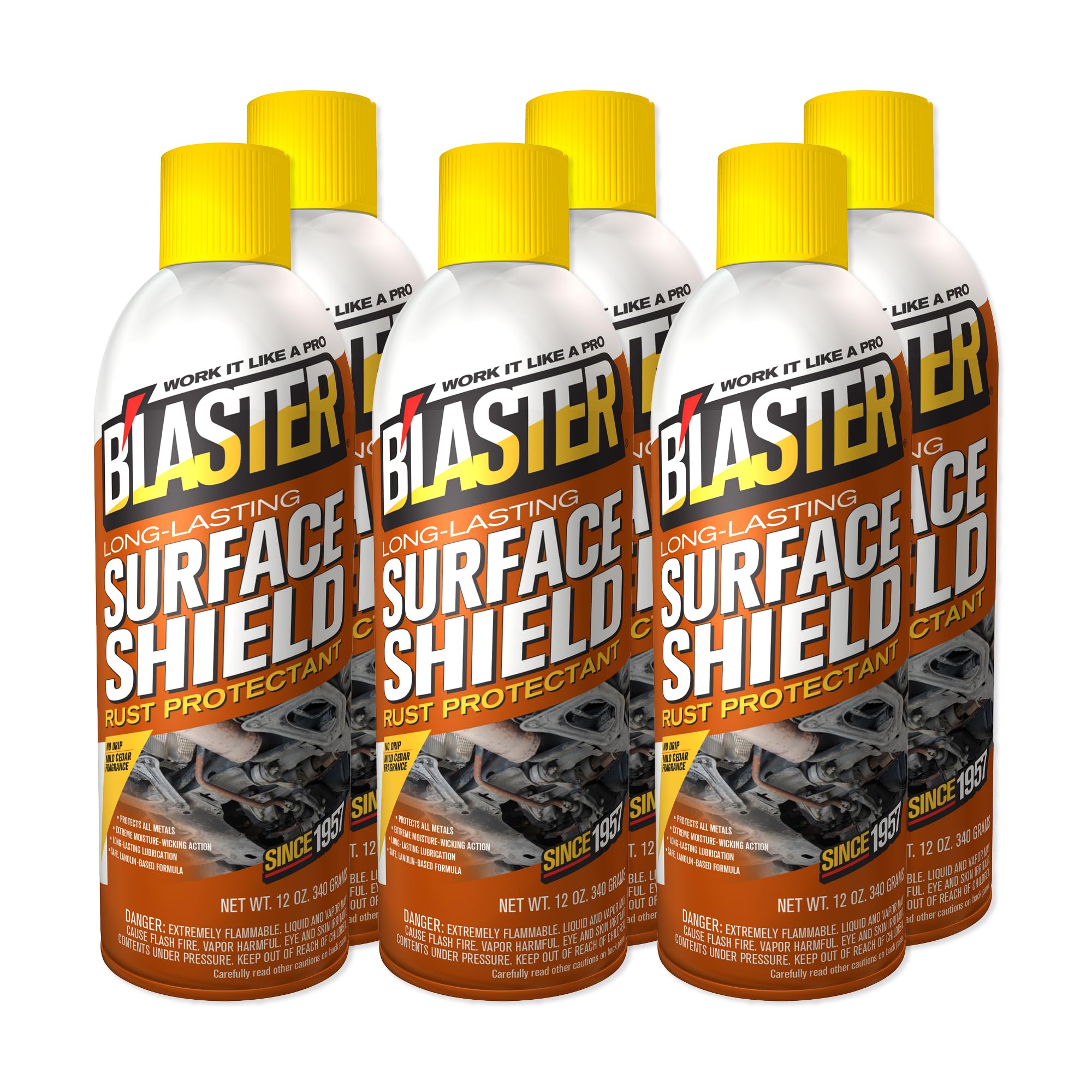
A thick lanolin coating that clings without sagging or dripping.
Surface Shield takes a different path to rust prevention: instead of a wax or urethane, it uses a thick lanolin-based coating that clings to metal and refuses to drip. That makes it a strong candidate for automotive undercoating, where you need a product that stays where you put it on vertical surfaces and doesn’t sag off before it sets. It’s a durable alternative to standard penetrating oils, and it aggressively displaces moisture in automotive, marine, and outdoor environments. One owner found a single can covers about a third of a truck underbody, which helps you plan a full project.
The strongest praise comes from salt-belt drivers. An Ohio owner reports it keeps vehicles looking like new, preferring it to other name brands because it’s thicker and seems to stick and last longer. Long-time salt-belt users — 10-plus years of winter driving — report no rust on 20-year-old Toyotas except on the exhaust, and they describe it as less stinky than Fluid Film and more durable. The manufacturer claims up to 2-year protection, with owners reapplying every two years plus annual touch-ups. The 6-pack is built like a professional solution, and the formula is 50-state VOC compliant.
The honest trade-offs: sprayability and adhesion get mixed feedback. Some cans deliver inconsistently and the coating collects dust, eventually looking ugly even though it’s working as a moisture barrier. It also smells bad when it hits a hot exhaust or catalytic converter, and the cans need a thorough shake because the formula thickens in cold temperatures. The messiness is the most common complaint, but for owners who prioritize effective protection over a clean look, it’s clearly worth it.
Effective and durable: the thick lanolin formula sticks and lasts longer than competing brands in real salt-belt use.
The compromise: it’s messy, collects dust, and smells on hot exhaust — protection over cosmetics.
7. KBS Coatings RustSeal Satin Black

A brush-on urethane that flows out to look powder-coated when it dries.
RustSeal is the answer when you want a hard, permanent shell on visible surfaces rather than a soft film. It’s a liquid you brush, roll, or spray, and it has superior flow and leveling properties — the brush marks flow out and the surface looks like it’s been powder coated. That’s a big deal for chassis, frames, floor pans, and suspension parts where you want both protection and a clean finish. It won’t crack, chip, flake, or peel, and it resists temperatures up to 600°F (316°C), so it’s genuinely tougher than a typical spray film.
The finish quality is what wins owners over — it’s described as beautiful, resembling powder coating, with easy application and good coverage. It forms a permanent non-porous barrier against moisture, oxygen, fuels, oils, most acids, and alkalis. A 2-year review on a 1966 Ford F100 frame found it still looking great with no bubbles or fading. The single quart covers 50 square feet, which is substantial for a frame project, and it’s VOC compliant.
Here’s where real-world prep matters: surface preparation is critical, and owners stress that you need bare metal or sandblasted surfaces, degreasing, and a metal prep step before applying. Skip that and the coating can fail. The brush can leave streaks and pull bristles, so foam brushes work better even though they shed. And the lid will seal shut — store leftovers in a glass jar, not the original can.
Why It Impresses
- Flows out brush marks for a powder-coated look
- Withstands up to 600°F without cracking or peeling
- Single quart covers 50 square feet of surface
Prep Demands
- Surface must be stripped to bare metal and degreased first
- Can lid seals shut — store leftover in a glass jar
- Brush application can leave streaks unless you use foam
Reach for this if: you’re restoring a frame or chassis and want a durable, good-looking finish you can brush on at home.
Not the pick if: you’re looking for a quick spray-and-go film — this demands proper surface prep to perform.
8. Rust-Oleum Pro Grade Rubberized Undercoating
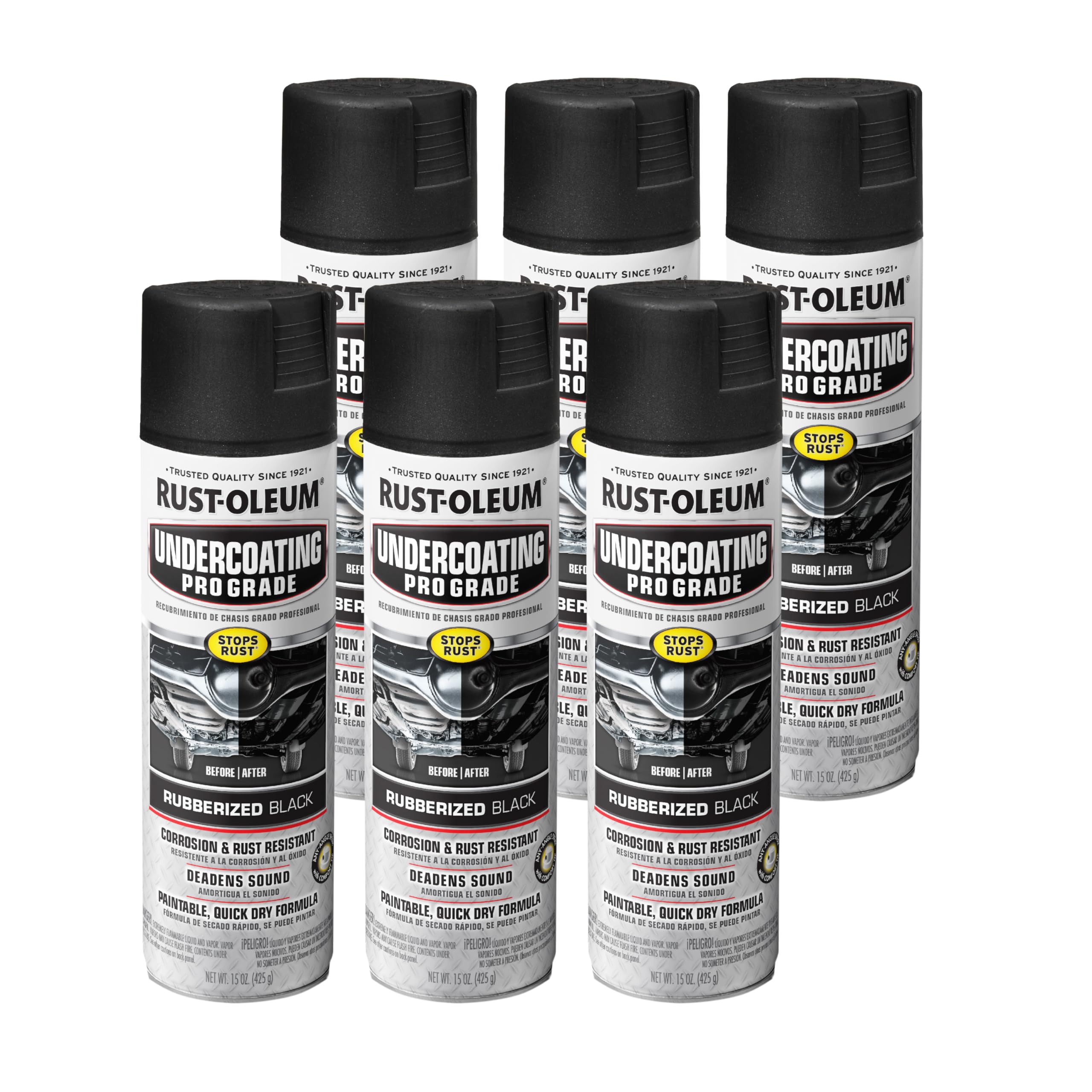
A professional-grade rubberized layer that deadens road noise while it blocks rust.
This Rust-Oleum product does double duty in a way most inhibitors don’t: it’s a corrosion barrier and a sound-deadening layer at the same time. The rubberized formula is designed for bare or primed metal underbodies of cars, trucks, trailers, and RVs, and it helps deaden the noise of road debris hitting the floor pan in addition to protecting against water, salt, and chemicals. It’s a professional-grade coating with a matte black finish, and it handles the aesthetics well — owners describe a very nice finish that adheres well to metal.
Ease of use is a genuine highlight. It dries to the touch in just 1 hour, which gets you back on the road fast, and it features a wide comfort spray tip with any-angle spray technology so you can paint upside down without the nozzle clogging. That any-angle feature matters more than you’d think when you’re contorted under a vehicle reaching up into wheel wells. The coverage is listed at 10-15 square feet per can, and the 443.6 ml can is waterproof once cured.
The practical concerns are coverage and durability. Some shoppers say rust eventually coming through, and others note the coverage per can is thinner than they hoped, which means you may need more cans than expected for a full underbody. It’s also on the premium side of the price spectrum, which one owner flagged even while confirming it works great. The spray is thick and needs shaking longer than the directions suggest — around 2 minutes by one account — but the any-angle tip makes the extra effort worth it. For a weekend undercoating job where you want sound deadening plus rust protection, this is a solid, proven choice.
Great all-rounder: combines corrosion protection with sound deadening in an easy any-angle spray that dries in an hour.
Plan for more cans: coverage runs thinner than expected, and the premium price adds up on a full vehicle.
9. POR-15 Rust Preventive Coating

The moisture-cured standard that forms a hammer-tough barrier on rusted metal.
POR-15 is built on a unique chemistry: instead of drying by evaporation like normal paint, it cures faster when moisture is present. That’s the opposite of every other coating on this list, and it’s the reason the cured finish is described as indestructible and hammer-tough. It forms an impenetrable barrier on rusted or clean metal, ideal for frames, mower decks, and rock sliders. Once cured, the finish is waterproof and resists water, chemicals, salt, and wear.
Owners consistently describe it as durable and long-lasting. A rusted mower deck that gets heavy use proved “quite durable” after treatment, and a steel garage door showed no new rust after about a year. The gray 32-fluid-ounce can covers a full 32 square feet, and it self-levels into a hard, glossy finish. It has excellent surface tolerance on porous materials too — wood, fiberglass, concrete, and brick — which makes it useful well beyond automotive work. The manufacturer’s 3-step system calls for a cleaner-degreaser and metal prep first, and owners agree that proper surface prep is essential for the best results.
The biggest real-world trap is storage: once you open the can, the moisture-curing chemistry means unused paint will harden inside within days. Owners strongly recommend transferring leftovers to a mason jar immediately, because the coating will stick the can lid straight to the can and you’ll never open it again. Peel-off issues are reported by a minority, usually traced back to rushed prep. It’s the premium end of the price spectrum, but for restoration work where you want a permanent seal on rusted metal, this remains the benchmark.
Why It’s The Gold Standard
- Moisture-cured chemistry forms an exceptionally hard, durable shell
- Works directly on rusted metal with proper prep
- 32-ounce can with good surface tolerance on many materials
The Real Trade-offs
- Unused paint hardens in the can within days — transfer to a jar
- Performance depends entirely on thorough surface prep
- Premium price for the top-tier protection
Choose it for: restoration projects where you want a one-time, permanent seal on rusted frames and heavy-use equipment.
skip it if: you’re not prepared to do the prep work and immediately store the leftover open can in a glass jar.
Understanding the Specs
Coverage (Square Feet)
This tells you how much surface a single can or quart will treat, and it’s the first number to check before you buy. A 50-square-foot aerosol like the Eastwood will vanish fast if you’re coating a full pickup frame, so match the coverage to your project size and buy accordingly.
Cure Time vs. Dry Time
Dry-to-touch is how fast you can stop worrying about smudging, while full cure is when the coating reaches maximum hardness. Some sprays dry in minutes, but brush-on urethanes like the 24-hour-cure Eastwood need a full day before the vehicle is really protected.
FAQ
How often should I reapply an auto rust inhibitor to my vehicle underbody?
What is the difference between a rust converter and a rust inhibitor?
Can I spray a rust inhibitor on electrical connections safely?
What is the best way to reach rust inside closed frame rails?
Should I remove rust before applying POR-15 or KBS RustSeal?
What is a dielectric barrier in a rust inhibitor?
How many cans of undercoating do I need for a full-size pickup truck?
Is it safe to store leftover rust inhibitor in the original can?
Final Thoughts: The Verdict
For most people, the auto rust inhibitor winner is the Eastwood Internal Frame Coating because its dual rust-converter and prevention formula combined with a 360-degree wand solves the hardest job in rust protection: reaching inside frame rails. If you want a clean dry film for tools and moving parts, grab the BOESHIELD T-9. And for saltwater and marine exposure where protection must last, the CorrosionX Heavy Duty is the one to reach for.
How We Picked
We do not accept paid placement. Every pick is matched to a real buyer and a real use-case; we do not hands-on test units.
Sources & Methodology
Specifications: manufacturer listings and product documentation. Review insights: verified customer reviews, as of August 2026. Pricing: not shown on this page (it changes often); check the current price via the retailer link.
As an Amazon Associate, Gadgets Feed earns from qualifying purchases. This does not affect which products we feature.