
Our readers keep the lights on and my morning glass full of iced black tea. As an Amazon Associate, I earn from qualifying purchases.
Specs are compiled from manufacturer listings and verified buyer reviews and can change over time — please confirm the key details on the product page before buying.
That orange bloom on your fender or frame isn’t just ugly — it’s actively eating the metal beneath it, and the longer you wait, the deeper it digs. The right auto rust treatment either chemically converts that corrosion into a stable, paintable surface or dissolves it away entirely, so you can stop the damage and seal it out for good.
I’m Min — the founder and writer behind Gadgets Feed. This guide is built by comparing the manufacturers’ published specifications and the patterns across verified customer reviews, so you get each pick’s real strengths and trade-offs instead of marketing spin.
Whether you’re facing a few surface spots or a full frame-off restoration, the best approach starts with choosing the right auto rust treatment for your specific job size and timeline.
Our Picks at a Glance
How To Choose The Best Auto Rust Treatment
Every rust product falls into two camps: converters that chemically change rust into a stable black layer, and removers that dissolve the corrosion off the metal entirely. Before you buy, ask yourself whether you plan to paint over the treated area or leave it bare, and how much surface you need to cover.
Match the product to your prep tolerance
Some treatments demand you wire-brush loose scale first, while others claim you can spray straight over surface rust. Be honest about the condition of your metal — heavy flaking rust needs mechanical removal no matter which product you choose, and clean metal means the treatment can actually bond.
Know your cure time and coverage
Full cure time is the difference between a weekend project and a week-long wait. A converter that cures in 1 hour gets you painting the same day, while a 48-hour cure means planning around a multi-day pause. Coverage per can or quart also decides how many containers you’ll need for a frame or trailer.
Quick Comparison
| Model | Best For | Full Cure Time | Container Size | Coverage | Amazon |
|---|---|---|---|---|---|
| Gempler’s Rust Converter★ Best Overall | Large area painting prep | 48 hours | 1 Quart | 125 sq ft | Amazon |
| Dupli-Color Rust FixBest Value | Quick spray touch-ups | 1 hour | 10.25 oz | 12-15 ft²/can | Amazon |
| B’Laster Surface ShieldTop Performer | Undercoating prevention | — | 2 Pack | — | Amazon |
| LISRUX 4-in-1 Converter | Heat & UV exposed metal | 24 hours | 34 fl oz | — | Amazon |
| Custom Shop Barrier Bond | Hard-to-reach spots | 24 hours | 10 oz | — | Amazon |
| MuzeFansi 2-in-1 Converter | Primer & paint in one step | 24 hours | 35 fl oz | Under 400 sq ft/gal | Amazon |
| Rust911 Remover | Submersion parts soaking | — | 32 oz (makes 4 gal) | 600 lbs steel/gal | Amazon |
| POR-15 Coating | Permanent hard barrier | 5 hours | 16 fl oz | Extensive | Amazon |
| BLACK STAR Converter | No-prep brush & roll | — | 1 Quart | — | Amazon |
In-Depth Reviews
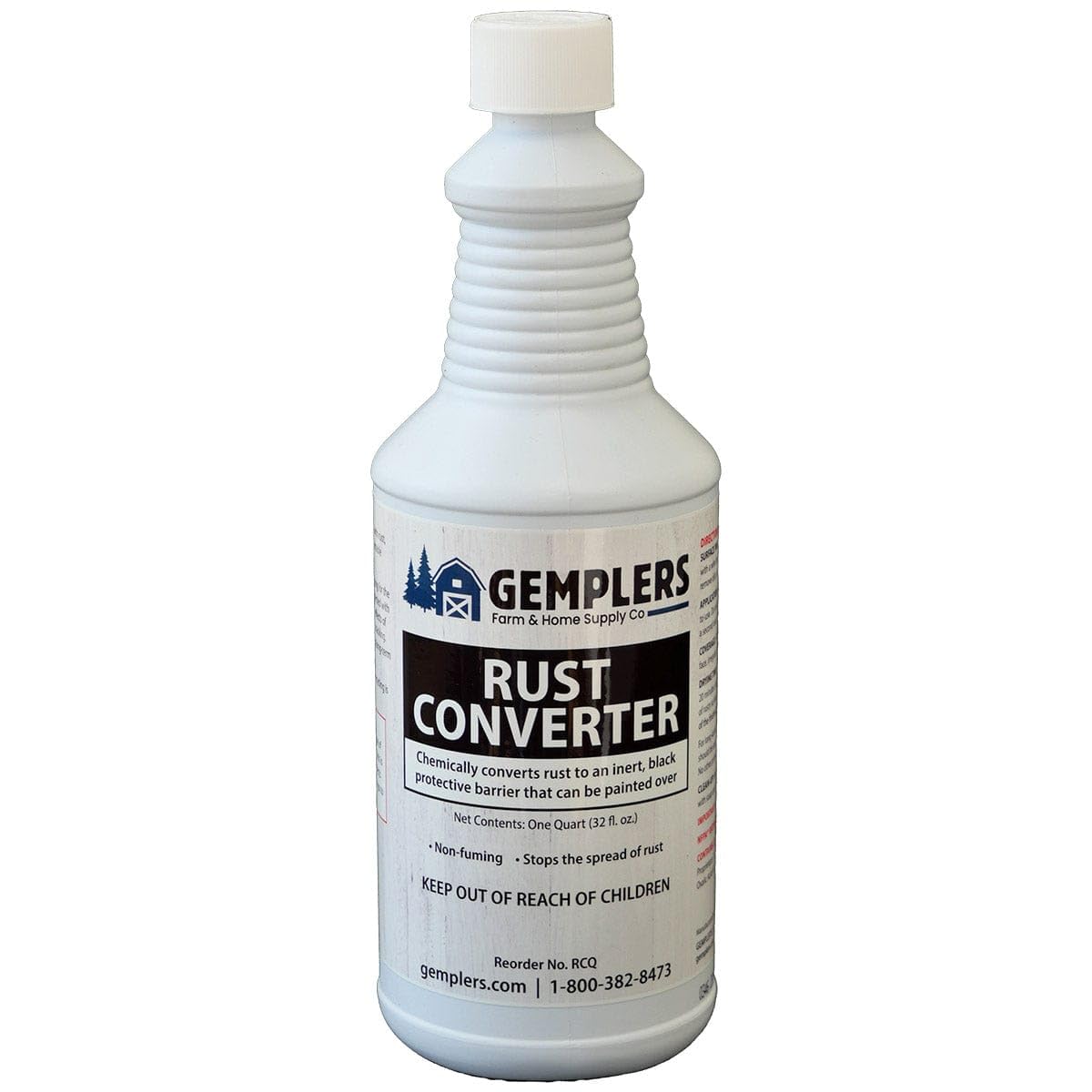
1. Gempler’s Rust Converter (1 Quart)
Our pick — over 4.5★ from 350+ verified ratings; the strongest balance of quality and price.
The quart that turns a 40-year-old yard trailer into a ready-to-paint surface
This liquid converter covers 125 sq ft per quart, so a full trailer, tractor, or fence line is one can away from being sealed. It brushes or sprays on, dries to a semi-gloss black, and the surface can even be left unpainted as long as it isn’t sitting directly in the weather.
Full cure takes 48 hours, so this is a multi-day project, not a same-day fix. Buyers report that a yard tractor trailer left outside for over four decades turned black and was easy to paint over — a strong sign of how deeply it penetrates. It dries to the touch in under 30 minutes, so you can recoat within the same session while you wait out the cure.
Compared to the spray cans above, this is the volume play for anyone with real surface area to treat. The durability feedback splits — some owners mention the finish holding for years while others say it doesn’t last unprotected, so painting over it is the safer bet for exterior metal.
Why owners reach for it
- 125 sq ft coverage per quart stretches further than any spray can
- Handles heavy, weathered rust — one 40-year-old trailer came out paintable
What to plan around
- 48-hour full cure means scheduling a multi-day pause
- Discoloration on nearby surfaces is a known quirk — mask carefully
Reach for this if: you have a big metal surface — trailer, tractor, or gate — that needs converting and you can wait two days before painting.
Think twice if: you need to paint the same afternoon, since the cure window here is the longest on this list.
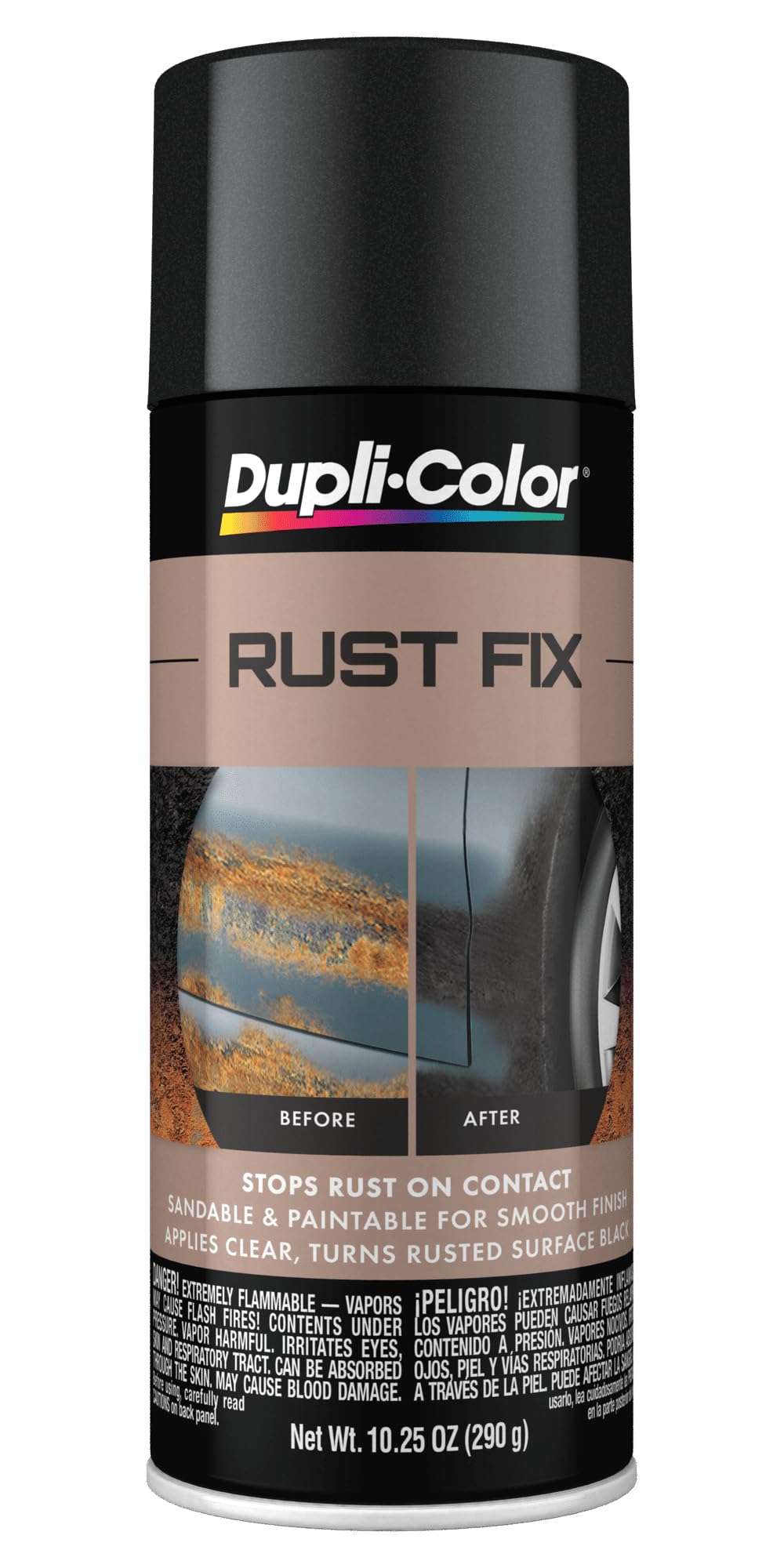
2. Dupli-Color Rust Fix Rust Treatment, Flat, Black, 10.25 oz
Point-and-spray rust destruction that cures in a single hour
This aerosol destroys rust on contact and fully cures in just 1 hour — versus 48 hours for the Gempler’s quart. So if you spot a rust patch in the morning, you can neutralize it before the day ends.
Coastal owners are the ones who swear by it — customers note living near the ocean and relying on this for years because it sprays on clear and turns rust black. It sands to a smooth finish for top coating, and the flat black look works fine on its own for small spots, which is exactly how many owners use it.
Where it falls short of the Gempler’s is volume: 10.25 oz covers only 12 to 15 ft² per can, so this is for touch-ups and small projects, not a full frame. It’s also outdoor-rated only, and the coating isn’t waterproof on its own — fine for a spot you’ll paint over, less ideal for bare metal left to the elements.
The quick-fix case
- 1-hour full cure means paint-ready the same day
- Aerosol reaches nooks without disassembly
The honest limits
- 12-15 ft² per can runs out fast on bigger jobs
- Not waterproof, so bare exterior metal needs a topcoat
Grab it for: small rust spots on a truck, jeep, or tools where you want a single-hour fix with zero cleanup.
Look elsewhere if: you’re treating an entire undercarriage — the can simply doesn’t carry enough juice.
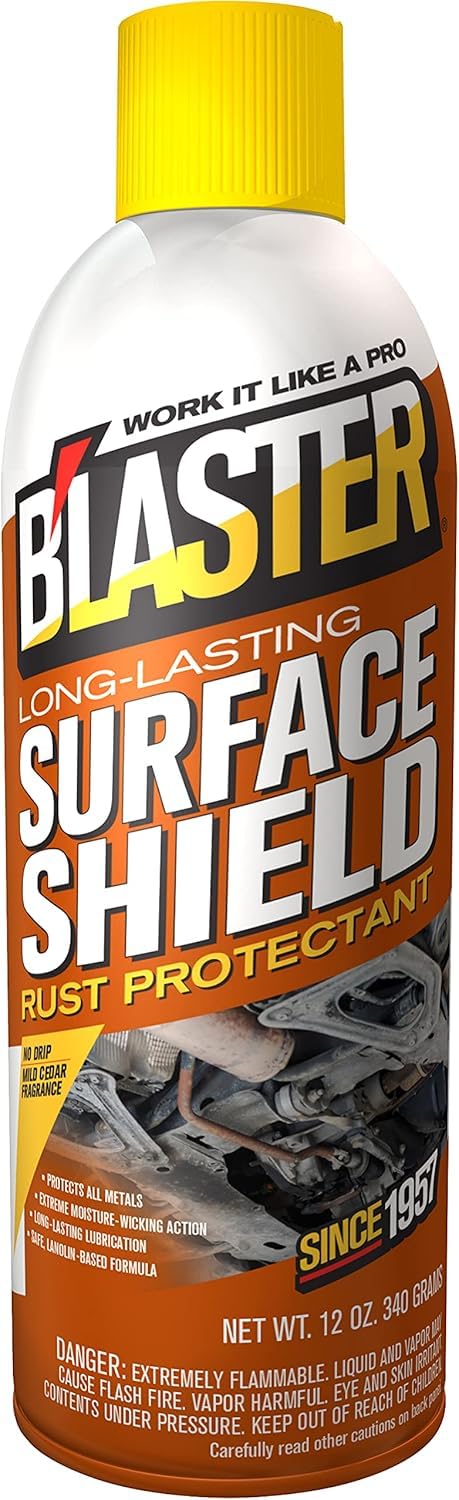
3. B’Laster Surface Shield Rust Prevention Spray – Lanolin Undercoating (2 Pack)
The thick lanolin shield that keeps salt-belt undersides looking new
This is a prevention play, not a cure: it forms a thick lanolin-based barrier that clings to metal without sagging or dripping, and aggressively displaces moisture. Owners in Ohio — deep in road-salt country — report it keeps vehicles looking like new, preferring it to other name brands because it’s thicker and seems to stick and last longer.
It resists high-pressure washing so the protection stays put, and the manufacturer rates it for up to 2-year corrosion protection.
The recurring complaint is the nozzle — clogging comes up often enough that it’s worth shaking the can thoroughly before every use, especially since the formula can thicken in cold temperatures. On a Toyota Tundra undercarriage or any brine-exposed frame, this is the set-and-forget layer you want between your metal and the salt.
What wins people over
- Thick lanolin clings without dripping like thin oils do
- Resists high-pressure washing so protection stays
The recurring gripe
- Nozzles can clog — shake well, especially when cold
Best for: anyone in the rust belt who wants a thick, wash-resistant undercoating that prevents rust before it starts.
Not for: treating rust that’s already formed — this prevents, it doesn’t convert.
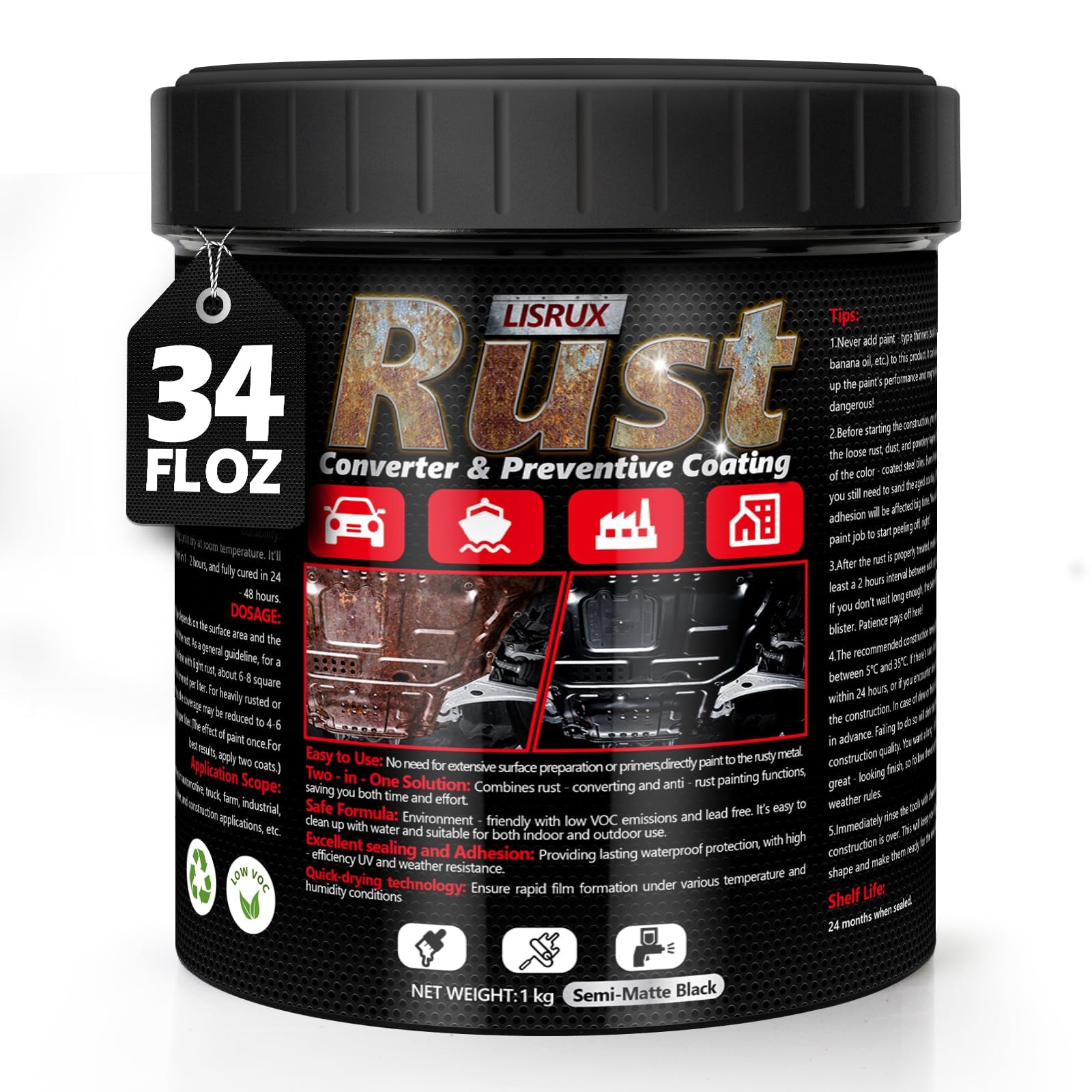
4. LISRUX 4-in-1 Rust Converter & Metal Primer, 34 Fl Oz
A 34-ounce water-based converter that stands up to 350°F heat
Heat resistance up to 350°F makes this the converter for engine bays, brake parts, and exhaust-adjacent metal that cheaper coatings can’t handle. It’s also UV resistant, so outdoor machinery won’t chalk or fade the way some flat blacks do.
Reviewers point out it covers well — one used it on a trailer that had sat in the weeds for years, sanded it down, applied 3 coats, and had no issues, noting it goes on like paint and dries fast. Because it’s water-based, you clean tools with just water, and at less than 1% VOCs (volatile organic compounds, the fumes that linger indoors), it’s far safer for indoor use than solvent-based options.
The catch is timing: each thin layer needs 24 hours to dry before the next, and the manufacturer warns against applying on overcast or rainy days, plus keeping the finished project dry for 7 days. That’s a long, weather-dependent window — fine for a patient garage project, frustrating if you need it done this weekend. Rust conversion results are mixed in owner feedback, so expect the best outcomes on lightly rusted, well-prepped metal.
Its superpower: 350°F heat tolerance plus UV resistance in a low-VOC, water-cleanup formula.
Its slow lane: 24-hour dry times between coats and a 7-day moisture-free window after finishing.
Choose it for: engine components or outdoor machinery where heat and sun would destroy a standard converter.
Pass if: you can’t commit to a week of dry, sheltered curing conditions.
5. Custom Shop Barrier Bond – Rust Converter, 10-Ounce Spray
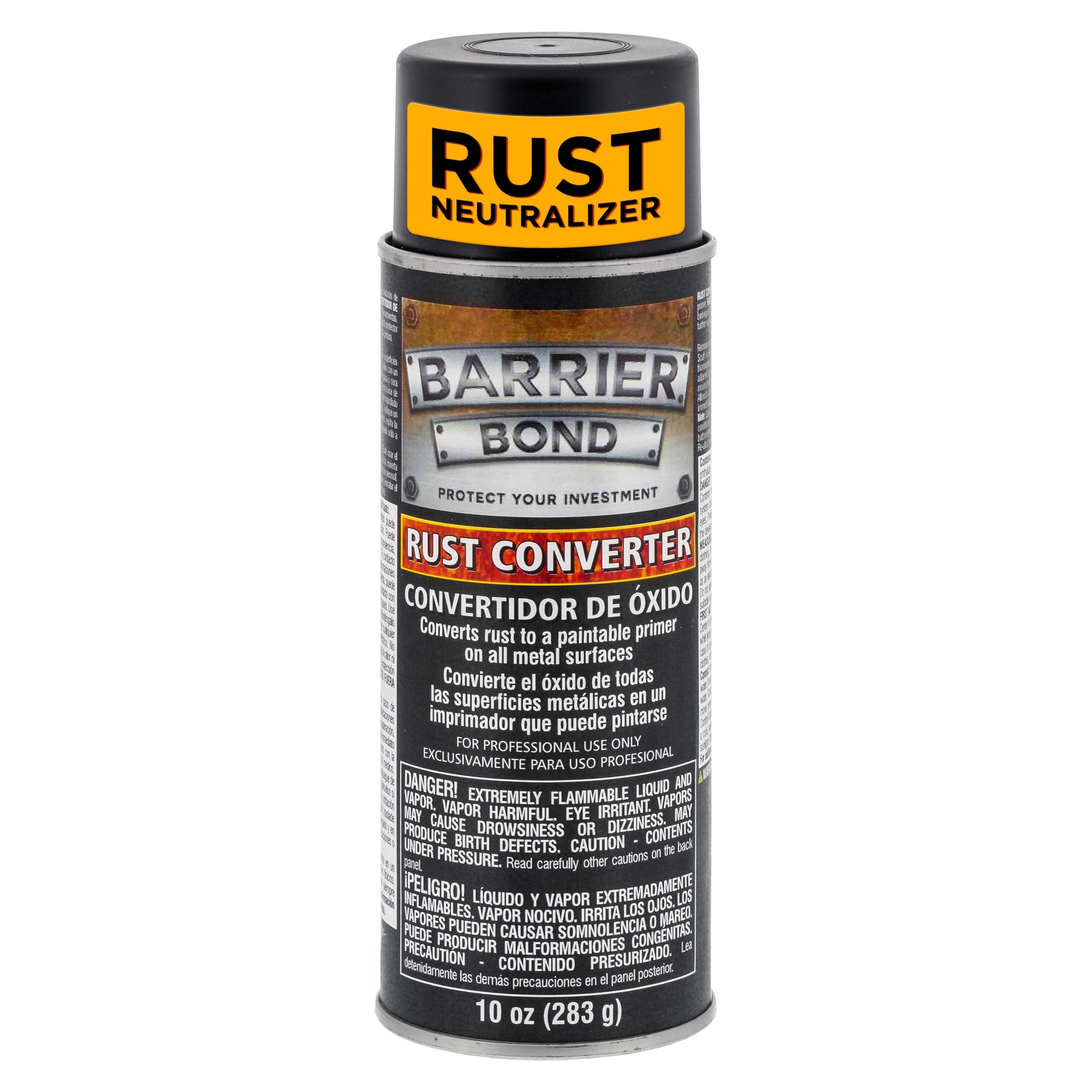
A thin, creeping spray that sizzles rust away in tight spots
This converter’s standout feature is reach: it’s a thin liquid that works in a pump sprayer and gets into tight spots a brush can’t touch, so owners use it on truck frames and report it removes rust and leaves a protective black layer. You don’t need to sand or scrape — just wire-brush off the loose flakes and spray.
The formula is finicky about following the bottle’s instructions exactly. Owners note the Amazon listing’s directions are wrong and that results suffer if you don’t follow the bottle — rinsing, wait times, and top-coating temperatures all matter. One owner used it on a 2010 F150 and watched it sizzle on the rust, which is the chemical etching working as intended.
Opinions split hard here: for some it’s a reliable converter and primer, ready for paint after 24 hours, while others report it doesn’t convert rust as advertised and leaves poor results. The safe read is that this rewards careful prep and exact instruction-following, and punishes shortcuts — so treat the label as law and you’ll likely land in the satisfied camp.
Why it earns its spot: pump-sprayer-friendly reach into cavities and tight frame areas that cans can’t access.
The real catch: effectiveness is inconsistent for owners who skip exact prep — follow the bottle, not the listing.
Reach for it if: you need to treat rust inside boxed frames or hard-to-reach joints on a truck or equipment.
skip it if: you want a forgiving, simple to use converter — this one demands precision, so it’s not for a rushed weekend job.
6. MuzeFansi 2-in-1 Rust Converter & Metal Primer, 35 oz

One coat that converts rust and primes in a single step, no sanding required
This converts rust into a stable surface while acting as the primer, so you skip the separate priming step entirely. It resists heat up to 350°F, plus UV and chemicals, making it a genuine all-rounder for engine bays, brake parts, and outdoor metal.
Owners are genuinely impressed by the transformation — one reports an 11-year-old truck frame looking new after treatment, and another describes covering heavy scale rust on frame rails with excellent results. It dries to a chalkboard-grey matte finish and cleans up with soap and water, which keeps the workspace simple. The 35 oz container covers under 400 sq ft per gallon, so it stretches across a frame or trailer bed.
The fine print matters: use it within 72 hours of opening, and don’t rub or scrape it once dry. Owners also note the product is best used within 2 to 3 days of opening, so plan your job around that window. It’s the pick for someone who wants primer and converter in one can with heat tolerance thrown in, at a competitive size.
Its edge: combined converter-plus-primer slashes steps, and 350°F heat resistance suits engine work.
What to respect: a 72-hour use-it-or-lose-it window after opening, so don’t crack the seal until you’re ready.
Best for: weekend restorers who want to convert, prime, and protect in fewer coats on frames and underbodies.
Not ideal if: you need a product that sits on the shelf indefinitely after opening.
7. Rust911 Rust Remover Dissolver, 32-Ounce Ultra-Concentrate

A 32-ounce bottle that makes 4 gallons of acid-free rust-dissolving bath
This is a different beast entirely: instead of converting rust into a paintable layer, it dissolves the rust off the metal so you’re left with bare, clean steel. The 32-ounce bottle makes 4 gallons of working solution, and one gallon of concentrate de-rusts up to 600 pounds of light to moderately rusted steel — numbers that make it the volume king for parts soaking.
It’s free from acids, non-toxic, and skin-friendly, which owners appreciate when dunking hands into the bath. It’s safe on steel, brass, copper, aluminum, and chrome, and the solution is reusable until it darkens, so a single batch does multiple parts. One owner restored a 77-year-old gas tank, noting the solution turns black like coffee when it’s done its work.
The catch is heat: cold water is ineffective, and shoppers say needing to warm the solution to activate it — one used a 500W halogen light to get results. Unmixed concentrate stores for up to 5 years, so it’s a smart long-term investment for anyone who restores parts regularly rather than occasionally.
Its claim to fame: acid-free, reusable, and wildly economical — 600 pounds of steel per gallon of concentrate.
Its demand: needs warmth to work well, so cold garages will slow it down significantly.
Choose it for: submersion jobs — gas tanks, cast iron, brackets — where you want bare metal, not a converted layer.
Avoid if: you’re treating rust in place on a vehicle; this is a soak-in-a-tub product, not a spray-on.
8. POR-15 Rust Preventive Coating, 16 Fluid Ounces, Silver

The moisture-cured hard coat that restoration owners call the gold standard
POR-15 has a cult following for a concrete reason: it cures by moisture, not evaporation, meaning it dries faster when humidity is present — the opposite chemistry of ordinary paints. Once cured, it forms a hammer-tough, non-porous barrier that stops rust permanently, and owners restoring multiple classics call it better than anything they’ve used, with a 1949 Buick as a recent test bed.
It drys to the touch in about 3 hours and reaches full cure in 5, which is remarkably fast for a coating this hard. Owners note it converts rust to metal, leaves a hard topcoat, and outlasts other rust repair products — one describing a solid frame after treatment with visible zinc coating from the prep step. The silver finish looks clean even before you topcoat.
The rigor required is the real trade-off: it demands the full 3-step system — cleaner-degreaser, metal prep to etch, then the coating — and you must stir, never shake, the can. It also needs a topcoat anywhere it’ll see UV light, since sunlight breaks it down. For bare, protected metal like a frame or underbody, this is the most permanent option on the list.
Its superpower: moisture-cured, hammer-tough finish that physically outlasts other coatings on restorations.
Its demand: strict 3-step prep and mandatory topcoat for UV exposure — this isn’t a spray-and-walk-away product.
Reach for it if: you’re restoring a classic and want the most durable, permanent rust barrier money can buy.
Look past it if: you want a quick, forgiving application — the prep discipline here is non-negotiable.
9. BLACK STAR Rust Converter, 1 Quart
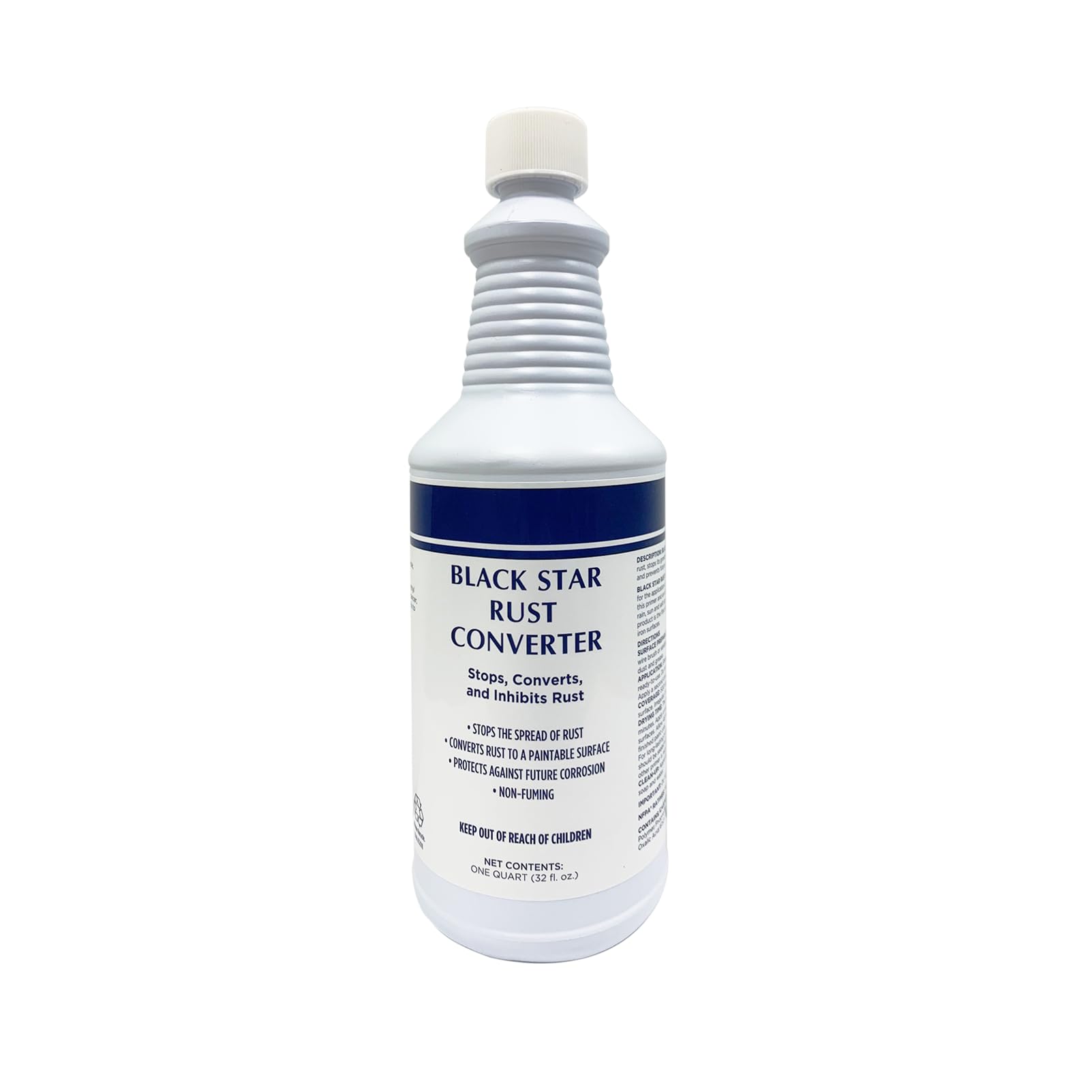
A brush-and-roll converter that skips sanding, blasting, and scraping entirely
The whole pitch here is no-prep: instead of damaging metal to remove rust, you spray, brush, or roll this on and it transforms rust into a slick polymer resin coating. Owners describe it as the least messy and easiest to apply of anything they’ve used on rusty parts, with one to two coats usually doing the trick.
It dries fast — about 8 hours to dry — and turns orange rust into a black, semi-gloss, corrosion-resistant finish that also works as a paint primer. One owner brushing it onto a deck-over trailer being rebuilt noted it covered well and bonded well. The quart size gives you real working volume for fence lines, roofs, and equipment.
The honest caveat from owners is that some spots may not fully convert on the first pass and need a second coat, and opinions split on whether the price matches the value. It dries to a hard, corrosion-resistant resin that seals out moisture, so the treated rust won’t reoxidize — meaning it’s a genuine one-and-done for lightly rusted metal that you don’t want to sand.
Its draw: zero sanding or wire-wheeling — just brush on and let the chemistry work.
Its honest caveat: heavier rust spots may need a second coat to fully convert.
Best for: DIYers who hate prep work and want to convert rust on fences, trailers, or tools with a brush.
Not for: anyone needing guaranteed one-coat perfection on heavily pitted metal.
Understanding the Specs
Full Cure Time
This is the clock that decides your project timeline. A 1-hour cure like the Dupli-Color lets you paint the same day, while the Gempler’s 48-hour cure means booking a multi-day pause. If you’re working in a garage over a single weekend, shorter cure times let you finish before Monday.
Coverage per Container
Coverage tells you how far a can or quart stretches, which directly sets how many containers you’ll need. The Gempler’s covers 125 sq ft per quart, while the Dupli-Color covers just 12 to 15 ft² per can. For a full frame or trailer, you want the big-coverage option to avoid running out mid-job.
FAQ
What’s the difference between a rust converter and a rust remover?
How long does a rust converter take to cure before I can paint?
Can I spray a rust converter or does it need a brush?
Does a rust converter work on heavy, flaking rust?
What is a lanolin undercoating and who needs it?
Is a rust converter safe on bare metal or just rust?
Can I leave a rust converter unpainted and exposed to weather?
How much rust can a concentrated remover actually handle?
Does a rust converter need a topcoat over it to last?
Which rust treatment is best for a vehicle frame restoration?
Final Thoughts: The Verdict
For the majority of shoppers, the auto rust treatment winner is the Gempler’s Rust Converter because its 125 sq ft coverage per quart and 48-hour cure make it the most versatile all-rounder for real metal projects. If you want a quick same-day fix for small spots, grab the Dupli-Color Rust Fix with its 1-hour cure. And for salt-belt undercoating protection on a daily driver, the B’Laster Surface Shield is the one to reach for before winter hits.
How We Picked
We do not accept paid placement. Every pick is matched to a real buyer and a real use-case; we do not hands-on test units.
Sources & Methodology
Specifications: manufacturer listings and product documentation. Review insights: verified customer reviews, as of August 2026. Pricing: not shown on this page (it changes often); check the current price via the retailer link.
As an Amazon Associate, Gadgets Feed earns from qualifying purchases. This does not affect which products we feature.