
Our readers keep the lights on and my morning glass full of iced black tea. As an Amazon Associate, I earn from qualifying purchases.
Specs are compiled from manufacturer listings and verified buyer reviews and can change over time — please confirm the key details on the product page before buying.
Working under a car on jack stands is the worst part of any DIY job. A portable scissor lift changes that completely, giving you a stable platform that raises the whole vehicle in one smooth motion. The three lifts here all clear the 5,000-lb bar, but they differ wildly in height, weight, and how much garage space they demand. This guide breaks down which one actually fits your shop, your vehicles, and your budget.
I’m Min — the founder and writer behind Gadgets Feed. This guide is built by comparing the manufacturers’ published specifications and the patterns across verified customer reviews, so you get each pick’s real strengths and trade-offs instead of marketing spin.
Whether you wrench for a living or just rotate tires at home, the right auto scissor lift is the difference between a back-breaking afternoon and a quick, safe job you actually look forward to.
Our Picks at a Glance

How To Choose The Best Auto Scissor Lift
Buying a lift is a durable-goods decision, so the specs matter more here than in almost any other tool purchase. Before you commit, you need to match the lift’s numbers to your concrete slab, your ceiling height, and the actual vehicles you own.
Lifting height is the real spec that matters
Capacity gets all the attention, but the maximum lifting height decides what you can actually do. A lift that reaches 25.6 inches gives you comfortable access for oil changes and tire rotations. A mid-rise unit that climbs to 55 inches opens up brake work and undercarriage inspections without lying flat on your back. Measure your garage ceiling before you shop, and remember the car’s roofline adds its own height on top of the lift.
Weight and portability are a trade-off you cannot skip
Portable lifts are only portable if you can actually move them. A 401-lb unit you can muscle around your driveway is a different beast from a 1,200-lb stationary machine that needs a permanent home. The heavier the lift, the more stable it tends to feel, but you pay for that in setup effort and floor space. Also check your concrete — a fully loaded lift concentrates serious weight on a small footprint.
Hydraulic health and safety locks
Every lift here runs on hydraulic cylinders, and the fluid matters. Most units ship empty and need ISO46 hydraulic oil added before first use. Mechanical safety locks should engage automatically as the lift rises, so the car stays put even if the hydraulic system loses pressure. A slow, controlled descent is a feature, not a bug — it means the valves are doing their job.
Quick Comparison
| Model | Best For | Max Lifting Height | Load Capacity | Weight | Amazon |
|---|---|---|---|---|---|
| APlusLift SL6600X★ Best Overall | Full undercarriage access | 55 inches | 6,600 lbs | 1,200 lbs | Amazon |
| Albott 7000 LBS | Portable value pick | 28 inches | 7,000 lbs | 401 lbs | Amazon |
| VEVOR 5,000 LBS | Mobile low-profile lifting | 25.6 inches | 5,000 lbs | 372.6 lbs | Amazon |
In-Depth Reviews
1. APlusLift SL6600X 6600LB Portable Mid-Rise Scissor Lift
Our pick — over 4★ from 50+ verified ratings; the strongest balance of quality and price.
The towering mid-rise that turns a garage into a real shop bay.
If you are tired of sliding on a creeper, this is the lift that gets you upright. Its 55-inch maximum lifting height is the standout here — more than double the 25.6 inches the VEVOR below reaches — which gives you room to actually sit or kneel under the chassis for brake lines, exhaust work, and transmission jobs. It handles a 6,600-lb load, so full-size trucks fit comfortably within its rated capacity.
The structure is a serious piece of steel. The dual 3 1/4-inch hydraulic cylinders and the triple roller design add stability and keep more contact on the floor, which owners say translates into a solid, confidence-inspiring feel. It ships with adjustable screw pads and a set of 2 3/4-inch truck adapters, so you can level it under different vehicles right out of the crate. The trade-off is the weight: at 1,200 pounds, it weighs roughly three times as much as the 401-lb Albott, so this is not a lift you roll around — it becomes a permanent resident of your garage.
Buyers report it was up and running 45 minutes after delivery, and the owner consensus is that the quality and build are genuinely impressive for the price. It runs on standard 110-volt current with a 15-amp-rated cord, which matters if your shop lacks a 220V outlet. The honest caveat: a couple of owners received units with wiring that needed attention, and the included manual’s schematic did not always help, so be prepared to troubleshoot with the seller if yours arrives with a loose connection.
Why It Earns The Top Spot
- 55-inch lift height — the tallest of the three picks
- 6,600-lb capacity with a 5-year structural warranty
- Dual hydraulic cylinders plus triple roller design for stability
What To Know Before You Commit
- 1,200-lb weight makes it effectively stationary
- Occasional wiring issues reported on delivery
The fit for you if: you have a dedicated garage space and want real undercarriage access for bigger jobs, not just oil changes.
Think twice if: you need to move the lift between locations — at 1,200 pounds, this one lives where it lands.
2. Albott 7000 LBS Portable Car Lift with Extension Plates
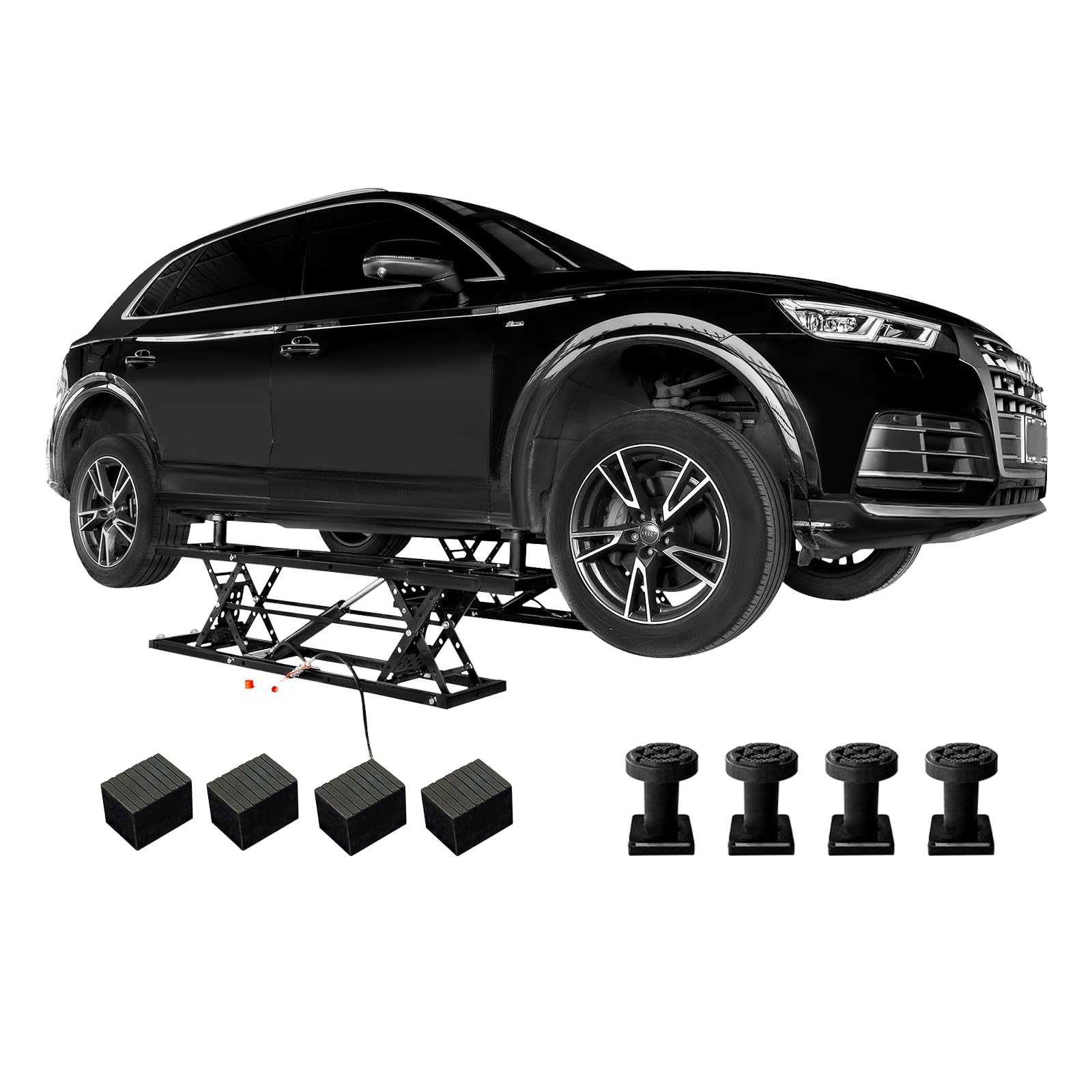
The mobile 7,000-lb workhorse that folds up against a wall.
This is the pick for the home mechanic who wants lift convenience without dedicating a bay to it. Four wheels let you roll it to the car, and the folding frame tucks away when the job is done. That combination of muscle and mobility is why it reads as genuine value.
The Q235B high-strength steel frame and anti-corrosion coating give it a solid, sturdily built feel, and the 28-inch maximum height offers enough clearance to work under the car comfortably. It comes with two extension panels and four adjustable height increments, so you can fine-tune the lift points to different vehicles. One real quirk to know: it requires a minimum load of around 220 lbs to descend, so you cannot simply drop it with an empty platform — a detail several owners flagged after setup.
Owners mention it lifts a Challenger easily with no leaks once the hose connectors are snugged down, and the safety locks engage reassuringly on the way up. The Q235B steel and solid construction win most of the praise, though the recurring gripe is the included rubber pads sitting too tall for low-slung cars — some owners swap in hockey pucks for extra clearance. The other watch-item is hydraulic fluid: it ships without oil (around 0.75 gallons of ISO46 needed), and a few units arrived with a messy leak in the accessory box from loose fittings. Tighten everything on day one and this is an outstanding first lift.
Owner Consensus: solidly constructed with no wobble or sway, and a fantastic value for the money — the weight and pad fit are the only real friction points.
Reach for this if: you want a genuinely portable lift that rolls to the car and stores flat when you are done.
Look elsewhere if: your cars sit very low — you will likely need to swap the stock pads for thinner ones.
3. VEVOR Portable Car Lift 5,000 LBS

The pre-built low-rise that is ready to work an hour after it lands.
For the backyard mechanic who wants the least setup hassle possible, this VEVOR arrives essentially pre-built. Customers note adding hydraulic oil and going to work — one buyer had it lifting a Ram 1500 quad cab with ease and holding the truck for three days without a drop of sag. That long-term reliability over a year of regular use is exactly what you want from a shop tool that does not take up much space.
The 5,000-lb capacity is the entry point for full-size trucks and SUVs, and the 11-inch extension plates broaden the contact area for long-wheelbase vehicles. The four lifting columns are adjustable by up to 3.2 inches, giving a whole lifting range from 9.06 to 25.6 inches. The rubber contact surface on the pads adds slip resistance so the vehicle stays put, and the mechanical safety locks prevent any unwanted sliding once you reach the desired height. At 372.6 pounds, it is the lightest of the three lifts here — noticeably easier to maneuver than the 1,200-lb APlusLift — and the foldable design with wall hooks saves floor space.
Quality is the thing everyone raves about, and the build feels well worth the money. The honest trade-off is the height ceiling: at 25.6 inches you get comfortable access for oil changes and tire rotations, but you will still be on your back for anything deeper. The recurring negative is the sheer weight — it is incredibly heavy to move despite the nylon pulleys. And a rare but real quality-control risk exists: a few units arrived with a cracked reservoir or poor weld at the flange, leaking fluid overnight. Check the reservoir and welds before your first fill.
What Wins People Over
- Runs right from the start after adding oil
- Held a Ram 1500 for days without dropping
- Rubber pads provide a strong, slip-resistant grip
Before You Buy
- 372.6-lb weight still demands real effort to move
- Rare weld or reservoir defects reported on arrival
The pick for: DIY owners who want a dependable, low-maintenance lift for standard service jobs without permanent garage space.
Not the pick for: anyone needing tall undercarriage access — the 25.6-inch ceiling keeps you low to the ground.
Understanding the Specs
Maximum Lifting Height
This is the distance from the ground to the lift platform at full extension. It determines whether you work sitting up or lying flat. A 25.6-inch lift suits oil changes and brake work; a 55-inch mid-rise lets you access the full undercarriage. Always measure your garage ceiling and account for your car’s roofline.
Load Capacity vs. Curb Weight
Load capacity tells you the heaviest vehicle the lift can safely raise — 5,000 lbs covers most cars and SUVs, while 7,000 lbs reaches full-size trucks. The lift’s own weight tells you about portability: a 400-lb unit rolls around, a 1,200-lb unit stays put. Both numbers matter for your floor and your back.
FAQ
Will a scissor lift damage my garage concrete floor?
Does a portable scissor lift need to be bolted to the floor?
What type of hydraulic oil does a scissor lift use?
Can a 5,000-lb lift handle a full-size pickup truck?
Why does my portable lift need a minimum load to come down?
Is a scissor lift safer than using jack stands?
How do I store a portable scissor lift when it is not in use?
What is the difference between a mid-rise lift and a low-rise lift?
Why does my lift leak hydraulic fluid?
Can one portable lift work on both a sports car and a truck?
Final Thoughts: The Verdict
For most people, the clear winner is the APlusLift SL6600X because its 55-inch lifting height changes what you can do in your own garage — real undercarriage access instead of lying flat. If you want portability and value, grab the Albott 7000 LBS. And for the simplest setup with the lowest footprint, the VEVOR 5,000 LBS is the one to reach for. Whichever you choose, remember the essential steps: flat concrete, the right hydraulic oil, and safety locks engaged every single time.
How We Picked
We do not accept paid placement. Every pick is matched to a real buyer and a real use-case; we do not hands-on test units.
Sources & Methodology
Specifications: manufacturer listings and product documentation. Review insights: verified customer reviews, as of August 2026. Pricing: not shown on this page (it changes often); check the current price via the retailer link.
As an Amazon Associate, Gadgets Feed earns from qualifying purchases. This does not affect which products we feature.