
Our readers keep the lights on and my morning glass full of iced black tea. As an Amazon Associate, I earn from qualifying purchases.
Every wire in your car audio system is a link in a chain, and the speaker wire is the one that carries the final signal from your amplifier to your speakers. A bad or undersized wire can choke that signal, introducing resistance that robs you of volume and clarity before the sound ever hits the driver. This guide breaks down the real trade-offs — gauge, conductor material, jacket flexibility, and length — so you pick a wire that matches your power demands and your installation path, not just the cheapest spool on the shelf.
I’m Min — the founder and writer behind Gadgets Feed. This guide is built by comparing the manufacturers’ published specifications and the patterns across verified customer reviews, so you get each pick’s real strengths and trade-offs instead of marketing spin.
Whether you are wiring a trunk subwoofer, door speakers, or a full competition build, finding the best auto speaker wire for your setup comes down to gauge thickness, conductor purity, and how easily the jacket routes through tight interior panels.
Quick Picks
- GEARit Speaker Wire 14 Gauge 100 ft — Best Overall
- Install Link 14 AWG Gauge Speaker Wire Cable (100 Feet) — Best Value
- DS18 SW-12GA-100RB 12-GA Ultra Flex Speaker Wire — Pro Grade
- InstallGear 14 Gauge Speaker Wire 100 ft Cable — Top Performer
- Monoprice Nimbus Series 16 Gauge AWG 2 Conductor CMP-Rated Speaker Wire (50ft) — Plenum Rated
- JAVEX 16-Gauge AWG Audio Speaker Wire Cable (100 FT) — Premium Pick
- GEARit 14 Gauge Speaker Wire Cable CL3 Rated 100ft — Outdoor Tough
How To Choose The Best Auto Speaker Wire
Picking the right wire is about matching three things: the power your amplifier delivers, the distance from amp to speaker, and the physical path the wire has to take through your car. Here is what to look for in each area.
Gauge: Thicker Wire Carries Power Farther
Wire gauge is the thickness of the conductor, and the rule is simple: lower number = thicker wire = less resistance. For a typical car audio system running less than 50 feet total, 14 AWG (American Wire Gauge, the standard thickness measure) is the sweet spot. If you are pushing a high-power subwoofer or running a very long path, step up to 12 AWG, which is 33% thicker than 14 AWG and handles more current with less voltage drop. For shorter runs or lower-power door speakers, 16 AWG works fine and is easier to bend in tight spots.
Conductor Material: CCA vs. OFC
Most budget-friendly auto speaker wires use CCA (Copper-Clad Aluminum) — an aluminum core coated in copper. CCA is lighter and costs less, but it has about 60% of the conductivity of pure copper, meaning it loses more signal over distance. OFC (Oxygen-Free Copper) is pure stranded copper with higher conductivity and better corrosion resistance. For a daily-driver stereo at moderate volumes, CCA is fine. For a competition system or a long run where every watt counts, OFC delivers noticeably cleaner sound and lower resistance.
Jacket Flexibility and Durability
A stiff jacket fights you the whole way through a car door boot, under carpet, or past seat rails. Look for a wire that reviewers describe as “flexible” or “soft touch” — it should bend around sharp corners without kinking or snapping the internal strands. PVC (polyvinyl chloride, the standard plastic coating) is the most common jacket material, but the quality of the PVC varies hugely between brands. A good jacket also resists heat and abrasion from rubbing against metal panels over years of driving.
Quick Comparison
On smaller screens, swipe sideways to see the full table.
| Model | Best For | Gauge (AWG) | Conductor Material | Length (Feet) | Amazon |
|---|---|---|---|---|---|
| GEARit 14 Gauge (100ft, 4-wire) | Flexible multi-room or car installs | 14 | CCA | 100 | $17.95Amazon |
| Install Link 14 AWG (100ft) | Budget home/car stereo | 14 | CCA | 100 | $19.95Amazon |
| DS18 SW-12GA-100RB | High-power subwoofer runs | 12 | CCA | 100 | $21.95Amazon |
| InstallGear 14 Gauge (100ft) | Easy-routing stereo installs | 14 | CCA | 100 | $24.99Amazon |
| Monoprice Nimbus 16 Gauge (50ft) | Safe in-wall or plenum runs | 16 | OFC | 50 | $42.99Amazon |
| JAVEX 16-Gauge OFC (100ft) | Pure copper signal fidelity | 16 | OFC | 100 | $42.88Amazon |
| GEARit 14 Gauge CL3 Rated (100ft) | Outdoor and in-wall durability | 14 | CCA | 100 | $37.33$43.00Limited time dealAmazon |
In‑Depth Reviews
1. GEARit Speaker Wire 14 Gauge 100 ft
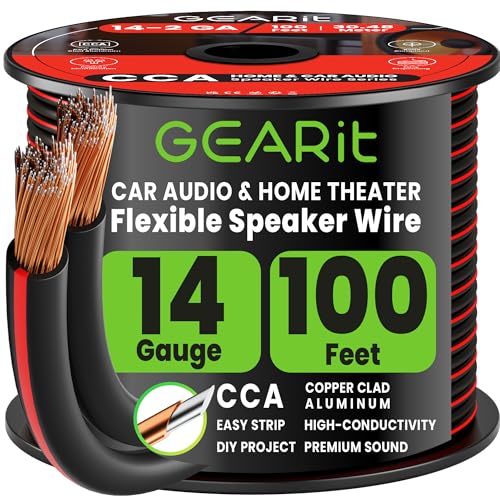
The four-conductor workhorse that one buyer ran 200 feet to a garage.
This GEARit wire gives you 14 AWG CCA in a single spool, but the key difference from most picks here is that it has 4 separate wires instead of the usual 2 — a 2.0x gap over the standard Install Link or InstallGear wire. That means you can run two separate speaker channels (left/right) in one pull, which saves a ton of time when wiring a full car audio system or a multi-room setup. The jacket is soft PVC with printed foot markers at every foot, so you measure and cut without a tape.
Buyers report that “it is very thick and durable” and “easy to strip,” which matches the specs: the wire diameter is 1.63 mm, giving it a solid feel. It is CCA, not pure copper, so it is lighter than equivalent OFC wire — a real bonus when routing through tight trim panels because the wire doesn’t sag or fight you. One reviewer ran it through PVC conduit to a new garage and paired outdoor speakers with no signal issues.
The 4-conductor setup is the headliner, but note that the wire is a single 100-foot spool with four strands, so you get 100 feet of four individual conductors, not 400 feet of wire. For the price, this is the most versatile single spool for anyone wiring multiple channels or zones.
Why it’s great
- Four-conductor design lets you run two speaker pairs in one pull.
- Foot markers every foot for precise, tool-free measurement.
- Soft PVC jacket routes easily around furniture and through car interiors.
Good to know
- CCA conductor — less conductive than pure copper, fine for moderate-power systems.
- At 2.37 pounds the spool is heavier than a standard 2-conductor reel of the same length.
Best for: Multi-channel car audio builds or whole-home setups where you want to minimize the number of wire pulls.
Skip if: You only need a single speaker pair — a 2-conductor wire is simpler and cheaper.
2. Install Link 14 AWG Gauge Speaker Wire Cable (100 Feet)

14 AWG CCA that reviewers call an economical choice for non-high-end audio.
This is a straight-ahead, no-frills 2-conductor 14 AWG CCA wire at a solid entry-level price. The frosty blue-on-black color scheme makes it easy to tell positive from negative at a glance, and the SoftFlex jacket, as the brand calls it, stays pliable even when routing through door boots or under seats. Owners mention it “strips easily and the copper strands aren’t too thin.”
Compared to the GEARit 4-conductor above, the Install Link gives you only 2 wires on a 100-foot spool. That is fine for a single pair of speakers, but if you are wiring both front and rear channels, you will need two spools or a 4-conductor alternative. One reviewer described it as “economical CCA wire for non-high-end audio,” which is exactly the honest assessment this pick earns — it will not win awards for ultimate conductivity, but it gets the job done cleanly for a daily driver.
For a budget-friendly build where power demands are moderate, this wire runs cool and connects easily. Just be aware that on very long runs (over 40 feet), the CCA material will show more voltage drop than a pure copper wire would.
Why it’s great
- Frosted blue/black polarity marking makes positive/negative identification instant.
- SoftFlex jacket stays flexible for easy routing around corners.
- Good value for small-to-moderate runs under 40 feet.
Good to know
- 2-conductor only — you will need two spools for a four-speaker setup.
- CCA limits conductivity on longer runs compared to pure copper wire.
Best for: Budget-minded builds with a single speaker pair and runs under 40 feet.
Skip if: You need multiple channels or high wattage for a competition system.
3. DS18 SW-12GA-100RB 12-GA Ultra Flex Speaker Wire

Thick 12 AWG CCA that buyers call flexible and easy to route through cars.
If you are feeding a powerful amplifier or a subwoofer that pulls serious current, this DS18 wire steps up to a 12 AWG conductor — 33% thicker than the 14 AWG standard. That extra girth lets it handle more current with less resistance, so your subwoofer hits harder and cleaner over longer distances. The CCA construction keeps costs reasonable, and the ultra-flex jacket lives up to its name: customers note the “100ft roll is flexible, easy to route through cars.”
A few buyers noted a practical catch: the wire does not come on a spool, just wound in a coil, so keeping it organized during a long install requires a bit of DIY management. Also, one reviewer suggests going down a gauge or two for home theater use — 12 AWG is overkill for most home receivers. But for a car audio subwoofer run where power demands are high, this is the budget-friendly way to get thick gauge without paying OFC prices.
The red and black jacket colors make polarity obvious, and at 100 feet you have enough to run from a trunk-mounted amp to a front subwoofer enclosure with plenty of slack.
Why it’s great
- 12 AWG is the thickest wire in this roundup, ideal for high-current subwoofer loads.
- Ultra-flex jacket routes easily through tight trim panels without kinking.
- 100-foot length covers even the longest car audio runs.
Good to know
- Not pre-spooled — comes in a coil that can tangle during installation.
- CCA material means conductivity is lower than an OFC 12 AWG wire would offer.
Best for: High-power subwoofer builds that need low resistance over a long run.
Skip if: You are only powering door speakers — 14 AWG is easier to route and more than enough.
4. InstallGear 14 Gauge Speaker Wire 100 ft Cable

Accurate 14 AWG with a thick, durable sleeve that one buyer says is easy to strip.
This InstallGear wire hits the 14 AWG CCA sweet spot with a “soft touch” PVC jacket that reviewers rave about. One buyer specifically noted “accurate gauge, thick durable sleeve, easy to strip” and reported no performance issues after a full year of use, even after speakers were knocked over. The two-color jacket (frosted blue and black) gives you instant polarity identification, which helps avoid a phase mistake that could damage your audio equipment.
The jacket flexibility here is a step above the more rigid vinyl on the Monoprice Nimbus below, making this a better choice for snaking wire through a dashboard or door boot. It is still CCA, so it falls short of the pure copper conductivity that the JAVEX delivers, but for a car stereo running under 50 feet, the difference is negligible in practical listening. Buyers also note the wire works well for moderate to long runs with vintage hi-fi gear, giving it versatility beyond just car audio.
If you want the most popular 14 AWG 2-conductor wire that balances flexibility and durability at a mid-range price, this is it.
Why it’s great
- Soft touch jacket with low memory — holds a bend but does not stay coiled.
- Clear two-color polarity marking prevents installation errors.
- Proven durability — reviewers point out surviving a year of use including physical abuse.
Good to know
- Insulation may be less abrasion-resistant than thicker-jacket wires for extreme automotive use.
- CCA conductor — performance is fine for home and car, but OFC wins for critical high-power systems.
Best for: Car stereo installs that need a flexible, easy-to-strip 14 AWG wire for moderate-power runs.
Skip if: You need a wire that can withstand constant rubbing against sharp metal edges — get a heavier jacket.
5. Monoprice Nimbus Series 16 Gauge AWG 2 Conductor CMP-Rated Speaker Wire (50ft)

100% pure bare copper with a fire-safe plenum jacket rated for in-wall use.
This Monoprice wire is the only CMP-rated (plenum rated, meaning the jacket has passed strict fire safety tests for use in air-handling spaces like ducts and ceiling voids) wire in this lineup. The conductors are 100% pure bare oxygen-free copper, not CCA, so conductivity is higher and corrosion resistance better than any aluminum-core wire here. The catch is that the gauge is 16 AWG, which is thinner than the 14 AWG and 12 AWG picks above — fine for runs under 20 feet but not ideal for long or high-power paths.
Shoppers say the vinyl jacket is stiff, especially at first, which can make routing through tight car panels harder than the ultra-flex CCA wires. One reviewer recommended cutting the jacket and spiraling the wires for extra flexibility. However, if you are running wire inside a wall or through a vehicle’s interior where fire code compliance matters, the CMP rating is a non-negotiable advantage. At only 1.92 ounces for 50 feet, it is also the lightest wire here — barely any weight to manage during installation.
For competition builds or ceiling-mounted speakers where you want zero compromise on conductor purity and safety, this is the pick. For a simple door speaker install, the stiffer jacket and thinner gauge make it less practical than a 14 AWG CCA wire.
Why it’s great
- 100% oxygen-free bare copper — the highest conductivity and corrosion resistance in this roundup.
- CMP-rated for safe in-wall/plenum installation per fire code.
- Ultra-lightweight at 1.92 ounces for 50 feet.
Good to know
- 16 AWG is thinner than the 14/12 AWG picks — limits power handling on long runs.
- Stiff vinyl jacket makes routing through tight spots harder than softer CCA wires.
Best for: In-wall or plenum installations where fire safety and pure copper conductivity are required.
Skip if: You need a flexible wire for tight car interiors or long high-power subwoofer runs.
6. JAVEX 16-Gauge AWG Audio Speaker Wire Cable (100 FT)
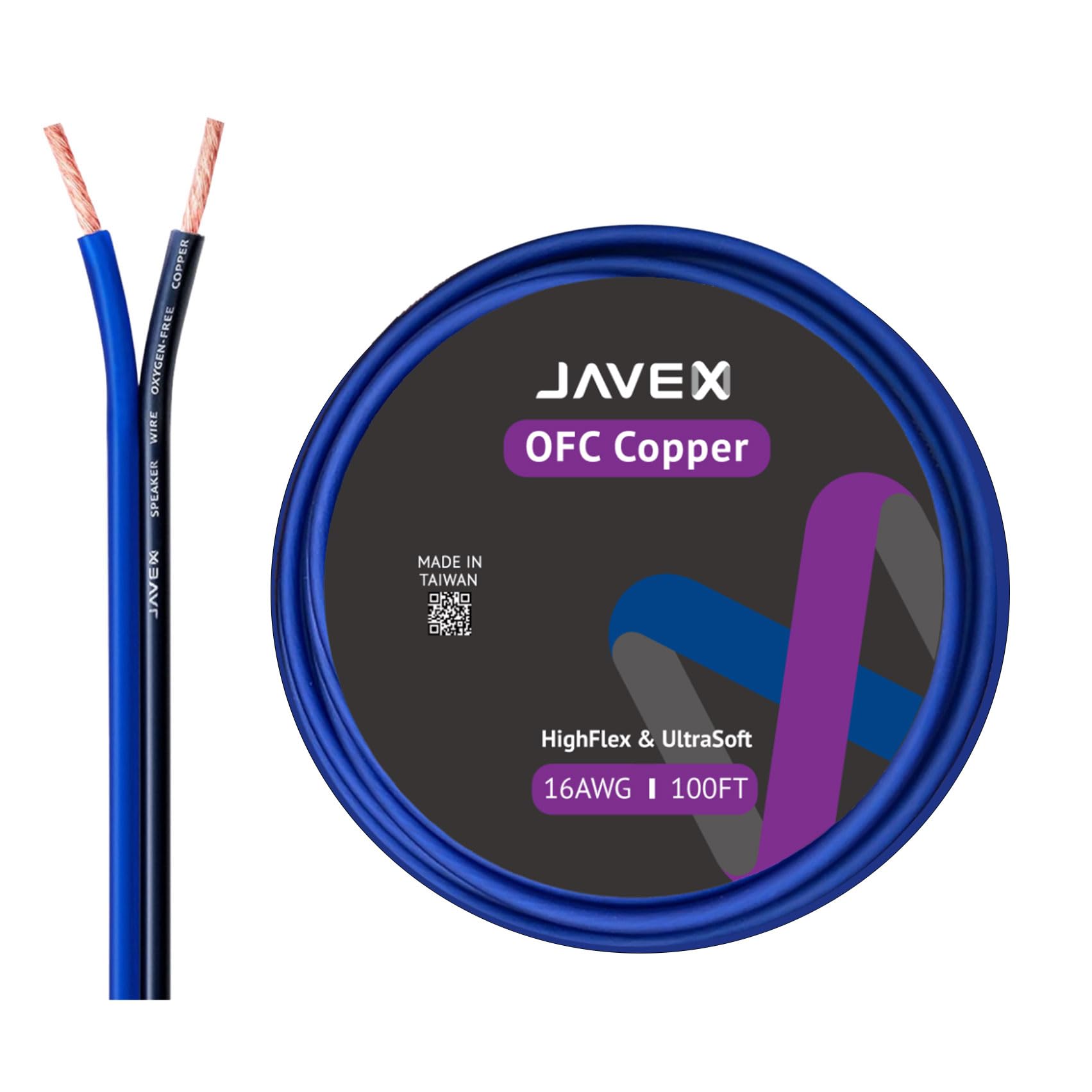
99.9% oxygen-free copper that buyers report is worth the extra money for pure signal.
The JAVEX wire is 16 AWG OFC (oxygen-free copper) — the same premium conductor type as the Monoprice above, but at 100 feet instead of 50 and with a much more flexible jacket. Owners mention it is “easy stripping without damaging strands” and that the insulation stays soft and pliable even in cold weather, unlike the stiffer plenum jacket on the Monoprice. The square-flat wire design with a dark color stripe on one conductor makes polarity identification simple.
This is the wire to choose when signal fidelity is your top priority. Oxygen-free copper has lower resistance and better corrosion resistance than CCA, so it delivers a cleaner signal with less distortion — a real difference you can hear on a high-resolution stereo system or in a competition sound quality build. The 16 AWG gauge is fine for runs up to about 30 feet, and because the wire is pure copper, it can handle more current than a 16 AWG CCA wire would.
The biggest practical difference versus the InstallGear or GEARit wires is the price premium and the slightly thinner gauge. For a moderate-power car audio setup running to door speakers, this is overkill — but for a critical listening environment where every detail matters, buyers agree “it is worth the extra cost over cheaper wire.”
Why it’s great
- 99.9% OFC — highest purity conductor in this roundup for best signal transmission.
- Flexible jacket stays soft in cold temperatures, making winter installation easy.
- Square-flat design reduces tangling and makes polarity marking clear.
Good to know
- 16 AWG limits the wire to runs under about 30 feet for best performance.
- Blue/black stripes can be harder to differentiate than classic red/black for polarity.
Best for: Audiophile-quality systems where pure copper signal fidelity and corrosion resistance are non-negotiable.
Skip if: You are on a tight budget or need a thicker gauge for a high-power subwoofer run.
7. GEARit 14 Gauge Speaker Wire Cable CL3 Rated 100ft
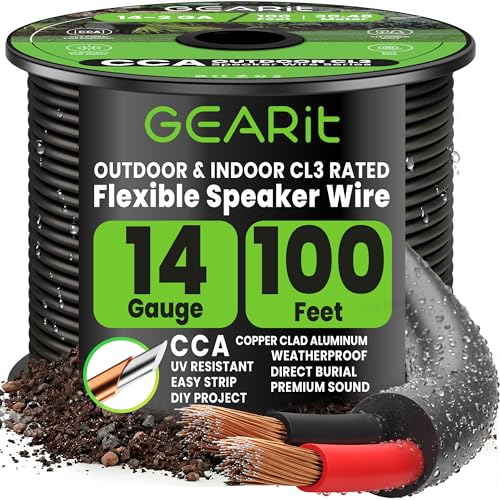
CL3-rated 14 AWG that buyers ran under a deck and through studs without ripping.
The GEARit CL3 rated wire is built for outdoor and in-wall use. CL3 (Class 3) is a fire safety rating that means the jacket meets flame-retardant standards for installation in walls and ceilings — essential if you are running wire inside your car’s body panels or through a garage wall. The jacket is notably tough: one reviewer noted it “ran through multiple studs without rips/freys,” and another used it for direct burial under landscape rock for outdoor Polk Atrium speakers.
Like the standard GEARit 4-conductor above, this wire uses CCA and sequential foot markers for easy cutting. The big difference is the CL3-rated jacket, which is thicker and more abrasion-resistant than the standard soft PVC — it passes the 30-volt voltage spec and handles exposure to sunlight and moisture better. One buyer ran the cable under a deck with no issues, calling it “very sturdy.”
The downside is the premium price over the standard GEARit wire, and the thicker jacket is stiffer, making it slightly harder to route through tight car interior corners than the ultra-flex DS18 or InstallGear wires. But for any outdoor speaker project or in-wall run where safety and durability matter, this is the most secure choice.
Why it’s great
- CL3 fire-safety rated for in-wall and outdoor installations.
- Tough jacket resists abrasion from studs, gravel, and concrete — buyers confirm it passes through obstacles.
- Sequential foot markers for fast, precise cuts without measuring.
Good to know
- Thicker, stiffer jacket than standard PVC — less flexible for tight dashboard routing.
- CCA conductor limits conductivity versus an OFC alternative at the same gauge.
Best for: Outdoor speakers, in-wall runs, or any installation where fire safety and jacket toughness are priorities.
Skip if: You are wiring door speakers inside a car — standard PVC is more flexible and cheaper.
Understanding the Specs
American Wire Gauge (AWG)
This is the standard for measuring wire thickness. The rule is simple: a lower number means a thicker conductor. 12 AWG is about 33% thicker than 14 AWG, which is about 30% thicker than 16 AWG. A thicker wire offers less resistance, meaning it can carry more current over longer distances before the signal degrades. For car audio, 14 AWG is the most common all-around choice — it handles most amplifier-to-speaker runs up to about 50 feet without noticeable loss. Use 12 AWG for subwoofers or any run over 40 feet. Use 16 AWG for short door speaker runs where flexibility matters more than raw power capacity.
CCA vs. OFC Conductor Material
CCA (Copper-Clad Aluminum) has an aluminum core with a thin copper coating. It is lighter and cheaper than pure copper, but it has roughly 60% of the conductivity of OFC (Oxygen-Free Copper). In practical terms, a CCA wire of the same gauge will introduce slightly more resistance over long runs. OFC is 100% pure copper with no oxygen trapped in the metal, which gives it the highest conductivity and best corrosion resistance. If you are building a competition system or running wire longer than 40 feet, OFC is the right choice. For a daily driver stereo at moderate volumes, CCA performs fine and saves you money.
Jacket Type and Rating
The jacket is the plastic coating around the wire. Standard PVC (polyvinyl chloride) is the most common — it is flexible, affordable, and fine for interior car use. CL3 rated jackets add flame-retardant properties for in-wall or outdoor installations, meeting fire safety codes. CMP (Plenum) rated jackets are the strictest standard, designed for air-handling spaces where fire safety is critical. A good jacket should be flexible enough to route through tight panels but tough enough to resist abrasion from metal edges. If you see reviews mentioning “soft touch” or “ultra flex,” that jacket will be easier to work with in a car interior.
Polarity Marking and Foot Markers
Polarity marking means the wire has a clear visual cue (a stripe, a color difference, or printed text) to tell the positive conductor from the negative. This is crucial because reversing polarity on one speaker causes it to play out of phase with the others, resulting in weak bass and a hollow soundstage. Foot markers are sequential numbers printed every foot on the jacket. They let you measure wire length without a tape measure or ruler, saving time during installation and reducing waste. Both features are small details that make a big difference in how fast and accurately you can wire your system.
FAQ
What gauge wire do I need for a car subwoofer?
Is CCA speaker wire good enough for car audio?
Can I use home theater speaker wire in my car?
How long can a 14 AWG speaker wire run be for a car?
What does CL3 rating mean on speaker wire?
Will thicker 12 AWG wire fit in my car speaker terminals?
How do I strip speaker wire without damaging the strands?
Can I bury CCA speaker wire directly in the ground for outdoor speakers?
What is the difference between 2-conductor and 4-conductor speaker wire?
How often should I replace car speaker wire?
Final Thoughts: The Verdict
For most buyers, the auto speaker wire winner is the GEARit 14 AWG 4-Conductor because it offers the most flexibility per pull with its four-conductor design, soft PVC jacket, and printed foot markers — all at a mid-range price that beats buying two spools of 2-conductor wire. If you want pure copper signal fidelity for a critical listening build, grab the JAVEX 16 AWG OFC. And for a tough outdoor or in-wall installation where fire safety and abrasion resistance are non-negotiable, the standout is the GEARit 14 AWG CL3 Rated.
How We Picked
We do not accept paid placement, and we did not hands-on test every unit. Instead, we match each pick to a real buyer and use-case by comparing the manufacturers’ published specifications against the patterns in verified customer reviews — so you get each pick’s real strengths and trade-offs instead of marketing copy.
Sources & Methodology
Specifications: manufacturer listings and product documentation. Review insights: verified customer reviews, as of June 2026. Pricing: not shown on this page (it changes often); check the current price via the retailer link.
As an Amazon Associate, Gadgets Feed earns from qualifying purchases. This does not affect which products we feature.
Product prices and availability are accurate as of the date/time indicated and are subject to change. Any price and availability information displayed on Amazon at the time of purchase will apply to the purchase of this product. As an Amazon Associate I earn from qualifying purchases.
CERTAIN CONTENT THAT APPEARS ON THIS SITE COMES FROM AMAZON. THIS CONTENT IS PROVIDED "AS IS" AND IS SUBJECT TO CHANGE OR REMOVAL AT ANY TIME.
Amazon and the Amazon logo are trademarks of Amazon.com, Inc. or its affiliates.